Parshat Vayera5 min read

Rabbi Yohanan Called Sodom the Little Sister With No Milk

Ezekiel had already drawn the family tree: Samaria the elder sister, Sodom the younger. The younger one never nursed anyone, and sulfur answered.

Curated by Arthur · Told by Maggid ·
Table of Contents
  1. Wall or Door
  2. Three Who Stood in a Furnace
  3. Generations That Never Rest From Harm
  4. Adam and the World No One Else Can Mend

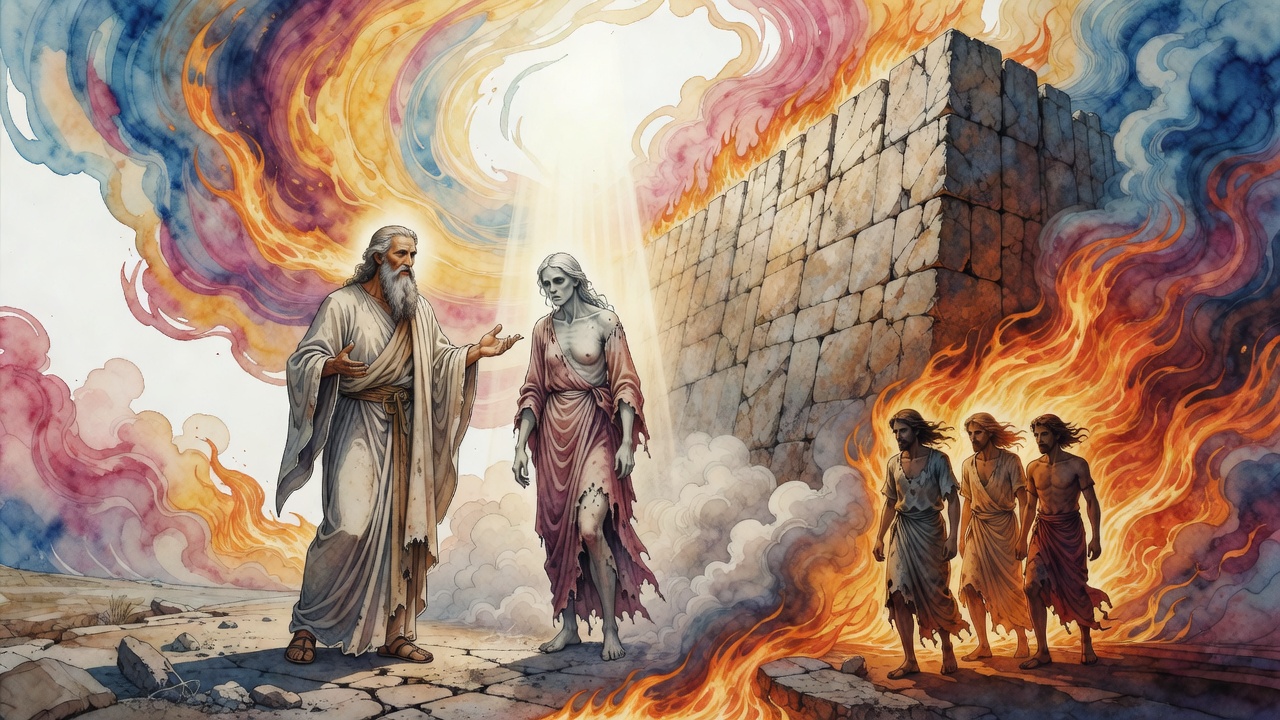
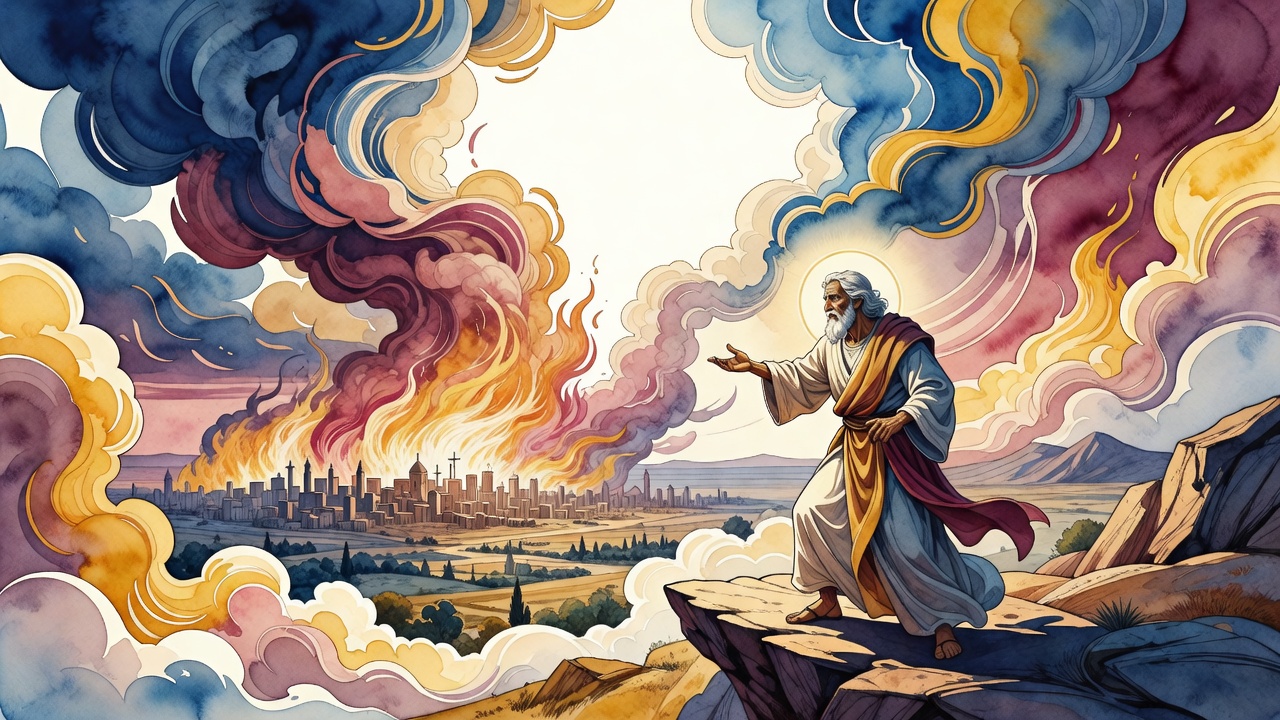
Rabbi Yohanan looked at the Song of Songs and saw a city of ash. "We have a little sister," the verse says, and he named her Sodom. Ezekiel had already drawn the family tree: Samaria the elder sister, Sodom the younger. The Song adds the wound. She has no breasts. She did not suckle mitzvot and good deeds. No milk of commandment ever left her body toward another life.

Rabbi Yohanan Called Sodom the Little Sister With No Milk Click for full size

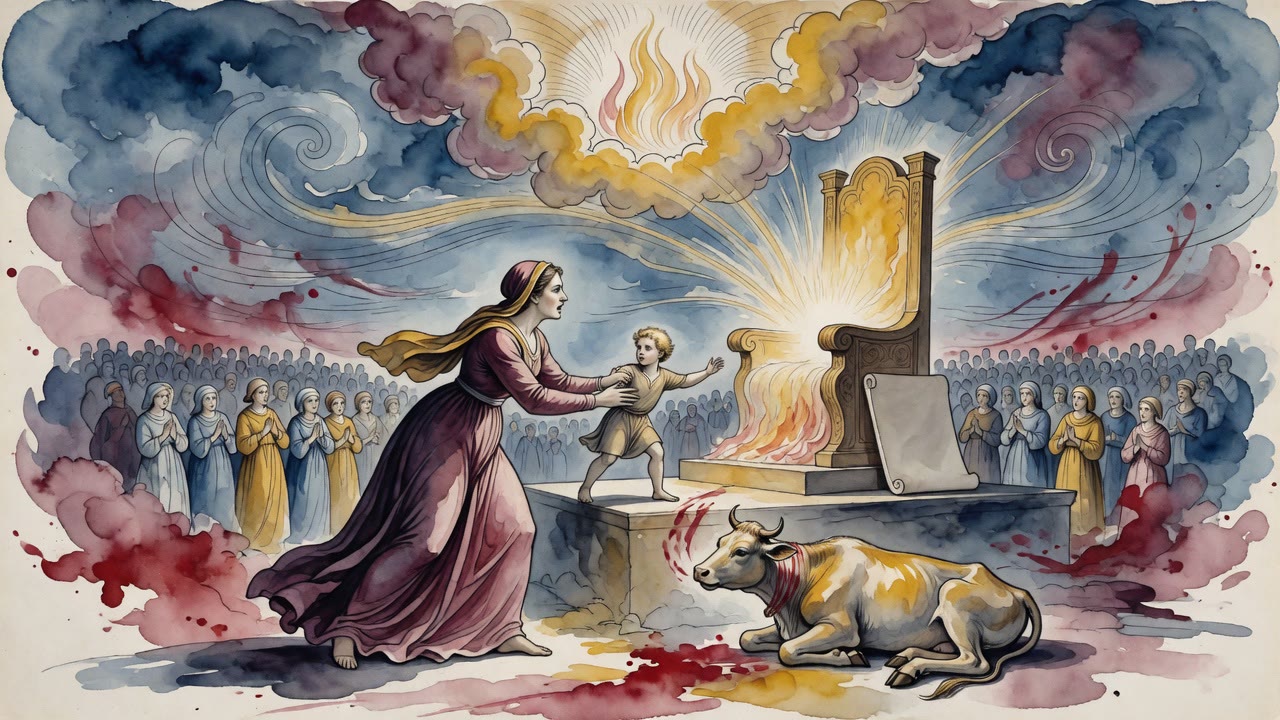
What shall we do for our sister on the day judgment is decreed? The midrash answers with sulfur and fire from heaven. The little sister without milk ends in a rain that no cistern can store. Hospitality failed there. Justice failed there. The body of the city could not feed goodness, so heaven fed it flame.

Wall or Door

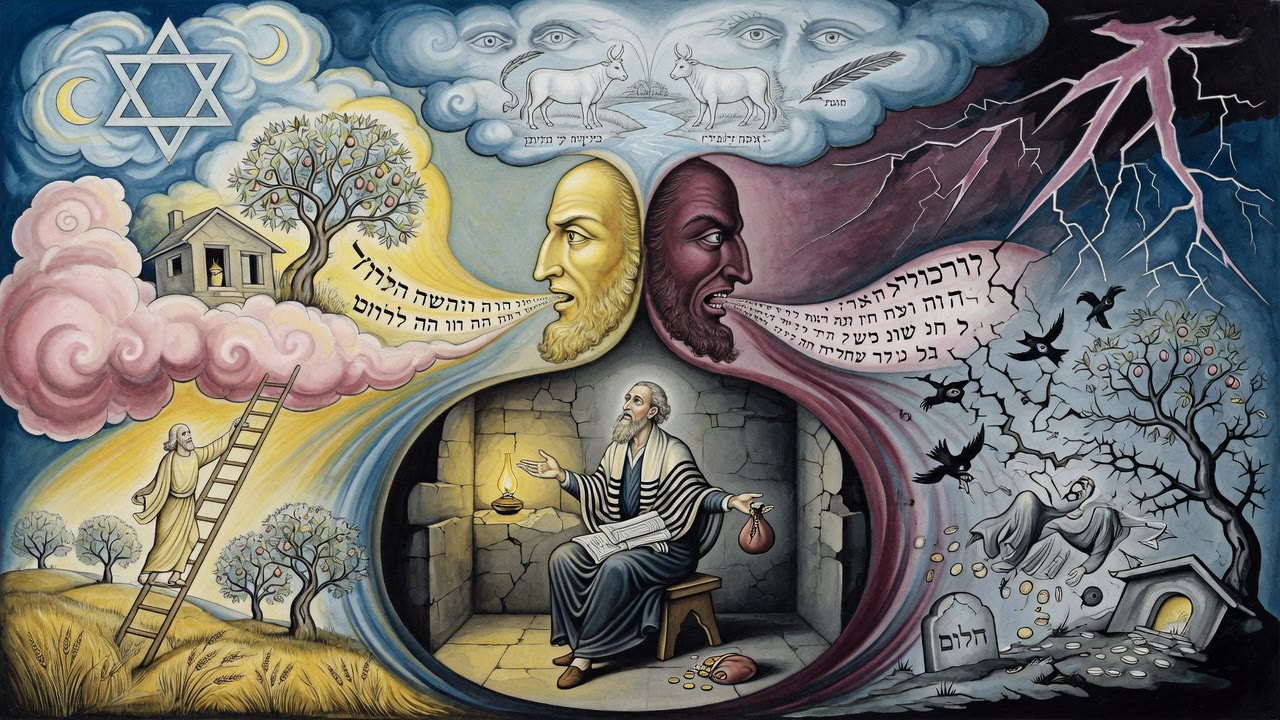
Then the camera turns to Israel. If she is a wall, we will build upon her. If she is a door, swinging both ways, the support will be only a thin cedar panel, a drawing that lasts a short while. Steadfast deeds invite lasting rescue. Wavering words invite temporary props.

Israel answers: I am a wall. We will stand firm in mitzvot and good deeds. My breasts are like towers. Unlike Sodom, this people claims the power to nurse righteousness into the world, to raise communities instead of starving them. Milk becomes metaphor for instruction and charity, for the ability to give life instead of taking it.

Exile still comes. Nations still taunt. The midrash gives Israel a counter-image: a king's daughter hurrying to spend the festival in her father's house, then returning home in peace. Exile as a visit with an end, not as Sodom's final fire. The daughter still has a father's table waiting. Sodom had no such table left.

Three Who Stood in a Furnace

The same midrash sets Hananiah, Mishael, and Azariah inside the logic. If they stand firm in deeds, God will build upon them and pull them out. If they waver, the help will be brief. They declare themselves a wall. They refuse the idol. They go down into fire and come up intact, as Daniel records. The furnace becomes the opposite of Sodom's rain: heat that does not consume the ones who would not bow.

Sodom had no milk. These three had a vow. The difference is not geography. It is whether a body will feed holiness or starve it. The fire tests the claim of the wall. The wall holds. The Song's love language becomes, for a moment, a survival manual under empire.

Generations That Never Rest From Harm

Kohelet Rabbah reads Ecclesiastes' line about days of pain and night without rest across whole generations. The Flood generation angered God day and night, and rain answered forty days and forty nights. The people of Sodom pained heaven until fire fell at the turn from night to morning. Egypt gave the Israelite no rest even after the furrow was finished: hoe me two more, chop me two more logs. Midnight struck the firstborn. Daylight opened the road out.

Sodom sits in that map of collective wrong that will not sleep. The little sister without milk is not a private failure. She is a city-shaped refusal that finally meets a matching rain. The midrash stacks Flood, Sodom, and Egypt so the pattern cannot be called accident. Day and night of harm invite day and night of answer.

Adam and the World No One Else Can Mend

Before any city, God walked Adam through the garden and said, "See My creations, how beautiful they are. Everything I made, I made for you. Do not ruin My world. If you destroy it, there will be no one to mend it after you." The crooked that God has made in the wake of human ruin is not a puzzle for clever hands to reverse at will. Stewardship fails, and even Moses later dies under a mortality that began in that first refusal.

Sodom is one later chapter of a garden warning ignored. Israel claiming to be a wall is one later attempt to nurse the world instead of burning it. The Song's little sister stands between them as a caution carved in ash and milk that never came. The three youths in the furnace prove that fire can still meet a different answer when a people, or even three men, choose the wall over the swing of the door.

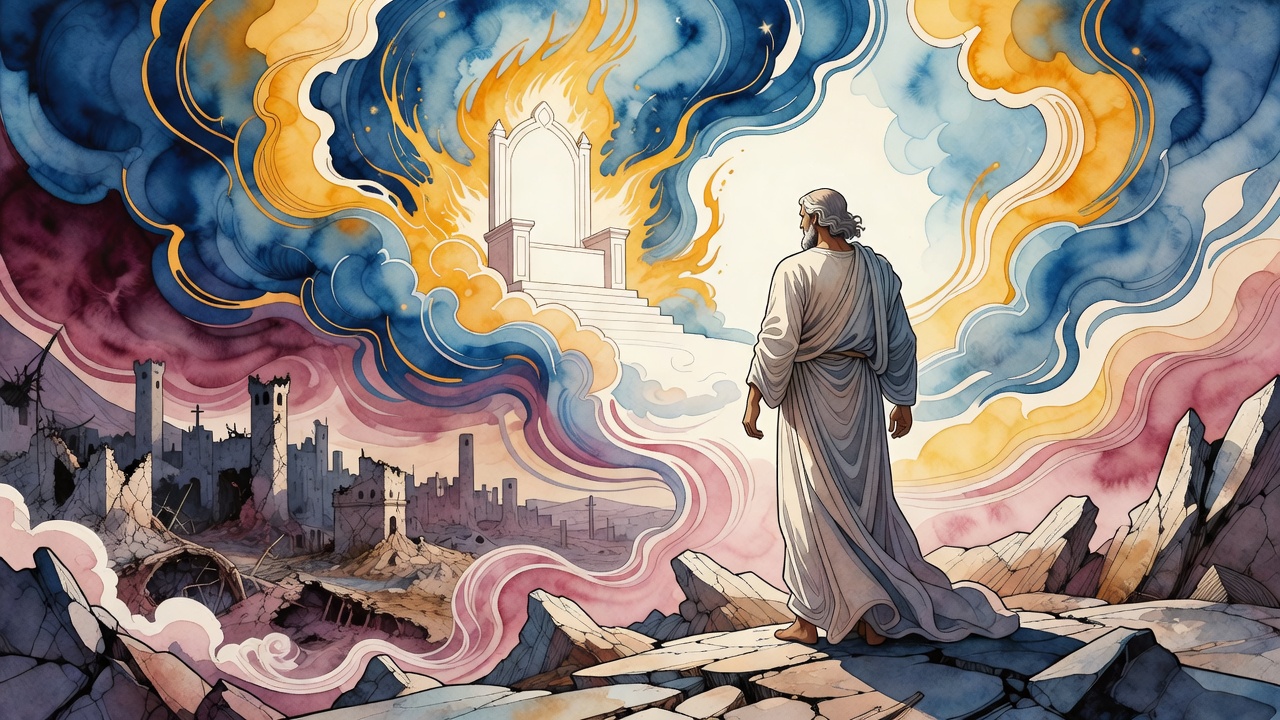
On the plain after the rain of sulfur the sister is gone. The Song still sings. Somewhere Israel practices being a wall. Somewhere three names from Daniel refuse a statue. Somewhere Adam's charge still hangs over every field and city: do not destroy what no later hand can fully straighten.


← All myths
From the tradition

Sources

3 sources

The texts behind this telling. Some cards carry a translation of the source; others are our own retelling of it, and each card says which. Every card links out to the original.

Shir HaShirim Rabbah 8:9Shir HaShirim Rabbah

Retold in our words. Read the original at the link below.The Sefaria Midrash Rabbah, 2022 · CC-BY

It’s a central part of how Jewish tradition understands itself, constantly weaving together narratives to find deeper meaning. to a fascinating example from Shir HaShirim Rabbah, a rabbinic commentary on the Song of Songs.

The passage begins with a curious interpretation by Rabbi Yoḥanan, linking a verse from the Song of Songs – "We have a [little] sister" (Song of Songs 8:8) – to the infamous city of Sodom. He boldly declares that Sodom is that little sister. Why Sodom? Well, the connection is drawn from (Ezekiel 16:46), which explicitly states, "Your elder sister is Samaria…and your younger sister…is Sodom."

Here’s the kicker: "And she has no breasts" (Song of Songs 8:8), Rabbi Yoḥanan continues, explaining that Sodom "did not suckle mitzvot (commandments)"– that's commandments – "and good deeds." for a second. Sodom, known for its wickedness, is portrayed as spiritually barren, unable to nurture goodness.

Then comes the crucial question: "What shall we do for our sister on the day" (Song of Songs 8:8) that judgment is decreed? The commentary connects this to the fiery destruction of Sodom, as described in (Genesis 19:24): "The Lord rained sulfur and fire on Sodom and on Gomorrah." It's a stark image of divine retribution.

Now, things get really interesting. The text pivots to Israel, drawing a sharp contrast with Sodom. "If she is a wall, we will build upon her" – this, says the text, is Israel. The Holy One, blessed be He, declares that if Israel stands firm in their deeds, like a wall, He will build them up and rescue them. But there’s a condition: "And if she is a door" – if they waver in their words, like a door swinging back and forth – then, "we will affix [natzur] upon her a cedar panel."

The word natzur is key here. It suggests a temporary fix, a superficial solution. The commentary explains: "Just as a drawing [tzura] exists only for a short while, so I will stand with him only for a short while." In other words, faithfulness brings lasting support, while wavering faith leads to fleeting assistance.

Israel then proclaims, "I am a wall" – a declaration of steadfastness. "Master of the universe, we are a wall and we will stand firm like a wall in [performing] mitzvot and good deeds." And, "my breasts are like towers" – signifying their destiny to establish righteous communities in the world.

So what does all this mean? Well, the commentary suggests that Israel's faithfulness will ultimately lead to redemption. Even when the nations taunt them about their exile and the destruction of the Temple, Israel can respond with hope: "We are comparable to the daughter of a king who hurries to spend the festival in her father’s home. She returns to her home in peace." It's a beautiful metaphor for exile as a temporary visit, a homecoming assured.

But the interpretation doesn't stop there. The passage offers another layer, focusing on Ḥananya, Mishael, and Azarya – the three companions of Daniel who famously refused to bow down to a false idol and were thrown into a fiery furnace (Daniel 3).

The same principles apply: If Ḥananya, Mishael, and Azarya stand firm in their deeds, God will build the world upon them and rescue them. But if they waver, His support will be temporary. They, too, declare, "We will stand firm in mitzvot and good deeds like a wall." And God responds, "Just as you descended into the fiery furnace intact, so I will extricate you intact." As (Daniel 3:26) tells us, they emerged from the fire unscathed, evidence of their unwavering faith.

What’s remarkable about this passage is how it uses the Song of Songs – a book often interpreted as a love poem – to explore themes of divine judgment, faithfulness, and redemption. It connects Sodom's destruction, Israel's exile, and the fiery trial of Ḥananya, Mishael, and Azarya, all to underscore the importance of unwavering commitment to mitzvot. It asks us: Will we be a wavering door, or a steadfast wall? What kind of legacy will we build? And how will our choices echo through generations?

Full source
Kohelet Rabbah 2:23Kohelet Rabbah

Retold in our words. Read the original at the link below.The Sefaria Midrash Rabbah, 2022 · CC-BY

The book of Ecclesiastes, or Kohelet, certainly grapples with that feeling. It can feel bleak. But within that perceived bleakness, ancient interpreters found profound meaning. Take this verse: "For all his days are pains, and his occupation is anger; even at night his heart does not rest. This, too, is vanity" (Ecclesiastes 2:23). But what if it's not just about one person, but about entire generations?

The Kohelet Rabbah, a rabbinic commentary on Ecclesiastes, offers some fascinating interpretations. It suggests that this verse isn't just a lament, but a reflection on the consequences of collective wrongdoing.

First, the Kohelet Rabbah connects this verse to the generation of the Flood. "For all his days are pains" – this, Their "occupation is anger" because they angered God with their very actions, their "handiwork." And "even at night his heart does not rest" from sins. The commentary even pulls in (Genesis 6:5) – "And every inclination of his heart’s thoughts was only bad all day long" – to emphasize that this wickedness was constant. It permeated everything. And God’s punishment? It came day and night: "The rain was upon the earth forty days and forty nights" (Genesis 7:12). The punishment mirrored the sin – relentless and inescapable.

There's another layer here. "Even at night his heart does not rest" could also refer to God! God, in a sense, couldn't rest easy knowing what He had to do – bring punishment upon them. "He obliterated all existence" (Genesis 7:23), the verse tells us. A difficult, painful decision.

The Kohelet Rabbah doesn't stop there. It draws parallels to the people of Sodom. Again, "For all his days are pains" – these are the Sodomites, who pained God with their wickedness. "And his occupation is anger" – they angered God with their actions. And the punishment? It came "at the end of the night into the morning," as it is stated: "The Lord rained upon Sodom and upon Gomorrah…" (Genesis 19:24). Once again, the idea of unrelenting consequences.

And yet a third interpretation? The Egyptians. "For all his days are pains" – the Egyptians, who pained God with their wicked deeds. "And his occupation is anger" – they angered God with their handiwork, with their oppression. The commentary gives a very human, relatable example here: even when an Israelite finished their grueling labor, the Egyptian would demand more: “Hoe me two furrows, chop me two logs.” There was no rest, no escape from their torment. "Even at night his heart does not rest."

And once more, this lack of rest applies to God as well. God decided to bring punishment upon them day and night, culminating in the slaying of the firstborn at midnight (Exodus 12:29), followed by the Exodus during the day. It was a complete and total reckoning.

What are we to make of all this? Is it just a historical recounting of divine punishments? Or is there something deeper? Perhaps the Kohelet Rabbah is reminding us that actions, especially collective actions, have consequences that ripple through time. They affect not only the perpetrators but also, in a profound way, the Divine. Maybe the “vanity” Kohelet speaks of isn’t just about individual pursuits, but also about the futility of thinking we can escape the weight of our choices, both as individuals and as societies. One that asks us to consider what kind of legacy we're building, day and night.

Full source
Kohelet Rabbah 7:13Kohelet Rabbah

Retold in our words. Read the original at the link below.The Sefaria Midrash Rabbah, 2022 · CC-BY

The book of Ecclesiastes, or Kohelet, as it’s known in Hebrew, poses a powerful question: "See the work of God, for who can mend what He has warped?" (Ecclesiastes 7:13).

Kohelet Rabbah, a collection of rabbinic interpretations of Ecclesiastes, uses this verse as a springboard to explore our responsibility to creation. It paints a vivid picture of God showing Adam, the first human, the wonders of the Garden of Eden. "See My creations," God says, "how beautiful and exemplary they are. Everything I created, I created for you." It's a gift, an incredible, precious gift.

There's a crucial condition attached. God implores Adam: "Make certain that you do not ruin and destroy My world, as if you destroy it, there will be no one to mend it after you." It's a staggering responsibility. Tikkun (spiritual repair) olam, the repairing of the world, is a concept deeply rooted in Jewish thought, and here, right at the very beginning, we see its origin. The implication is clear: we are stewards of this world, not simply inhabitants. Our actions have consequences that extend far beyond ourselves.

Then, the text takes a poignant turn, connecting Adam's actions to the death of Moses, Moshe Rabbenu, our teacher, the most humble of men. How are these two figures linked?

Kohelet Rabbah uses an analogy to explain. She gives birth to a son, raises him in captivity, and then dies. Later, the king passes by the prison, and the son cries out, "My lord the king, I was born here, I grew up here; I do not know due to what sin am I placed here." The king replies, "Due to your mother's sin."

Similarly, the text suggests, Moses' death is, in a sense, a consequence of Adam's sin. As it's written, "Behold, the man has become like one of us" (Genesis 3:22), referring to Adam after eating from the Tree of Knowledge. This is verbally linked to the verse "Behold, your days are drawing near to die" (Deuteronomy 31:14), which foretells Moses' passing. The Midrash, a form of Jewish biblical interpretation, is telling us that Moses, even with his unparalleled righteousness, could not escape the decree of mortality that came into being because of Adam's actions.

As Ginzberg retells in Legends of the Jews, the consequences of Adam’s sin reverberate throughout history, affecting even the most righteous.

It’s a sobering thought. As we find in Midrash Rabbah, Adam’s actions not only had immediate consequences but also set in motion a chain of events that continue to affect us today.

Are we doomed to repeat the mistakes of the past? Perhaps. But the story also offers a glimmer of hope. If Adam's actions could have such far-reaching consequences, then surely our own actions, however small, can also contribute to the healing and repair of the world.

Tikkun olam. It's not just a phrase; it's a call to action. A reminder that we each have a role to play in mending what has been warped, in creating a world that reflects the beauty and perfection that God envisioned in the Garden of Eden. What will you do today to answer that call?

Full source