5 min read

Solomon's Listening Heart Solved Every Riddle

Solomon asked for a listening heart, then proved it with mothers, riddles, and proverbs that kept multiplying beyond the first answer.

Curated by Arthur · Told by Maggid ·
Table of Contents
  1. The Child Between Two Mothers
  2. The Queen Came Looking for a Wall
  3. The Nations Sent Their Wise Men
  4. The Proverbs Kept Multiplying
  5. The Heart That Kept Listening

Solomon asked for the one thing a king cannot fake.

Not longer life. Not gold. Not the necks of his enemies under his foot. He asked for a listening heart.

A throne can be inherited. Soldiers can be commanded. Treasuries can be filled by tax and conquest. But a listening heart has to stay quiet while two people speak at once, while grief lies, while fear performs innocence, while a riddle hides its door in plain sight. Solomon asked for that silence inside himself, and heaven gave it.

The Child Between Two Mothers

The first test came wrapped in screams.

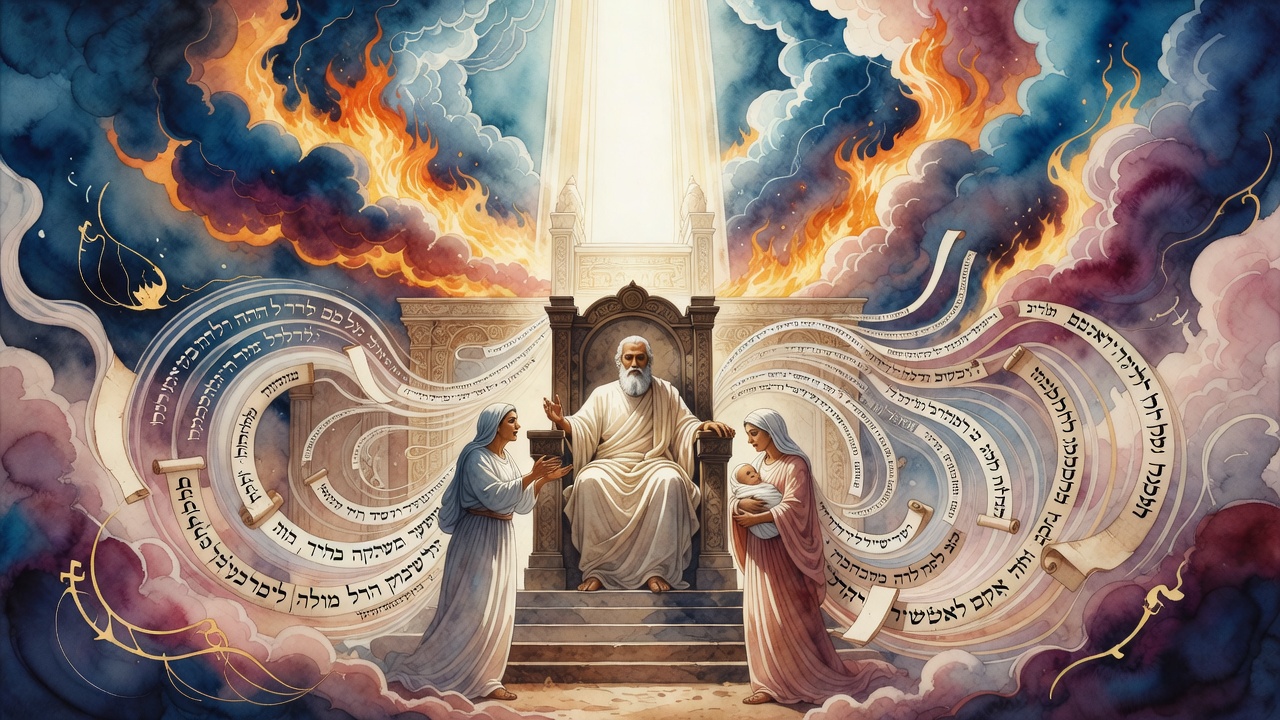
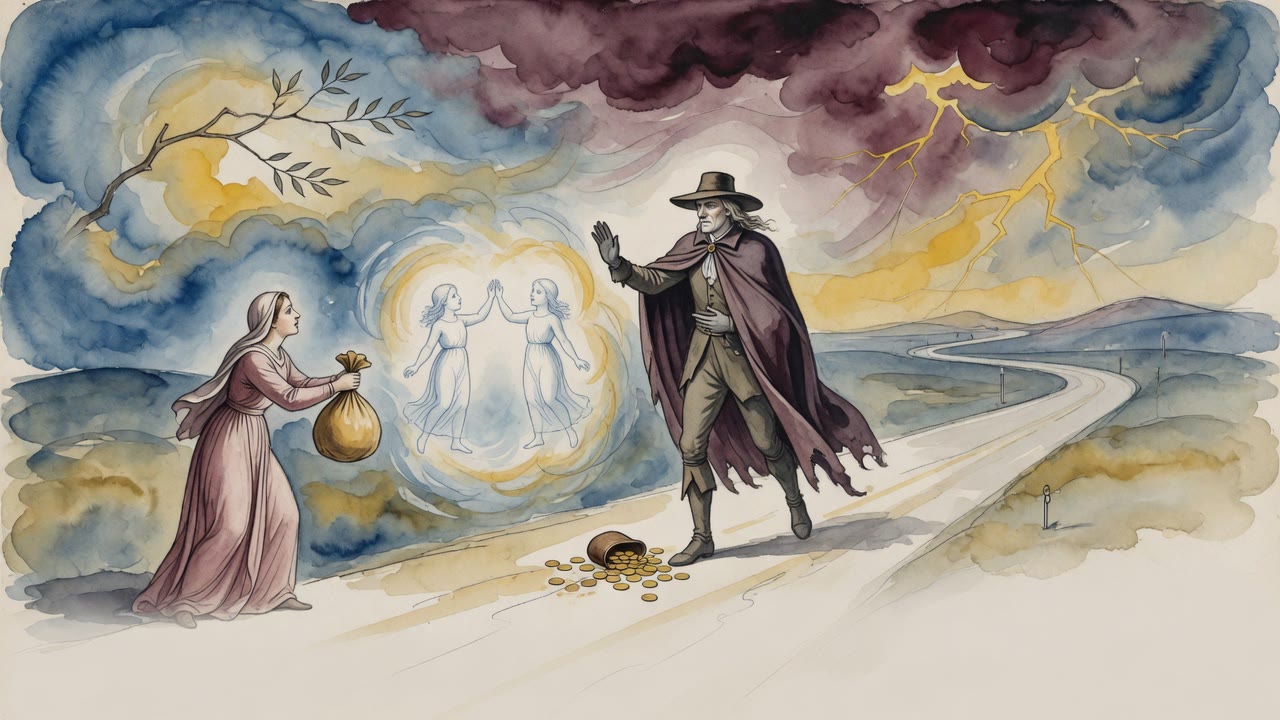
Two women stood before the king. One living child. One dead child. Each claimed the living boy. No witness could separate their words. No mark on the child could prove the truth. The court had only two mothers, two stories, and one small body breathing between them.

Solomon called for a sword.

The room changed. Servants froze. The women understood the threat at the same moment, but only one body moved from claim to surrender. "Give him to her," she said. "Let him live." The other accepted the division because possession mattered more to her than breath.

The listening heart heard the truth before the sword fell. Solomon returned the child to the woman who would rather lose him alive than win him dead.

The Queen Came Looking for a Wall

News of Solomon's wisdom traveled farther than armies.

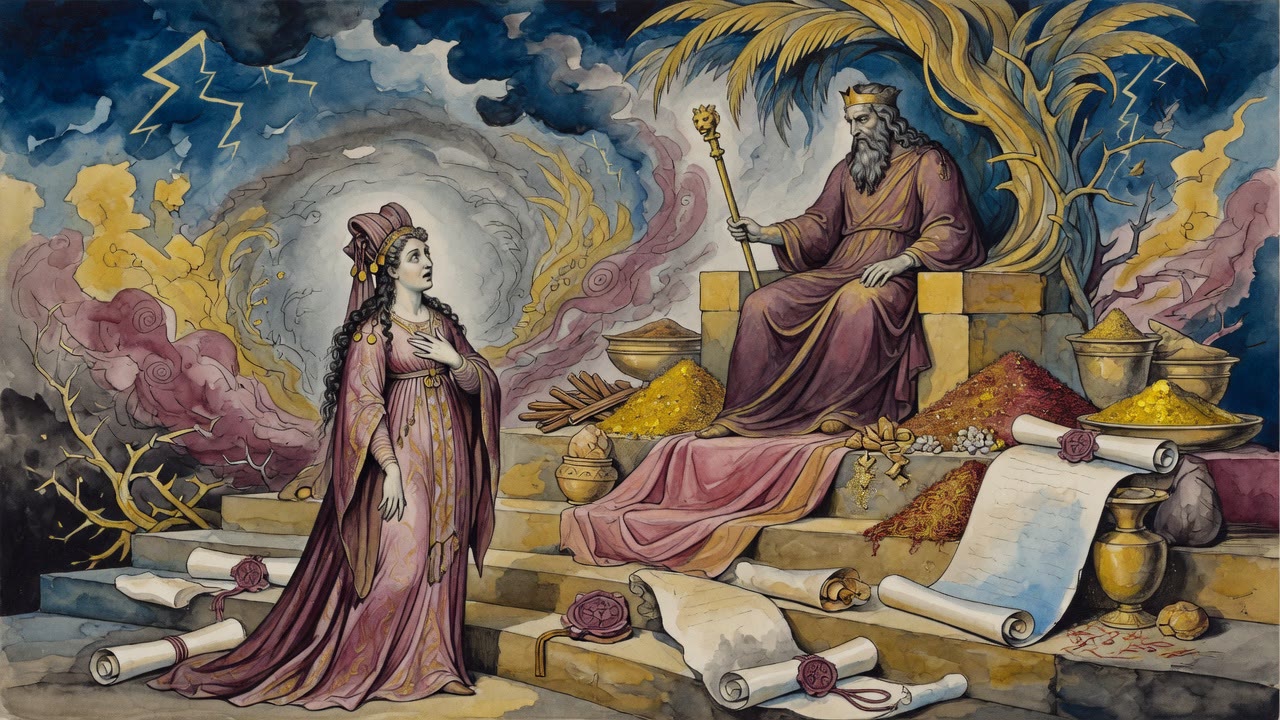
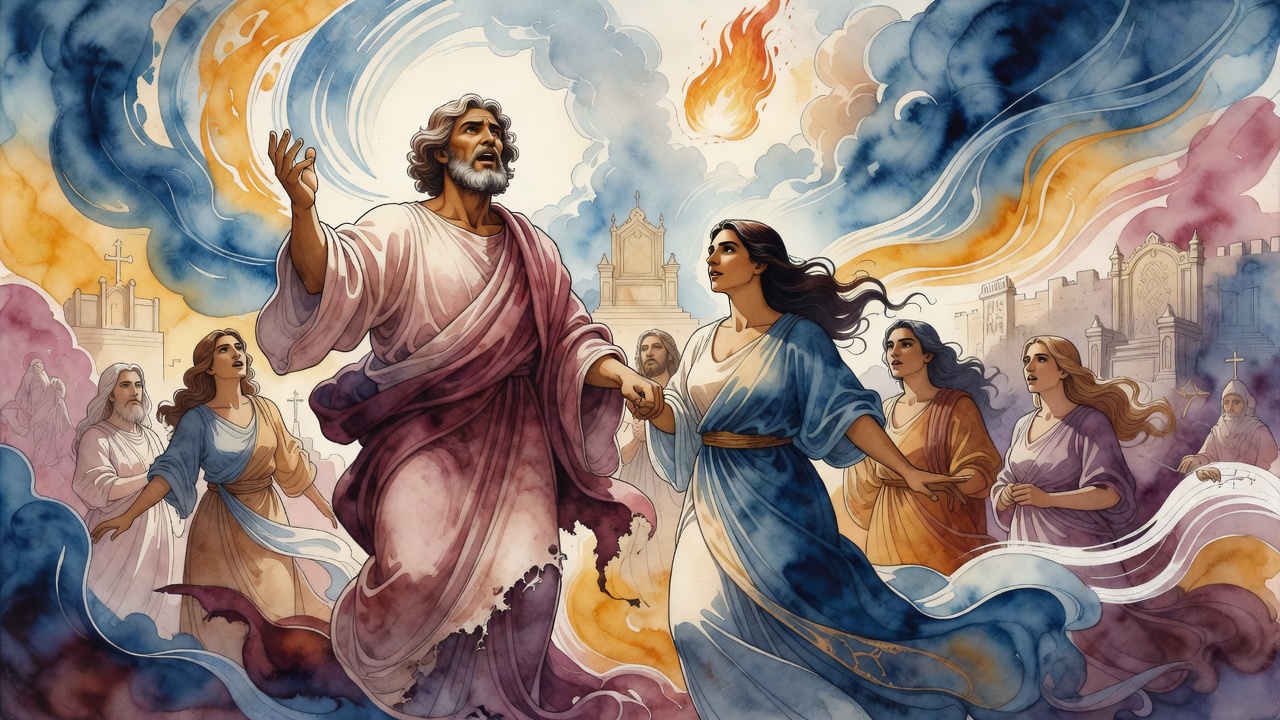
The Queen of Sheba did not come merely to admire it. Admiration is cheap. She came with riddles sharpened for failure. She wanted to find the wall, the place where reputation stopped and ignorance began. Every famous man has one. She arrived with treasures, attendants, spices, and questions designed to open hidden cracks.

Solomon answered.

Not with strain. Not with theatrical cleverness. One after another, the riddles yielded. The queen had expected performance and found perception. The same heart that had heard motherhood in a cry could hear the secret hinge inside a puzzle. She had brought tests from a distant court. He received them as if the answers had been waiting inside the questions.

The Nations Sent Their Wise Men

Other wise men came too, carrying problems that sounded like traps.

A woman married to two. Two sons. Four people with one father. The words knotted themselves deliberately. Solomon listened until the knot showed where it wanted to loosen. Riddles from foreign courts did not frighten him because wisdom was never just possession of Israel's scrolls. It was attention to the order God had placed under things.

A riddle is a locked room. It punishes impatience. Push too hard and the lock jams. Solomon waited for the room to describe its own door.

That waiting was the gift. The king who had asked for a listening heart kept proving that listening can be sharper than speed.

The Proverbs Kept Multiplying

The record says Solomon spoke three thousand proverbs.

Only a portion survived in the visible book. That absence did not trouble the sages. A proverb is not a stone counted once and stored. It is a seed. One saying can branch into three. Three can branch into nine. A single line set inside a student's mind may produce more wisdom than a scroll can hold.

Solomon's wisdom did not sit in him like coins in a treasury. It multiplied because it taught others how to see. The mother learned that a king could hear love under terror. The queen learned that distance could not protect a riddle from true attention. The wise men of the nations learned that cleverness was smaller than wisdom.

The Heart That Kept Listening

A lesser king would have made wisdom into a display.

Solomon made it into judgment. Into hospitality for difficult questions. Into patience before speech. The listening heart did not mean softness. It could summon a sword. It could expose a false mother. It could meet a queen without flinching and untie riddles meant to humiliate him.

The gift worked because Solomon did not ask to know everything. He asked to hear rightly. Knowledge can become storage. A listening heart remains alive. It waits at the center of the noise until the truth gives itself away.

That is why the riddles kept coming. A throne with gold draws tribute. A throne with wisdom draws questions. Solomon's court became the place where the hardest questions in the world came to discover that they had been answerable all along.


← All myths

From the tradition

Sources

4 sources

The texts this telling draws on, in full. Open a card to read inline, or expand it for a wider, quieter read.

Legends of the Jews 5:25Legends of the Jews

It all starts with a heart-wrenching dispute, a real head-scratcher. Two women stood before Solomon, both claiming to be the mother of the same child. Can you imagine the tension? The stakes? How do you even begin to unravel such a knot?

In Legends of the Jews, that masterful compilation of Jewish folklore by Louis Ginzberg, Solomon listened intently as the women presented their case. Now, some might think a young king would be stumped. Hesitant. Overwhelmed. But not Solomon. He was ready.

His response was… unexpected, to say the least. Solomon declared that God, in His infinite wisdom, had foreseen such a conflict. And, therefore, He created human organs in pairs. Why? So that neither party in the dispute could be wronged!

The king’s counselors weren't immediately impressed. In fact, they were worried. Ginzberg tells us that upon hearing this pronouncement, they lamented, "Woe to thee, O land, when thy king is a youth." It sounds like they thought Solomon had lost his mind!

But just hold on a second. Because here’s where the genius of Solomon shines through. The story doesn't end there.

In short order, the counselors realized the wisdom behind Solomon's seemingly bizarre statement. The scales fell from their eyes, and they exclaimed, "Happy art thou, O land, when thy king is a free man." What a turnaround! They initially doubted him, but they now admired his profound intelligence.

Now, get this: the story takes another fascinating twist. According to the legend, this whole situation wasn't just a random occurrence. It was orchestrated! As Ginzberg writes, the quarrel "had of set purpose been brought on by God to the end that Solomon's wisdom might be made known." It was a test, a divine set-up to reveal Solomon's extraordinary gifts to the world.

And there's more! It turns out that the two litigants weren't even human. They were spirits, disguised as women! Talk about a plot twist! That’s how you know this isn't your everyday courtroom drama.

And finally, to remove all doubt about the fairness of Solomon’s verdict, a bat kol (בַּת קוֹל‎), a heavenly voice, proclaimed, "This is the mother of the child." Case closed! Divinely adjudicated.

So, what are we to make of this incredible story? It's more than just a clever solution to a difficult problem. It's a evidence of the idea that true wisdom can come in unexpected forms, and that sometimes, the most unconventional approaches are the most effective. It also tells us that God can intervene, and does. It's a reminder that sometimes, what seems like misfortune can actually be a carefully orchestrated opportunity for greatness to be revealed.

Isn’t that a powerful thought?

Full source
Legends of the Jews 5:51Legends of the Jews

Legends of the Jews turns to The Queen of Sheba Tests Solomon With Ancient Riddles.

Well, stories abound, and some of the most intriguing revolve around riddles, specifically, riddles posed by none other than the Queen of Sheba. Of all the tales, only a handful of riddles displaying Solomon’s incredible wit have survived. They are all tied directly to the Queen and her visit. for a second. The Queen of Sheba, ruler of a distant land, undertaking a long and arduous journey to test the wisdom of Solomon. What was her motivation? What was their relationship? The story of this queen, her connection to Solomon, and the reasons that propelled her from her faraway kingdom to Jerusalem is a fascinating chapter in the already eventful life of the wisest of all men. It's a story that makes you wonder about the power of curiosity, doesn't it?

The tradition says Solomon's dominion extended far beyond the human realm. He ruled not only over people, but also over the beasts of the field, the birds of the air, even demons, spirits, and the specters of the night. He possessed a unique gift: he understood the language of them all, and they understood him. Legends of the Jews, by Louis Ginzberg, paints this picture vividly. It’s wild to imagine a king with such comprehensive power! What would he say to the animals, and what did he learn from the spirits?

Full source
Legends of the Jews 5:78Legends of the Jews

These aren't just any riddles; they're the kind that were posed to King Solomon himself, a man renowned for his unparalleled wisdom. The book Legends of the Jews by Louis Ginzberg, a treasure trove of Jewish folklore and tradition, recounts these encounters, and they're far more than just intellectual games. They’re windows into the values and beliefs of a culture.

For a moment. It sounds impossible. A woman married to two men? But this isn’t about breaking any commandments. The answer, of course, is Tamar. Remember her story? In the book of Genesis, Tamar cleverly disguises herself as a prostitute to trick her father-in-law, Judah, into fulfilling his obligation to provide her with offspring after his sons die. She ends up bearing him twins. Two sons, one father, but a lineage tangled enough to give anyone a headache!

See, these riddles aren't just about clever wordplay. They’re about knowing your history, understanding the intricacies of the Torah, and recognizing the patterns within the narratives.

Ready for another one? This one's a bit darker: "A house full of dead; no dead one came among them, nor did a living come forth from them?" What could that possibly be?

This one calls to mind the tragic story of Samson and the Philistines. Specifically, when Samson pulls down the pillars of the temple, killing himself and thousands of Philistines inside. A house full of dead, but no one brought the dead in, and no one living came out. A devastating, powerful image.

These aren’t just about intellectual prowess; they’re about understanding the weight of history, the consequences of actions, and the complexities of the human condition.

Now, the final piece of this puzzle involves a queen – often identified as the Queen of Sheba – testing Solomon's wisdom. She presents him with a seemingly impossible task: to determine the root end versus the branch end of a sawn cedar trunk. How could you possibly tell?

Solomon, in his infinite wisdom, instructs her to cast the trunk into water. The root end, being denser, would sink, while the branch end would float. Simple, yet brilliant! As Legends of the Jews tells us, this display of wisdom prompts the queen to exclaim, "Thou exceedest in wisdom and goodness the fame which I heard, blessed be thy God!"

The Midrash Rabbah, a collection of rabbinic interpretations of the Hebrew Bible, expands on this, painting a picture of a Queen utterly astonished by Solomon's ability to discern the truth through observation and understanding of natural laws.

What’s fascinating is that these riddles, these stories, aren’t just relics of the past. They continue to challenge us, to provoke us, and to offer us glimpses into a world where wisdom was prized above all else. They remind us that true intelligence isn't just about knowing facts, but about understanding the stories that shape us, the values that guide us, and the world around us. So, the next time you're faced with a seemingly impossible question, remember Solomon, remember Tamar, remember Samson, and remember the power of a good story to unlock the deepest truths.

Full source
Kohelet Rabbah 23:2Kohelet Rabbah

The Book of Kings tells us that Solomon "spoke three thousand proverbs" (I (Kings 5:1)2). But wait a minute... when we actually read through the Bible, how many proverbs do we find attributed to Solomon? Rabbi Shmuel bar Naḥmani, in Kohelet Rabbah, flags this discrepancy. He points out that we only find around eight hundred verses of proverbs directly linked to Solomon. So, what's going on?

Is the Bible exaggerating? Is it some kind of poetic hyperbole? Not quite. The tradition suggests something far more profound. Kohelet Rabbah explains that each and every verse Solomon composed wasn't just a simple statement. It held within it multiple layers of meaning – two or three, at the very least.

Think of it like this: a simple proverb might offer practical advice The first reading. But underneath, it could be touching on deeper philosophical truths or even hinting at spiritual realities.

It gets even wilder. The Rabbis take this idea of layers of meaning to a whole new level. They suggest that each verse contained not just a few meanings, but three thousand parables! And each one of those parables? Each one contained one thousand and five meanings!

Where do they get this number? They find a hint in the very same verse: "And his poems [shiro] were one thousand and five" (I (Kings 5:1)2). The Rabbis cleverly connect the word "poems" (shiro) to the idea of "remainder" (shiyuro), suggesting that for each parable, the "remainder" – the layers of meaning not explicitly stated – was one thousand and five.

Now, I know what you might be thinking: that’s a lot of layers! Is it meant to be taken literally? Perhaps not. But the point is clear: Solomon's wisdom was so vast, so multi-faceted, that a single saying could unlock a seemingly infinite number of interpretations.

It challenges us, doesn't it? To not just read the words on the page, but to delve deeper. To search for those hidden meanings, those subtle nuances, those layers of truth waiting to be discovered. Maybe we won’t find three thousand parables in a single verse, but perhaps we’ll find something even more valuable: a deeper understanding of ourselves, of the world, and of the divine wisdom woven into the fabric of existence.

Full source