5 min read

Solomon Sleeps While Rome Rises from the Sea

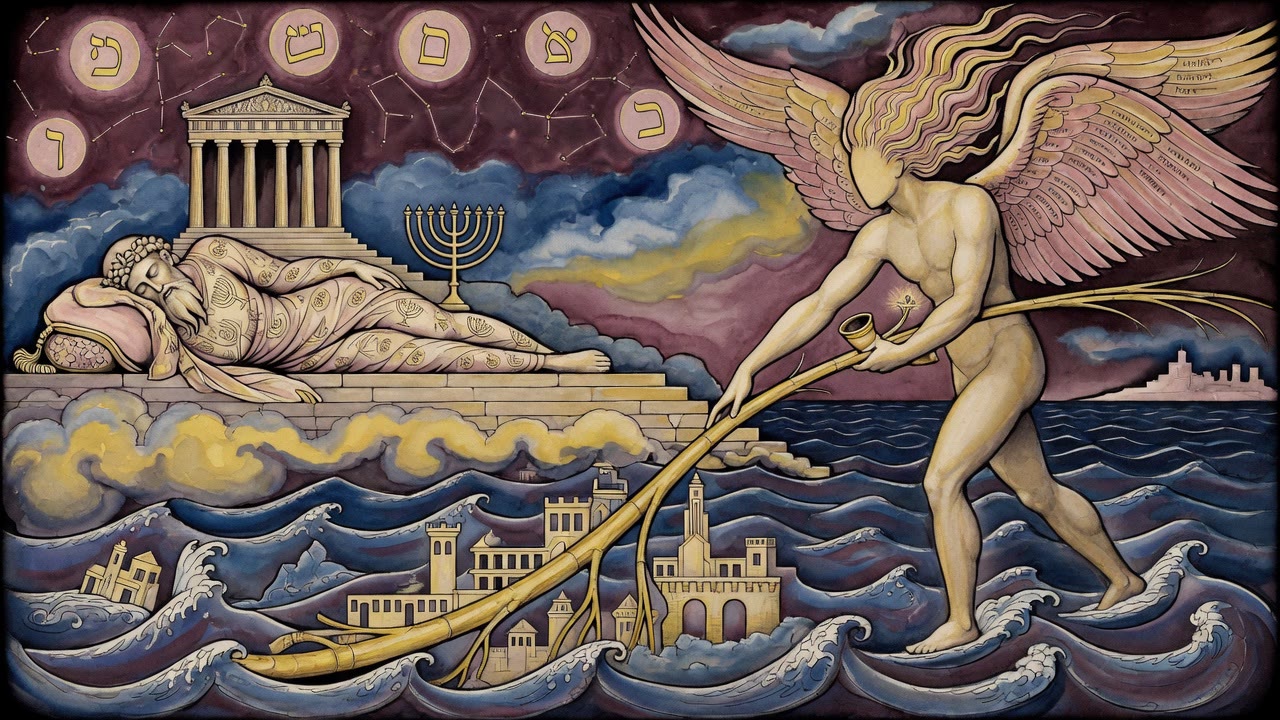
On the Temple dedication night, Solomon sleeps under false stars while Gabriel plants the reed that will become Rome from the sea.

Curated by Arthur · Told by Maggid ·
Table of Contents
  1. The Teacher Is Removed
  2. The Wedding Covers the Temple
  3. The Stars Above the Bed
  4. Bathsheba Breaks the Morning
  5. Gabriel Plants a Reed

The Temple stood finished, and Solomon slept.
Stones had been lifted, beams set, vessels prepared, songs readied, and Jerusalem had reached the night it had been waiting for. The house of God was complete. Fire, offering, priesthood, kingship, and memory were supposed to meet at dawn.

The Teacher Is Removed

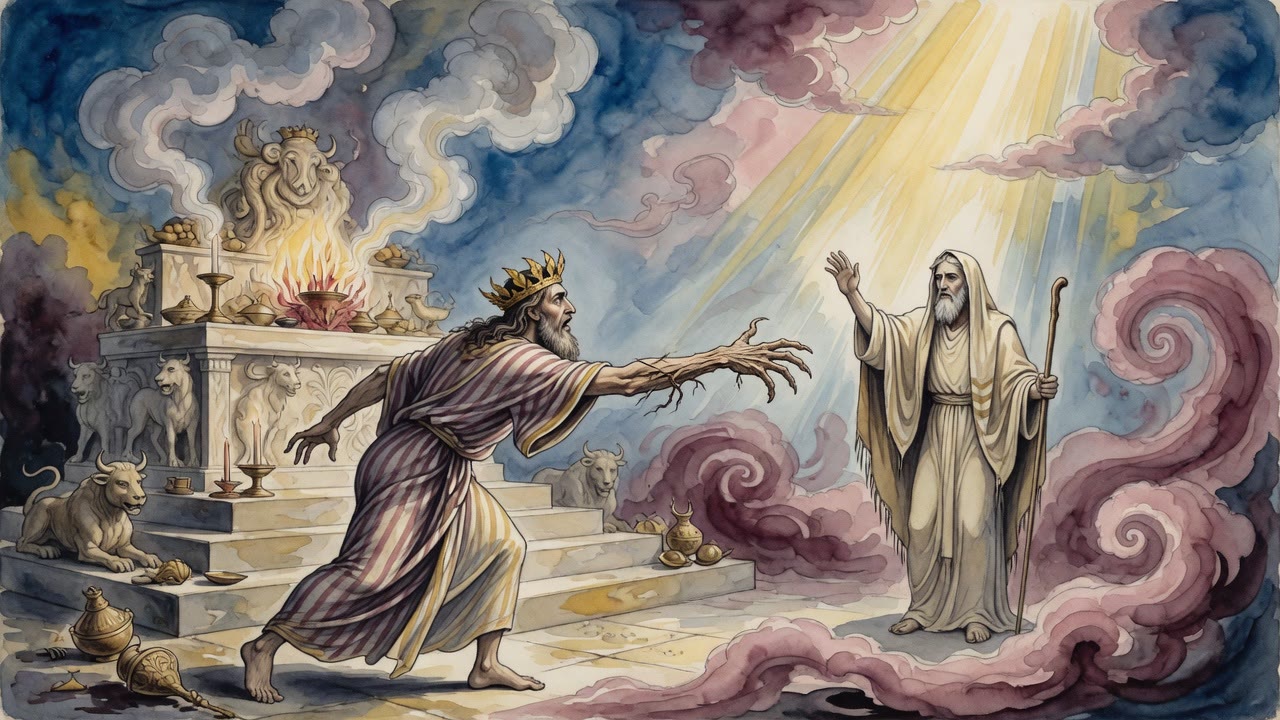
One old restraint had already fallen. Shimei ben Gera, the man who had cursed David in his humiliation, had lived under Solomon's eye. He was not only an enemy from the old reign. He was Solomon's teacher, a hard human boundary left from David's wounded house.

As long as Shimei lived, Solomon did not take Pharaoh's daughter. The desire waited. The royal arrangement waited. The door remained closed because someone in the king's world still carried the force of rebuke.

Then Shimei crossed the line set for him and died by Solomon's order. The last warning voice went quiet. Solomon, wisest of kings, did not pause long in the silence. He married Pharaoh's daughter on the same night the Temple was completed.

The Wedding Covers the Temple

Jerusalem should have had one center that night. The Temple should have filled every street with its gravity. Instead there were two celebrations, and the wedding glittered louder.

The rejoicing over Pharaoh's daughter rose over the rejoicing for the Temple. Courtiers know which music keeps a king smiling. They crowded toward the royal marriage, toward wine, toward spectacle, toward the new queen's rooms. The house built for God's name stood complete, but another house was stealing the breath of the city.

Above, anger gathered. Jerusalem, newly crowned with holiness, stood close to destruction before its service had even settled into rhythm. The wound was not merely that Solomon married unwisely. It was that he let the dedication of the Temple become background noise at its own birth.

The Stars Above the Bed

Pharaoh's daughter knew how to make a room obey her.

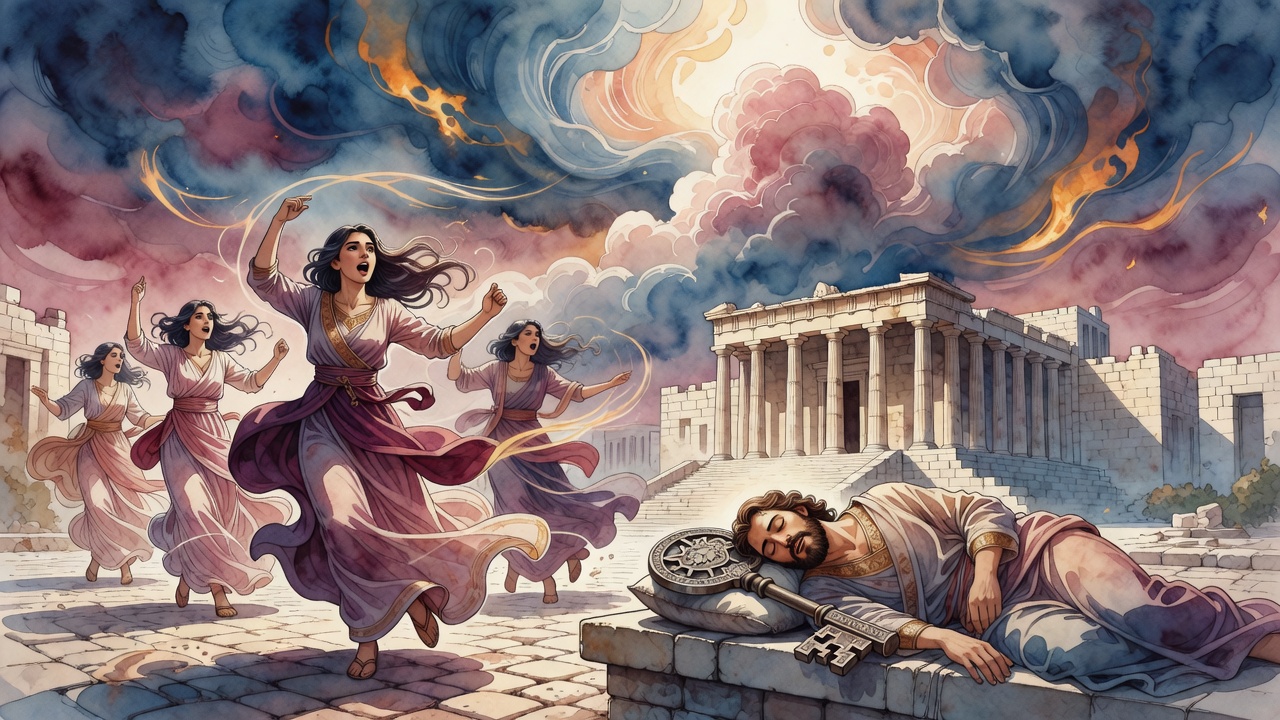
She brought a thousand songs, each one tied to the service of another idol, and had them sung before Solomon through the night. Then she spread a canopy above him and fixed it with jewels that shone like stars and constellations. When Solomon stirred and tried to rise, the false heavens glittered over his face.

Morning came outside. Inside, the jewels lied.

Solomon looked up and sank back into sleep. The king who had built a house for the God of Israel lay under a handmade sky, drugged by song, wine, and the softness of being obeyed. The daily offering waited. Priests waited. Israel waited. No one wanted to wake the king.

By the fourth hour of the day, the offering still had not been brought at its proper time. Joy curdled into fear. The people had watched a Temple rise, and now, on its first great morning, they were trapped by the sleep of the man who built it.

Bathsheba Breaks the Morning

They went to Bathsheba.

She entered where others were afraid to enter and woke her son. The mother of the king did not flatter him. She bent him over a post and struck him with words sharper than royal shame.

What, my son. What, son of my womb. What, son of my vows.

She named the danger plainly. Everyone knew David feared Heaven. If Solomon collapsed into appetite, they would say the fault came from his mother. She reminded him that she had wanted more than a son fit for a crown. She had wanted a son quick in Torah, worthy of prophecy, able to rule himself before ruling others.

Then she pressed the king where kings hate pressure. Do not give your strength to women. Do not drink like rulers who forget the law. Do not pretend that wisdom makes commandment unnecessary. A king has enough power to sin without hearing no. That is why the no must be carved into him early.

Gabriel Plants a Reed

The night did not end when Solomon woke.

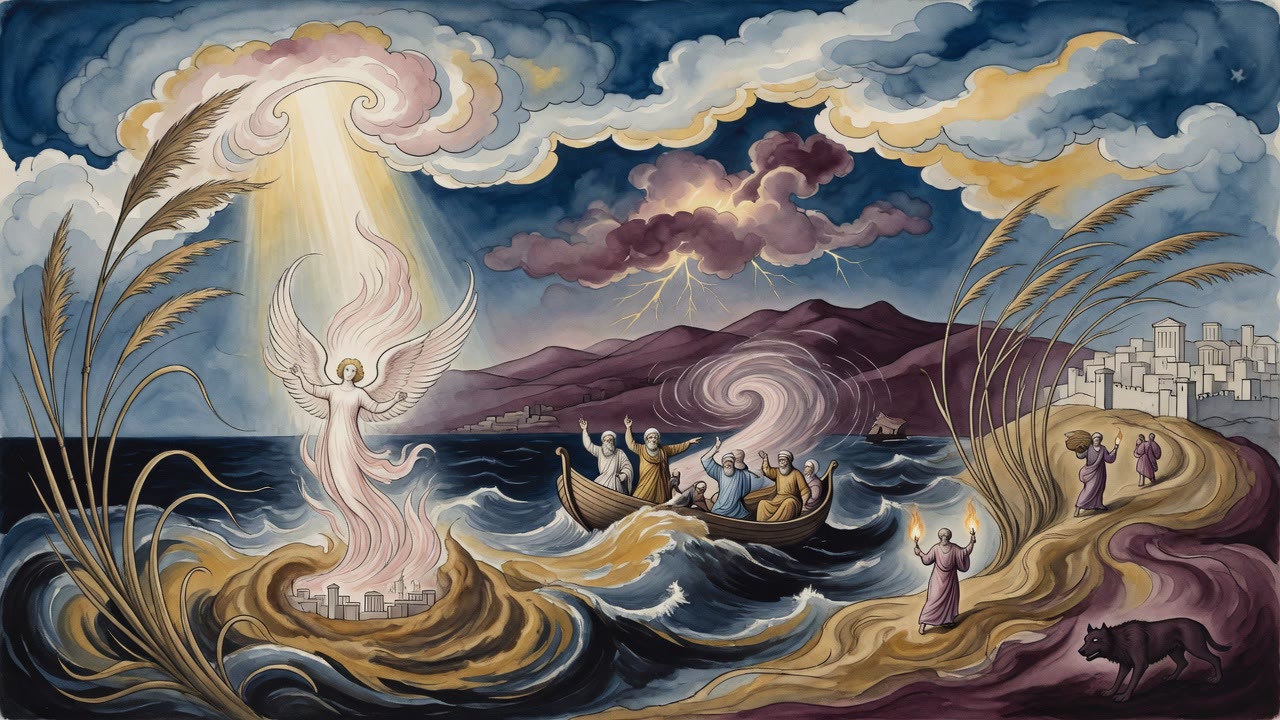
Gabriel descended to the sea and planted a reed in the water. One reed. A thin green thing, hardly a kingdom, hardly an omen. Around it, earth began to gather grain by grain. The sea accepted the deposit. Mud thickened. A small island began where there had been only water.

Time moved. Solomon's kingdom split after him. Jeroboam raised golden calves and pulled the northern tribes toward a rival worship. On that day, a hut was built on the island that had formed around Gabriel's reed.

That hut was Rome's first dwelling.

The Temple night and the sea-reed now belonged to the same chain. A king slept through the morning offering, and far away an empire began as a speck in the water. Solomon wanted a palace marriage beside a holy house. The angel planted the consequence where no court musician could sing over it.


← All myths
From the tradition

Sources

3 sources

The texts this telling draws on, in full. Open a card to read inline, or expand it for a wider, quieter read.

Bamidbar Rabbah 10:4Bamidbar Rabbah

A fascinating story from Bamidbar Rabbah 10, a section of the larger Midrash Rabbah, a collection of rabbinic homilies and interpretations of the Torah. It’s a story about King Solomon, the wisest of all men, and a night that almost changed everything.

Rabbi Yishmael offers a dramatic answer. It all happened on the very night Solomon finished building the Temple. A night of double celebration, because he also married the daughter of Pharaoh.

According to this midrash, the joy over Solomon's marriage to Pharaoh’s daughter actually overshadowed the rejoicing for the Temple itself. Can you imagine? This upset God, and the verse says that God even considered destroying Jerusalem in response! As we find in (Jeremiah 32:31), God said, “For [this city has been] a cause of My wrath and of My anger [from the day that they built it until this day; remove it from My presence].”

Why did this marriage cause so much upheaval? Well, the Rabbis explain that Pharaoh's daughter introduced Solomon to a thousand types of song, each dedicated to a different idol. She created a seductive, almost hypnotic atmosphere. Even worse, she put a canopy above Solomon covered in gems that shone like stars. Every time he tried to wake up for his duties, he saw the dazzling display and fell back asleep.

Rabbi Levi adds that on that particular day, the morning offering in the Temple wasn’t sacrificed until the fourth hour of the day – terribly late! There was an incident, we're told, where the daily morning offering was sacrificed at the fourth hour. Imagine the distress of the Israelites. It was the dedication of the Temple, but they couldn't wake Solomon! They were afraid to disturb the king.

So, what did they do? They went to Bathsheba, Solomon's mother, and she took matters into her own hands.

Bathsheba woke Solomon and delivered a powerful rebuke. The text says, "The oration with which his mother admonished him" (Proverbs 31:1). Rabbi Yoḥanan paints a vivid picture: Bathsheba bent him over a post! She then asks, "What, my son?" (Proverbs 31:2). She reminds him that everyone knows his father, King David, was God-fearing. Now, she fears, they'll say she's the reason he's straying.

She continues, "What, son of my womb?" (Proverbs 31:2), reminding him of the sacrifices she made for him, even breaking custom to ensure he was a worthy heir. "And what, son of my vows?" (Proverbs 31:2). While other women prayed for sons fit for kingship, she prayed for a son quick in Torah and worthy of prophecy.

Then comes the core of her message: "Do not give your strength to women" (Proverbs 31:3). She warns him against the dangers of lust and reminds him of the Torah's commandment: "He shall not amass for himself many wives" (Deuteronomy 17:17). Be careful, she warns, these things destroy kings.

She then challenges him: "It is not for kings, Lemuel" (Proverbs 31:4), implying, what business do you have with kings who say, 'Why do we need God [lama lanu el]?' Don't emulate their actions! "It is not for kings to drink wine" (Proverbs 31:4), she continues. Why do you act like kings who get drunk and engage in lewd acts? Don't be like them.

Rabbi Shimon explains that drinking wine can lead one to forget the Torah's commandments, the meḥukak, especially "You shall not commit adultery" (Exodus 20:13). Bathsheba reminds Solomon that justice was entrusted to the House of David. Drinking wine could lead him to "subvert justice for all the children of the poor" (Proverbs 31:5).

The text even explores the proper use of wine: "Give strong drink to the hopeless, and wine to embittered souls" (Proverbs 31:6). Rabbi Ḥanan says wine was created to reward the wicked in this world and to comfort mourners. It should be used to ease suffering, not to cloud judgment.

The passage then turns to the responsibility of the court to advocate for those who cannot advocate for themselves: "Open your mouth for the mute" (Proverbs 31:8), specifically orphans who don't know how to claim their inheritance.

Finally, the text returns to the name "Lemuel." It suggests that "Lemuel" means whispering [nam] to God [lael], saying, "I can amass many wives and not sin." It's a warning against arrogance and the belief that one is above temptation.

The midrash then interprets Bathsheba's admonishment through the lens of Torah law, connecting it to the prohibitions against intermarriage, adultery, and excessive drinking. It emphasizes that these prohibitions are not arbitrary but are essential for maintaining spiritual and moral integrity.

The episode concludes by suggesting that Solomon eventually conceded his error. He learned from the mistakes of Noah and Adam, who were both led astray by wine. Solomon realized that true wisdom lies in acknowledging one's limitations and adhering to the teachings of the Torah.

So, what can we take away from this story? It's a reminder that even the wisest among us are fallible. It's a call to humility, a warning against arrogance, and a reminder of the importance of staying grounded in our values. And perhaps most importantly, it highlights the power of a mother's love and a mother's wisdom in guiding her child back to the right path. It's a powerful narrative about temptation, responsibility, and the enduring strength of moral guidance, still resonant today.

Full source
Legends of the Jews 5:19Legends of the Jews

Legends of the Jews turns to Solomon Executes Shimei and Accidentally Creates Rome.

Our tale revolves around King Solomon, the wisest of men, but even he couldn’t escape the long arm of cause and effect. It all starts with Joab, and then Shimei ben Gera.

Shimei, had a history with David, Solomon's father. According to the biblical account, Shimei had hurled curses and stones at David during a time of great distress for the King (II (Samuel 16:5-1)3). It was a pretty low blow. After David's death, Solomon remembered this disrespect. Joab also found himself on Solomon's wrong side. Both men paid the ultimate price. the verse says Shimei's death, in particular, was a bad omen for Solomon.

Why? Because Shimei wasn't just anyone. He was Solomon's teacher! As long as Shimei, this living reminder of the past, was around, Solomon held back from a fateful decision: marrying the daughter of Pharaoh.

The moment Shimei was gone, Solomon went ahead with the marriage. A big mistake, many believed. And that's where things get really interesting.

The Zohar, that foundational text of Jewish mysticism, and Ginzberg's Legends of the Jews tell us that immediately after Solomon married Pharaoh’s daughter, the Archangel Gabriel himself descended from heaven. What did he do? He planted a reed in the sea. Just a single reed.

Sounds insignificant. But here's where the story takes a turn into the mythic. Slowly, inexorably, earth began to accumulate around that reed. Bit by bit, an island began to form.

Now, fast forward. On the very day that Jeroboam, the first king of the Northern Kingdom of Israel, erected those infamous golden calves – a blatant act of idolatry – a small hut was built on that newly formed island. And that, my friends, was the very first dwelling place of Rome.

Rome! From a reed planted by an angel as a consequence of Solomon's marriage. Incredible, isn’t it?

Midrash Rabbah and the Talmud (Shabbat 56b) expand on the negative associations with Solomon's marriage to the Egyptian princess. The Rabbis saw it as a catalyst for spiritual decline and, ultimately, for the division of the kingdom.

So, what are we to make of this fantastic tale? Is it a literal historical account? Probably not. But as a story, it's incredibly powerful. It speaks to the interconnectedness of events, the idea that even seemingly small actions can have enormous, unforeseen consequences generations later. It also serves as a cautionary tale about the dangers of straying from the righteous path.

It's a reminder that our choices, both good and bad, create ripples that extend far beyond our own lives, shaping the world in ways we may never fully understand. And sometimes, those ripples lead to Rome.

Full source
Yalkut Shimoni on Nach 172:2Yalkut Shimoni on Nach

Why Solomon's Marriage to Pharaoh's Daughter Was a Disaster is the question behind this passage from Yalkut Shimoni on Nach.

Rabbi Yehudah, quoting Rav, makes a curious observation: "One should always live in the same place as his teacher because so long as Shimi ben Geira was alive, Shlomo did not marry Pharaoh’s daughter." What's the connection? The implication is that Shimi ben Geira, perhaps a figure of moral authority or a teacher, exerted a restraining influence on Solomon. His presence acted as a check on Solomon’s actions.

You might be thinking, "Wait a minute! I thought we weren't supposed to crowd our teachers!" The text anticipates this, addressing the apparent contradiction. It explains that living near one's teacher is beneficial when one is subservient and receptive to their guidance. However, if one is not open to learning, distance might be better. It's all about the student's attitude.

Then, the story takes a truly wild turn. “At the moment when Shlomo married Pharaoh’s daughter the angel Gavriel came down and stuck a reed in the sea, which gathered a sandbank around it. At the moment when Yerovam ben Navat built his two golden calves, the great city of Rome was built upon this bank.”

Can you believe it? The marriage of Solomon and Pharaoh's daughter is linked, through divine intervention, to the eventual rise of Rome! It's a chain reaction of epic proportions. The initial act, seemingly a political alliance, sets in motion a series of events with far-reaching, even world-altering, consequences.

The passage continues, stating that Solomon converted Pharaoh's daughter. And for four years, he "loved the Lord..." (Melachim I 3:3), at least until he began building the Temple. But then, everything shifted when he "...took Pharaoh's daughter, and brought her into the city of David..." (Melachim I 3:1). This act, bringing her into the heart of the holy city, is seen as a turning point.

The prophet Jeremiah echoes this sentiment: "For this city has aroused My anger and My wrath since the day they built it..." (Yirmiyahu 32:31). The implication is that Solomon's actions, particularly his marriage and the integration of Pharaoh's daughter into Jerusalem, contributed to a decline, a straying from the divine path.

However, the story doesn't end on a completely negative note. The Yalkut Shimoni tells us that in Solomon’s old age, right before he died, the Ruach (spirit) Hakodesh (רוח הקודש, the Holy Spirit) rested upon him. And he then spoke out three books – Mishlei (Proverbs), Shir ha-Shirim (Song of Songs) and Kohelet (Ecclesiastes). This suggests a redemption, a return to wisdom and divine inspiration at the end of his life.

So, what can we take away from this intricate, multi-layered passage? It highlights the interconnectedness of actions and consequences. It reminds us that even seemingly small decisions can have ripple effects far beyond what we can imagine. And it offers a glimmer of hope, suggesting that even after missteps, there's always the possibility of return, of finding wisdom and inspiration, even in our twilight years. It makes you think about the power of choices, doesn't it?

Full source