5 min read

Solomon Taught the Bird Language and Warned of Death

A yearly visitor refused Solomon's treasure and asked for the speech of birds and beasts, a gift the king wrapped in a death warning.

Curated by Arthur · Told by Maggid ·
Table of Contents
  1. The Visitor Refused Gold
  2. The Warning Came First
  3. The Birds Opened Their Mouths
  4. Even an Ant Could Humble a King
  5. Wisdom Became a Cage

The man came every year and left with a gift.

Solomon had no shortage of gifts to give. Gold moved through his court like water. Spices, horses, carved work, rare woods, vessels bright enough to catch a torch flame, all of it could be placed in a visitor's hands before the palace doors closed behind him. The man had accepted such kindness before.
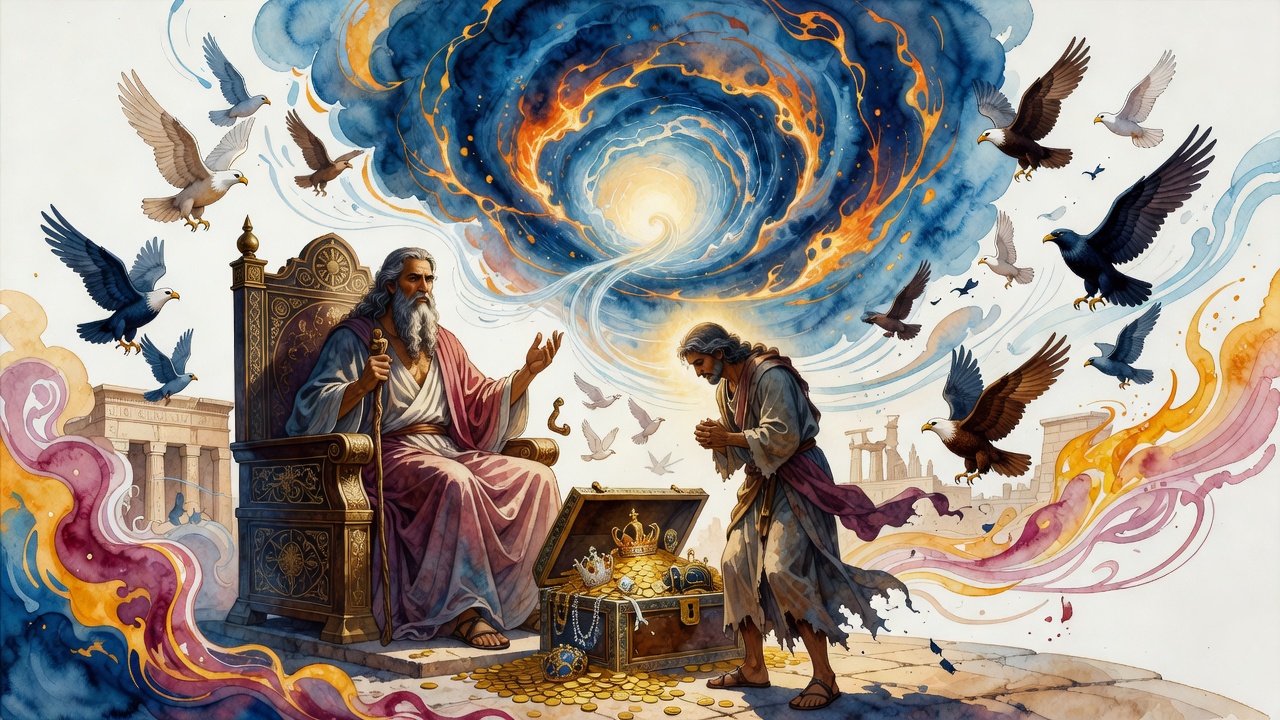
One year he refused treasure.

He wanted the speech of birds and animals.

The Visitor Refused Gold

Solomon knew the request was not small.

Other kings could give robes, rings, posts in government, safe passage, or a purse heavy enough to bend the belt. Solomon could give knowledge that opened the hidden conversation of creation. Birds did not merely chirp near his window. They carried news. Beasts did not merely low in their stalls. Their voices entered the king's understanding.

The visitor had watched enough, year after year, to know that Solomon's wealth was the least marvelous thing in Jerusalem.

He did not ask for silver. He asked for access to the world under human noise: the warning in a raven's throat, the complaint of an ox, the quick counsel of sparrows, the small politics of insects in the dust.

The palace grew still around the request.

The Warning Came First

Solomon did not answer with delight.

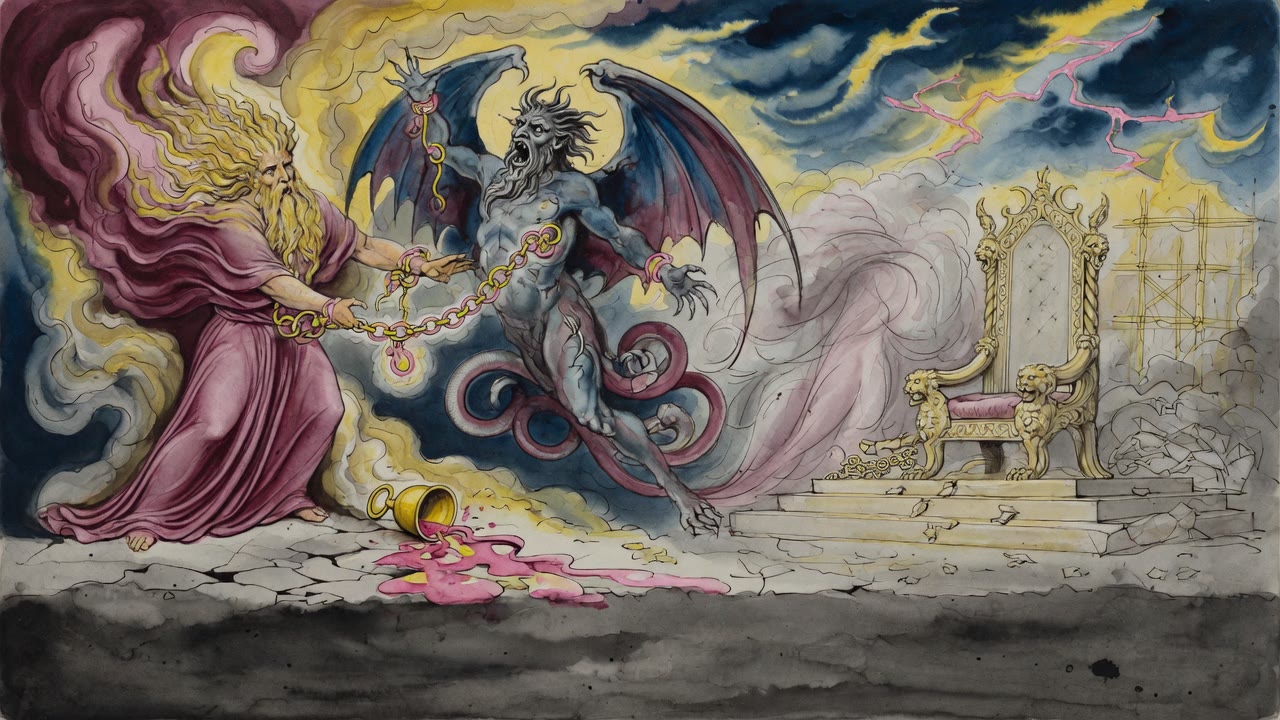
He warned the man before he taught him. If even one word heard from an animal passed from his mouth to another person, death would follow. Not embarrassment. Not loss of favor. Death.

The warning was part of the gift. Secret knowledge is not safe because it is beautiful. A man who understands every creature can become drunk on being the only human in the room who hears the truth beneath the surface. He can laugh at a bird's prediction before anyone else knows danger is coming. He can ruin a household by repeating what a beast muttered beside a trough. He can use listening as power.

Solomon placed a wall around the man's tongue before opening his ears.

The man still wanted it.

The Birds Opened Their Mouths

So Solomon taught him.

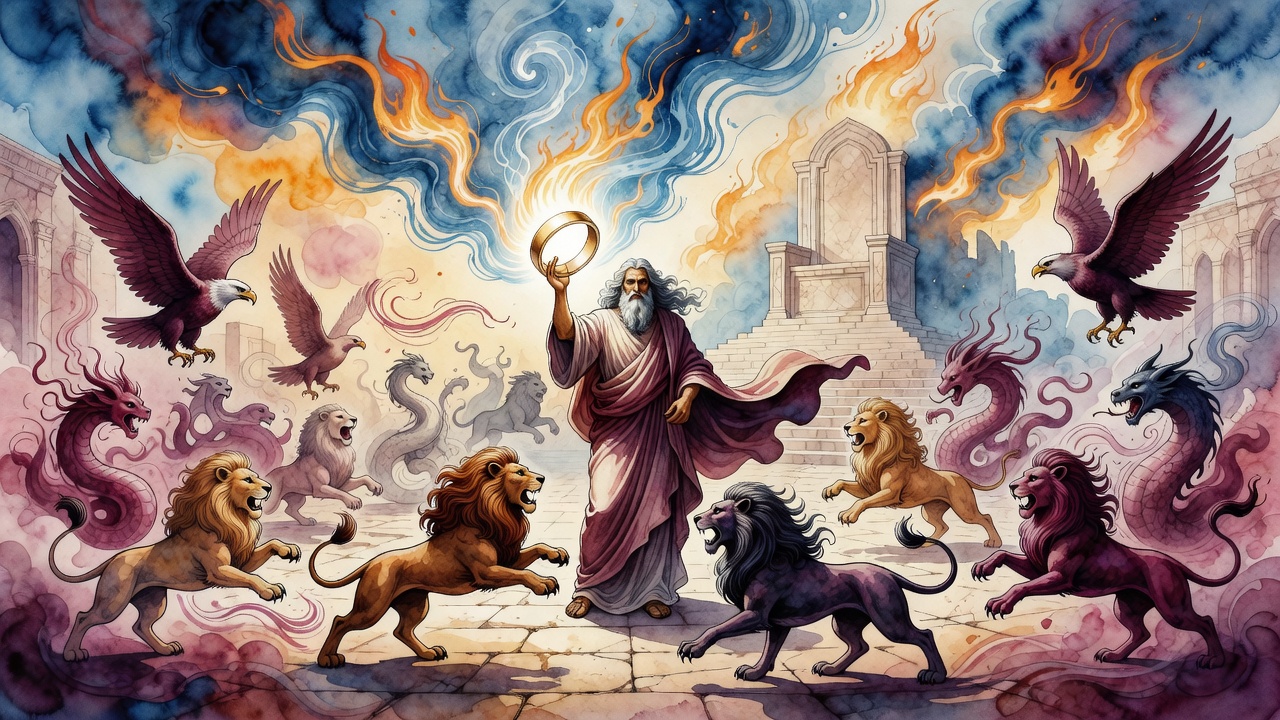
The world changed at once. The courtyard was no longer background sound. Wings cut the air with meaning. A donkey's bray became speech. The muttering of animals at dusk, the cry of birds before dawn, the nervous talk of creatures before rain, all of it broke open.

The man had wanted wonder. He received burden.

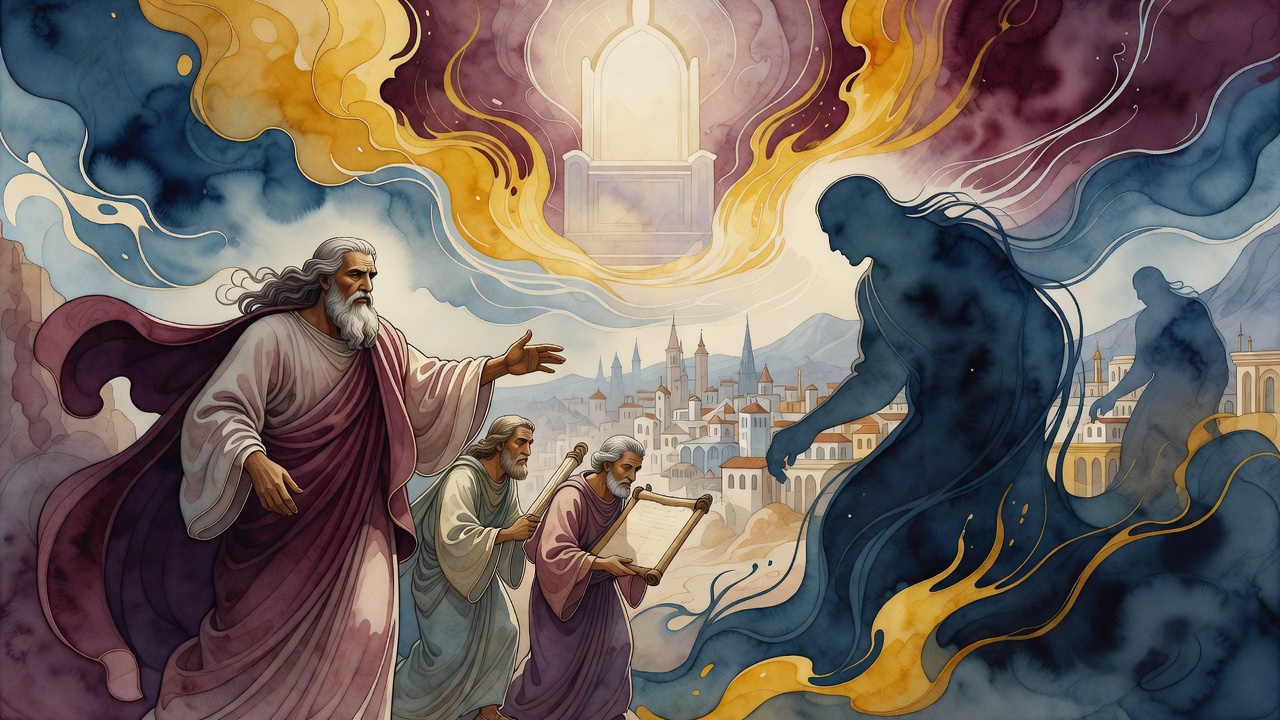
That is how Solomon's own gift worked. In the Talmudic tale of Luz, the king hears birds announce that the Angel of Death has been sent for two of his trusted men. Birdsong becomes intelligence, and intelligence becomes panic. Solomon tries to outrun the decree by sending the men toward the deathless city, only to discover that the gate of Luz was the very place appointed for them.

Sometimes a bird tells the truth no king can repair.

Even an Ant Could Humble a King

Solomon's mastery of languages did not make every creature small.

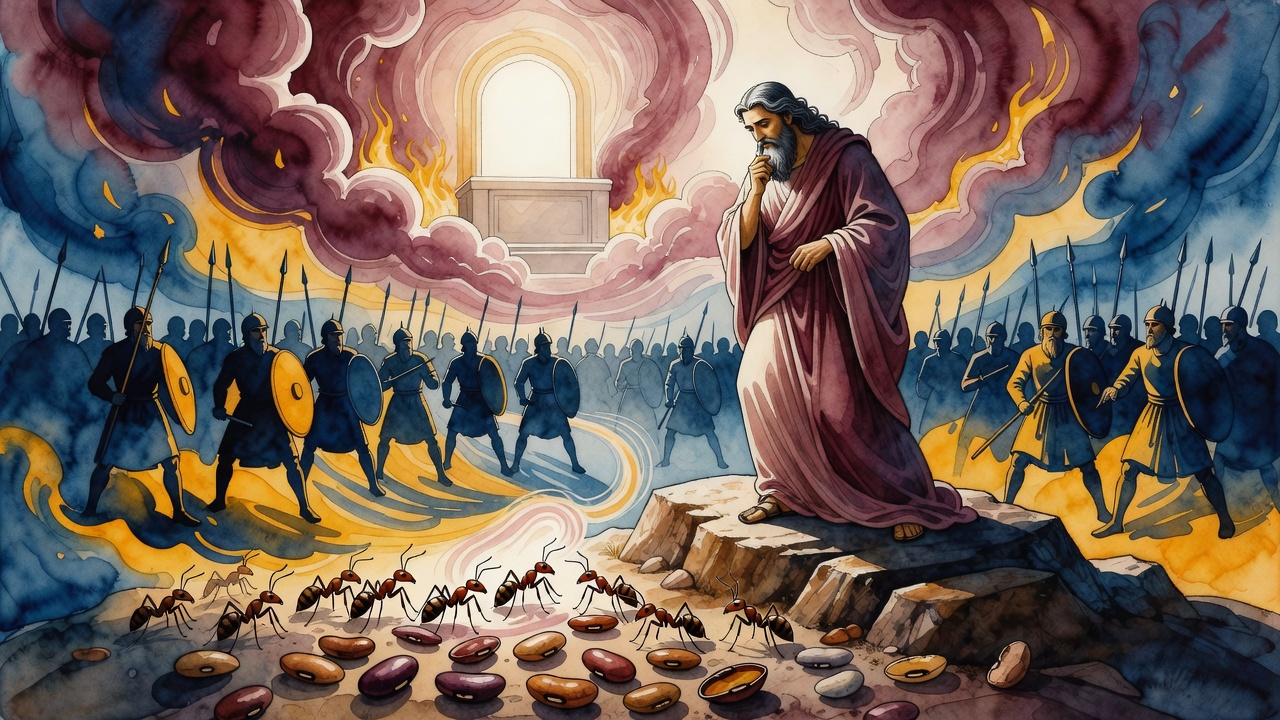
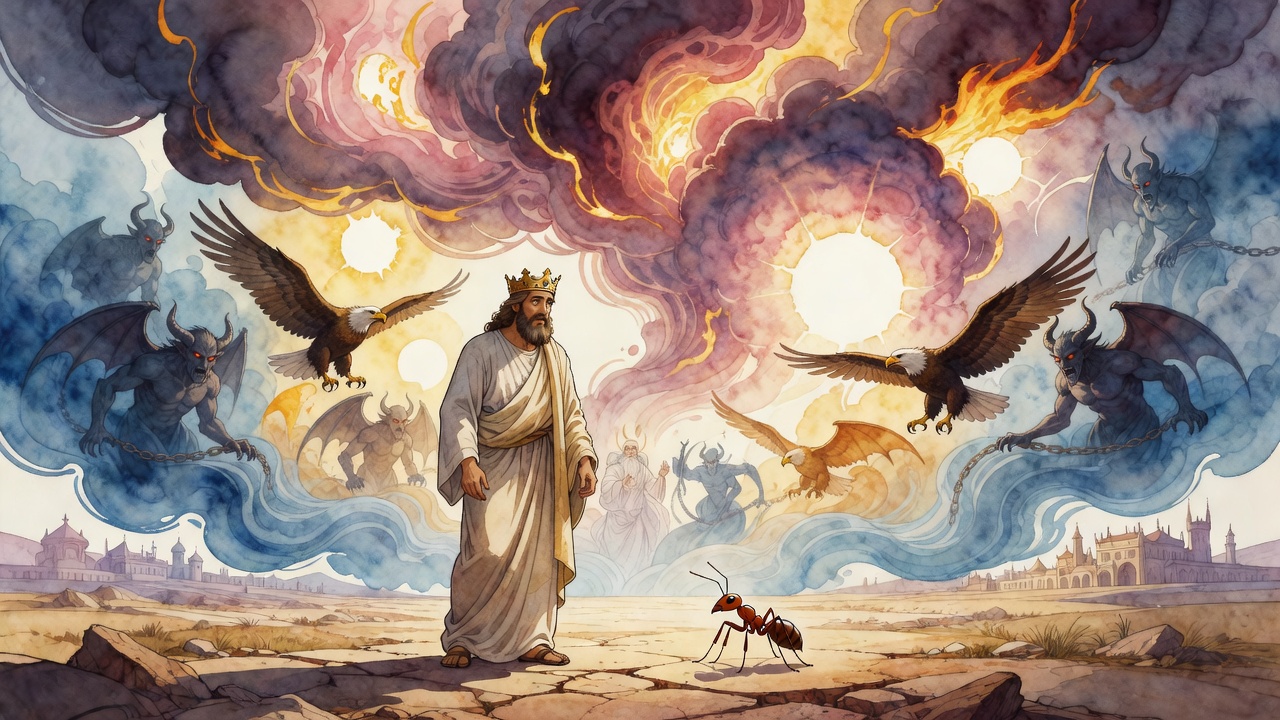
One exemplum tells of an ant who invited the king and his army to a feast. Solomon came amused, with soldiers and servants behind him. Beneath an ordinary anthill he found storehouses full enough to feed multitudes. The tiny host had prepared a table fit for a king.

No lecture was needed. It stood there in crumbs and chambers under the ground. Solomon, who commanded armies and understood birds, still had to bend his attention downward. Wisdom did not only descend from throne to subject. Sometimes it rose from the dust, carried by an insect with enough provisions to embarrass a palace.

The man who wanted animal speech was asking to enter that humiliation too.

Wisdom Became a Cage

The visitor left with what he had begged to receive.

Every road after that was crowded. A bird in a branch might know the next accident. A beast in a field might reveal a neighbor's secret. A small creature might speak with more accuracy than an adviser in embroidered clothes. The man could listen, but he could not safely repeat.

Solomon had given him a kingdom of sound and locked his mouth at the gate.

That is the hard edge of the legend. Hidden knowledge does not always free the one who receives it. Sometimes it narrows him. Every new understanding becomes one more thing he must carry alone. The man asked for the language of creatures because he thought it would make the world larger. It did. Then it made his silence larger too.

In Solomon's court, even wonder came with a death sentence tied around it.


← All myths

From the tradition

Sources

3 sources

The texts this telling draws on, in full. Open a card to read inline, or expand it for a wider, quieter read.

Legends of the Jews 5:37Legends of the Jews

The legendary King Solomon, wisest of all men, knew. And, as the stories tell us, he sometimes shared that knowledge… with a price.

One tale, found in Ginzberg's Legends of the Jews, recounts the story of a man who traveled a great distance each year to visit Solomon. Each time he departed, Solomon, ever generous, would offer him a gift. But one year, this visitor refused a material reward. He had something else in mind.

"Teach me," he implored the king, "the language of the birds and the animals."

Can you imagine the audacity? To ask for such a gift! Yet, Solomon, known for his wisdom and understanding, was willing. But he didn’t just hand over the keys to the animal kingdom’s linguistic secrets. He issued a grave warning.

"If thou tellest others a word of what thou hearest from an animal," Solomon cautioned, "thou wilt surely suffer death; thy destruction is inevitable." A heavy price,. To possess such incredible knowledge, to understand the hidden conversations of the natural world, but to be bound by absolute silence. A secret so potent, so dangerous, that revealing it meant certain death.

Despite the king's stark warning, the visitor was undeterred. He persisted. He craved this forbidden knowledge more than life itself, it seemed. And so, Solomon, seeing his unwavering desire (or perhaps, his folly?), relented. He instructed him in the secret art, granting him the ability to understand the voices of the creatures around him.

What happened next? Did the man keep his vow of silence? What did he learn from the animals? And did he ultimately succumb to the temptation to share the secrets he now possessed? Well, those are stories for another time. But this small glimpse into the world of Solomon and his extraordinary gifts serves as a potent reminder: knowledge is power, but some knowledge comes with a burden, a responsibility… and sometimes, a deadly cost. What secrets would you be willing to keep, even under the threat of death?

Full source
Sukkah 53aTalmud Bavli, Sukkah

He too once saw a skull floating upon the surface of the water. He said to it: Because you drowned others, they drowned you; and in the end those who drowned you will themselves be drowned. Rabbi Yohanan said: A man's feet are his guarantors; to the place where he is summoned, there they carry him.

There were those two Cushites who used to stand before Solomon: Elihoreph and Ahiyah, the sons of Shisha, who were the scribes of Solomon. One day the Angel of Death saw that he was sad. He said to him: Why are you sad? He said to him: Because they have demanded of me these two Cushites who sit here. Solomon handed them over to demons and sent them to the city of Luz. When they reached the city of Luz, they died.

The next day the Angel of Death saw that he was cheerful. He said to him: Why are you cheerful? He said to him: To the very place where they were demanded of me, there you sent them. Immediately Solomon opened his mouth and said: A man's feet are his guarantors; to the place where he is summoned, there they carry him.

Full source
Gaster, Exempla No. 343 (Codex Gaster 66)The Exempla of the Rabbis (1924)

King Solomon, master of seventy languages, including the speech of birds and insects (1 Kings 4:33), was boasting. He had spent an afternoon detailing to his court the strength of his armies, the size of his fleet, the reach of his treasuries. He had concluded by declaring himself the greatest king who had ever lived.

The Holy One heard him. And the Holy One sent him an invitation, from an ant.

The Feast in the Anthill

A tiny ant arrived at the palace and invited Solomon and his army to a feast lasting seven days and seven nights. She also requested the loan of a hundred servants to help her with preparations.

Solomon, amused but intrigued, accepted. His hundred servants were dispatched. The armies followed. They arrived at what appeared to be an ordinary anthill. And underneath it found immense subterranean storehouses, piled with food enough to feed thousands of men.

They feasted for seven days and seven nights. At the end of the week, the ant approached the king.

She bowed and said: "I notice that throughout the week you never once asked after my welfare, nor did you ask how I, a small ant, came to possess such treasures."

Solomon, embarrassed, apologized. He asked her now.

The Ant's Reckoning

She answered: "King Solomon, you are the smallest and most insignificant of many kings who lived before you. Every item of food you have eaten this week I collected from the abandoned packs of dead kings, kings who once waged wars against each other, believing themselves the greatest on earth, and whose corpses lay on my fields. I gather what they leave behind. You are simply the latest guest at a table I have been laying for centuries."

Solomon, the exempla says, was greatly humbled. He returned to Jerusalem no longer describing himself as the greatest king who ever lived.

The story, preserved in Codex Gaster 66 and woven into the rich medieval Solomoniad cycle, uses the smallest creature in creation to deliver the largest correction. If even an ant can outlive a king, what is a king really? Whatever Solomon had boasted about that morning, he ate it that week from the pantry of men who had boasted the same way before him.

Full source