Parshat Emor5 min read

Shelomith's Son Was Refused a Tent in Dan, Then Cursed the Name

Dan's camp rejects a man with an Egyptian father. He utters the Name in rage, while Shelomith's old wound still burns under the sand.

Curated by Arthur · Told by Maggid ·
Table of Contents
  1. The Tent That Would Not Open
  2. How Shelomith Was Sullied
  3. The Name Left His Mouth
  4. High Places and Closed Doors
  5. Sand Still Holds the First Egyptian
Shelomith's Son Was Refused a Tent in Dan, Then Cursed the Name Click for full size

The Tent That Would Not Open

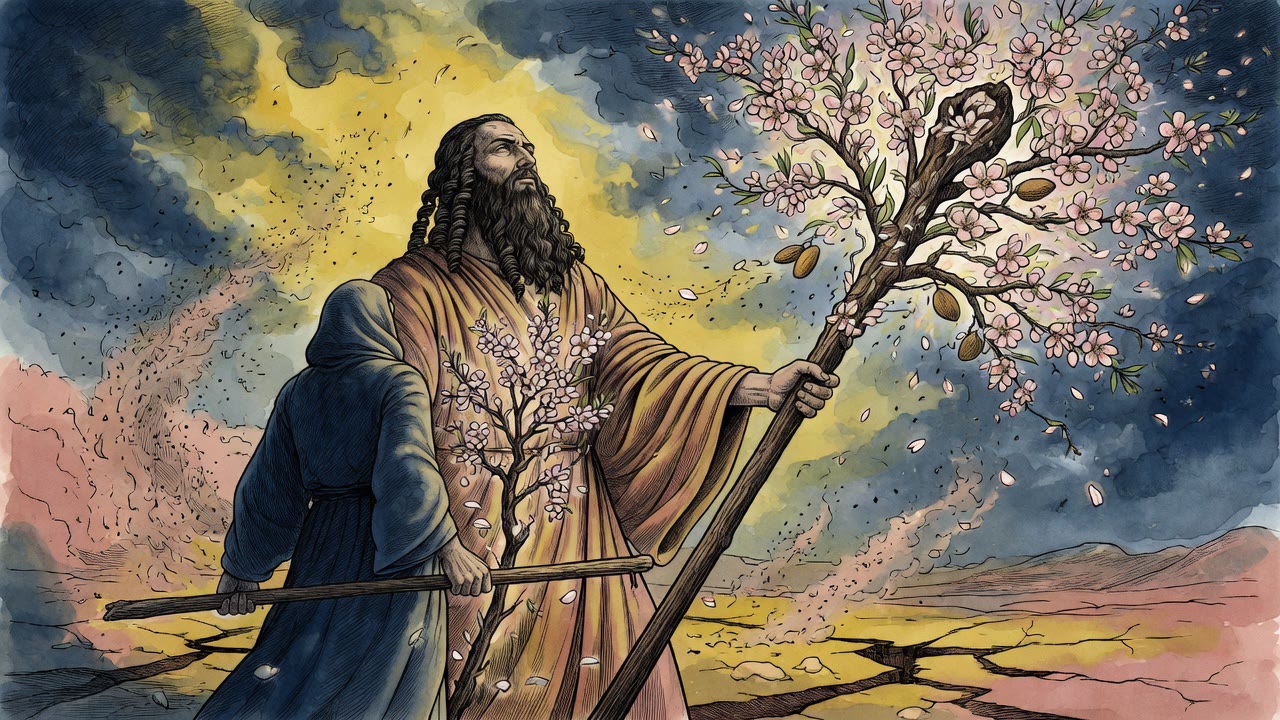
He came with rope and pegs to pitch his tent among the standards of Dan. The men of the tribe looked at his face, then at the paperwork of blood, and closed the gap between their banners.
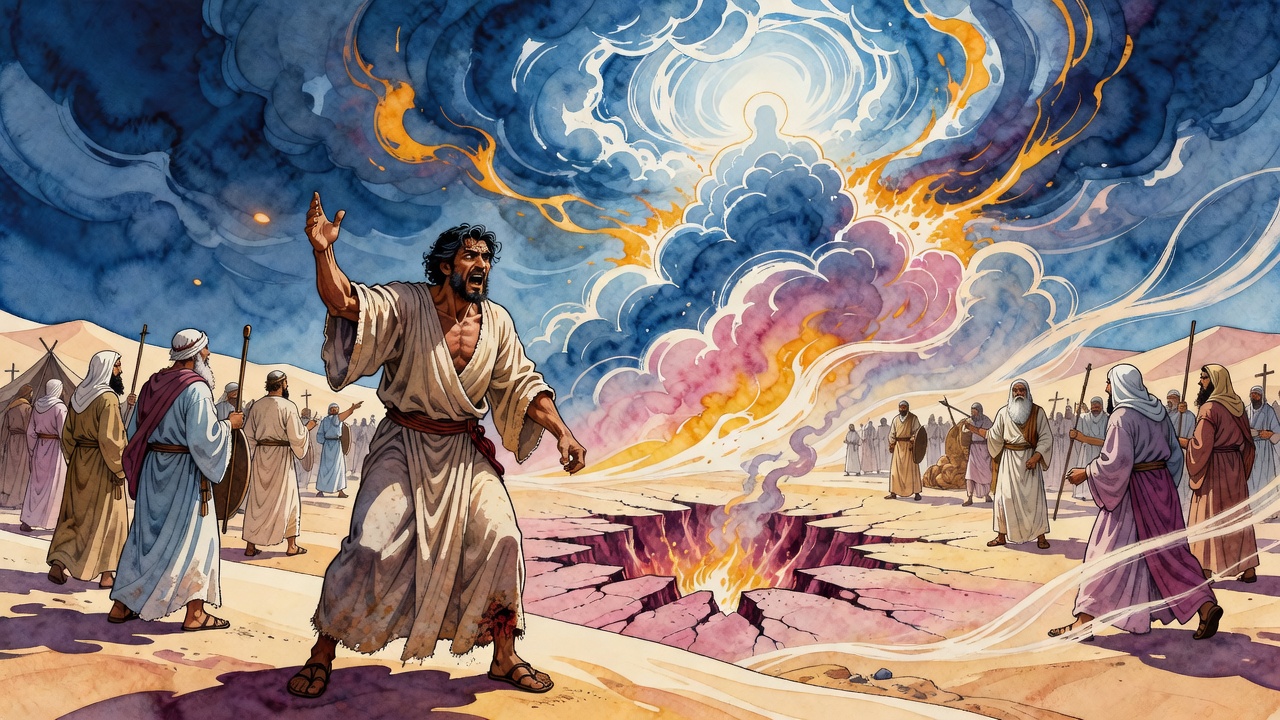
"You have an Egyptian father," they said. "Each with his standard, under the banners of their fathers' houses" (Numbers 2:2). Fathers' houses. Not mothers' houses. Shelomith bat Dibri of the tribe of Dan could not buy her son a place under Dan's cloth.

He stood holding canvas that would not be allowed to rise. The camp around him moved like a body that already knew its shape. Judah to the east. Reuben to the south. Standards snapped in wind that did not care whose mother had been Israelite. Genealogies had just been read in public, and the reading had thrown him out of the story before he could finish staking a door.

His mother had given him an Israelite name and an Israelite tongue. His father had given him nothing he could show at a boundary.

How Shelomith Was Sullied

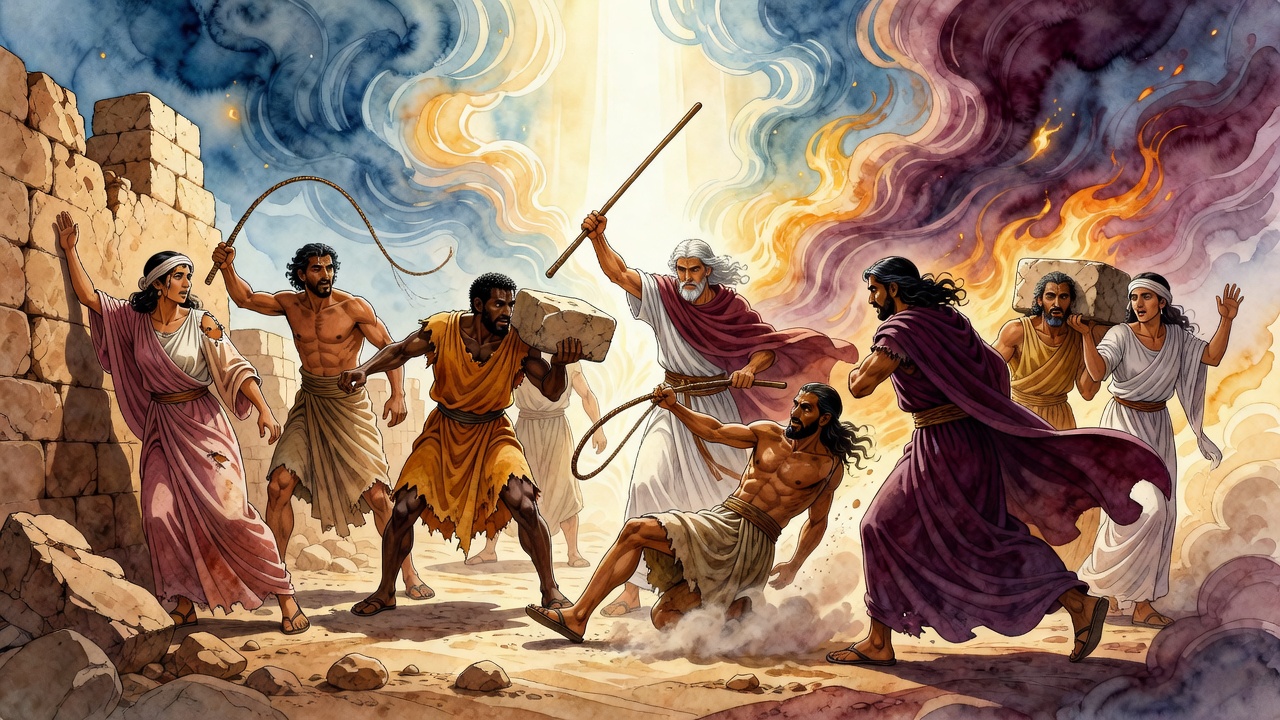
Long before the desert, in the brick yards of Egypt, a taskmaster ruled over ten officers, and each officer ruled over ten Israelites. One hundred ten souls under one whip-hand. The taskmaster found an officer, sent him to gather his groups of ten, and entered the house left empty.

He sullied Shelomith. When the officer returned and saw the Egyptian leaving, the beating began. Day after day. "Toil properly. Toil properly." The rape was not enough. The public work-song of the whip had to erase what the husband had seen.

Moses felt the holy spirit kindle. He raised his eyes and measured the double crime: the woman taken, then the man broken for noticing. He struck the Egyptian and hid him in the sand (Exodus 2:12). One body under grit. One secret that would outlive the bricks.

Years later, the child of that violence walked the wilderness with Israel, carrying a bloodline no standard wanted to fly.

The Name Left His Mouth

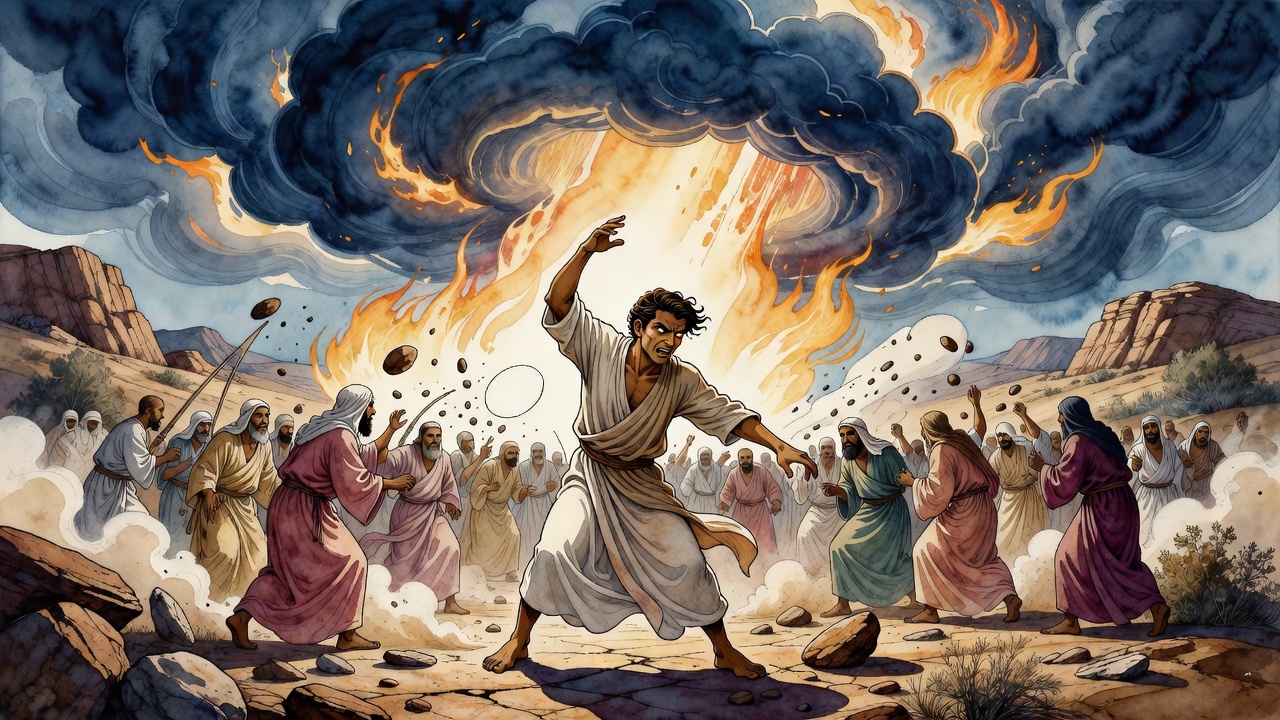
Rejection at Dan's edge did what the whip had done in Egypt: it made a private wound into public law. He "went out" from the portion on genealogies and found no tent waiting. Immediately he began to utter the Name and curse it (Leviticus 24:10-11).

Not a muttered insult. The Name. The letters Israel had received as life, turned into a weapon against the God who had just arranged the camp by fathers. His tongue did what his hands could not do to the banners. He made the air unclean where his body had been declared unclean of belonging.

The camp heard. Stones would answer later. But first the silence of men who had quoted a verse and walked away, leaving him alone with syllables too heavy for rage to hold safely.

Bloodguilt, elsewhere, is written over a bull slaughtered apart from the tent of meeting, as if a life had been taken (Leviticus 17:3-4). Here the life taken is speech itself. A man who cannot place his offering inside the ordered camp pours his fury into the Name instead of onto an altar.

High Places and Closed Doors

Before the Tabernacle rose, high places were open and firstborns served. After it rose, the service narrowed to priests and one entrance. Whoever slaughters a bull apart from that entrance is treated as one who sheds blood. The Holy One binds slaughter to a door so that worship cannot scatter into every private grudge.

The son of Shelomith never reached that door with a gift. He reached a tribal edge with a rejected peg. Where others learned to honor God by bringing flesh to the tent, he learned to wound God by speaking what should only be guarded. Both stories turn on a threshold: who may enter, who may offer, who may stand under a father's banner.

Isaiah's hard line hangs over both scenes: one who slaughters the bull as if he slays a human (Isaiah 66:3). Theft of a comrade's animal is murder by another name. Theft of a place in the camp becomes murder of speech, a curse where blessing should have been.

Sand Still Holds the First Egyptian

Moses once hid a body in sand to stop a whip. The desert now holds a different problem: a man born of that first violence, refused by Dan, cursing the Name that brought him out of Egypt at all.

God's answer, spoken over the long wound of nations, looks past this world of being delivered into foreign hands through sin, toward a day when kings become guardians and those who trust are not ashamed (Isaiah 49:23). The promise does not erase the stones waiting for the blasphemer. It sets the camp's cruelty and the man's rage inside a longer clock.

Shelomith's son dies under law. Shelomith's old night in Egypt does not. The sand keeps both stories: the Egyptian Moses buried, and the son Egypt left inside Israel's census.


← All myths

From the tradition

Sources

2 sources

The texts behind this telling. Some cards carry a translation of the source; others are our own retelling of it, and each card says which. Every card links out to the original.

Midrash Tanchuma, Emor 24Midrash Tanchuma

Retold in our words. Read the original at the link below.Townsend 1989 translation of Midrash Tanhuma, S. Buber Recension · CC-BY

(Lev. 24:10:) “Now there went out the son of an Israelite woman, [whose father was Egyptian].” From where did he go out? R. Hiyya bar Abba said, “He went out from the Parashah on genealogies. When he came to pitch his tent in the camp of Dan, they rejected him. Now they said to him, ‘You have an Egyptian father, but it is written (in Numb. 2:2), ‘each with his standard, under the banners of their fathers' houses,’ and not ‘of their mothers' houses.’ Immediately (according to Lev. 24:11), he began to utter the name [of God] and curse it.” R. Levi said, “He was clearly a bastard. How so? Taskmasters were from Egypt, and the officers were from Israel. The taskmaster was in charge of ten officers, and the officer was in charge of ten Israelites. [Thus,] it turned out that the taskmaster was in charge of a hundred and ten Israelites. On one occasion a taskmaster met an officer. He said to him, ‘Go gather your groups of ten.’ When he had gone, he entered his house and sullied Shelomith, the officer's wife. [When] her husband returned, he found him leaving his house. When [the taskmaster knew that her husband] noticed him, he beat him every day and said to him, ‘Toil properly, toil properly.’ The holy spirit was kindled in Moses. He raised his eyes to the sky. He said, ‘Was it not enough for this wicked man to rape his wife, but that he should return and beat him?’ Immediately (according to Exod. 2:12), ‘he smote the Egyptian and hid him in the sand.’” The Holy One, blessed be He, said, “In this world you are delivered through sins into the hands of the nations of the world. However, in the world to come (according to Is. 49:23), ‘Kings shall be your guardians; their ladies, your wet nurses; they shall bow down before you, nose to the ground, and lick the dust of your feet; then you shall know that I am the Lord; those who trust Me shall not be ashamed.’”

Full source
Midrash Tanchuma, Achrei Mot 12Midrash Tanchuma

Retold in our words. Read the original at the link below.Townsend 1989 translation of Midrash Tanhuma, S. Buber Recension · CC-BY

(Lev. 17:3-4:) “If any single person from the House of Israel slaughters […]. And does not bring it unto the entrance of the tent of meeting.” Isaiah has said (in Is. 66:3), “One who slaughters the bull slays a human.” Whenever anyone steals his comrade's bull and slaughters it, it is as if he slays its owner. Another interpretation of “One who slaughters (shohet) the bull slays a human”: (Zev. 14:4:) Before the tabernacle was set up, all high places (bamot) were permitted and the service was with the firstborn; but since the tabernacle has been set up, the high places have been forbidden, and the service is with the priests. The Holy One, blessed be He, said, “Whoever sacrifices a bull apart from the tent of meeting is like one who slays a person, it is as though he has taken (shohet) a life. Thus it is stated (in Lev. 17:4), ‘bloodguilt shall be imputed to that man; he has shed blood.’ So whoever slaughters (shohet) at the tabernacle honors me, as stated (in Ps. 50:23), ‘Whoever sacrifices a thank offering honors Me.’ Now what reward shall I repay to him? When I bring salvation to Israel, he will have the right to see it, as stated (ibid., cont.), ‘and to the one who sets his way aright I will show the salvation of God.’” R. Abbahu said, “All salvation that comes to Israel is of the Holy One, blessed be He, as stated (in Ps. 91:15-16), ‘I will be with him in distress … and show him My salvation.’” Israel said, “Master of the world, inasmuch as you said, ‘I will be with him in distress,’ (in the words of Ps. 60:7), ‘save with Your right hand and answer me.’” [Thus] if You answer us, salvation is Yours, as stated (in Ps. 80:3) “come to save us”; such that Your right hand not be behind, as stated (Lamentations 2:3), “He placed His right hand behind.” R. Berekhyah the Priest beRabbi said, “See what is written (in Zech. 9:9), ‘Rejoice greatly, O daughter of Zion […]; behold your king comes to you righteous and saved.’ [The active voice,] ‘saving’ is not written here, but [the passive] ‘saved.’ And so it [says] (in Is. 62:11), ‘Say to the daughter of Zion, “Behold, your salvation is coming.”’ ‘Your savior’ is not written here, but ‘your salvation.’ He, as it were, is saved.” R. Meir said, (concerning Exod. 14:30), “’So the Lord saved (wywsh', voweled as wayyosha') Israel on that day’: the written text (ketiv) [reads] ‘so [the Lord] was saved (wywsh', voweled as wayyiwwasha').’ As it were, He was saved [on that day] with Israel.” R. Ammi said, “Moses praised the congregation of Israel (in Deut. 33:29), ‘Fortunate are you, O Israel; who is like you, a people saved through the Lord.’ ‘A people the Lord saved’ is not written here, but ‘a people saved through the Lord.’ It is comparable to a person who had a seah of wheat for a second tithe. What does he do? He gives coins to redeem it. So [it was] in the case of Israel. Through what were they redeemed? Through the Holy One, blessed be He, as it were, ‘a people saved through the Lord.’” The Holy One, blessed be He, said to Israel, “In this world you are saved by means of flesh and blood: In Egypt by means of Moses and Aaron; in the days of Sisera by means of Barak and Deborah; among the Midianites by means of Shamgar ben Anath, as stated (Jud. 3:31), ‘and he also saved Israel’; and likewise through the Judges. But because they were flesh and blood, you again became enslaved. However, in the world to come, I myself will redeem you, and you will never again be enslaved. Thus it is stated (in Is. 45:17), ‘Israel has been saved by the Lord with an everlasting salvation.’”

Full source