5 min read

Moses Faced Death and Argued With God Over One Egyptian

At the border of death Moses asked if one Egyptian he slew outweighed Egypt's firstborn. Afterward the abyss still heard Amram's son.

Curated by Arthur · Told by Maggid ·
Table of Contents
  1. One Egyptian on the Scales
  2. The Honor That Would Not Soften the Decree
  3. A God to Pharaoh, a Man Who Must Die
  4. After the Body, the Search for Amram's Son
  5. Clouds That Hide, Heavens That Remember Sinai
Moses Faced Death and Argued With God Over One Egyptian Click for full size

One Egyptian on the Scales

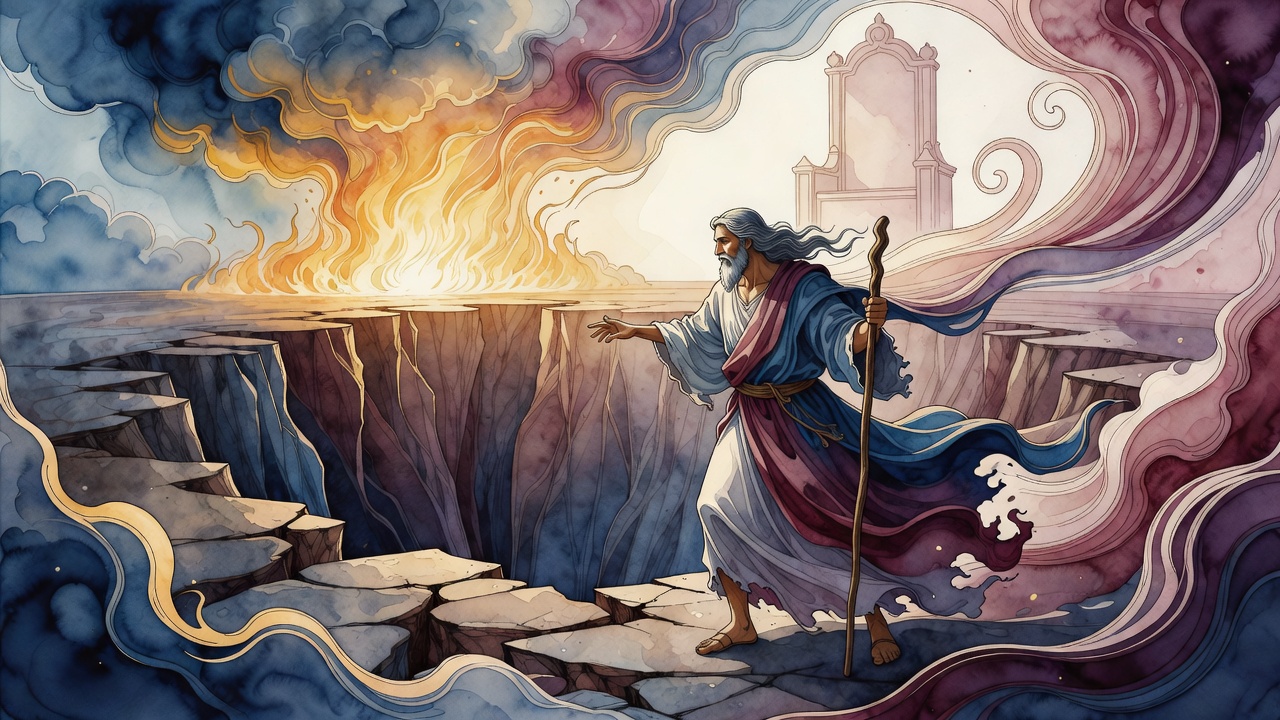
Moses did not go quiet into the sentence of death. Standing at the edge of the land he would never enter, he pushed a hard question toward God. "Was it I, perchance, that counseled Thee to slay the Egyptian?" He meant the taskmaster he had struck down years before, when he was still a prince with a Hebrew heart, and one blow had made him a fugitive.

God answered with a counterweight that left no room for self-pity. "Thou didst slay all the firstborn of Egypt, and shall I die on account of one single Egyptian that I slew?" The court of heaven, in this telling, did not pretend the scales were empty. It put nations beside one man and forced Moses to hear the difference.

The Honor That Would Not Soften the Decree

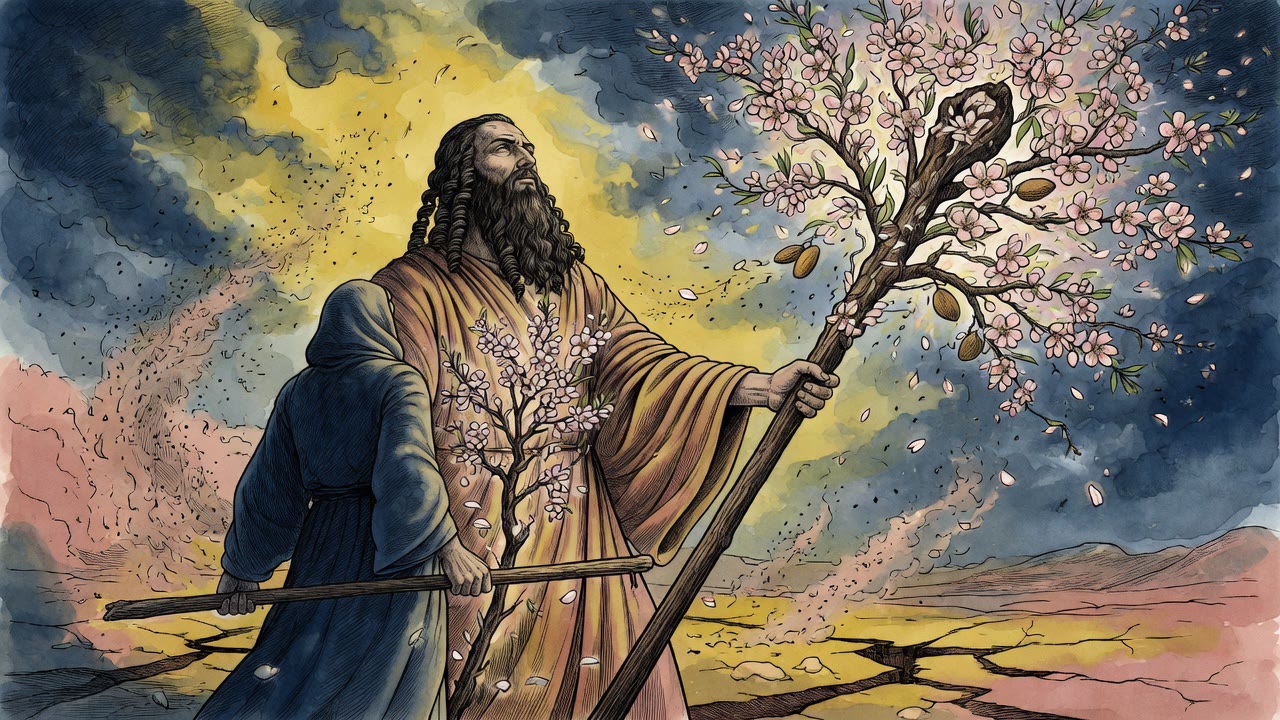
Then the voice that had spoken from the bush turned to comfort that was almost a ledger. "Dost not thou remember the great honor I showed thee?" God reminded him how heaven itself had bent when Moses spoke. "Thou didst say to Me, 'Arise,' and I arose; thou saidst, 'Turn about,' and I turned about." For his sake bread fell and a well rose. For his sake the order of heaven and earth had been inverted in the desert.

God named the golden calf and the prayer that stopped a destruction. "Pardon, I pray Thee, the iniquity of this people," Moses had cried, and the decree loosened. God went further. The Torah is named for the Lord, yet He linked it to Moses' name: "It is the Torah of My servant Moses." Israel bears God's name, yet God had also called them after the servant who carried them. Honor stacked like gold. The border still did not open.

A God to Pharaoh, a Man Who Must Die

The same speech that honored him also marked how strange he had become. "I made thee a god to Pharaoh." No living being may see God, and the people had been afraid to come near Moses after Sinai. He had fasted forty days as if he needed nothing. He had received the Ten Commandments, the Sabbath, circumcision, and more honor than the seventy elders. None of that canceled the decree. Greatness was not a bribe. It was a history God refused to erase while still saying no.

Moses heard himself praised and still heard the gate shut. That is the cruelty and the cleanliness of the scene. Heaven would not pretend he had been small. Heaven would not pretend death could be bargained away by old victories.

After the Body, the Search for Amram's Son

Later tradition tells of a search that treated Moses like a missing prince rather than a closed book. An investigator went to the Abyss and asked, "Hast thou seen the son of Amram?" The deep answered that it had not seen him, but had heard his call. Authority can leave an echo even where bodies cannot stand.

The search turned to the sons of Korah, who dwell where the earth once opened. "Have ye seen the son of Amram?" They answered that they had not seen him since the day Moses bid the ground swallow them. Even his enemies in the pit measured time by his command.

Clouds That Hide, Heavens That Remember Sinai

The clouds of glory were asked next. "Is Moses perchance with you?" They said he was hid from the eyes of all living. Concealment, not absence. Then the heavens: "Have ye seen the son of Amram?" They answered they had not seen him since, at God's command, he mounted to receive the Torah. The last clear sighting heaven admits is the ascent that made Israel a people of law.

So the death argument and the posthumous search become one story. Moses argued about a single Egyptian because he still thought justice could be negotiated person by person. God answered with firstborn and with honor that does not cancel mortality. Afterward the cosmos keeps looking for Amram's son and finds only traces: a call in the deep, a memory in the pit, a hiding in the cloud, a Sinai date in the sky. The man who once made Pharaoh tremble still organizes the map of where he cannot be found.

That is succession without a successor standing in the room. The nation keeps the Torah named for him. The border keeps its refusal. The Egyptian stays one body in a long war of bodies. The firstborn stay a night no servant of God can pretend was small. Between them Moses dies arguing, and the worlds keep answering as if the argument never quite ended.


← All myths
From the tradition

Sources

2 sources

The texts behind this telling. Some cards carry a translation of the source; others are our own retelling of it, and each card says which. Every card links out to the original.

Legends of the Jews 6:136Legends of the Jews

Retold in our words. Read the original at the link below.The Legends of the Jews by Louis Ginzberg (1909) · Public Domain

It might sound sacrilegious, but the great Moses, our teacher, apparently did. And the conversation, as recorded in Legends of the Jews, is fascinating.

In Ginzberg's retelling, Moses challenges God about his impending death. He says, "Was it I perchance, that counseled thee to slay the Egyptian?" He's referring to an incident early in his life, before the Exodus, when Moses killed an Egyptian taskmaster he saw beating a Hebrew slave.

God's response? "Thou didst slay all the firstborn of Egypt, and shall I die on account of one single Egyptian that I slew?"

It’s a powerful exchange. Moses is questioning the fairness of his fate. He’s pointing out what he sees as an inconsistency. Is God holding him to a higher standard than He holds Himself? It's bold, to say the least.

But then God, in this incredibly human depiction, tries to comfort Moses. He reminds him of all the amazing things he accomplished, all the ways God honored him during his lifetime. It's almost like a divine pep talk.

God says, "Dost not thou remember the great honor I showed thee?" And then He launches into a litany of Moses's achievements and the divine accommodations made for him. "Thou didst say to Me, 'Arise,' and I arose; thou saidst, 'Turn about,' and I turned about." God is referencing the incredible power Moses had, the ability to command even the divine will.

Think about the miracles in the desert. "For thy sake too did I invert the order of heaven and earth...I caused bread to rain from heaven, and the well 'sprung up.'" God emphasizes how he bent the natural order for Moses’s sake. We often think of miracles as these spontaneous acts of divine intervention, but here, we see them almost as responses to Moses's will.

And the praise keeps coming. God reminds Moses that when the Israelites sinned with the Golden Calf – that infamous low point – Moses interceded. "Pardon, I pray Thee, the iniquity of this people," Moses pleaded, and God relented. This moment, recounted in Exodus 32, highlights Moses's role as an advocate, a protector of his people.

But it goes even further. "The Torah is named after Me, it is the Torah of the Lord, but I named it after Thy name, saying, 'It is the Torah of My servant Moses.'" The very foundation of Jewish law, the Torah (the first five books of the Hebrew Bible), is linked to Moses's name! God even says, "The children of Israel also are named after Me...but I called them after thy name."

There's an echo here of the idea of kiddush (the sanctification blessing over wine) Hashem, sanctifying God's name. But here, God is sanctifying Moses’s name!

God continues, detailing how Moses fasted for forty days and forty nights on Mount Sinai, just as God needs no sustenance. "I am God, and see, 'I made thee a god to Pharaoh;'" – a fascinating phrase that emphasizes Moses's power and authority in the eyes of the Egyptians. God made Moses unique: “no being may see Me, and thee too did I make so that 'the people were afraid to come nigh thee...'" God essentially made Moses a conduit of His own power and awe.

He reminds Moses of his role in receiving the Ten Commandments, in bestowing the Sabbath and circumcision upon Israel. "I gave thee the Torah as an inheritance, and honored thee more than all the seventy elders."

This wasn’t just a pat on the back. It's a profound statement about Moses's unique role in Jewish history and his relationship with God.

So, what do we take away from this celestial conversation? It shows us a God who is willing to engage, to reason, even to comfort. And it reveals a Moses who is not afraid to question, to challenge, but also deeply deserving of the immense honor bestowed upon him. And that even in those moments of doubt, they can find solace and recognition in the eyes of the Divine.

Full source
Legends of the Jews 7:75Legends of the Jews

Retold in our words. Read the original at the link below.The Legends of the Jews by Louis Ginzberg (1909) · Public Domain

It's a kind of cosmic detective story, but instead of a grizzled gumshoe, our investigator is… well, it's not entirely clear who it is! But they are on a mission to find Moses after he's no longer on Earth.

The first stop? The Abyss, that primordial, chaotic void often associated with the depths of the earth and the realm of the dead. Our investigator asks, "Hast thou seen the son of Amram?" (Amram being Moses' father). The answer comes back, chillingly: "I have not seen him, but heard indeed his call." What does it mean to hear his call but not see him? Is it an echo of his earthly authority, lingering even in the deepest darkness? It’s a fascinating image.

Next, the investigator tries Korah's sons, those who, along with their father, met a rather dramatic end. Remember the story? Korah challenged Moses' authority, and as punishment, the earth opened up and swallowed them whole (Numbers 16). They dwell now in the Abyss, a fitting eternal consequence. The question is posed: "Have ye seen the son of Amram?" Their reply: "We have not seen him since the day upon which at Moses' bidding the earth opened its mouth and swallowed us." Ouch. Their fate is forever intertwined with Moses, yet even they can't offer any clues to his current whereabouts.

Moving on, the search takes us to the clouds of glory, those radiant, divine manifestations that often accompany God's presence. "Is Moses perchance with you?" the investigator asks. The answer: "He is hid from the eyes of all living." So, he’s there, but hidden. The clouds of glory, a symbol of divine revelation, conceal him. Is this a protective measure? A sign of his elevated status? The text leaves us wondering.

Finally, the investigator ascends to the heavens themselves. "Have ye seen the son of Amram?" And the answer is: "We have not seen him since at God command he mounted to us to receive the Torah" – the sacred law, the five books of Moses. This is perhaps the most telling response. It highlights Moses' defining moment: his ascent to Mount Sinai to receive the Torah. It implies that his connection to heaven is through that pivotal event. He hasn't been seen since then.

So, what are we to make of this quest? It seems less about finding Moses' physical body and more about tracing his legacy, his impact on different realms of existence. The Abyss remembers his call, Korah's sons remember his authority, the clouds of glory conceal him, and the heavens remember his ascent to receive the Torah.

It’s a reminder that even after death, great figures continue to resonate, their influence felt in the most unexpected corners of creation. Their stories become woven into the very fabric of our understanding of the world. And maybe, just maybe, that's a kind of immortality in itself.

Full source