5 min read

Ten Words Carved Twice Upon the Twin Stones

The sages said each tablet held all ten words, twin stones that refuse bargain hunting among commandments and still break the back that carries them.

Curated by Arthur · Told by Maggid ·
Table of Contents
  1. Twins in the Hands of God
  2. No Bargaining Among the Words
  3. Stones That Sadden the Carrier
  4. What the Broken Pair Still Means

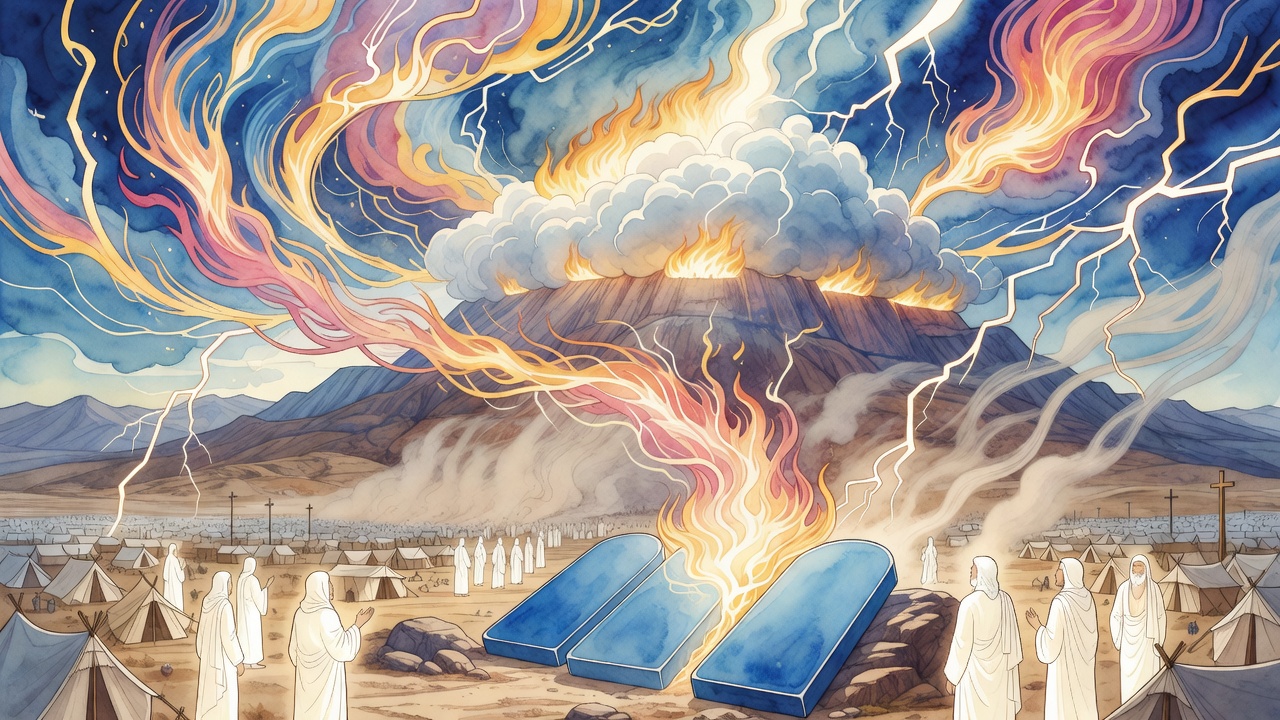
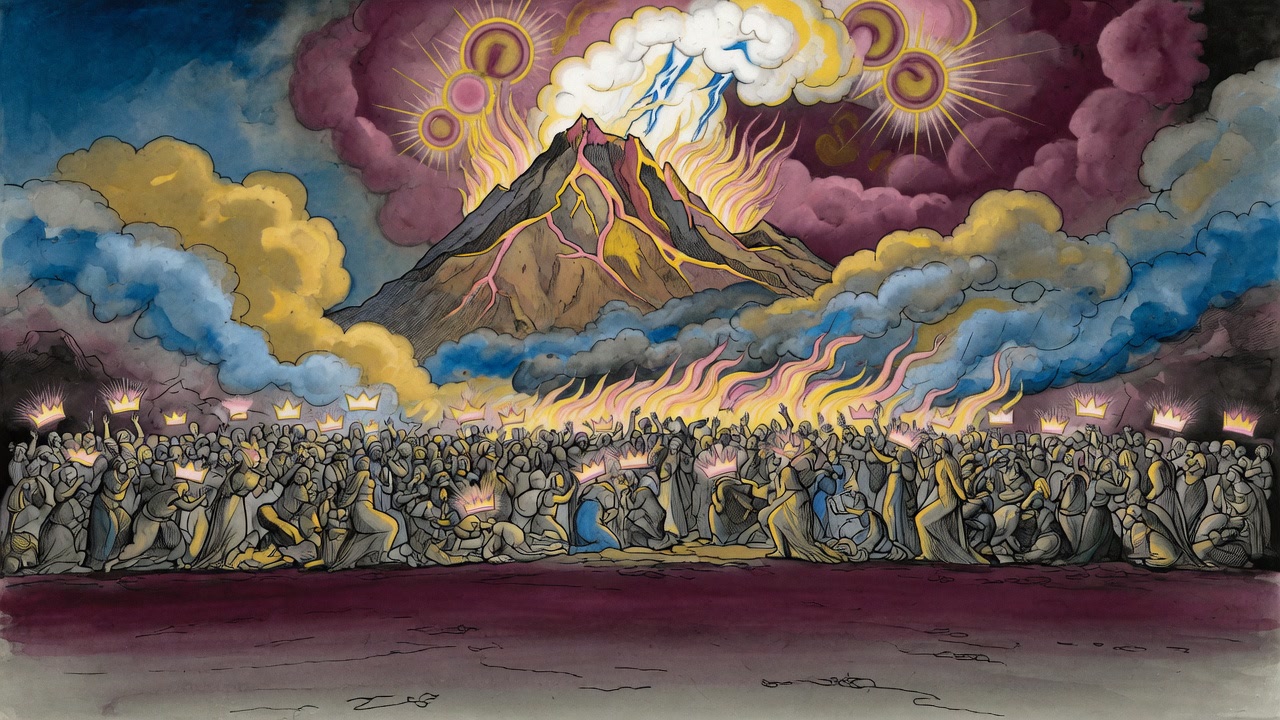
Moses came down with two stones against his chest, and the letters were still hot in the rock. Rabbi Chanina ben Gamliel would later say five commandments on each tablet. The other sages said no. All ten on each stone. Twenty inscriptions. Twin records.

Ten Words Carved Twice Upon the Twin Stones Click for full size

Twins in the Hands of God

Their proof began with Deuteronomy. These things the Lord spoke, and He wrote them on two tablets of stone. "These things" means the whole set, written on the tablets in the plural, read by the sages as the complete ten on both. Song of Songs gave them images. Two fawns, twins of a gazelle. Matched. Hands like wheels of gold set with emeralds, the tablets held complete in the divine grip.

The view changes the stones from a split contract into a doubled one. Not God on one side and neighbors on the other, as if the two could be filed apart. Each tablet carries the full covenant. If one breaks, the other still holds every word.

No Bargaining Among the Words

Midrash Tanchuma on Eikev heard another danger. "And it shall come to pass if you heed these statutes." The midrash set that verse beside Proverbs. She does not steer a straight path of life; her ways wander, and she does not know it. Rabbi Abba bar Kahana warned against practicing give and take among the commandments, weighing which reward looks larger, shopping the list as if Torah were a market stall.

The twin tablets already refuse that market. You do not keep the side that flatters you and discount the side that costs. The full ten sit on each stone so the hand that holds one stone still holds the whole claim.

Stones That Sadden the Carrier

Kohelet said, "One who transports stones will be saddened by them." Kohelet Rabbah turned the load into Torah study. The words are heavy. They bruise the shoulders of the one who carries them day after day. Wisdom is not a feather. The student who treats the load as decoration will drop it. The student who knows the sadness of the weight is the one still walking with it at dusk.

Transport is the right verb. Torah is not a jewel left on a shelf. It is stone after stone moved into the mind and the mouth until the body feels the cost and keeps moving anyway.

What the Broken Pair Still Means

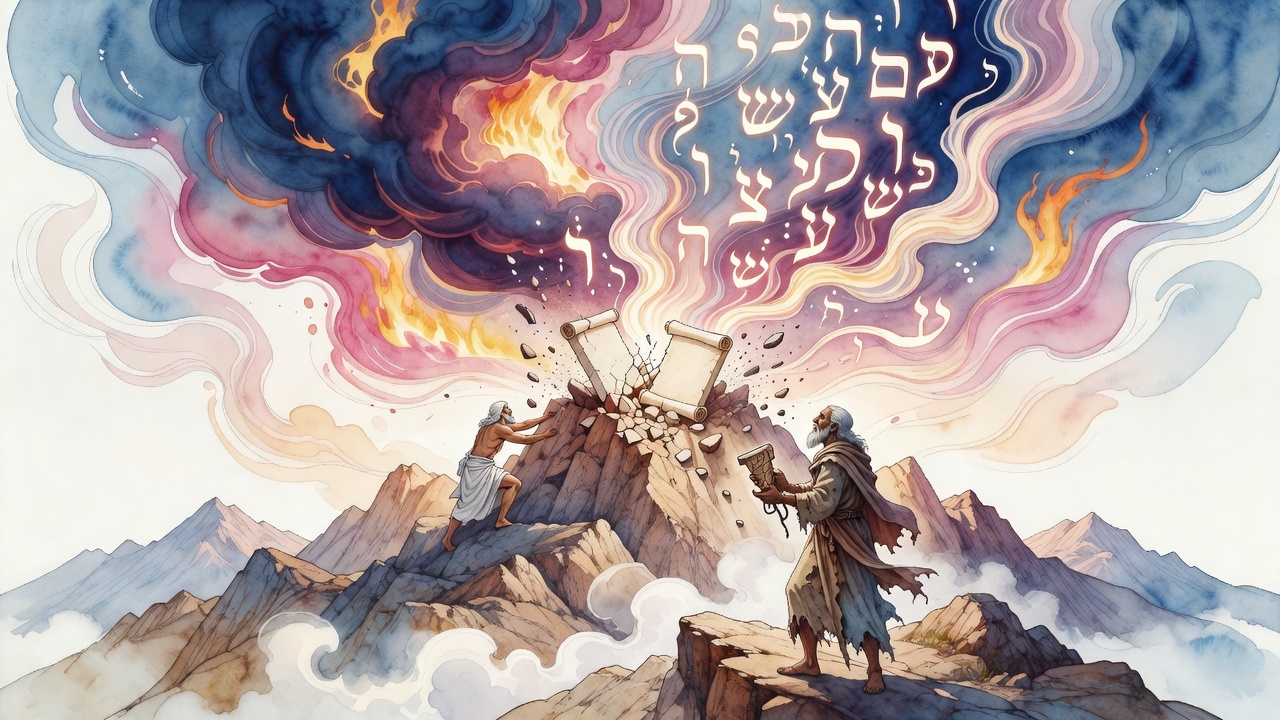
When the first tablets shattered, the doubled design already hinted at survival. The covenant was never meant to live in a single fragile copy. The second set would come. The full ten would be written again. The ban on bargaining would still stand. The sadness of the carrier would still be the price of love for the words.

Moses' arms trembled under the weight. The camp saw two stones and thought of lists. Heaven had carved a mirror, a refusal to split God from neighbor, and a warning that the person who shops commandments by reward has already begun to wander without knowing it.

Picture the camp watching Moses' arms shake. Some counted commandments the way merchants count weights. Five for heaven, five for earth, a neat ledger. The sages who insisted on ten and ten were fighting that ledger in advance. The whole speech of God sits complete on each stone so no one can file half the covenant under optional.

Rabbi Abba bar Kahana's warning about give and take among commandments fits the same fight. A person says, this mitzvah pays more, that one can wait. The wandering ways of the proverb begin there, in the shopping mind that does not know it is already lost. Eikev's "if you heed" is not an invitation to auction. It is a call to a straight path.

Kohelet's stone carrier knows why the path hurts. Study bruises. Memory fails. A page that would not open yesterday still resists today. The sadness is not a sign to drop the load. It is proof the load is real. A religion of feathers would not need twin tablets or bruised shoulders.

When the first tablets broke, Israel learned what every doubled document teaches. Loss is possible. Total erasure is harder when the design assumed fracture. The second carving would come. The full ten would be written again. The student bent under stones would still be the truest image of love for the words.

At night the campfires caught the edges of the letters, or so the children claimed. Adults told them not to invent miracles. Still, more than one sleepless student put a hand to his own chest and felt, for a moment, two tablets there, twin and heavy, refusing to be bargained down to a lighter faith.


← All myths
From the tradition

Sources

3 sources

The texts behind this telling. Some cards carry a translation of the source; others are our own retelling of it, and each card says which. Every card links out to the original.

Mekhilta Tractate Bachodesh 8:22Mekhilta DeRabbi Yishmael

Retold in our words. Read the original at the link below.Mechilta, translated by Rabbi Shraga Silverstein · CC-BY

The sages offered an alternative view of how the Ten Commandments were arranged on the two tablets. While Rabbi Chanina ben Gamliel taught that five commandments appeared on each tablet, the sages argued that all ten were written on each tablet, for a total of twenty inscriptions.

Their proof begins with (Deuteronomy 5:19): "These things the Lord spoke... and He wrote them on two tablets of stone." The verse says "these things," referring to all ten commandments, were written on the tablets, plural. The sages read this to mean that the complete set of ten was inscribed on both stones, not split between them.

The Mekhilta then cites two poetic verses in support. (Song of Songs 4:5) compares two objects to "two fawns, twins of a gazelle." The emphasis on "twins" suggests the tablets were identical, mirror images of each other, each bearing the same content. Just as twins are alike, the two tablets carried the same words.

(Song of Songs 5:14) describes hands as "wheels of gold, set with emeralds," which the sages connected to the tablets held in God's hands. The imagery of matched golden wheels reinforces the idea of symmetry and completeness in each tablet.

This view transforms the tablets from a divided document into a doubled one. Rather than splitting the commandments, with obligations toward God on one side and obligations toward humans on the other, God inscribed the full covenant on both stones. Each tablet was a complete record, ensuring that even if one were lost or broken, the entire covenant would survive intact on the other.

Full source
Midrash Tanchuma, Eikev 2Midrash Tanchuma

Retold in our words. Read the original at the link below.Townsend 1989 translation of Midrash Tanhuma, S. Buber Recension · CC-BY

(Deut. 7:12:) “And it shall come to pass if you heed [these statutes].” This text is related (to Prov. 5:6), “She does not steer a straight path of life; her ways wander, and she does not know it.” R. Abba bar Kahana said, “That you should not practice give and take among the commandments of Torah to see which reward of Torah and commandment is greatest and perform that one. Why? (Ibid.) ‘Her ways wander, and she does not know it.’ The paths of [rewards of] the Torah have been moved.” R. Hiyya said, “A parable: To what is the matter comparable? To a king who had an orchard and introduced workers into it, but the king did not disclose the reward (i.e., the payment) for his seedlings to them; because if he revealed the reward for his [various] seedlings, one would see which seedling increased [their] reward, and plant that one. The work in the orchard would end up with some of it suspended and some of it carried out. Similarly the Holy One, blessed be He, did not reveal the reward for each and every commandment in the Torah; for if he had revealed it, the commandments would have been found with some of them carried out and some of them suspended.” And R. Aha said in the name of R. Abba bar Kahana, “The Holy One, blessed be He, has made the reward for fulfilling a commandment moved around in this world, so that Israel would totally fulfill them.” R. Simeon ben Johay taught, “For two commandments did the Holy One, blessed be He, reveal their reward. These are the lightest of the light and the weightiest of the weighty ones. The lightest of the light ones is sending away [the mother from] the nest; and there it is written (in Deut. 22:7), ‘and you will prolong your days.’ The most weighty is honoring parents, about which it is [also] written (in Deut. 5:16 // Exod. 20:12), ‘so that you will lengthen your days.’ Note that they are equal with regard to reward [in] this world.” R. Abba bar Kahana said, “If in regard to paying a debt, length of days is written, how much the more so when it is a case of damage to purse and loss of life.” R. Levi said, “They said something greater than that: A case of paying a debt is more important than a case of damage to purse and loss of life.” R. Abba bar Kahana said in the name of Rabbi, “Just as the giving of their reward is great, so [too] are their punishments great.” That is what is written (in Prov. 30:17), “The eye that mocks a father and scorns obeying a mother will have the wadi ravens pluck it out and the young eagles devour it.” The Holy One, blessed be He, said, “A raven, which is cruel to its young, will come and pluck it out without profiting from it; an eagle, which is merciful to its young, will come and will profit from it.” And where is it shown that a raven is cruel to its young? Where it is stated (in (Job 38:4)1), “Who provides prey for the raven, when its young cry unto God and wander about without food.” It also says (in Ps. 147:9), “to young ravens when they cry out.” When the raven reproduces, it reproduces white [young]. Then the male says to the female that another bird has begotten it. So they reject and forsake them. What does the Holy One, blessed be He, do? He brings forth gnats from their dung. Then [the gnats] fly, and [the young] eat them. This is what is written (in (Job 38:4)1), “Who provides prey for the raven.” But the eagle is merciful, as it is written (in Deut. 32:11), “As an eagle stirs up its nest and hovers over its young]; it spreads its wings, takes them up, and bears them aloft on its pinions.” As it is not confident about them because of other birds who pursue them. What does it do? It places them on its wings and says, “Better that the arrow should go through me and not through my children.”

Full source
Kohelet Rabbah 9:1Kohelet Rabbah

Retold in our words. Read the original at the link below.The Sefaria Midrash Rabbah, 2022 · CC-BY

It’s a book known for its wisdom, but sometimes couched in rather…opaque language.

Take this verse from (Ecclesiastes 10:9): "One who transports stones will be saddened by them; and one who splits wood will benefit from it." Sounds straightforward. Maybe. But our sages in Kohelet Rabbah, a collection of rabbinic interpretations on Ecclesiastes, dig a little deeper.

The first interpretation is all about Torah study. "One who transports stones will be saddened by them" is understood to mean that one who moves themselves away from their studies will ultimately be sorry. Why? Because they’ll forget what they learned! .. it's just gone. You'll seek a matter, the midrash (rabbinic interpretive commentary) says, but you will not find it.

What about splitting wood? "And one who splits wood will benefit from it [yisakhen]." The Rabbis see a connection between the word "benefit" – yisakhen – and the word for "attendant," sokhenet, as in the verse from I (Kings 1:2), "She will be an attendant [sokhenet] for him.” As long as you toil in the wood, you will benefit from it. In other words, consistent effort yields rewards. It’s a beautiful image of dedicated labor bringing forth something valuable.

Now, the midrash being the midrash, it doesn't stop there. It revisits the verse and offers a more literal interpretation. "One who transports stones" could simply be someone who moves stones from place to place. So, what's the problem? Well, unscrupulous people might move stones from their own fields onto public land. Sneaky. But ultimately, according to Midrash HaMevo’ar, it is they who will stumble. Their own trickery will be their downfall.

But here’s where it gets really interesting. Rabbi Meyashya brings in the story of Abraham and the Akeidah – the binding of Isaac. Remember that? Abraham was commanded to sacrifice his son, and on the way to Mount Moriah, Abraham chopped wood for the offering. Rabbi Meyashya says that in reward for those two logs that Abraham chopped, his descendants were privileged to have the sea split for them into twelve strips when they left Egypt! Talk about a return on investment!

So, what's the takeaway? Maybe it’s that consistent effort, like splitting wood, brings tangible benefits. Maybe it’s about the importance of staying connected to our studies, to our traditions. Or maybe, just maybe, it’s a reminder that even seemingly small acts of devotion can have ripple effects we can't even imagine. A few logs chopped on a mountain become the parting of the Red Sea. What "stones" are you carrying, and what "wood" are you splitting today?

Full source