Parshat Yitro5 min read

Fiery Words Circled Sinai Before They Cut Into the Stone

The first commandment left heaven looking like a shooting star. It wheeled once over the tents, hung there, then came down and cut itself into stone.

Curated by Arthur · Told by Maggid ·
Table of Contents
  1. The Line Drawn Around the Base
  2. The Word That Flew Before It Spoke
  3. They Asked Him to Stop Speaking
  4. Rods of Gold and a Stone That Rolled
  5. What Came Down and What Broke

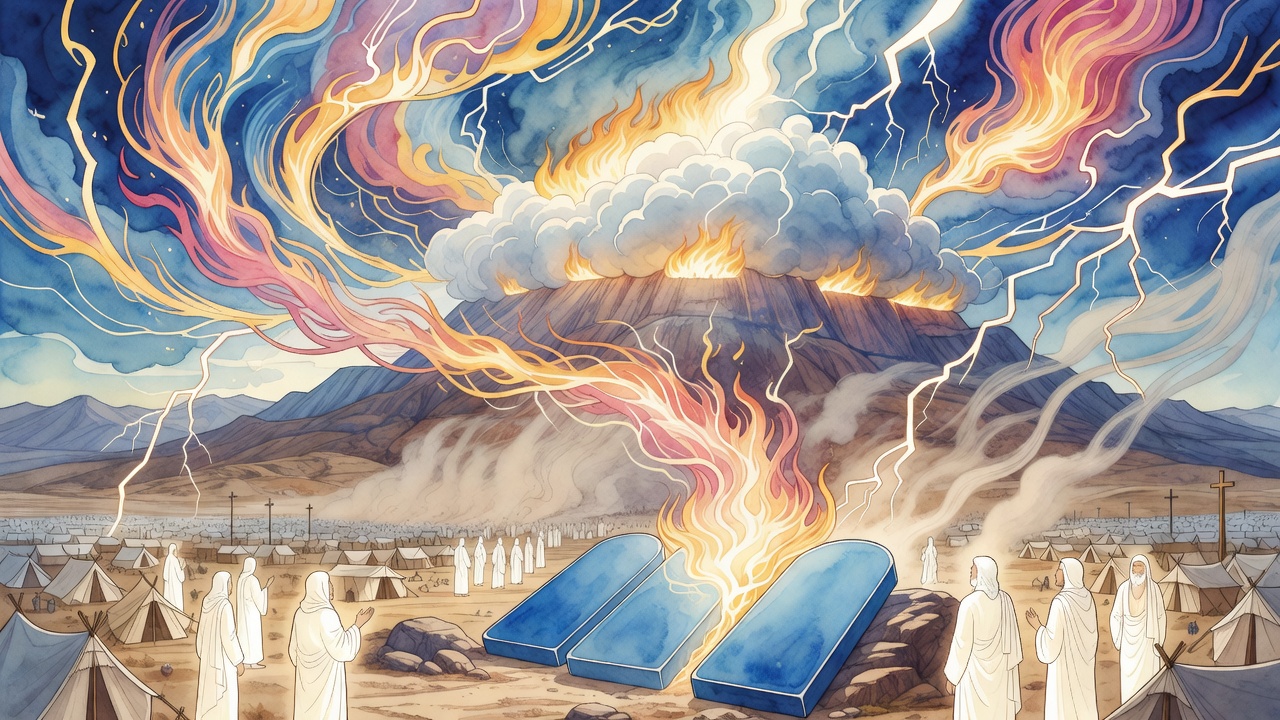
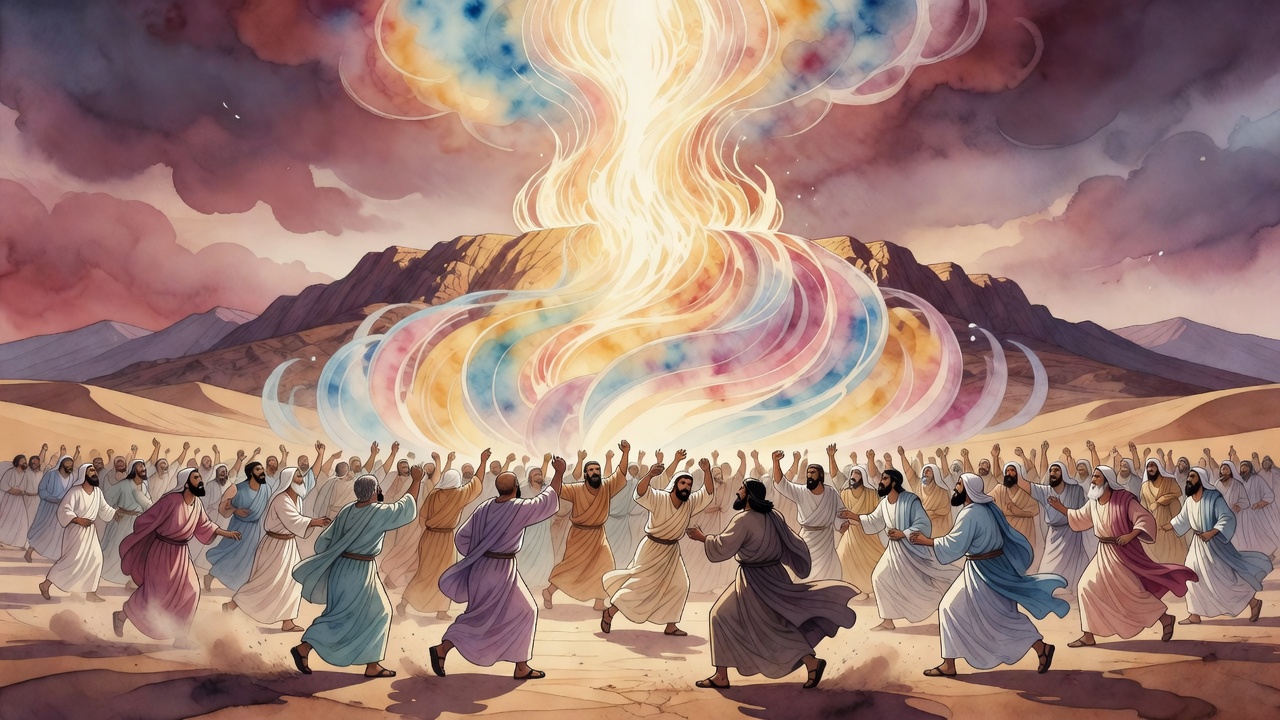
The first word came out of heaven burning. It went up like a shooting star, circled the wilderness, and came back. Fiery torches moved with it. Every man and woman in the camp stood watching a sentence fly.

Fiery Words Circled Sinai Before They Cut Into the Stone Click for full size

Then it stopped and hung above the tents, and stayed there long enough for the whole of Israel to understand that whatever happened next was not going to be undone.

The Line Drawn Around the Base

Before any of it began, Moses had walked the perimeter and set the markers himself. The instruction had two halves and the second half is the one people miss. Do not climb the mountain. Do not go near its edges either. Whoever comes close will be put to death (Exodus 19:12).

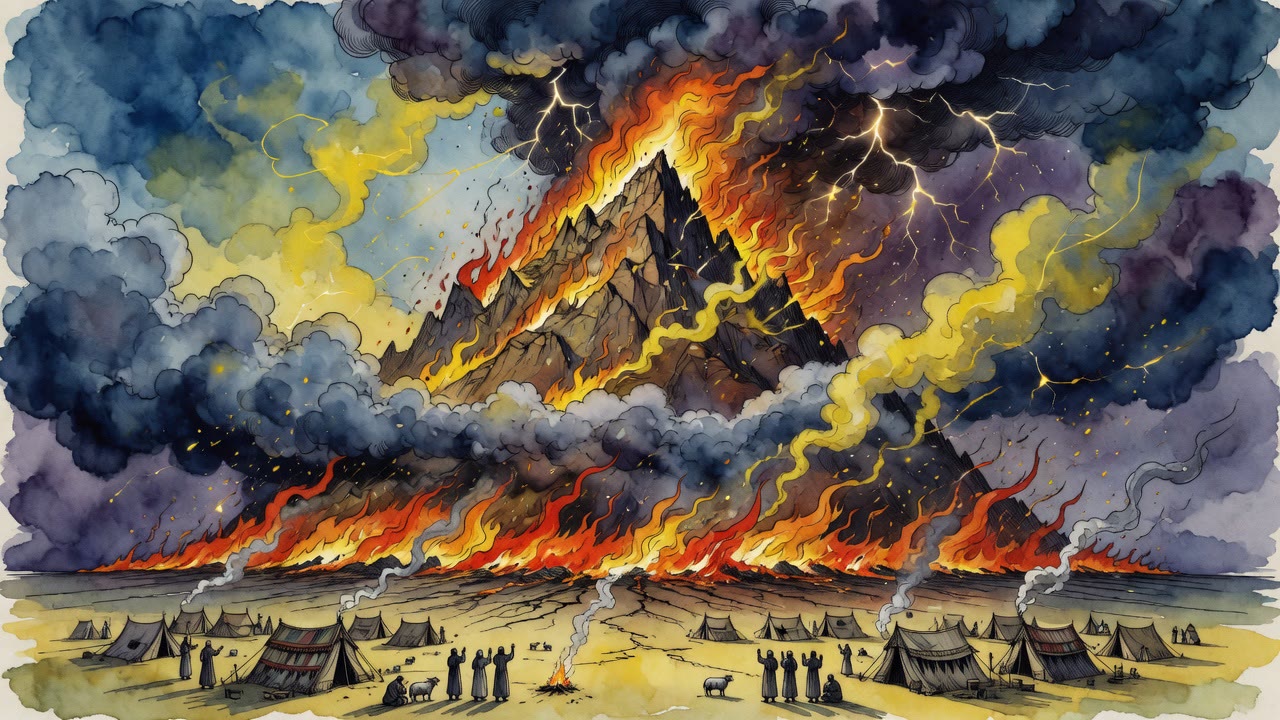
The fence did not sit at the summit. It ran around the whole base of the mountain, a ring of stones on open ground with nothing on the other side of it but slope and smoke. Beasts had to be kept off it as strictly as people. On the one morning in history when God came down to talk to everybody at once, the first thing built was a barrier to stop anyone from walking toward Him.

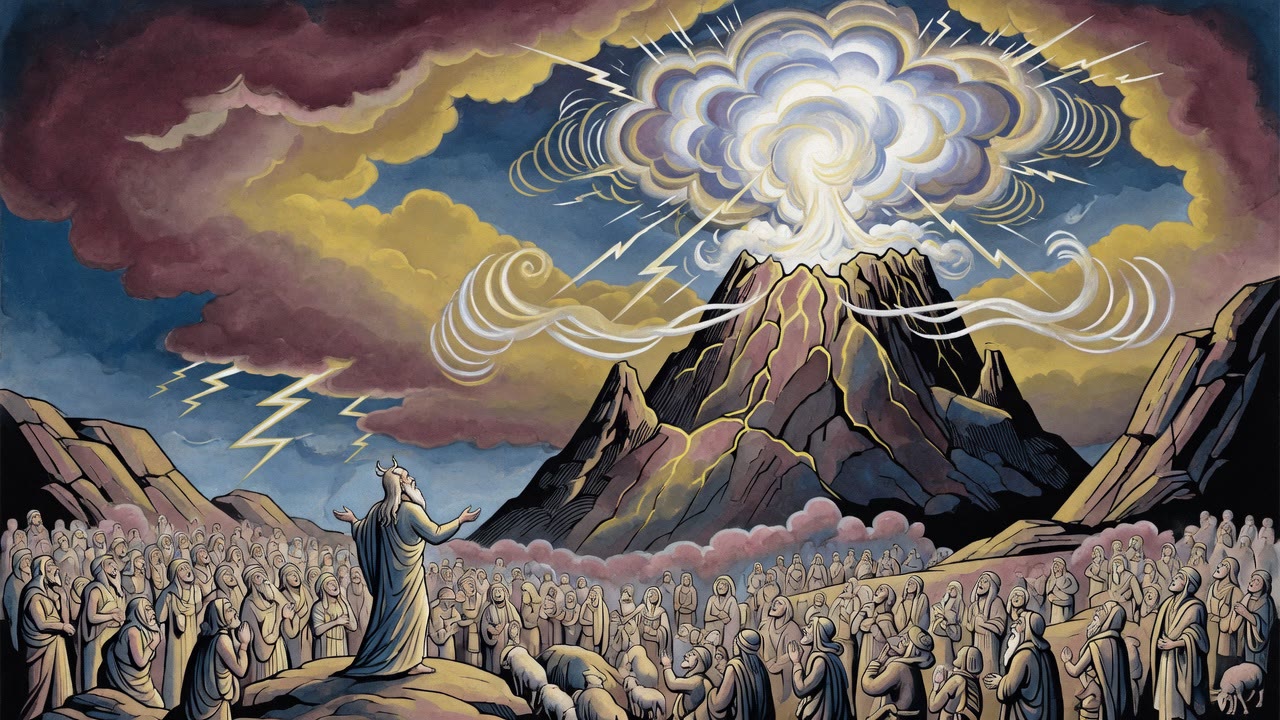
Nobody crossed it. The smoke went up off the peak the way smoke comes off a kiln, and the ground moved under them, and the people stood behind a line of rocks and waited.

The Word That Flew Before It Spoke

What came out of the fire did not sound at first. It flew.

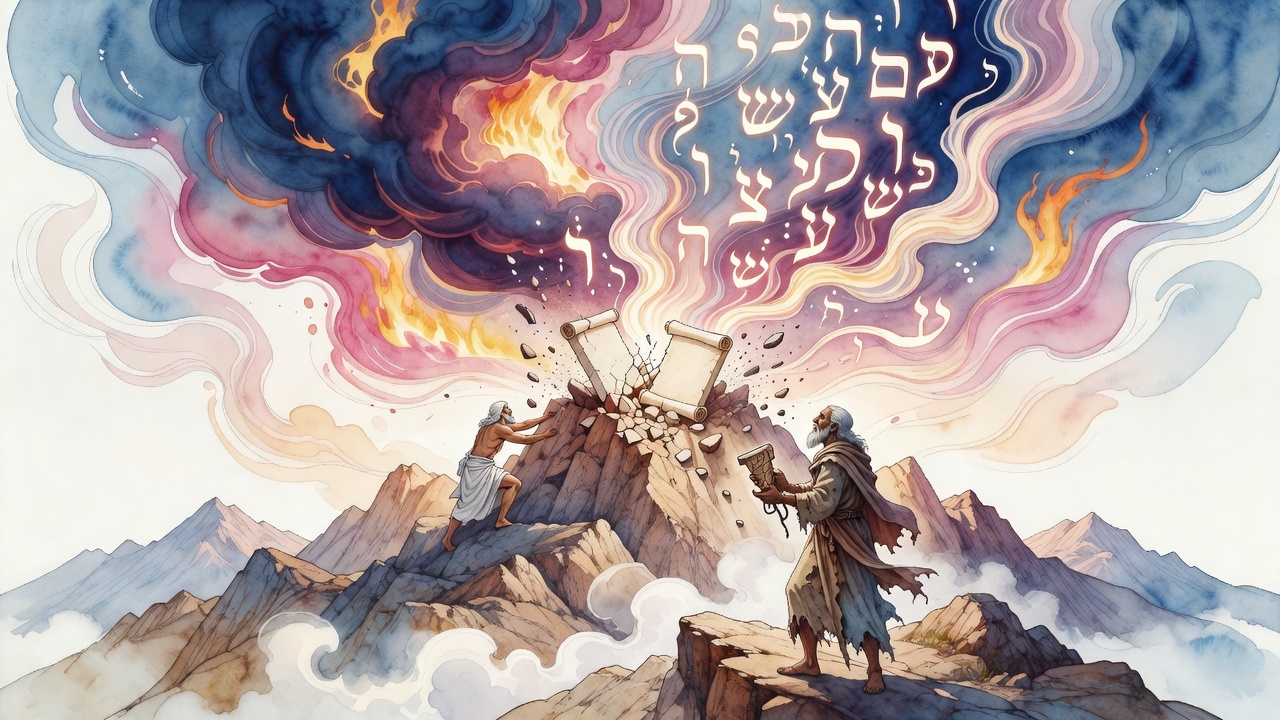
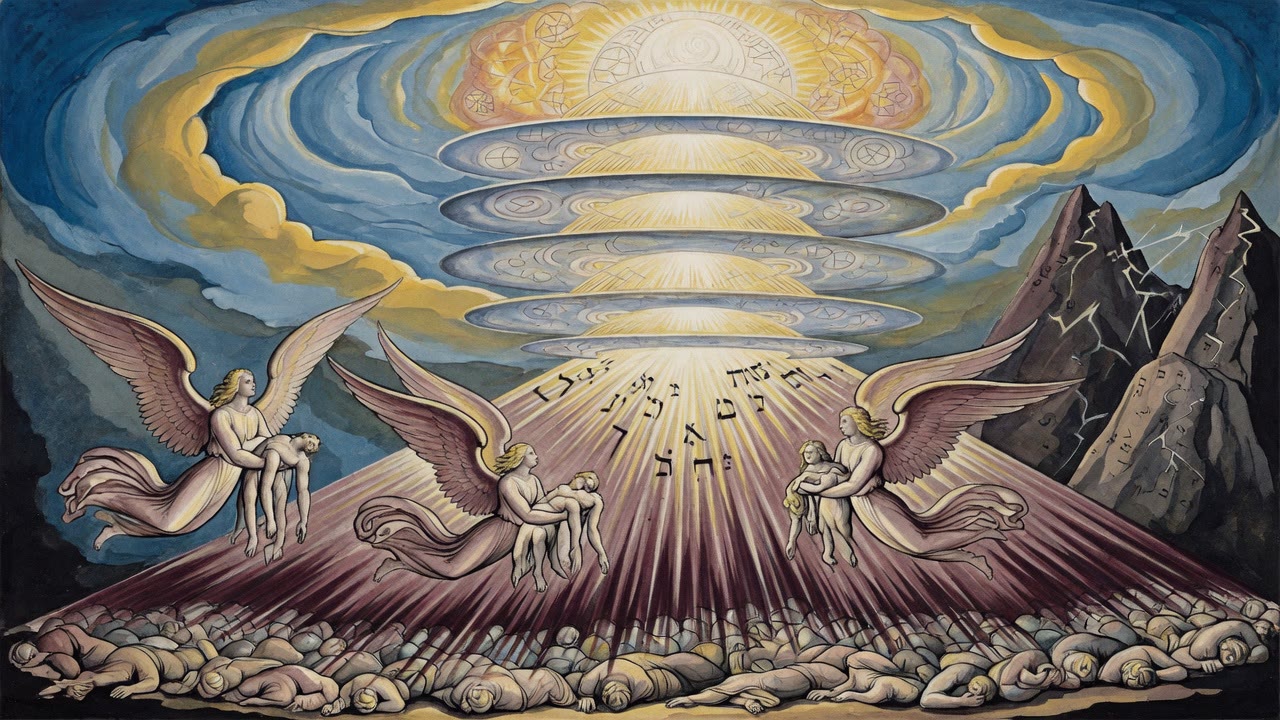
Lightning came with it and torches came with it, and the thing wheeled in the air over the camps like something searching for an address. Then it dropped, and where it landed it engraved itself into the stone of the covenant, and only after the letters were cut did the sentence arrive in a form a person could repeat.

"I am the Lord your God, who brought you out of the land of Egypt, out of the house of bondage" (Exodus 20:2).

Then the second word came the same way. Star, wheel, hover, engraving. And the third. All ten words took that road, one after another, ten times fire crossing the sky over a crowd that had walked out of a brickyard seven weeks earlier.

They Asked Him to Stop Speaking

Israel had asked for this. Now they backed away from it.

They saw the thunder and the flames and the mountain smoking, and they moved back and stood at a distance, and they sent Moses forward with a request that is one of the strangest things a people ever asked of a God who had just rescued them. "You speak with us and we will listen. Do not let God speak with us, or we will die" (Exodus 20:19).

Nobody argued with them. Moses left the crowd standing where it was and walked up into the thick darkness by himself, and the fence stayed exactly where it had been laid, and the people watched a man they knew go into a cloud that had been killing the air all morning.

Rods of Gold and a Stone That Rolled

What he came back with was stranger than the fire had been.

"His hands are rods of gold set with beryl" (Song of Songs 5:14). Rabbi Yehoshua bar Nehemya heard the tablets in that line and said they could be rolled up like a scroll, sapphire that curled in the hand instead of snapping. Rabbi Menahema, in the name of Rabbi Avun, went further and said they had been quarried out of the orb of the sun. A slab cut from daylight, carried down a mountain by a man on foot.

How the writing sat on them was argued for centuries and nobody backed down. Five on one and five on the other, said one house, the way a pair of hands carries five fingers each. Ten on this one and ten on that one, said the sages, both tablets carrying the whole covenant. Rabbi Shimon ben Yohai said twenty on each. Rabbi Simai said forty on each, because the verse says they were written on both their sides, from this side and from that side, and he counted the sides fourfold (Exodus 32:15).

Nobody at any point suggested that the stone had a front and a back like an ordinary tablet, or that the letters stopped anywhere.

What Came Down and What Broke

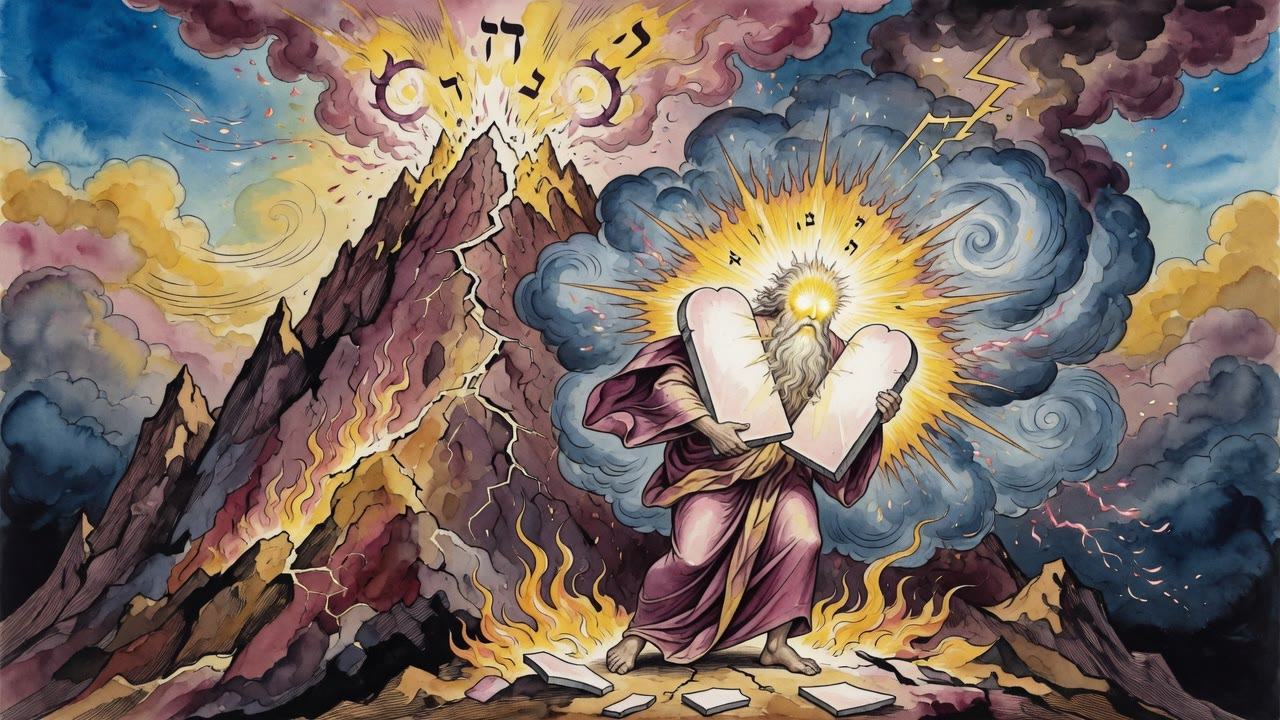
Moses carried them down and heard the noise in the valley before he could see it, and then he saw it, and he threw the tablets and they broke at the foot of the mountain.

Sapphire hewn from the sun, lying in pieces on the ground next to a calf made out of melted earrings. The camp went quiet. Somewhere behind them the ring of boundary stones was still sitting on the sand where it had been laid, and it had done its work perfectly. Not one person had crossed it. The damage on that plain had all been done from the safe side of the line.


← All myths

From the tradition

Sources

3 sources

The texts behind this telling. Some cards carry a translation of the source; others are our own retelling of it, and each card says which. Every card links out to the original.

Targum Neophyti on Exodus 20:1Targum Neofiti

Retold in our words. Read the original at the link below.Sefaria Community Translation · CC0

It was a spectacle. The Targum Neophyti on (Exodus 20:1) describes it as shooting stars, lightning, and fiery torches all rolled into one. A blazing, celestial phenomenon erupting from the Divine.

This wasn't just any light show. It was a word taking flight, soaring through the heavens with incredible speed. It flew, it wheeled, and then… it returned.

What did the people do? They were terrified. Understandably so!

The journey wasn't over. This fiery word, this divine spark, didn't just vanish. Instead, it hovered over the camps of Israel, a powerful presence watching over them. And then, in its final act, it descended and became engraved on the tablets of the covenant. All of Israel saw it.

Then, a voice boomed out: "I the LORD am your God who brought you out of the land of Egypt, the house of bondage" (Exod. 20:2).

But it didn't stop there. According to the tradition, each and every subsequent word, each of the Ten Commandments, was given in the same awe-inspiring way. Shooting stars, fiery torches, winging swiftly through the air…each one a cosmic event.

This elaborate description, this incredible imagery, really emphasizes the sheer importance of the Ten Commandments. It emphasizes the world-shaking nature of the event. This wasn't just a set of rules being handed down. It was a moment that redefined the relationship between God and the Israelites, between the Divine and humanity. It was a moment, as the Targum Neophyti implies, that forever changed the cosmos.

Full source
Targum Pseudo-Jonathan on Exodus 19:12Targum Pseudo-Jonathan on Exodus

Retold in our words. Read the original at the link below.The Targum of Jonathan ben Uzziel, trans. J. W. Etheridge, London, 1862 · Public Domain

The Targum Pseudo-Jonathan records the terrifying perimeter drawn around the mountain: "Thou shalt set limits for the people that they may stand round about the mountain, and shalt say, Beware that you ascend not the mount, nor come near its confines; whoever cometh nigh the mount will be surely put to death" (Exodus 19:12).

The Aramaic preserves two distinct prohibitions. Do not ascend. Do not even come near its confines. The boundary is not just around the summit. It is around the entire mountain's base. The holiness radiates outward like heat from a furnace, and crossing the invisible line carries a capital consequence.

This is a strange commandment from a God who wants to be close to His people. On the very day of maximum intimacy, the giving of the Torah, a hard border is drawn. Why?

The rabbis offer a consistent answer. Holiness without structure is not holiness but chaos. If every Israelite had charged the mountain in zealous enthusiasm, the revelation would have devolved into spectacle. The boundary forced a pause. It created the difference between rushing and receiving.

The Talmud in Sanhedrin 44a grounds Temple reverence in this Sinai precedent: sacred space requires sacred limits. A courtyard with no fence is no courtyard at all.

The takeaway: the most intimate moments with God are often those with the clearest boundaries. The fence is not the opposite of the encounter. It is the architecture that makes the encounter bearable.

Full source
Shir HaShirim Rabbah 5:14Shir HaShirim Rabbah

Retold in our words. Read the original at the link below.The Sefaria Midrash Rabbah, 2022 · CC-BY

Take this one: "His hands are rods of gold set with beryl; his belly is a slab of ivory covered with sapphires." (Song of Songs 5:14). Beautiful imagery, but what does it mean?

Well, Shir HaShirim Rabbah, a classic commentary on Song of Songs, dives deep into that very verse. And what they find is…well, let’s just say it involves the Ten Commandments, the Tablets of the Covenant, and even a little bit of sunshine.

The commentary starts by focusing on the phrase “His hands are rods of gold.” Shir HaShirim Rabbah equates these "rods of gold" (gelilei zahav) with the Tablets of the Covenant themselves. (Exodus 32:16) tells us, "The tablets were God's handiwork." It’s a pretty powerful image. And the "rods of gold," according to this interpretation, also represent the words of Torah. Words so precious, (Psalm 19:11) says "They are more desirable than gold, than much fine gold!"

It gets even more intriguing. Rabbi Yehoshua bar Neḥemya suggests these tablets were a miraculous creation, rolled up like a scroll (niglalin). They were crafted from sapphire and designed to be scrolled! Rabbi Menaḥama, quoting Rabbi Avun, takes it a step further: these tablets, he says, were hewn from the very orb of the sun (migalgal)! Tablets born from pure sunlight?

Okay, so we’ve got these radiant, sapphire tablets. But how were the Ten Commandments inscribed on them? This is where things get really interesting, because the Rabbis couldn’t agree.

The text asks: How were they inscribed? Five on this tablet and five on that tablet, as it is stated: “His hands are rods of gold,”, Just as a person has two hands with five fingers on each, there were two tablets with five commandments on each. in accordance with the statement of Rabbi Ḥanina ben Gamliel: That is what is written: “He inscribed them on two tablets of stone” (Deuteronomy 4:13).

One opinion, attributed to Rabbi Ḥanina ben Gamliel, drawing on (Deuteronomy 4:13), suggests a simple, elegant symmetry: five commandments on one tablet, five on the other. Makes sense. But other Rabbis weren't so sure.

Some argued, based on the same verse in Deuteronomy (4:13) – “He told you His covenant that He commanded you [to perform], the Ten Commandments, and He inscribed them on two tablets of stone” – that all ten commandments were inscribed on each tablet!

And then Rabbi Shimon ben Yoḥai enters the conversation. He agrees with the Rabbis's derivation based on the verse in (Deuteronomy 4:13), and since an additional verse (Deuteronomy 5:19) also states that God wrote ten commandments on the tablets, Rabbi Shimon derives that there were twenty commandments on each tablet. “He inscribed them on two tablets of stone” (Deuteronomy 5:19) – twenty on this tablet and twenty on that tablet.

Rabbi Simai takes it even further, saying there were forty on this tablet and forty on that tablet, as it is stated: “Tablets that were written on both their sides; from this side and from that side they were inscribed” (Exodus 32:15) – fourfold.

So, to recap: we've gone from five commandments per tablet to ten, then twenty, and finally, forty! It's a fascinating example of how rabbinic interpretation can expand and explore the meaning of scripture.

What are we to make of these wildly different interpretations? Is it simply a disagreement about the literal inscription on the tablets? Or is something deeper going on here? Perhaps the number of commandments on each tablet isn't the point. Maybe the Rabbis are trying to tell us something about the many-sided nature of the Torah itself – how it can be understood and applied in countless ways, each as valid as the last.

Maybe the "rods of gold set with beryl" represent not just the literal tablets, but the inexhaustible richness of divine wisdom, shining as brightly as the sun from which they were hewn.

Full source