5 min read

The Angel That Slapped a King for Naming the Fourth a Son of God

Three men stood unburned in the fire, and when the king cried that the fourth looked like a son of God, an angel came down and struck his mouth.

Curated by Arthur · Told by Maggid ·
Table of Contents
  1. The Three Who Walked in the Coals
  2. Gabriel Walks Into the Oven
  3. The King Counts the Figures in the Fire
  4. The Hand From Heaven
  5. The One Who Came Down

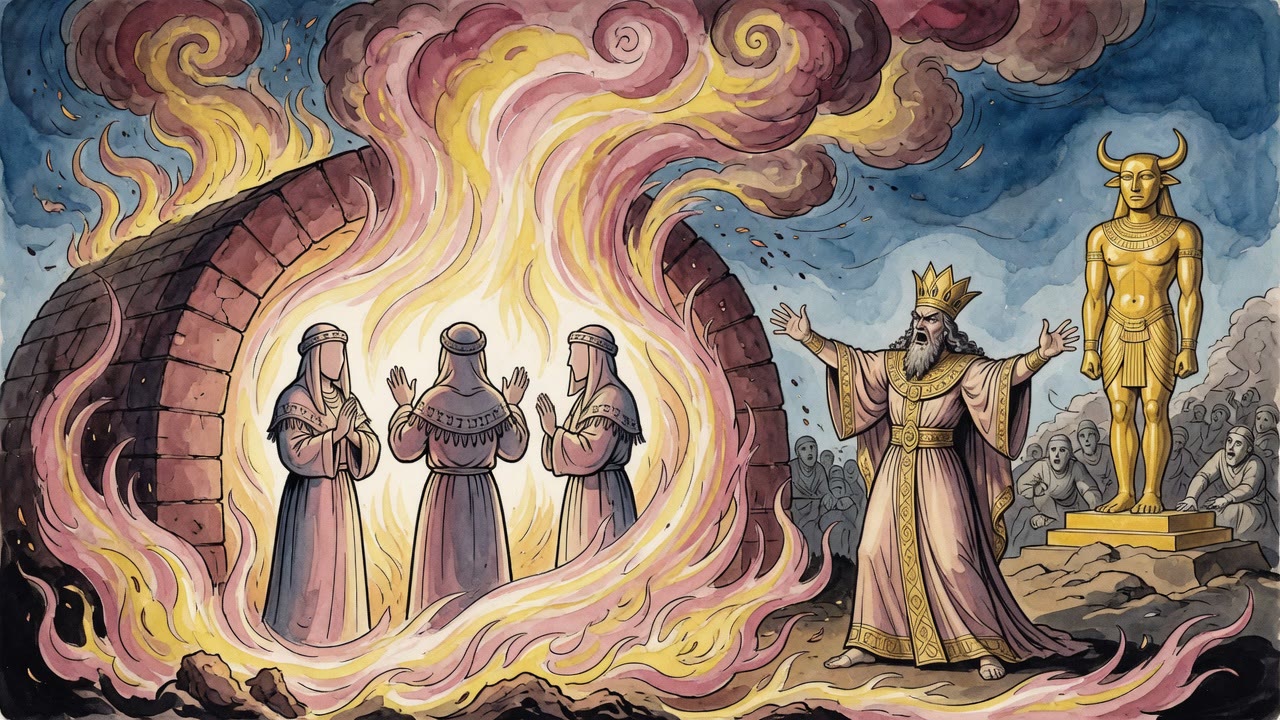
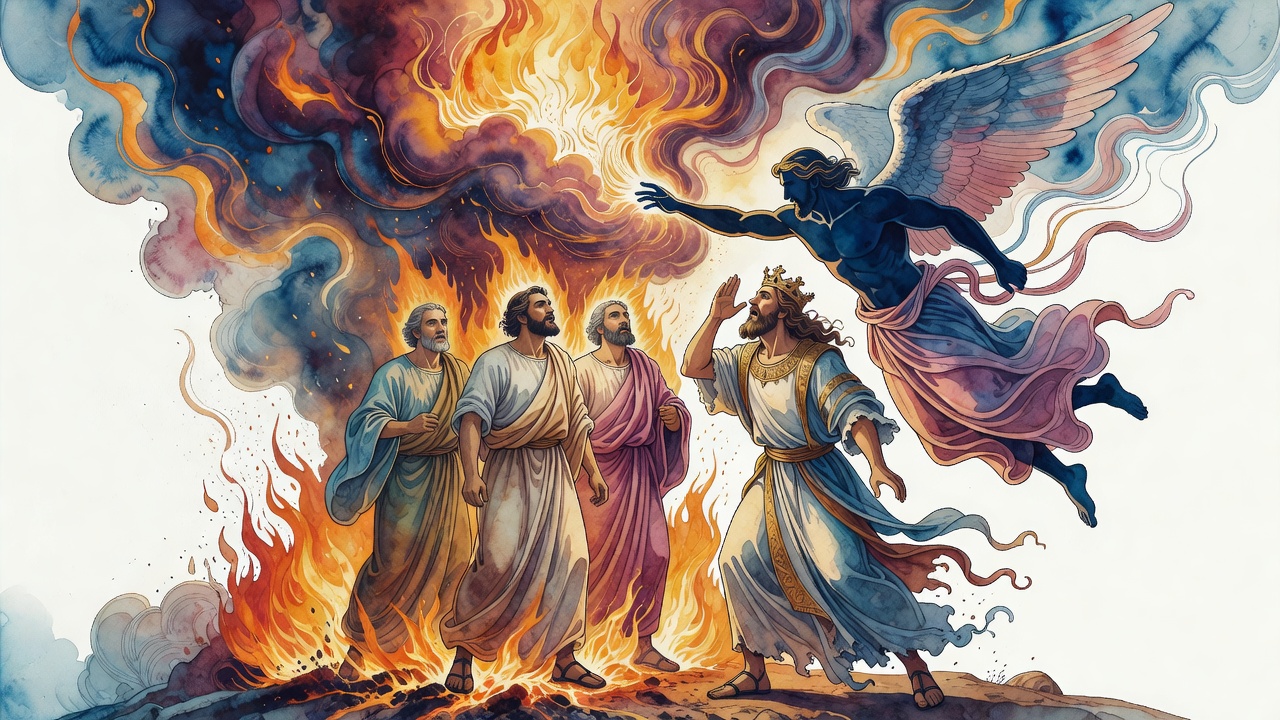
The fire roared forty-nine cubits above the mouth of the oven, and Nebuchadnezzar leaned toward it like a man leaning over the edge of a well. His servants had fed the blaze naphtha and pitch and dry brushwood until it lashed sideways and swallowed the Chaldeans who had lit it. Four nations died in that heat. The king did not flinch. He had thrown three young men of Judah into that furnace bound in their cloaks and trousers and hats, and he had come to watch them burn.
They were not burning.

The Three Who Walked in the Coals

Bound, they had gone down into the center of the fire. There Azariah opened his mouth, and what came out was not a scream. "Blessed are You, Lord, God of our fathers, and Your name is glorified forever," he prayed. He did not protest that his people had been wronged. He confessed. "Everything that has fallen on us and on Jerusalem is true judgment, because we sinned and turned away from You." The Temple was gone. The altar was gone. He had no prince, no prophet, no sacrifice left to bring. So he offered the only thing the fire had not taken. "Let our crushed spirit count before You like rams and bullocks on the altar."

Above the oven the angels of heaven crowded forward. Three righteous men in the flames, and not one of them had moved to save himself. The angels wanted to swoop down and pull them out. God stopped them at the edge of the sky. "Did they do this for your sakes?" He asked. "No. They did it for Me. I will save them with My own hands."

Gabriel Walks Into the Oven

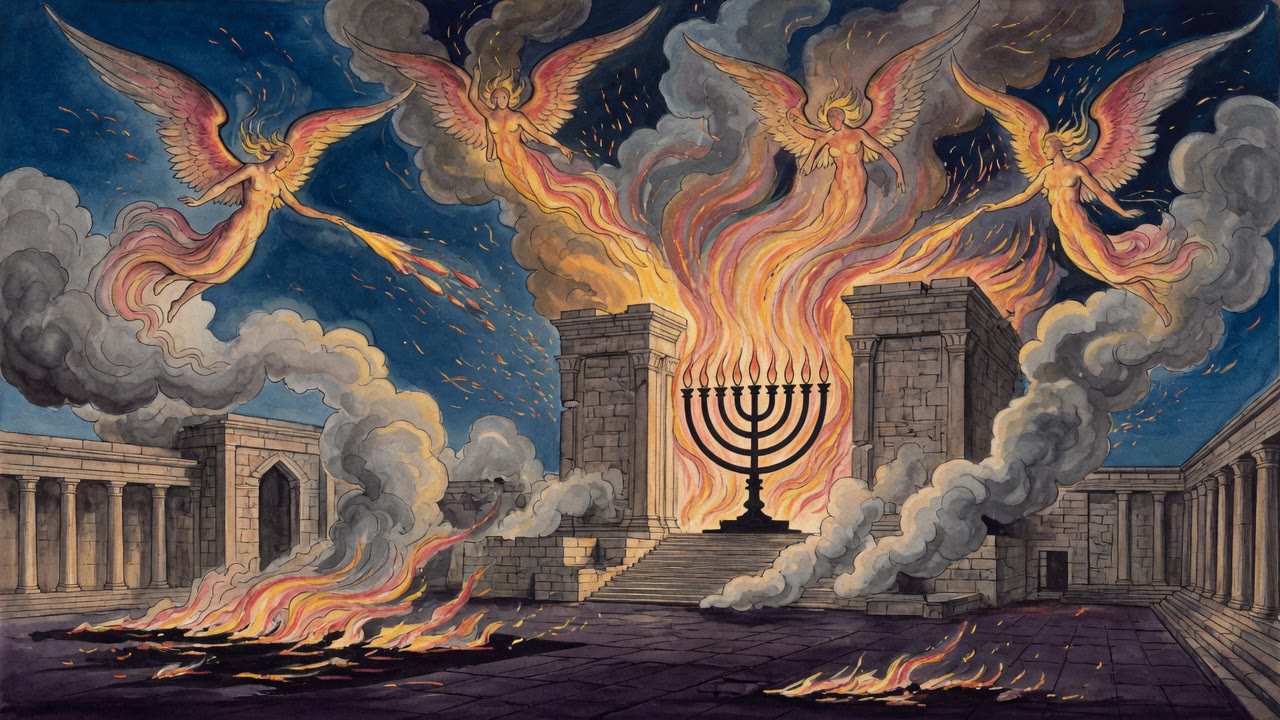
Yurkami, the angel of hail, stepped forward and offered to put the fire out with cold. Gabriel, the angel of fire, waved him off. Hail would be too quiet a thing, he said. The wicked deserved a sharper answer. So Gabriel went down into the furnace himself and split the heat in two. Outside the oven he let the flames climb higher, until the men who trusted in their own cruelty cooked where they stood. Inside, at the very heart of the coals, he turned the air to a cool and moist breeze, a soft whistling wind moving over the three as if it were morning in a garden. Their hair did not singe. The smell of smoke did not touch their cloaks. They rose to their feet and began to sing.

And the ropes that had bound them fell away into the fire and lay there glowing, while the three walked loose among the coals.

The King Counts the Figures in the Fire

Nebuchadnezzar rose from his seat. He had ordered three men thrown in. He counted again. He counted a fourth.

"Did we not cast three men bound into the midst of the fire?" he said to his counselors, and they answered that it was so. The king pointed into the blaze with a shaking hand. "Lo, I see four men loose, walking in the midst of the fire, and they have no hurt." Then his voice climbed, higher and higher, past what any mouth should reach. "And the form of the fourth," he cried, "is like a son of God."

The word left him. It hung over the furnace.

The Hand From Heaven

At that hour an angel came down out of heaven and struck the king across the face.

The blow staggered him. The angel stood over him and did not soften it. "Wicked one," the angel said. "Putrid drop. Retract your words." The king, who an hour before had counted himself lord of all the earth, stood with his cheek stinging and his mouth still open around the thing he had said. The angel leaned closer. "And does He have a son?"

Nebuchadnezzar understood that he had lifted his tongue too high. He had stood at the edge of a fire that burned four nations and could not touch three boys, and he had reached for the one word that was not his to speak. The slap taught him whose mouth that word did not fit.

So he corrected himself in front of his whole court. "Blessed be the God of Shadrach, Meshach, and Abed-nego," he said, "who sent His angel and delivered His servants who trusted in Him." He did not say son. He had been struck out of that word. He said angel, and he said servant, and he kept his eyes low.

The One Who Came Down

The three walked out of the oven, and the smell of fire was not on them. Behind them the coals settled. The fourth figure, the one the king had named wrongly and then renamed, was no son. Rabbi Reuven said simply that he was an attendant of God's own, a servant sent down into the heat to keep three servants company, the same Gabriel who had turned the coals to a whistling wind. He had come to cool a fire. On his way out he had cooled a king as well, with the flat of a heavenly hand.


← All myths
From the tradition

Sources

4 sources

The texts this telling draws on, in full. Open a card to read inline, or expand it for a wider, quieter read.

Midrash Shmuel 5:7Midrash Shmuel

"Multiply not, speak not so very high, high" (1 Samuel 2:3), this speaks of Nebuchadnezzar, who answered and said, "Lo, I see four men... and the form of the fourth is like a son of God" (Daniel 3:25).

Rabbi Pinchas in the name of Rabbi Reuven: At that hour an angel descended from heaven and struck him, and said to him, "Wicked one, putrid drop, retract your words! And does He have a son?" Immediately he answered and said, "Blessed be the God of Shadrach, Meshach, and Abed-nego, who sent His angel" (Daniel 3:28), "who sent His son" is not written here, but "who sent His angel."

Rabbi Reuven said: he was an attendant of His own.

Full source
Prayer of Azariah 1:1-22Additions to Daniel

Three young men of Judah stood inside Nebuchadnezzar's furnace, the flames roaring around them, and did the one thing no one expected. They prayed. Azariah opened his mouth in the middle of the fire and began not with a complaint but with praise. Blessed are You, Lord, God of our fathers, and Your name is glorified forever.

What follows is striking. Azariah does not protest that his people have been wronged. He confesses. Everything that has fallen on us and on the holy city of Jerusalem, he says, is true judgment, because we sinned and turned away from You. We broke Your commandments. We did not keep Your ways. The exile, the foreign king, the loss of the Temple, all of it was deserved.

Then comes the turn from confession to plea. Do not abandon us completely, Azariah asks. Do not break Your covenant, for the sake of Abraham whom You loved, and Isaac, and Israel. We are smaller now than any nation. We have no prince, no prophet, no altar, no sacrifice, no place to bring an offering and find mercy.

So he offers the only gift left in the fire: a broken and humble heart. Let our crushed spirit count before You like rams and bullocks on the altar, he prays. Receive us in mercy, and let no one who trusts in You ever be put to shame.

Full source
Song of the Three 1:23-27Additions to Daniel

While Azariah prayed inside the flames, the king's servants kept stoking the furnace as hard as they could. They fed it naphtha, pitch, dry tow, and brushwood until the fire leapt forty-nine cubits above the mouth of the oven. The blaze grew so monstrous that it lashed outward and burned the very Chaldeans standing too close to the furnace, the men who had lit it.

Inside, where the heat should have been most deadly, something else was happening. An angel of God came down into the furnace beside Azariah and his companions and beat the flame back out of the oven. The fire that devoured men outside could not touch the three within.

The angel changed the air around them entirely. The center of the furnace, where the coals raged hottest, became like a cool and moist breeze, a soft whistling wind moving gently over them. The flames did not so much as singe their hair or trouble them in the slightest.

It is a quiet reversal worth holding onto. The same fire was lethal to the powerful men who trusted in their own cruelty and harmless to the three who trusted in God. The furnace did not change its fuel. What changed was who walked unharmed in the middle of it, kept by a messenger sent for exactly that purpose.

Full source
Legends of the Jews 10:85Legends of the Jews

Legends of the Jews turns to Faith of Nebuchadnezzar.

This wasn't just any furnace. According to the legends, Nebuchadnezzar’s wrath knew no bounds. The fire blazed so intensely that flames shot forty-nine ells (that’s about 75 feet!) above the oven, instantly incinerating the unfortunate heathens standing nearby. Ginzberg, in Legends of the Jews, notes that no fewer than four nations were exterminated by the furnace's heat!

As they were being hurled into the inferno, the three offered a fervent prayer, begging God to show them grace and shame their enemies. Imagine the scene: flames roaring, the heat unbearable, and these young men, instead of screaming in terror, pouring out their hearts in prayer.

The angels, ever eager to help, wanted to swoop down and rescue them. But God, in His infinite wisdom, refused. "Did they do this for your sakes?" He asked. "No, they did it for Me. I will save them with Mine own hands." It’s a powerful statement about the nature of true faith – it's not about expecting divine intervention, but about unwavering commitment to God, even when the odds are stacked against you.

Even Yurkami, the angel of hail, offered to extinguish the fire. But Gabriel, the angel of fire himself, stepped in, pointing out that hail wouldn't be dramatic enough. He proposed a more fitting solution. He, the angel of fire, would descend and cool the fire inside the oven, while the heat outside intensified, further punishing the wicked.

And that’s exactly what happened. Gabriel carried out his mission, creating a comfortable oasis within the raging flames. The three youths, unharmed, began to sing a hymn of praise to God, thanking Him for His miraculous deliverance. Imagine the Chaldeans looking on in disbelief as they see these three men casually strolling around in a furnace!

The Chaldeans saw not only the three men but also a fourth figure – the angel Gabriel himself, acting as their attendant. Nebuchadnezzar, witnessing this miracle, was struck with terror. He recognized Gabriel as the angel who, in the form of a pillar of fire, had decimated the army of Sennacherib (Ginzberg). Seeing him again brought back the memory of God's awesome power.

But the miracles didn't stop there. The fiery furnace, which had been sunk into the ground, rose into the air! It broke apart, the bottom fell out, and the image Nebuchadnezzar had erected toppled to the ground. The four nations were consumed by fire, and Ezekiel, who was present at the scene, revived the dead in the valley of Dura (Ginzberg). It was a complete and utter display of divine power, leaving Nebuchadnezzar shaken to his core.

So, what does this story tell us? It's more than just a dramatic tale of survival. It's a evidence of the power of faith, the unwavering belief in something greater than ourselves, even when faced with seemingly insurmountable challenges. It's about standing up for what you believe in, even when the heat is on – literally. And sometimes, just sometimes, that faith can move mountains… or, in this case, raise a fiery furnace into the air.

Full source