6 min read

The Assembly That Raised the Torah From the Ashes of Exile

Babylon burned the Temple and left one prince of David in a jail cell. Seventy years later Ezra led a company of exiles home to rebuild the walls.

Curated by Arthur · Told by Maggid ·
Table of Contents
  1. The Fire Left Only One Man of David's House
  2. The Road Back From Babylon
  3. Ezra Came Up and Made the Temple Ready
  4. Eight Hundred Scrolls Entered the Court
  5. The Name Sealed the Boundary
The Assembly That Raised the Torah From the Ashes of Exile Click for full size

The Fire Left Only One Man of David's House

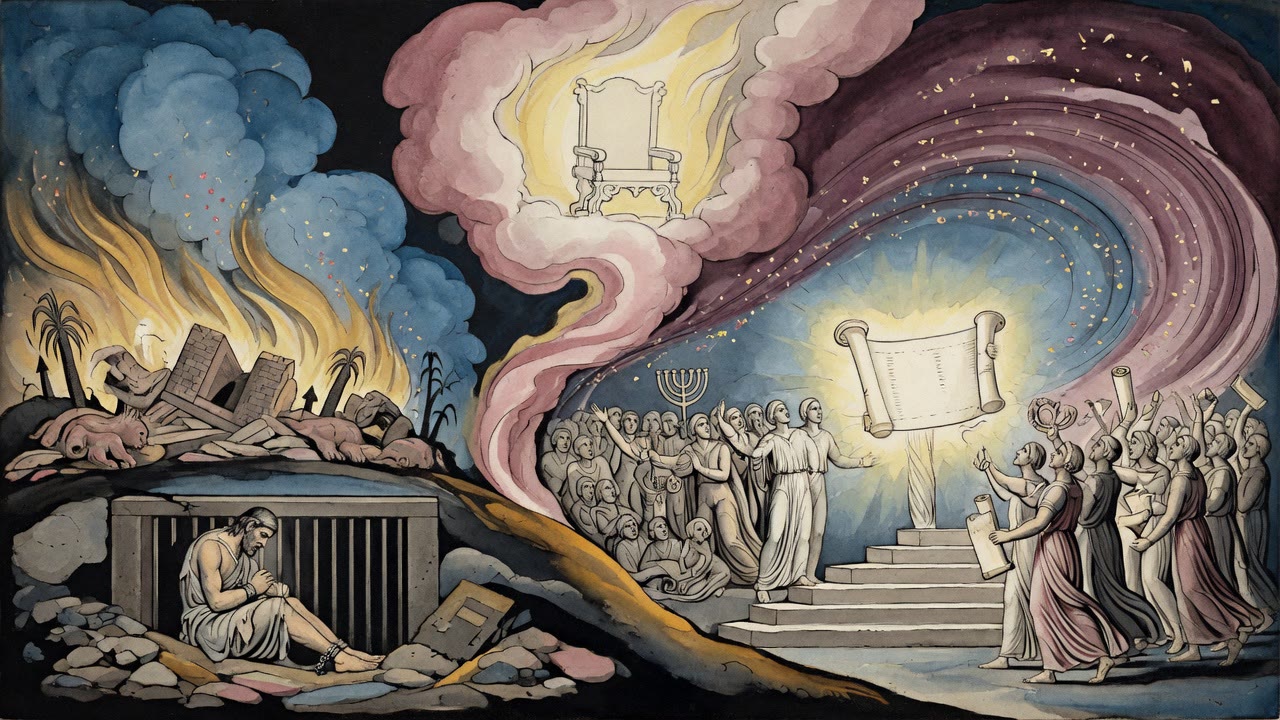
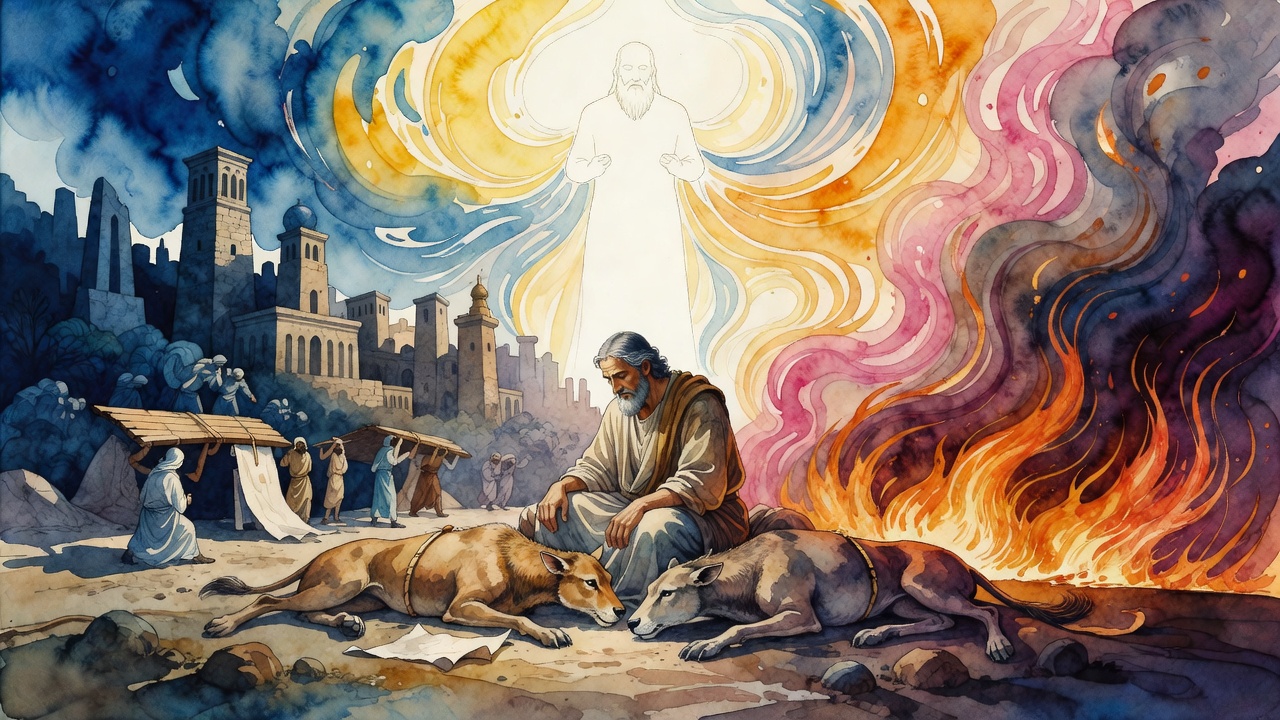
The army came in the ninth year of the king and did not leave. They threw a wall of earth around Jerusalem and sat down to wait. Two years the city starved behind its own stones. In the eleventh year the walls broke, and Nebuchadnezzar carried the last of Judah north into Babylon, the warriors and the officials, seven thousand fighting men out of Benjamin and the other tribes, and behind them the smoke of the burning Temple.

Count the loss. Eight hundred and fifty years since Israel had first walked into the land. Eight hundred and ninety since they had left Egypt. All of it folded shut in a single season.

And of the house of David, the line that was supposed to hold the world steady, there remained one man. Jeconiah sat in a Babylonian prison for thirty-seven years before a new king pulled him out of the dark and let him live. He had sons in that foreign city. He begot Shealtiel and Malkiram and Pedaiah and Gemariah, thirty-eight families in all, a royal house shrunk to a handful of names the sages passed from mouth to mouth in the exile. That was all that was left of the kingdom of David. Names, whispered, in Babylon.

The Road Back From Babylon

Seventy years the kingdom of Babylon held. Then it cracked. Belshazzar ruled his three years and fell, and Darius the Mede came, and the kingdom of the Chaldeans went out the way a lamp goes out when the last of the oil is gone.

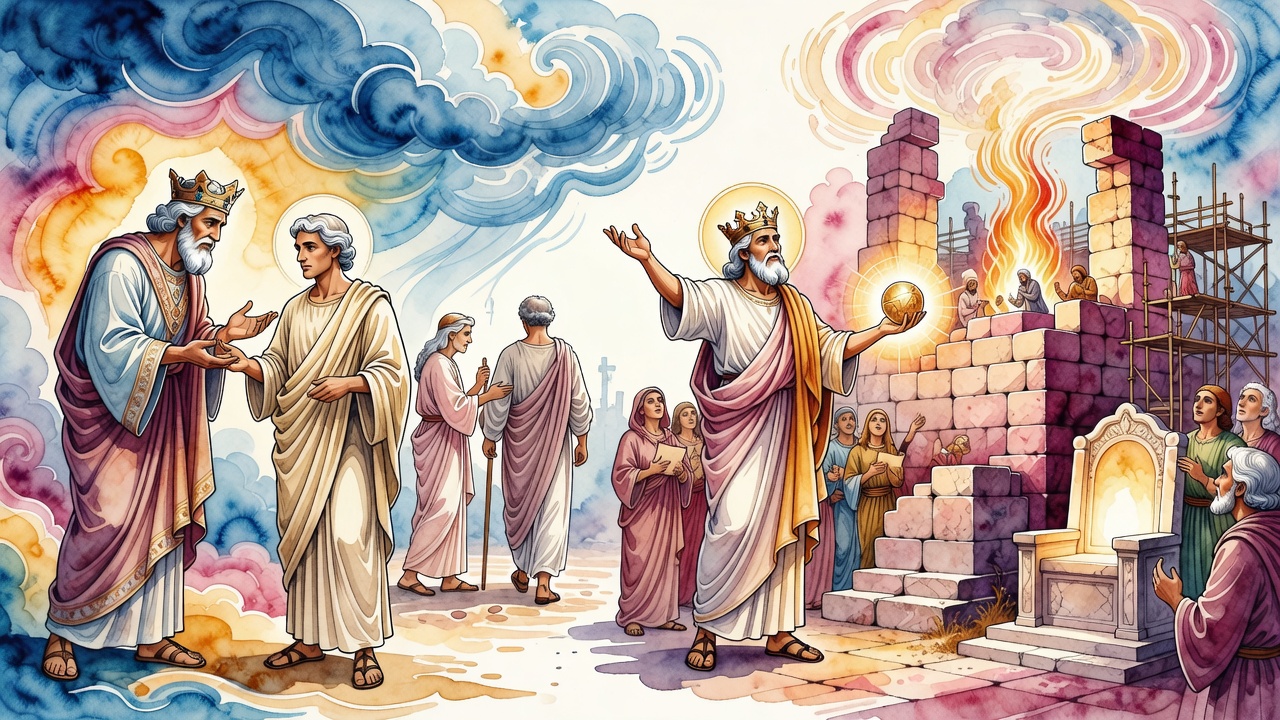
In the first year of Cyrus king of Persia the gates opened. Zerubbabel son of Shealtiel, grandson of the imprisoned king, went up to Jerusalem with his exiles walking behind him. Beside him came Jeshua son of Jehozadak, whose family had held the high priesthood since before the fire, and the prophets Haggai and Zechariah to keep the hands moving on the stone.

It did not go smoothly. Ahasuerus rose up, halted the building of the house, and set himself to tear Israel out of the earth root and branch. He failed. He and the wicked Haman were the ones torn out of the world, and the walls went back up.

Ezra Came Up and Made the Temple Ready

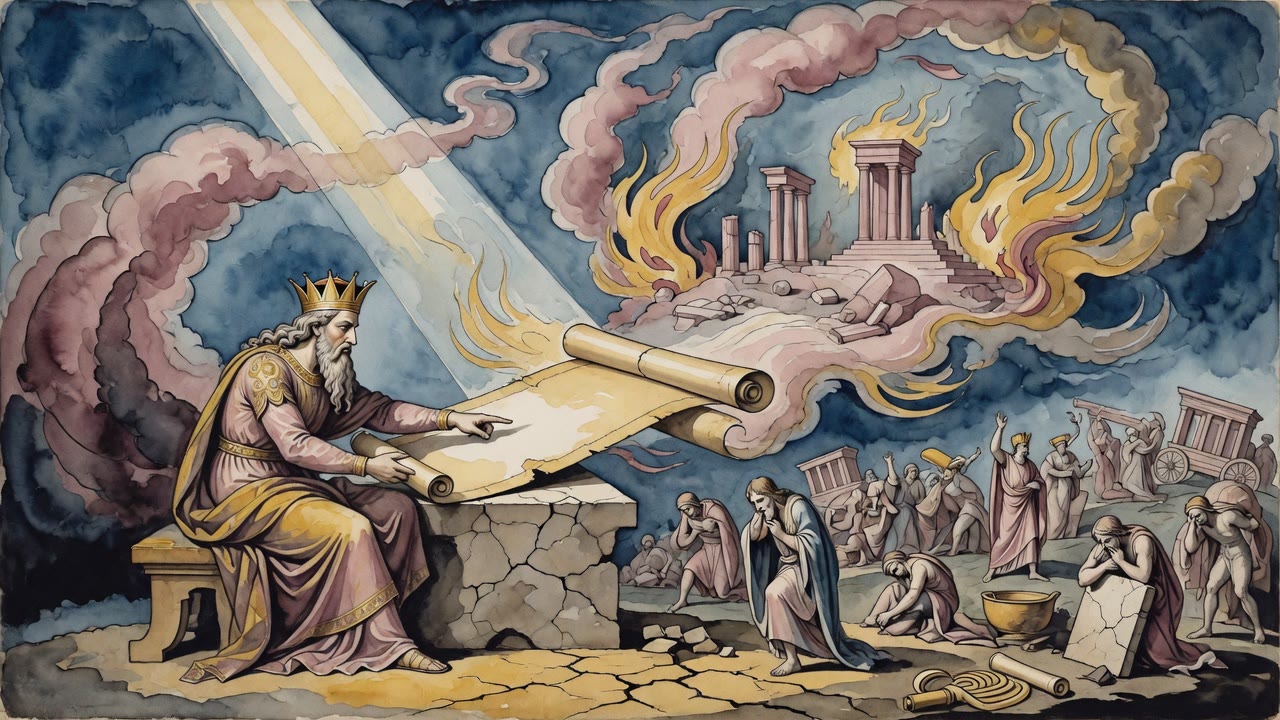
Then Ezra the Scribe came up. In the eighteenth year of the Mede, seventy years after the Temple had burned, he led another company of exiles out of Babylon and set his hands to the ruin. He built the walls of Jerusalem. He made the Temple ready. Around him the scattered thing began, slowly, to draw back into a people. The children born in Babylon had never seen this place. He would show them what a nation looked like when it stood on its own ground again.

Eight Hundred Scrolls Entered the Court

They called the assembly, and Ezra and Zerubbabel and Jeshua stood at the head of it. The people came up into the court, and they did not come empty. Priests came, eight hundred of them in their garments. Children came, eight hundred, small and solemn among the men. And the scrolls came. Eight hundred rolls of the Torah, carried in on the arms of those who had guarded them through the long night, the same Law that had nearly gone into the flames with everything else.

Trumpets tore the air. The Levites lifted their voices and sang until the sound pressed on the walls. Anyone standing in that court felt the whole weight of the thing turn over, eight hundred scrolls of the Law lifted into the light above a people that had been ash and prison one generation before.

But this was not only a feast. There was a judgment waiting to be made, and the trumpets had gathered the court that would make it.

The Name Sealed the Boundary

At the edge of the returned people stood the Cutheans. Long before, the Assyrians had emptied the town of Cuthah and its neighbors and planted their people in Samaria, and the newcomers had taken up a bent and partial worship of Israel's God. Now they wanted in. They wanted to lay stones on the house.

The assembly refused them. "You have nothing to do with us to build a house unto our God," the leaders said, and they shut the door and sealed it shut.

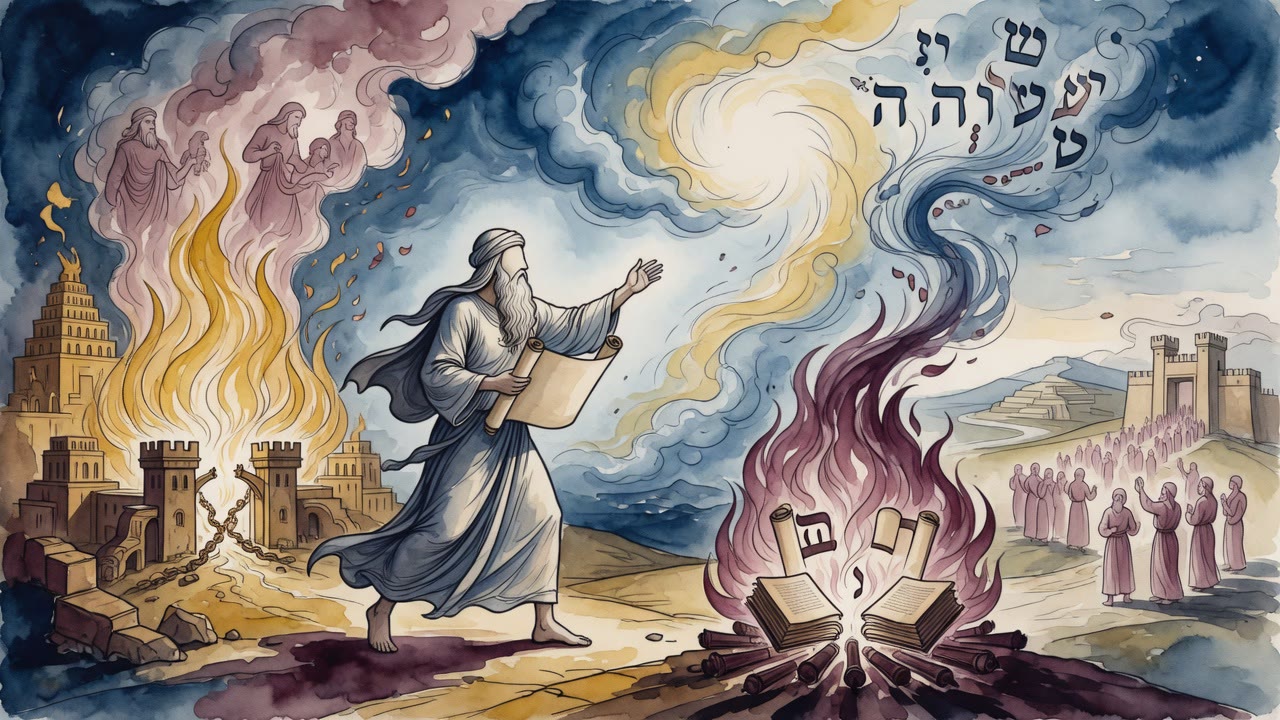
They sealed it with the Torah's own instruments. The ban went out with the mystery of the Ineffable Name, the Name no mouth is permitted to shape, and with the very script that had once been cut into the tablets of the Law at Sinai. The court above and the court below signed the decree together. From that hour no Israelite was to eat a Cuthean's bread. "Everyone who eats the bread of the Cutheans is as though he had eaten the flesh of swine," they ruled, and no man in Israel was to receive a Cuthean as a proselyte, not then and not ever.

The verdict reached past this world into the next. The Cutheans would have no portion in the resurrection of the dead. No portion and no inheritance in Israel. No right, no memorial, in Jerusalem.

So the same script that raised the Law up out of the ashes drew the line around who stood inside it. Eight hundred scrolls had come into the light, and the first act of the restored covenant was to decide, with the Name and with the letters of Sinai, exactly where its edge would fall.


← All myths
From the tradition

Sources

2 sources

The texts behind this telling. Some cards carry a translation of the source; others are our own retelling of it, and each card says which. Every card links out to the original.

Seder Olam Zutta 7:1Seder Olam Zutta

Translation of the source text.Seder Olam Zuta, Rabbi M. Grossberg. London, 1910 · Public Domain

And in the eleventh year of his reign, Nebuchadnezzar king of Babylon exiled him. And he died in his captivity, to fulfill what is said, "He shall be buried with the burial of a donkey" (Jeremiah 22:19). He exiled Jerusalem and all the officials, and from Benjamin and from the rest of the tribes seven thousand exiles, all of them warriors who make war. And after him reigned Jehoiachin his son three months and ten days. Seraiah was High Priest, and Jeremiah was prophet. And Nebuchadnezzar king of Babylon exiled him, he and eighteen thousand with him, and he made Zedekiah king, the brother of his father, son of Josiah, and he reigned eleven years.

Until the year three thousand three hundred and thirty-eight from creation. Jehozadak, brother of Ezra the Scribe, was High Priest. Jeremiah and Ezekiel were prophets. In the ninth year of his reign the army of Babylon came against Jerusalem and encamped against it and built a siege-wall around it, and the city came under siege until the eleventh year of his reign. And in that year Judah was exiled from its land. That was the year eight hundred and fifty from their entry into the land, and eight hundred and ninety from their departure from the land of Egypt, and the year three thousand three hundred and thirty-eight from the creation of the world.

And there remained of the house of David none but Jeconiah alone. And he begot Shealtiel and Malkiram and Pedaiah and Gemariah; they were thirty-eight families. And Nebuchadnezzar reigned until the thirty-seventh year of the exile of King Jehoiachin, until the year three thousand three hundred and sixty-four from creation. Nebuchadnezzar died and Evil-merodach his son reigned twenty-three years. In the first year of his reign he brought Jehoiachin out of the house of imprisonment. And afterward he died in Babylon, after the death of Zedekiah.

Shealtiel son of Jehoiachin, the sages spoke of him in the exile. And Belshazzar reigned three years. And Shealtiel died, and after him stood Zerubbabel his son, in the fifty-second year after the destruction of the Temple, which was the seventieth year of the kingdom of Babylon. Darius the Mede reigned, and the kingdom of the Chaldeans came to an end. And Zerubbabel went up to Jerusalem, and his exiles with him, in the first year of Cyrus king of Persia. And Joshua son of Jehozadak was High Priest. And Haggai and Zechariah and Ezra were prophets. Ahasuerus arose and halted the work of the Temple and sought to uproot Israel, and the Holy One, blessed be He, uprooted him and the wicked Haman from the world.

In the eighteenth year of the Mede, which was the seventieth year after the destruction of the Temple, Ezra the Scribe went up to Jerusalem and another exile with him, and he built the walls of Jerusalem and prepared the Temple, and Zerubbabel returned to Babylon and died there. And after him stood Meshullam his son. And in his days the kingdom of Greece reigned, in the fifty-second year of the Mede and Persian. And Haggai, Zechariah, and Malachi died. At that time prophecy ceased from Israel. That was the year three thousand four hundred and forty-two from the creation of the world.

From here onward incline your ear and hear the words of the sages.

Full source
Pirkei DeRabbi Eliezer 38:25Pirkei DeRabbi Eliezer

Retold in our words. Read the original at the link below.Pirke de Rabbi Eliezer, trans. Rabbi Gerald Friedlander, London (1916) · CC-BY

Ezra, Zerubbabel son of Shealtiel, and Jeshua son of Jehozadak – powerful figures in their time – are leading a grand assembly. They’ve gathered 800 priests, 800 children, and – impressively – 800 scrolls of the Torah. Trumpets blare, Levites sing, the atmosphere is thick with anticipation. But this isn’t just a joyous celebration. There's a serious purpose here.

What's going on? They're about to excommunicate the Cutheans.

Who were the Cutheans? These weren't just any group; they were a people from the region of Cuthah, transplanted to Samaria by the Assyrians centuries before (2 (Kings 17:2)4). Over time, they'd adopted a form of Judaism, but not quite "correctly," according to our story. They were kind of like distant cousins who showed up to the family reunion with a dish that just...wasn't right.

The excommunication wasn't subtle. It was done "with the mystery of the Ineffable Name" – referring to the sacred, unpronounceable name of God – "and with the script such as was written upon the tables (of the Law)." This wasn't just a social snub; it was a spiritual hammer blow. The ban was reinforced by both the heavenly and earthly courts of justice.

But it gets even more intense. The decree went so far as to forbid Israelites from eating the Cutheans’ bread. Why? Because "everyone who eats the bread of the Cutheans is as though he had eaten of the flesh of swine." A pretty strong statement. This was about maintaining a very clear boundary.

The text continues, "Let no man make a proselyte in Israel from among the Cutheans." The door to full acceptance was slammed shut. And the consequences? According to Pirkei DeRabbi Eliezer, they were denied a portion in the resurrection of the dead, based on the verse from (Ezra 4:3), "Ye have nothing to do with us to build an house unto our God." Ouch.

This wasn't just about this life; it was about the next one too. They were to have "neither portion nor inheritance in Israel," echoing (Nehemiah 2:20), "But ye have no portion, nor right, nor memorial, in Jerusalem." The message was clear: the Cutheans were permanently excluded.

What does this tell us? It’s a stark reminder of how religious identity can be fiercely guarded, how boundaries are drawn and defended. It also reflects a time of rebuilding and defining who was truly part of the community after the Babylonian exile. But it's also a window into the complex world of ancient Israel, where faith, politics, and identity were deeply intertwined.

Full source