Parshat Chayei Sarah7 min read

The Bandit Who Grew Old at the Bend in the King's Road

He worked the king's road until his own hands quit, and when he went down at last to make peace, the gate had nothing left to give him.

Curated by Arthur · Told by Maggid ·
Table of Contents
  1. The Bend Where the Road Narrowed
  2. The King's Word Came Down the Road Once
  3. The Morning His Hands Would Not Close
  4. Robbers Are Coming to Rob Me
  5. What They Told Him at the City Gate
  6. What They Carried Out at Dusk
The Bandit Who Grew Old at the Bend in the King's Road Click for full size

The Bend Where the Road Narrowed

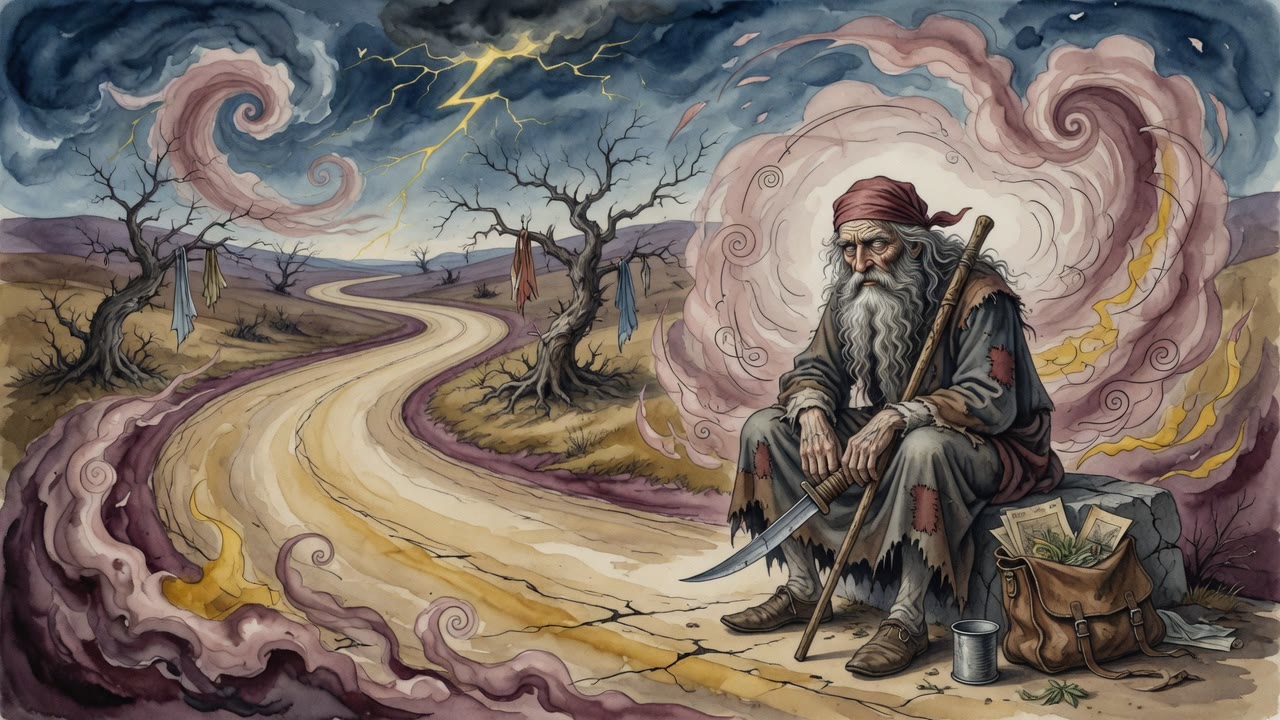
He worked a bend in the road where the ruts forced a cart to slow, and he had worked it so long that the stones there had learned the shape of his heels. A merchant came up with barley on a mule. The man stepped out of the terebinth shade, cut the sack loose, and was back among the roots before the shouting started. It went that way most mornings. Travelers on that stretch carried two purses, one to lose and one to keep.

He was not young when he took the bend and he was not young now. The trade kept no ledger and paid no pension. It gave him the shade, a fire pit, a black pot, and a name that reached a village three days ahead of him.

The King's Word Came Down the Road Once

In the dry season a herald of the king rode up with two soldiers and did not dismount.

"Turn back from your way," the herald said.

That was all of it. No manacles, no fine, no soldiers left behind at the bend to see it done. The bandit waited in the ruts until the horses were small in the distance, and then he laughed, and the laughing went on a good while past the joke.

That night he broke brambles over his knee and fed them under the pot. A great tree burns quietly. Set an oak or a cedar alight and the fire does its enormous orange work almost in silence. Brambles are different. They snap and spit and crack, throwing out noise wildly out of proportion to the little heat they put under a pot, and what the noise says, to anyone sitting close enough, is that they are trees. We are trees too, say the brambles. We are trees.

He sat close. He laughed again, and the fire cracked back at him, and the two sounds were not easy to tell apart.

The Morning His Hands Would Not Close

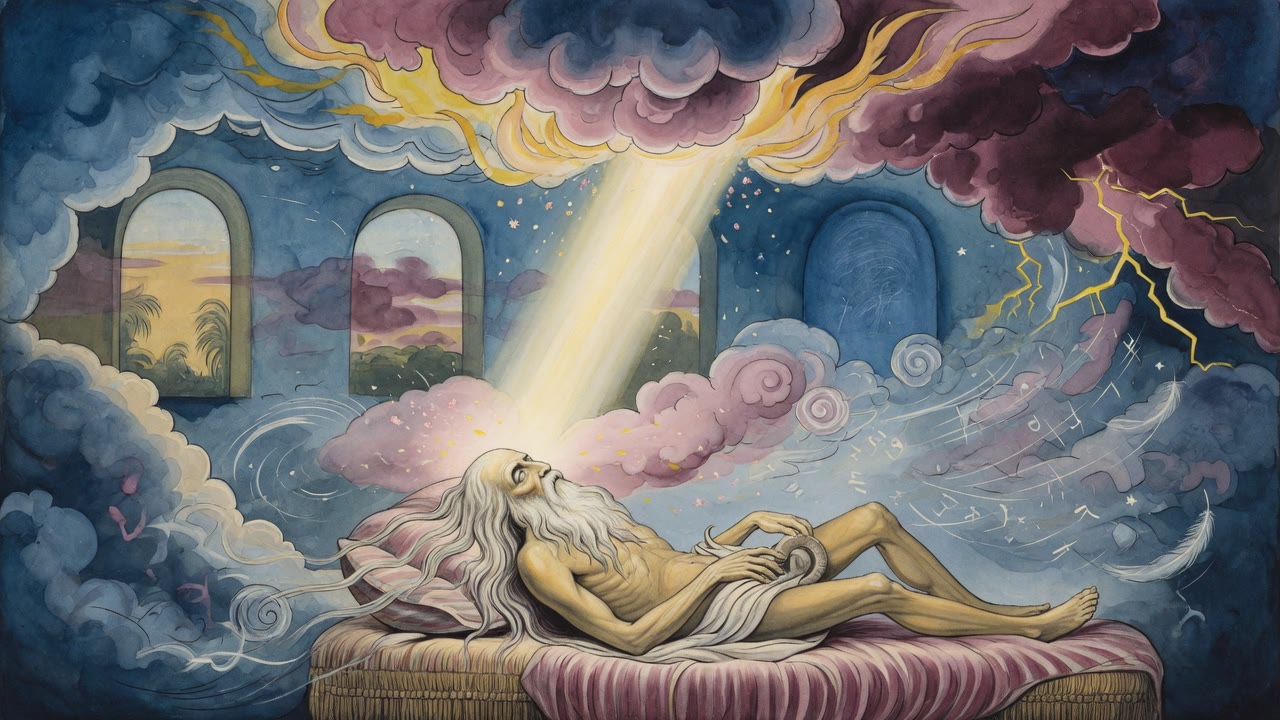
Age came for him from the outside in. The doors that open a body onto the street began to shut, one hinge at a time, until sound arrived thin and light arrived late. The mill in his belly stopped grinding. A bowl of lentils sat in him all day like a stone dropped down a dry cistern, so he ate less, and then less than that.

One morning a cart came up the ruts loaded with wineskins, one old driver on the bench, no guard, no dog. It was the easiest thing the road had offered him in a year.

He told his legs to move. His legs stayed. He told his right hand to close on the halter, and his fingers went out slowly toward the strap and opened again, the way a hand opens in sleep. The cart rolled past. The driver never once looked over.

He sat down in the road and said out loud that he would take the next one tomorrow. He said it more than once, to make it firm. Then it was tomorrow, and he could not.

Robbers Are Coming to Rob Me

He started waking at birds.

A sparrow would strike up in the thorn above the fire pit while the sky was still grey, and the sound would go into him like a hand clapped on his shoulder, and he would come up off the ground with his arms out in the dark, shouting into the empty bend, "Robbers. Robbers are coming to rob me."

Nobody was coming. Nobody had bothered to come for years. The road had written him off before he had.

His voice went after that. Something starts deep in a man, below thinking, the heart takes it up and finishes it, and the lips are meant to carry it out into the air. His lips had gone slack as a torn wineskin. He would sit at his fire with a whole finished sentence complete inside him and nothing on his mouth but breath. The brambles went on insisting they were trees.

What They Told Him at the City Gate

He went down to the city in the spring. It took him three days to walk what he had once walked in one. He came to the gate with his sandals ruined and both hands shaking on a stick, and told the men sitting there that he had come to make peace with the king.

They knew him. Everyone on that road knew him.

"The king holds no gratitude toward you," one of them said.

He began to explain about his hands. He held them up to show how the fingers no longer closed, how a man in that condition robs nobody, how he had put the whole business behind him.

"That is the reason," the man said. "You did not turn back of your own goodwill. You turned back because you ran out of road."

The bandit stood in the gateway with his hands still raised. Somewhere behind him a mill was grinding, filling the whole street with its noise, and he could barely hear it at all.

What They Carried Out at Dusk

He died in the month of rains, in a borrowed room, among people who did not know his name and would not have lent him the room if they had.

The women who washed him worked quickly, talking about something else. A body comes out of the womb with a cry and it goes down into the grave with a cry, and those two openings sit side by side. A woman on the birthing stool is called haita, the living one, because she stands at the very lip of dying and does not die. She is also called mehabalta, the pledged one, because for those hours she is mortgaged into the hand of death, the way a poor man's cloak is held against a loan until sundown.

Happy is the man whose going out matches his coming in, clean at the end as he was clean at the start. Nobody said that over him. Nobody said much of anything over him.

Travelers kept calling the place by what he had been, so his name outlasted him, which is one way of leaving a name and not the good way. Up at the bend the black pot sat where he had set it, filling with rain, and the ash beneath it had stopped saying anything at all.


← All myths
From the tradition

Sources

4 sources

The texts behind this telling. Some cards carry a translation of the source; others are our own retelling of it, and each card says which. Every card links out to the original.

Midrash Tanchuma Buber, Chayei Sara 7:2Midrash Tanchuma Buber, Chayei Sara

Translation of the source text.Midrash Tanchuma (Buber), Public Domain, on Sefaria · CC-BY-SA

[(Ecclesiastes 12:1:) IN THE DAYS OF YOUR YOUTH.] Do not wait until you have grown old, [but rather repent] before the evil days come. Rabbi Isaac said: These are the days of old age, when a person says he will do a thing and cannot. And why are they called days of evil? Rabbi Simeon ben Yochai said a parable. To what is the matter comparable? To one who would sit by the road and rob those who passed to and fro. The king said to him, "Turn back from your way," but he did not turn back. When he had grown old, he said, "Now I will make peace with the king." They said to him, "The king holds no gratitude toward you." Why? Because you did not turn back of your own goodwill. Therefore [Scripture says]: REMEMBER [your Creator in the days of your youth, before the evil days come].

Full source
Kohelet Rabbah 4:1Kohelet Rabbah

Retold in our words. Read the original at the link below.The Sefaria Midrash Rabbah, 2022 · CC-BY

Ecclesiastes, or Kohelet as it's known in Hebrew, certainly thinks so. Chapter 12 is a powerful, poetic meditation on aging, and the Rabbis, as they so often do, dug deep to unlock its secrets.

Let’s take one verse: “The doors to the street will be shut, with the fading of the sound of the mill; and one will arise to the voice of a bird, and all the sources of music will be lowered” (Ecclesiastes 12:4). Sounds cryptic. Well, Kohelet Rabbah, a Midrashic (rabbinic interpretive commentary) commentary on Ecclesiastes, cracks it open for us.

"The doors to the street will be shut” – according to the Midrash, these aren’t literal doors. They represent a person’s orifices. as we age, our senses can become less sharp, almost as if the doors to the outside world are closing down.

Then comes, "with the fading of the sound of the mill” – this refers to the stomach not grinding. In other words, digestion slows down. The youthful appetite fades.

And what about, "and one will arise to the voice of a bird”? This is where it gets really interesting. The Midrash tells us that the elderly, when they hear the birds tweeting, they say: "Robbers are coming to rob me! The heightened anxiety, the feeling of vulnerability that can come with age, where even the chirping of birds sounds like a threat.

Finally, "and all the sources of music will be lowered” – the Midrash interprets this as referring to the lips. The voice weakens, perhaps, or the joy of singing fades.

But the interpretation doesn't stop there. Rabbi Ḥiyya ben Rabbi Neḥemya offers another layer. He says that "the sources of music" are actually the kidneys that conceive, and the heart that concludes. Whoa. Now, that's a curveball!

What could this mean? Well, the Rabbis often saw the body as a microcosm of the larger world. So, perhaps, the kidneys, traditionally associated with procreation and the beginning of things, initiate thought, while the heart, the seat of emotion and understanding, brings it to a conclusion. And only then does it get expressed by the lips. It's a fascinating glimpse into how the Rabbis understood the process of thought itself. The idea that thought is initiated by the kidneys and concluded by the heart, before it is expressed by the lips.

This passage from Kohelet Rabbah reminds us that aging is not just a physical process, but a deeply personal and emotional one. It's a time of closing doors, fading sounds, and heightened anxieties. But it's also a time for reflection, for drawing on the wisdom of the heart, and for finding meaning in the simple sounds of the world, even if those sounds sometimes feel threatening. It’s a reminder to listen to the stories our bodies tell, and to find the music, however faint, that still resonates within us.

Full source
Kohelet Rabbah 6:1Kohelet Rabbah

Retold in our words. Read the original at the link below.The Sefaria Midrash Rabbah, 2022 · CC-BY

Ecclesiastes, or Kohelet as it's known in Hebrew, tackles this very feeling. "For like the crackling of brambles under the pot, so is the laughter of the fool; this, too, is vanity" (Ecclesiastes 7:6). But what does it really mean?

Kohelet Rabbah, a collection of rabbinic interpretations on Ecclesiastes, dives deep into this verse. And it starts with a fascinating insight about… permission.

That Rabbi Levi, son of Rabbi Ze’eira, would always ask for permission to speak before beginning his addresses. Why? Well, he connected it directly to the "crackling brambles." The image isn't just about annoying laughter. It’s about the sound of something insignificant trying to sound important. When big, strong trees catch fire, their burning is a silent, powerful force. But brambles? Those thorny, scrubby bushes? When they burn, they crackle and pop, making a lot of noise – a disproportionate amount of noise, really – for how little substance they actually have. "All the trees, when they are ignited, their sound does not carry; however, these brambles when they are ignited, their sound carries. They are saying: We, too, are trees."

Rabbi Levi, in his humility, saw himself as those brambles. He understood that even those who lack wisdom, those who might be considered insignificant, still yearn to be heard. He was saying: “Even those who are not wise want to have their voices heard. Therefore, please grant me permission to speak.”

Isn't that profound? He wasn't just being polite. He was acknowledging a fundamental human desire: the desire to be validated, to contribute, to have our voices matter. He recognized that even the "fool's laughter," however grating, is a manifestation of this desire.

So, the next time you hear laughter that rubs you the wrong way, or when you feel the urge to speak up even when you doubt your own wisdom, remember Rabbi Levi and the crackling brambles. Remember the inherent human need to be heard. And maybe, just maybe, offer a little bit of space for that voice to be expressed. It's a powerful reminder that even the smallest voices deserve a chance to be heard, and that true wisdom lies in recognizing the value in every voice, regardless of how "crackling" it may seem.

Full source
Kohelet Rabbah 2:1Kohelet Rabbah

Retold in our words. Read the original at the link below.The Sefaria Midrash Rabbah, 2022 · CC-BY

Kohelet Rabbah turns to A Good Name at Death Outweighs a Good Birth.

Kohelet, or Ecclesiastes, that most philosophical of biblical books, puts it starkly: "A time to be born, and a time to die." (Ecclesiastes 3:2). Seems obvious. We’re born, we live, we die. But according to Kohelet Rabbah, the ancient commentary on Ecclesiastes, there's a deeper wisdom hidden within those simple words.

Rabbi Berekhya asks a pointed question: Is that all there is to Solomon’s wisdom? Just stating the obvious? Surely not! He suggests a profound idea: "Happy is the person whose time of death is like the time of his birth; just as at the time of his birth he was clean [of sin], so, too, at the time of his death he is clean." What a powerful aspiration! To leave this world as untainted as we entered it. It's not about literal sinlessness, perhaps, but about striving for a life of integrity, leaving behind more good than bad.

The commentary then explores the intense experience of childbirth, drawing a striking parallel to death. When a woman is on the birthing stool, she’s called ḥaita. Why? Because she's on the verge of dying, yet she lives – ḥayya!

And there's more. She's also called meḥabalta. Kohelet Rabbah explains this term by linking it to the concept of a pledge or security. It’s like she is "mortgaged in the hands of death," just as the Torah says, "if you take as security [ḥavol taḥvol] your neighbor’s garment" (Exodus 22:25). It's a potent reminder of the inherent risk and vulnerability in bringing new life into the world.

Rabbi Simon, quoting Rabbi Natan of Beit Guvrin, offers another fascinating comparison. He asks, why are "the grave and the barren womb" juxtaposed in (Proverbs 30:16)? The answer? To show us that just as one is removed from the womb with loud cries, so too, one will be removed from the grave with loud cries. This isn't necessarily about sorrow, though. According to some interpretations, these are "cries of thanksgiving to God when the dead are resurrected." (Note 2 in the original text).

It’s a beautiful and somewhat startling image: a resurrection not of silent, peaceful rising, but of joyous, loud cries of gratitude.

So, what does this all mean for us? Kohelet Rabbah uses these powerful metaphors to encourage us to think deeply about our lives, our deaths, and the connection between the two. It’s not just about avoiding sin, but about living a life that allows us to approach our final moment with a sense of completion, of having lived authentically and with purpose. A life, perhaps, that culminates not in quiet resignation, but in a triumphant cry of gratitude.

Full source