Parshat Beshalach6 min read

The Cloud That Led Them Out and the Cloud That Blocked Their Prayers

At the sea a freed nation sang until the mountains leapt. Out of Jerusalem the same people wept in chains, every mercy turned to ruin.

Curated by Arthur · Told by Maggid ·
Table of Contents
  1. The Road That Sang
  2. The Same People on a Different Road
  3. The Cloud Turned Its Face Away
  4. Two Roads Laid Beside Each Other
  5. The Turning He Promised to Do Again
The Cloud That Led Them Out and the Cloud That Blocked Their Prayers Click for full size

The Road That Sang

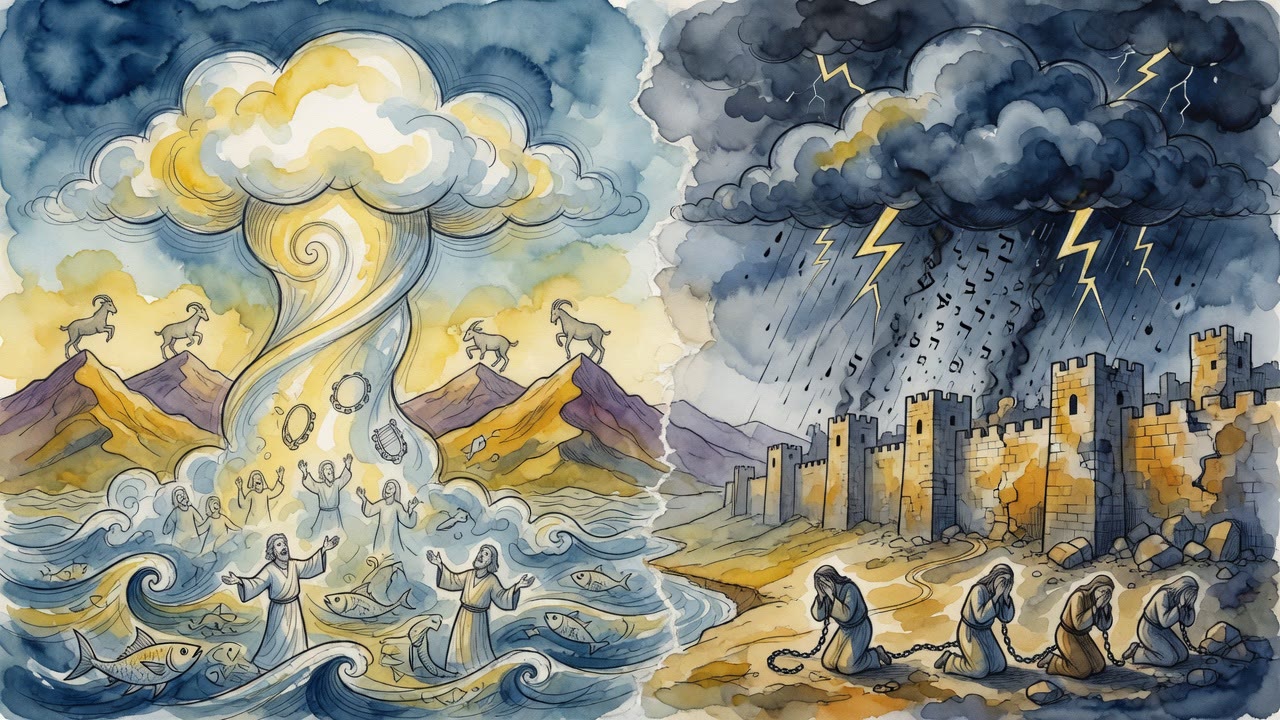
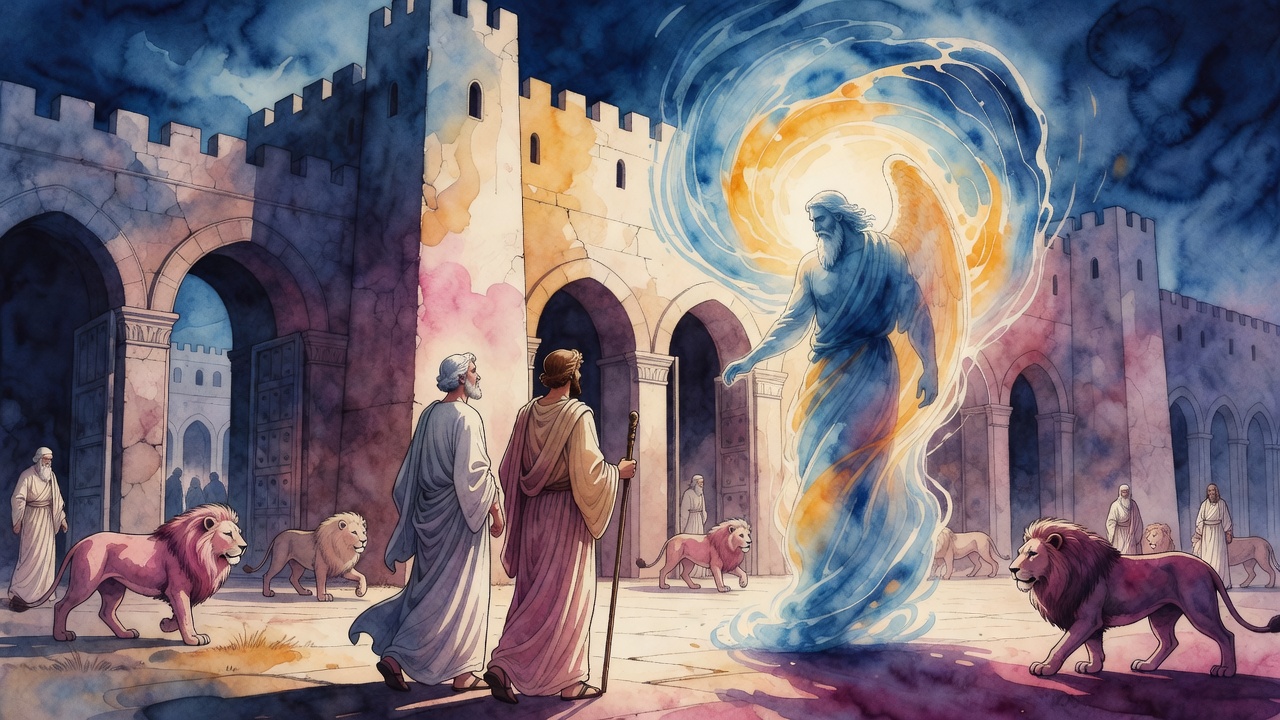
The sea still stood in two walls of water when the singing began. On the far shore, with Egypt's chariots broken in the surf behind them, a whole nation found its voice at the same instant, as though one throat had opened inside six hundred thousand chests. Moses lifted his hand and the words came out already shaped into music, and the people answered him line for line. "I will sing to the Lord, for He has triumphed gloriously." The sound did not stay on the beach. It climbed into the hills, and the hills threw it back. The mountains skipped like rams. The low hills leapt like lambs. A child who had never known a morning without bricks and straw rode laughing on someone's shoulder.

For forty years the singing had a floor beneath it. When they thirsted, water came. When they hungered, the ground lay white with bread before dawn. A cloud walked in front of them by day and stood over the tents like a roof built out of God's own attention. Near the end of it all Moses would remind them how they had crossed those years, held close against heaven the way a man carries his son over every dry riverbed and through every waste. Not one of them lacked a thing. Those who held fast were, every one, alive.

That was one departure.

The Same People on a Different Road

Long generations later the same nation left a city, and no one sang. They came out through the shattered wall of Jerusalem in iron collars, roped neck to neck, and the road bent north under them toward Babylon. A woman wept in the night with her palm pressed to her cheek, and the tears kept wetting it, and there was no line of song for anyone to catch and answer.

The mountains were the same mountains. When Israel had left Egypt they had skipped like rams. Now the prophet Jeremiah lifted his eyes to them and the whole ridge was shaking, trembling as if the ground had lost its nerve. The bread was gone with the song. Where a people had once walked forty years and lacked nothing, small children now dragged at their mothers on the exile road and begged for bread, and no hand had any to give. At the breast, the tongue of the infant stuck dry to the roof of its mouth.

The Cloud Turned Its Face Away

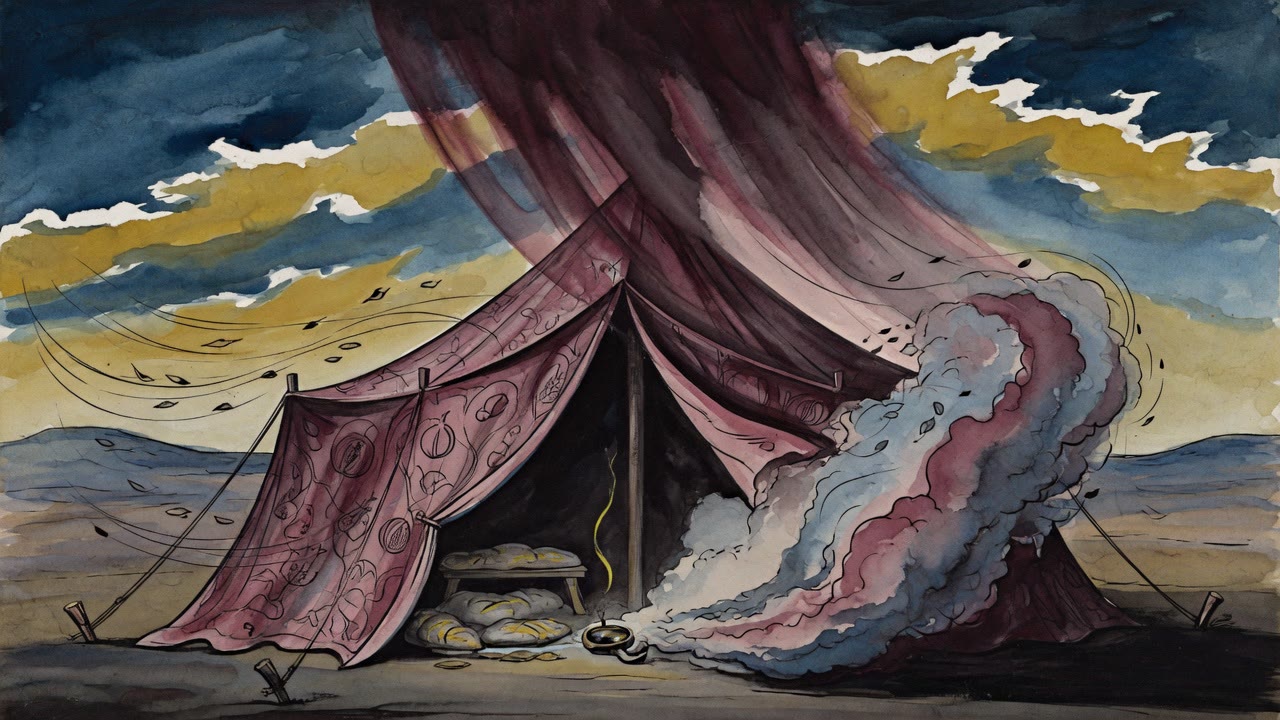
The cloud was the cruelest mirror of all. Once it had gone before them by day, a canopy, a sign that the eye above them never closed. On the road out of Jerusalem the exiles raised their prayers the way people had always raised them, and the prayers went up and struck something and fell back. Jeremiah gave it words. God had wrapped Himself in a cloud so that no prayer could pass through. The same white presence that had been a roof was now a wall. It shut. Their words piled against it and slid down unheard.

And the glory that had ridden with them, the majesty a man carries against his chest like a son, lay thrown down. Jeremiah watched it drop from heaven to the earth, the splendor of Israel cast out of the height it had lived in, down into the mud of a foreign road.

Two Roads Laid Beside Each Other

Laid side by side, the two mornings answered each other image for image. On the first road, song; on the second, a woman weeping in the dark. On the first, mountains leaping like young rams; on the second, the same mountains shuddering. On the first, bread from the sky and a people that lacked nothing; on the second, children crying for bread that was not there. On the first, a nation carried like a son against the chest of heaven; on the second, that same nation flung to the ground. On the first, the living who had held fast and were all of them alive; on the second, the cracked tongue of a nursing child. On the first, a cloud that led; on the second, a cloud that shut the sky.

Point for point the ruin answered the redemption. Nothing in the long catalog of grief stood alone. Each horror on the road to Babylon had once been a mercy on the road from Egypt, the same object turned over to show its dark side.

The Turning He Promised to Do Again

But a thing turned over can be turned back. The mountains that leapt and then shook were still standing, and a mountain that has done both once can do the first again. The cloud that opened and then closed was still only a cloud, and a shut door is still a door. Whoever had matched the two roads so exactly had not built the mirror to gloat. Every grief on the northern road had a mercy behind it in the desert, and a mercy remembered is a mercy that can arrive twice. The God who had reached into a house of slaves and drawn a song out of a people who had forgotten they had throats could reach into Babylon and draw it out again.

On the road north the exiles carried that buried hope like a coal wrapped in ash. The song at the sea had risen once out of a morning that looked like the end of everything. It could rise a second time. And when it did, the mountains would remember the older thing they knew how to do. They would skip like rams. The little hills would leap like lambs. And somewhere on the long way home a child who had known nothing but exile would ride laughing on a shoulder, and no one would take the song away.


← All myths
From the tradition

Sources

3 sources

The texts behind this telling. Some cards carry a translation of the source; others are our own retelling of it, and each card says which. Every card links out to the original.

Yalkut Shimoni on Nach 1046:2Yalkut Shimoni on Nach

Retold in our words. Read the original at the link below.Sefaria Community Translation · CC-BY

They burst into song! Remember the verse? "Then Moses and the children of Israel sang this song to the Lord..." (Exodus 15:1). Pure, unadulterated joy, expressed in music.

Then, fast forward to the destruction of Jerusalem, the exile from our homeland. The Yalkut Shimoni on Nach poignantly contrasts this, telling us that when Israel went out of Jerusalem, they didn't sing. They wept. As (Lamentations 1:2) says, "Bitterly she weeps in the night, her cheek wet with tears. Song versus tears. Freedom versus exile.

What brings this contrast to mind? Well, the Yalkut Shimoni continues with a passage about a king – specifically, a king holding a feast. And The text presents two different perspectives on why this king decided to throw such a lavish party in the third year of his reign.

One explanation suggests that the king had faced rebellions in his territories. After successfully conquering them, he celebrated his victories with a grand feast. A celebration of power, a display of dominance. Makes sense. Kings throughout history have done similar things.

But there's another, perhaps more human, explanation. Some say it was simply his birthday. A personal milestone. And, being a king, he invited all his subjects to join in the festivities. The logistics? A royal birthday bash for the ages!

So, which is it? A celebration of conquest, or a celebration of life? The Yalkut Shimoni leaves it open to interpretation. Maybe it was both. Maybe the king saw his military victories as a personal achievement worthy of a massive birthday celebration.

Regardless, this short passage from the Yalkut Shimoni From the highs of liberation to the lows of exile, from political power plays to personal celebrations, history is full of complexities. And sometimes, the truth lies somewhere in between the song and the tears.

Full source
Yalkut Shimoni on Nach 1026:11Yalkut Shimoni on Nach

Retold in our words. Read the original at the link below.Sefaria Community Translation · CC-BY

The Jewish tradition is filled with these echoes, these comparative moments that help us understand not just where we've been, but who we are.

One of the most fascinating collections of these echoes is found in the Yalkut Shimoni, a compilation of rabbinic commentary on the entire Hebrew Bible. It's like a vast, sprawling conversation across centuries, and within it, there are these little gems, these side-by-side comparisons that make you go, "Aha!"

It draws a powerful contrast between two pivotal moments in Jewish history: the Exodus from Egypt and the Exile from Jerusalem. What happens when you put these two events in conversation with each other? The result is both heartbreaking and strangely hopeful.

The first comparison focuses on the very land beneath their feet. When Israel left Egypt, Moses declared, "The mountains skipped like rams!" (Psalms 114:4). It’s a picture of joy, of liberation so powerful that even the earth itself rejoices. But when Israel was exiled from Jerusalem, Jeremiah laments, "I look at the mountains, they are quaking" (Jeremiah 4:24). The same mountains, once dancing with joy, now tremble with sorrow. What a stark contrast! It speaks to the profound shift in the relationship between the people and the land, from one of promised freedom to one of devastating loss.

Next, the Yalkut Shimoni contrasts provision and hunger. Leaving Egypt, Moses proclaims, "God your God has been with you these past forty years: you have lacked nothing" (Deuteronomy 2:7). Forty years of wandering, yes, but also forty years of divine sustenance, of miracles in the desert. Yet, when Israel is exiled from Jerusalem, Jeremiah cries out, "The young children ask bread, and no one gives it to them" (Lamentations 4:4). The innocence of children, contrasted with the harsh reality of deprivation. The memory of divine care replaced by the agony of abandonment.

Finally, the comparison turns to the very nature of God's relationship with Israel. Leaving Egypt, Moses reminds them, "And in the wilderness, where you saw how God your God carried you, as a man carries his son" (Deuteronomy 1:31). A tender image of divine protection and love. But leaving Jerusalem, Jeremiah cries, "He has cast down from heaven to earth the majesty of Israel" (Lamentations 2:1). The intimate, loving embrace is replaced by a sense of divine rejection, of majesty brought low.

What does it all mean? Why these comparisons? It seems the Yalkut Shimoni is trying to tell us something profound about the cyclical nature of history, about the consequences of our actions, and about the enduring, if sometimes obscured, presence of God. But it's also a hint that the reverse is possible too. Just as the mountains once danced and now tremble, perhaps they can dance again. Just as children once lacked bread, perhaps they will be fed once more. And just as God's majesty was cast down, perhaps it can be raised up again.

These echoes across time aren't just about remembering the past. They're about understanding the present and shaping the future. By recognizing the patterns, by learning from the contrasts, we can, perhaps, break the cycle and move towards a world where the mountains dance more often than they tremble.

Full source
Yalkut Shimoni on Nach 1026:13Yalkut Shimoni on Nach

Retold in our words. Read the original at the link below.Sefaria Community Translation · CC-BY

The Yalkut Shimoni, a compilation of rabbinic commentary on the Hebrew Bible, offers a poignant reflection on this very idea, drawing a stark contrast between the Exodus from Egypt and the exile from Jerusalem. It’s found in the section dealing with the books of Nevi’im and Ketuvim (Prophets and Writings), specifically section 1026.

Let's consider the Exodus, the ultimate liberation. The Yalkut Shimoni reminds us that Moses, witnessing the miracle of freedom, declared, "while you, who held fast to God your God, are all alive today" (Deuteronomy 4:4). What a powerful statement of faith! It's evidence of the life-affirming power of clinging to God, a direct result of experiencing divine deliverance. God was palpably present, and the people responded with unwavering belief.

Then… Jerusalem.

Fast forward centuries later, to the destruction of the Temple and the exile to Babylon. The prophet Jeremiah, in the depths of despair, laments, "the tongue of the suckling cleaves to its palate for thirst" (Lamentations 4:4). The innocence of a child, the most basic need for sustenance, is denied. This is the voice of utter desolation, a far cry from Moses' triumphant declaration.

The contrast is stark.

And it gets even more profound. The Yalkut Shimoni continues, noting that during the Exodus, Moses proclaimed, "and the cloud of God was on them by day" (Numbers 10:34). The cloud, a symbol of God's protective presence, guiding and sheltering the Israelites in their journey.

Now, listen to Jeremiah's agonizing cry from the exile: "[You have screened Yourself off] with a cloud, that no prayer may pass through" (Lamentations 3:44). The very same cloud, once a symbol of divine protection, now becomes a barrier, an impenetrable wall between the people and their God. Prayers, the lifeblood of the soul, cannot reach their intended recipient.

Why this dramatic shift?

The Yalkut Shimoni doesn't explicitly state the reason, but it invites us to contemplate the profound impact of historical events on our perception of the Divine. The Exodus was a time of unparalleled revelation, a clear demonstration of God's power and love. The exile, on the other hand, was a period of immense suffering, a time when God seemed distant, even absent.

Perhaps, the Yalkut Shimoni suggests, our relationship with God isn't static. It's not a one-size-fits-all formula. Our experiences, both collective and individual, shape our understanding, our prayers, and even our ability to perceive God's presence in the world. Times of joy call forth expressions of gratitude and faith, while moments of sorrow may lead to questioning, doubt, and even a sense of abandonment.

The key takeaway? To remember that even in the darkest of times, when the "cloud" seems to block our prayers, the possibility of connection remains. Jeremiah’s very lament is, in itself, a prayer. Perhaps the path back to feeling God's presence lies in acknowledging our pain, in voicing our doubts, and in never ceasing to seek a glimmer of light, even in the deepest darkness.

Full source