6 min read

The Fire Rolled Korah Like a Ball Into the Mouth of the Earth

Moses shaved him bald as part of a purification rite. Korah walked back through the camp and his own neighbors asked him who he was.

Curated by Arthur · Told by Maggid ·
Table of Contents
  1. The Man Nobody Recognized
  2. You Have Too Much
  3. We Will Not Go Up
  4. Two Deaths for One Man
  5. Some Say They Are Still Down There
The Fire Rolled Korah Like a Ball Into the Mouth of the Earth Click for full size

The Man Nobody Recognized

The razor went over every inch of him.

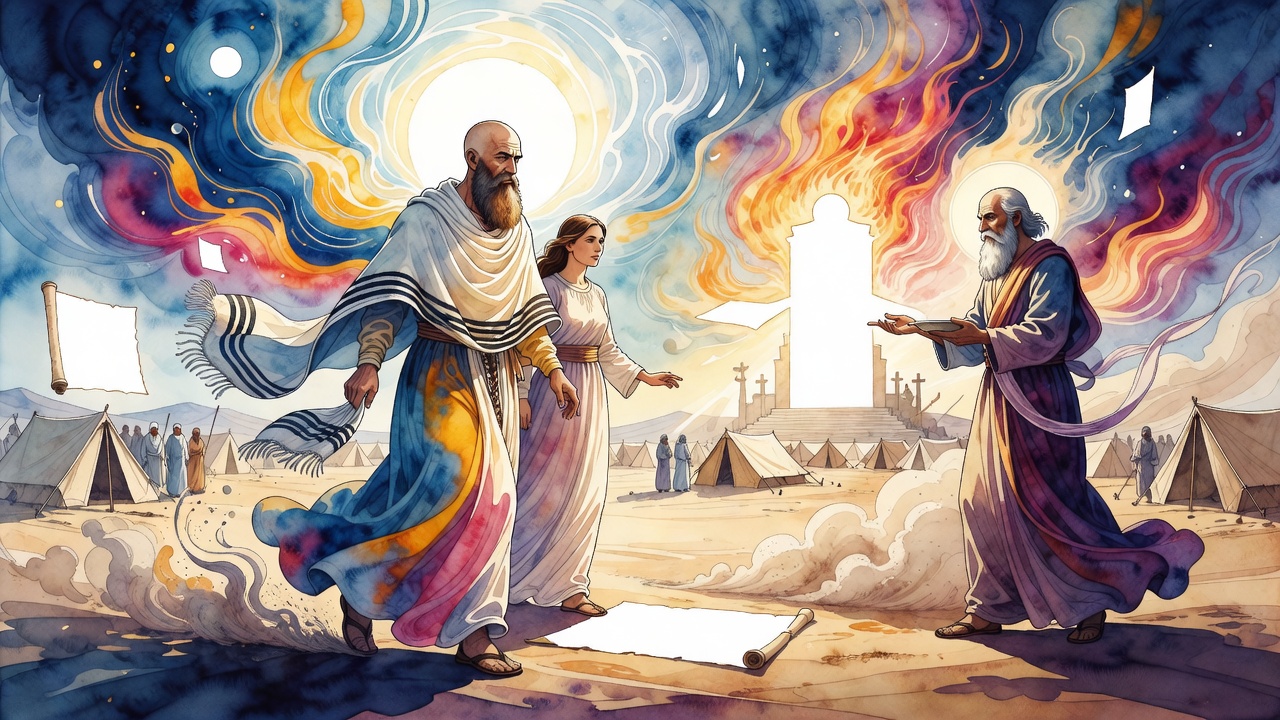
God had told Moses to purify the Levites, and purifying a Levite meant passing a blade across all his flesh, and Korah was a Levite, so Moses did it to Korah like everyone else. Then Moses took him by the arms and the legs and lifted him and swung him back and forth in the air the way a priest waves an offering, and set him down, and said, "You are pure."

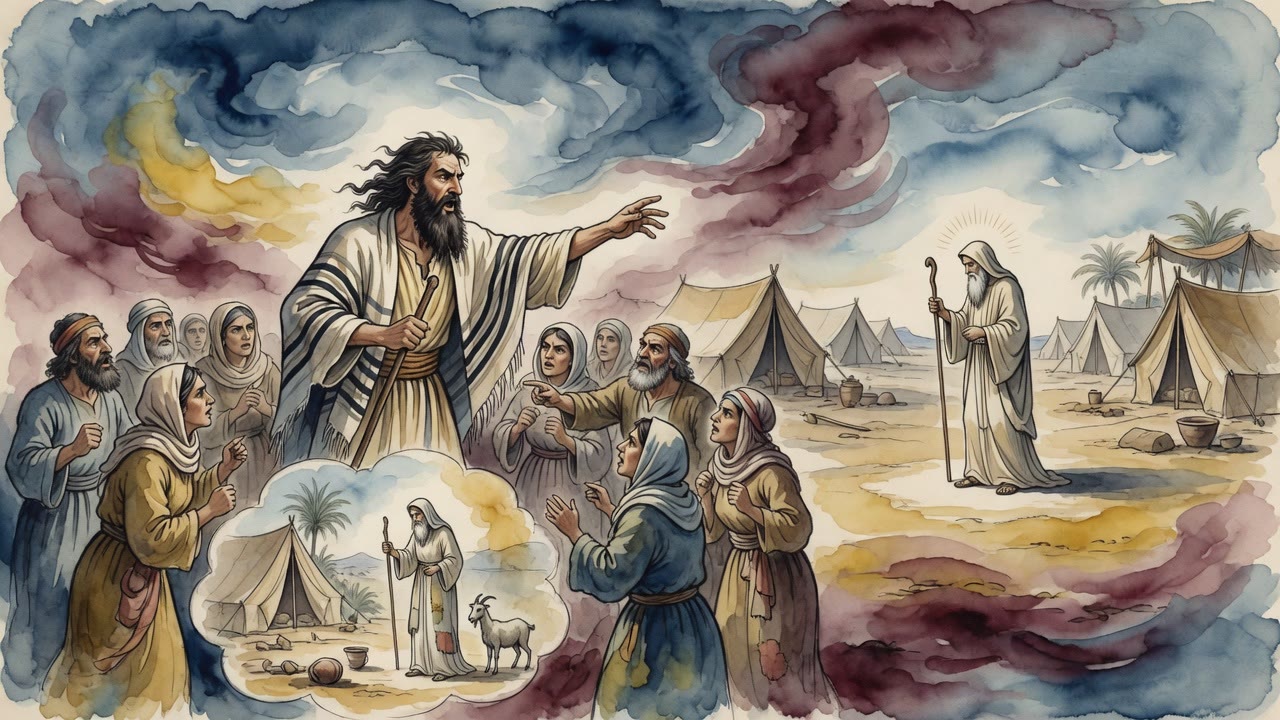
Korah walked back into the camp. People he had known his whole life looked straight at him and did not know who he was.

"Who did this to you?"

"Moses did it to me," he said, and he told them the rest of it. The arms. The legs. The waving. "And then he brought in his brother Aaron, dressed him up like a bride, and sat him down in the Tent of Meeting."

He took his garment and went home and asked his wife what to do.

You Have Too Much

She did not talk him out of it, and by morning he had company.

Two Reubenites came in first, Dathan and Abiram, whose names meant the one who breaks the law and the one who will not bend, and who camped on the south side of the Tabernacle where the sons of Kohath camped, close enough to Korah's tent that the friendship had been forming for years. Behind them came two hundred and fifty men, and these were not malcontents. They were princes of the tribes, men with standing.

They went through the camp counting up what the priesthood took. Moses is king. His brother is High Priest. His nephews are deputies. The gift offering goes to the priest, the tithe goes to the priest, twenty-four gifts in all go to the priest.

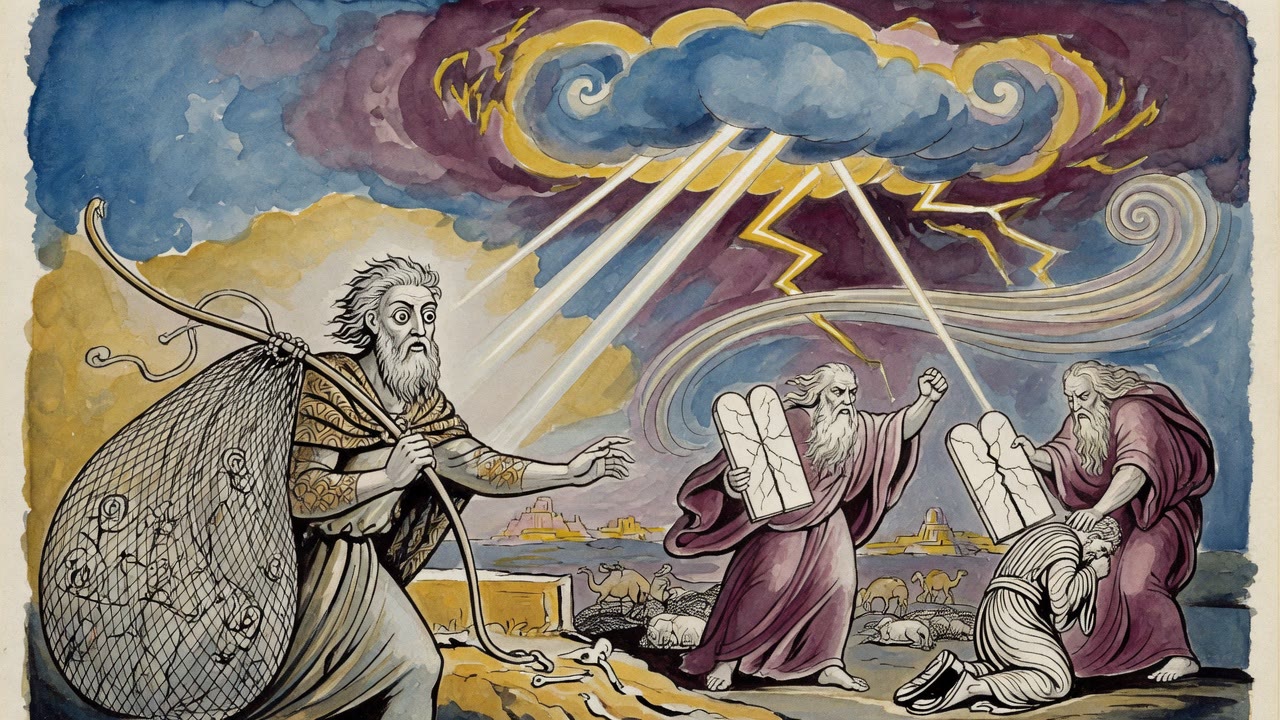
Then the whole assembly stood in front of the two brothers and said it out loud. "You have too much. Every one of this congregation is holy and the Lord is among them. Why do you lift yourselves above the assembly of the Lord?"

Korah gathered his people closer. "You have loaded more on us than Egypt did," he said. "We were better off under Pharaoh than under you."

They began looking around for stones. Moses went down on his face in the dirt.

"I am not after a kingdom," he said when he got up. "My brother is not after the priesthood." And then, not to them, "Master of the universe, You are the one who told me to bring Aaron near. They are standing here to kill us."

He straightened up and gave them a time. "In the morning the Lord will make known who is His." Morning, he said, not tomorrow. Every magician in the world could work together to turn a morning into an evening and not manage it, and the one who split light from darkness had split Aaron out from everybody else the same way, and by first light they would all be able to see it.

We Will Not Go Up

Moses sent for Dathan and Abiram.

The answer came back four words long. "We will not go up."

Not we will not come. Not we will not go. Up. They had a mouth on them and the mouth chose the direction, and the direction stuck.

Moses said that if they would not come to him he would go to them, because a man looks different when someone is standing in front of him and they might yet be ashamed. So he walked out to their tents alone. They came out to meet him and stood in the doorway, and they stood there the way Goliath would stand in a valley one day, cursing, blaspheming, letting the whole camp hear what they thought of him.

Moses turned around and said it in front of everyone. "If these men die the ordinary death of ordinary men," he said, "then God did not send me."

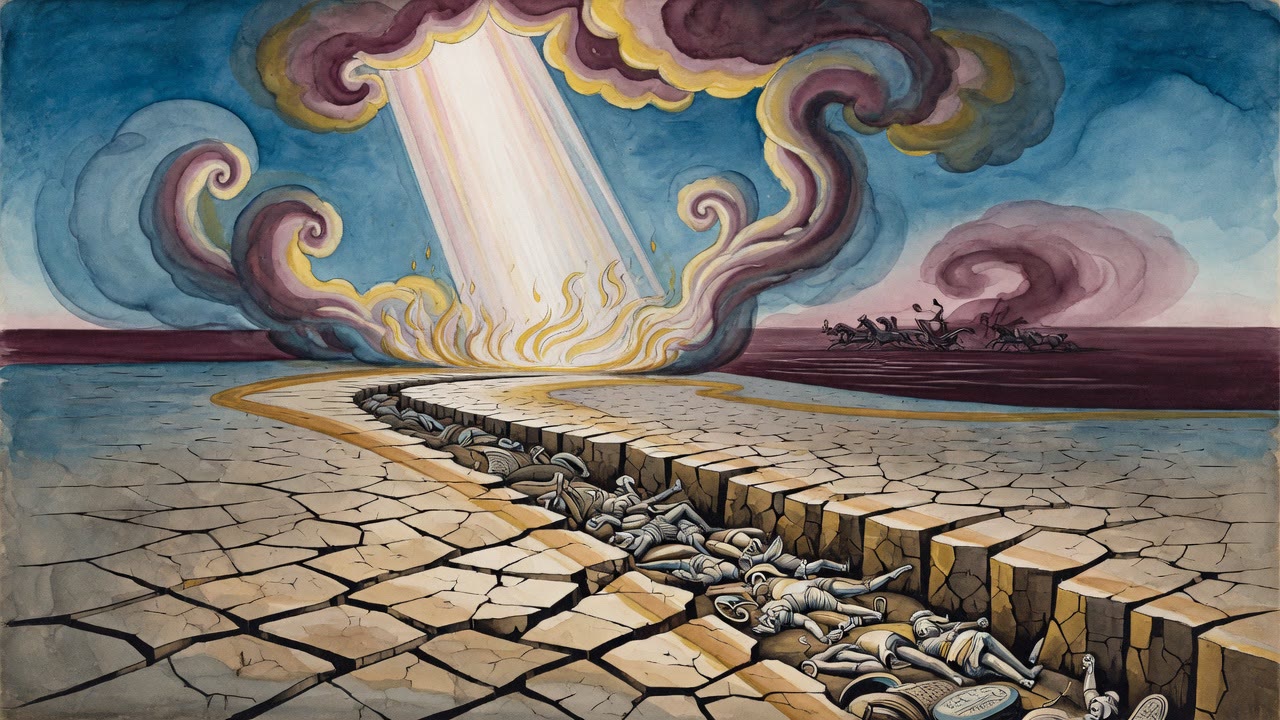
The ground under their feet split open.

Two Deaths for One Man

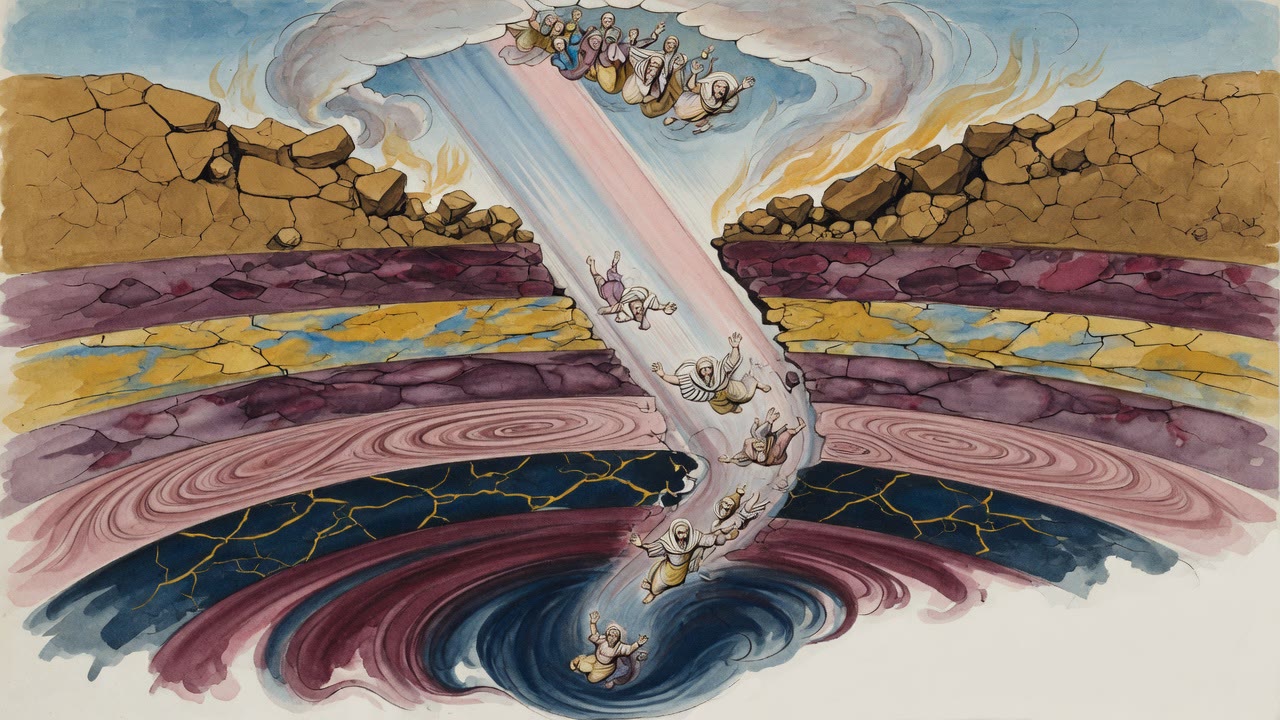
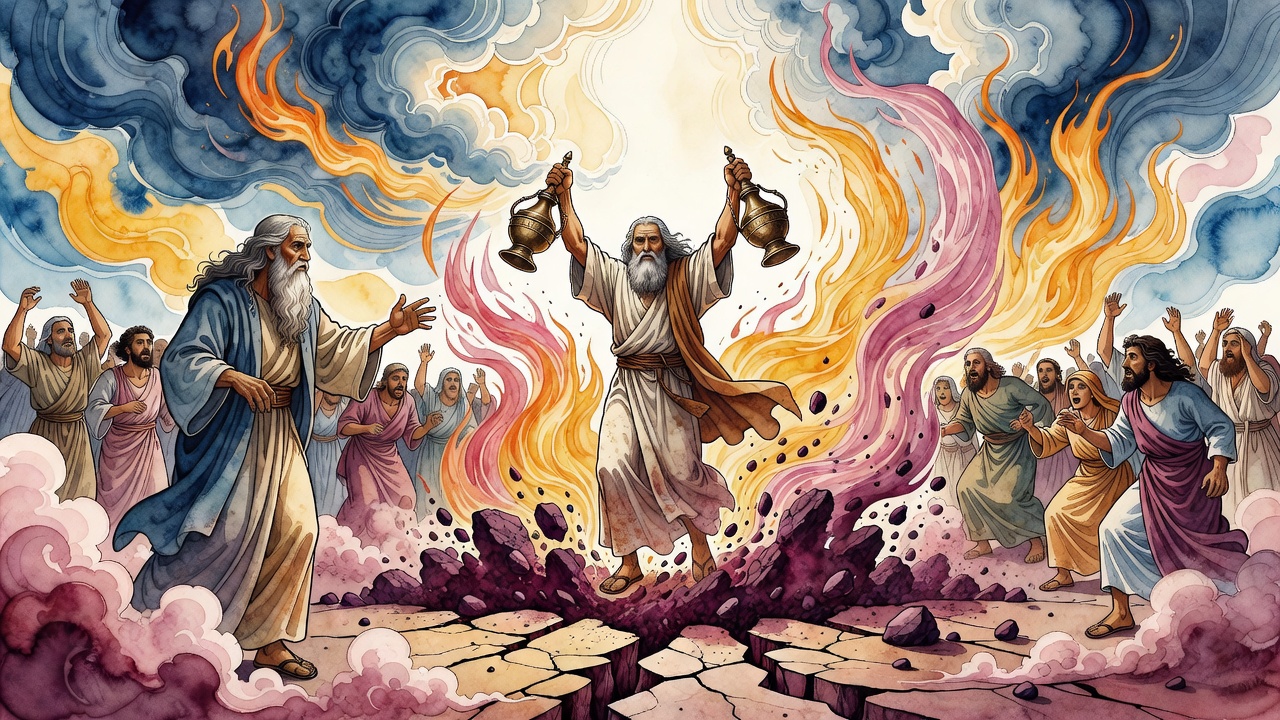
Fire came out from the Lord and took the two hundred and fifty men holding their censers, and the earth took Dathan and Abiram and their wives and their children and the infants at the breast, and Korah got both.

He was standing among the ones being burned, censer in his hand, incense still smoking in it, because Moses had told him to bring his own fire pan and he had brought it. The fire caught him first, in full view of every man burning beside him, so that none of them could ever say Korah had brought this down on them and then slipped out of it. Then the fire rolled him. It turned him over and over on the ground like a ball, all the way across the camp, and kept rolling him until it delivered him to the mouth of the earth, and the ones going down saw him arrive among them, so that none of them could say it either.

Israel ran. They had been standing in a ring around the whole thing and they broke and ran from the sound coming out of the ground, and what they were shouting as they ran was, "Moses our master, save us!"

Then the earth closed over them.

Some Say They Are Still Down There

By the next week the jobs were filled. The men were gone and their offices were not; other leaders were appointed in their places and the camp went on marching.

The court above does not sentence anyone under twenty. The court below does not sentence anyone under thirteen. In Korah's quarrel, day-old babies burned and went down into the deepest part of the abyss, and there is no way to make that arithmetic come out even.

As for the men themselves, the earth closed and that was the last anyone saw, and some hold that nothing after that was ever finished. That they are alive down there. That the punishment is still going on, this morning, under the feet of whoever is standing above them.


← All myths
From the tradition

Sources

4 sources

The texts behind this telling. Some cards carry a translation of the source; others are our own retelling of it, and each card says which. Every card links out to the original.

Midrash Mishlei 1:13Midrash Mishlei

Translation of the source text.Midrash Mishlei (Buber, Hebrew Wikisource) + Sefaria Community Translation · CC-BY-SA

[13] (Proverbs 1:22): "'How long, you simple ones, will you love simplicity?' - These are the generation of the wilderness; 'and scoffers delight in their scoffing' - These are the congregation of Korah; 'and fools hate knowledge' - This refers to the wicked kingdom that did not accept the yoke of Heaven and the yoke of Torah. (Proverbs 1:23): 'Turn to my reproof' - These are Israel, whom Moses rebuked for the Golden Calf incident. 'Behold, I will pour out my spirit to you' - When he explained to them the Mishnah Torah. 'I will make my words known to you' - This teaches that he made known to them the particulars and explanations of the Torah, purity and impurity, prohibition and permission. (Proverbs 1:24): 'Because I have called and you refused' - This is the Holy One, Blessed be He, who sounded His voice to Israel, and they sinned against Him again, as it is said (Exodus 16:28): 'How long do you refuse to keep My commandments and My laws?' Another interpretation: 'Because I have called' - This is Moses, who was calling them words of Torah, and they were not believing, as it is said 'How long do you refuse?' Another interpretation: 'Because I have called' - This is Jeremiah, who was calling to Israel in Jerusalem to repent, and they did not believe him, as it is said (Zechariah 7:11): 'But they refused to hearken, and pulled away the shoulder, etc.' 'I have stretched out my hand, and no one regards' - This is Gabriel, whose hand was stretched out over Jerusalem for six and a half years, with coals in his hand, and he wished to throw them in anger, but he waited for them to repent, and they did not heed. Another interpretation: 'I have stretched out my hand, and no one regards' - This is the Holy One, Blessed be He, whose hand was stretched out for six and a half years that they might return in repentance, but they did not return. Until when? Rabbi Jeremiah said: Until His anger returned, as it is said (Hosea 14:5): 'I will heal their backsliding, I will love them freely; for My anger is turned away from him.' (Proverbs 1:25): 'But you have ignored all my counsel' - This is Moses, who was advising Israel, and they would turn away from him and cancel his counsel. 'And would have none of my reproof' - This is Jeremiah, that every reproof and reproof that he was reproving Israel, they were scorning him and ridiculing him. Jeremiah said to them: By your lives, a day is coming, just as you were ridiculing me and playing with me, to mock and ridicule you, from where? From what is written after it: (Proverbs 1:26): 'I also will laugh at your calamity,' and it says: (Proverbs 1:27): 'When your fear comes as destruction, etc.' (Proverbs 1:28): 'Then they will call me, but I will not answer' - And why all this? Rabbi Ishmael said: The Holy One, Blessed be He, said to them through my prophets (Isaiah 55:6): 'Seek the Lord while He may be found,' by your lives, a day will come when you will call Me, and I will not answer you, the proof is 'Then they will call me, but I will not answer,' and why all this - (Proverbs 1:29): 'Because they hated knowledge, and did not choose the fear of the Lord.' (Proverbs 1:30): 'They would none of my counsel, they despised all my reproof' - said the Holy One, Blessed be He: I said to you through my prophets (Ezekiel 33:11): 'Turn back, turn back from your evil ways,' by your lives, a day will come when I will punish you according to your ways, as it is said: (Proverbs 1:31): 'Therefore they shall eat the fruit of their own way, etc.' And why all this: (Proverbs 1:32): 'For the waywardness of the naive will kill them, etc.' But whoever listens to my words of Torah, I will seat him in tranquility and security, as it is said: (Proverbs 1:33): 'But whoever listens to me will dwell securely.'"

Full source
Bamidbar Rabbah 18:4Bamidbar Rabbah

Retold in our words. Read the original at the link below.The Sefaria Midrash Rabbah, 2022 · CC-BY

His story, recounted in Bamidbar Rabbah (Numbers Rabbah) 18, is a wild ride of ambition, rebellion, and some seriously bad consequences.

So, "Korah took…" That's how the story begins. But what did he take? According to the Midrash (rabbinic interpretive commentary), he took his garment and went to get advice from his wife. Why? Because Moses, acting on God's instructions, had just given Korah a rather… thorough… purification ritual.

God had told Moses to purify the Levites, which included shaving them completely. As it says in (Numbers 8:6-7), "Take the Levites from among the Israelites and purify them. So shall you do to them, to purify them…and they shall pass a razor over all their flesh". And Moses, well, he followed orders. Including Korah.

Being Korah. One minute you're a respected Levite, the next you're bald as an egg. According to Ginzberg's retelling in Legends of the Jews, Korah goes around Israel, but no one recognizes him. He tells them, bitter as can be, that Moses did this to him, that Moses even waved him around and declared him pure. He then describes how Moses adorned his brother Aaron as High Priest and seated him in the Tent of Meeting.

It's not hard to see why Korah was steamed. He felt humiliated and bypassed. So he rallied the people, stoking their discontent. He accused Moses of playing favorites, of setting up a dynasty where Moses was king, Aaron was High Priest, and their sons were deputies. "You have too much!" they cried, according to (Numbers 16:3), "as the entire congregation, all of them are holy, and the Lord is among them, and why do you elevate yourselves over the assembly of the Lord?"

According to Bamidbar Rabbah, Rabbi Levi says that Korah gathered his people and complained that Moses and Aaron had made things worse than they were in Egypt. They were even thinking of stoning Moses! Talk about a hostile work environment.

Moses, understandably, was taken aback. "Moses heard and he fell on his face" (Numbers 16:4). He tried to reason with them, explaining that he wasn't seeking power, nor was Aaron seeking the High Priesthood. In fact, Moses said, "Master of the universe, is this not what You commanded me: 'You, draw near to you Aaron your brother and his sons with him'?" (Exodus 28:1). But they are standing against us to kill us!

Then comes the famous test. Moses proposes that God will reveal who is truly chosen. "Morning, the Lord will disclose who is His," Moses says (Numbers 16:5). Rabbi Natan makes an interesting point: Why does it say “morning [boker]” and not “in the morning [baboker]”? He suggests that just as God distinguished between light and darkness, He would clearly distinguish Aaron as sanctified.

But the rebellion didn’t stop there. Moses summoned Datan and Aviram, two more rebels. And their response? "We will not go up" (Numbers 16:12). It’s a seemingly small detail, but the Midrash picks up on it. They said, "We will not go up," implying they would descend instead. "A fool’s mouth is ruin for him" (Proverbs 18:7). Their words foreshadowed their fate.

Moses, ever the leader, decided to go to them, hoping they would reconsider. But when they saw him, they began to curse and blaspheme. The text notes that "Datan and Aviram emerged standing" (Numbers 16:27). The Midrash asks, who emerges standing? It's a reference to Goliath, who also emerged standing, cursing and blaspheming.

Then comes the climax. Moses declares that if these men die a natural death, then God didn't send him. But if the earth opens up and swallows them whole… well, that's another story. And, of course, "the earth opened its mouth" (Numbers 16:32).

The story doesn't end there. "Fire emerged from the Lord, and consumed the two hundred and fifty men" (Numbers 16:35). Rabbi Berekhya emphasizes how grave the sin of dispute is. Even babies were swallowed by the earth because they were associated with Korah's rebellion. As it is written: “[Datan and Aviram had come out and they stood at the entrance of their tents] with their wives, and their children, and their infants” (Numbers 16:27), [and it is written:] “They and everything that was theirs descended alive into the abyss” (Numbers 16:33).

So what do we take away from the story of Korah? It's a cautionary tale about ambition, resentment, and the dangers of undermining divinely appointed authority. But perhaps, too, it's a reminder to those in power to lead with humility and fairness, lest they inadvertently sow the seeds of dissent.

Full source
Legends of the Jews 5:4Legends of the Jews

Retold in our words. Read the original at the link below.The Legends of the Jews by Louis Ginzberg (1909) · Public Domain

Legends of the Jews turns to Dathan and Abiram Join Korah's Rebellion Against Moses.

Korah wasn't alone. Oh no, discontent rarely travels solo. According to the ancient texts, several others joined him in his quest to unseat Moses. First, there were the Reubenites, Dathan and Abiram. Now, their names themselves are almost like a warning! Midrash (rabbinic interpretive commentary) tells us that Dathan signifies “transgressor of the Divine law,” and Abiram means "the obdurate", They were, shall we say, destined for trouble.

It didn't stop there. Two hundred and fifty men, prominent figures in Israel, even princes of the tribes, threw their lot in with Korah. The whispers? The sheer scale of this challenge to Moses's leadership?

What was the link? What brought them together? The text gives us a clue: geography! Korah, a Kohathite, had his station south of the Tabernacle, the Mishkan, the portable sanctuary that accompanied the Israelites in the desert. The Reubenites were also encamped there. As the proverb goes, "Woe to the wicked, woe to his neighbor!" It seems like proximity bred familiarity, and familiarity, in this case, bred rebellion. A friendship blossomed, and Dathan and Abiram became loyal followers in Korah’s plot against Moses.

How our surroundings and the people we associate with can influence our own path. And it also highlights the incredible challenges that leaders throughout history have faced. And the constant need to navigate dissent and maintain unity, even in the face of powerful opposition.

Full source
Midrash Tanchuma, Korach 9Midrash Tanchuma

Retold in our words. Read the original at the link below.Townsend 1989 translation of Midrash Tanhuma, S. Buber Recension · CC-BY

(Numb. 16:31:) “Then it came to pass, as soon as he had finished speaking […, that the ground under them was split apart].” [This is] to teach you He causes retribution to spring up from any place that He wants. (Numb. 16:33:): “So they and all that belonged to them went down alive into Sheol.” Some say they are alive and being punished up to the present. (Ibid., cont.) “Then the earth closed over them.” They perished but not their offices;, other leaders were appointed in their stead. (Numb. 16:34:) “Then all Israel, since they were round about them, fled at their cry”; since they cried out to Moses, “Moses our master, save us!” (Numb. 16:35:) “And a fire went forth from the Lord [and consumed the two hundred and fifty men offering the incense].” These had been swallowed up, but those were burned; and Korah stood among those who were burned, as Moses had said (in Numb. 16:17), “you also and Aaron, each his censer.” Moreover, Korah received more [punishment] than all of them, in that he was [both] burned and swallowed up. And why were both sentences carried out against him? Because if he had been burned but not swallowed up, those who were swallowed up would have complained and said that though only Korah had brought retribution upon them, here they were being swallowed up while he escaped. But if he had been swallowed up and not burned, those who were burned would have complained and said, “Although only Korah brought this retribution upon us, here we are burned while he escaped.” For that reason he was condemned to both deaths. First in the sight of all who were being burned, he was set ablaze; in his hand was the censer with the incense in it, and [then] the fire rolled him up like a ball. And the fire rolled him along until it brought him to the mouth of the earth among those being swallowed up, as stated (in Numb. 16:32), “And the earth opened its mouth.”

Full source