6 min read

Korach Shaved Himself and Stirred Israel to Revolt

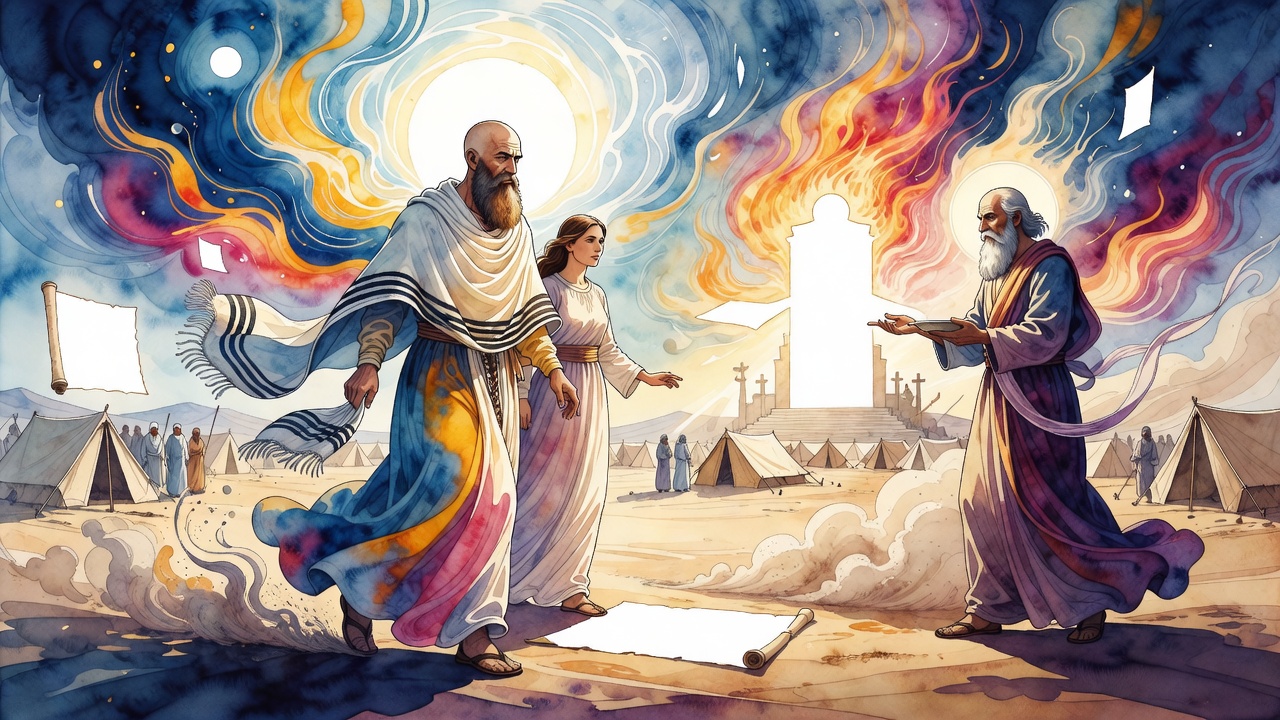
Korach left the Levite razor and walked among the camps unrecognizable. His wife sent him with a tallit. Moses refused his meal offering.

Curated by Arthur · Told by Maggid ·
Table of Contents
  1. A Levite Without Hair Becomes a Torch
  2. Aaron Adorned Like a Bride
  3. Do Not Accept Their Meal Offering
  4. The Ground Waits With an Open Mouth

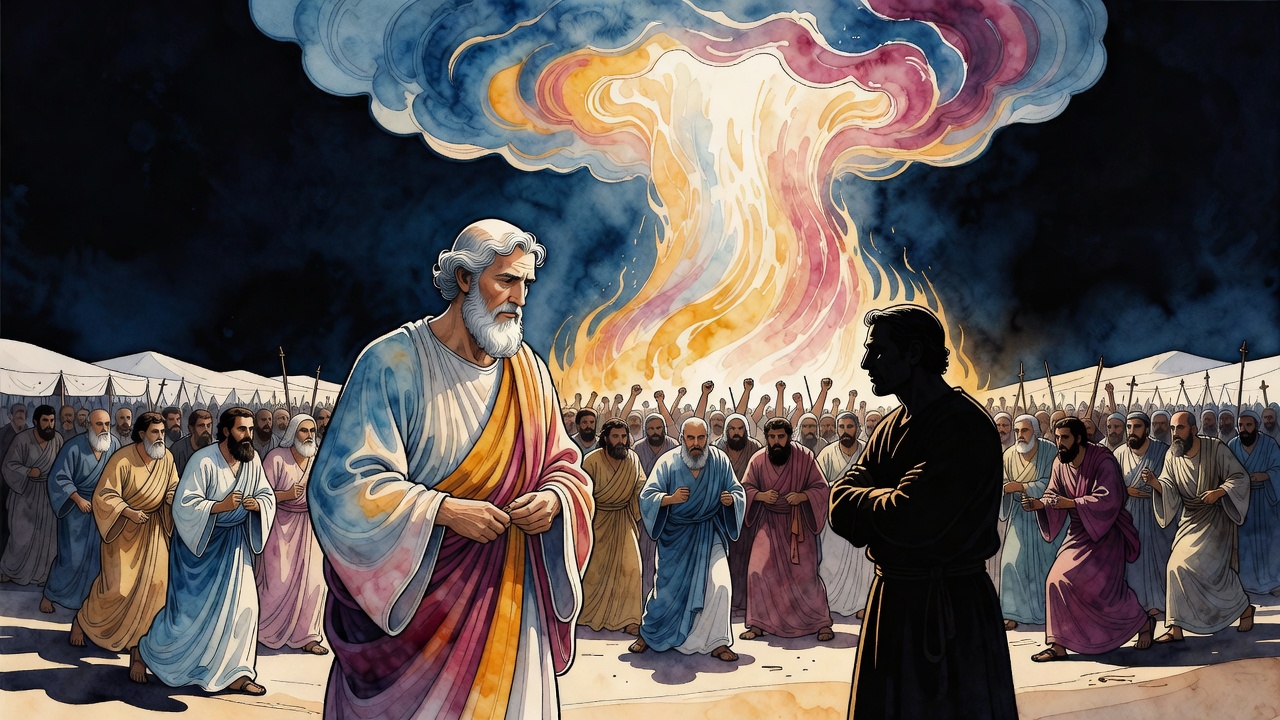
Korach took his prayer shawl and went to his wife for counsel. The Holy One had ordered the Levites purified with a razor over every bit of flesh, and Moses had done the work on Korach himself. The man who expected honor walked out smooth-headed, and the camps of Israel did not know his face.

Korach Shaved Himself and Stirred Israel to Revolt Click for full size

"Who did this to you?" they asked.

"Moses," he said. "He took me by the hands and by the feet, waved me, and said I was pure. Then he dressed his brother Aaron like a bride and seated him in the Tent of Meeting."

A Levite Without Hair Becomes a Torch

The enemies of Moses did not need a long speech. A shaved Levite made the argument for them. Moses is king. Aaron is high priest. Aaron's sons stand ready as deputy priests. The priest takes terumah. The priest takes a gift from the tithe. Twenty-four gifts stream toward one family while the rest of the tribe carries beams and ash.

They gathered against Moses and Aaron with the cry that the whole congregation was holy, and that the brothers had raised themselves above the assembly of the Lord (Numbers 16:3). Korach had begun with a private wound and ended with a public banner. The razor meant for purity became a scar he could show at every tent flap.

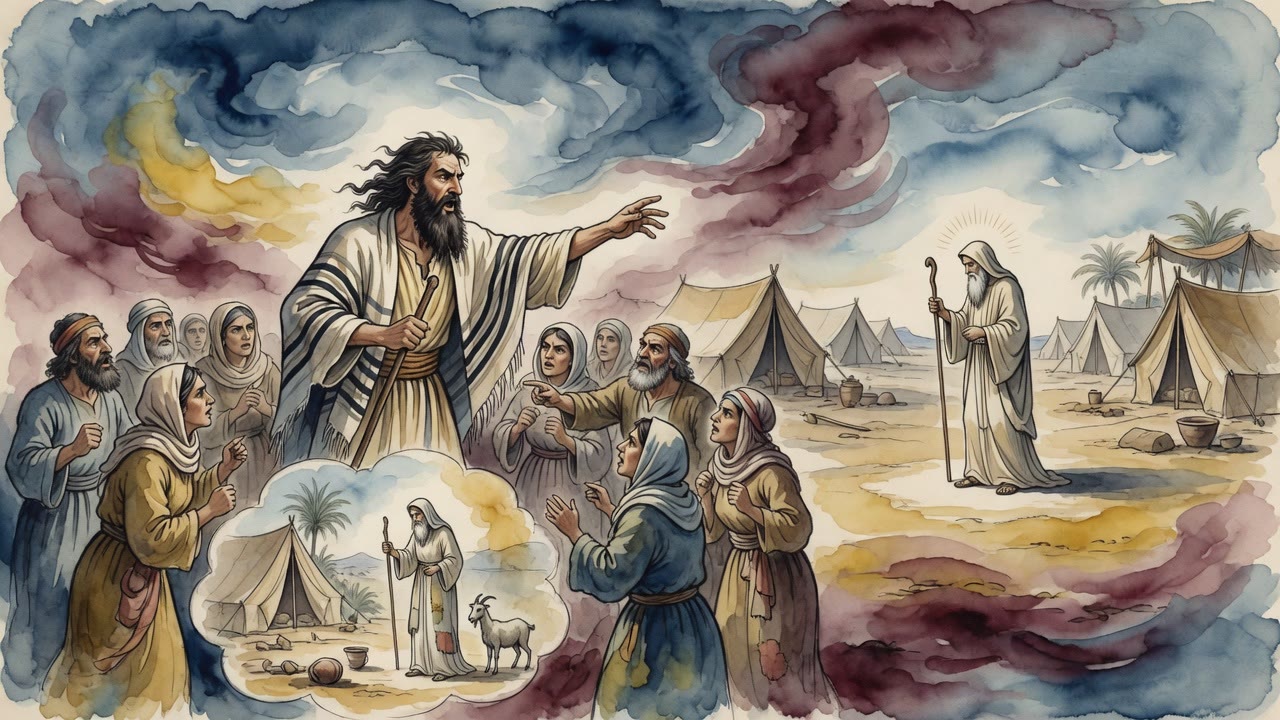
His wife had not stopped him. Counsel in the house became revolt in the camp. The tallit he took when the story opens was not for prayer alone. It was a prop for a man who wanted to look like the law while tearing at the men who held it. He wrapped himself in wool and walked the lanes like a teacher, and every question he answered pointed back to the same complaint. Why should one household drink from every cup?

Children pointed at his bare scalp. Elders who remembered Egypt whispered that the man who split the sea now split the tribe. Korach let the whispers grow. He did not need to invent envy. He only needed to give it a shaved head and a story.

Aaron Adorned Like a Bride

Korach's telling made Aaron's glory sound like theft. The high priest's garments were not a costume contest. They were the weight of blood and incense and the dread of entering the holy place with a wrong thought. But envy does not measure weight. It measures shine.

In Korach's mouth, the waving of the Levite body was humiliation, not consecration. Being lifted by hands and feet sounded like a child tossed for show. Moses heard the distortion and felt the camp tilt. The same man who had refused a throne in Egypt was now painted as a king who shaved rivals for sport.

Israel listened because the story was simple. One family rises. Everyone else scrapes the floor of the Mishkan (the portable sanctuary Israel carried through the wilderness). Simple stories travel faster than the long memory of the plagues. Men who had seen the sea stand like walls now nodded at a cousin's grudge as if it were Torah.

Aaron did not answer the parody. He still wore the bells on the hem that announced each step toward danger. The bridegroom image stuck anyway. Once a joke finds a priest's robe, it climbs faster than smoke.

Do Not Accept Their Meal Offering

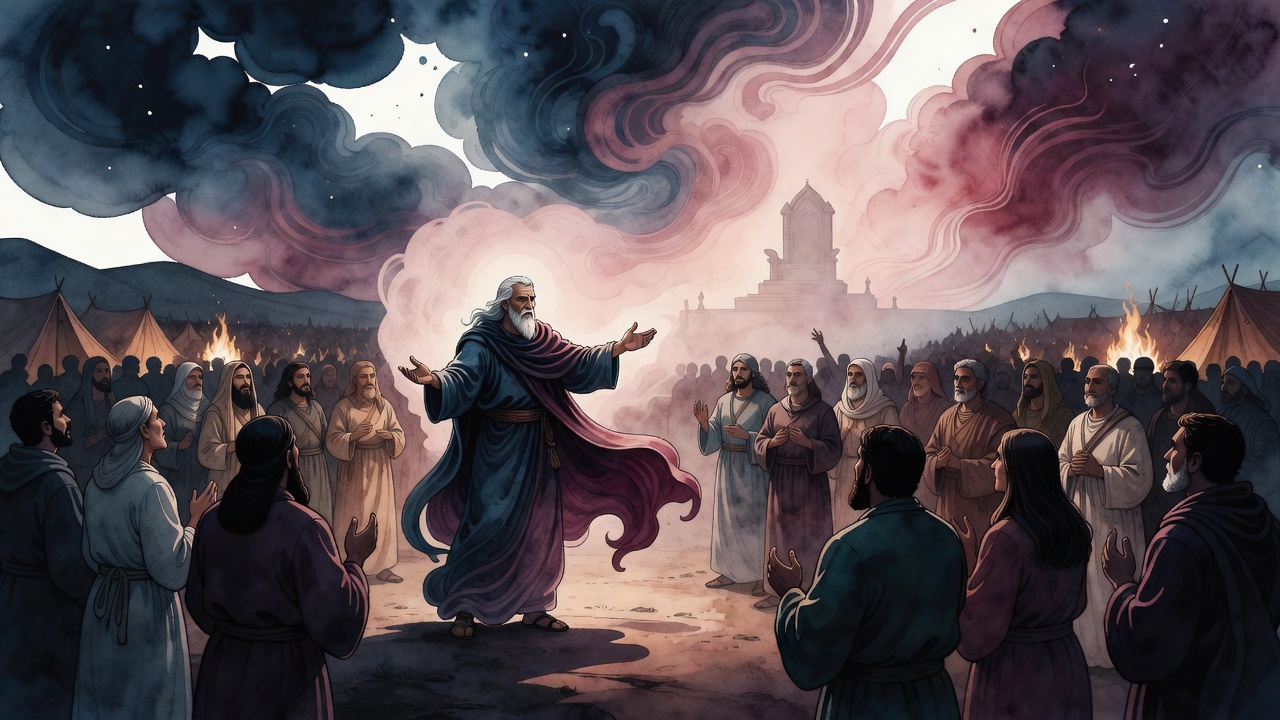
When the confrontation hardened, Moses fell on his face, then rose into a prayer as sharp as a blade. "Pay no attention unto their meal offering," he said to the Lord (Numbers 16:15). The verse should have said "their service." Moses aimed deeper. Israel brought a daily meal offering, and Korach's company still held a share in that gift as sons of Levi. Moses asked that their portion not rise. Let the fire leave it alone. Let the altar refuse the men who refused the camp.

He added a second claim that still burns. "I have not taken one donkey from them." A worker in a sanctuary usually takes wages from the sanctuary. When Moses came down from Midian to Egypt on Israel's behalf, custom would have allowed him a beast for the road. He took nothing. Samuel would later stand and ask the same question of a nation, whose ox, whose donkey, as if the line of honest prophets were one long refusal to bill the flock.

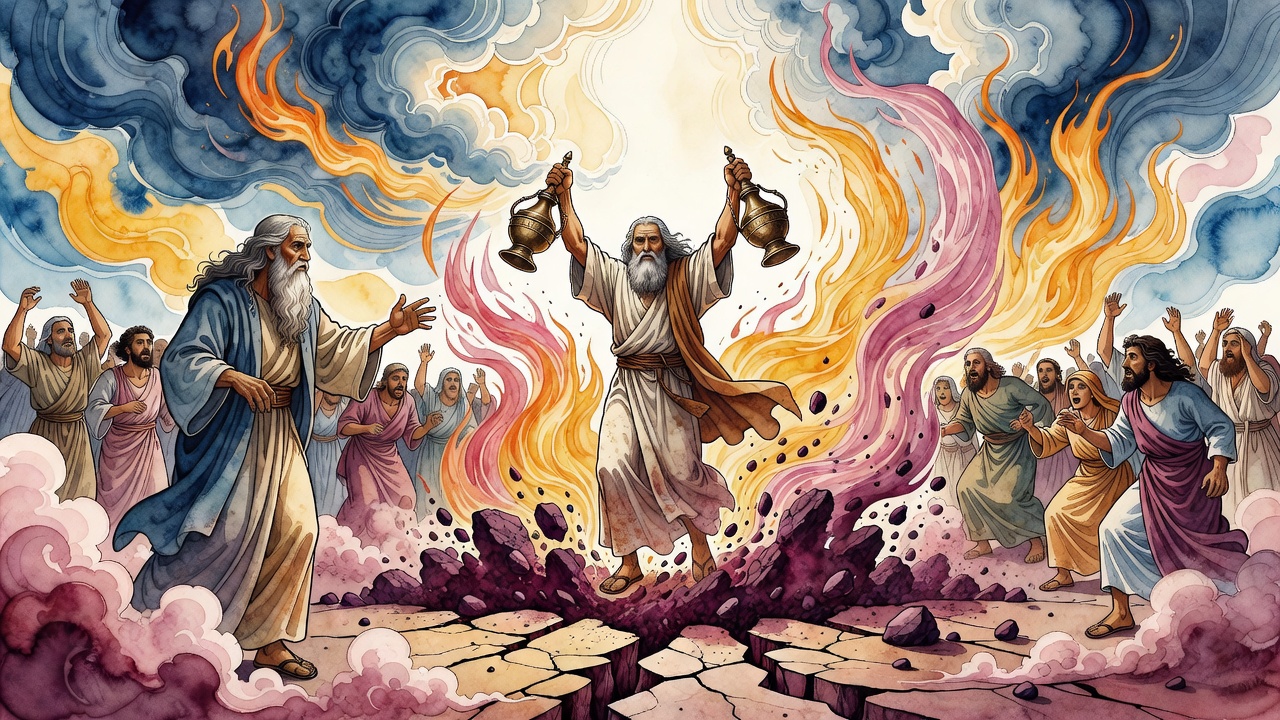
Korach wanted the gifts. Moses listed what he had never claimed. The quarrel was not only about rank. It was about whether holy work turns into a payroll for the loudest cousin. Dust stuck to Moses' knees from the ground where he had prayed. Korach's circle held fire pans already, as if metal could vote.

Night came down on two kinds of heat. One was the altar's steady hunger. The other was a coalition counting heads in the dark, sure that holiness was a majority opinion.

The Ground Waits With an Open Mouth

By morning the challenge would be settled with fire pans and incense, with the earth itself invited to judge. Korach still walked as if a tallit and a shaved scalp could rewrite Sinai. Aaron still wore the garments that marked him for a death he accepted daily. Moses still refused to bill Israel for a donkey.

The camp smelled of dust and argument. Children watched men choose sides. Somewhere a woman who had given counsel waited for the news that would make her house either famous or empty. Korach had taken his prayer shawl into that counsel the way another man takes a sword. He came out armed with a face the camps could pity and a speech the camps could chant.

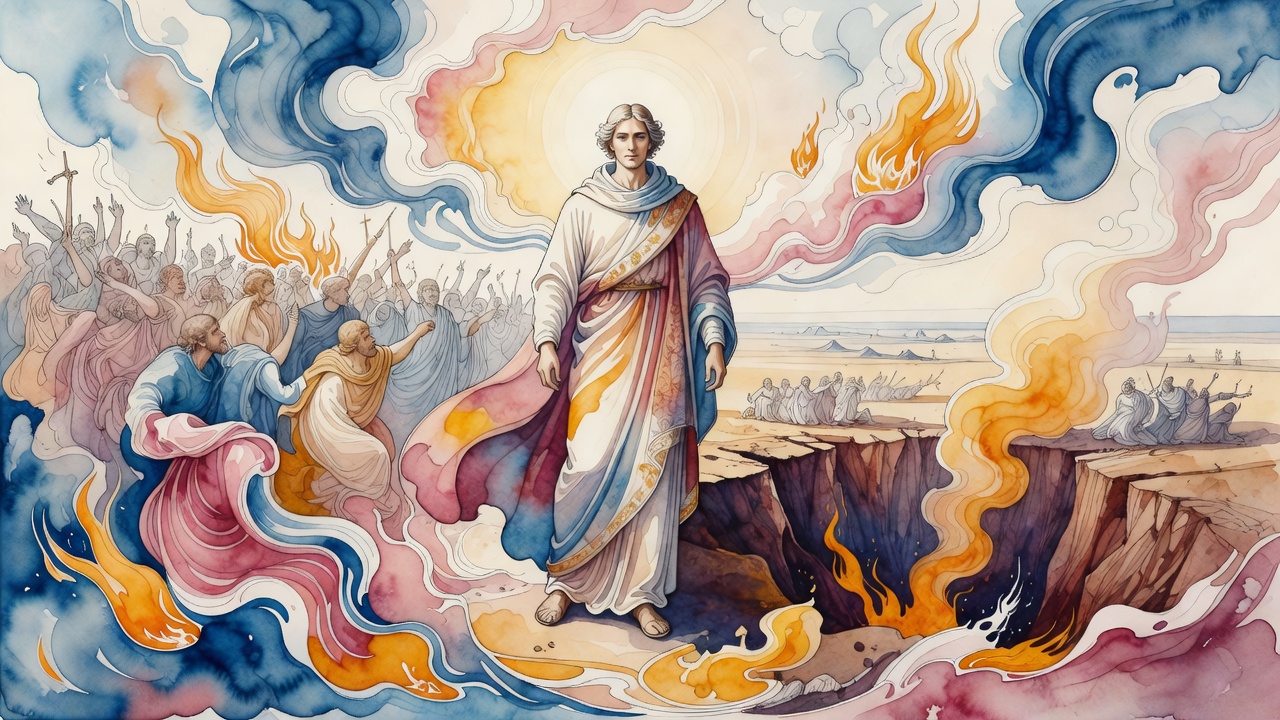
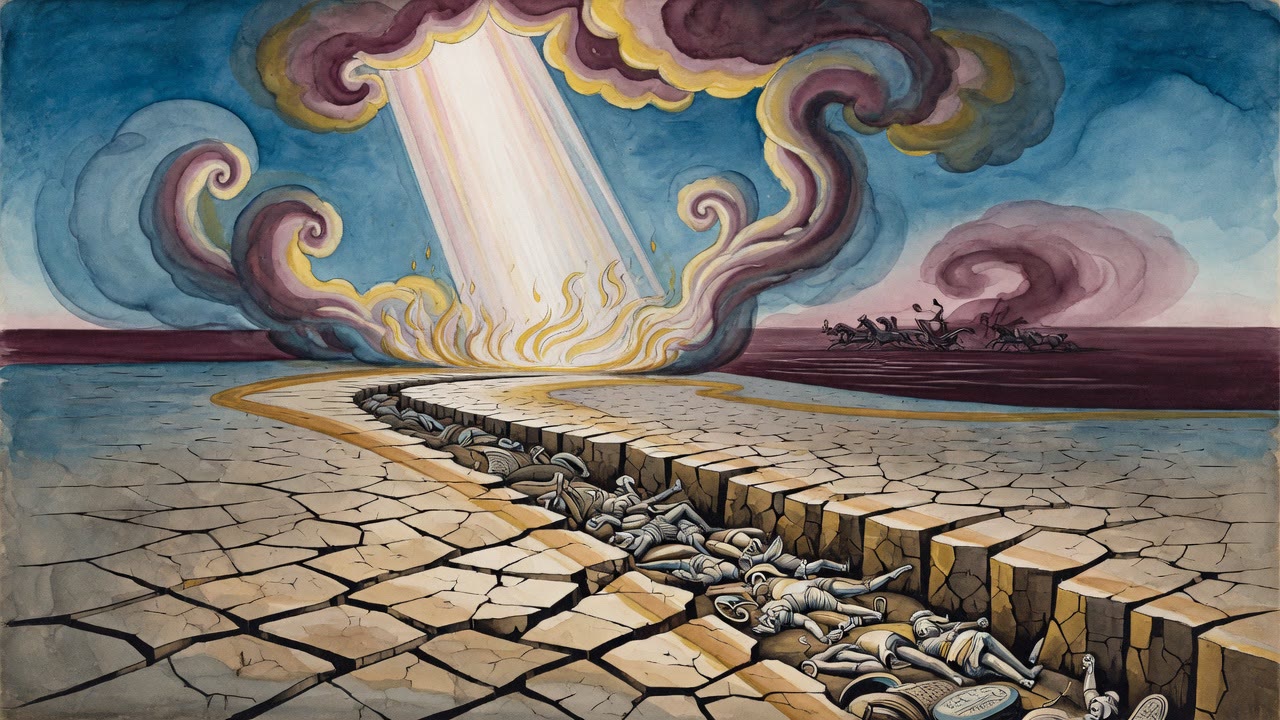
The ground under the tents remembered older mouths. It had opened for blood once in the first generation of brothers. It would open again for men who called themselves holy while they aimed at the Tent. Korach did not look down. He looked at Aaron's shine and called it theft, and the story that follows takes the soil from under his feet.


← All myths

From the tradition

Sources

2 sources

The texts behind this telling. Some cards carry a translation of the source; others are our own retelling of it, and each card says which. Every card links out to the original.

Midrash Tanchuma, Korach 3Midrash Tanchuma

Retold in our words. Read the original at the link below.Townsend 1989 translation of Midrash Tanhuma, S. Buber Recension · CC-BY

(Numb. 16:1:) “Now Korah […] took.” [What] he took [was] his prayer shawl and he went to get counsel from his wife. When the Holy One, blessed be He, said (in Numb. 8:6–7), “Take the Levites from among the Children of Israel and purify them. Now this is what you shall do for them to purify them [… and have them pass a razor over all of their flesh].” [Moses] immediately did so to Korah. [Korah] began to go around all Israel, but they did not recognize him. They said to him, “Who did this to you?” He told them, “Moses. And not only that, but taking me by my hands and by my feet, they waved me and said to me, ‘See, you are purified.’ Moreover, he brought his brother Aaron, adorned him like a bride, and had him sit in the tent of meeting.” The enemies of Moses immediately began to incite Israel against him. So they said, “Moses is king, his brother Aaron is high priest, and his children are deputy high priests! The priest has a priestly offering (terumah); the priest has a priestly offering from the tithe; the priest has twenty-four priestly gifts!” Immediately (in Numb. 16:3) “They gathered together against Moses and against Aaron, and they said unto them, ‘You have gone too far (rb), for all the congregation are holy, every one of them, and the Lord is in the midst of them; so why do you elevate yourselves over the community of the Lord?’” R. Levi said, “At that very time Korah gathered his company and said to them (i.e., to Moses and Aaron), ‘You have increased (rt. rbh) the burden upon us to be more than the slavery of Egypt. We were better off under the Egyptians than under your authority, for in each and every year fifteen thousand and forty-five of us die.’” Now they wished to stone him. [Therefore] (according to vs. 4), “When Moses heard this, he fell on his face.” Moses said to them, “I do not desire kingship, nor does Aaron [desire] high priesthood. Thus it is stated (in vs. 11), “and as for Aaron, what is he that you should murmur against him?” Moses said to the Holy One, blessed be He, “Master of the world, did you not command me thus (in Exod. 28:1), ‘And you shall bring near unto yourself Aaron [… to serve me as priests]?’ Now they have arisen against us to kill us.” [So Moses] said to them (in Numb. 16:5), “In the morning the Lord will make known those who [belong to Him…].” What does “morning” mean? R. Nathan said, “The Holy One, blessed be He, said, ‘If all the magicians of Egypt gathered together and tried to turn the morning into the evening and the evening into morning, they would be unable [to do so]; but just as I [formerly] separated the light and the darkness (in Gen. 1:4), so have I separated out Aaron to sanctify him in the holy of holies.’” Immediately (in Numb. 16:12), “Then Moses sent to summon [Dathan and Abiram…, but they said, ‘We will not come up.’” "We will not go" or "We will not come" is not written here, but “We will not come up.” (Prov. 18:7:) “A fool's mouth is his ruin!” They opened their mouth for a calamity, by saying that they would die by going down and not going up. Just as they spoke, so did they die (according to Numb. 16:33), “So they and all that belonged to them went down alive to Sheol.” Moses said, “In as much as they did not want to come [to me], I shall go to them. Perhaps they will be ashamed and repent.” It is so stated (in Numb. 16:25), “Then Moses arose and went unto Dathan and Abiram.” When they saw him they began to curse and blaspheme, as stated (in vs. 27), “and Dathan and Abiram came out standing (rt. ntsb).” Does one go out sitting, kneeling, or lying prostrate? It is simply that it is to teach that they went out cursing and blaspheming. As going out and standing upright (rt. ytsb) is mentioned here, and going out and standing upright (rt. ntsb) is [also] mentioned in reference to Goliath the Philistine, where it is written (in I Sam. 17:4, 16), “And there went out a champion [….] Then the Philistine drew near at dawn and in the evening, and he took his stand (rt. ytsb) for forty days.” Just as going out and standing upright (rt. ntsb) involved cursing and blaspheming in that case, so also in this case did going out and standing upright (rt. ntsb) involve cursing and blaspheming. Moses therefore began by saying (in Numb. 16:29, 32), “If these [people] die….” And it is also written (in Numb. 16:32), “And the earth opened its mouth [and swallowed them].” Come and see how [harmful] dissension is! As anyone who [even] aids dissension, the Holy One, blessed be He, eradicates his memory. Thus it is stated (in Numb. 16:35), “And a fire went forth from the Lord and consumed the two hundred and fifty men [coffering the incense].” R. Berekhyah said, “How harmful is dissension! An emissary of the court on high only imposes a penalty [on people] from the age of twenty years, while the court below [only imposes a penalty] from the age of thirteen years. In the case of Korah's dissension, however, one-day-old babies were burned and swallowed up in nethermost Sheol. Thus it is written (in Numb. 16:27, 33), ‘[and Dathan and Abiram came out standing at the entrance of their tents] with their wives, their children, and their little ones. So they and all that belonged to them went down alive to Sheol.’” It is therefore stated (Numb. 16:1), “Now Korah […] took.”

Full source
Midrash Tanchuma, Korach 7Midrash Tanchuma

Retold in our words. Read the original at the link below.Townsend 1989 translation of Midrash Tanhuma, S. Buber Recension · CC-BY

(Numb. 16:15, cont.) “And he said unto the Lord, ‘Pay no attention unto their meal offering.’” Do not accept them in repentance. Scripture should have said, “Pay no attention unto their service"? What is the meaning of “their meal offering?” This is what Moses said to the Holy One, blessed be He, “Master of the world, I know that these have a share in that meal offering that Israel offers every day. [But] in as much as these have withdrawn from Your children, do not pay attention to their portion. Let the fire leave it alone and not consume it.” (Numb. 16:15, cont.) “I have not taken one donkey from them.” That which I had [a right] to take I did not take. By universal custom, one who works in the sanctuary receives wages from the sanctuary. [In my case, however,] when I went down from Midian to Egypt I had a right to take a donkey from them, since it was on behalf of their needs that I was going down [there]; but I did not take [one]. Similarly also did Samuel the righteous say (in I Sam. 12:3), “Here am I, testify against me before the Lord and before His anointed; whose ox have I taken, or whose donkey have I taken?” When I sacrificed an ox for their offerings to seek mercy for them and likewise for anointing a king over them, it belonged to me, as stated (in I Sam. 16:2), “Take a heifer with you […].” And similarly it says (in I Sam. 9:12), “because the people have a sacrifice today at the high place (bamah).” But I took nothing from what belonged to them. Also when I sought to handle their lawsuits and their [other] needs, and when I made the circuit of the cities, as stated (in I Sam. 7:16), “And he went on a circuit year by year to Bethel, Gilgal, and Mizpah, and he judged Israel in all those places;” [although] by universal custom litigants go to the judge, I went around from city to city and from place to place. Now even Moses said to Israel (in Exod. 18:16), “When they have a matter, it comes unto me.” But I (Samuel) did not act in this way. Instead I took the trouble to go to them. (Numb. 16:15, cont.) “’And I have not harmed a single one of them,’ in that I neither convicted the innocent nor acquitted the guilty.” When Moses saw that they continued in their pride and in their rebellious acts, then (according to Numb. 16:16-18) “Moses said unto Korah, ‘[Tomorrow] you and all your company [are to be present before the Lord: [you, they, and Aaron]; And let each one take his censer […].’ So each one took his censer.” Then Korah went about all that night and led Israel astray. Now he would say to them, “What do you suppose? That I am busy obtaining greatness for myself? I wish for greatness to go the rounds to all of us, while Moses has taken kingship for himself and has given the high priesthood to his brother Aaron as an eternal statute.” So did he go about seducing each and every tribe as it suited them, until they joined him. How is it shown that when they entered and approached, they were all speaking? It is so stated (Numb. 16:19), “And Korah gathered all the congregation against them.” When they entered and came with him, immediately (we read in Numb. 16:20–21), “Then the Lord spoke unto Moses and unto Aaron, saying, ‘Separate yourselves from the midst of this evil congregation, [so that I may consume them in a moment].’” (Numb. 16:22:) “But they fell on their faces and said, ‘O God, the God of all human spirits, [shall one person sin and You become angry with the whole congregation]?’” They said to him, “Master of the world, in the case of a king, when a province rebels against him, when they persist in cursing the king or his deputies, ten or twenty of them, he sends out his legions and carries out reprisals against it. So he kills the good with the evil, because he does not know who among them has rebelled and who has not rebelled, who has honored the king and who has cursed him. You, however, know the thoughts of every person, even what the hearts and the reins counsel. So You know who has sinned and who has not sinned, for You know the spirit of each and every person.” It is therefore stated (in Numb. 20:22), “O God, the God of all human spirits.” The Holy One, blessed be He, said to them, “You have spoken well. I am making the matter known, who has sinned and who has not sinned.”

Full source