Parshat Korach5 min read

Moses Gives Korach One Night Before Fire

Two hundred fifty men want the altar by nightfall. Moses buys them until morning, hoping sleep will unmake a rebellion.

Curated by Arthur · Told by Maggid ·
Table of Contents
  1. The Camp Wants the Altar Tonight
  2. Why Morning and Not Now
  3. Censers Like a Soft Poison
  4. Gentle Words Before the Hard Ones
  5. Night Holds the Camp Like a Fist
Moses Gives Korach One Night Before Fire Click for full size

The Camp Wants the Altar Tonight

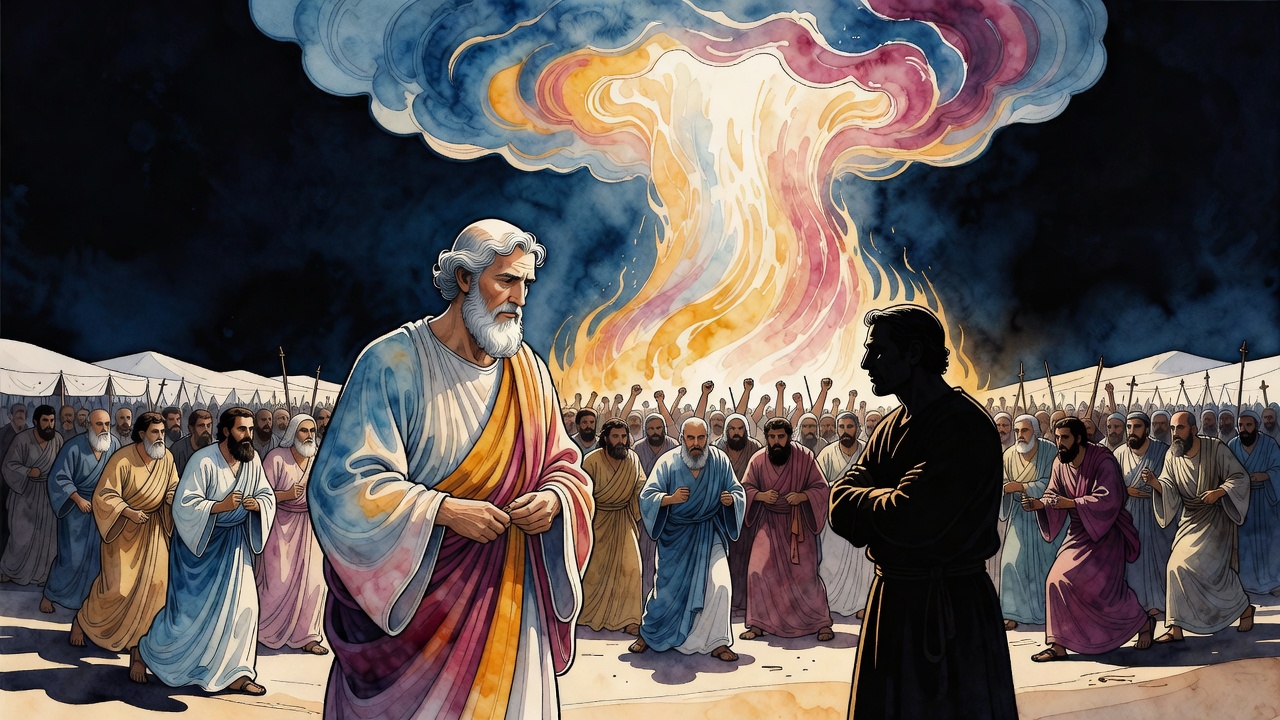
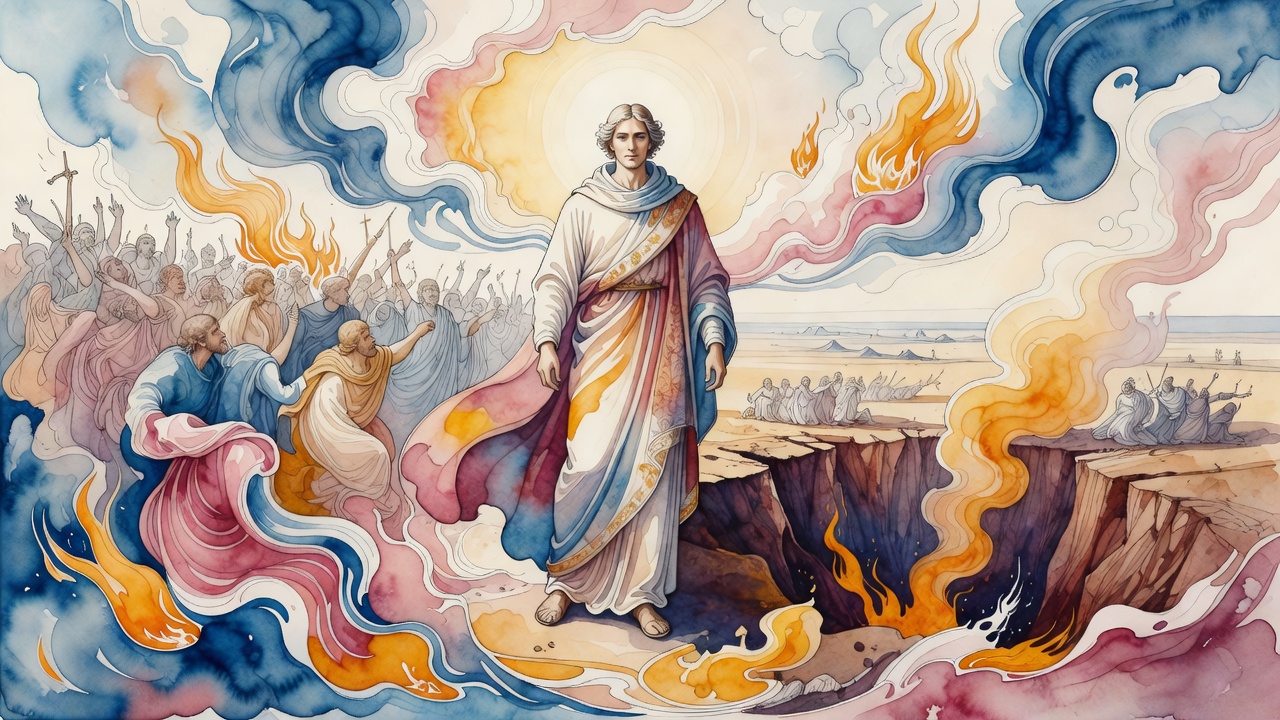
Korach did not whisper. Two hundred fifty men stood with censers in their hands and hunger in their throats for the high priesthood. One God, one Torah, one altar, one high priest: and still they came as a crowd to seize what only one man could wear.

Moses looked at the faces flushed with argument and the day's heat. He did not open the tabernacle. He did not call fire down at dusk. The sun was dropping, and with it the chance to end the quarrel before sleep.

"In the morning," he said, "the Lord will make known those who belong to Him" (Numbers 16:5).

Korach's people heard delay and called it weakness. Moses heard a gap wide enough for a man to turn around inside.

Why Morning and Not Now

Moses told himself what he would not put in a decree. Perhaps they had eaten and drunk too much. Perhaps the heat of the quarrel was half a full stomach. Give them night. Give them empty mouths and cooler blood. Between now and dawn, a man can still turn around.

He said he had no authority to enter the tabernacle now, as if the hour itself forbade holy risk. The delay was mercy dressed as procedure. He would not stage a capital test while tempers were still sticky with the day's talk.

Another word lived under the first. God had set boundaries in the world: evening and morning, light and darkness, Israel and the nations, Aaron set apart to consecrate the most holy things (I Chronicles 23:13). If you can confuse morning with evening, Moses told them, then you can nullify this too. Until you can, wait for morning.

The separations of creation became a fence around the priesthood. Korach wanted to step over the fence while calling the step holiness.

Censers Like a Soft Poison

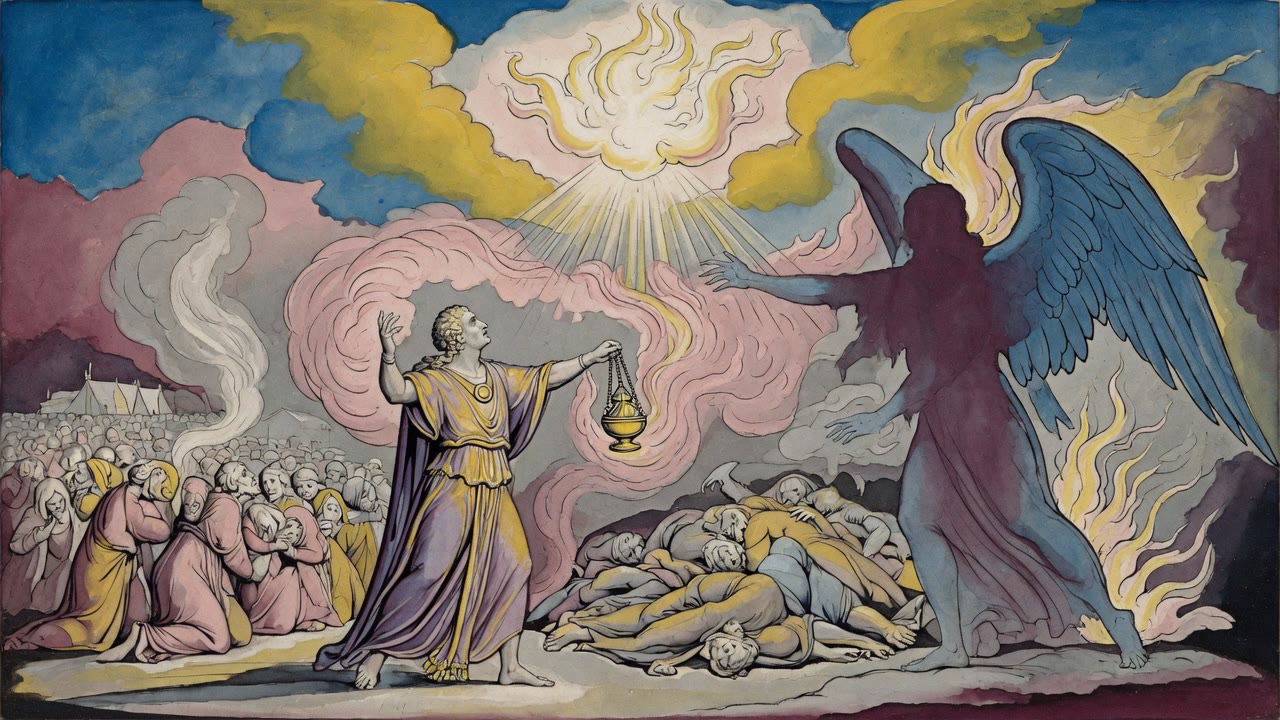
"Do this," Moses said. "Take censers. Place fire in them." He offered them the work that looks most like honor: incense, precious among offerings. He also handed them the tool that had already burned Nadab and Abihu.

He warned them in the same breath. Only the one the Lord chooses is the holy one. Two hundred fifty souls do not all walk out of that fire as priests. He said he was willing even for his own part in the test, so they would hear fairness and not only refusal.

The censers flashed in the late light. The men did not put them down. Brass caught the last sun and threw it back like a set of small, angry moons. Moses watched hands that would not open.

He had given them a path that looked like promotion and smelled like the grave of two older priests. They chose the shine.

Gentle Words Before the Hard Ones

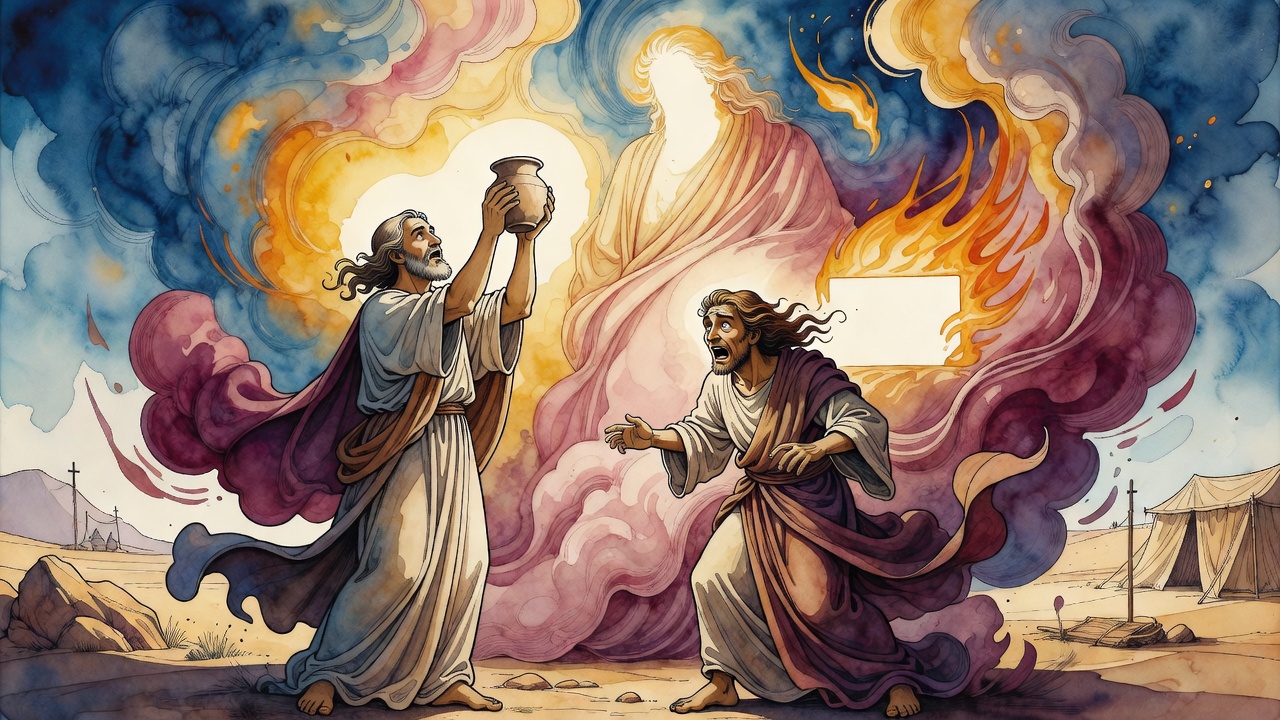
Moses turned to Korach with a softer voice first, the way a man speaks to a brother who still might hear. "Please listen, you children of Levi." Is the honor you already have too small? God drew you near. Your brothers stand with you because you stand at the head.

When Korach did not bend, Moses widened the circle. Before others joined the stubborn core, let them reconsider. He told them the quarrel was not against Aaron's personality. It was against the One who had given Aaron the oil and the office.

A king frees a slave and seats him among senators. If the freed man had stolen the seat, the others might rise. When the master himself seats him, a rising is a rising against the master. "As for Aaron, what is he that you murmur against him?" (Numbers 16:11).

Aaron, for his part, had once trembled under that oil, afraid he was not worthy. The rebels did not remember the tremble. They remembered only the title.

Night Holds the Camp Like a Fist

Darkness came. The censers cooled in hands that would not open. Some men slept. Some rehearsed speeches for a morning that would not be a debate club. Wives asked questions that got short answers. Children felt the camp's mood the way animals feel weather.

Moses waited for a repentance that did not arrive in time. He had bought hours with a sentence. They spent the hours sharpening the same claim.

Morning would make known who belonged to God. Morning would also make known who had spent the bought hours hardening instead of turning. The earth under their tents was still closed. It would not stay closed for every name in that company.

The night Moses purchased sat between a living camp and an open mouth in the ground. He had paid for it with patience. They spent it on pride. When the sun returned, the test he had delayed arrived on schedule, and the censers went with the men who would not put them down.


← All myths
From the tradition

Sources

2 sources

The texts behind this telling. Some cards carry a translation of the source; others are our own retelling of it, and each card says which. Every card links out to the original.

Midrash Tanchuma, Korach 5Midrash Tanchuma

Retold in our words. Read the original at the link below.Townsend 1989 translation of Midrash Tanhuma, S. Buber Recension · CC-BY

(Numb. 16:5:) “In the morning [the Lord will make known those who belong to him].” What reason did he have for saying, “In the morning He will make known?” Moses said, “Perhaps they said this thing because they had been excessively eating and drinking.” He therefore said, “In the morning.” Perhaps between now and then they will repent. He said to them, “I have no authority to enter [the tabernacle] now. Even though there is no eating and no drinking, it is simply because of us [that we are forbidden to enter] as we have taken food and drink.” Another interpretation (of Numb. 16:5), “In the morning.” Moses said, “The Holy One, blessed be He, has distinguished boundaries for those in His world. And that is what is written in the beginning (in Gen. 1:5), ‘There was evening and there was morning.’ And (in vs. 4) ‘God separated the light and the darkness,’ for its use in the world. And just as he made a separation between the light and the darkness, so did he separate Israel from the nations, [as stated] (in Lev. 20:26), ‘I have separated you from the [other] peoples to be Mine.’ So also did he separate Aaron, as stated (in I Chron. 23:13), ‘Aaron was separated to consecrate the most holy things.’ If you can confuse those distinctions in which he made a separation between the day and the night, you may be able to nullify this.” For this reason he said to them (in Numb. 16:5), “In the morning the Lord will make known [those who belong to Him].” Such a one is already designated; (according to ibid., end) “the one whom He will choose He will have draw near unto Him.” (Numb. 16:6:) “Do this; take censers, [Korah and all his company].” What was his reason for saying this to them? He said to them, “In the religions of the nations there are many laws, and they do not all assemble in one house. Now as for us, we only have one God, one Torah, one justice, one altar, and one high priest; but you two hundred and fifty men are [yet all] seeking high priesthood! I also am willing in this regard.” (Numb. 16:11:) “Therefore you and all your company” have come together against the Lord. (Numb. 16:6 -7:) “Do this, take censers. And place fire in them.” Here you have a ministry more precious than all the others. It is the incense, the most precious of the sacrifices. But a deadly poison had been put within it, through which Nadab and Abihu were burned. He therefore warned them (in vs. 7, cont.), “then it shall come to pass that the man whom the Lord chooses is the holy one,” And do we not know that the one that the Lord chooses is the holy one? It is simply that Moses said to them, “See, I am telling you that you are not to incur guilt on your two hundred and fifty souls, because when you sacrifice, [only] the one to be chosen from among you shall come out alive, and all [the rest] of you shall perish.” (Numb. 16:7:) “You Levites have gone too far!” See, I have told you a great thing! Were they not fools, in that when he gave them this warning, they took it upon themselves to offer sacrifice? They had sinned against their own lives, as stated (in Numb. 17:3), “The censers of these who have sinned at the cost of their lives.” Now since Korah was a clever man, how did he see fit to commit this folly? It is simply that his eyes misled him. He foresaw a great lineage stemming from himself, [e.g.,] Samuel, who was the equivalent of Moses and Aaron, as stated (in Ps. 99:6), “Moses and Aaron among his priests, and Samuel among those who call His name.” Moreover, the twenty-four [Levitical] shifts would stem from his descendants, all of whom would prophesy by the holy spirit, as stated (in I Chron. 25:5), “All these were sons of Heman, the king's seer in matters pertaining to God for his greater glory.” He said, “Is it possible that, when this greatness is going to stem from me, I should perish?” But he did not foresee correctly, since his children would repent, and those [great ones] would stem from them. But Moses did foresee well. He therefore participated on this assumption, when he heard from the mouth of Moses that they all would perish, but one would escape, as stated (Numb. 16:7) “then it shall come to pass that the man whom the Lord chooses is the holy one.”

Full source
Midrash Tanchuma, Korach 6Midrash Tanchuma

Retold in our words. Read the original at the link below.Townsend 1989 translation of Midrash Tanhuma, S. Buber Recension · CC-BY

(Numb. 16:7-8:) “You Levites have gone too far! So Moses said unto Korah, ‘Please listen, you Children of Levi.” Do you have someone speaking with Joseph, who tells Simon to listen? Some say that he wished him to reconsider. So he said gentle words to him. When he saw that he did not listen to him, he said (to himself), “Before others join with him, they should reconsider.” He began to urge them (in Numb. 16:8), “’Please listen, you Children of Levi,’ is the honor that you have too little.” It is so stated (in vs. 9) “Is it too small a thing for you […]?” He turned again to Korah (in vs. 10), “That he has had you approach Him and all your brother Levites along with you?” [It was] because he was the head person in the tribe, that his brothers had become an extension of himself. (Numb. 16:11:) “Therefore you and all your company have come together against the Lord.” Is this dissension which you are creating against us? Is it not rather against the Holy One, blessed be He? It is comparable to a king who had a lot of slaves. He wanted to make one of them a freedman and give him a dominion. He reconsidered and [even] made him [one of the] senators. His companions rose up against him. If he had made himself a freedman and taken this dignity for himself, it would have been well for them to rise up against him. Now that his master has acted for him, when anyone rises against him, is not such a one rising up against his master? So also did Moses say to them, “If my brother Aaron had taken the priesthood for himself, it would have been well for you to murmur against him. [But since] the one who gave it to him was the Holy One, blessed be He, to whom belong royalty, high office and power, whenever someone rises against my brother Aaron, is he not taking sides against the Holy One, blessed be He?” It is therefore written (in Numb. 16:11), “and as for Aaron, what is he that you murmur against him?” Come and see the piety of Aaron the righteous! When Moses stood Aaron up and poured the anointing oil upon his head, Aaron trembled with fear. He said to him, “Moses my brother, perhaps I was not worthy to be anointed with the anointing oil; for I may have acted fraudulently and become liable to excision, since it is stated (in Exod. 30:32), ‘Upon human flesh it shall not be poured.’” Therefore, the Holy One, blessed be He, has testified over him (in Ps. 133:1-3), “See how good and pleasant it is […]! It is like the precious oil upon the head running down onto the beard, the beard of Aaron […]; Like the dew of Hermon….” [Scripture] has compared the anointing oil with the dew of Hermon. As the dew of Hermon has no [rules concerning] fraudulent use, neither does the anointing oil that was on the head of Aaron have [rules concerning] fraudulent use. It is therefore written (in Numb. 16:1), “[Therefore you and all your company] have come together against the Lord.” With all these words Moses [tried to] appease Korah, but you do not find that he gave him any answer. Because he was clever in his wickedness, he said [to himself], “If I answer him, I know that, since he has great wisdom, he will now overwhelm me with his words and seduce me into being reconciled with him against my will. It is [hence] better that I not respond to him.” When Moses saw that there was nothing to be gained with him, he withdrew from him. (Numb. 16:12:) Then Moses sent to summon Dathan and Abiram. They also persisted in their wickedness and did not care to answer him (ibid., cont.), “and they said, ‘We will not come up.’” Their [very] mouths tripped up [these] wicked men, for a covenant is made with the lips. So they went down to Sheol, as stated (in Numb. 16:33), “So they and all that belonged to them went down alive to Sheol.” After they had gone down alive to Sheol, they died. (Numb. 16:13:) “Is it so small a matter that you have brought us up from a land flowing with milk and honey to kill us in the desert, [that you must also lord it over us]?” They said to him, “On what basis do you assume superiority over us? What good have you done with us? You brought us out of the land of Egypt, which was (according to Gen. 13:10) “like the garden of the Lord”; but you have not brought us into the land of Canaan. Rather here we are dying in the desert, where the plague is sent among us every day; (according to Numb. 16:14) ‘would you put out the eyes of these people….’” (Numb. 16:15:) “Now Moses was very angry.” He was very anguished. To what is this comparable? To a man who argues with his companion and reasons with him. When he answers him, he has peace of mind; but if he does not answer him, then this involves great anguish.

Full source