Parshat Tetzaveh5 min read

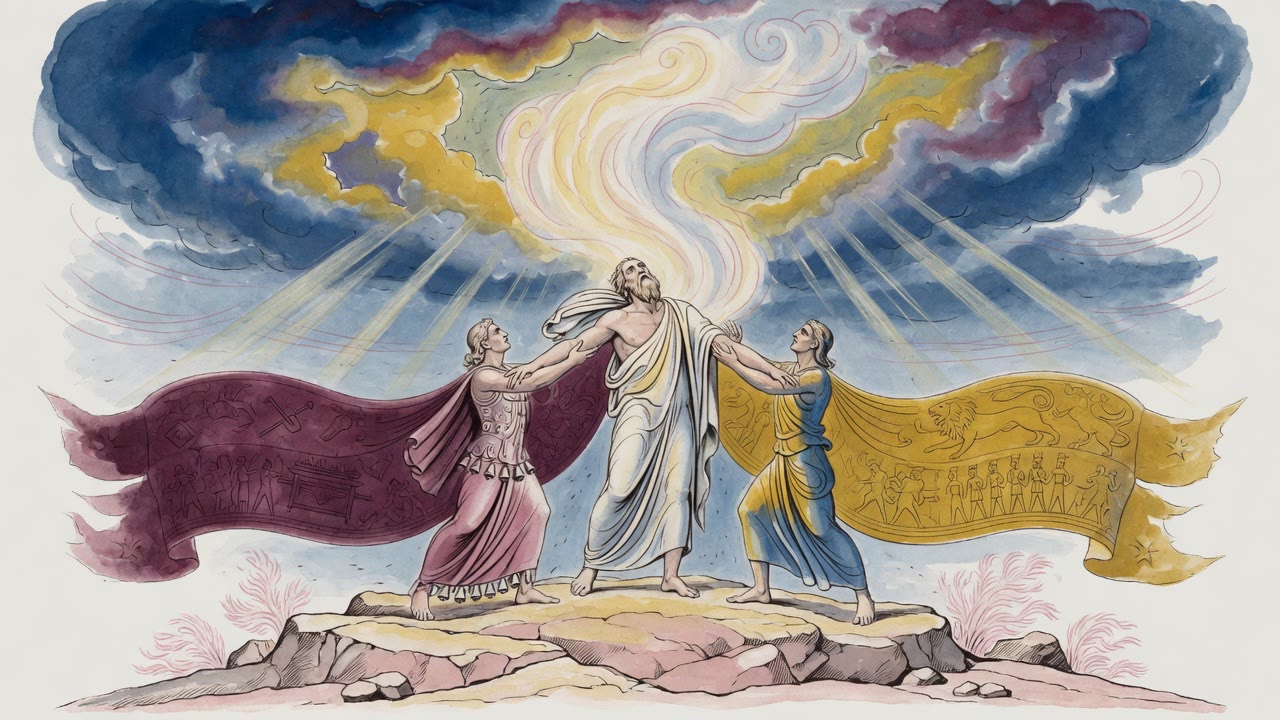
Moses Holds Aaron Back from the Tent Door

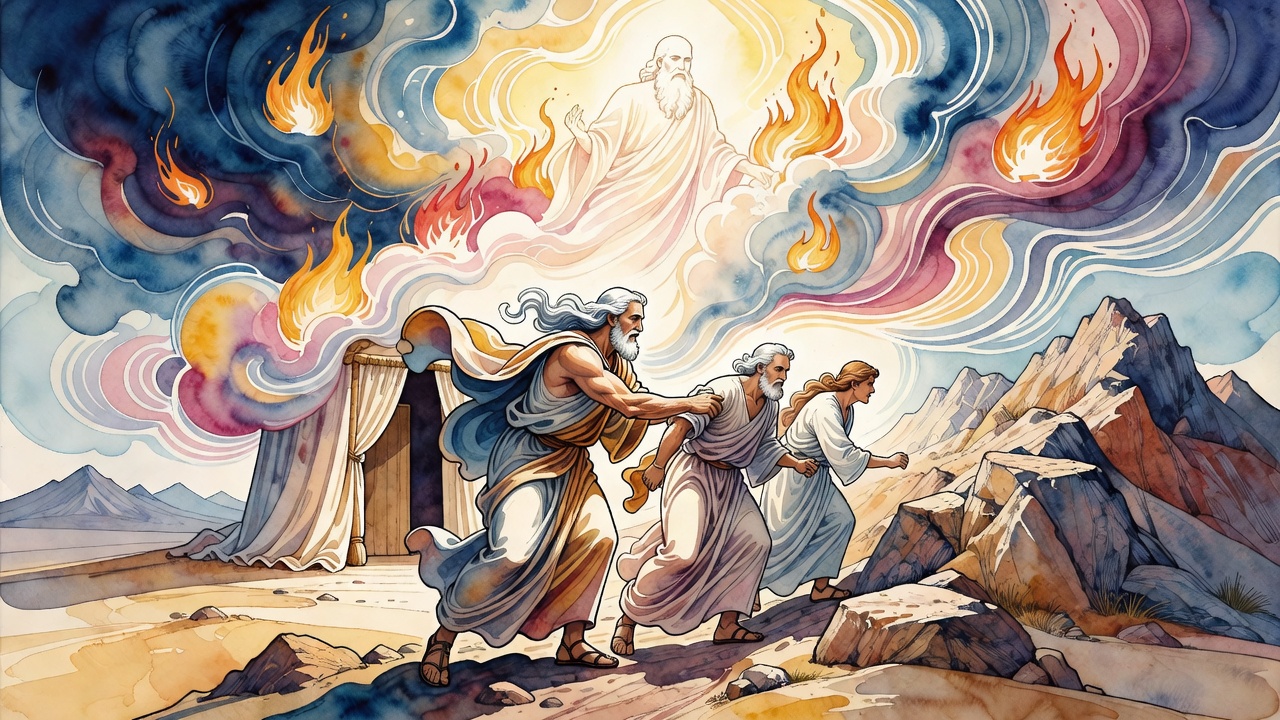
Aaron rushes the Tabernacle door to begin, but Moses pulls him beyond the camp, up a mountain with Eleazar, toward a word still unsaid.

Curated by Arthur · Told by Maggid ·
Table of Contents
  1. The Door That Waited
  2. Three Climb
  3. This Oil, Not Forever
  4. Return Without the Easy Door
Moses Holds Aaron Back from the Tent Door Click for full size

The Door That Waited

Aaron reached the Tabernacle with the hunger of a man finally given work that fits his hands. Curtains. Altars. The smell of new wood and oil. He wanted the threshold. He wanted the first service to begin under his own feet.

Moses stopped him. We shall now go beyond the camp. Not inside. Outside. Away from the holy furniture Aaron had been dressed to serve. The high priest's first lesson was delay. Desire for the sanctuary met a brother's arm across the door.

Aaron's face asked the question his mouth then spoke once they stood in open ground. Tell me the commission God has given you. Moses answered with more waiting. Wait until we reach the mountain. Revelation had a geography. It would not be rushed at the curtain's edge.

Three Climb

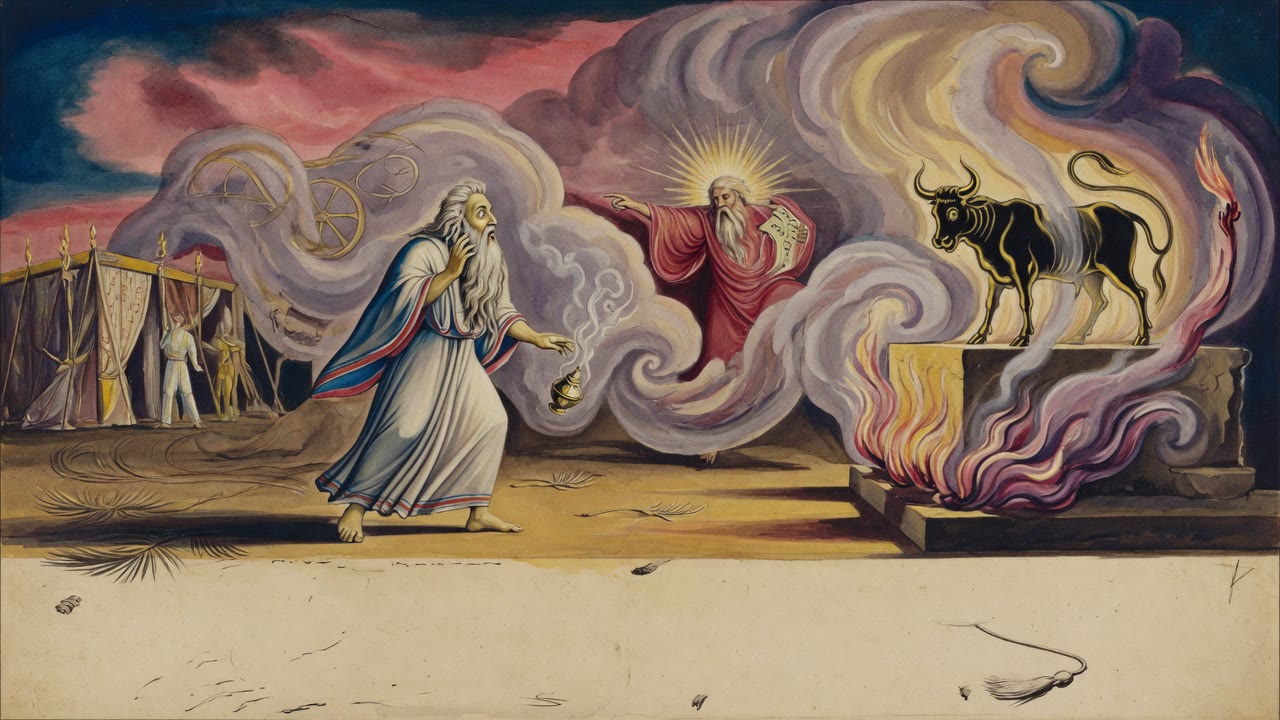
At the mountain's foot Moses turned to the people. Stay here until we return. I, Aaron, and Eleazar will go to the top of the mount, and we shall return when we have heard the Divine revelation. The camp became a held breath. Three men climbed with a silence that weighed more than tools.

Eleazar walked between uncle and father, heir to a service he had not yet touched. Aaron climbed with oil still imagined on his beard and a door still unopened behind him. Moses climbed as the one who knew the next word and refused to spend it early.

Stone under sandals. Wind that had known Sinai before any tent. Whatever waited at the summit was not a public spectacle. It was a narrowing. Priesthood would begin with listening in thin air, not with Aaron's first confident step into the Holy Place.

This Oil, Not Forever

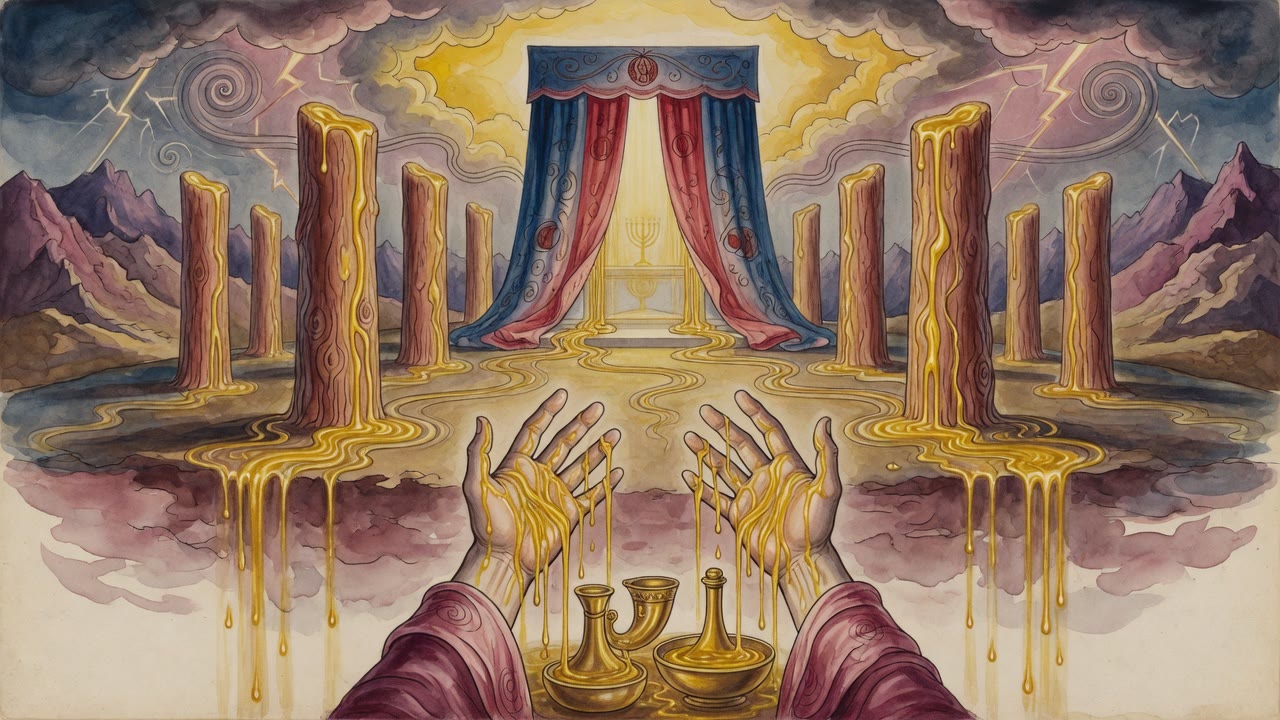
Later teachers would press the word this against the anointing of altar and priests. This was the dedication. This is the anointment of Aaron and of his sons. Not a river of oil that runs through every future age without limit. The Tabernacle's day of anointing was singular. The Second Temple would stand without that same pour. Even messianic hope does not simply reprint the first ceremony as endless copy.

David and Aaron stand as two anointed claims in one prophetic image. One seeks kingship. One seeks priesthood. Neither claim is casual grease. Each is a corridor of office that heaven marks and limits. Aaron's climb was the body learning what the later midrash would name in grammar. This, not every day. This mountain, not every door Aaron might choose.

The people below could not hear the summit. They only knew their leaders had gone up without them and that the Tabernacle still waited like a sealed letter.

Return Without the Easy Door

When the three came down, Aaron would enter at last, but the memory of the held-back hand would travel with him. Holiness is not only the room. It is the order of approach. Beyond the camp first. Mountain second. Word third. Curtain last.

Eleazar carried the climb in his bones for the years when he would wear the garments after his father. Moses carried the burden of sequencing other men's eagerness. Aaron carried the bruise of love that refuses a premature step into glory.

In the camp, someone had already begun to argue about gifts and portions and which tribe had brought what to the dedication. That noise would find its answers in other hours. For this hour the story is simpler and stranger. The priest who longed for the tent was taught the long way around, so that when he finally crossed the threshold, he would know the office was given, not seized.

Night settled on boards and sockets. Oil waited in its horn. The door that had been refused in the morning would open under a discipline the mountain had written into three sets of feet.

Halfway up the slope, Aaron's heel slipped on loose stone. Eleazar caught his father's elbow without a speech. The gesture was small and priestly in its own way. Hold what is holy. Hold what is falling. Hold the man who will soon hold the people.

Below, someone started a song and stopped, unsure whether music belonged to a day when leaders vanished into cloud and rock. Dogs barked once and fell quiet. The Tabernacle's gold caught a late angle of sun and threw it back like a question Aaron could still see when he looked over his shoulder.

Moses did not look back. Looking back would have invited the camp's impatience into the climb. He kept the pace of a man carrying a sealed word. When they reached the place of hearing, the wind thinned, and even Aaron's eagerness learned a colder grammar. Service would be loud with bells later. First it had to be quiet enough to receive.

On the way down, dust filmed their ankles. The door of the tent waited with the same patience as before. Aaron's desire had not died. It had been trained. That training would outlast any single day's anointing oil.


← All myths

From the tradition

Sources

2 sources

The texts behind this telling. Some cards carry a translation of the source; others are our own retelling of it, and each card says which. Every card links out to the original.

Legends of the Jews 5:63Legends of the Jews

Retold in our words. Read the original at the link below.The Legends of the Jews by Louis Ginzberg (1909) · Public Domain

The story isn't quite so simple.

In Legends of the Jews, Aaron, eager to begin his sacred duties, headed straight for the Tabernacle. But Moses stopped him. "," Moses said "we have to go beyond the camp first."

Beyond the camp? What was that about?

Once they were outside, Aaron, naturally curious, asked Moses to tell him exactly what God had commanded. But Moses, again, held back. "Wait until we reach the mountain," he replied.

Talk about building suspense!

Finally, at the foot of the mountain – and we're not told exactly which mountain, though we can assume it's Mount Sinai where so much Divine communication occurred – Moses addressed the people. "Stay here," he instructed, "until we return. Aaron, Eleazar, and I will go to the top of the mount. We'll come back once we've heard the Divine revelation."

And so, the three of them, Moses, Aaron, and Eleazar, ascended.

Isn’t it fascinating how even after such a monumental event as Aaron's appointment, there's still this element of mystery, this sense of anticipation? What was so important that it needed to be revealed outside the camp, and then only on the mountain? What was this Divine revelation they were about to receive?

It leaves you wondering, doesn't it, about all the unspoken moments, the untold stories that shape the grand narratives we know so well. What do you think was going through Aaron's mind at that moment? What was the significance of going "beyond the camp"? Food for thought,.

Full source
Bamidbar Rabbah 14:13Bamidbar Rabbah

Retold in our words. Read the original at the link below.The Sefaria Midrash Rabbah, 2022 · CC-BY

The core of the discussion revolves around the verse, “This was the dedication of the altar” (Numbers 7:88). The midrash (rabbinic interpretive commentary) asks, is this a one-time event, or does it imply a continuous anointing? The answer, according to this interpretation, is a resounding "no." "This," the text emphasizes, signifies a limit. The altar was anointed only in the Tabernacle, not during the Second Temple period, and not in the Messianic Era. This is according to the Etz Yosef commentary, which suggests that the "future" mentioned in the midrash actually refers to the time of the Second Temple.

That even something as seemingly eternal as the dedication of the altar has a specific time and place.

The text then extends this line of reasoning to the anointing of Aaron and his sons. Again, the verse "this is the anointment of Aaron and the anointment of his sons" (Leviticus 7:35) is interpreted as a limitation. They will not be anointed again. But what about the verse in (Zechariah 4:14), "These are the two anointed ones"? The midrash resolves this apparent contradiction by identifying them as Aaron and David, each seeking their respective domains: priesthood and kingship. Aaron seeks his priesthood, and David seeks his kingship.

This interpretation highlights a crucial distinction between different forms of leadership and authority, each with its own unique anointing and purpose.

The passage then shifts its focus to the offerings brought on the day of the altar's dedication. It explores the timing: Did the offerings occur on the day of the anointing, or after? It seems the Midrash is teasing out a potential ambiguity in the text, and then resolving it. Rabbi Shimon clarifies that Israel had been separating priestly gifts since Mount Sinai, but Aaron and his sons didn't acquire them until they were anointed. The verse, "That the Lord commanded to give them on the day He anointed them" (Leviticus 7:36), seals the deal. We learned that on the day that the Tabernacle was anointed, on that day, the priests acquired the gifts.

Why does the verse state: “On the day that it was anointed”? It was on that day that Naḥshon son of Aminadav presented his offering. The midrash tackles a potential chronological hiccup: Did Naḥshon present his offering before or after the anointing? The verse "This was the dedication of the altar, on the day that it was anointed" resolves the issue. The princes presented their offerings after the anointing.

So what's the big deal? Why all this fuss about timing and sequence? Because, as we soon discover, it's not just about chronology, but about equality and shared merit.

The passage emphasizes that all the princes were equal in counsel and merit. Rabbi Shimon adds that their contributions were voluntary and equal in every respect – length, width, and weight. No one offered more than another. Had they done so, none of their offerings would have overridden Shabbat (the Sabbath). The Holy One, blessed be He, honored their mutual respect by allowing them to present offerings on Shabbat, ensuring there would be no interruption in their service.

"Twelve silver dishes" – these are what they contributed, and no disqualification befell any of them. Rabbi Yudan raises an interesting point: Didn't they present only one dish, basin, and ladle on the day of the anointing? Why does the verse say "Twelve silver dishes, twelve silver basins, twelve golden ladles"? The answer: The verse ascribes to them as though they all presented their offerings on the first day, and as though they all presented their offerings on the last day.

The message here is profound. It is a statement about unity, equality, and the enduring power of collective action. The princes, through their shared purpose and equal contributions, transcended the limitations of time and space, embodying a timeless ideal of community.

Perhaps it's a reminder that even within the most structured systems of ritual and tradition, there's always room for interpretation, for questioning, and for finding deeper meaning. And that true dedication lies not just in following the rules, but in understanding the spirit behind them, and striving for equality and unity in all that we do.

Full source