Parshat Yitro6 min read

The First Word Shook Creation and Showed a Thousand Faces

When the first commandment left God's mouth the mountains bowed and the sound turned visible, and each Israelite met a different face.

Curated by Arthur · Told by Maggid ·
Table of Contents
  1. The First Word Left His Mouth
  2. The Rivers Stopped and the Mountains Bent Low
  3. They Watched the Voice Leave the Fire
  4. Every Face Belonged to a Different Israelite
  5. The Speech That Spoke to Each Alone
The First Word Shook Creation and Showed a Thousand Faces Click for full size

The First Word Left His Mouth

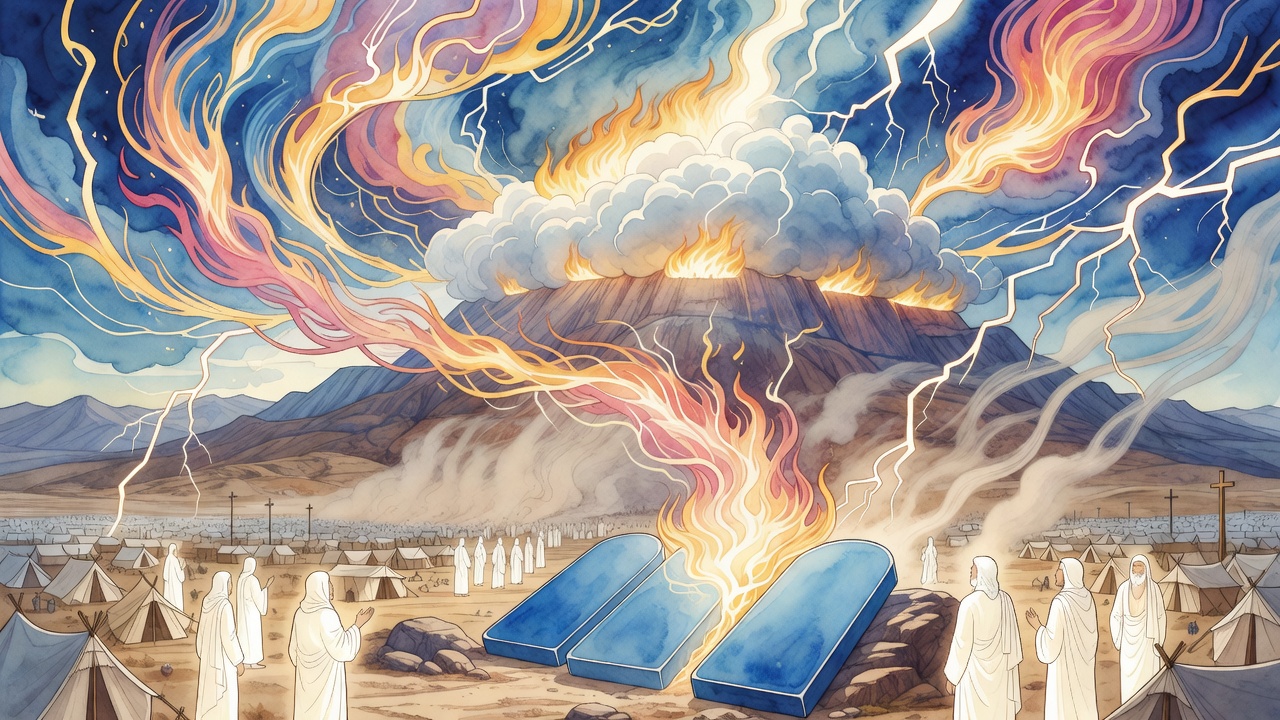
The mountain smoked. Six hundred thousand of them stood packed in the dust at its foot, shoulder against shoulder, and above them the summit burned without turning to ash. Then God opened His mouth and the first word came out. "I am the Lord your God." Two words in the holy tongue, and creation heard them before Israel did.

It was not a sound the way thunder is a sound. It was an event. The heavens shuddered. The earth pitched like the deck of a ship in a storm.

The Rivers Stopped and the Mountains Bent Low

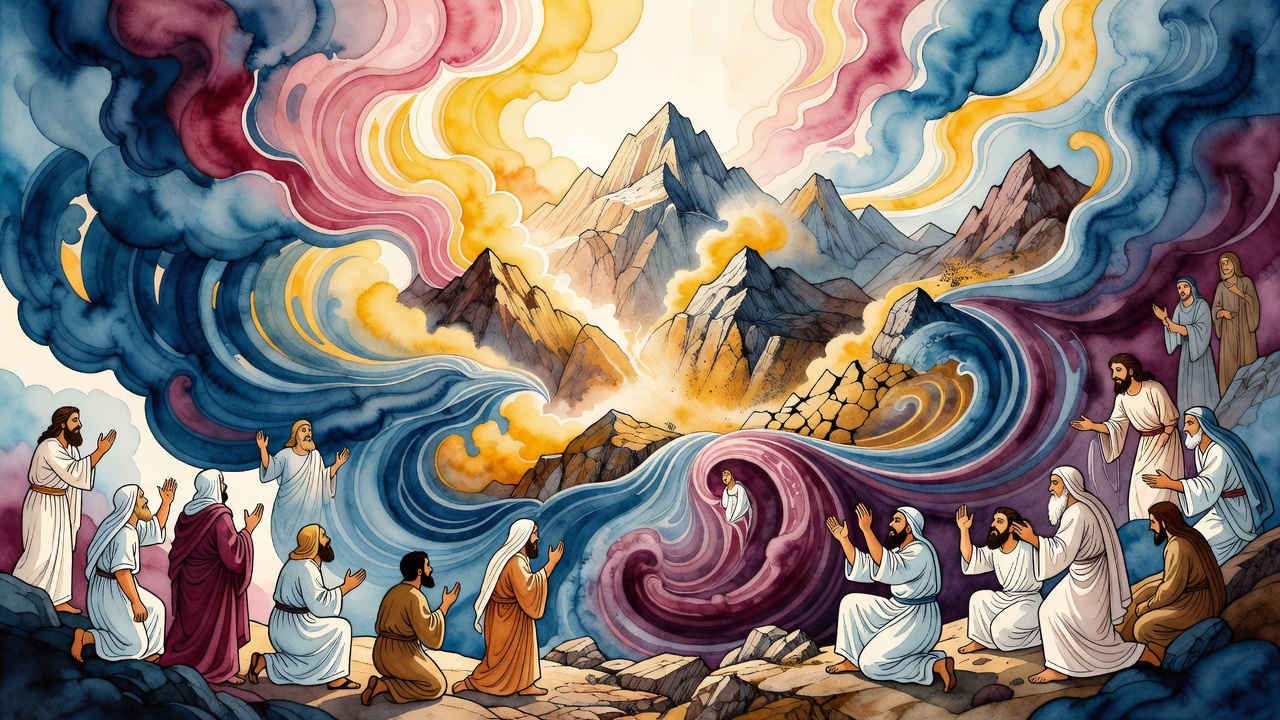
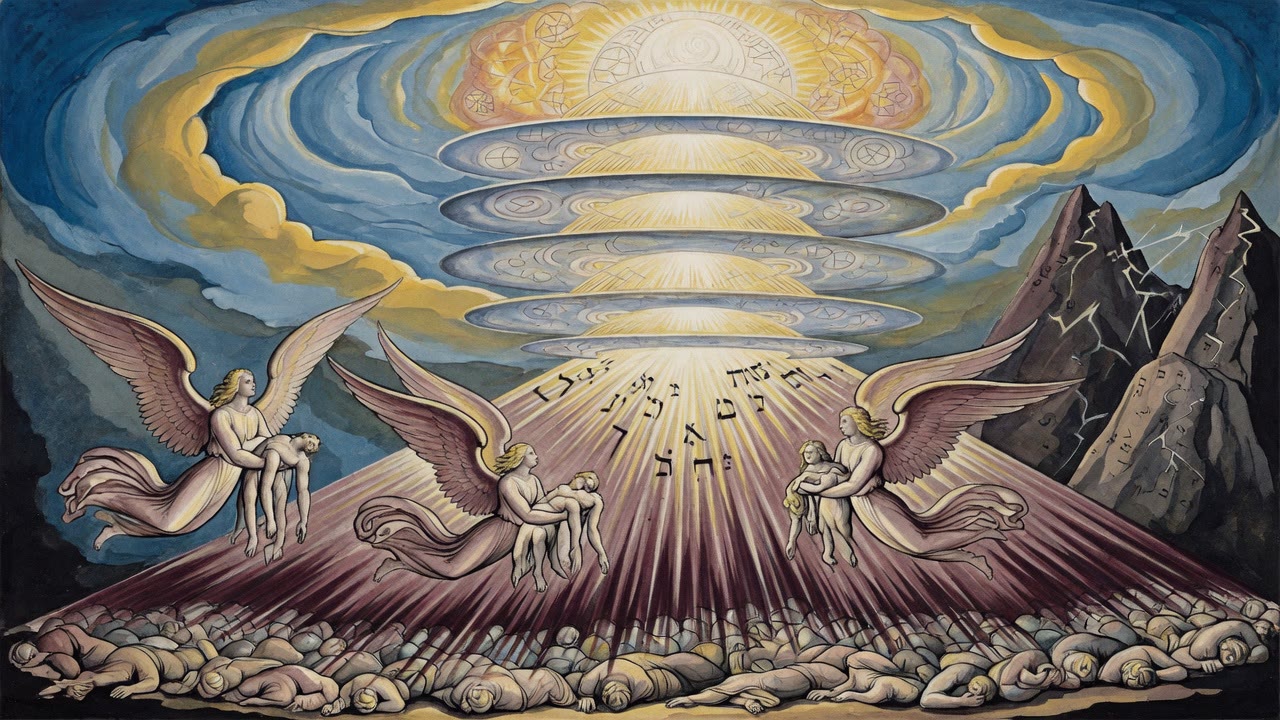
Rivers that had run in their beds since the third day of creation fled backward up their own channels. Mountains that had never moved leaned down toward the voice. Trees bowed until their crowns brushed the ground and held there, bent low, like servants who did not dare to rise.

The dead heard it too. Down in Sheol, in the dark beneath the world, the ones who had died in every generation before that morning rose up onto their feet. They stood, and they kept standing, because the covenant spoken at the mountain reached backward to them and forward to every soul not yet born. The living could not carry what the dead carried. The Israelites who stood at Sinai that day fell on their faces in the dust as though the word had emptied the breath straight out of them.

They Watched the Voice Leave the Fire

Here is the strange part. A voice is a thing the ear catches and the eye always misses. A man opens his mouth, air moves, meaning travels, and no one watching sees any light spill out with the words. That is how speech works in every tent and every field on earth. It did not work that way at the mountain.

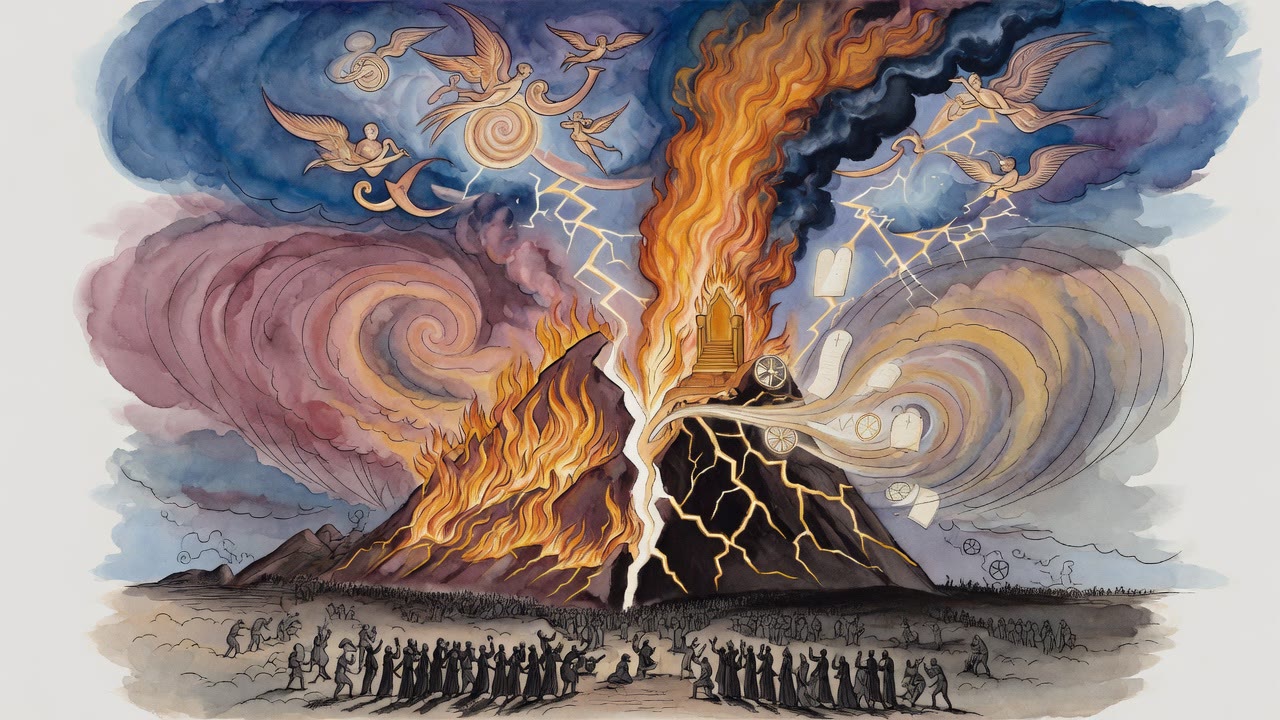
The people saw the voice. It went forth from the mouth of the Almighty as lightning and as thunder made visible, a shape that moved through the air so that eyes could follow it. They saw the thunderings. They watched the words leave the fire and cross the open space between the summit and their upturned faces. Sound had become a thing the eye could hold.

Every Face Belonged to a Different Israelite

And when they looked, no two of them saw the same face.

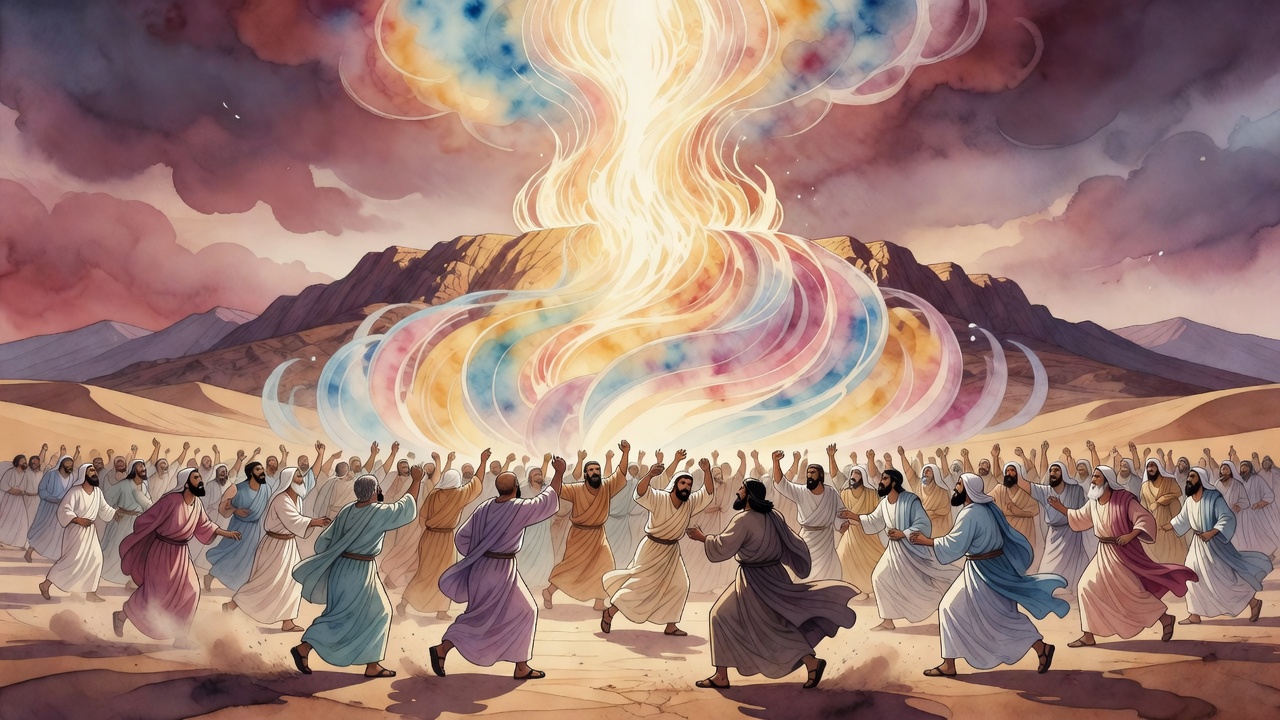
God has no face the way a man has a face. At the mountain He showed them faces anyway, many of them, all in the same instant. To some He appeared stern, His look hard as a father's when he first sits his son down over the letters of Scripture and teaches him to tremble at every one. To others He turned a measured, even face, the face for law weighed and argued and learned by heart. To others a welcoming face, warm as a teacher glad to see a student come through the door. And to others He laughed outright, the open face a grandfather turns on a child who has climbed into his lap for a story.

Stern, measured, welcoming, laughing. The same voice, the same breath, the same instant, and each Israelite met the one face shaped for exactly what that soul had come to carry.

He was like a portrait painted so cunningly that its eyes find every corner of the room at once. A thousand people crowd in front of it, and every one of them is certain the painted eyes rest on him alone. A man steps to the left, and the face follows him. He crosses to the right, and still it watches only him. So it was with the Holy One at the mountain. A great multitude of Israelites, and every single one of them the only one He was watching.

The Speech That Spoke to Each Alone

So every Israelite said the same thing, and every one of them meant it as a private and secret truth. "The speech is speaking with me." Not with the nation. With me.

The word had gone out to the whole nation in one breath, yet it arrived at each person at the exact weight that person could hold. The ones who remembered the manna were not astonished. The bread from heaven had done the same. Infants had tasted it and it was milk, sweet as cream at the breast. Young men bit into it and it was bread and oil and honey. The old tasted soft wafers steeped in honey. One bread, and every mouth received the taste it could bear. If the manna could do that, the voice could do far more.

So the voice came with strength, and the strength was cut to fit the listener, not the speaker. The strong heard a strong word. The frail heard a word they could survive.

That was the danger hidden in the wonder. A thousand faces. A voice that changed for every ear. A person might have counted the faces and decided he was looking at a crowd of gods, a court of powers dividing the mountain between them. So through all of it and under all of it ran one sentence, the same sentence He had begun with. "Even though you see all these forms, I am the Lord your God." One. Not two powers. Not a hard god and a gentle god splitting the world in two. The same One who had stood at the sea, the same One who would stand there in the time to come, wearing every face at once and speaking to every soul alone.

The mountain still smoked. The bent trees had not yet straightened. And every man and woman in that crowd walked home carrying a face no neighbor had seen, and the certainty that the word had been meant for them.


← All myths

From the tradition

Sources

3 sources

The texts behind this telling. Some cards carry a translation of the source; others are our own retelling of it, and each card says which. Every card links out to the original.

Pirkei DeRabbi Eliezer 41:12Pirkei DeRabbi Eliezer

Retold in our words. Read the original at the link below.Pirke de Rabbi Eliezer, trans. Rabbi Gerald Friedlander, London (1916) · CC-BY

The voice of the first commandment wasn't just a sound. It was an event. A cataclysm. "The heavens and earth quaked," the verse says. The natural world itself responded with terror and awe. Rivers fled, mountains trembled, trees bowed down. The very foundations of existence seemed to shift.

It gets even wilder.

Pirkei DeRabbi Eliezer goes on to say that even the dead, those resting in Sheol, the Jewish concept of the underworld, were awakened. They rose up, standing on their feet. And here's the truly astonishing part: they stood there, not just for that moment, but "till the end of all the generations."

What does that even mean?

The text anchors this idea with a verse from Deuteronomy (29:15): "But with him that standeth here with us this day." It argues that this "him" included not only those physically present at Sinai, but also "those (also) who in the future will be created, until the end of all the generations." Everyone who ever was, and everyone who ever will be, was somehow present at that monumental event. We were all there. for a second. It's a radical concept of collective memory, of shared destiny. Sinai wasn't just a historical event for a specific group of people. It was a cosmic event that imprinted itself on the soul of humanity, binding us all to the covenant.

But the experience was so overwhelming, so intense, that the Israelites who were alive at the time couldn't even bear it. The text concludes with the stark statement: "The Israelites who were alive (then) fell upon their faces and died."

Death. The ultimate surrender to the divine.

Why this dramatic ending? Perhaps it emphasizes the sheer power and incomprehensibility of God's word. Or maybe it highlights the transformative nature of the encounter at Sinai – a complete and utter redefinition of reality.

So, next time you read the Ten Commandments, remember this story. Remember the earthquake, the fleeing rivers, the resurrected dead. Remember that, in some profound way, you were there too. And ask yourself: what does it mean to be a witness to such a world-shattering event, even across the vast expanse of time? What responsibility does that inheritance place upon us?

Full source
Pirkei DeRabbi Eliezer 41:16Pirkei DeRabbi Eliezer

Retold in our words. Read the original at the link below.Pirke de Rabbi Eliezer, trans. Rabbi Gerald Friedlander, London (1916) · CC-BY

We open our mouths, make noises, and those noises carry meaning. The person listening hears us. But that's all they do. They hear. They don't see the sound.

Unless. unless you were at Mount Sinai.

In Pirkei DeRabbi Eliezer, a fascinating and somewhat enigmatic work of Jewish literature, something extraordinary happened there. Rabbi Jehudah tells us that normally, when we talk, you hear the sound of my voice, but you don't see any light coming with it. It's just sound. Plain and simple.

At Sinai? That was different.

"The Israelites heard the voice of the Holy One, blessed be He, on Mount Sinai, and saw the voice going forth from the mouth of the Almighty in the lightning and the thunder." Imagine witnessing that. The very voice of God, not just heard, but seen as lightning and thunder! The verse from (Exodus 20:18) confirms this: "And all the people saw the thunderings and the lightnings." It wasn't just a booming voice; it was a visual spectacle, a sensory overload of the divine.

What does it mean to see a voice? It hints at a level of divine communication that transcends our everyday experience. Maybe it means the message was so powerful, so overwhelming, that it impacted them on every level of perception. Perhaps the seeing was a metaphor for profound understanding.

And that brings us to another interesting point from Pirkei DeRabbi Eliezer. All the commandments, all the mitzvot (commandments), in the Torah number 611. But where do the other two come from to make up the traditional 613?

Well, Rabbi Jehudah continues, those two were spoken directly by God. As it says in (Psalm 62:12), "God has spoken once, two have I heard thus." These two commandments, directly from the source, were likely the first two of the Ten Commandments – "I am the Lord your God" and "You shall have no other gods before Me." (Although, it doesn't specifically say that here). for a second. We have 611 commandments received through Moses, but two, the most fundamental ones, spoken directly, visibly, audibly, by God at Sinai. Two commandments so powerful they were seen as well as heard.

And maybe, just maybe, remember Sinai, where the voice of God wasn't just heard, but seen, evidence of the power and mystery of the divine encounter.

Full source
Yalkut Shimoni on Torah 286:7Yalkut Shimoni on Torah

Translation of the source text.Torat Emet (Yalkut Shimoni) + Sefaria Community Translation · CC-BY-NC

Another interpretation of "I am the LORD your God" (Exodus 20:2). Rabbi Hanina bar Pappa said: The Holy One, blessed be He, appeared to them with stern faces, welcoming faces, moderate faces, and laughing faces. Stern faces were for Scripture, for when a person teaches his son Torah he must teach him with awe. Moderate faces were for Mishnah. Welcoming faces were for Talmud. Laughing faces were for aggadah. The Holy One, blessed be He, said to them: Even though you see all these forms, "I am the LORD your God" (Exodus 20:2). Rabbi Levi said: The Holy One, blessed be He, appeared to them like an icon that shows its face to every side. A thousand people look at it, and it looks at all of them. So too, when the Holy One, blessed be He, spoke, every single Israelite said: The speech is speaking with me. It is not written here, "I am the LORD your God" in the plural, but "I am the LORD your God" in the singular. Rabbi Yose bar Hanina said: The speech spoke with each person according to his own strength.

Do not be astonished. The manna that descended for Israel was tasted by each person according to his own strength: infants according to their strength, just as an infant nurses from his mother's breasts, so was its taste, as it is said, "and its taste was as the taste of rich cream" (Numbers 11:8); young men according to their strength, as it is said, "My bread which I gave you, [fine flour] and oil and honey I fed you" (Ezekiel 16:19); and elders according to their strength, as it is said, "and its taste was like wafers with honey" (Exodus 16:31). If the manna was tasted by each person according to his own strength, then the divine speech, all the more so. David said, "The voice of the LORD is with strength" (Psalms 29:4). It is not written, "with His strength," but "with strength," meaning with the strength of each person. The Holy One, blessed be He, said to them: It is not because you hear many voices [that there are many divinities]. Rather, know that I am the One who says, "I am the LORD your God" (Exodus 20:2). Why were the Ten Commandments not written at the beginning of the Torah? They gave a parable: To what may the matter be compared? To a king who entered a province and said to its people: Shall I reign over you? They said to him: Have you done us any good that you should reign over us? What did he do? He built the wall for them, brought water in for them, and fought wars for them. Then he said to them: Shall I reign over you? They said to him: Yes, yes. So too the Holy One, blessed be He, brought Israel out of Egypt, split the sea for them, brought down the manna for them, drove the quail to them, raised up the well for them, and fought the war with Amalek for them. Then He said to them: Shall I reign over you? They said to Him: Yes, yes.

Rabbi said: This comes to make known Israel's praise, for when they all stood before Mount Sinai to receive the Torah, they all made themselves equal, with one heart, to accept the kingship of Heaven with joy. And not only that, but they were delighting with one another [another reading: pledging themselves for one another]. When the Holy One, blessed be He, was revealed to make a covenant with them concerning hidden sins, as it is said, "The hidden things belong to the LORD our God" (Deuteronomy 29:28), they said to Him: Concerning the revealed things we make a covenant with You, but concerning hidden things we do not make a covenant with You, lest one person sin in secret and the whole community be endangered through him. "I am the LORD your God" was said so as not to give the nations of the world an opening to say there are two powers. Rather: "I am the LORD your God." I am He at Marah, I am He at the sea, I am He at Sinai, and I am He in the time to come. "See now that I, I am He" (Deuteronomy 32:39); "And even to old age I am He" (Isaiah 46:4); "Thus says the LORD, the King of Israel and his redeemer... I am the first" (Isaiah 44:6); "I the LORD am first, and with the last I am He" (Isaiah 41:4). Rabbi Natan said: From here is an answer to the heretics who said that there are two powers. When the Holy One, blessed be He, stood and said, "I am the LORD your God," who stood and protested against Him? And if you say this matter happened in hidden places, Scripture has already said, "I have not spoken in secret" (Isaiah 45:19). It was not given as a private register. And so it says, "I the LORD speak righteousness, I declare things that are right" (Isaiah 45:19).

Full source