5 min read

The Hand That Wrote on Belshazzar's Wall

Belshazzar drank from the Temple's sacred vessels at his feast. Then a hand appeared from nowhere and wrote four words on the wall that ended his kingdom.

Curated by Arthur · Told by Maggid ·
Table of Contents
  1. The Vessels
  2. The Hand
  3. What Daniel Said
  4. What Had Brought This On
  5. That Night

The Vessels

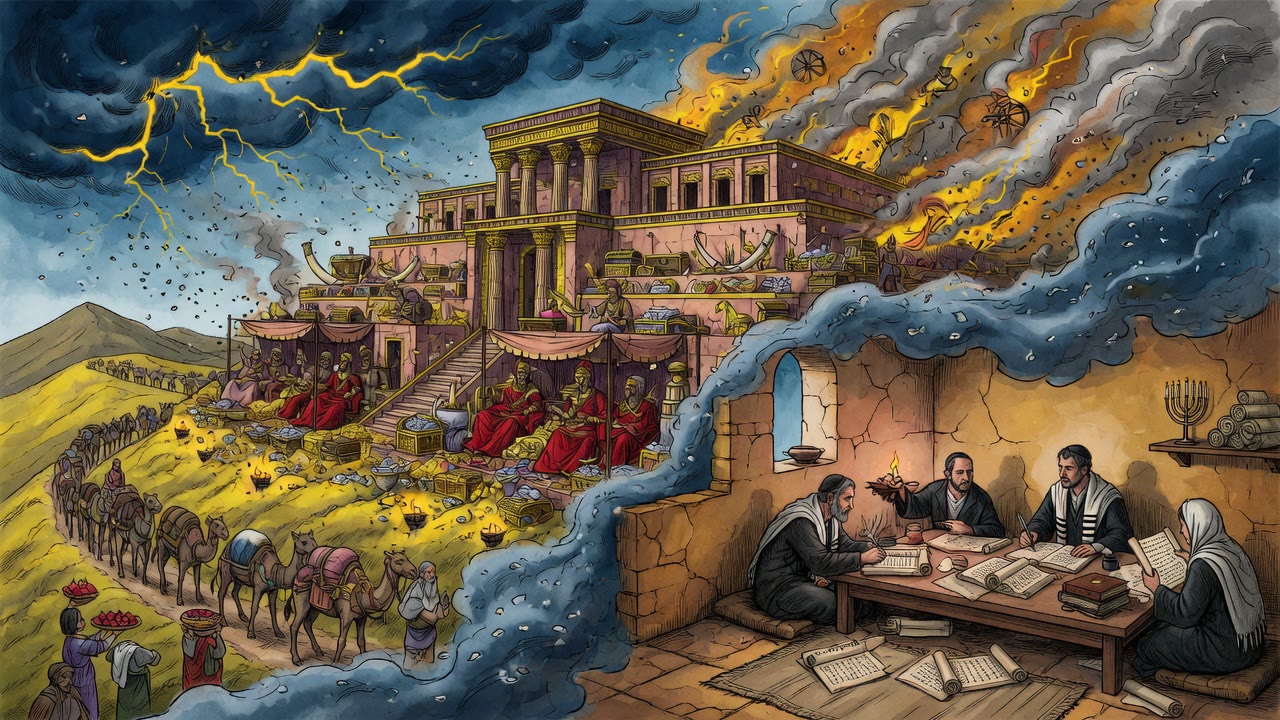
Belshazzar knew what the vessels were. His grandfather Nebuchadnezzar had taken them from the Jerusalem Temple sixty-five years earlier, and the family had held them in storage ever since, too sacred to use, too valuable to discard. When Belshazzar decided to hold a feast for a thousand of his lords, something moved him to bring the vessels out.

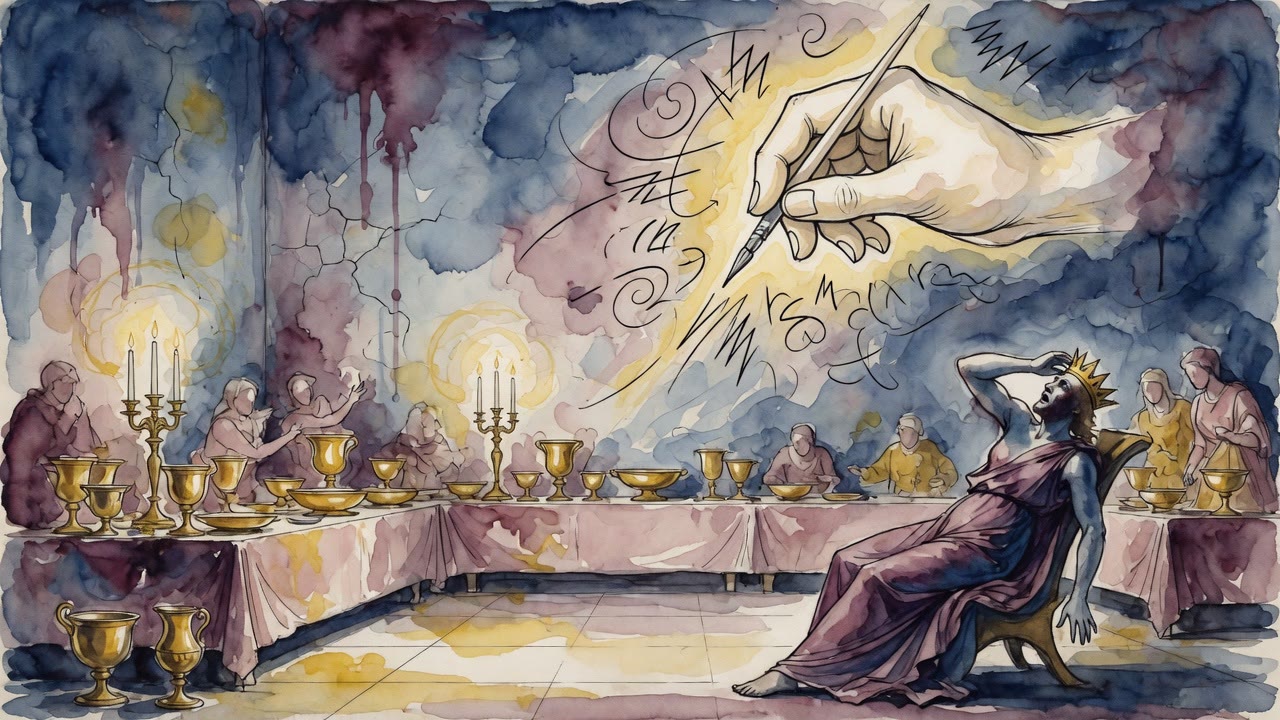
He drank from the golden cup consecrated to the God of Israel. He handed cups down the table to his lords, his wives, his concubines. The feast was lit with the particular arrogance of a man who believes his empire is permanent and that the gods of the peoples he has conquered have no reach over him. He had survived everything so far. He was the king of Babylon. The city walls were thick enough that armies could turn around without making a dent. He could drink from whatever cups he found in his treasury.

The Hand

The fingers appeared on the plastered wall near the lampstand, where the light was best. Not a figure. Not a voice. Not a vision that could be attributed to wine or imagination. A hand, with no arm attached to it, writing on the wall with what appeared to be ordinary deliberate motion, the way you write something you have decided to write.

Belshazzar's face changed. The brightness went out of it. His knees knocked against each other. His legs stopped supporting him. He called for all the wise men of Babylon, the enchanters, the astrologers, the diviners, the men whose professional function was exactly to interpret unusual phenomena. He promised the first one who could read the writing purple robes and the third position in the kingdom. They looked at the writing and could not read it.

What Daniel Said

The queen mother remembered there was a man who had served Nebuchadnezzar, a Jewish captive brought from Jerusalem in the first wave of deportations. Belshazzar summoned Daniel. He offered the same reward: purple, gold, third place in the kingdom.

Daniel said he did not want the gifts. He would read the inscription and interpret it.

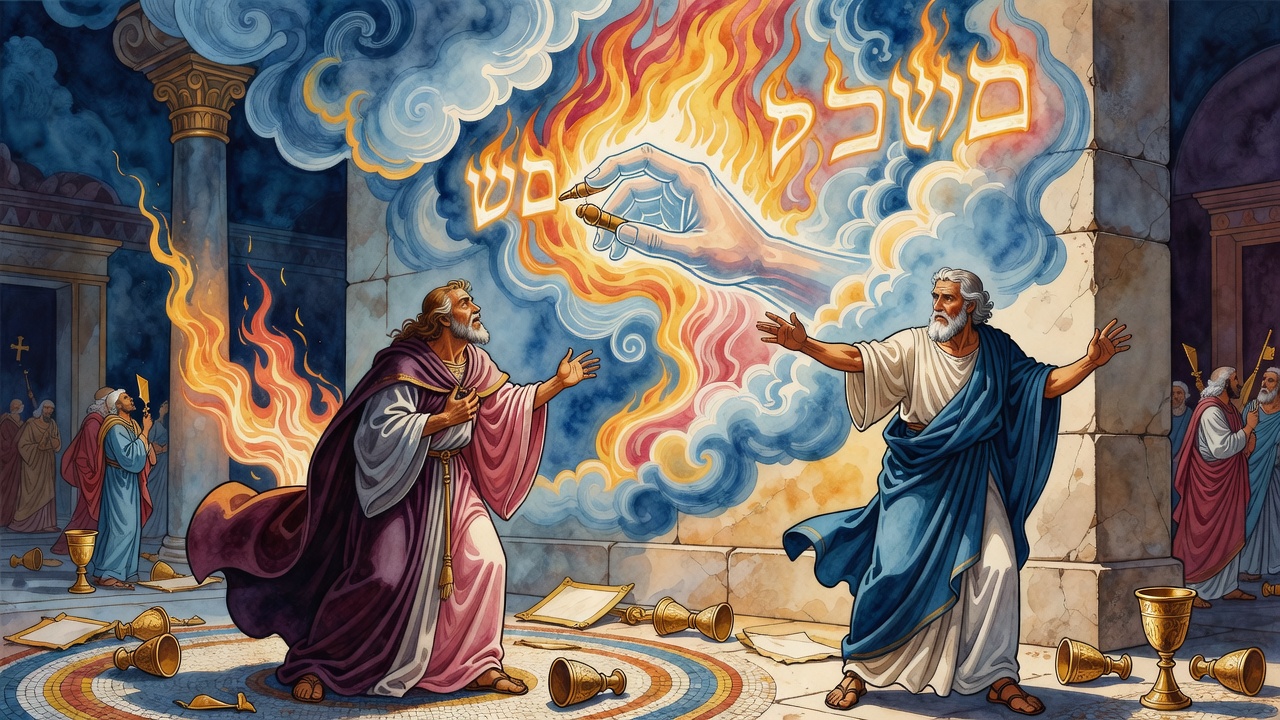
The inscription read: Mene Mene Tekel Ufarsin. Daniel stood before the king and a thousand lords and their wives and delivered what the words meant. Mene: God has numbered your kingdom and finished it. Tekel: you have been weighed in the balances and found wanting. Peres: your kingdom has been divided and given to the Medes and Persians.

He said this in the banquet hall with the sacred vessels still on the table.

What Had Brought This On

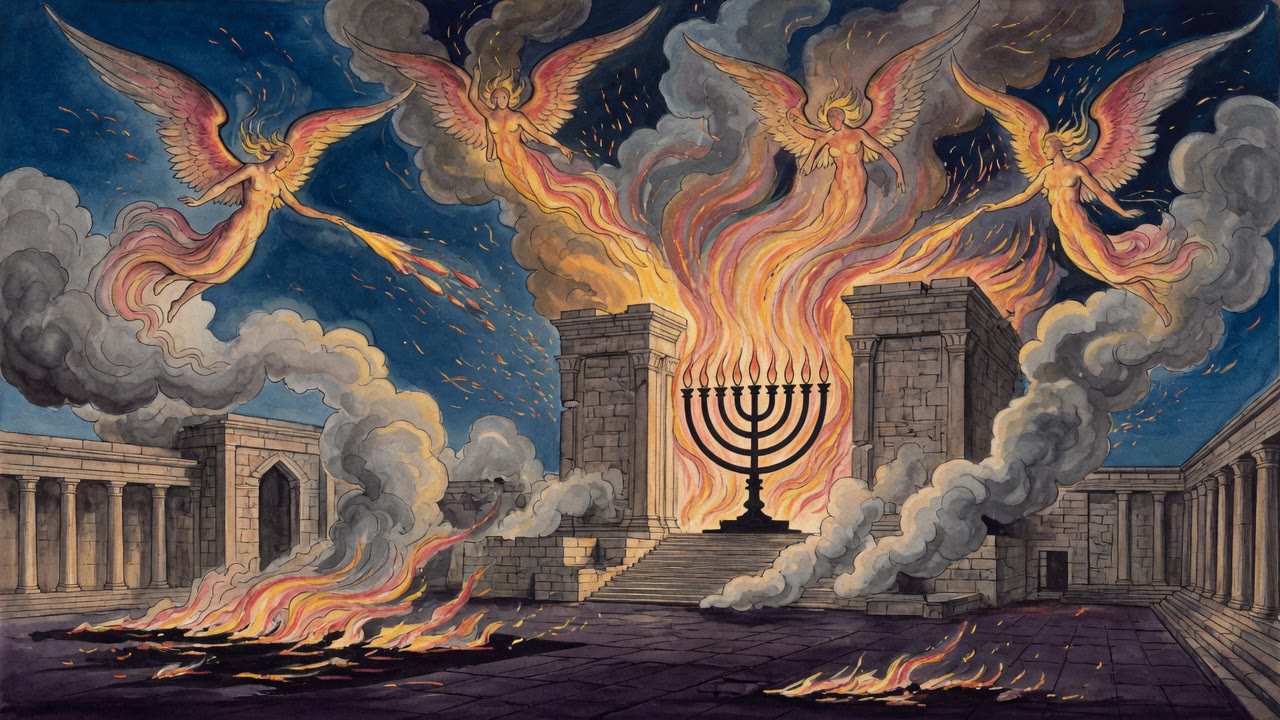
The midrashic tradition traces the mechanism by which Belshazzar reached this moment. Nebuchadnezzar, whatever his crimes against Judah, had at least treated the Temple vessels with a kind of reverence born of fear. He had humiliated the people but respected the objects. Belshazzar had gone one step further. He had calculated that he was safe. The Temple was destroyed. The God of Israel had clearly been defeated. Therefore the vessels were inert, trophies from a settled campaign, and he could drink from them at a feast.

That calculation was the error. The vessels were not inert. They had been consecrated to something that was not defeated and did not accept the premise that destruction of the Temple constituted a verdict on God's existence or power. Drinking from those cups was not merely impolite toward a foreign people's traditions. It was a theological assertion, and the hand that appeared was the response to the assertion.

The Mekhilta's reading of this event frames it explicitly as measure for measure: Belshazzar used the sacred as the profane, and was immediately weighed and found to have no substance.

That Night

They dressed Daniel in purple and gave him the chain of gold and proclaimed him third in the kingdom. These honors lasted hours.

That same night Belshazzar king of the Chaldeans was killed. Darius the Mede received the kingdom. The Chronicles of Jerahmeel, a twelfth-century Hebrew chronicle, records that God had been working through both the Median and Persian lines for this purpose: two powers raised simultaneously to converge on Babylon at the moment the writing appeared. The feast had been the last act of a dynasty that had already been weighed. The hand wrote what was already true. The night confirmed it.


← All myths

From the tradition

Sources

4 sources

The texts this telling draws on, in full. Open a card to read inline, or expand it for a wider, quieter read.

Chronicles of Jerahmeel LXVIIChronicles of Jerahmeel (Gaster, 1899)

The fall of Babylon began with a friendship and ended with a finger. According to the Chronicles of Jerahmeel, a 12th-century Hebrew chronicle translated by Moses Gaster in 1899, God raised up two kings to destroy the Chaldean empire: Darius of Media and Cyrus of Persia. Cyrus married Darius's daughter, binding them into an alliance, and together they marched against Belshazzar, king of Babylon.

The first battles went badly for the alliance. The Chaldeans launched a devastating night attack, and the Medes fled in confusion. Only Cyrus and his Persians held their ground. The casualties among the Medes and Persians were enormous. But Belshazzar made the fatal mistake of celebrating too soon. Believing he had won, he threw a great feast for his thousand princes and rewarded them with silver and gold.

As the wine flowed, Belshazzar grew drunk and reckless. He ordered his servants to bring the golden vessels that Nebuchadnezzar had plundered from the Temple in Jerusalem. These were the sacred vessels of God's own house. Belshazzar, his princes, his wives, and his concubines drank wine from them, defiling what had been consecrated to the God of Israel.

God's response was immediate. He sent a scribe from His throne. A disembodied hand appeared by the lamplight and wrote on the palace wall in red ink, using Hebrew characters but Aramaic words: "He thought, He weighed, He separated." Belshazzar saw only the fingers, and the sight was enough to make every bone in his body tremble. The message meant that God had measured Belshazzar's kingdom, weighed it, and found it wanting. That night, Darius and Cyrus attacked again. This time Babylon fell, and Belshazzar's kingdom was divided between the Medes and the Persians, exactly as the writing had declared.

Full source
Chronicles of Jerahmeel LXVIIIChronicles of Jerahmeel (Gaster, 1899)

Daniel stood before King Belshazzar of Babylon and delivered the verdict no ruler wants to hear. According to the Chronicles of Jerahmeel, a 12th-century Hebrew chronicle compiled by Jerahmeel ben Solomon and translated by Moses Gaster in 1899, Daniel rebuked the king for defiling the sacred vessels of the Temple. God had sent an angel to inscribe a message on the palace wall in Hebrew characters but Aramaic words: "Mene, Mene, Tekel, Upharsin."

The meaning was devastating. God had "numbered" the years of Belshazzar's kingdom and found them complete. The seventy years of Israel's captivity had ended. The king had been "weighed" and found wanting. His kingdom would be "taken away" and handed to the Medes and Persians.

Daniel did not stop there. He reminded Belshazzar that his grandfather Nebuchadnezzar had been humbled by God, forced to wander among wild beasts until he acknowledged the power of heaven. Belshazzar had learned nothing from this. After defeating Darius and Cyrus in battle, he thanked his idols of silver and gold rather than his Creator. Then he compounded the insult by drinking wine from the holy Temple vessels alongside his princes, wives, and concubines.

When the court heard Daniel's interpretation, terror seized them. The princes fled and trampled each other at the gates. Belshazzar collapsed onto his bed and fell into a death-like sleep. That night, a doorkeeper who had served Nebuchadnezzar drew the king's own sword from beneath his pillows and severed his head. He carried it through the darkness to Darius and Cyrus. The two kings prostrated themselves before the God of heaven, vowed to free His people and rebuild the Temple, then marched into Babylon and reduced it to wasteland like Sodom and Gomorrah. They divided the Chaldean empire between them by lot.

Full source
Antiquities X.10Antiquities of the Jews (Josephus)

Daniel was still a teenager when Nebuchadnezzar brought him to Babylon in chains. He and three companions from the royal family of Judah, Hananiah, Mishael, and Azariah, were given Babylonian names, Babylonian education, and food from the king's own table. Daniel refused the food. He asked their guardian to let them eat only vegetables and water for ten days as a test. After ten days, the Jewish captives looked healthier and stronger than everyone eating royal meals.

That was just the beginning. Josephus records that Daniel became "very busy about the interpretation of dreams, and God manifested himself to him." When Nebuchadnezzar had a second dream, this time about a great tree cut down, its stump left in the field among wild beasts, none of the Babylonian wise men could interpret it. Daniel alone told the king the truth: the tree was Nebuchadnezzar himself, and he would lose his throne, live among animals in the wilderness for seven years, and only be restored when he acknowledged that God rules over all kingdoms.

It happened exactly as Daniel predicted. The most powerful king on earth was reduced to living like a beast. After seven years, Nebuchadnezzar prayed and was restored to his throne.

Generations later, King Belshazzar hosted a great feast using the sacred gold and silver vessels looted from the Temple in Jerusalem. In the middle of the banquet, a disembodied hand appeared and wrote on the wall: MENE, MENE, TEKEL, UPHARSIN. The king was terrified. None of his wise men could read the script. They called for Daniel, now an old man. He read the writing without hesitation: God has numbered your kingdom and finished it. You have been weighed and found wanting. Your kingdom is divided and given to the Medes and Persians. That very night, Belshazzar was killed and Darius the Mede took the kingdom (Daniel 5:30).

Full source
Mekhilta Tractate Shirah 6:9Mekhilta DeRabbi Yishmael

Belshazzar, king of Babylon, threw the banquet that ended his dynasty. The Mekhilta cites (Daniel 5:1), "King Belshazzar made a great banquet". And reads it as the culmination of Babylonian arrogance. This was no ordinary feast. Belshazzar used the sacred vessels that Nebuchadnezzar had looted from the Temple in Jerusalem, drinking wine from golden cups consecrated to God.

The prophet Habakkuk had already pronounced judgment on exactly this kind of behavior. (Habakkuk 2:15) warns: "Woe unto him who makes his neighbor drink! You pour out your wrath even unto intoxication." The verse cuts both ways, Belshazzar made others drink from holy vessels, and God would pour out wrath upon him in return. (Habakkuk 2:16) adds the consequence: "You will be sated with shame rather than glory."

The banquet that was meant to display Belshazzar's power became the stage for his destruction. That very night, as the revelry continued, the mysterious hand appeared and wrote upon the wall. The words were weighed, numbered, divided. (Daniel 5:30) records the outcome with chilling brevity: "That very night King Belshazzar was killed."

The Mekhilta DeRabbi Yishmael (Tractate Shirah 6:9) places this story alongside the drowning of Pharaoh, another ruler who defied God and discovered that the very instruments of his arrogance became the instruments of his end.

Full source