The King Who Healed His Servant's Sore Foot
A king orders a physician to heal his servant's foot, and the midrash names that order as the shape of love's affliction for Israel.
Table of Contents
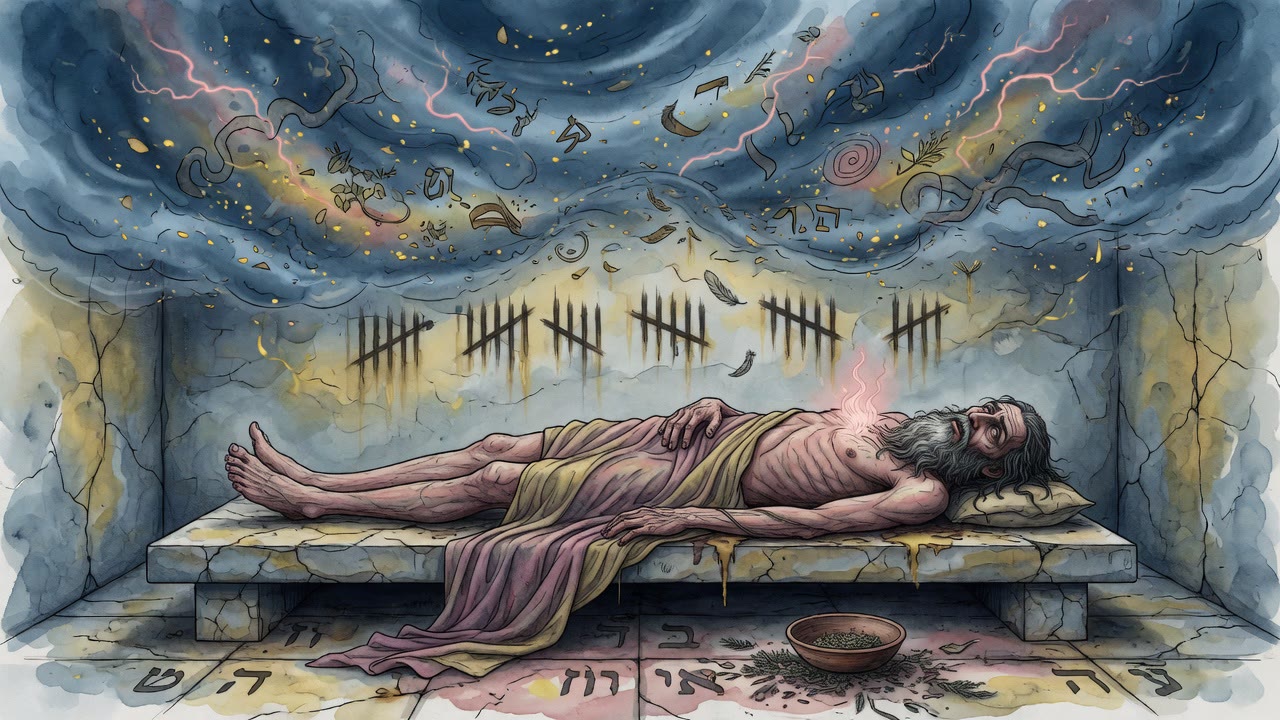
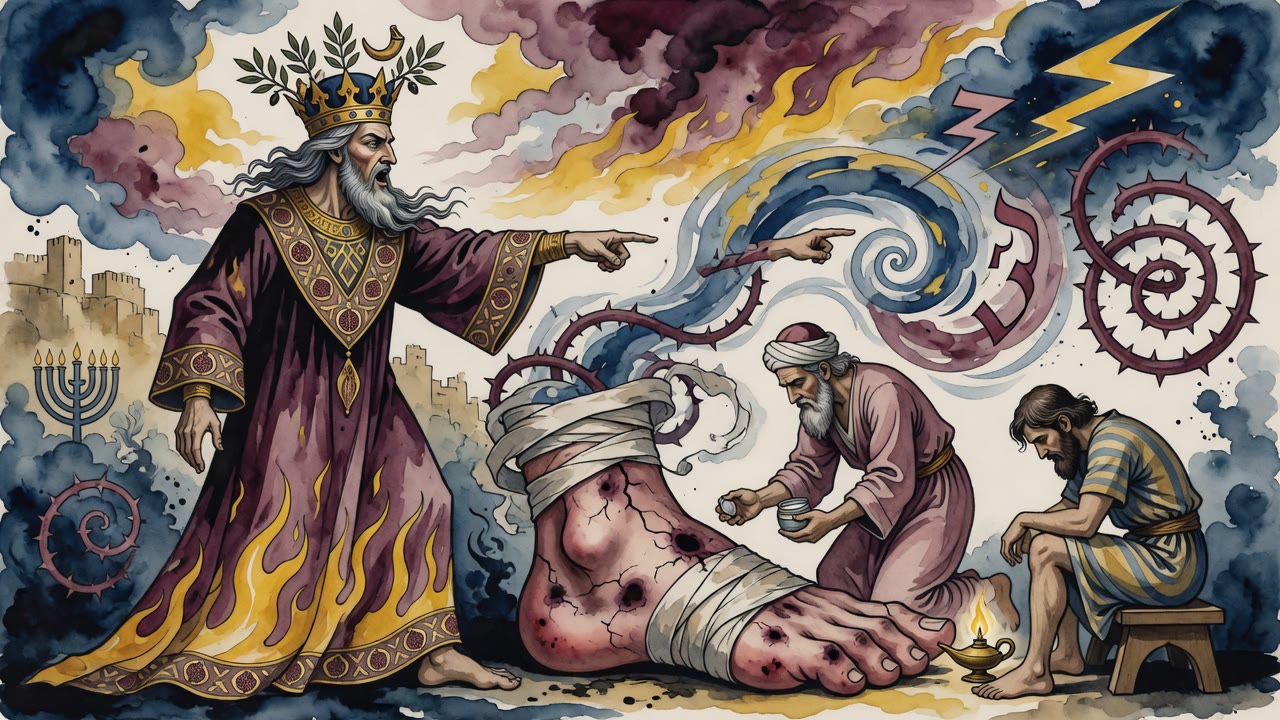
The servant limped into the courtyard with the sore still open on his foot. Flies found it before the palace physician did. The king did not turn away. He pointed at the wound and ordered the doctor to clean it, bind it, and bring the man back whole, not half-healed and discarded.
 Click for full size
That order is how the midrash names the trouble that falls on Israel. Not a lash thrown in rage. A treatment that hurts because the one who loves will not leave the flesh to rot.
The Sore That Was Not Punishment Alone
God does not send every blow as a sentence. When the verse says the Lord corrects the one He loves, the picture is a father who will not let a son limp forever for the sake of the son's pride. Scholars who lose children young find their grief counted as atonement, and the midrash dares to say those young souls arrive pure in the world to come. The pain is real. The framing is love, not theater.
Beginnings and endings reverse for the righteous and the wicked. The righteous open in strife and close in joy. The wicked open in joy and close in strife. The pattern is not a proverb carved on a wall. It is a map of known lives.
The Tyrants Who Started in Joy
Pharaoh stood over the Nile and called the river his own making. He ended under the wheels of his chariots when the sea closed. Sennacherib mocked Jerusalem and swore no god could save the city from his hand. He ended cut down by his own sons while bowing to the idol he trusted. Nebuchadnezzar swore he would climb above the clouds and be like the Most High. He ended cast down, grass in his mouth, mind stripped until the season of his pride was spent.
Each of them began the story with a feast of power. Each of them finished it broken. The midrash lines them up not to gloat, but to show that joy at the start of a wicked path is not a promise. It is bait.
Abraham's Early Quarrels and Late Peace
Abraham began with herdsmen fighting over wells and with a journey that pulled him from every familiar street. He ended old, blessed in all things, the quarrels settled into inheritance. The same measure that crushed the tyrants lifted him, because the measure of goodness, the sages insist, is always greater than the measure of punishment.
Rabbi Yose works the math backward from Adam. One prohibition broken once, and death ran through every generation. If a single refusal can seed that much loss, then a person who refuses forbidden food, who fasts on the Day of Atonement, who gathers charity for the poor, sends merit forward without an edge. The accidental killer in the forest still receives a city of refuge. How much more the one who means the kindness.
A farmer who forgets a sheaf in the field and blesses no one still earns a blessing written in the Torah. A coin that slips from a cloak and feeds a stranger the owner never saw is counted as if both hands had opened on purpose.
Mountains Without End, a Deep Without Floor
David sang that God's righteousness is like the mighty mountains and His judgments a great deep. The mountains march past the horizon. No last ridge. So the reward for those who walked uprightly has no last coin. The tehom, the deep, swallows every measuring line. So the punishment of the wicked in the time to come has no floor a rope can find.
Which immensity becomes the inheritance is the choice the psalm forces open. The midrash does not soften the choice. It only refuses to pretend the two sides are the same size. Reward heaped like everlasting hills. Justice plunging past every cord.
The Window While Mercy Stands
A person can stack wrongdoing heap by heap until the pile looks past saving. God sees the stack. For the one who turns, He declines to dwell on it. The heaps do not get the last word.
The summons still carries a clock. Return while the attribute of mercy still stands on the bench. Come back while the same Name that defends has not yet turned to accuse. The door is open now. The advocate is still an advocate. The window is not forever, and that is why the servant with the sore foot is not told to wait until the wound invents its own cure.
Watch the servant leave the courtyard with the bandage still tight. He does not thank the pain. He thanks the king who refused to call the limp natural. Israel under affliction is not asked to enjoy the knife. Israel is asked to recognize the physician's order inside it, and to walk back toward the One who still wants the body whole.
The tyrants never learned that lesson. They mistook early joy for proof of heaven's favor. Abraham learned the opposite arithmetic: early strife can be the road to a late table of blessing. The mountains of reward and the deep of judgment are not equal piles. The midrash forces the comparison so no one pretends the scales are flat.
← All myths