6 min read

The River From the Temple That Brought the Dead Sea to Life

In exile beside a Babylonian canal, Ezekiel is shown a Temple no hand will build, and a river from its threshold that wakes the dead salt sea.

Curated by Arthur · Told by Maggid ·
Table of Contents
  1. By the Canal of the Exiles
  2. The Temple No Hand Had Raised
  3. Waters From Under the Threshold
  4. The Sea That Was Given Back Its Life
  5. The Argument Over Whether Anything Can Be New
The River From the Temple That Brought the Dead Sea to Life Click for full size

By the Canal of the Exiles

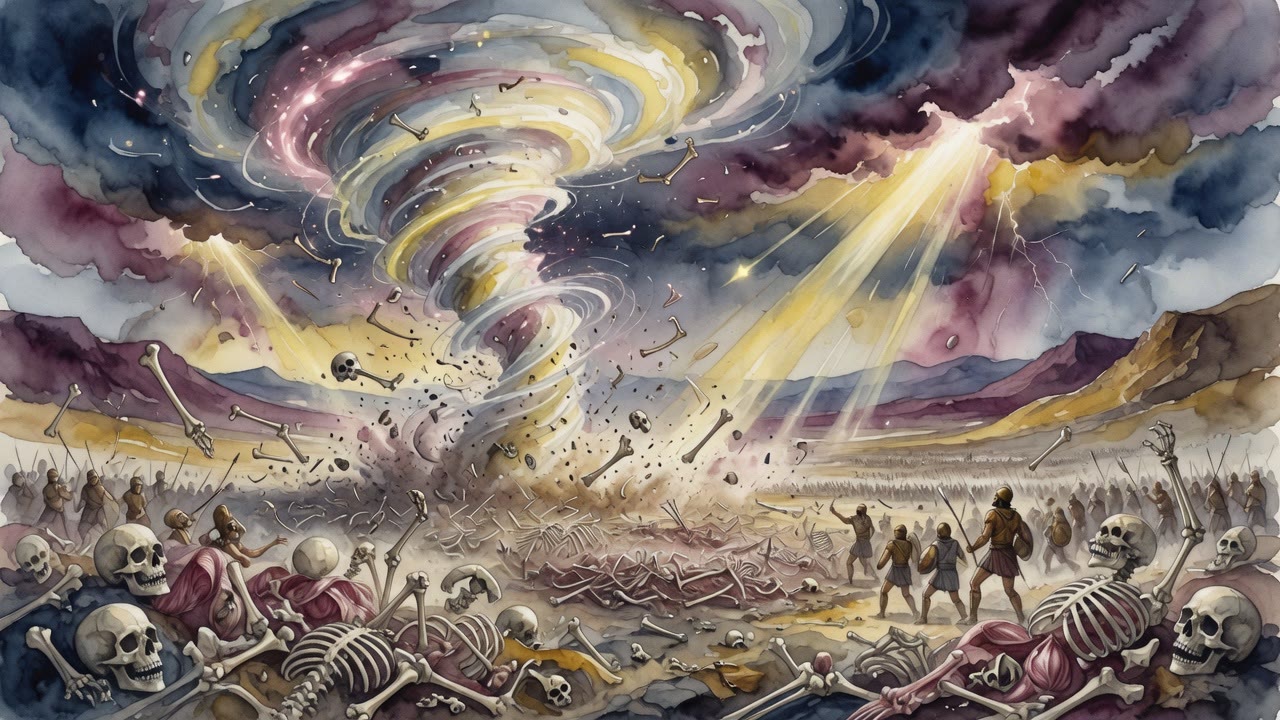
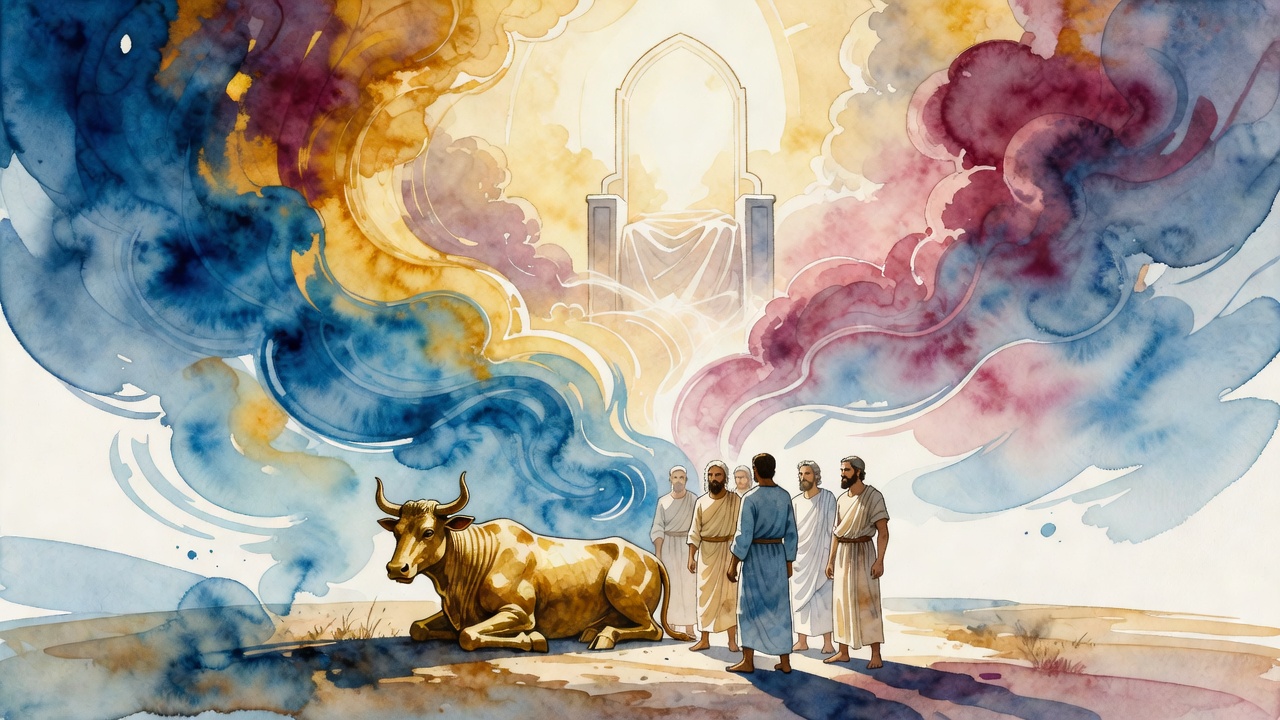
The hand came down on him beside a ditch of standing water. Ezekiel was sitting among the deported, where the canal called Chebar cut its slow brown line through Babylonian mud, when the weight of it seized him and carried him out of the land of his captivity. One moment there was clay underfoot and the smell of a foreign river. The next there was a mountain, and on the mountain something like the frame of a city, and a man standing in the gate whose body shone like polished bronze.

The man held a measuring line of flax and a rod. He gave no greeting. He said, "Son of man, look with your eyes, hear with your ears, and set your heart on everything I show you."

The Temple No Hand Had Raised

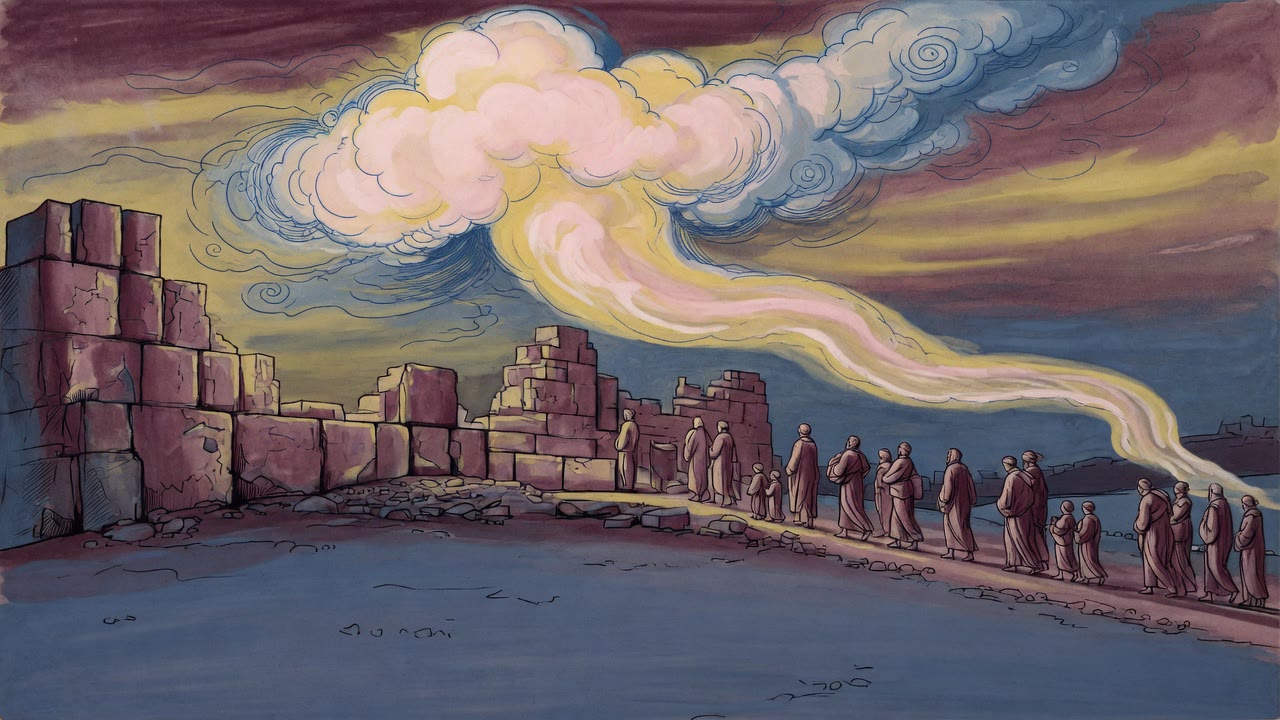
They walked the courts together, and the walls stood fresh as if the mortar had dried that morning, though no mason had climbed here and no quarry had been opened. This was not the house Solomon built and the fire took. This was the house of the days to come, lifted up and made new by the one who needs no builders, and no chisel had touched a single stone of it.

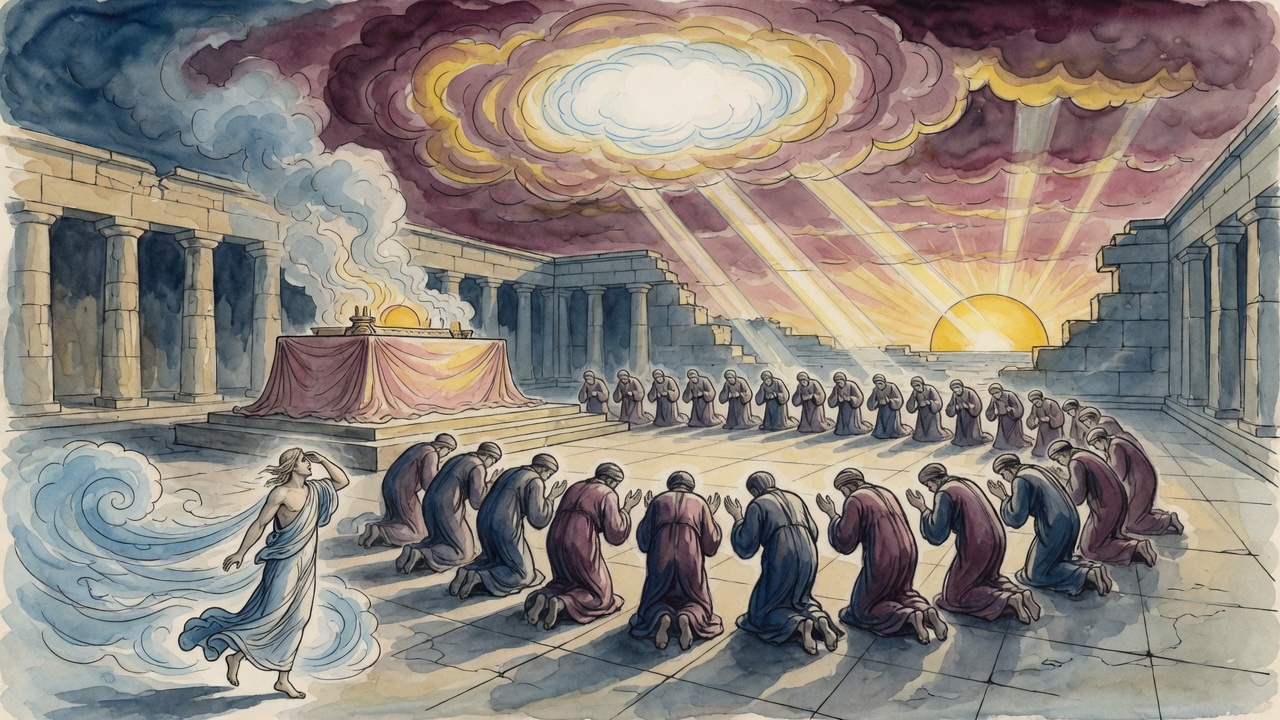
The gate of the inner court that faced east stood shut. Ezekiel set his hand to it and it did not move. "This gate shall stay shut the six days of labor," the bronze man said. "But on the Sabbath it shall be opened, and on the day of the new moon it shall be opened." No hand would open it. It would swing wide of itself, on the evening the work of the world stopped and on the night the moon came back thin to the sky.

Waters From Under the Threshold

Then he saw the water. It came out from under the threshold of the house, eastward, thin as a thread where it left the door, sliding past the right side of the altar. The man went out through the north gate with the line in his hand and led Ezekiel down along the flow. A thousand cubits, and he made him wade across. The water reached his ankles. A thousand more, and it climbed to his knees. A thousand more, and it rose past his waist. A thousand more, and he could not cross. It had become a river no foot could touch bottom in, a torrent to swim in and be carried.

Where it left the sanctuary the current split, and Ezekiel counted the channels. Twelve streams, one for each tribe of Israel, fanning eastward across the land. They ran down to the brook of Kidron and past it, higher than any flood the valley had ever held, down to the fords of the Jordan, out toward the Arabah, the scorched trench that falls away toward the sea of salt.

The Sea That Was Given Back Its Life

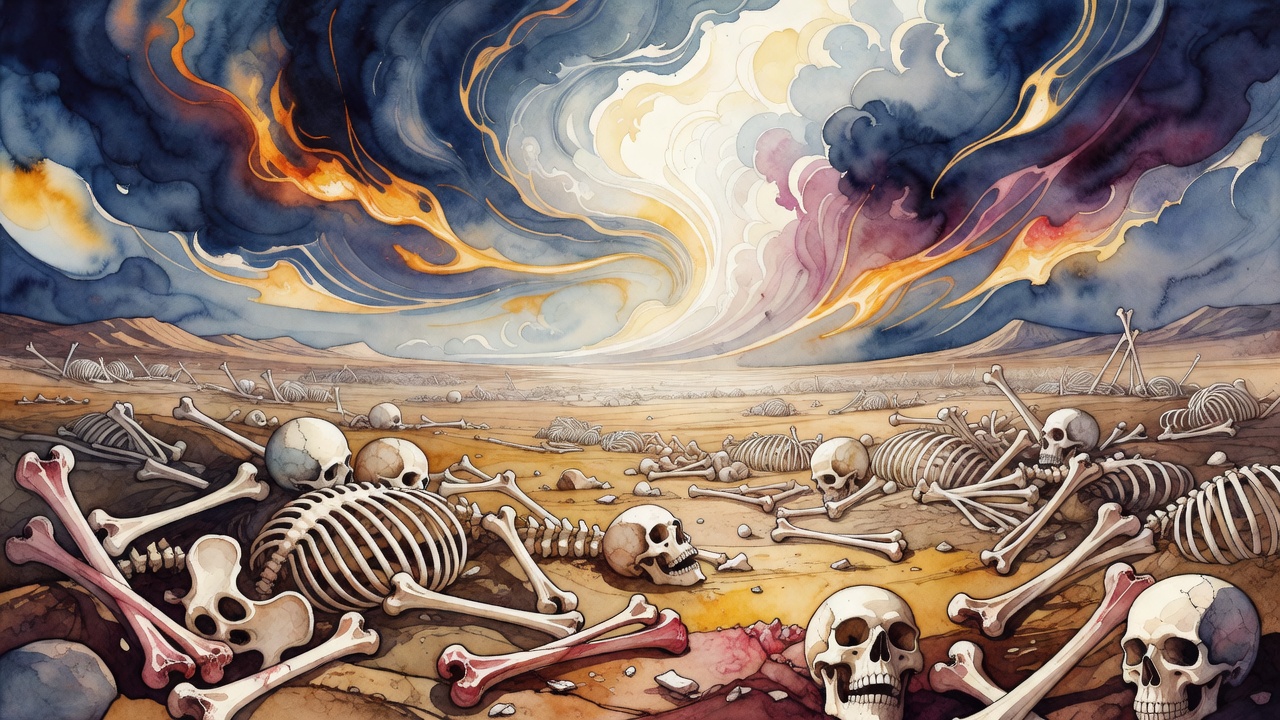
Ahead lay the water that killed. Nothing swam in the sea of salt. No reed stood at its lip. Its shore was a white crust, and the hills above it held the memory of cities burned to lime. The river ran down into that dead brine, and the brine woke. The bitter water turned sweet and moving and full. Fish crowded the shallows, kind upon kind, as many as the fish of the Great Sea. Where the stream reached, everything lived.

Along both banks, on this side and on that, trees stood that Ezekiel had no name for. Their leaves did not wither and their fruit did not fail. Every month they broke into new fruit, a fresh crop under every new moon, because the water at their roots had come out from the sanctuary. The fruit was food. The leaf was medicine. A man could pull a single leaf and carry healing in his hand.

The Argument Over Whether Anything Can Be New

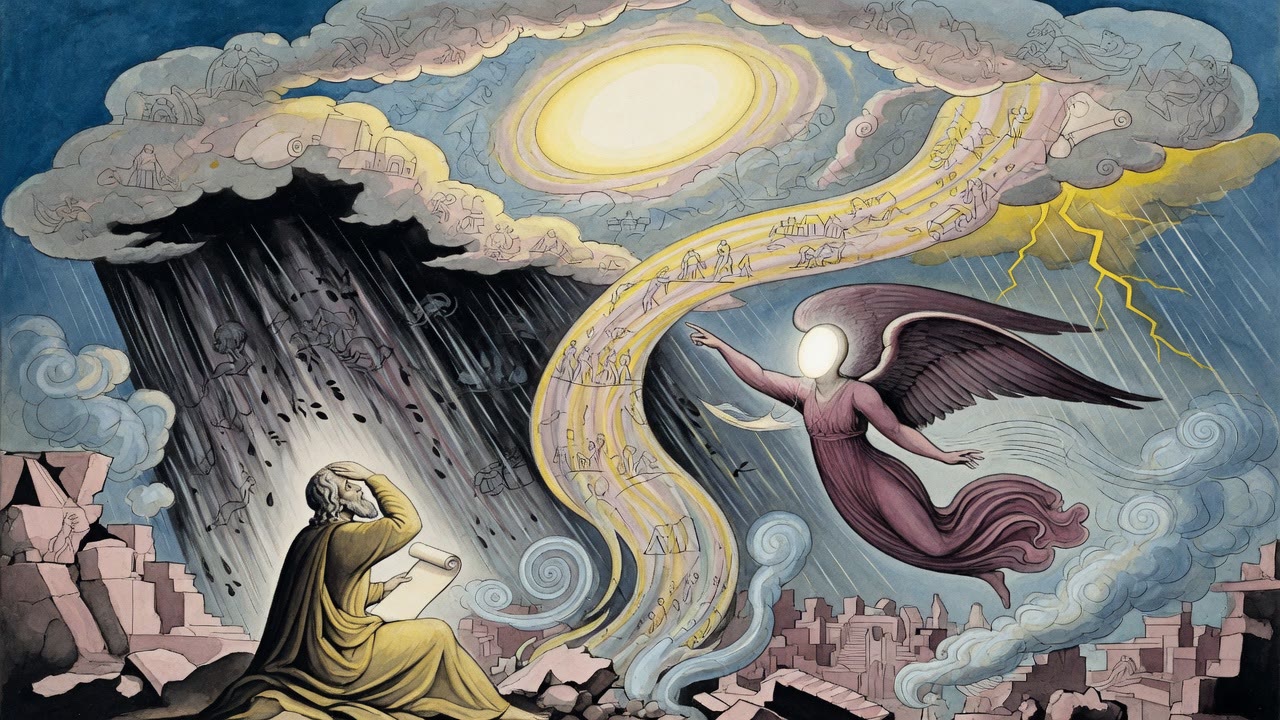
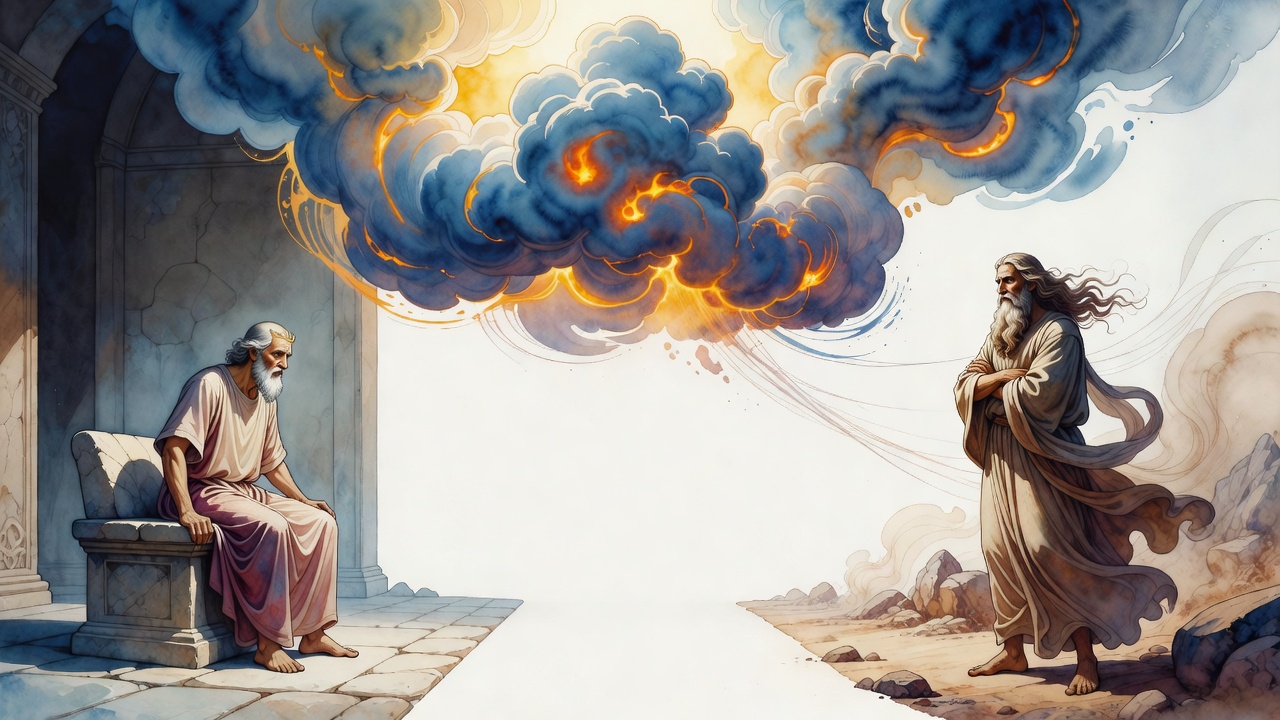
Generations after the prophet sealed his scroll, men bent over his words in the study house, and one of them set the objection down like a stone on the table. "Is it not written," he said, "that there is nothing new under the sun? A river, some trees, fish in the water. All of it is only wood and water and things the world has seen before."

The answer came back sharp. The righteous will be made new, the sages said, they and every good deed their hands ever did, while for the wicked nothing new is held in store. Renewal is not paid out to the sun and the seasons like a wage. It is kept for those who trust the one whose threshold the river flows from. The new thing is not a stranger kind of fish. It is the dead sea itself standing up alive, the one water everyone had written off, roaring back with more life than it had ever drowned. That was the thing the world had never yet seen, and the thing it had been promised.

They remembered the voice the whole house was built on. "Behold, I do a new thing. Now it shall spring forth." The eastern gate opening with no hand upon it. The salt sea thick with fish. The leaves that never browned. Not a patching of what fire had taken, but something the sun had never once shone upon.

The bronze man brought Ezekiel back along the bank, past the trees, and asked him, "Son of man, have you seen this?" Then he led him up the shore. Behind them the shut gate waited for its Sabbath, and the sea of salt went on breathing.


← All myths
From the tradition

Sources

3 sources

The texts behind this telling. Some cards carry a translation of the source; others are our own retelling of it, and each card says which. Every card links out to the original.

Pirkei DeRabbi Eliezer 51:12Pirkei DeRabbi Eliezer

Retold in our words. Read the original at the link below.Pirke de Rabbi Eliezer, trans. Rabbi Gerald Friedlander, London (1916) · CC-BY

Pirkei DeRabbi Eliezer turns to Ezekiel's Breathtaking Vision of the Third Temple.

Consider this beautiful passage from Pirkei DeRabbi Eliezer, Chapter 51. It paints a picture of the Garden, specifically focusing on the rivers that flow through it and the trees that line their banks.

A stream, not just any stream, but one teeming with life, nourishing everything it touches. And along its banks? Every kind of tree imaginable, "bearing according to their kind." It's a riot of biodiversity, a harmony of greens and browns, all thriving in perfect harmony. The verse explicitly states, “upon the banks thereof on this side and on that side” (Ezekiel 47:12). This isn't just a few trees sparsely planted; this is abundance, overflowing life.

Here’s where it gets really interesting. These aren't trees that fruit once a year and then rest. No, Pirkei DeRabbi Eliezer tells us that "every month they bring forth new fruit." Constant renewal, a never-ending harvest. (Ezekiel 47:12) confirms this, promising that the trees "shall bring forth new fruit every month. It points to a realm beyond our own, a place of perpetual blossoming.

And what about the fruit itself? Some of it is "for food," sustaining life, providing nourishment. But there's more to it than just sustenance. “Because the waters thereof issue out of the sanctuary: and the fruit thereof shall be for meat, and the leaf thereof for healing" (Ezekiel 47:12). The leaves of these trees, according to this vision, possess healing properties. It's not just about surviving; it's about thriving, about wholeness, about healing, all stemming from the sacred source of the waters.

So, what does this all mean? Is it a literal description of a physical place? Perhaps. But maybe, just maybe, it's also a metaphor. A metaphor for the potential that lies within us, the capacity for constant growth and renewal, the ability to heal ourselves and the world around us. The image of the Garden, overflowing with fruit and healing leaves, can serve as a powerful reminder of the abundance that is always available to us, if only we know where to look. A reminder to seek the sacred waters, to nurture our own inner gardens, and to bring forth new fruit, month after month, year after year.

Full source
Pirkei DeRabbi Eliezer 51:7Pirkei DeRabbi Eliezer

Retold in our words. Read the original at the link below.Pirke de Rabbi Eliezer, trans. Rabbi Gerald Friedlander, London (1916) · CC-BY

Our tradition certainly does. It’s filled with prophecies and visions of a future so bright, it’s almost hard to imagine. One of the most evocative of these visions concerns the Temple in Jerusalem.

What will happen to the Temple in the days to come? Rabbi Eliezer, in Pirkei DeRabbi Eliezer, a fascinating early medieval text filled with aggadic (narrative) expansions of biblical stories, paints a stunning picture. He says that in the future, the Temple will be raised up and renewed. It won't just be rebuilt; it will be transformed. He finds support for this idea in the Book of Isaiah (43:19), where God declares, "Behold, I will do a new thing; now shall it spring forth; shall ye not know it?" A “new thing.” Not just a restoration, but a completely fresh start. A spiritual blossoming.

The vision doesn't stop there. Rabbi Eliezer goes on to describe the Temple gates. According to him, the gates that are currently buried will be renewed and rise up in their rightful places. And he focuses on a specific gate: the gate of the inner court that faces east.

This eastern gate has a special role. The prophet Ezekiel (46:1) provides the details: "Thus saith the Lord God: The gate of the inner court that looketh toward the east shall be shut the six working days; but on the Sabbath day it shall be opened, and in the day of the new moon it shall be opened." In other words, this gate will remain closed throughout the week, a symbol of the separation between the mundane and the sacred. But on Shabbat, the Sabbath, and on Rosh Chodesh, the New Moon, it will miraculously open by itself!

The quiet anticipation as Shabbat approaches. The hushed expectancy as the new moon appears in the sky. And then, without human intervention, the great doors swing wide, inviting all to enter and connect with the Divine.

What does this all mean? Is it a literal prophecy? A symbolic representation of spiritual renewal? Perhaps it's both. The image of the Temple rising again, its gates opening on their own, speaks to a deep longing within us. A longing for a world where the sacred is not hidden away, but freely accessible. A world where we can all experience the divine presence with ease.

The promise of renewal, of a "new thing" springing forth, is always there, waiting to be realized. Maybe, just maybe, all we need to do is open our hearts and prepare to receive it.

Full source
Pirkei DeRabbi Eliezer 51:10Pirkei DeRabbi Eliezer

Retold in our words. Read the original at the link below.Pirke de Rabbi Eliezer, trans. Rabbi Gerald Friedlander, London (1916) · CC-BY

Is that really true? Is there no hope for renewal, for something truly new to break through?

In Pirkei DeRabbi Eliezer, a fascinating text of Jewish legend and lore, the answer is a resounding YES… but with a twist.

Rabbi asks, "Is it not written, 'There is no new thing under the sun'?" And the sages reply, essentially saying, "Hold on a minute! That's not the whole story." They explain that the righteous, and all their good deeds, will be renewed. But the wicked? Not so much. "No new thing" will be given to them. So, it all depends on who you are and what you do. It all boils down to whom you worship and in whom you trust.

Isn't that a powerful idea? The possibility of renewal is always there, but it’s not automatic. It's earned, it's cultivated, it's a gift given to those who strive for righteousness.

And these waters will become twelve streams, each one corresponding to one of the twelve tribes of Israel. We find this imagery vividly described in the Book of Ezekiel (47:1): "And he brought me back unto the door of the house; and behold, waters issued out from under the threshold of the house eastward…"

But here's where it gets even more interesting. These streams won't just flow; they'll deepen as you move through them. Three streams will reach your ankles, three will rise to your knees, and three will engulf you up to your neck – "for the neck is the extremity of the body," Pirkei DeRabbi Eliezer clarifies.

(Ezekiel 47:3-4) elaborates: "When the man went forth eastward with the line in his hand, he measured a thousand cubits, and he caused me to pass through the waters, waters that were to the ankles. Again he measured a thousand, and he caused me to pass through the waters, waters that were to the knees."

Finally, these waters will descend to the brook of Kidron, rising higher than anything ever seen before, becoming "waters to swim in, a stream that could not be passed through" (Ezekiel 47:5). From there, they'll flow down to the fords of the Jordan River, eventually reaching the Arabah – the desolate valley leading to the Dead Sea (Ezekiel 47:8).

What does it all mean? What is the significance of this incredible vision?

Perhaps it's a metaphor for the renewal of the world, a cleansing and revitalizing force that will flow out from the Temple, touching every corner of the land and every aspect of our lives. Or maybe it represents the flow of divine wisdom and blessing, accessible to all who seek it.

Whatever the interpretation, this passage from Pirkei DeRabbi Eliezer offers a powerful counterpoint to the seemingly bleak statement that "there is no new thing under the sun. What will we do to merit that renewal? What will we do to join that flow?

Full source