6 min read

The Ruddy Shepherd They Would Only Call the Son of Jesse

Samuel flushed red at the shepherd boy, sure he saw another Esau, while the house sneered at the son of Jesse who called himself a mere stain.

Curated by Arthur · Told by Maggid ·
Table of Contents
  1. The Prophet Steps Back From a Red-Skinned Boy
  2. The Word That Turned Esau's Blood Into a Court's Sentence
  3. The Name They Would Not Give Him
  4. The Traveler With Two Coins
  5. The Threshold of the House

The oil in the horn should have leapt toward the boy. Instead the prophet stepped back.
The Ruddy Shepherd They Would Only Call the Son of Jesse Click for full size

The Prophet Steps Back From a Red-Skinned Boy

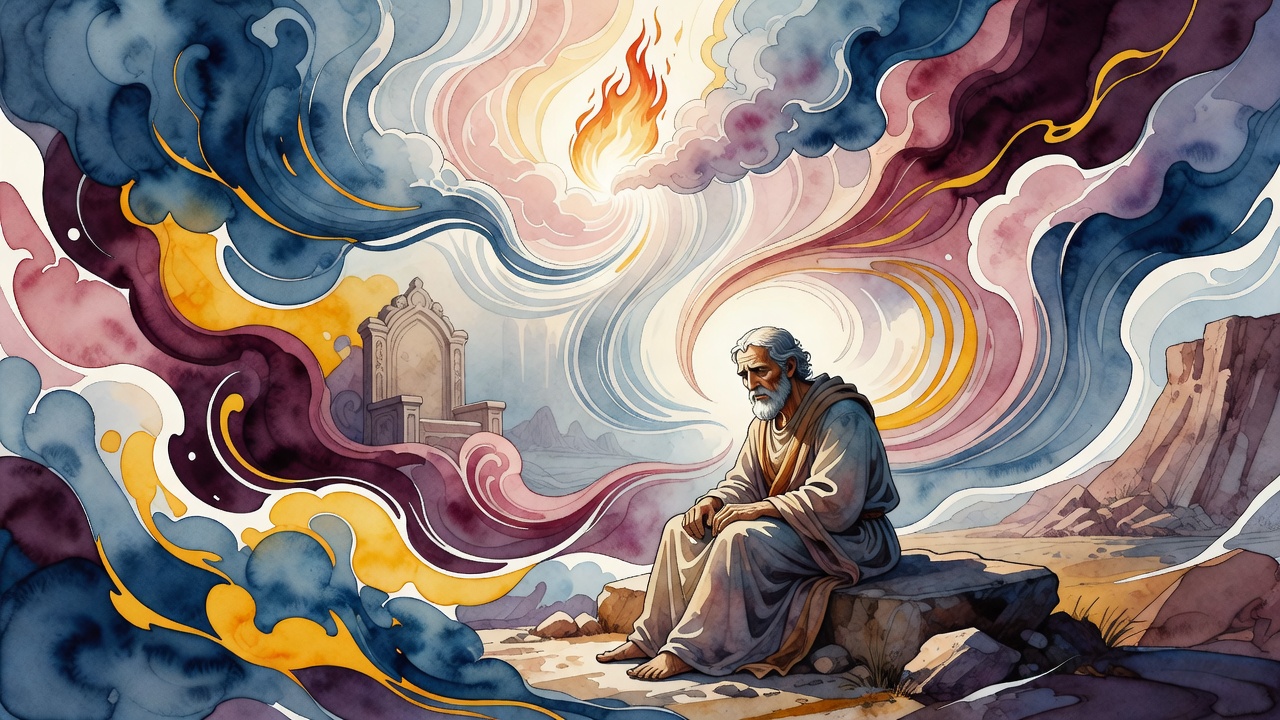
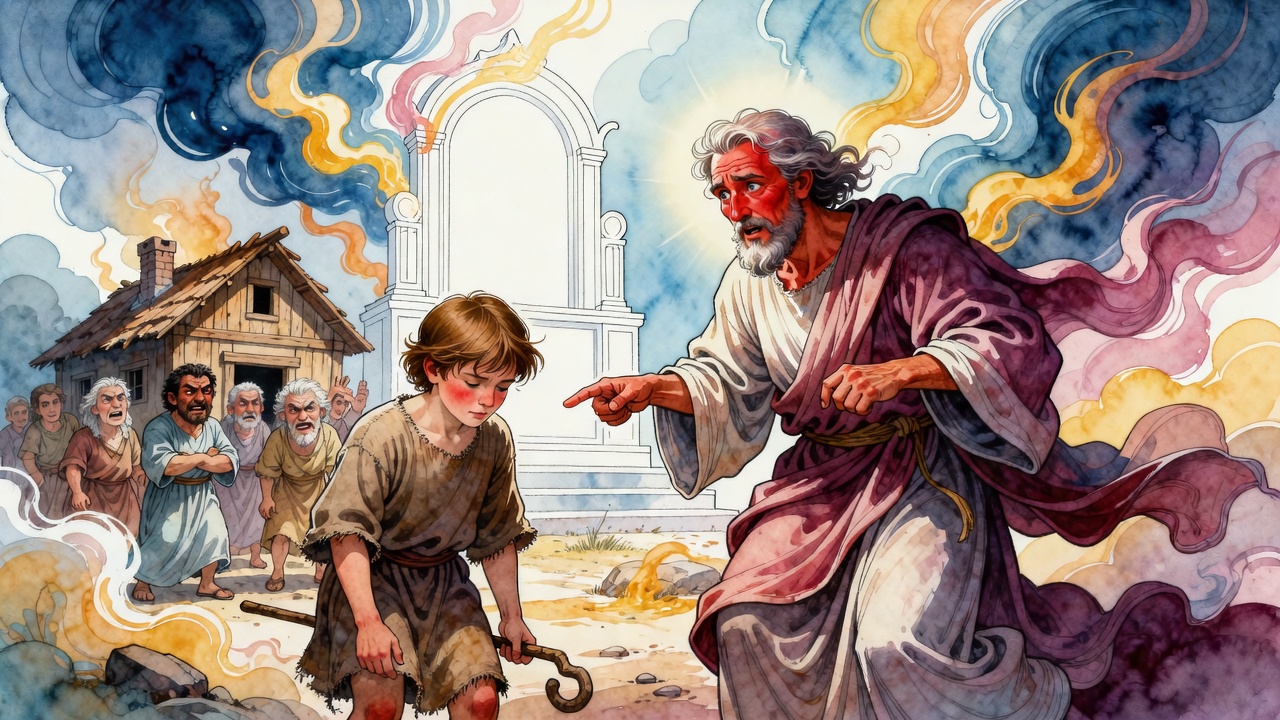
Samuel had come to Bethlehem to find a king hidden inside a shepherd's house. He passed over the tall sons and the broad sons, the ones built like soldiers. Then Jesse sent out to the field, and they brought in the youngest, and the boy's face was ruddy, flushed so red it looked as if the sun had settled under his skin. Samuel looked at him and felt his own stomach turn. He half rose from his seat. He had seen that color once before, on a child born generations back who came out red all over like a hairy mantle, and that child had grown into Esau, a man who lived by the sword and by his own hunger. This one too spills blood, Samuel thought. He did not want to pour holy oil over another hunter.

The Word That Turned Esau's Blood Into a Court's Sentence

Then a voice reached him, and it belonged to the God who had sent him. "Look at his eyes," it said. The boy had beautiful eyes, and the whole difference between this red and Esau's red lived exactly there. Esau killed by his own consent, on his own word, whenever the mood took him. This one would spill blood only after a court of seventy judges had weighed the case and handed down its sentence. The same color, two different men. One a murderer, one a king who would take a life only by the law.

"Rise and anoint him," the voice said, "for this is the one." Samuel rose from before the boy and let the oil run down. This is the one in this world, and this is the one in the world to come.

The Name They Would Not Give Him

The oil dried, and the years did not soften. Long after the horn had touched his head, the boy stayed, in every mouth that mattered, only the son of Jesse. Not David. The son of Jesse. His enemies turned the phrase into a weapon and threw it at him in the open. "May the son of Jesse hand out fields and vineyards to you all," they sneered, as if he were a pretender buying loyalty he had never earned. "As long as the son of Jesse walks the earth, not one of you is safe, and no kingdom of yours will ever stand." They said it to hollow him out. A man's name in that world was his essence, his destiny, the proof that he existed as himself and not as some appendage of his father. To call him only the son of someone was to say he was no one. "And I have no name," he answered, and felt himself erased.

They pressed harder. "God has abandoned him," they said. "The Presence has left him. The crown will never return to his house." David heard them chase these lies and threw the question back. "You love emptiness. How long will you run after things that are hollow?" He would not let their doubt become his own. He would not believe that his stepping aside for a single moment could bring the whole kingdom down.

The Traveler With Two Coins

And yet, alone, David said a stranger thing. "I am a stain," he said. Not to his enemies. About himself.

He told it as a small story. Picture a traveler with two coins in his fist and a long road at his back. He comes to two inns. One is laying out fish on silver, course after course. The other sets down plain meat. He looks at the fish and his throat tightens, because he knows what happens if he sits at that table and then cannot pay. So he goes to the innkeeper and says only, "Give me food for two coins." The innkeeper laughs. What can I bring you for so little? And the traveler answers, "Have you not heard the saying? According to my purse, I dance." He asks for exactly what he can afford, and not a crumb more.

David weighed himself on the same scale. He would not push in among the great. He pictured Abraham, Isaac, and Jacob seated together in an inner room, Moses and Aaron in the chamber just outside it, and himself standing at the far edge, on the threshold, asking for nothing more than to be let in the door.

The Threshold of the House

"I would rather crouch at the doorway of God's house," he said, "than sit in comfort anywhere else. And if they will not even grant me the threshold, still I will not leave the inn." He did not want a chair among the patriarchs. He wanted to be near them, even at the door, even on the stone at the foot of it.

His enemies believed that grand offerings bought God's favor. David knew the counter. Balaam built seven altars and God turned away from the smoke. The wicked man's sacrifice is a thing God cannot stomach. What God wants is the prayer of the upright, the low and honest voice, the man who names himself a stain and still lifts his face toward the door.

So the red-cheeked boy the prophet had feared, the youngest son with no name of his own, the traveler counting out two coins, stood at the threshold heaven had already chosen for him, and asked only to stay there.


← All myths
From the tradition

Sources

3 sources

The texts behind this telling. Some cards carry a translation of the source; others are our own retelling of it, and each card says which. Every card links out to the original.

Midrash Tehillim 4:8Midrash Tehillim

Retold in our words. Read the original at the link below.Rabbi Mike Feuer, Jerusalem Anthology · CC-BY

Midrash Tehillim, a collection of rabbinic interpretations of the Book of Psalms, gives us a glimpse into his struggle.

How long will you shame me and call me the son of Jesse?" David is clearly wrestling with his identity. He's not just David, the king, the poet, the warrior. He's perpetually "the son of Jesse." It’s a constant reminder of his origins, a label he can't seem to shake.

He then quotes the taunts of his enemies. They sneer, "May the son of Jesse give you all a portion," "For you have chosen the son of Jesse," and the most cutting of all: "For as long as the son of Jesse lives on the earth, you shall not be established, nor your kingdom." It's brutal. They're weaponizing his lineage against him, suggesting his very existence is a threat to their power. And then, the kicker: "And I have no name." He feels utterly reduced, stripped of his own identity.

What's going on here? Why is David so fixated on this? In ancient times, names held immense power. They weren't just labels; they were reflections of a person's essence, their destiny. To be denied a name, to be only known as "the son of…" is to be denied your very being. The Midrash (rabbinic interpretive commentary) captures David's anguish, his feeling of being overshadowed, of not being seen for who he truly is.

The text continues, "Do you love emptiness? Until when will you pursue things of emptiness?" It's a rhetorical question, a challenge to those who doubt him. The Hebrew word for "emptiness" here is rikut, often associated with vanity and falsehood. David is accusing his detractors of chasing illusions, of believing in their own propaganda.

"They say, 'God has abandoned [us], God has forgotten [us],' [that] His Presence has departed from him and that the kingdom will not return to him forever." They're claiming divine abandonment, suggesting that God's favor has turned away from David. This is a serious accusation, particularly for a king whose legitimacy rested on divine appointment.

And then, David fires back: "You seek lies. What do you think? Do you believe that by my departing for a moment, the kingdom…" The sentence is left unfinished, but the implication is clear: do they truly believe that his temporary absence will lead to the downfall of the kingdom? He's challenging their lack of faith, their short-sightedness.

It's a powerful moment of defiance. David, despite feeling diminished and attacked, refuses to be defined by his lineage or his enemies' doubts. He asserts his own worth, his own connection to the divine.

What does this ancient struggle tell us today? Maybe it's a reminder that we all confront identity, with being seen for who we are beyond our labels and our past. Maybe it's an encouragement to find our own voice, even when we feel overshadowed. Maybe it's a call to have faith in ourselves, even when others try to diminish us.

Because, like David, we all have the potential to rise above the limitations that others try to impose on us. We all have the potential to claim our own name.

Full source
Midrash Shmuel 19:6Midrash Shmuel

Translation of the source text.Midrash Shmuel, Krakow 1893, Public Domain, on Sefaria · CC-BY-SA

"And he sent and brought him in. And he was ruddy, etc." (1 Samuel 16:12). When Samuel saw David, he began to flush red and to rise up. He said: This one too is a shedder of blood, as you say, "And the first came out ruddy" (Genesis 25:25). The Holy One, blessed be He, said to him: "with beautiful eyes", David kills by the consent of the Sanhedrin, but Esau kills by his own consent. "And the LORD said: Arise, anoint him, for this is he" (1 Samuel 16:12, ibid.). The Holy One, blessed be He, said to him: Arise from before him. Rabbi Shmuel bar Nachman said: "This is he" in this world, and "this is he" in the world to come; therefore he praises the Holy One, blessed be He, with ten psalms: "I love You, O LORD, my strength. The LORD is my rock and my fortress, etc." (Psalms 18:2). Rabbi Simon said: Even at the end of the book he praises the Holy One, blessed be He, with ten psalms: "Hallelujah. Praise God in His sanctuary, etc." (Psalms 150:1).

Full source
Midrash Tehillim 17:1Midrash Tehillim

Retold in our words. Read the original at the link below.Rabbi Mike Feuer, Jerusalem Anthology · CC-BY

The Midrash Tehillim, a collection of rabbinic teachings on the Book of Psalms, offers a powerful glimpse into David's humility. It tells of David declaring, "I am a stain.

The Midrash (rabbinic interpretive commentary) illustrates this feeling with a parable. He comes across two inns, one serving extravagant fish dishes, the other simpler meat dishes. He thinks, "If I ask for food, they'll bring out all these plates, and I only have two coins!" So, he goes to the innkeeper and simply says, "Give me food for two coins." The innkeeper asks what he can offer for so little. The traveler replies, "Haven't you heard? 'According to my purse, I dance.'" In other words, he acknowledges his limitations.

David uses this same kind of thinking to describe his place in the world. He says, "I cannot sit with the great ones; I will wait with the little ones." He imagines Abraham, Isaac, and Jacob in a small room, Moses and Aaron in the antechamber, and himself standing on the threshold. As it says in (Psalms 131:1-2), "I have chosen to huddle in the house of God. And if I cannot sit on the threshold, I will not leave the inn." He’s saying, even if he can only be on the periphery, he wants to be close to God.

This leads us to (Psalm 17:1), "Hear, O Lord, my righteousness." But is David truly righteous? Doesn't he have flaws?

The Midrash then quotes (Proverbs 21:27), "The sacrifice of the wicked is an abomination." Rabbi Yehoshua, in the name of Rabbi Chanina, brings in the story of Balaam, who told Balak to build seven altars, implying that God desires sacrifices (Numbers 23:1). But God tells Job's friends (Job 42:8), "Now take for yourselves seven bulls and seven rams." The Lord says, "I do not desire your sacrifices; the sacrifice of the wicked is an abomination to Me."

So, what does God desire? The Midrash answers with (Proverbs 15:8): "The prayer of the upright is His delight." It’s not grand gestures or impressive offerings, but sincere prayer from a humble heart. The Zohar, the foundational text of Jewish mysticism, emphasizes the power of intention in prayer as well.

What does this all mean? Perhaps it's about recognizing that true connection with the Divine isn't about perfection or status. It's about approaching God with humility and sincerity, acknowledging our limitations, and offering our heartfelt prayers, even if we feel like a "stain." And maybe, just maybe, that humility is what makes our prayers truly beautiful in God's eyes.

Full source