6 min read

The Sea Stood Like a Stoppered Flask Over Egypt

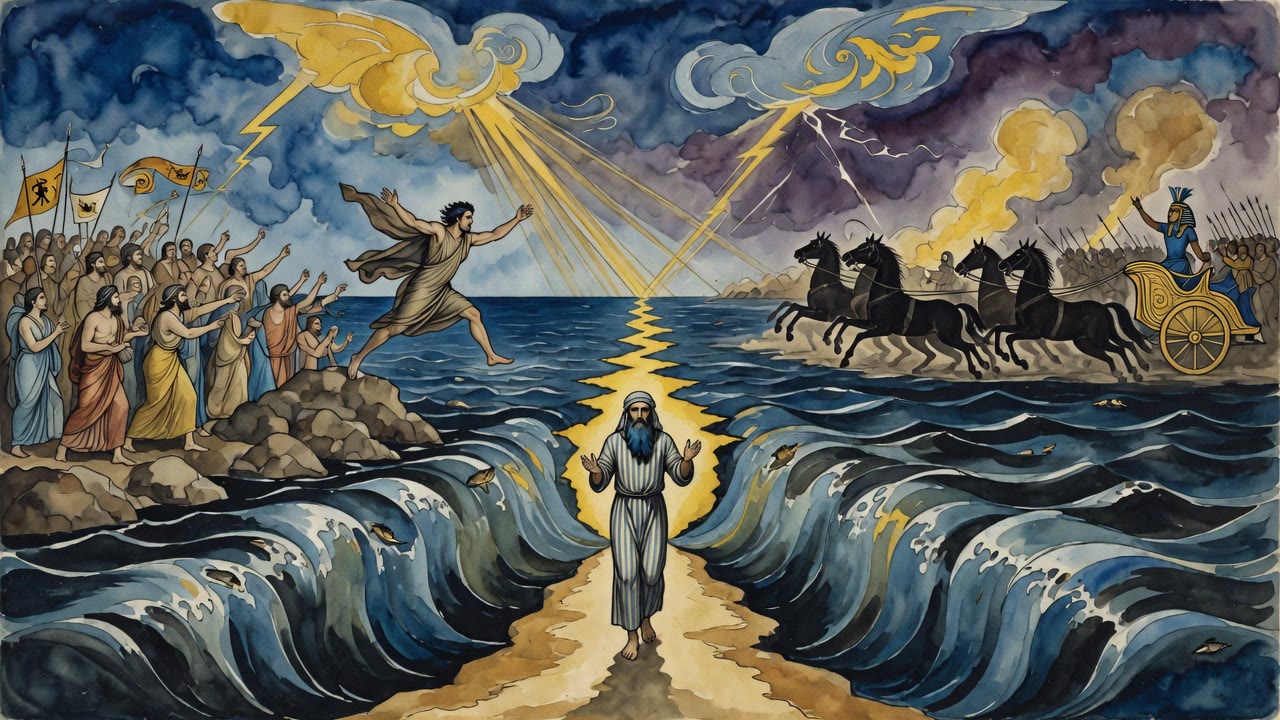
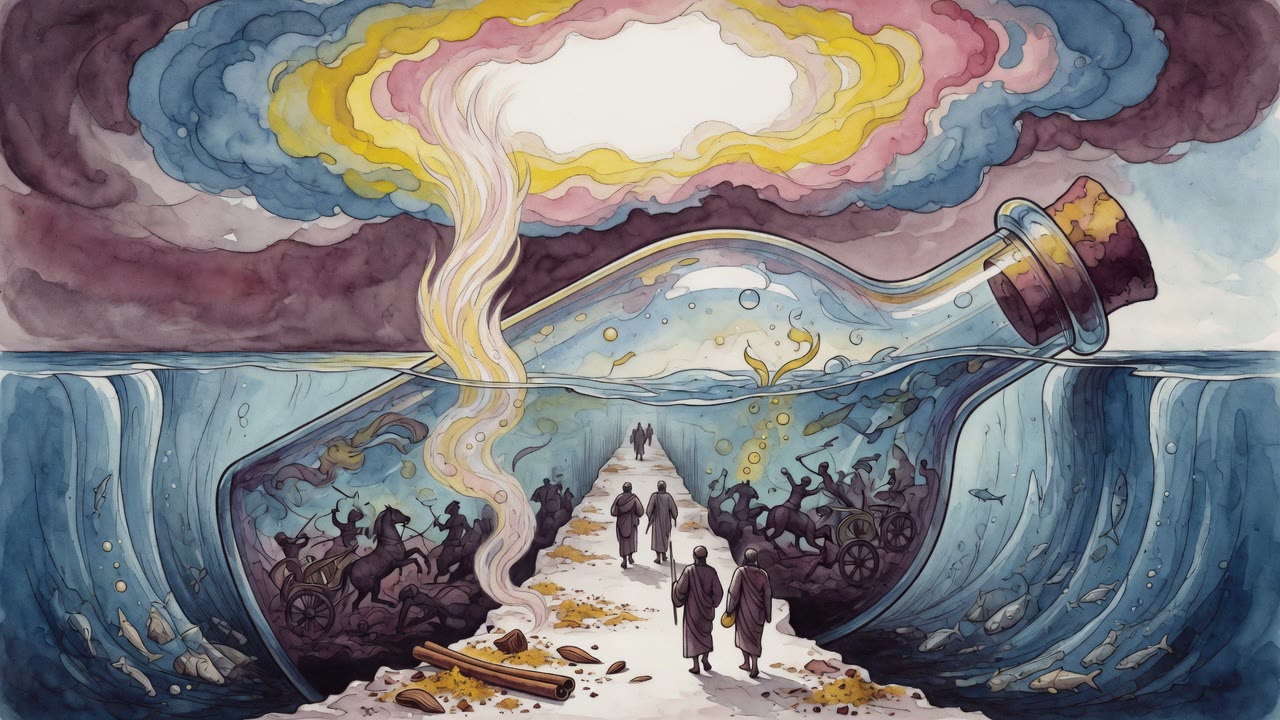
Egypt's breath sealed inside a bound flask of water while Israel walked a spice-path through the same sea, and the depths arched into a dome over the pursuers.

Curated by Arthur · Told by Maggid ·
Table of Contents
  1. The Smell Came First
  2. A Ceiling Built Like a Heart
  3. Ten Cubits Away, a Garden
  4. Dead and Not Dead on the Sand
  5. The Song Started While He Was Still There

The charioteer took his last full breath on the dry road between the walls, and after that his chest would not work in either direction.
The Sea Stood Like a Stoppered Flask Over Egypt Click for full size

Nothing was pressing on him, which was the part he had no time to understand. There was no weight on his ribs and no water in his mouth. His lungs had been stoppered, the way a flask is stoppered when it is bound at the neck so that it lets nothing out and takes nothing in, and his spirit was sealed inside him with whatever air he already had.

The Smell Came First

What reached him instead of water was the smell. The sea had gone thick around the wheels and it was boiling like a pot over a fire (Job 41:23), and the reek came up off it and got into him and made him faint where he stood, though he was still upright in the car with the reins wrapped around his fists.

His horse had stopped screaming. The left wheel had locked into ground that had been a road a hundred heartbeats ago and was now something between mud and jelly, and behind him six hundred cars were doing the same thing at the same time, six hundred drivers going purple and quiet with not one drop of water on their faces.

He had come down that corridor at a gallop. He had seen the walls standing on either side and had read them as a road, since a road is what it looked like, and he had whipped the horse forward into it because the men ahead of him were going and because a chariot in a line does not stop.

A Ceiling Built Like a Heart

He looked up, because a man looks up.

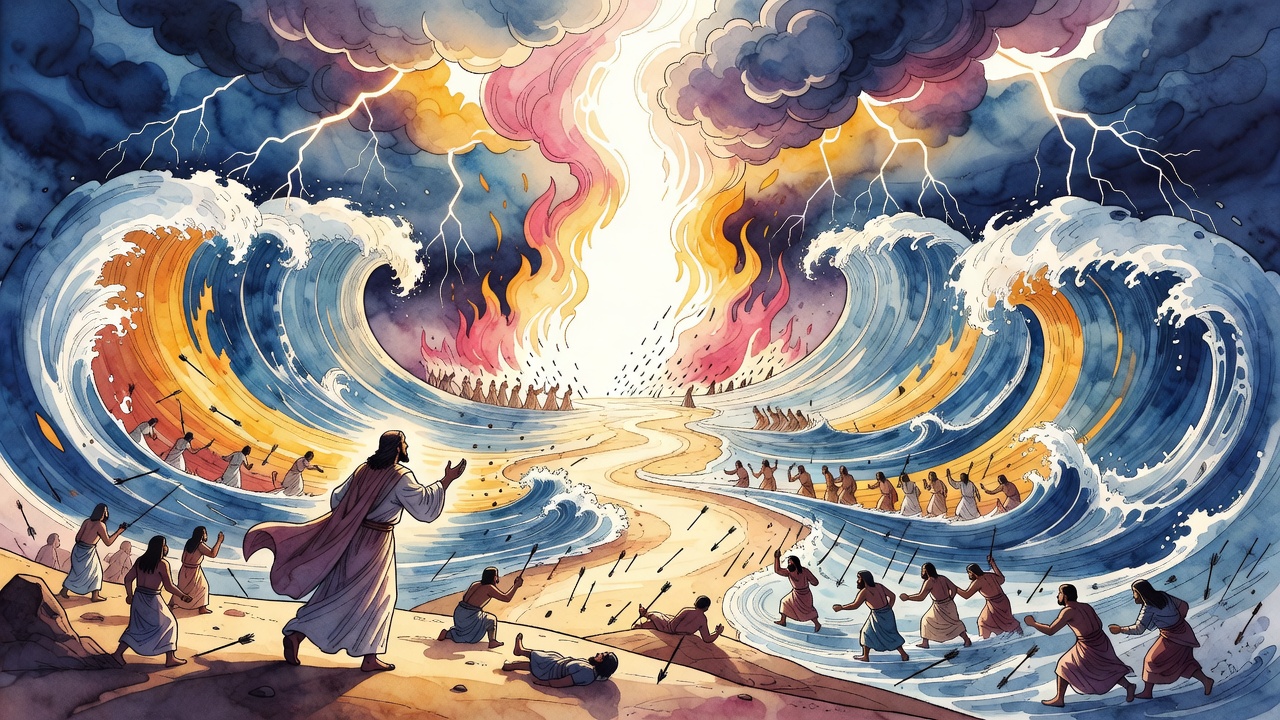
The two walls were not standing straight anymore. They had leaned in toward each other overhead and met and were holding, and the shape they made above him was a dome. Nothing about it was falling. It had a curve a mason would have recognized, a deliberate arch closing off a room, the way the two chambers of a heart are joined by the arch between them.

He had expected a collapse. A collapse he could have understood, since water held up comes down, and coming down is the only thing water knows how to do. This was not a collapse, though, and it took him a moment to find the word for what it was. Somebody had roofed him.

Under the vault the column stopped moving. Men were still in their cars with their hands still on their weapons and their faces going dark, and the whole army stood there arranged in ranks inside a building that had been put up around it in less time than it takes to turn a horse.

Ten Cubits Away, a Garden

Through the water he could still see across the corridor, and there were people over there, and they were eating.

The same sea that had shut his chest was behaving entirely differently ten cubits off. On that side the walls were a bed of spices, and a north wind and a south wind had been called up to blow across them so the smell would carry (Song of Songs 4:16). Children on that side had their mouths against the wall. Sweet water was coming out of the salt for them, running water, living water, the kind that comes out of a struck rock, and a woman was catching it in a cup and holding the cup for somebody smaller.

They were eating and drinking and laughing in a corridor made of the same body of water that was killing him.

He had put a whip across the backs of people who looked like her. He was going to die of the smell of a sea that she would remember all her life as a garden, and there was no room left in him to say anything about it, because his mouth would not open outward any more than it would open inward.

Dead and Not Dead on the Sand

The sea put him on the shore and did not finish him there.

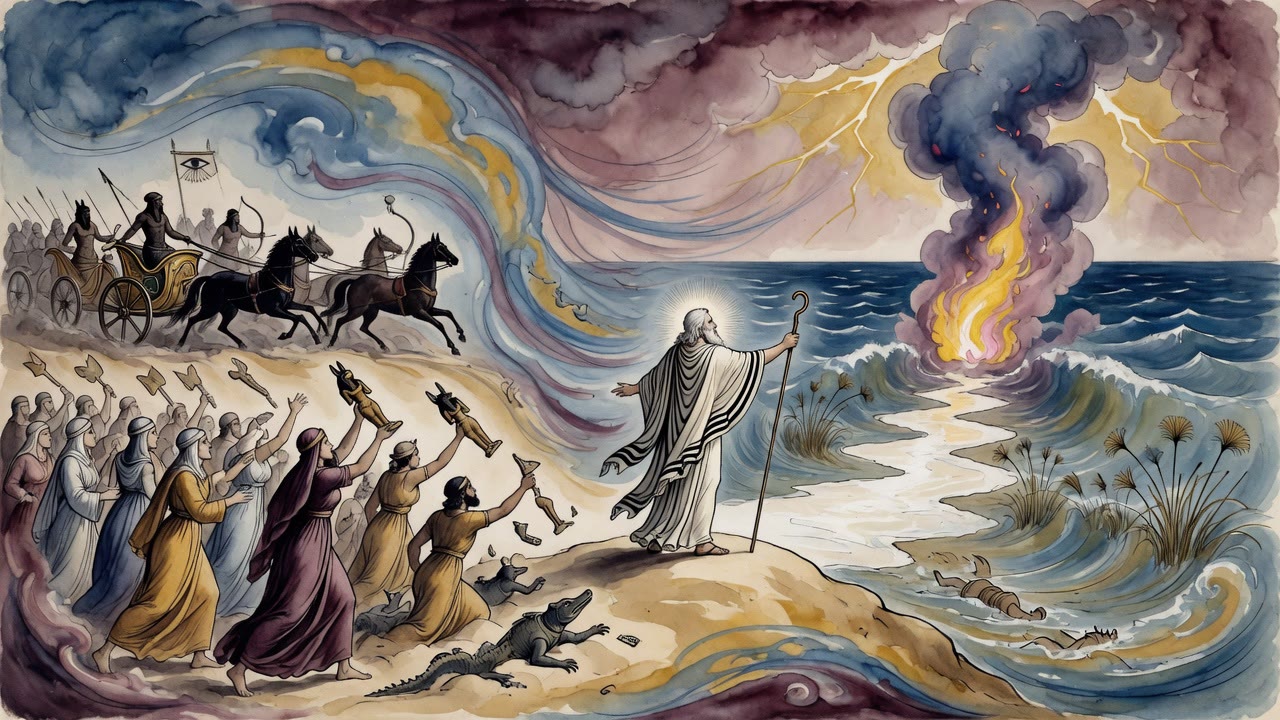
He lay in the wet sand among several thousand men in every stage of leaving, some already gone quiet, some still working their jaws, the way Rachel lay dying on the road to Ephrath with breath enough left to name her son. It was a beach of dead men, though he was not dead yet, and there was a long stretch of daylight between those two facts.

They had not all been killed the same way either. The blows had come down on that army in different kinds, one worse than the next, the way the plagues had come down on Egypt in different kinds, so the beach sorted the army into a long row of endings that did not match each other.

Israel walked that shoreline and looked at them. Nobody was spared the looking, and nobody could go home afterward and say that the enemy had simply disappeared into the water and become a rumor.

The Song Started While He Was Still There

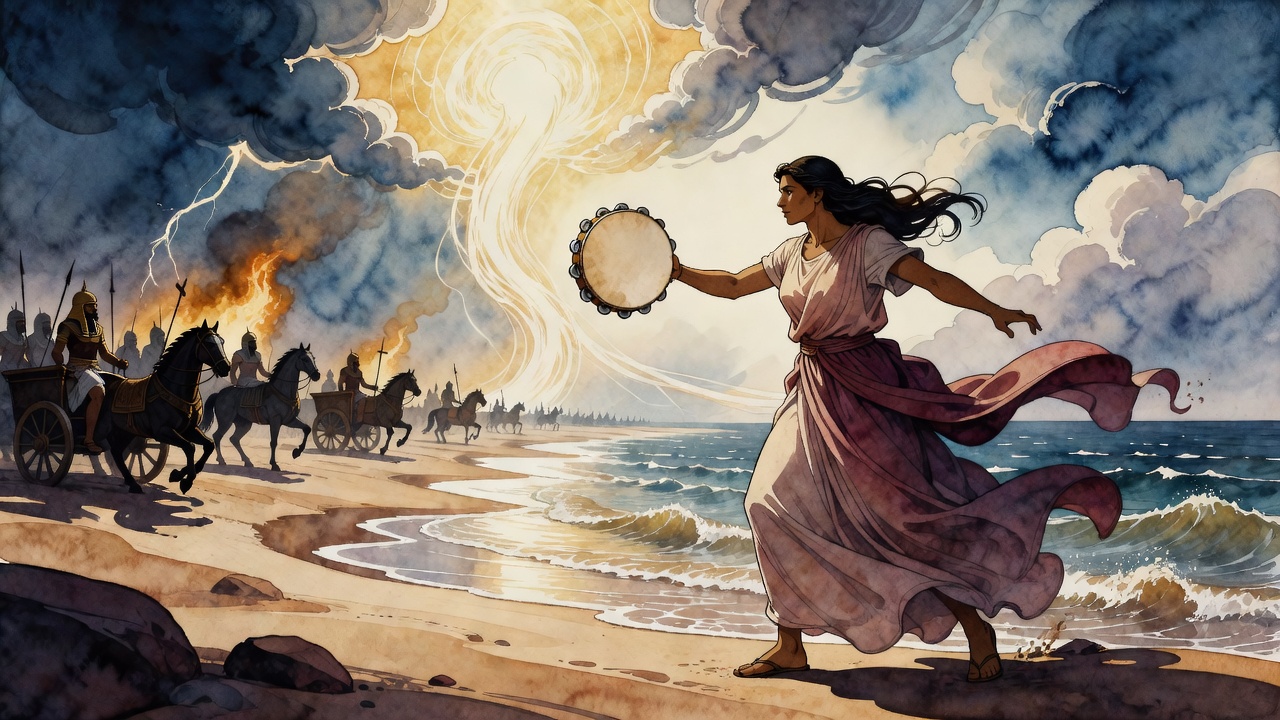
They began to sing before he was done dying.

He could hear it from where the water had set him down, a whole nation coming in on one line and then the next, and it did not stop and it was not a small sound. It went on over the noise the men beside him were making, which was not singing.

Behind them all the vault held its shape a while longer over an empty road. Then the sea forgot the whole arrangement, and the arch came apart, and the water went back to being water over the place where the road had been.


← All myths
From the tradition

Sources

4 sources

The texts behind this telling. Some cards carry a translation of the source; others are our own retelling of it, and each card says which. Every card links out to the original.

Mekhilta Tractate Shirah 6:18Mekhilta DeRabbi Yishmael

Retold in our words. Read the original at the link below.Mechilta, translated by Rabbi Shraga Silverstein · CC-BY

This teaching from the Mekhilta on the Song at the Sea expounds the words (Exodus 15:8) "They stood up like a flask," describing how the waters of the sea piled up and stood firm. The rabbis draw a vivid comparison. Just as a sealed and bound flask neither emits its contents nor admits anything from outside, so the spirits of the Egyptians were bound up tightly within them, unable to escape and unable to draw relief, while at the very same time Israel ate and drank and rejoiced in safety. The single image of the stoppered flask captures both halves of the miracle, the choking confinement of the pursuers and the open abundance enjoyed by the redeemed.

The passage then turns to the wonder of the water itself, teaching that sweet water issued forth for Israel out of the salt sea. The proof is (Psalms 78:16) "and He brought forth nozlim from the rock." The rabbis define nozlim as living, flowing waters, and they support this meaning from two further verses. In (Song of Songs 4:15) the beloved is called "a garden spring, a well of living waters," and in (Proverbs 5:15) the teaching is "Drink water from your pit and nozlim from your well." By gathering these verses the Mekhilta shows that nozlim everywhere denotes fresh running water. So in the midst of the salted sea G-d provided His people fresh streams to drink, turning the place of their enemies' terror into a place of their own delight.

Full source
Mekhilta Tractate Shirah 6:19Mekhilta DeRabbi Yishmael

Retold in our words. Read the original at the link below.Mechilta, translated by Rabbi Shraga Silverstein · CC-BY

The Mekhilta draws a remarkable distinction between what the Red Sea was for Egypt and what it was for Israel. For the Egyptians, the sea was a sealed tomb. For the Israelites, it was a garden of spices.

The image begins with a bound flask, stopped up, sealed, neither emitting nor admitting anything. This was the experience of the Egyptian soldiers trapped in the sea. Their spirits were bound up within them. They could neither breathe in nor breathe out. The smell of the sea overwhelmed them, and they suffocated in its grip. (Job 41:23) describes it: "He bubbles up the sea like a pot", the waters churned and boiled around them.

Israel walked through the same sea and experienced something entirely different. For them, the waters were like a bed of spices, fragrant, pleasant, invigorating. The same verse from Job continues: "He makes the sea like a spice-bed." And the Mekhilta adds (Song of Songs 4:16): "Awake, O north wind, and come, O south, blow over my garden that its spices may flow."

The same body of water. The same moment in time. For one people, a cauldron of death. For the other, a perfumed garden. This teaching from the Mekhilta DeRabbi Yishmael (Tractate Shirah 6:19) insists that God's creation is not neutral, it responds differently to different people based on their relationship with the Creator. The sea knew who was who.

Full source
Mekhilta Tractate Shirah 6:20Mekhilta DeRabbi Yishmael

Retold in our words. Read the original at the link below.Mechilta, translated by Rabbi Shraga Silverstein · CC-BY

The Mekhilta DeRabbi Yishmael offers a vivid image of what happened to the Egyptians at the bottom of the Red Sea. The Torah says "the depths were congealed in the heart of the sea" (Exodus 15:8), using the Hebrew word "kafu." The rabbis connect this word to "kippah", a dome or an arch. And from this linguistic link, they reconstruct the scene.

God made the waters form a dome over the Egyptians, like an arched ceiling closing in from above. The sea did not simply crash down on them in a chaotic flood. It curved over them, sealing them beneath a vault of water.

The Mekhilta then offers an anatomical analogy to explain the shape. A human heart has two chambers and an arch connecting them. Just as the heart is structured with an arching form, so God "arched the sea over them." The waters formed a living architecture, a dome of ocean pressing down with the same organic structure as the human body's most vital organ.

This image transforms the crossing of the Red Sea from a simple parting-and-closing into something far more deliberate. The Egyptians were not merely drowned. They were entombed beneath a carefully constructed vault. The sea became a building, walls, ceiling, and all, with the Egyptian army trapped inside its chambers. The language of the Torah, read closely enough, reveals that even in destruction, God's hand shaped the waters with precision and purpose, not chaos.

Full source
Mekhilta Tractate Vayehi Beshalach 7:14Mekhilta DeRabbi Yishmael

Retold in our words. Read the original at the link below.Mechilta, translated by Rabbi Shraga Silverstein · CC-BY

The Torah states that Israel saw the Egyptians "dead on the shore of the sea" (Exodus 14:30). The Mekhilta asks a blunt question: were they actually dead? The answer is more disturbing than a simple yes. The word "dead" here means something between life and death, they were dying, not yet fully dead. The Israelites watched their former oppressors in the agony of a drawn-out death on the shoreline.

The Mekhilta draws a parallel to Rachel's death in Genesis: "And it was as her soul departed when she died" (Genesis 35:18). Was Rachel dead at that moment? Not quite, the verse captures the process of dying, the soul in the act of departure. The same language applies to the Egyptians on the beach. They were strewn along the shore in various states of expiration, close enough for the Israelites to witness the full spectacle of their destruction.

A second interpretation adds another layer. "And Israel saw Egypt dead", the word "dead" encompasses different types of death, each one worse than the last. The Egyptians were not all destroyed in the same way. They were struck with different plagues in the sea, mirroring the variety of punishments they had received in Egypt. Some deaths were swift, others prolonged. Some were violent, others suffocating. The Mekhilta wants the reader to understand that divine justice at the sea was not a single blanket act of drowning. It was individualized punishment, each Egyptian received a death calibrated to their particular cruelty against Israel.

Full source