5 min read

The Serpent Walked Until Heaven Cut His Feet

Once the serpent stood on feet and reasoned Eve toward the fruit. Judgment cut those feet away and left death's poison in his mouth.

Curated by Arthur · Told by Maggid ·
Table of Contents
  1. Feet in the Dust of Eden
  2. Subtilty and Wickedness
  3. The Sentence That Shortened a Body
  4. Dust for Bread
  5. The Rib and the Crawl
The Serpent Walked Until Heaven Cut His Feet Click for full size

Feet in the Dust of Eden

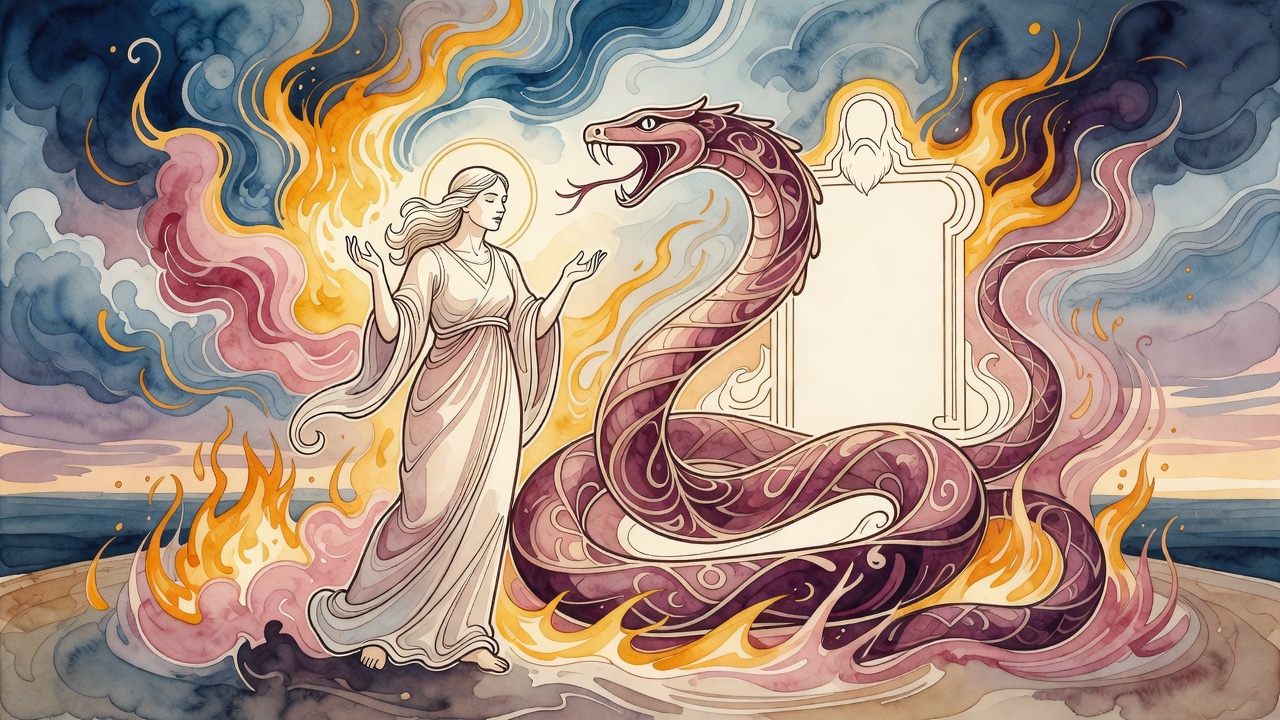
The serpent stood. Not coiled. Not low. He stood on feet the way a man stands, and he walked the garden paths as if the paths belonged to him. Leaves brushed his shoulders. Fruit hung at the height of his mouth. When he came toward Eve, he did not scrape through grass. He approached on a level with her eyes and offered a reason that sounded like care.
She had been built from the thirteenth rib of Adam's right side, drawn out while he slept under God's hand (Genesis 2:21). The right side is the side of kindness in the old symbols. Thirteen is the number of echad, one, and of ahavah, love. She woke into partnership, not into a lesser rank. She knew the garden's fruits by name. She also knew the one tree that was not for eating.

The serpent knew that tree better than he admitted. He came close enough that his breath moved the leaves near her face.

"You will not die," he said, and the words were soft. "You will know."

Subtilty and Wickedness

The fruit was cool in her palm. The skin broke under her teeth. Sweetness and a sudden sharpness of sight arrived together. She handed the rest to Adam, and he ate without the long argument she had endured. When the Voice walked the garden in the cool of the day, both of them hid among the trees like children who have broken a jar.

God asked her what she had done. The Hebrew keeps her short. The fuller cry she carries in the old Aramaic memory is longer and sharper.

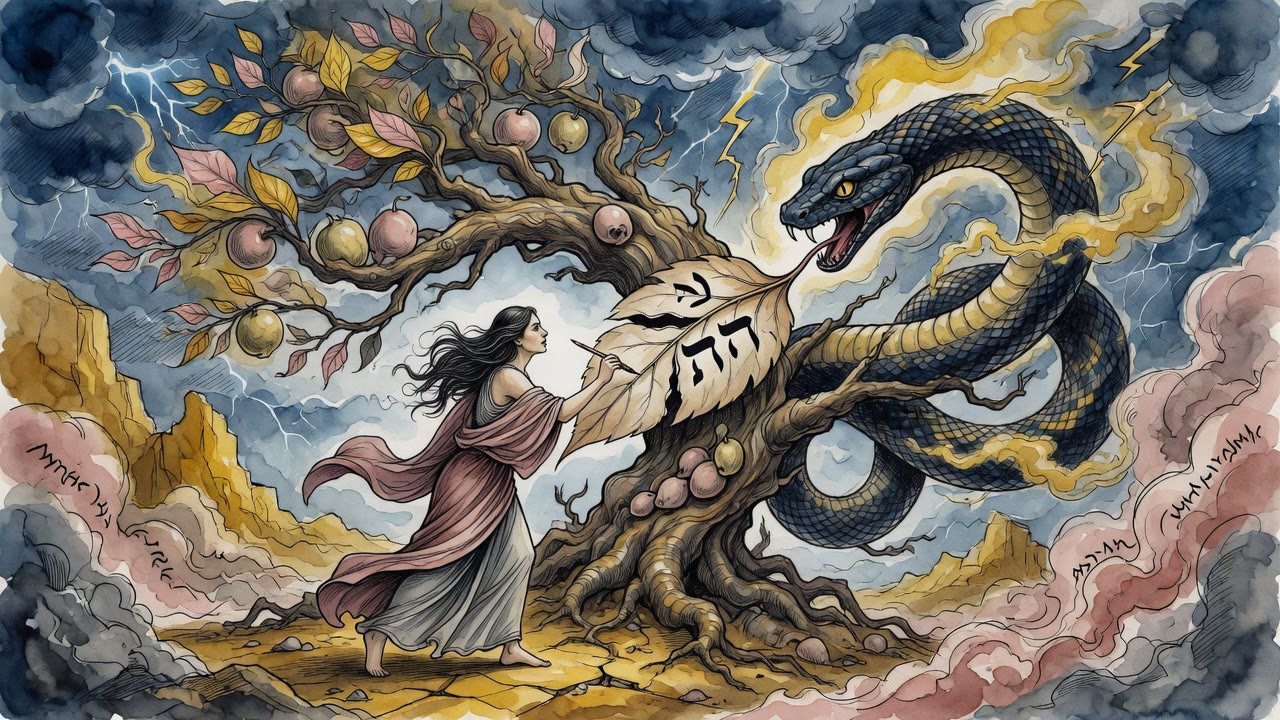
"The serpent beguiled me with his subtilty," she answered, "and deceived me with his wickedness, and I ate" (Genesis 3:13).

Two charges. Subtilty names the cleverness that out-argued her. Wickedness names the malice that wanted her ruined. She does not claim the fruit walked into her hand. She ends on the same two words that end the verse: and I ate. The serpent's mouth opened the door. Her teeth closed it.

Adam stood nearby with juice still on his tongue and no better defense than hers. The three of them were brought into judgment together, man, woman, and the upright creature that had reasoned a woman toward death.

The Sentence That Shortened a Body

God did not only curse the serpent. He remade him in front of the ones he had taught.

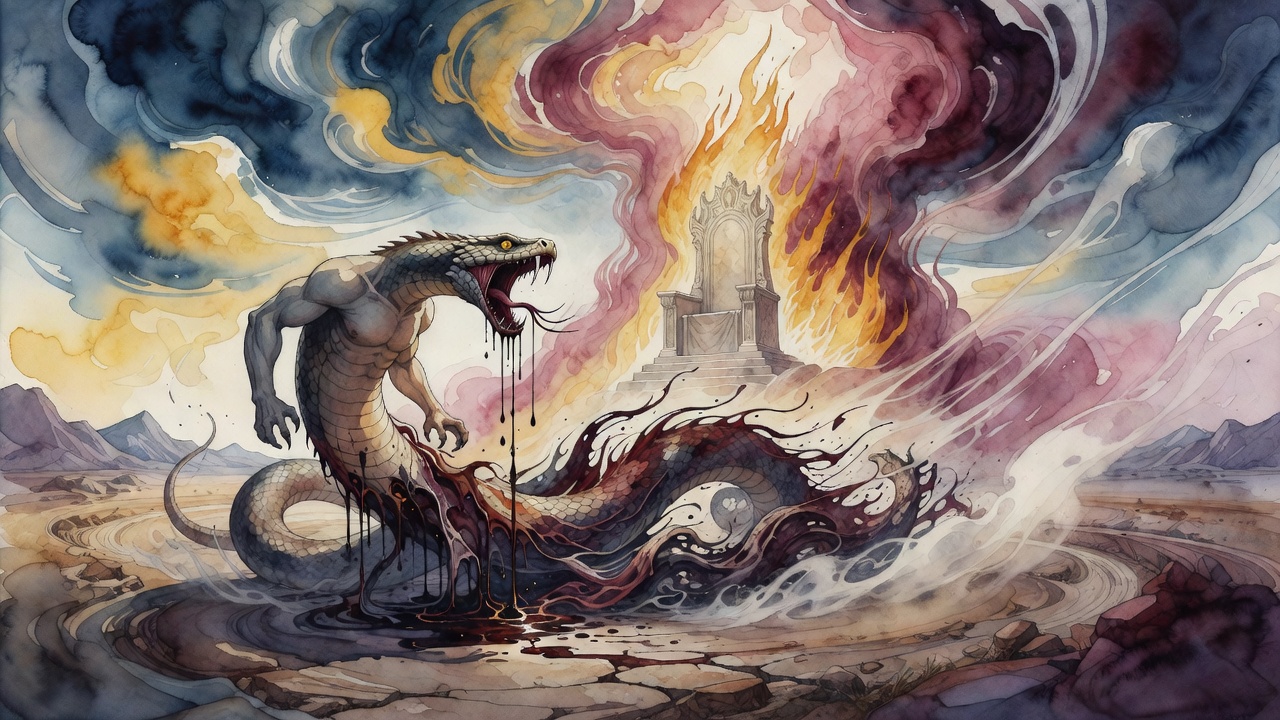
"Upon thy belly thou shalt go, and thy feet shall be cut off, and thy skin thou shalt cast away once in seven years, and the poison of death shall be in thy mouth, and dust shalt thou eat all the days of thy life" (Genesis 3:14).

The feet that had carried him into the conversation fell away. The upright spine folded into a line of muscle. He hit the dirt with a sound that was not a hiss yet, only the first wet scrape of a body learning a lower world. Dust entered the places where ankles had been. Every seven years he would shed the skin that remembered how tall he had been. In his mouth, forever, the poison of the death he had sold as knowledge.

What he gave Eve he would carry between his jaws. The gift returned as sentence. Mortality, which he had offered as a door, became the only flavor left on his tongue.

Dust for Bread

He crawled past the tree. He crawled past the place where Adam and Eve had stood clothed in light. The path that had felt like a royal road became a groove of belly and scale. He ate dust because dust was now his portion, and the dust tasted like the end of an argument he thought he had won.

Eve watched him go lower than any animal she had named. The creature that had stood eye to eye with her now measured the world by belly-length. Adam said nothing useful. The garden still smelled of fruit and fear. Somewhere beyond the first shock, both of them understood that speech itself had changed. Words could kill. Words could also tell the truth of a fall without erasing the faller.

Outside the gate, years later, their sons would argue about whether a Judge ruled the world. The serpent already knew the answer. A Judge had measured his feet and found them too proud for Eden. He moved through later grass as a reminder that cleverness without mercy ends on its stomach, carrying in its mouth the very death it taught.

The Rib and the Crawl

Eve pressed a hand to her side where she had never had a scar, only a story of being taken from kindness. Adam watched the serpent's track and the first blood of thorns already waiting beyond the trees. The garden did not clap. It only held its breath while three sentences finished three bodies.

When they walked east at last, the serpent was already there in the dust ahead of them, a living footnote to the first conversation that went wrong. He could not stand to bow. He could only crawl to remember.


← All myths

From the tradition

Sources

3 sources

The texts behind this telling. Some cards carry a translation of the source; others are our own retelling of it, and each card says which. Every card links out to the original.

Targum Pseudo-Jonathan on Genesis 3:14Targum Pseudo-Jonathan on Genesis

Retold in our words. Read the original at the link below.The Targum of Jonathan ben Uzziel, trans. J. W. Etheridge, London, 1862 · Public Domain

Targum Pseudo-Jonathan on (Genesis 3:14) tells us the original serpent was not a crawling thing. God "brought the three unto judgment", Adam, Eve, and the serpent. And pronounced the serpent's sentence.

"Upon thy belly thou shalt go, and thy feet shall be cut off, and thy skin thou shalt cast away once in seven years; and the poison of death shall be in thy mouth, and dust shalt thou eat all the days of thy life."

The serpent once had feet. He walked upright. The punishment literally severed them. He became a creature condemned to its belly, shedding skin every seven years as a reminder of what he had done, carrying the poison of the death he had brought into the world inside his own mouth. What he gave to Eve, death, he would now carry forever.

The Targumist makes the punishment fit the crime with eerie precision. The serpent's gift to humanity was mortality. From now on, mortality rides in his jaws.

Full source
Targum Pseudo-Jonathan on Genesis 3:13Targum Pseudo-Jonathan on Genesis

Retold in our words. Read the original at the link below.The Targum of Jonathan ben Uzziel, trans. J. W. Etheridge, London, 1862 · Public Domain

When God turns to the woman and asks, "What is this you have done?" the Hebrew gives her a famously terse reply, "The serpent beguiled me, and I ate" (Genesis 3:13). The Targum Pseudo-Jonathan, the expansive Aramaic rendering that regularly enlarges the bare Hebrew with interpretive detail, lets Eve say more. In its version she answers, "The serpent beguiled me with his subtilty, and deceived me with his wickedness, and I ate."

Two verbs, two distinct faults. Subtilty names the intellectual side of the deception, the cunning and cleverness with which the serpent reasoned her toward the fruit. Wickedness names the moral side, the malice of a creature who actively wanted her to fall. By splitting the act in two, the Targumist lets Eve describe both how she was outwitted and that she was lied to by someone bent on her ruin.

Yet the expansion does not become an excuse. Eve still closes her sentence exactly as the Hebrew does, with the words "and I ate." The serpent's subtilty and wickedness did not put the fruit in her mouth. She did. The Targum thus lets her tell the fuller truth of what was done to her while leaving intact her own accountability for the choice she made.

Full source
Targum Pseudo-Jonathan on Genesis 2:21Targum Pseudo-Jonathan on Genesis

Retold in our words. Read the original at the link below.The Targum of Jonathan ben Uzziel, trans. J. W. Etheridge, London, 1862 · Public Domain

The Torah says God took "one of his ribs" to make the woman. Targum Pseudo-Jonathan on (Genesis 2:21) gets oddly specific. "He took one of his ribs, it was the thirteenth rib of the right side, and closed it up with flesh."

Why the thirteenth? Jewish mystical tradition treats the number 13 as sacred, the numerical value of echad, "one," and of ahavah, "love." The Targumist may be signaling that Eve was taken from the seat of unity and love in Adam's body. The human marriage will carry that signature forever.

The right side matters. In Jewish symbolism, the right hand is the side of kindness (chesed). The woman is not formed from the left, the side associated with gevurah, severity. But from the side of compassion. The Targumist is quietly saying that the partnership of husband and wife is rooted in kindness from its first breath.

Full source