5 min read

The Shunamite Woman Rode to Elisha and Said Only Shalom

A woman who built a room for a prophet so he could rest, who had asked for nothing, now rode hard toward him with her dead son lying upstairs.

Curated by Arthur · Told by Maggid ·
Table of Contents
  1. A Boy Carried Out of the Field
  2. The Promise She Had Begged Him Not to Make
  3. Gehazi Came First and Failed
  4. The Room He Had Used Before
  5. The Soul That Had Been Here Before

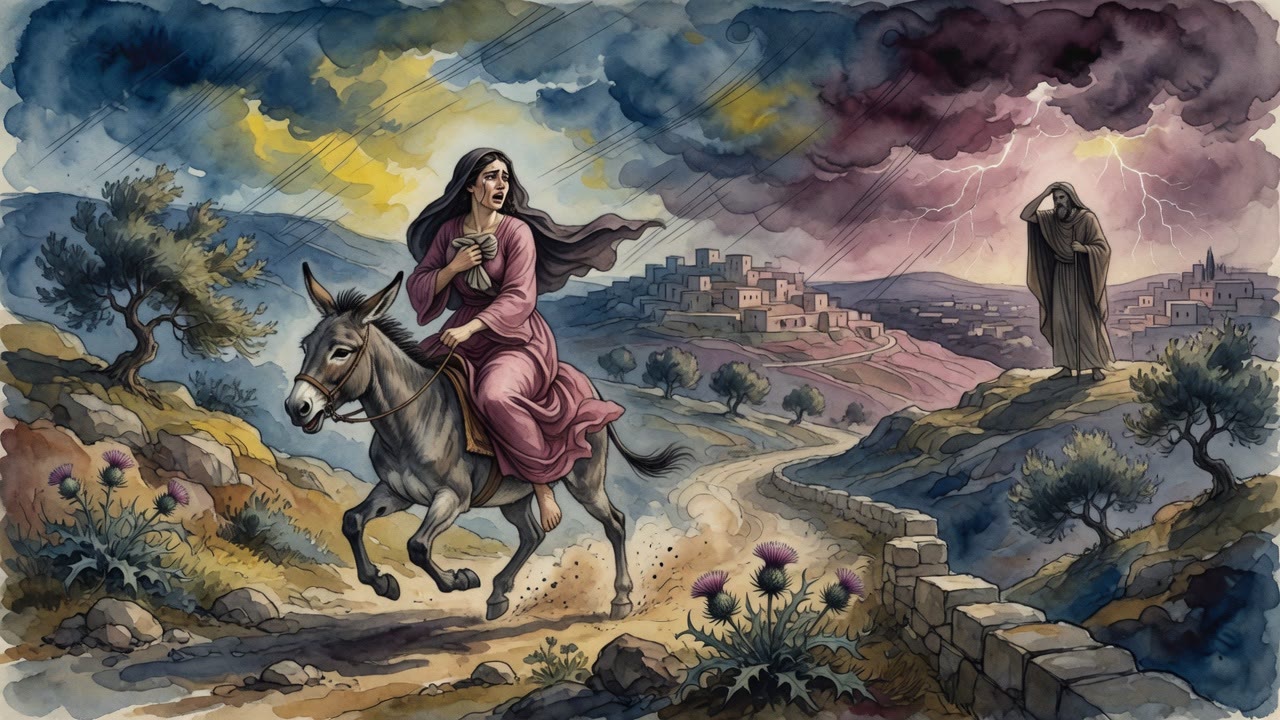
The boy was running between the rows when his hands went to his head. The reapers did not hear him at first. The sickles kept their rhythm, the cut barley fell, the heat sat heavy on the field outside Shunem. Then the small voice came again, thinner this time. Head. My head. His father straightened, saw the child swaying among the stalks, and called to a young man to carry him home to his mother.
A Boy Carried Out of the Field

She took him onto her knees. He was warm and then he was warmer, and the warmth was wrong, and by noon the wrongness had won. She held him until the small chest stopped moving and the head she had cradled grew still against her arm. No screaming. No tearing of her dress in the doorway where the neighbors could see. She carried him up the narrow stairs to the room she had built, and she laid him on a bed that was not his.

The room was plain. A bed, a table, a chair, a lamp. She had built it years before, not for her son, but for a stranger. She had watched a holy man pass through her town again and again, moving from one high place to another, and she had told her husband: "let us make a small upper chamber for him, so that when he comes to us he can turn in there." That was all she had wanted. A place for holiness to rest under her roof. She had asked for nothing back.

The Promise She Had Begged Him Not to Make

The prophet had wanted to repay her. He had offered to speak for her to the king or to the commander of the army. She had said: "I live among my own people. I need nothing." Then his servant Gehazi had noticed the obvious: she had no son and her husband was old. Elisha had called her back to the doorway of the room she had built and told her that within a year she would be holding a son.

She had not wanted the promise. "Do not lie to your servant," she said. "Do not give me something I might lose." He gave it anyway, and the child came as he said, and now the child was upstairs on his bed and she had saddled a donkey and told the servant to drive fast and not to slow down unless she told him to.

Gehazi Came First and Failed

Elisha saw her coming from a distance and sent Gehazi ahead to ask whether everything was well. She rode past the question. "Shalom," she said. "Shalom." Everything is fine. She did not stop to explain herself to the servant. She came all the way to the man who had made the promise and then she fell at his feet and held them and said: "did I ask a son of my lord? Did I not say do not mislead me?"

Elisha sent Gehazi ahead with his staff and instructions to lay it on the boy's face. Gehazi went. He laid the staff on the child. Nothing happened. He came back and reported: "the child did not wake." Elisha had already started walking. He walked the whole distance to her house in Shunem himself.

The Room He Had Used Before

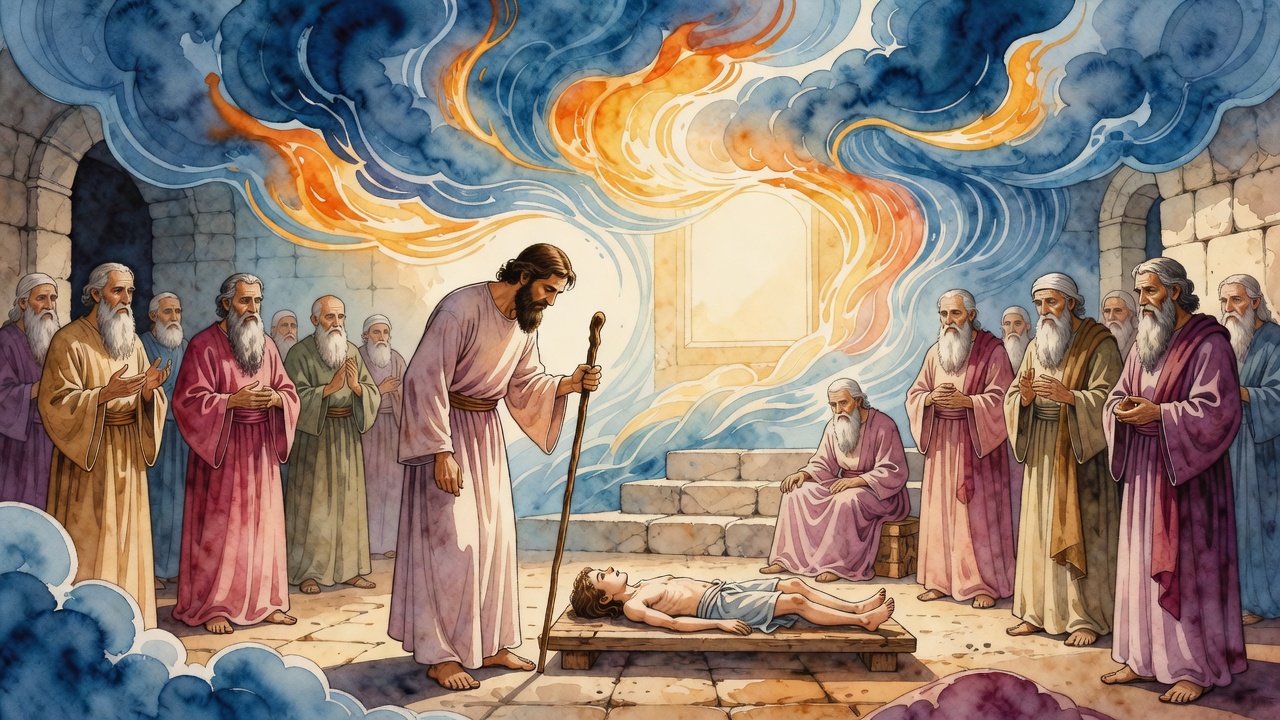
He went up and closed the door. The boy was lying on the bed, on the bed where Elisha had slept on his own visits through Shunem, the plain bed in the plain room with the table and the chair and the lamp. He stretched himself over the child, mouth on mouth, eyes on eyes, hands on hands. The child's flesh grew warm. Elisha rose and walked through the house. Then he went back and stretched himself over the child again, and the boy sneezed seven times and opened his eyes.

Elisha called Gehazi. Gehazi called the woman. She came to the room and Elisha said: "take your son." She fell at his feet and pressed her face to the ground. Then she took her son and went out.

The Soul That Had Been Here Before

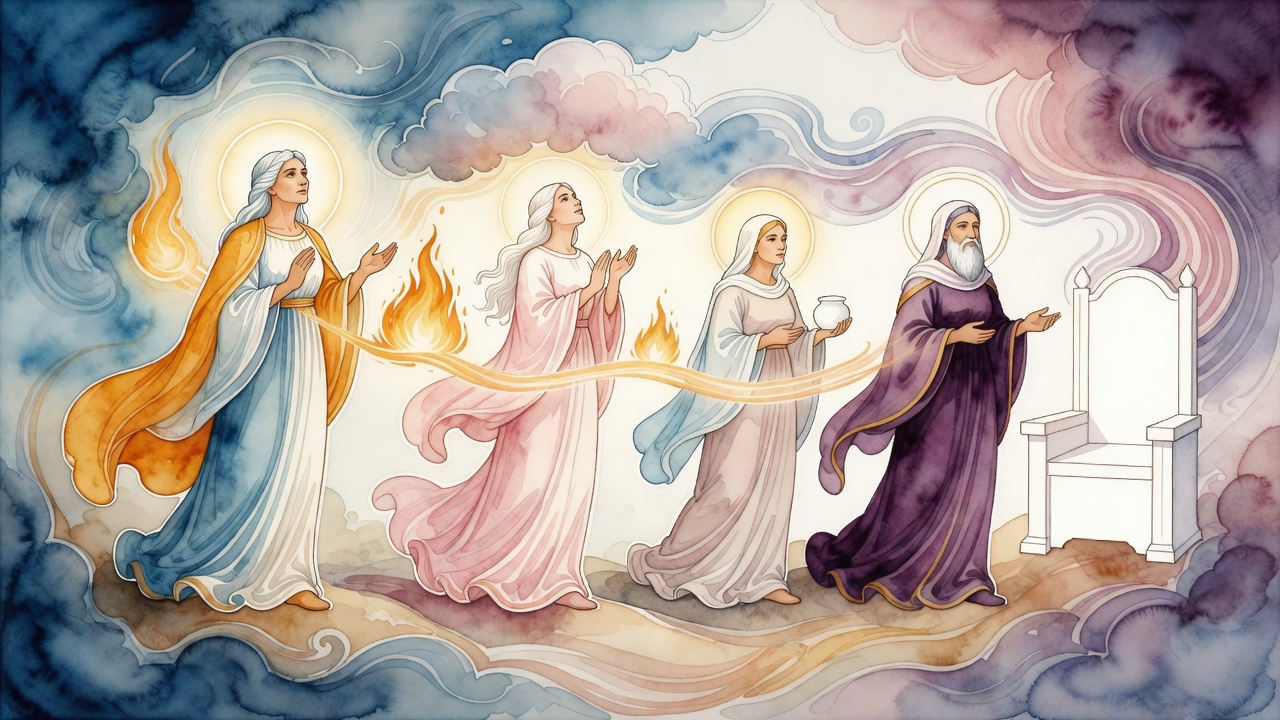
One kabbalistic tradition placed this woman in a much longer story. The soul of Eve, it said, had passed through a chain of righteous women, each one carrying something of what the first woman had lost. First into Sarah, who began the repair. Then into Hannah, who prayed in silence at Shiloh until Eli thought she was drunk. Then into the Shunamite woman who gave the prophet a room and asked for nothing and rode hard when the gift was taken away. The soul moved forward through women who knew how to want something, lose it, and refuse to accept the loss without going all the way to the source.


← All myths
From the tradition

Sources

5 sources

The texts this telling draws on, in full. Open a card to read inline, or expand it for a wider, quieter read.

Pirkei DeRabbi Eliezer 33:4Pirkei DeRabbi Eliezer

The Pirkei DeRabbi Eliezer, a fascinating ancient text filled with stories and interpretations, brings us a wild tale about the prophet Elisha. Specifically, Pirkei DeRabbi Eliezer 33 recounts a teaching from Rabbi Joshua ben Ḳorchah that will leave you saying, "Wow!"

Rabbi Joshua asks, are you astonished by something seemingly impossible? Don't be! Come and learn from the story of Elisha, the son of Shaphat. And here's the kicker: according to this tradition, no woman could gaze upon his face without dying!

That. A man so filled with divine power that his very appearance was lethal to women. He traveled "from mount to mount, and from cave to cave," seeking solitude and connection with the divine.

One day, as recounted in (2 Kings 4:8), Elisha journeyed to Shunem. There, a "great woman" – a woman of stature and means – welcomed him with open arms. This woman, we're told, was a sister of Abishag, the Shunammite, and the mother of Oded, the prophet. Quite a lineage!

Recognizing Elisha’s holiness, she tells her husband something extraordinary. According to her, no woman is able to gaze at his face without dying. “Let us make, I pray thee, a little chamber on the wall; and let us set for him there a bed, and a table, and a stool, and a lampstand," she says, as we read in (2 (Kings 4:1)0). A place for him to find rest and peace.

So, every time Elisha passed through Shunem, he would turn into this chamber. As (2 (Kings 4:1)1) tells us, "And it fell on a day, that he came thither, and he turned into the chamber." It became his sanctuary.

Then comes another intriguing detail. Elisha calls for the Shunammite woman. "And he said, Call her. And when he had called her, she stood at the door" (2 (Kings 4:1)5). Why did she stand at the door, hesitant to enter fully? It was "Because she was unable to gaze at his face, so that she should not die." The woman, knowing the potential danger, keeps her distance, yet still wants to provide hospitality to this holy man. It speaks volumes about her character, her faith, and the perceived power of Elisha.

Now, Elisha had something to say to her. but we'll save that part for another time.

What does this incredible story tell us? Is it a literal account? A metaphor for the overwhelming presence of the divine? A reflection on the perceived power dynamics between men and women in ancient times? Perhaps it’s all of these things and more. It certainly gives us something to ponder, doesn't it?

Full source
Pirkei DeRabbi Eliezer 33:6Pirkei DeRabbi Eliezer

Pirkei DeRabbi Eliezer turns to The Shunammite Woman Whose Kindness Raised the Dead.

She hesitates. "My lord is very old," she protests, referring to her husband, "and the way of women has departed from me… it is impossible." (2 (Kings 4:1)6). She understands the natural order. She knows her body. And yet..

"Nay, my lord, thou man of God, do not lie unto thine handmaid," she pleads (ibid.). Is it disbelief? Or perhaps a desperate hope that supersedes logic?

Here's where the wondrous comes in. Rabbi Zechariah highlights a powerful verse: "He will fulfil the desire of them that fear him" (Psalm 145:19). The Holy One, blessed be He, answers the prophet's prayer, fulfilling the Shunammite woman’s deepest yearning. She conceives and bears a son. Imagine the joy! A life filled with purpose and meaning.

But the story takes a heartbreaking turn.

The child grows, full of life. One day, he goes out to the fields where his father is with the reapers. Pirkei DeRabbi Eliezer tells us "he went forth to refresh himself, and to look at the reapers." But then, tragedy strikes. "A mishap overtook him, and he died," as (2 (Kings 4:1)8) tells us. The verse continues, "It fell on a day, that he went out to his father to the reapers." Pirkei DeRabbi Eliezer adds an interpretation: "this restrained them (from work) until he came (among them)." The implication is that his presence, even in his suffering, held them back from their tasks.

The verse concludes, "And he sat on her knees till noon, and then died" (2 (Kings 4:2)0). Can you imagine the mother's anguish? The child, the miracle, now lifeless in her arms. A blessing seemingly snatched away.

It’s a jarring reminder that life, even with its moments of divine intervention, is filled with unexpected twists and turns. Joy and sorrow are often intertwined, and the blessings we receive can be fragile, precious, and sometimes, tragically short-lived. What do we do when a promised miracle ends in heartbreak? What does it mean to hold faith when life feels impossibly unfair? These are the questions this ancient story leaves us to ponder.

Full source
Legends of the Jews 8:6Legends of the Jews

It's a story of faith, resourcefulness, and the enduring power of good deeds.

Like his mentor Elijah, Elisha was known for his compassion. He wasn’t just some aloof spiritual figure; he was deeply involved in the lives of ordinary people, especially the poor and the vulnerable. And that brings us to this remarkable widow.

Her husband? None other than Obadiah. Now, you might know Obadiah as a prophet in his own right – the one who prophesized against Edom. But here’s a twist: Obadiah was also a high-ranking official in the court of the notoriously wicked King Ahab. As Ginzberg retells in Legends of the Jews, Obadiah was actually an Edomite by birth. He was surrounded by evil, living in the heart of corruption, yet he remained steadfast in his faith. It's a powerful image, isn't it? The Midrash Rabbah compares him to Esau, Jacob's brother. Esau lived with pious parents but went astray, while Obadiah lived amidst wickedness and remained righteous.

Here's where the story takes a tragic turn. While serving in Ahab's court, Obadiah used his position and personal fortune to support hidden prophets. He even borrowed money – from the future king, no less! – to keep them fed and safe. This was a HUGE risk. He was putting everything on the line to do what he believed was right.

Then, Obadiah dies. The king, now looking for any excuse to squeeze money from his subjects, demands that Obadiah’s children repay their father’s debt. Can you imagine the widow’s despair? She’s facing utter ruin.

So, she does something incredible. She goes to the graveyard and cries out, "O thou God-fearing man!" And here, according to the story, a heavenly voice responds. It doesn’t immediately offer a solution, but it asks a profound question: "There are four God-fearing men: Abraham, Joseph, Job, and Obadiah. To which of them dost thou desire to speak?" for a second. What an amazing moment! God acknowledges Obadiah as being among the most righteous figures in history. The widow responds, "To him of whom it is said, 'He feared the Lord greatly.'" She's referring to the verse in (1 Kings 18:3), which specifically praises Obadiah's profound fear of God.

What happens next? Well, that's a story for another time. But this moment, this plea from a desperate widow, this recognition of Obadiah's unwavering faith… it speaks volumes about the power of righteous actions, even in the darkest of times. It reminds us that even when we feel like we're drowning, our deeds, our character, our faith – they resonate far beyond our own lives. They echo in eternity. And they can call forth miracles we never imagined possible.

Full source
Yalkut Reuveni, Nos. 1, 8, 61, 63 (via Hebraic Literature, 1901)Hebraic Literature (1901)

The Yalkut Reuveni, a late Kabbalistic anthology, preserves one of the strangest Jewish teachings about the soul: gilgul, transmigration. Souls, this tradition says, do not vanish at death. They are sent again into new bodies to finish unfinished work.

The Yalkut teaches that the soul of Eve passed through a chain of righteous women. First into Sarah, the mother of Israel, who began to repair what Eve had let slip. Then into Hannah, who prayed silently at Shiloh (1 Samuel 1). Then into the Shunammite woman who hosted Elisha (2 Kings 4:8). Then into the widow of Tzarfat (Zarephath) who fed Elijah.

The tradition offers a mystical reading of a puzzling verse. When Hannah was accused of being drunk while she prayed, she answered, “I am a woman of a sorrowful spirit” (1 Samuel 1:15). The Kabbalists heard in that phrase an echo of Eve — the original sorrow of the first woman, still lingering in Hannah’s soul, still asking to be healed.

Rahab’s soul, the tradition continues, passed first into Heber the Kenite, then afterward into Hannah as well. Eli the priest bore the soul of Jael, wife of Heber, who slew Sisera.

And sometimes, the Yalkut adds with startling generosity, the souls of pious Jews pass into Gentiles — so that those souls, from within other nations, might speak kindly of Israel and plead on her behalf. As the rabbis taught: “The pious of the nations of the world have a portion in the world to come.”

Every sorrow, the Kabbalists say, is an old soul asking for one more chance.

Full source
Legends of the Jews 8:9Legends of the Jews

Legends of the Jews turns to Abishag's Journey.

This is a story found in the Bible in (2 (Kings 4:8-1)7), and elaborated on in the Legends of the Jews by Louis Ginzberg. It tells of a woman from the town of Shunem, some say she was the sister of Abishag and wife of the prophet Iddo, who showed exceptional hospitality to the prophet Elisha. When Elisha journeyed through Israel, he'd often stop in Shunem. And something about him deeply impressed this woman.

Ginzberg explains that the prophet’s very presence was overwhelming. His aura was so potent that no one could look him directly in the face and live!

Most women, tried to minimize household expenses and work. But the Shunammite was different. She embraced the opportunity to welcome Elisha into her home. She even noticed remarkable things about him. She observed that not even a fly dared to come near the holy man, and a beautiful fragrance emanated from him. "If he weren't such a great righteous one," she mused, "and the holiness of the Lord didn't invest him, there wouldn't be such a pleasant fragrance about him."

To ensure his comfort, she gave Elisha the best room in the house. And he, wanting to repay her kindness, offered her the greatest gift he could imagine: the promise of a child within a year.

The woman was incredulous. "Oh, my husband is an old man, and I am past the age of bearing children; this promise cannot be fulfilled," she protested. It just seemed impossible.

But here's where the miraculous comes in. Despite her doubts, exactly as the prophet foretold, before a year had passed, she became a mother. A miracle, born from hospitality.

What does this story tell us? Perhaps it's about the unexpected blessings that can arise from simple acts of kindness. Or maybe it's a reminder that even when we think something is impossible, the divine can still intervene. It makes you wonder: what miracles might be waiting to unfold in our own lives, if only we open our doors. And our hearts, a little wider?

Full source