5 min read

The Silver Cup Closed on Benjamin First

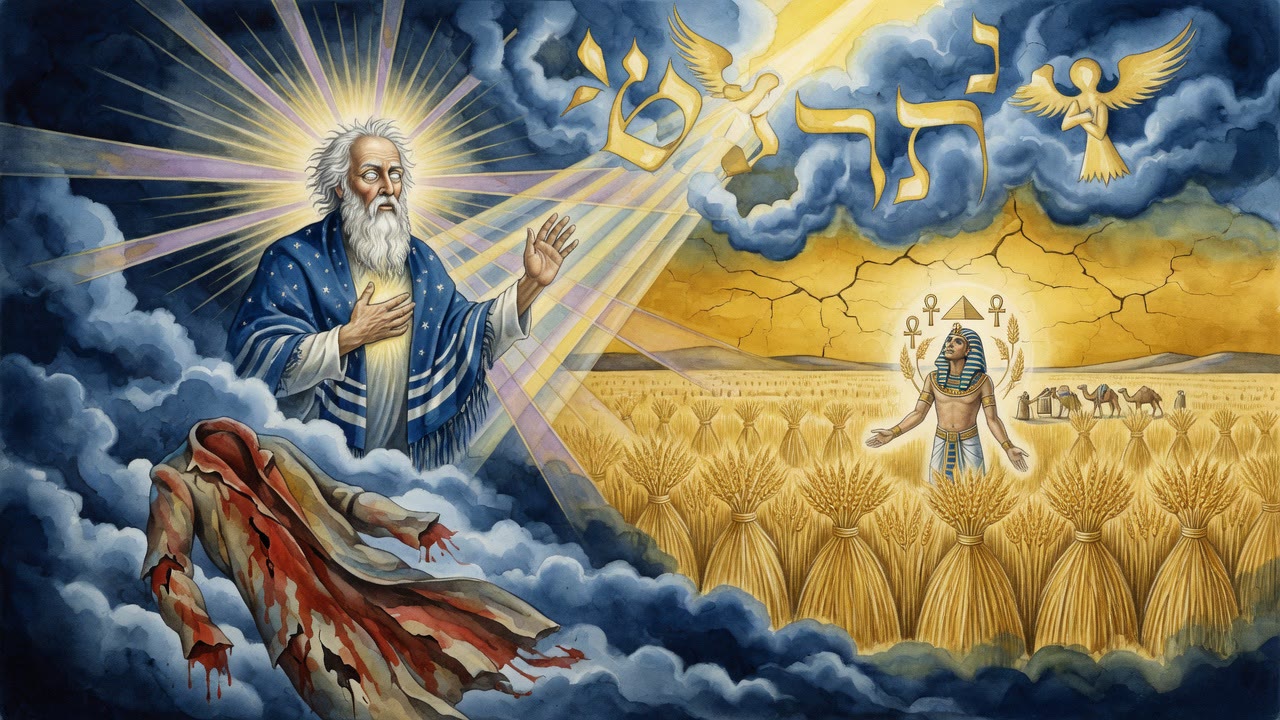
Joseph sends Manasseh after the brothers with a planted cup. Benjamin's sack opens last, and the men who sold a brother tear their own clothes.

Curated by Arthur · Told by Maggid ·
Table of Contents
  1. The Search That Saved the Eldest for Last Shame
  2. Clothes Torn on the Road
  3. How the Famine Herded Them South
  4. The Weak Animal on the Road

The road out of Egypt still tasted of grain dust when the steward's shout hit the brothers' backs. Sacks of food hung from the donkeys. Silver for the purchase already sat in the mouths of those same sacks, a kindness they did not yet understand as a snare. Joseph had watched their names enter the gate lists the night before and had not slept clean.
The Silver Cup Closed on Benjamin First Click for full size

He needed them close to the city. Distance would harden pride. Proximity would make them bend.

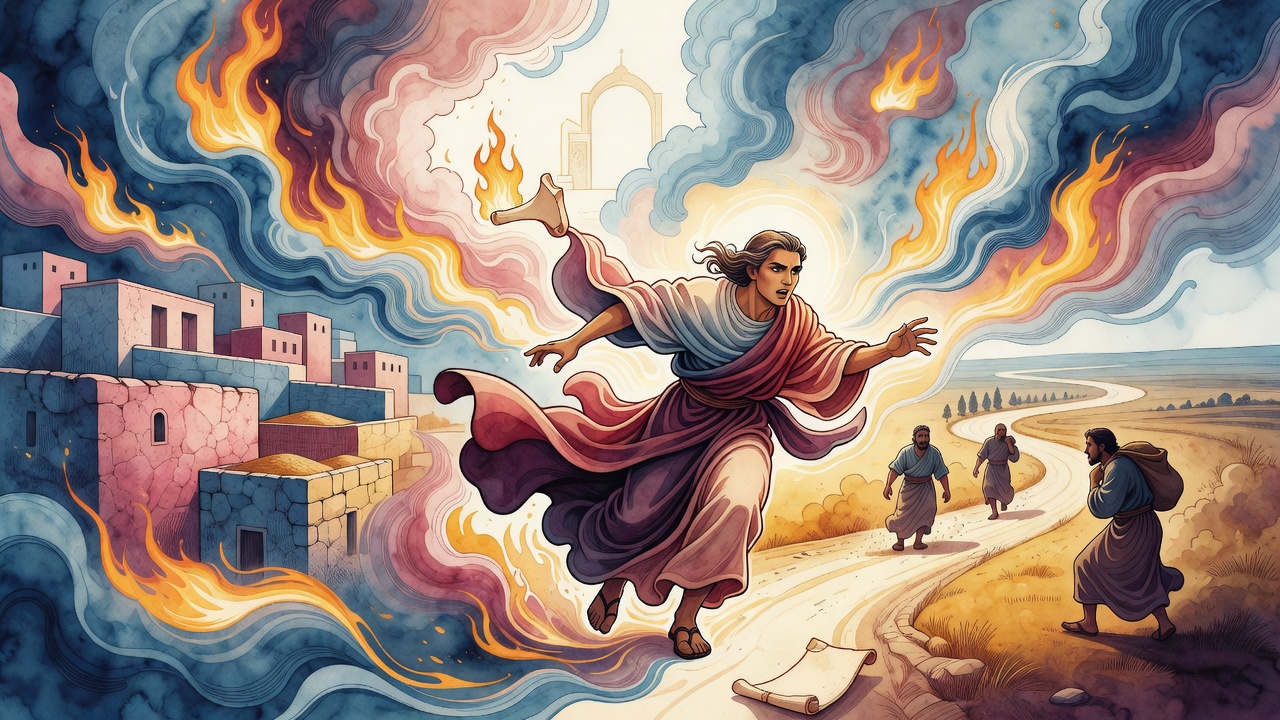
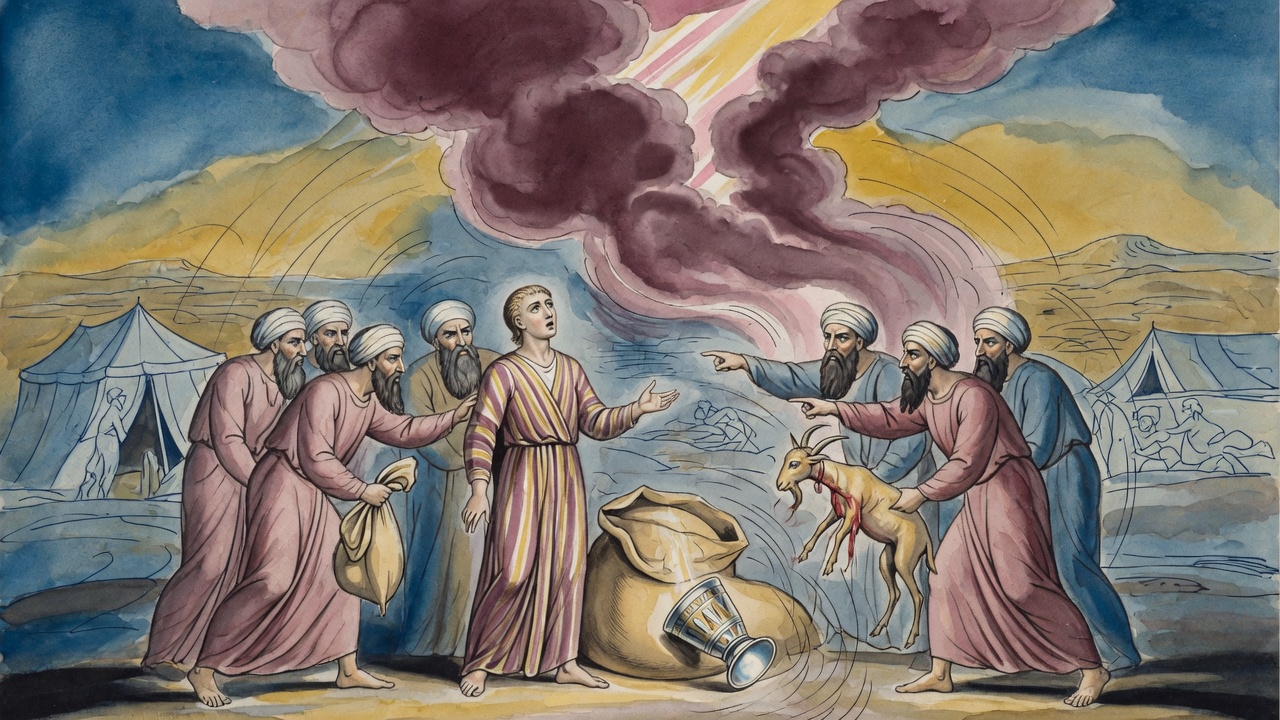
Manasseh, his steward and his own son, ran them down before the last wall of Egypt fully fell behind. "The silver cup is missing," he said. The accusation hung between the dust and the heat. The brothers straightened as one animal does when a whip cracks too near.

The Search That Saved the Eldest for Last Shame

They answered with the bravado of men sure of their hands. With whomsoever the cup was found, let him die, and the rest would be bondmen. Manasseh softened the sentence the way a net softens before it closes. Only the man with the cup would be slave. The others could go free.

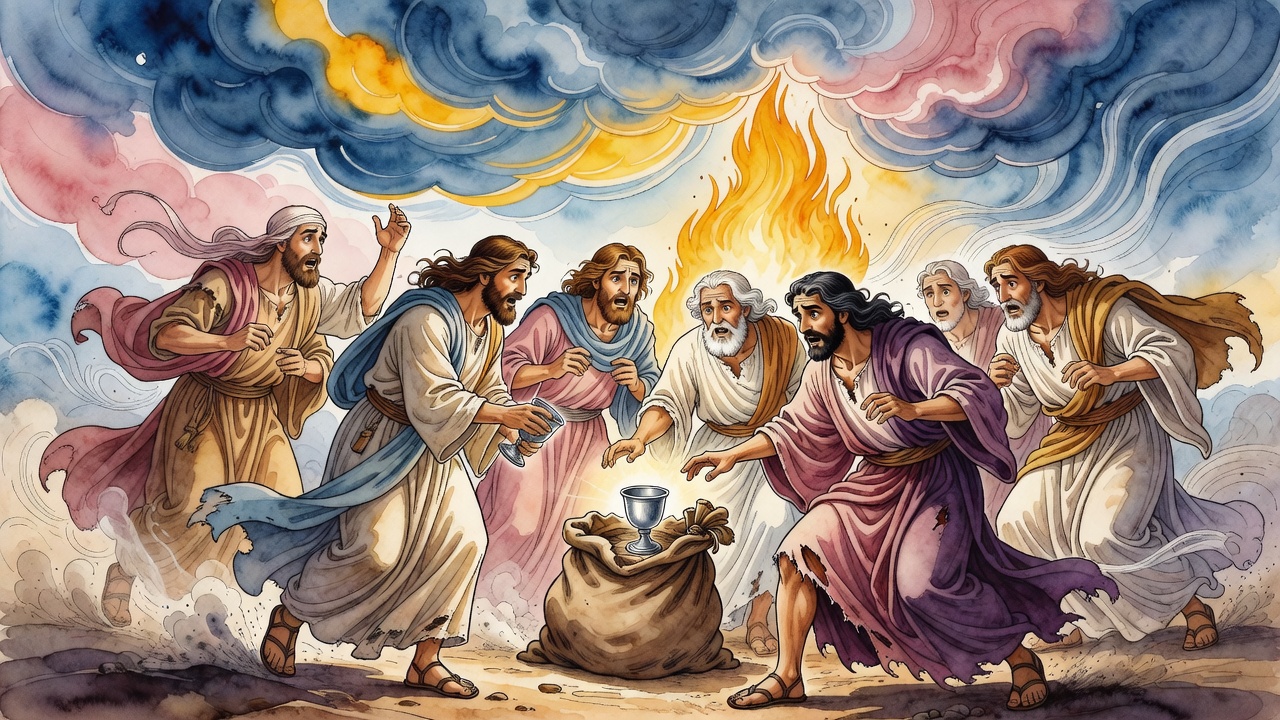
He opened sacks starting with Reuben, the eldest, so the order would look fair. Grain spilled. Silver coins of the purchase winked and were set aside. Sack after sack. The sun climbed. Donkeys stamped. When he reached Benjamin, the youngest, the last knot gave, and the cup flashed like a tooth in a dark mouth.

Benjamin stared at metal he had not stolen. The brothers turned on him before they turned on the steward.

Clothes Torn on the Road

"O thief and son of a thief," they shouted. They dragged Rachel's memory into the dust and said her old theft had stained the father, and now the son stained them. Benjamin's answer cut back harder. Was this as evil as the kid of the goats, as the sale of a brother into slavery?

Silence took the road. Then cloth tore. Eleven pairs of hands found their garments and ripped them open because grief had nowhere else to go. Years earlier those same hands had made Jacob tear his clothes for a bloodied coat and a lie about Joseph. Now the measure returned on their own bodies. The road remembered what the palace still pretended not to know.

Manasseh watched them fold and did not smile. The grief he forced into their throats would leave a mark on his own line later, a tax of trouble paid for the pain of this hour. A trap always bills someone twice.

How the Famine Herded Them South

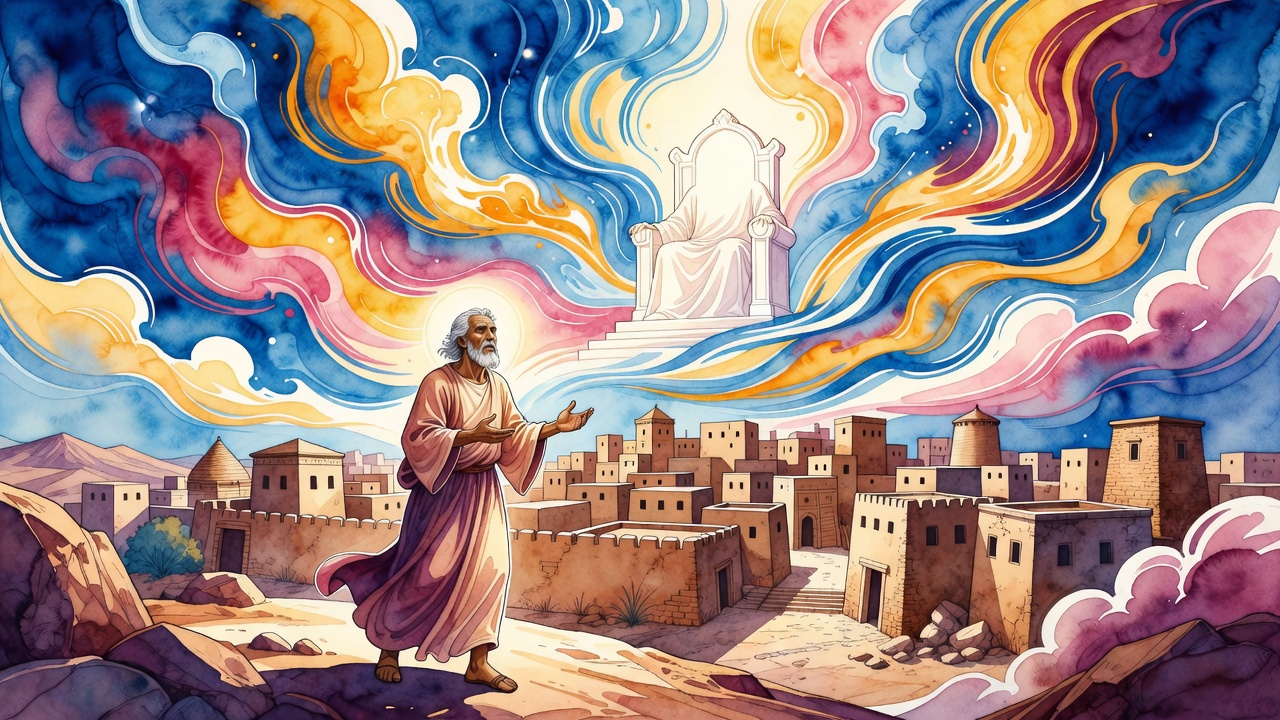
The cup had not begun that morning. It began when famine closed on Phoenicia, Arabia, and Jacob's house in the land, and the old man felt Joseph alive under Egyptian stone. Jacob would not flaunt grain before Esau's and Ishmael's kin. He sent sons, not slaves, and ordered them through separate gates so the evil eye would not gather on eleven tall men at once.

Joseph had already written the decree that forced free men to send their own sons for grain. Gate scribes wrote fathers and grandfathers every evening and brought the lists to the viceroy. Joseph scanned names the way a hunter scans tracks. When his brothers' names finally appeared, the reunion he had been staging for years stepped onto the road with a planted cup in its hand.

On the journey south they had spoken of finding Joseph, of ransoming him, of force if force were needed. They arrived talking rescue and left accused of theft. The rescue they had rehearsed on the road and the trap Joseph was writing met in Benjamin's sack and would not shake hands.

The Weak Animal on the Road

Years later a shepherd would drive flock for forty days across desert without losing a sheep, training hands that refuse to drop the weak animal. Years later a mountain would make the earth itself shake as if the dead were rising to answer for blood. Those later pressures do not soften the cup. They name what Joseph was already forging on this road: a household forced to count every living body, and a judgment hour that will not let a sold brother stay buried under a polite lie.

On this road the weak animal was Benjamin. Joseph would not let him vanish into Egypt alone without forcing the brothers to choose. Sell again, or stand. Accuse, or tear cloth for a living brother instead of a fake corpse.

They turned back toward the city with Benjamin between them and the cup riding like a verdict. Joseph waited in rooms that still smelled of grain and old power. He had not yet told them who he was. He had only closed a silver mouth on the youngest and watched the men who once sold a dreamer learn how it feels when a household's future sits in a sack they cannot explain.

Cloth hung open on their chests. Dust stuck to the tears. One brother tried to rebind his garment and failed, fingers shaking too hard for the knot. The donkeys turned. Egypt took them in again, not as buyers this time, but as men walking toward a truth they had buried in a pit long before any cup was minted. Benjamin walked in the middle, the cup's accusation riding his silence, while the city gates opened like a mouth that already knew their names.


← All myths
From the tradition

Sources

4 sources

The texts behind this telling. Some cards carry a translation of the source; others are our own retelling of it, and each card says which. Every card links out to the original.

Legends of the Jews, I. Joseph, Joseph's Brethren In EgyptLegends of the Jews

Retold in our words. Read the original at the link below.Project Gutenberg eBook #1494, The Legends of the Jews, Volume 2 · Public Domain

That feeling, that undercurrent of destiny, hums through the story of Joseph and his brothers.

The famine wasn't just devastating Egypt. As Ginzberg recounts in Legends of the Jews, its grip tightened around Phoenicia, Arabia, and even reaching Jacob's home in Palestine. While his sons went about their daily lives, Jacob, their father, felt a stirring in his heart. He suspected Joseph was alive, somewhere in Egypt. His prophetic intuition, dimmed by grief, flickered back to life.

There was another, more practical reason for sending his sons to Egypt. Jacob, ever the shrewd patriarch, didn't want to flaunt his family’s relative comfort. He was, as it were, trying not to awaken the envy of his neighbors, the descendants of Esau and Ishmael. To avoid trouble, he instructed his sons to travel discreetly, without drawing attention to themselves with displays of food or weaponry. He knew his sons were impressive men, tall and handsome, and he cautioned them, as we learn, against entering the city together through the same gate, fearing the dreaded ayin hara, the "evil eye."

Meanwhile, in Egypt, Joseph was arranging a reunion. The famine presented an opportunity. To ensure his brothers would come, he enacted a decree: "By order of the king and his deputy… he who desireth to buy grain in Egypt may not send his slave hither… but he must charge his own sons." This, Joseph hoped, would bring his brothers to him. He also forbade the reselling of grain, limiting purchases to household needs.

At the city gates, guards meticulously recorded the names of all who came to buy grain, including their fathers and grandfathers. Every evening, this list was brought to Joseph. These precautions, as Ginzberg details, were "bound to bring Joseph's brethren down to Egypt, and also acquaint him with their coming as soon as they entered the land."

As they journeyed, Joseph consumed the brothers' thoughts. They spoke of finding him, of ransoming him, even of using force if necessary. "We know that Joseph was carried down into Egypt," they said, "and we will make search for him there… and if his master should refuse to sell him, we will use force, though we perish ourselves."

Upon arriving, they were questioned by a guard – none other than Manasseh, Joseph's own son! Unaware of his identity, they answered his questions, wondering if this was a new tax or something else entirely.

That evening, Joseph reviewed the list and found their names. He ordered all grain distribution points closed except one. At that station, sales were only to be made after obtaining the purchaser's name. Joseph provided the overseer with his brothers' names, instructing him to seize them upon arrival.

But the brothers' first priority was finding Joseph. For three days, they searched, even in the city's roughest neighborhoods. Joseph, aware of their presence but not their location, sent servants to find them, but they were nowhere to be found – not in Mizraim (Egypt), not in Goshen, not in Raamses. Finally, Joseph dispatched sixteen servants who searched the city house to house and discovered them in a place of ill-repute, dragging them before their long-lost brother.

What a dramatic turn of events! After all the years of separation, the longing, the scheming, the brothers finally stand face to face, though they don’t yet know who is before them.

Full source
Legends of the Jews, I. Joseph, The Thief CaughtLegends of the Jews

Retold in our words. Read the original at the link below.Project Gutenberg eBook #1494, The Legends of the Jews, Volume 2 · Public Domain

Legends of the Jews (Ginzberg) turns to The Thief Caught.

The brothers hadn't even cleared the city gates when Joseph, eager to spring his trap but also wary of letting them get too far, sent his steward, Manasseh, after them. His mission? To accuse them of theft and bring them back. Joseph, ever the strategist, hoped the proximity to the city would make them more compliant.

Manasseh, following orders, caught up with them. "The silver cup is missing!" he declared, accusing them of theft. The brothers, indignant and sure of their innocence, responded with bravado: "With whomsoever of thy servants the cup be found, let him die, and we also will be my lord's bondmen." A harsh sentence, but they were confident.

Manasseh, playing his part perfectly, softened the blow, or so it seemed. "He with whom the cup is found shall be the bondman, and the rest shall be blameless." He then proceeded to search their sacks, starting with Reuben, the eldest, to avoid suspicion, and ending with Benjamin, the youngest. And, of course, the cup was found in Benjamin's sack.

The shock, the outrage. "O thou thief and son of a thief!" the brothers shouted at Benjamin, according to Ginzberg's retelling. "Thy mother brought shame upon our father by her thievery, and now thou bringest shame upon us." Benjamin, bewildered, could only retort, "Is this matter as evil as the matter of the kid of the goats, as the deed of the brethren that sold their own brother into slavery?" Ouch.

In their fury and vexation, the brothers rent their clothes – a powerful symbol of grief and despair. Midrash Rabbah connects this act to their past sin, noting that just as they caused Jacob to tear his clothes in mourning for Joseph, they now tear their own. And, in a fascinating twist, it also foreshadows Mordecai, a descendant of Benjamin, tearing his clothes on account of his brethren, the people of Israel, in the story of Purim.

But the consequences didn’t end there. Because Manasseh, Joseph's steward, caused them such grief, the tribe of Manasseh's territory was "torn" in two, with half on one side of the Jordan and half on the other. And Joseph himself, for his harsh treatment of his brothers, was punished through his descendant Joshua, who tore his clothes in despair after the defeat at Ai.

Convicted, the brothers had no choice but to return to the city. As they walked, they continued to berate Benjamin, "O thou thief and son of a thief, thou hast brought the same shame upon us that thy mother brought upon our father." Yet, Benjamin bore their abuse in silence, and for his humility, God promised that His Shekinah (Divine Presence) would "dwell between his shoulders," and called him "the beloved of the Lord."

Back in the city, they were brought before Joseph. They fell to the earth before him, fulfilling his childhood dream of dominance. But Judah, simmering with rage, warned his brothers, "Verily, this man hath forced me to come back hither only that I should destroy the city on this day."

Joseph, through an interpreter, accused them of stealing the cup to divine the whereabouts of their lost brother. Judah, ever the eloquent spokesman, protested their innocence, but acknowledged that "God hath found out the iniquity of thy servants." He even suggests that their collective sin, the selling of Joseph, was the reason they were all caught together.

Joseph then delivered what seemed like a final blow: only Benjamin would remain as his slave. "Go hence, and tell your father, 'The rope follows after the water bucket.'" In other words, bad luck comes in threes.

But the story isn't over. Judah, unable to bear the thought of his father's grief and Benjamin's enslavement, steps forward, ready to fight. As we read in Legends of the Jews, "Now it is all over with peace!" he cried, preparing to use force to rescue Benjamin.

What happens next? Well, that's a story for another time. But the stage is set for a powerful confrontation, a moment of truth that will reveal the true nature of these brothers and the depths of Joseph's plan. And what price are we willing to pay for the mistakes of our past?

Full source
Legends of the Jews 4:155Legends of the Jews

Retold in our words. Read the original at the link below.The Legends of the Jews by Louis Ginzberg (1909) · Public Domain

He wasn't born a leader, that's for sure.

For forty long years, he was a shepherd for his father-in-law, Jethro. And let me tell you, he was a good one! Jethro had no complaints. According to the Legends of the Jews, not a single sheep was lost to wild beasts under Moses' watch. And the flocks? They multiplied like crazy!

It first appears shepherding is a simple life, out in nature, peaceful. But imagine this: Moses once drove those sheep for forty days straight, searching for pasture in the barren desert. Forty days! And get this – not a single sheep was lost!

Why the desert? What was it about that desolate landscape that drew Moses in?

Well, some say he had a prophetic sense. A deep knowing that his own destiny, and the destiny of Israel, was intertwined with the desert. As Ginzberg's retelling in Legends of the Jews tells us, Moses foresaw that the desert would be where God's wonders would manifest.: the burning bush, the manna from heaven, the giving of the Torah (the first five books of the Hebrew Bible) at Mount Sinai. All in the desert.

But there's a darker side to this connection. The desert, as we find in Midrash Rabbah, would also become the "grave of the human herd" – the very people Moses would lead out of Egypt. And, tragically, it would also be his own final resting place.

So, from the very beginning, Moses had this presentiment, this feeling that the desert would be the stage for his life's work. It was true then, and some believe it will be true again in the "latter days."

The tradition says that Moses will return to the desert, to lead a resurrected generation into the promised land, just like he led their ancestors out of Egyptian bondage. This idea that the past is always connected to the future, that the desert holds both death and rebirth.

So, the next time you think of Moses, remember the shepherd in the wilderness. Remember his connection to the desert, a place of both immense hardship and incredible revelation. It’s a reminder that even in the most desolate places, there is always the potential for something extraordinary to emerge.

Full source
Legends of the Jews 2:43Legends of the Jews

Retold in our words. Read the original at the link below.The Legends of the Jews by Louis Ginzberg (1909) · Public Domain

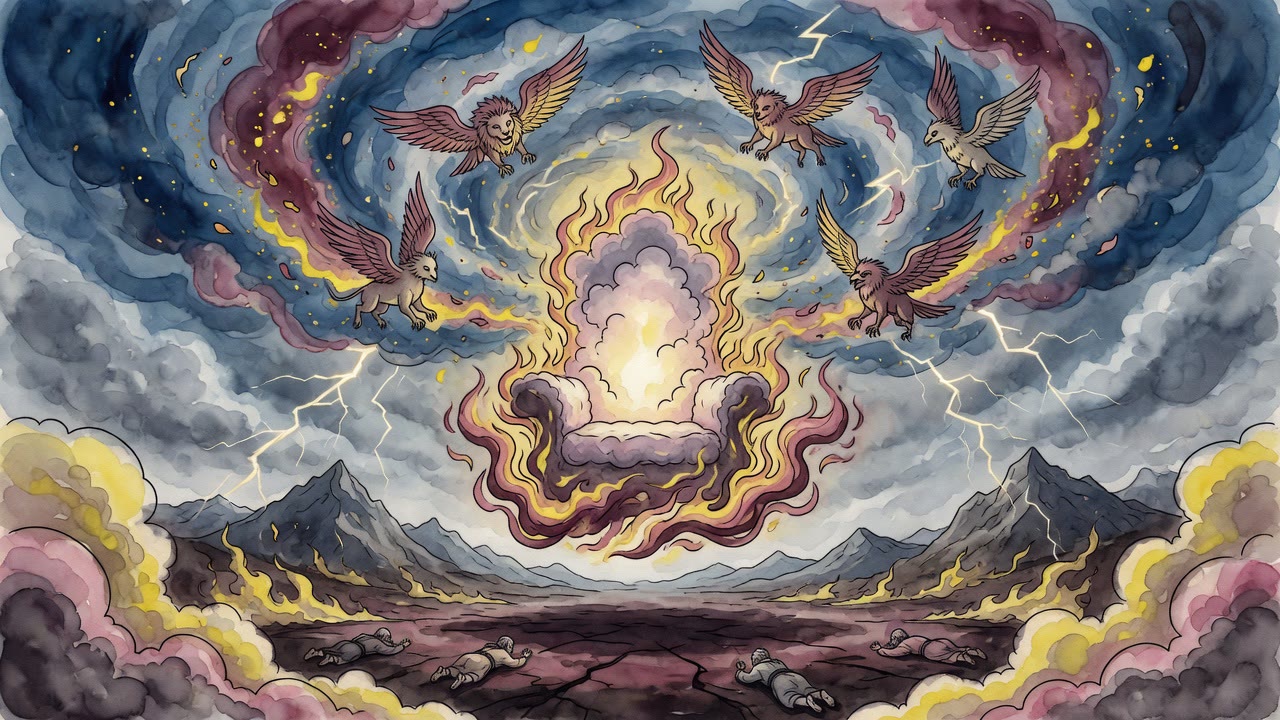
Like you're being held accountable for. everything? That's what the Earth felt at the Revelation at Sinai. According to Legends of the Jews, the Earth itself was terrified, convinced that the resurrection of the dead was upon it. It thought it would have to answer for all the blood it had soaked up, for all the murdered bodies it had concealed.

What calmed it down? The first words of the Decalogue – the Ten Commandments. A powerful reminder that even cosmic anxiety can be soothed by divine law.

Picture the scene at Mount Sinai. The air crackling with anticipation, maybe a little fear. But even with all the extraordinary phenomena happening that morning, God didn't reveal Himself right away. Why? Well, as Legends of the Jews also tells us, it was summertime. And after those short summer nights, everyone was still asleep!

It fell to Moses to rouse the nation. He went through the camp, not with a booming decree, but with a gentle, almost romantic call. "Arise from your sleep," he called, "the bridegroom is at hand, and is waiting to lead his bride under the marriage-canopy." Isn't that beautiful? imagery for a second: God as the bridegroom, Israel as the bride, and the covenant – the Ten Commandments – as the marriage contract. It transforms the giving of the law into a moment of profound intimacy and commitment.

With Moses leading the way, the nation processed toward Sinai. Moses ascended the mountain alone, acting as the go-between, the best man, if you will. He turned to God and said, "Announce Thy words, Thy children are ready to obey them."

The text goes on to say that Moses' voice, when he repeated God's words to the people, had as much power as the Divine voice he heard. That’s a staggering thought. Moses, in that moment, became a conduit, a vessel for the divine. Not just a messenger, but a true reflection of God's power and intent.

What power do we have to amplify goodness, to echo truth, to awaken others to the presence of the divine in their own lives? Perhaps, like Moses on Sinai, we all have the potential to be more than just speakers of words, but carriers of a transformative message.

Full source