Parshat Terumah5 min read

The Temple That Burned but Was Only Made Invisible

When the Temple burned, the fire found only an empty shell. The true sanctuary had slipped out of sight, still standing, waiting on Zion.

Curated by Arthur · Told by Maggid ·
Table of Contents
  1. The Pattern Above the Mountain
  2. Everything Below Answers to Something Above
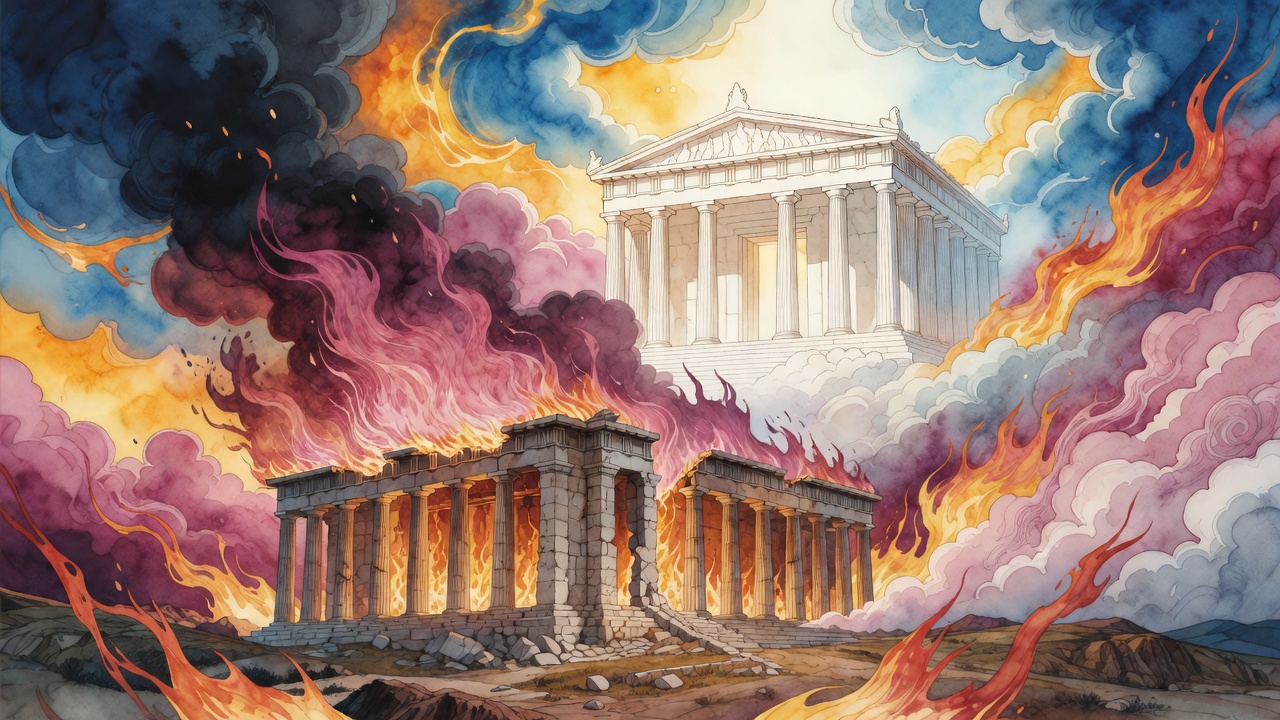
  3. The Night the Fire Found Only the Shell
  4. The Sanctuary That Slipped Out of Sight
  5. The Promise on Mount Zion
The Temple That Burned but Was Only Made Invisible Click for full size

The Pattern Above the Mountain

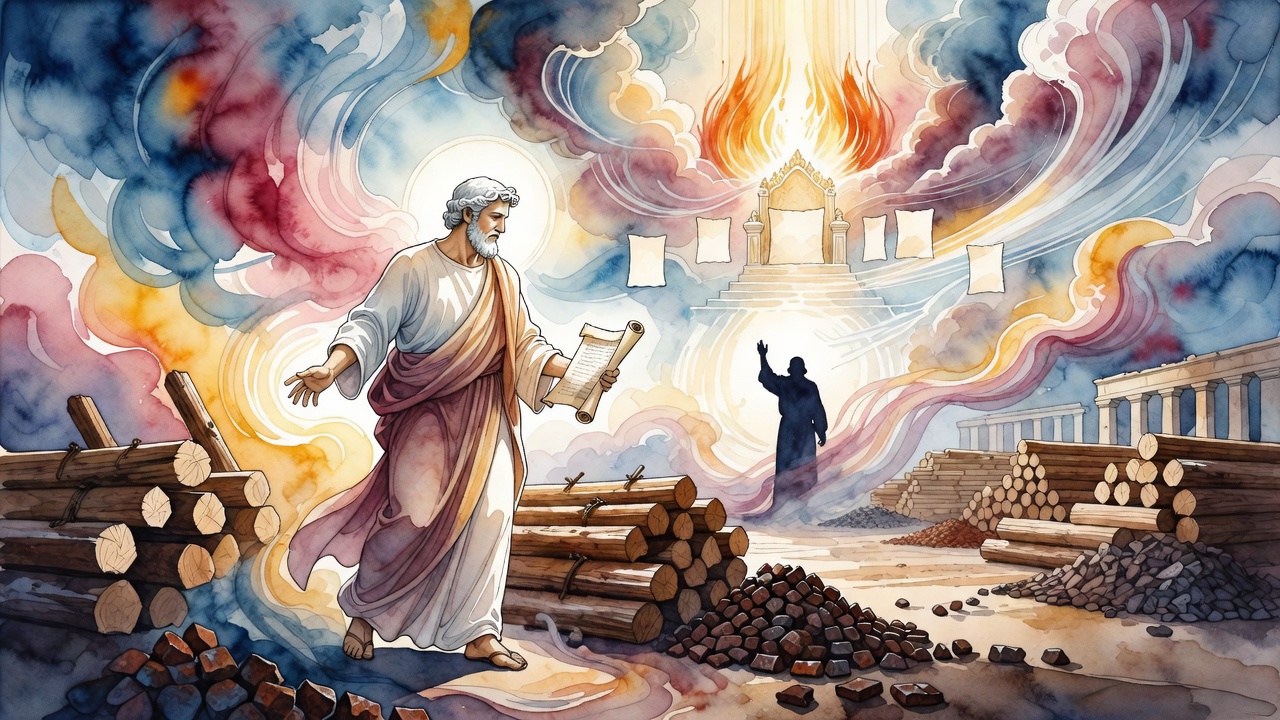
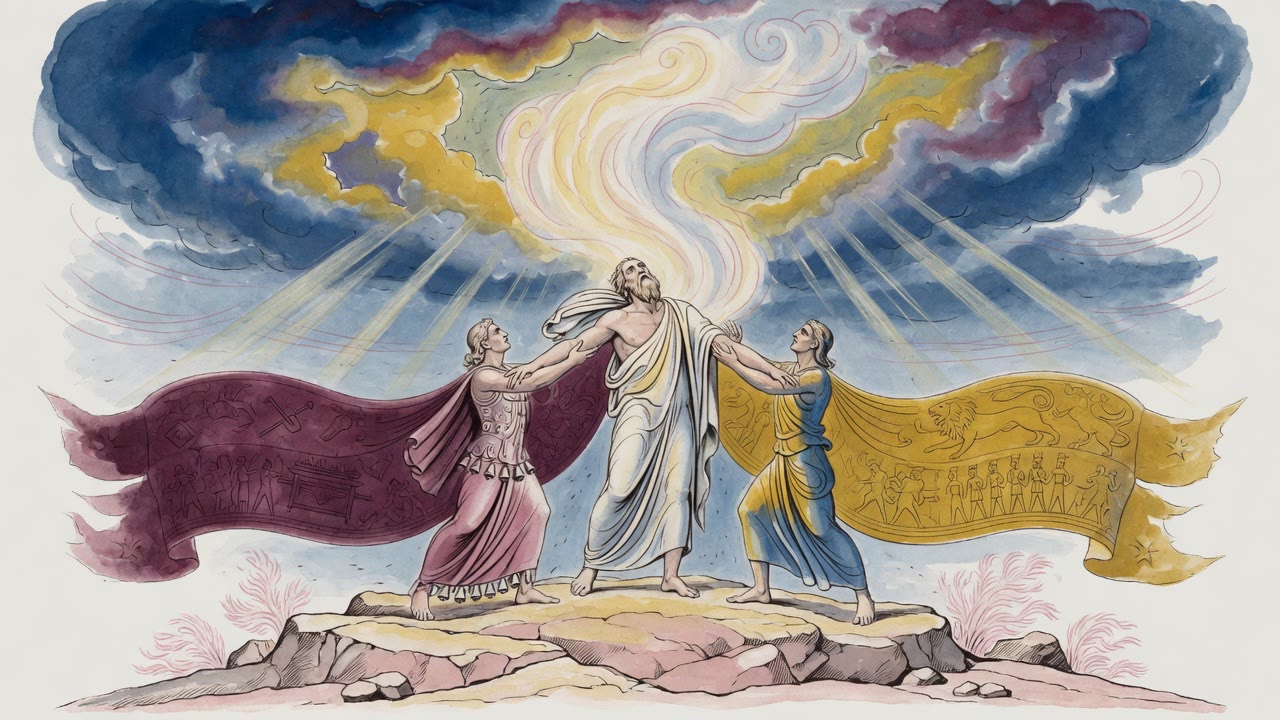
The cloud on the summit was not empty. Moses had climbed into it and stayed forty days, and on one of those days the angel of the presence raised a hand toward the dark and the dark came apart.

A sanctuary hung in the opening. Not a drawing of one. A tent of pure light. Boards and clasps, a hanging veil, a lamp with seven mouths of flame. Above a covered chest, two winged shapes leaned toward each other over a space that held a voice. Moses could hear the voice without hearing any words.

"Look until you have it by heart," the angel said. "What stands here, you will raise below."

Moses looked until his eyes burned. He counted the loops. He measured the winged shapes with his gaze. He did not yet understand why a thing already built in heaven needed a twin down in the sand.

Everything Below Answers to Something Above

The angel answered the question Moses had not asked. "For everything above there is a thing below that stands in its place," it said, and it began to name the pairs.

Above, the stars burned in their thousands. Below, a people would carry that fire in their own bodies, for a star would come out of Jacob and never fall. Above, the armies of heaven stood in ranks. Below, the tribes would camp by their banners, the hosts of the Lord under a lower sky. Above, the winged ones guarded the seat of glory. Below, Moses would hammer their likeness out of a single sheet of gold.

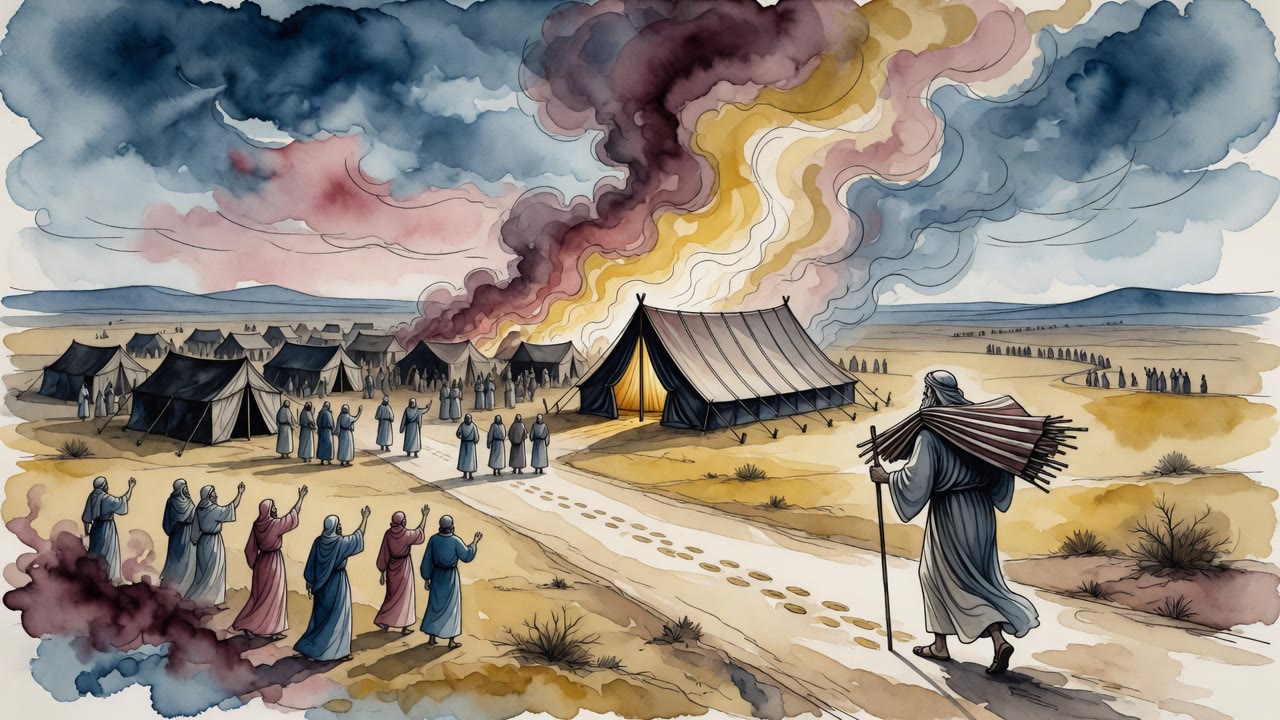
"He stretched the heavens over the deep like a curtain," the angel said. "You will hang curtains of goats' hair, and they will mean the same thing." A small tent in the wilderness, sewn to the measure of the whole sky. Moses saw it now. The dwelling would not resemble heaven. It would be heaven's own shape, pressed down small enough for human hands to carry through the desert.

The Night the Fire Found Only the Shell

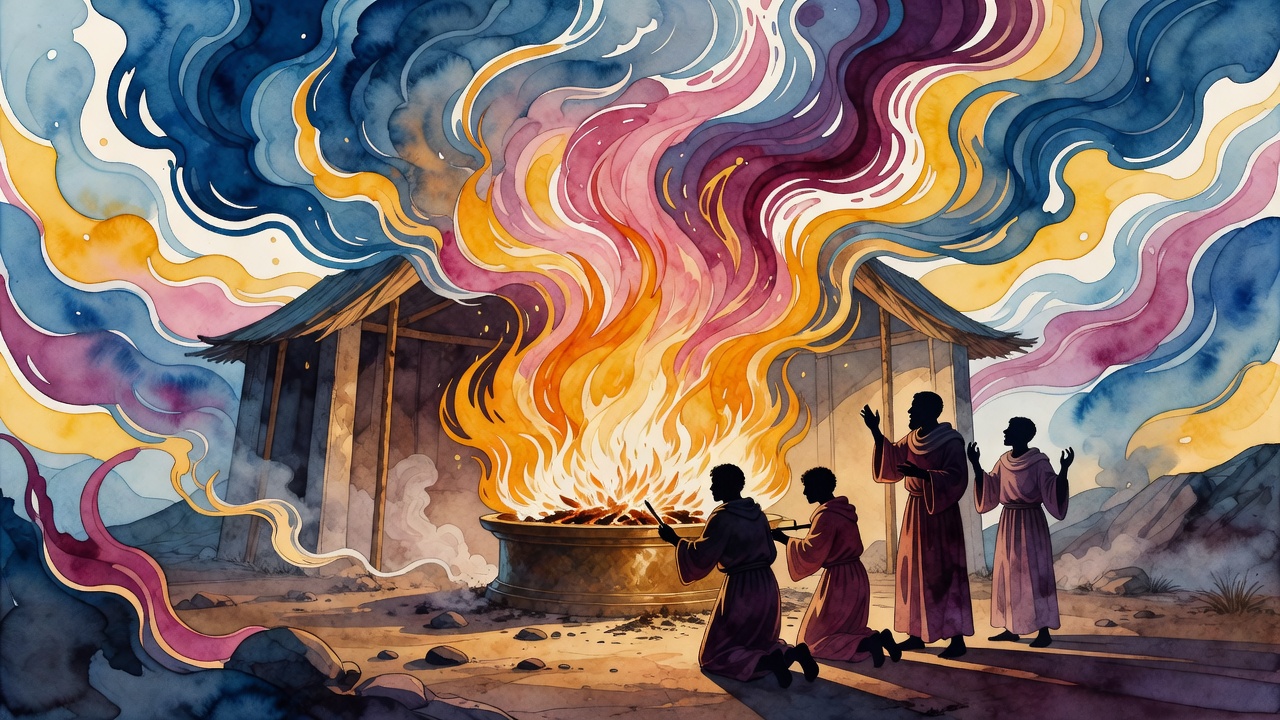
Then the angel turned the darkness again, and now it showed a city on a hill, and a house of cedar and stone that Solomon would raise where the tent had stood. Moses watched it gleam. He watched the smoke of its offerings go up straight for hundreds of years. Then he watched the ring of siege fires close, and the walls broke open, and soldiers ran in with torches toward the veil.

Moses cried out and reached toward the vision as if his arm could cross the years.

"Watch," the angel said. "Do not mourn yet. Watch what the fire takes."

The flames climbed the curtains. But as they climbed, the sanctuary inside the burning shell rose quietly out of them, lifted the way breath lifts off water, and drew back into the same dark it had first come from. The torches ate cedar and gold leaf and stone. They found an empty room. What the enemy burned that night was only the case around the thing. The thing itself was already gone from their eyes, and it was not destroyed.

The Sanctuary That Slipped Out of Sight

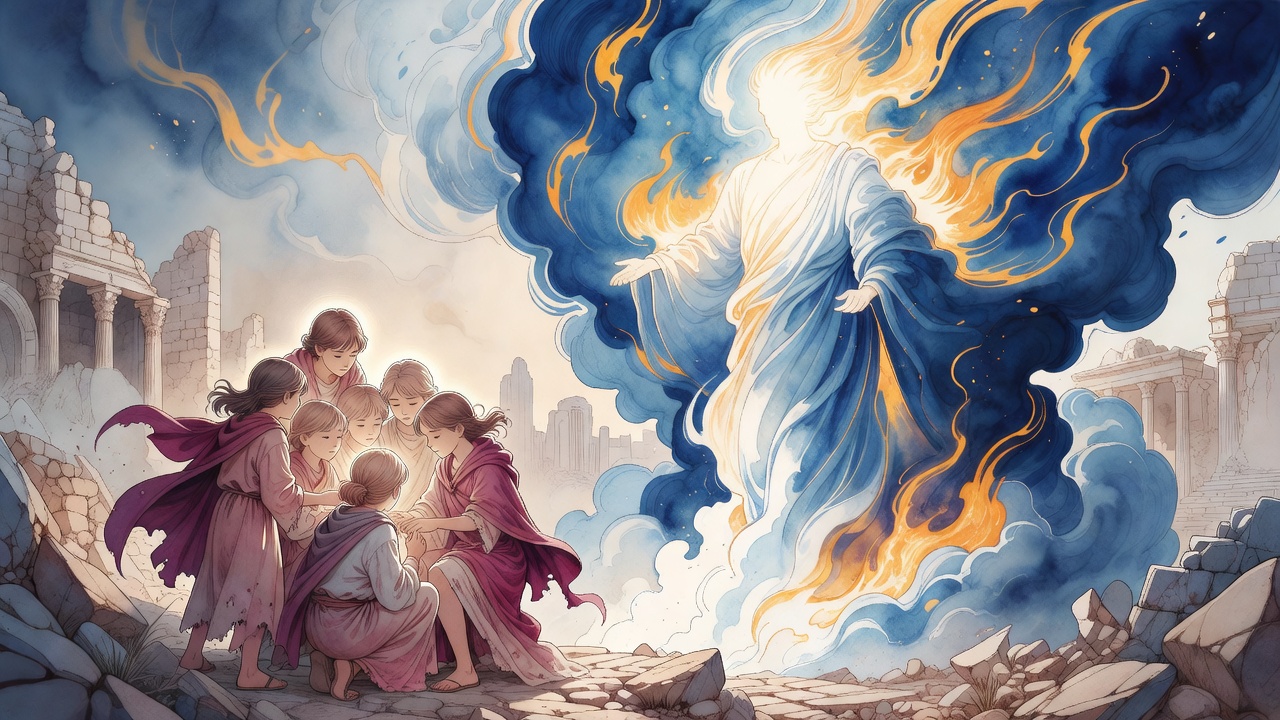
"It is still standing," the angel said. "The altar is still warm. The offerings still rise inside it. Only no eye down there can find it now."

Moses asked whether any eye at all could find it.

"The same eyes that find the first light," the angel said. On the first day of creation a light had been made too pure for the wicked to touch, and it had been folded away, and it went on shining in its hiding place for the righteous alone. The hidden sanctuary was like that light. A tzaddik walking the ruined mount might feel warmth where the crowd felt only wind, might catch incense where the crowd smelled ash. The house had not fallen. It had stepped out of sight and gone on with its work.

The Promise on Mount Zion

Moses wanted the end of it, and the angel gave him the end.

A day was coming when the hidden house would come down again and be built in the open, on Mount Zion, in Jerusalem, in stone that any eye could touch. On that day the lights of the sky would themselves be made new, the sun and the moon and the stars renewed for healing and for peace and for blessing, for all the chosen of Israel. And it would hold from that day and to all the days of the earth. No fire after it. No second hiding.

The dark closed over the vision. The cloud on the summit was only cloud again. And the angel of the presence turned back to its first work and spoke to Moses according to the word of the Lord, so that the man could carry the pattern down the mountain in his own two hands.


← All myths
From the tradition

Sources

3 sources

The texts behind this telling. Some cards carry a translation of the source; others are our own retelling of it, and each card says which. Every card links out to the original.

Legends of the Jews 3:27Legends of the Jews

Retold in our words. Read the original at the link below.The Legends of the Jews by Louis Ginzberg (1909) · Public Domain

It wasn’t just a tent, was it? According to ancient wisdom, it was a reflection of something much, much bigger.

The idea is this: "for to all that is above there is something corresponding below." It's a profound statement. What does it mean? Well, imagine a vast, interconnected web, where every element on Earth has a celestial counterpart.

The Legends of the Jews, that incredible compilation of stories and midrashim (rabbinic interpretive commentary) by Rabbi Louis Ginzberg, reminds us of this very idea. Ginzberg draws on a wealth of sources to paint a picture of interconnectedness.

Consider the stars. We gaze up at the night sky, awestruck by their brilliance. But the tradition tells us there are stars "below" as well. What could that mean? Perhaps a reference to the lineage of greatness that will emerge from the Jewish people, "a star shall come out of Jacob" (Numbers 24:17).

And it doesn't stop there. God has armies, hosts of angels, Ofannim (celestial beings described in Ezekiel's vision) above. And here, on Earth? God has His hosts: the people of Israel, "the hosts of the Lord" (Exodus 12:41).

The Mishkan itself was full of these symbolic echoes. Above, God has Cherubim, angelic beings guarding the divine presence. And in the sanctuary of Israel, we find their earthly representations.

God dwells "above," in the celestial realms, but also "below," in the sacred space created by human hands. It’s like a divine residence permit!

Even the physical structure of the Mishkan held this symbolism. “God hath stretched out the heavens above like a curtain, and below, in the sanctuary, were curtains of goats' hair." A small, earthly imitation of the vast expanse of the cosmos.

So, what does this all mean for us? Perhaps it's an invitation to see the sacred in the everyday. To recognize that the rituals we perform, the communities we build, and the spaces we create can be reflections of something truly divine. That even here, on Earth, we can catch a glimpse of the heavens.

Full source
Emek ha-Melekh 3:389Emek HaMelekh

Retold in our words. Read the original at the link below.Sefaria-hosted English translation · CC-BY

Emek HaMelekh turns to The Invisible Temple.

What if the destruction wasn’t quite… complete?

There's a fascinating idea tucked away in Jewish mystical thought. It suggests that the Temple wasn't truly obliterated. It simply became… invisible. The Emek ha-Melekh, a Kabbalistic text, hints at this very notion. It’s not that the heavenly Temple continues to exist, that’s a more common concept. This idea suggests the earthly Temple is still here, right now, just beyond our perception.

In this view, sacrifices are still being offered in this hidden sanctuary. Now, that's a radical thought! It challenges our understanding of loss, of destruction, of reality itself. Is it literal? Is it metaphorical? Perhaps it's both.

The notion of invisible things existing alongside our reality isn’t entirely unique in Jewish tradition. Remember the primordial light? The light created on the first day of creation? Some stories say that light was never truly taken away. It’s still here, shining brightly, but only visible to the Tzaddikim (a righteous person), the righteous souls. (See "The Light of the First Day," p. 83 in Tree of Souls if you want to dive deeper!)

So, what does this all mean? Is there a secret Temple humming with activity just out of sight? Maybe. Maybe not in a literal, brick-and-mortar sense. But perhaps it points to something deeper: the enduring spirit of connection, the unbroken chain of tradition, the unwavering faith that even in the face of utter devastation, something sacred remains.

Perhaps the Temple lives on in our hearts, in our prayers, in our commitment to living a life of meaning and purpose. Maybe, just maybe, that’s the most real Temple of all.

Full source
Book of Jubilees 2:1Book of Jubilees

Retold in our words. Read the original at the link below.Sefaria Community Translation · CC-BY

This ancient Jewish text, considered scripture by some but excluded from the standard biblical canon, paints a sweeping picture of history and destiny. And within its pages, we find a yearning for a time of ultimate renewal.

Specifically, the text speaks of a future when the sanctuary of the Lord will be rebuilt in Jerusalem, on Mount Zion. But it's not just about bricks and mortar, is it? It's about something much deeper.

The passage continues, "…and all the luminaries be renewed for healing and for peace and for blessing for all the elect of Israel, and that thus it may be from that day and unto all the days of the earth." What are these "luminaries"? Are we talking about the sun, moon, and stars? Possibly! These celestial bodies, in Jewish tradition, are often seen as reflecting divine order and influence. So, if they're renewed, it suggests a total restoration of cosmic harmony.

A world where even the stars themselves are aligned for healing, peace, and blessing. Pretty powerful stuff. It’s a vision of complete tikkun (spiritual repair) olam (repairing the world) on a grand, universal scale.

And who gets to experience this renewed world? "All the elect of Israel," the text says. Now, who exactly are the "elect"? That's a question that has been debated for centuries. Does it refer to a specific group within Israel? Or is it a broader term for those who are chosen, those who strive to live a righteous life? Perhaps it's both.

This vision isn't just a fleeting moment either. The Jubilees emphasizes that this renewal will last "from that day and unto all the days of the earth." A permanent state of harmony, a world bathed in divine blessing.

Following this pronouncement, the text shifts. "And the angel of the presence spake to Moses according to the word of the Lord, saying…" This sets the stage for further revelations, further instructions, all delivered through the intermediary of an angel directly to Moses. image for a moment – the divine word flowing down, transforming the world.

The Book of Jubilees, though not widely known, offers a glimpse into a tradition of Jewish thought.

Full source