6 min read

The Three Days Abraham Said Nothing on the Way to Moriah

God tells Abraham to take his son to the mountain. Abraham rises early, saddles his donkey himself, and says nothing for three days.

Curated by Arthur · Told by Maggid ·
Table of Contents
  1. The Morning He Did Not Hesitate
  2. The Three Days
  3. What Isaac Knew and When He Knew It
  4. The Voice That Called Before the Knife Fell
  5. The Names the Mountain Held

The Morning He Did Not Hesitate

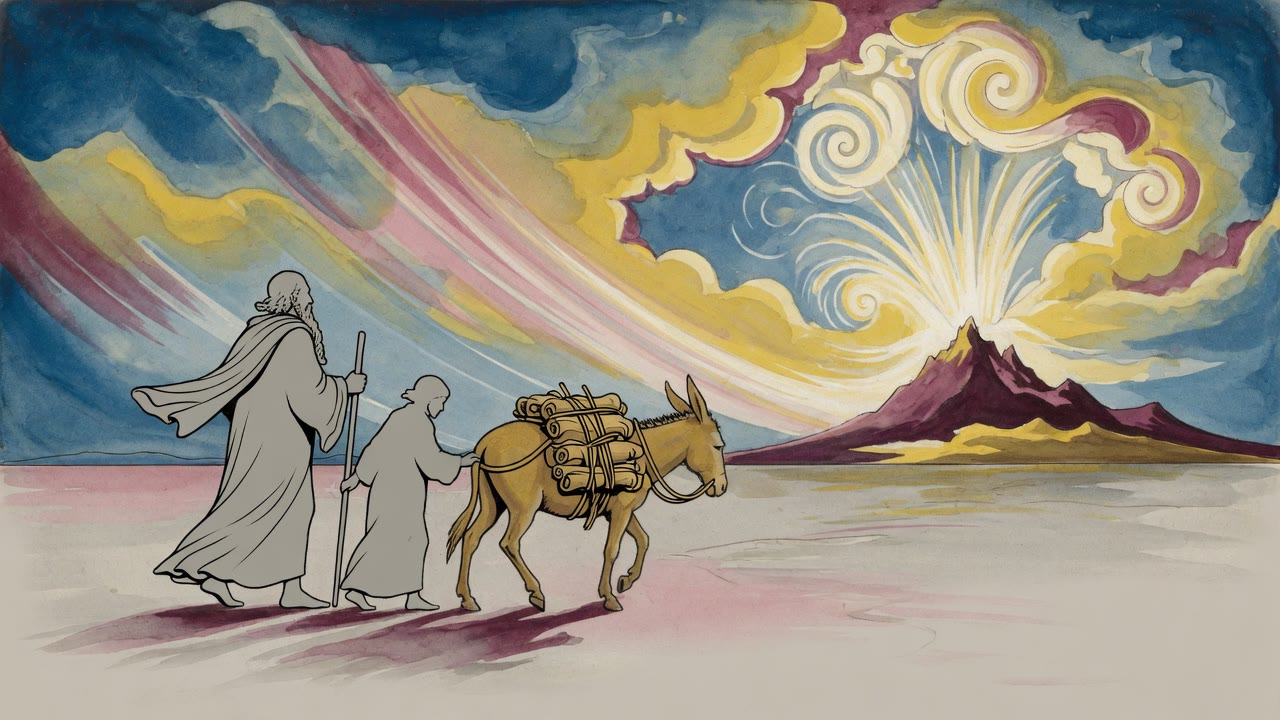
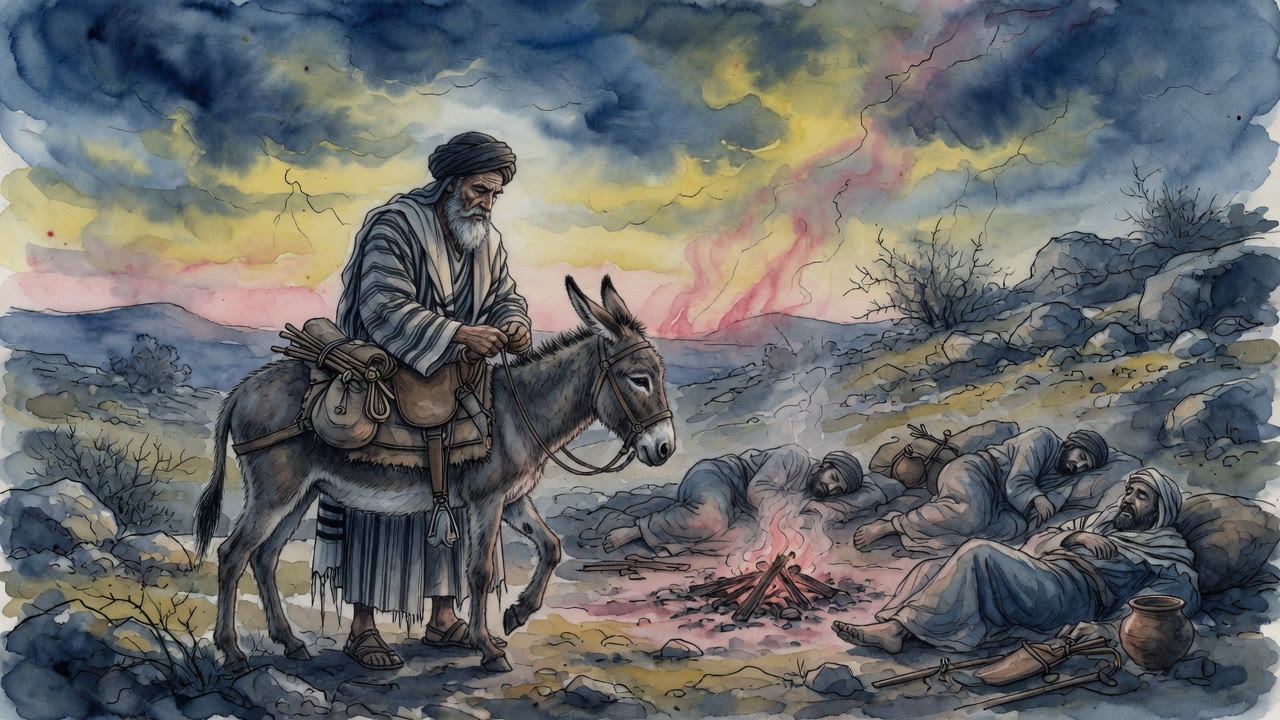
God spoke in the night. Abraham rose before dawn and saddled his own donkey. He did not wake a servant for this task. He split the wood himself. He took two young men and his son Isaac and started walking toward the place God had named.

The Book of Jubilees notices the speed of it. Abraham rose early, without hesitation, without sleeping on it, without a morning's delay to reconsider. The sages took this as evidence of something in him that had not been broken by the command: his willingness to act without understanding. He had been given a destination and a purpose and he had moved toward both with the same directness he had shown when he left Haran, when he entered Canaan, when he sat at the entrance of his tent in the heat and ran toward the strangers.

He saddled his own donkey and said nothing.

The Three Days

On the third day Abraham lifted up his eyes and saw the place from a distance. Three days of walking. Three days of silence about where they were going and why. Isaac walked beside his father and the two young servants walked behind them, and Abraham carried what he knew and kept it entirely to himself.

The tradition asked what those three days felt like. The mountain had been visible in a pillar of cloud for Abraham, a sign the Almighty had given so he would know he was going to the right place. But for the first two days there was only the road and the wood and the donkey and the son walking beside him asking questions his father deflected.

The Book of Jasher fills in the domestic texture of what preceded the three days. Isaac had been born into a household of specific covenant weight. He was the son of promise, the one Abraham had waited one hundred years for, the child whose birth had made his parents laugh. Abraham had circumcised him on the eighth day. He had grown up knowing he was the inheritor of everything his father had been promised.

What Isaac Knew and When He Knew It

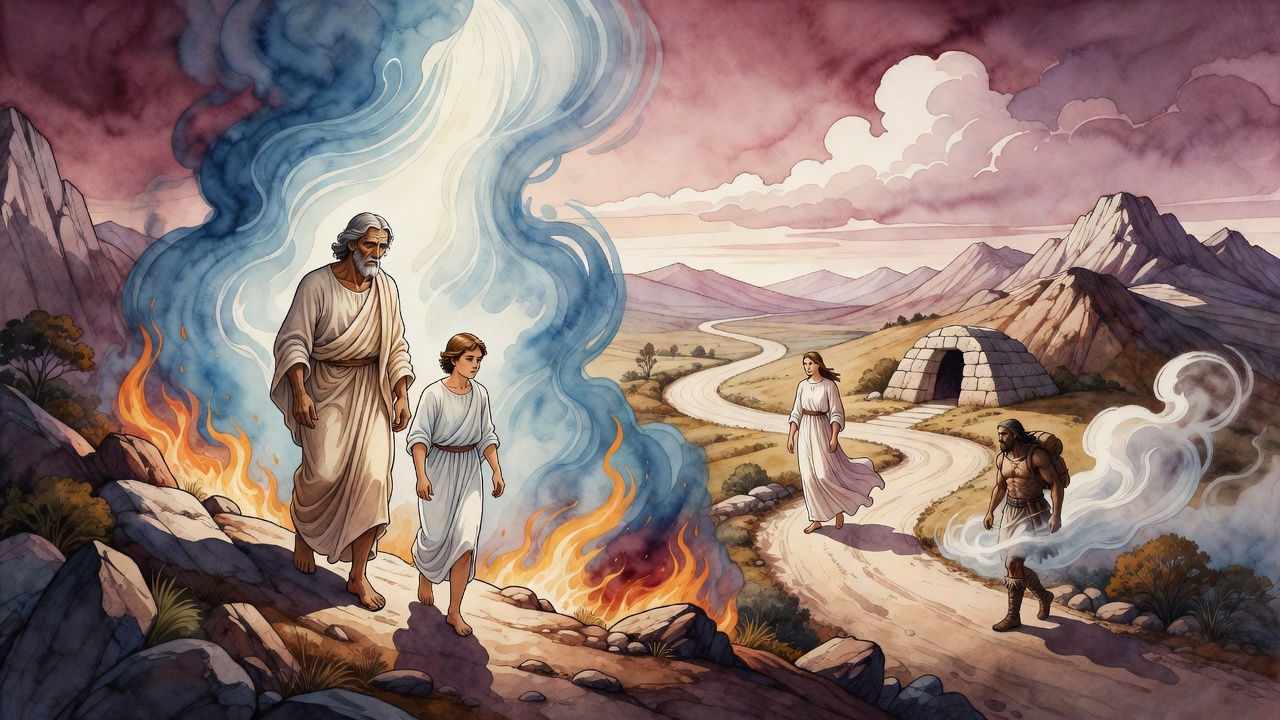
On the third day, when Abraham told the servants to stay with the donkey, when he said we will go and worship and we will return, Isaac carried the wood up the mountain while Abraham carried the fire and the knife. Isaac asked the question Abraham had been waiting for and dreading: I see the fire and the wood, but where is the lamb for the offering?

Abraham said: God will provide the lamb, my son. And they walked on together.

The tradition was divided about what Isaac understood and when. Some held that Abraham told him the full truth partway up the mountain and Isaac submitted willingly, going to the altar as a mature man who chose his own binding. Others held that Isaac did not know until the knife was raised. The uncertainty itself is preserved as part of the story's meaning: both readings require extraordinary things of the participants. A willing Isaac chose death. An unknowing Isaac trusted his father with the same completeness his father trusted God.

The Voice That Called Before the Knife Fell

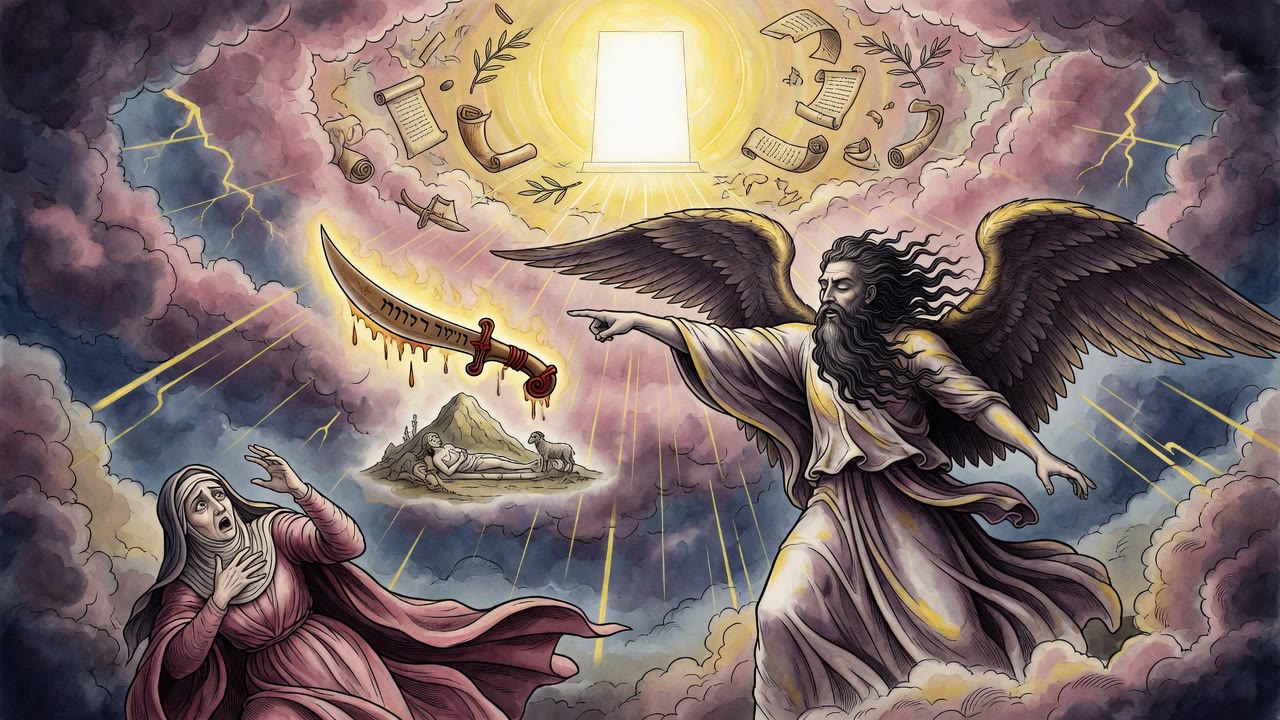
Abraham bound Isaac on the altar. He stretched out his hand and took the knife. The angel of God called to him from heaven by name, twice. Abraham. Abraham. And Abraham said: here I am.

The place received a name: the Lord will see, or the Lord will be seen. The tradition attached this name to a geography that mattered: the mountain where Abraham did not kill his son became, in time, the mountain where the Temple was built. The ram that Abraham sacrificed instead of Isaac bled on ground that would absorb millennia of sacrifice. The ram's horn became the shofar. The binding at Moriah echoed through every subsequent act of worship that the descendants of Isaac performed on that hill.

God renewed the promise there, on that ground. Because Abraham had not withheld his son, the promise was not a gift. It was a covenant earned under the hardest terms that had ever been offered.

The Names the Mountain Held

Abraham called the place one name. David would call it a mountain in the Psalms: who will ascend upon the Lord's mountain. Isaiah would call it the mountain of the Lord's house, established at the head of the mountains in the last days. The same place, named by every generation for what they needed it to mean, carrying all the names at once.

The rabbinic tradition read this convergence as intentional. One place called by the right name by every person who had ever approached it in faith. Abraham saw it from three days' distance and knew it was the right hill by the cloud. His willingness to climb it without fully understanding why established the terms by which the hill would matter to everyone who came after.


← All myths
From the tradition

Sources

3 sources

The texts this telling draws on, in full. Open a card to read inline, or expand it for a wider, quieter read.

Book of Jubilees 18:1Book of Jubilees

He said, "Because thou hast obeyed My voice, and hast not withheld thy son, thy first-born, but hast offered him up to Me, in order that I might make a great nation of thee, and (because) I have blessed thee, I will multiply thy seed as the stars of the heaven and as the sand which (is) on the sea-shore; and thy seed shall possess the gate of their enemies. And in thy seed shall all the nations of the earth be blessed, because thou hast hearkened to My voice. And now descend, do not tarry, unto thy servants and thy cattle." And Abraham went to his servants, and they rose up and went together to Beersheba, and Abraham dwelt in Beersheba as he had done formerly. And Isaac was with him, and he did not return to his father's house, because he had sworn that he would offer him (as) a burnt-offering on the mountain. And Rebecca heard that Isaac had gone to Mount (Moriah), and she went to Abraham, and he blessed her and told her all that had befallen him, and he said to her that he had offered (him) as a burnt-offering before the Lord, and that he had been saved from death; and she knew that it was a trial in order to see whether he was God-fearing, and that he had stood the trial. And she went to Isaac, and told him what had happened to him, and that he had been bound (as) a sacrifice, and he blessed his mother, and they rejoiced because he had been found blameless. Therefore it is ordained and written on the heavenly tables, that they shall celebrate the feast of weeks in this month once a year, to renew the covenant every year. And this whole festival celebrate ye unto the Lord in your habitations: ye shall not do any work therein, and ye shall not defile your feasts by any work of impurity; for it is a holy day unto the Lord, and all who do any work therein shall die: ye shall not prepare anything on it, nor carry (water) through your habitations on that day; ye shall not go from habitation to habitation; and ye shall not dress any food: prepare ye your houses, and eat only what has been prepared on the sixth day, and guard yourselves from all impurity and from everything that defiles on this day. It is a day of holy convocation, and a day of holy joy before the Lord, blessed (be) the God of glory who hath chosen Abraham, because he stood the trial as God willed that he should do, and that his seed should be blessed for ever. And Abraham rejoiced that he had not withheld his son from Him, but that he had obeyed His voice, and that he had turned his hand from slaying him. Therefore it is ordained that we should celebrate this festival, that we should rejoice thereon before our God once a year. And Abraham sent away Hagar and her son Ishmael, and he gave them gifts, and sent them away, and they went to the desert of Beersheba. And Isaac was grown up, and he brought his wife Rebecca to him, and she was the daughter of Bethuel, the Syrian, from Mesopotamia, and she (was) the sister of Laban. And Abraham took a wife for Isaac, and she came to dwell in the tent of Sarah his mother. And he blessed them, and they dwelt in Hebron. And Abraham was growing very old: he was an hundred and seventy-five years old, and all his days were completed in joy; and he died in a good old age, and was gathered to his people, and his sons Isaac and Ishmael buried him in the double cave in the field of Ephron the son of Zohar the Hittite, which is opposite Mamre, in the portion which Abraham had bought from the sons of Heth. There was he buried, and his wife Sarah, and there they buried Rebecca, and there Leah was buried. And all the days of Abraham were an hundred and seventy-five years; and he completed his days in joy, and with a good old age he was gathered to his people. And the Lord blessed Isaac in all things. And Isaac continued to love the Lord as his father Abraham had loved Him, and he offered sacrifices to the Lord as Abraham had taught him. And Isaac continued to increase in possessions, and in cattle, and in fields, and he was blessed in all things as the Lord had blessed Abraham his father. But Rebecca his wife was barren: she bare no children to him.

Ever wonder what happened right after the Akeidah, the Binding of Isaac? It’s one of the most intense moments in the Torah, a true test of faith. But what happened when Abraham came down from that mountain?

Well, the Book of Jubilees gives us a glimpse. Remember, this isn't in the Torah itself, but it's an ancient Jewish text, considered scripture by some. It fills in some fascinating details.

First, there's the divine voice, echoing Abraham's name twice. "Abraham, Abraham," God calls out. And Abraham replies, "Behold, here I am." It's a moment of profound connection. Then comes the blessing. God says, "Because thou hast obeyed My voice… I will multiply thy seed as the stars of the heaven." A promise of countless descendants, a nation blessed beyond measure. And it all stems from Abraham’s willingness to follow God's command. “In thy seed shall all the nations of the earth be blessed, because thou hast hearkened to My voice.”

After that earth-shattering moment, Abraham doesn't linger. He heads back to his servants and they journey back to Beersheba. But Isaac doesn’t return home immediately. Why? Because Abraham had sworn to offer him as a burnt offering. It's a sobering thought.

Now, here's where it gets interesting. Rebecca, Isaac's future wife, hears what happened on Mount Moriah. She goes to Abraham, who tells her the whole story, that he had offered Isaac as a burnt-offering before the Lord, and that he had been saved from death. The text makes it clear: she understands it was a test, and that Abraham passed with flying colors.

Then, Rebecca shares the story with Isaac. Can you imagine that conversation? He blesses his mother, and they all rejoice that he was found "blameless." A family reunited, forever changed by this trial.

And this event, the Book of Jubilees says, is why we celebrate Shavuot, the Feast of Weeks. It says that, it is ordained and written on the heavenly tables, that they shall celebrate the feast of weeks in this month once a year, to renew the covenant every year. This festival isn't just a historical remembrance, it's a yearly renewal of the covenant, a chance to reconnect with that moment of faith and obedience. It's a time for holy convocation, and a day of holy joy before the Lord.

The Book of Jubilees even lays out specific rules for observing Shavuot: no work, no defiling the feasts, no preparing food on the day itself. Prepare beforehand, and focus on the holiness of the day.

Then, the narrative shifts. Abraham sends away Hagar and Ishmael, giving them gifts. Isaac marries Rebecca. And finally, Abraham, at the ripe old age of 175, dies "in a good old age" and is buried by his sons Isaac and Ishmael in the Cave of Machpelah in Hebron. It’s a poignant end to a long and impactful life. The text notes that Sarah was buried there, and that Rebecca and Leah would be buried there as well. A family’s story etched in stone.

The text concludes by emphasizing Isaac’s devotion, emulating his father’s love for God and increasing in possessions and blessings. But it also reminds us of Rebecca's initial barrenness, setting the stage for the next generation's challenges and triumphs.

So, what does it all mean? The Book of Jubilees paints a richer, more detailed picture of the aftermath of the Akeidah. It shows us the emotional toll, the family dynamics, and the enduring legacy of Abraham's faith. It connects this pivotal moment to the ongoing observance of Shavuot, reminding us that the covenant is not a one-time event, but a living, breathing relationship that we renew each year. And it reminds us that even after the most intense trials, life goes on, shaped and molded by the choices we make and the faith we hold.

Full source
Jasher 21Book of Jasher

Book of Jasher turns to Covenant of Isaac of Abraham.

The Book of Jasher, a non-canonical Jewish text mentioned in the Bible itself (Joshua 10:13 and (2 Samuel 1:1)8), gives us some intriguing glimpses. Chapter 21 dives into the years following Isaac's birth, and let me tell you, it's got all the makings of a good family drama.

The chapter opens with the joyous occasion: Sarah, finally, miraculously, gives birth to Isaac. "God visited Sarah, and the Lord remembered her," the verse says, echoing the biblical narrative. Abraham, overjoyed, names the boy Isaac, meaning "he will laugh," a poignant reminder of the divine promise fulfilled. And, of course, he circumcises Isaac on the eighth day, fulfilling the covenant God made with him. The Book of Jasher even tells us that Abraham was one hundred and Sarah ninety years old when Isaac was born to them.

A grand feast is held to celebrate Isaac's weaning. According to the Book of Jasher, everyone who's anyone is there. Shem and Eber, figures from the line of Noah, are there along with Abimelech, king of the Philistines. Even Terah, Abraham's father, makes the trip from Haran with Nahor, his brother, showing that the extended family rejoiced on hearing that a son had been born to Sarah. It’s a picture of familial joy… but shadows are lurking.

Because there’s also Ishmael, Abraham's firstborn son with Hagar. The verse reads, Ishmael was fourteen when Isaac was born. Now, picture this: Isaac is five years old, and according to the Book of Jasher, Ishmael is already an accomplished archer. One day, they’re sitting together, and Ishmael decides to… well, to rehearse killing Isaac. He draws his bow, puts an arrow in it, and aims.

Talk about sibling rivalry! Sarah witnesses this and is, understandably, horrified. She demands that Abraham cast out Hagar and Ishmael. "Cast out this bondwoman and her son," she says, "for her son shall not be heir with my son." The Book of Jasher makes it clear that Sarah’s motivation is to protect Isaac’s inheritance.

Abraham, though grieved, complies with Sarah's request. He sends Hagar and Ishmael away with some bread and water. They wander in the wilderness, eventually settling in the wilderness of Paran. Ishmael becomes an archer, and eventually marries an Egyptian woman and has children. God blesses Ishmael, giving him flocks and herds because of his father, Abraham.

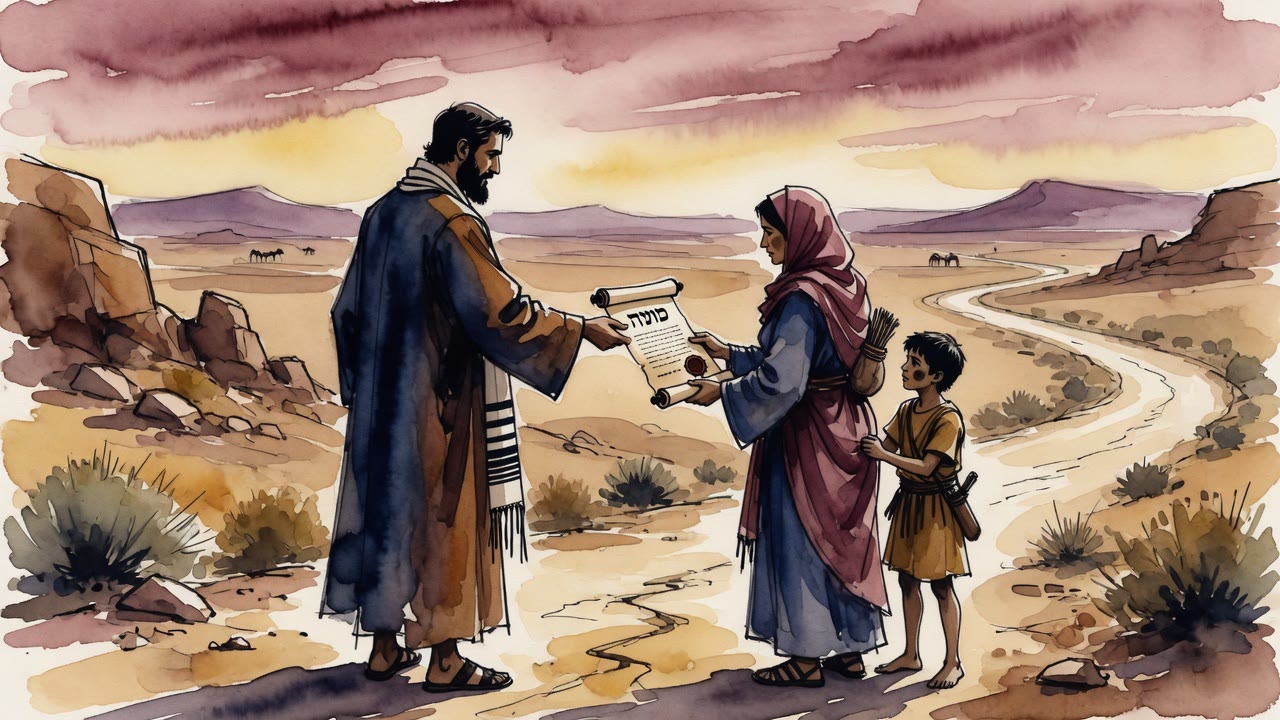
Years pass, and Abraham longs to see Ishmael. He sets out to find him, but what happens next is… well, it's a fascinating cultural lesson wrapped in a family drama. Abraham finds Ishmael's tent, but Ishmael isn't there. Only his wife. And she is not welcoming.

Abraham, still on his camel because he’d sworn to Sarah that he wouldn't dismount, asks for water. The wife refuses, berates her children, and curses Ishmael. Abraham, overhearing this, is furious. He instructs her to tell Ishmael a cryptic message: "When thou comest home put away this nail of the tent which thou hast placed here, and place another nail in its stead."

In other words, divorce her.

Ishmael understands the message immediately. He knows it's from his father and that his wife has dishonored him. He divorces her and takes another wife, whom he brings back to his tent.

Three years later, Abraham tries again. He visits Ishmael, and this time, he finds a very different scene. The new wife welcomes him warmly, offering him food and water. Abraham, pleased, tells her to tell Ishmael: "The nail of the tent which thou hast is very good, do not put it away from the tent."

In other words, this wife is a keeper.

Ishmael understands the message and is overjoyed that his father approves. The Book of Jasher concludes this section by stating that because of this second wife's respect, "the Lord blessed Ishmael."

So, what does this chapter from the Book of Jasher tell us? It's a reminder that even in the lives of our patriarchs and matriarchs, family life was complicated. There were jealousies, resentments, and cultural clashes. But ultimately, it's a story about reconciliation, respect, and the enduring power of family bonds – even when those bonds are tested by distance and circumstance. It asks us to think about what it truly means to honor our parents, and how our choices impact not only ourselves but also generations to come.

Full source
Book of Jubilees 16:26Book of Jubilees

In this ancient text, which some consider to be part of the broader Jewish apocrypha, we find a pivotal moment concerning Abraham, his wife Sarah, and a promise that reshapes the destiny of their lineage.

The verse reads, "And (that) all the seed of his sons should be Gentiles, and be reckoned with the Gentiles; but from the sons of Isaac one should become a holy seed, and should not be reckoned among the Gentiles." Abraham, the patriarch, the man who embodies faith, has sons whose descendants will be considered Gentiles. Yet, from his son Isaac, a different path emerges. A "holy seed" will spring forth, distinct from the nations, set apart.

What does it mean to be a "holy seed"? The Book of Jubilees continues, "For he should become the portion of the Most High, and all his seed had fallen into the possession of God, that it should be unto the Lord a people for (His) possession above all nations and that it should become a kingdom and priests and a holy nation."

This isn't just about lineage; it's about purpose. It's about a covenant, a divine promise that elevates Isaac's descendants to a unique status. They are to be a people especially belonging to God, a kingdom, a nation of priests, a holy nation. This concept of a chosen people, of a nation dedicated to serving God, is a foundation of Jewish identity and belief.

The narrative then shifts to a more intimate scene: "And we went our way, and we announced to Sarah all that we had told him, and they both rejoiced with exceeding great joy."

Can you imagine the emotions swirling between Abraham and Sarah? After years of longing for a child, after the miraculous birth of Isaac, they now receive this extraordinary prophecy. Their son will not just continue their line, but he will be the progenitor of a people destined for greatness, set apart for holiness. Their joy must have been immense, a profound sense of hope and purpose washing over them.

But pause for a moment and consider the implications. This passage from the Book of Jubilees raises profound questions about identity, belonging, and the very nature of chosenness. It speaks of separation, yet also of a unique responsibility to serve as a light to the nations. How do we balance these ideas? How do we understand the call to be distinct while also embracing our shared humanity?

These are not easy questions, and they continue to resonate today. The story of Abraham, Sarah, and Isaac reminds us that identity is not just a matter of birth, but a matter of destiny, purpose, and the choices we make along the way.

Full source