Parshat Tzav6 min read

The Water Moses Poured Bought Every Yom Kippur to Come

Moses set his own hands to the laver at the door of the Tent, and the water he poured over his brother paid for every Day of Atonement still unborn.

Curated by Arthur · Told by Maggid ·
Table of Contents
  1. The Laver at the Door of the Tent
  2. Seven Days of Waiting and Then the Eighth
  3. The Voice That Stopped at the Doorposts
  4. No Army Ever Came to Guard the Tent
  5. He Walked Into the Inner Room Armed
The Water Moses Poured Bought Every Yom Kippur to Come Click for full size

The Laver at the Door of the Tent

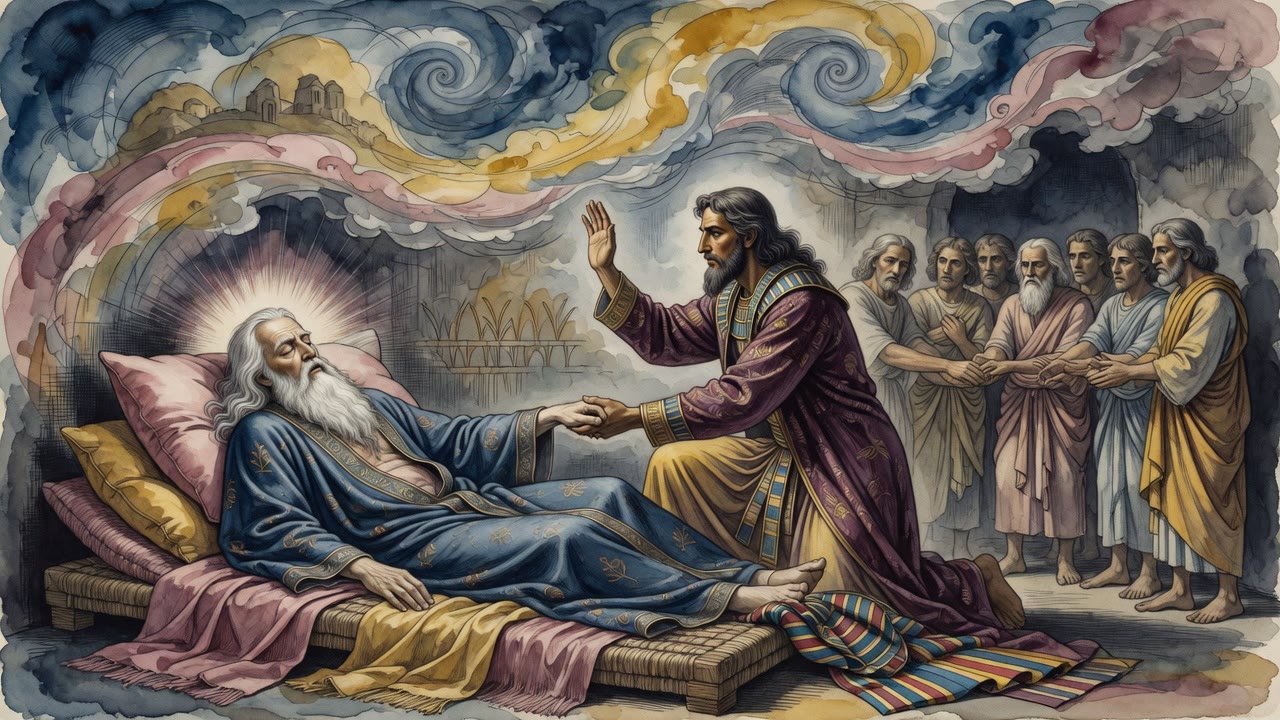
Moses carried the water himself. He did not send a Levite for it and he did not have it brought to him in a basin. He set his own hands to the laver standing at the door of the Tent and called his brother forward.

Aaron came. The whole assembly stood behind him, close enough to hear the water hit the ground. Moses poured it over Aaron's hands. Then over his feet. Then the four sons stepped up in order, Nadab and Abihu and Eleazar and Ithamar, and the water went over their shoulders and darkened the linen at the collar and ran off their elbows. The dirt at the doorway turned to mud.

Nothing in that camp had ever been washed that way.

What Aaron did not know, standing with his eyes shut and his beard dripping, was how far forward the water reached. Every Yom Kippur that had not happened yet was being paid for at that doorway. Every high priest who would ever strip in the Temple court, immerse, dress in white, strip again, and sanctify his hands and his feet from the golden laver, all of it was bought in the few minutes Moses stood pouring water over his brother in front of Israel.

Seven Days of Waiting and Then the Eighth

After the washing came the sitting. Seven days at the entrance of the Tent, going nowhere, while Moses performed the service that was supposed to be Aaron's. For a week Aaron watched his own office done by another man's hands.

On the eighth day they called him to the altar.

He climbed the ramp. He killed the sin offering and its blood went against the base, he sent up the burnt offering, he laid out the peace offerings, and the smoke stood up straight in the windless air over the camp. Then he turned at the top of the ramp, lifted both hands toward the people, and blessed them.

And then he came down. Not carefully, not the way a man leaves a room he might have died in. He came down that ramp in joy, an old man past eighty with blood dried under his fingernails, and everyone standing at the foot of the altar saw it on his face before he reached the bottom.

The Voice That Stopped at the Doorposts

The Tent behind him was doing something for the whole world that nobody in the world had noticed.

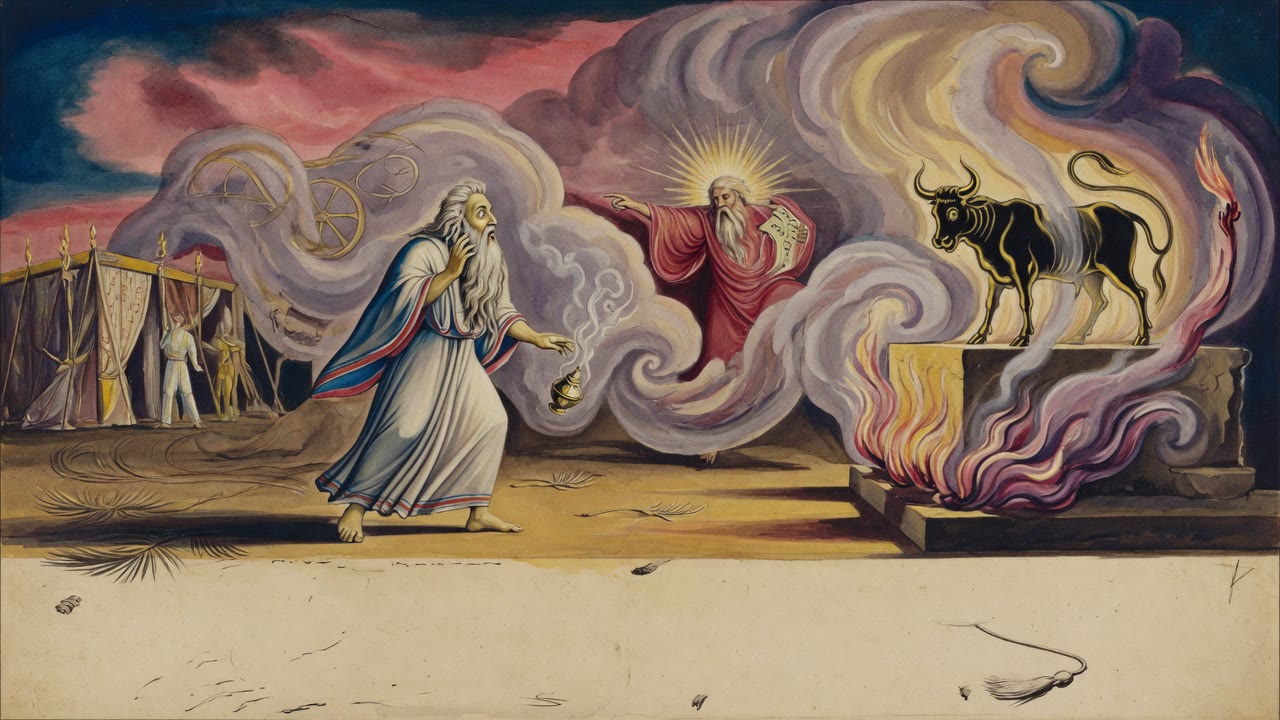
Before those boards went up, when God spoke, the speech went out over everything. It did not stop at the edge of the camp. It crossed the wilderness and the trade roads and the walled cities, and men who had never heard of Israel doubled over where they stood, their bowels turning to water, holding onto walls until the sound passed. The speech came out of the fire with two natures in it. To Israel it was an elixir of life. To everyone else it was the other thing.

"For who of all flesh has heard the voice of the living God speaking out of the midst of the fire, as we have, and lived?" (Deuteronomy 5:23) The people who asked that had watched the ones who heard and did not live.

Then the Ohel Mo'ed (אֹהֶל מוֹעֵד), the Tent of Meeting, was raised, and the voice changed its habits. It came from above the ark, filled the space inside the curtains, and stopped at the doorposts. It did not go out. The caravans on the road past the camp heard wind and goats and nothing else.

No Army Ever Came to Guard the Tent

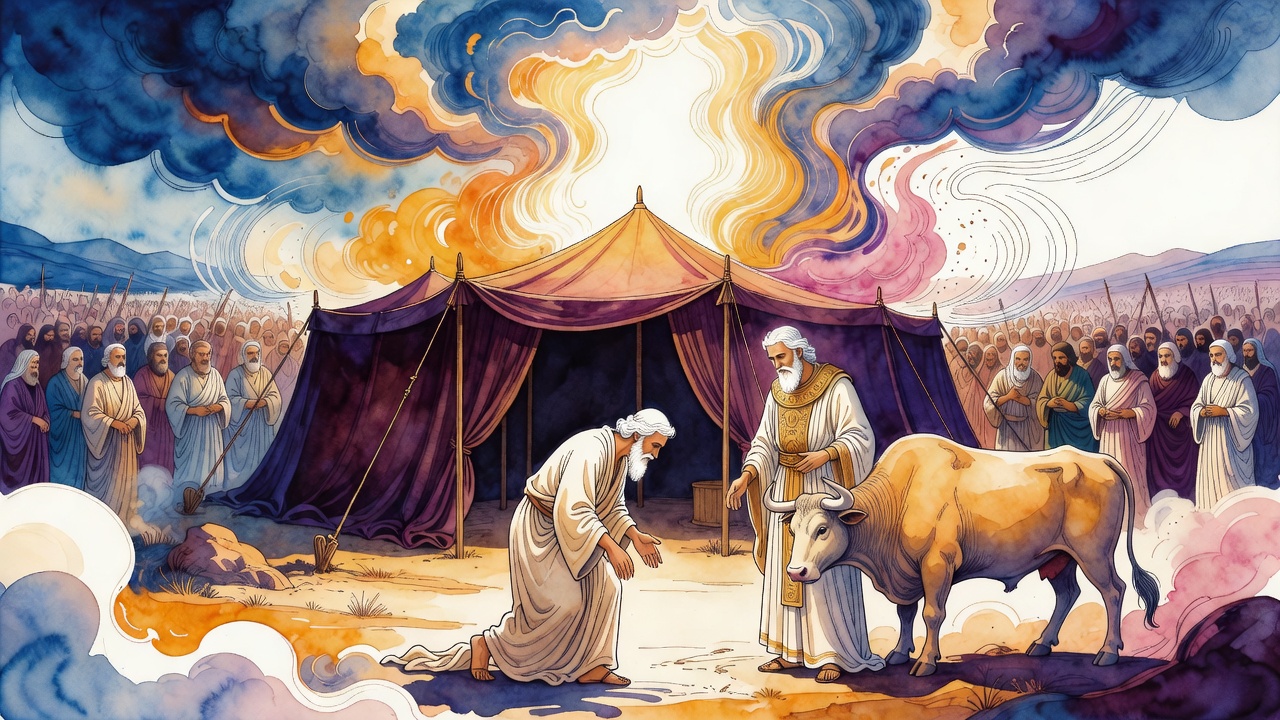
The nations went on with their business. They fortified granaries. They walled their wells and posted watchmen on the roads where their caravans moved, and not one of them ever sent a soldier toward a tent of goat hair standing in the wilderness of Sinai.

Had they understood what those boards and curtains held back on their behalf, they would have ringed the camp with their own encampments. Siege works. Ditches and towers. Standing watches in shifts, generation after generation, paid out of the treasuries of kings, to keep a shrine upright that belonged to somebody else and served them anyway.

Instead the Tent stood in the middle of the camp with Levites around it, and the world outside kept its footing and never learned why.

He Walked Into the Inner Room Armed

Once a year, on Yom Kippur, the curtain at the back opened for one man.

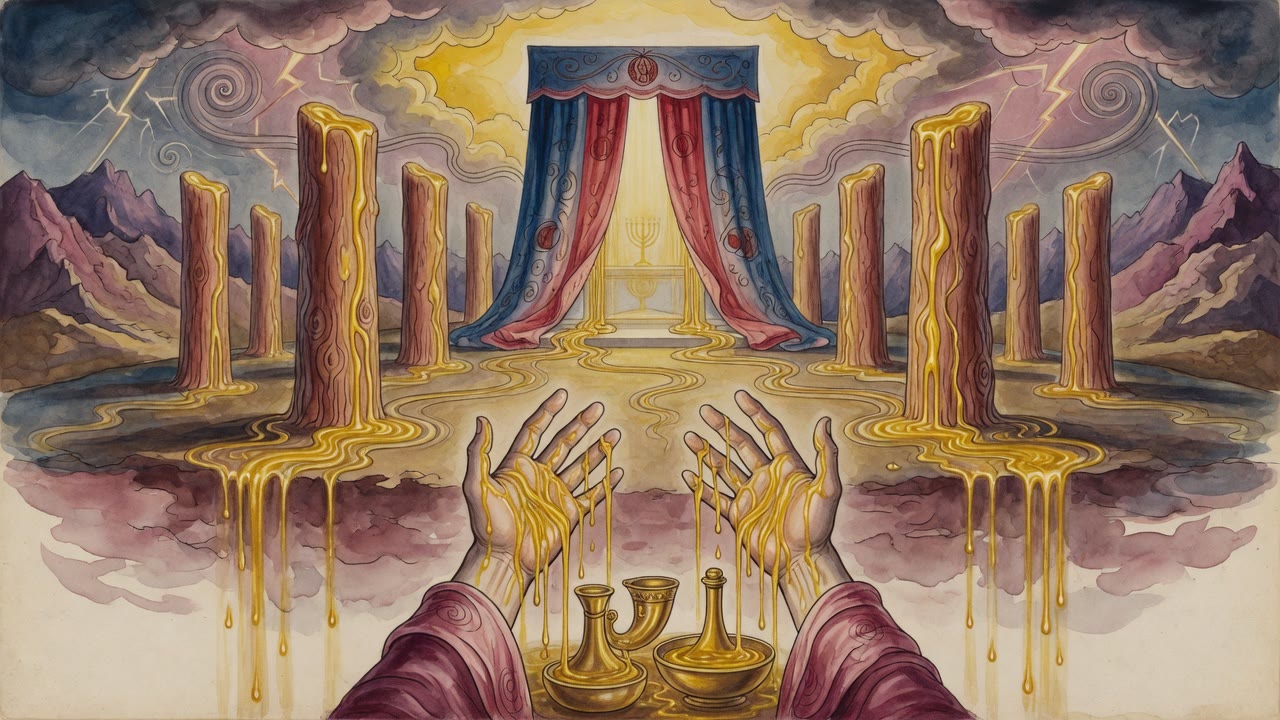
Aaron went in alone, and he went in the way a commander opens a campaign, because war is made with tachbulot, with stratagems, and nobody crosses that threshold empty-handed. He carried no blade. He carried chavilot (חבילות), bundles, roped together and loaded onto him the way a soldier is loaded before a march.

The Torah went in with him. So did circumcision, the covenant cut into the flesh of every man in the camp outside. Shabbat came. Jerusalem came, a city not yet built, and the twelve tribes with their father's last words still fastened to them, and Judah out in front of the rest. The offerings came. The tithes came, and the gifts lifted off the harvest for the sanctuary, and the merit of Israel's own stature. Each bundle had been tied on with the same small word, this, and this, and this, until Aaron stood loaded to the shoulders with everything his people had ever done right.

He went past the curtain carrying all of it.

Behind him the bells on the hem of his robe knocked once against the fabric and then went quiet, and the men out in the court counted, and waited to hear them start again.


← All myths
From the tradition

Sources

4 sources

The texts behind this telling. Some cards carry a translation of the source; others are our own retelling of it, and each card says which. Every card links out to the original.

Sifra, Mekhilta deMiluim I 5Sifra, Mekhilta deMiluim

Translation of the source text.Sifra by Rabbi Shraga Silverstein · CC-BY

5) (Vayikra 8:6): "And Moses drew near Aaron and his sons and he washed them with water.": At that time they merited the laving of hands and feet and the immersions of Yom Kippur.

Full source
Sifra, Mekhilta deMiluim II 18Sifra, Mekhilta deMiluim

Translation of the source text.Sifra by Rabbi Shraga Silverstein · CC-BY

18) (Vayikra 9:22): "And he came down from offering the sin-offering and the burnt-offering and the peace-offerings": Having acquitted himself of his offerings, he descended from the altar in joy.

Full source
Vayikra Rabbah 21:6Vayikra Rabbah

Retold in our words. Read the original at the link below.The Sefaria Midrash Rabbah, 2022 · CC-BY

What would you bring with you? What could possibly prepare you for such an encounter?

Well, Rabbi Yudan, in Vayikra Rabbah 21, offers a fascinating perspective. He interprets the verse "for with stratagems you shall wage war for yourself" (Proverbs 24:6) as an allusion to the High Priest entering the Holy of Holies armed, not with weapons, but with something far more powerful: bundles upon bundles, ḥavilot, of mitzvot (commandments), good deeds.

Think of it: the High Priest isn't just walking in alone. He’s accompanied by a whole entourage of merits, each one evidence of the covenant between God and the Jewish people. These mitzvot act as advocates, whispering their good word on his behalf.

What exactly are these bundles? Rabbi Yudan breaks it down.

First, there's the merit of Torah. "This is the Torah" (vezot haTorah), (Deuteronomy 4:44), it says. The Torah, our guide and instruction manual for life, walks with him. Then comes the merit of circumcision, brit milah, "This is My covenant" (zot brisi), (Genesis 17:10). That physical sign of our eternal bond, a constant reminder of commitment, is there too.

And Shabbat, the day of rest, a weekly sanctuary in time. "Happy is the person who performs this…who keeps the Sabbath from its desecration" (Isaiah 56:2). The holiness of Shabbat accompanies him.

Jerusalem, the heart of our people, is also present: "This is Jerusalem" (zot Yerushalayim), (Ezekiel 5:5). The very stones of our holy city speak on his behalf.

He carries the merit of the tribes, each unique and vital: "This is what their father spoke to them" (vezot asher diber lahem avihem), (Genesis 49:28). The collective strength and history of the twelve tribes are there. Judah, too, with his own special blessing: "This is for Judah" (vezot l'Yehudah), (Deuteronomy 33:7).

And what about Israel itself? "This, your stature" (zot komatēkh), (Song of Songs 7:8). The Song of Songs, traditionally understood as an allegory for the love between God and Israel, lends its passionate devotion to the High Priest’s cause. It’s a beautiful and powerful image.

Even contributions and tithes play their part. "This is the contribution" (vezot ha-terumah), (Exodus 25:3), and "[bring all the tithes to the storehouses…] test me now with this" (bazot), (Malachi 3:10). Our acts of generosity, our willingness to share what we have, these too are a source of merit.

Finally, the offerings themselves: "With this Aaron shall come" (bezot yavo Aharon), (Leviticus 16:3). The sacrifices, symbolic of our desire to draw closer to God, complete the High Priest’s arsenal of merit.

So, what does this all mean? Rabbi Yudan paints a picture of the High Priest entering the Holy of Holies not as a lone individual, but as a representative of the entire Jewish people, carrying with him the weight and the glory of our collective covenant. He is bolstered by every good deed, every act of devotion, every moment of connection to the Divine.

What bundles of mitzvot are we carrying with us? What merits are we accumulating in our daily lives? Perhaps, like the High Priest, we too can approach the Divine, not with fear, but with the confidence that comes from a life lived in accordance with God's will.

Full source
Vayikra Rabbah 1:11Vayikra Rabbah

Retold in our words. Read the original at the link below.The Sefaria Midrash Rabbah, 2022 · CC-BY

It turns out, according to some ancient Jewish texts, the answer might be closer – and more dangerous – than we think.

Rabbi Yehoshua ben Levi, a sage from the Talmudic period, makes a startling claim in Vayikra Rabbah, the midrash on Leviticus. He says that if the nations of the world had truly grasped the immense benefits the Ohel Mo'ed (אֹ֣הֶל מוֹעֵד֙), the Tent of Meeting, provided them, they would have surrounded it with encampments and fortifications, protecting it at all costs. Now, that's a bold statement. What exactly was so special about this Tent?

The answer, it seems, lies in the raw, unfiltered power of the Divine voice itself. The text goes on to explain that before the Mishkan (מִשְׁכָּן), the Tabernacle, was erected, the nations of the world could actually hear the voice of God. But instead of being a blessing, it was… well, let's just say it had some rather unpleasant side effects. Apparently, they would be afflicted with diarrhea! Yes, you read that right. The divine speech was so overwhelming, so intense, that those who heard it would lose control of their physical faculties.

But it drives home a powerful point: that direct, unmediated contact with the Divine can be a dangerous thing.

The proof-text cited is from (Deuteronomy 5:23): “For who of all flesh that heard the voice of the living God [speaking from the midst of the fire like us, has lived?]" In other words, the implication is that nobody can hear the voice of God directly and survive unchanged.

Rabbi Simon takes this idea even further. He suggests that the Divine speech emerged with two distinct natures: an elixir of life for Israel, and an elixir of death for the other nations. Talk about a double-edged sword! He then quotes (Deuteronomy 4:33): “Has a people heard the voice of God as you heard, and lived?” The implication being: you heard and lived, but the others? Not so much.

What was it about the Israelites that allowed them to withstand the power of the Divine voice, while others couldn’t? Was it a matter of spiritual preparation? Divine favor? Or something else entirely?

Finally, Rabbi Ḥiyya offers a crucial detail. He explains that when God spoke "from the Tent of Meeting," the voice would stop there. It wouldn't emerge outside. The Tent acted as a buffer, a filter, protecting the world from the full force of God's unbridled power.

The Tent of Meeting, therefore, wasn’t just a place of worship. It was a vital shield, a necessary intermediary between the human and the Divine. That even the most beautiful and powerful forces need to be approached with respect, caution, and perhaps, just a little bit of… insulation.

So, the next time you find yourself yearning for a direct connection to the Divine, remember the story of the Tent of Meeting. Remember the nations afflicted with… well, you know. And be grateful for the structures, the traditions, the interpretations that help us to approach the Holy in a way that is both meaningful and, dare I say, a little less… messy.

Full source