The Yoke Esau Set on Seir and the Oath That Sealed It
His sons would not let the old quarrel sleep. Four thousand men came down from Seir. Esau named a lion yoked to an ox as the price of peace.
Table of Contents
 Click for full size
Four Thousand Off the Mountain
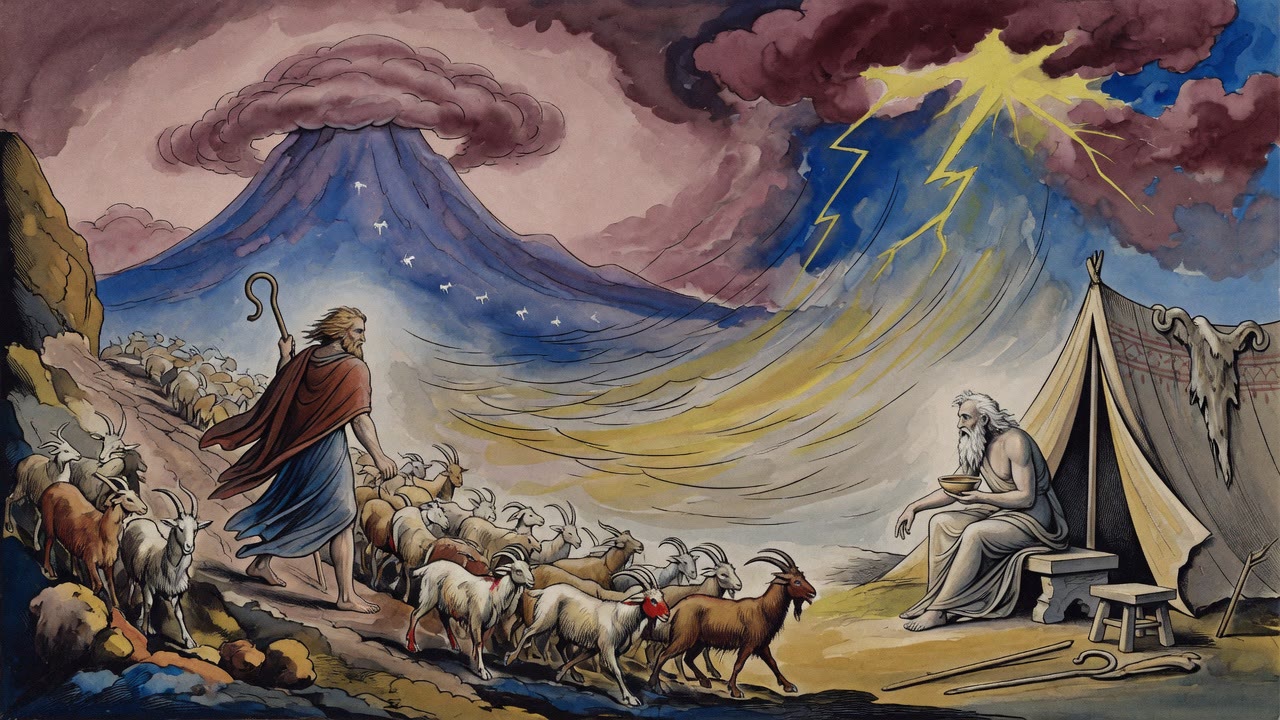
Esau sat in his house in the red mountains, old, and his sons would not let him rest. Their father had grown quiet in Seir. His brother had grown quiet in the land below. The old quarrel had cooled into silence. The sons would not have it.
They stood in his hall and named every wound. The birthright sold for a bowl. The blessing taken in the dark. Every grievance their grandfather Isaac had tried to bury before he died. They put a sword in Esau's hand. They put an army at his back. Four thousand fighting men gathered behind him, and Esau let them lead him down out of the heights toward the tower where Jacob lived.
Jacob had buried his dead and was still in mourning when the watchmen called down the warning. He climbed the wall and looked out over the plain. He saw the host. He did not arm himself first. He spoke first.
"Is it a comfort to you," he called down, "that you have come with sword and spear against your brother? Our father commanded us, both of us, while he still drew breath. He set the law of brotherhood between us with his own mouth. Go back to your mountains. Take the peace he asked for, and let there be no blood between the sons of one father."
The words went out over the heads of four thousand men and reached Esau standing among them. Esau did not soften. He had come too far down the mountain to climb back up empty. The plea only sharpened the thing already set in him.
The Oath of the Lion and the Ox
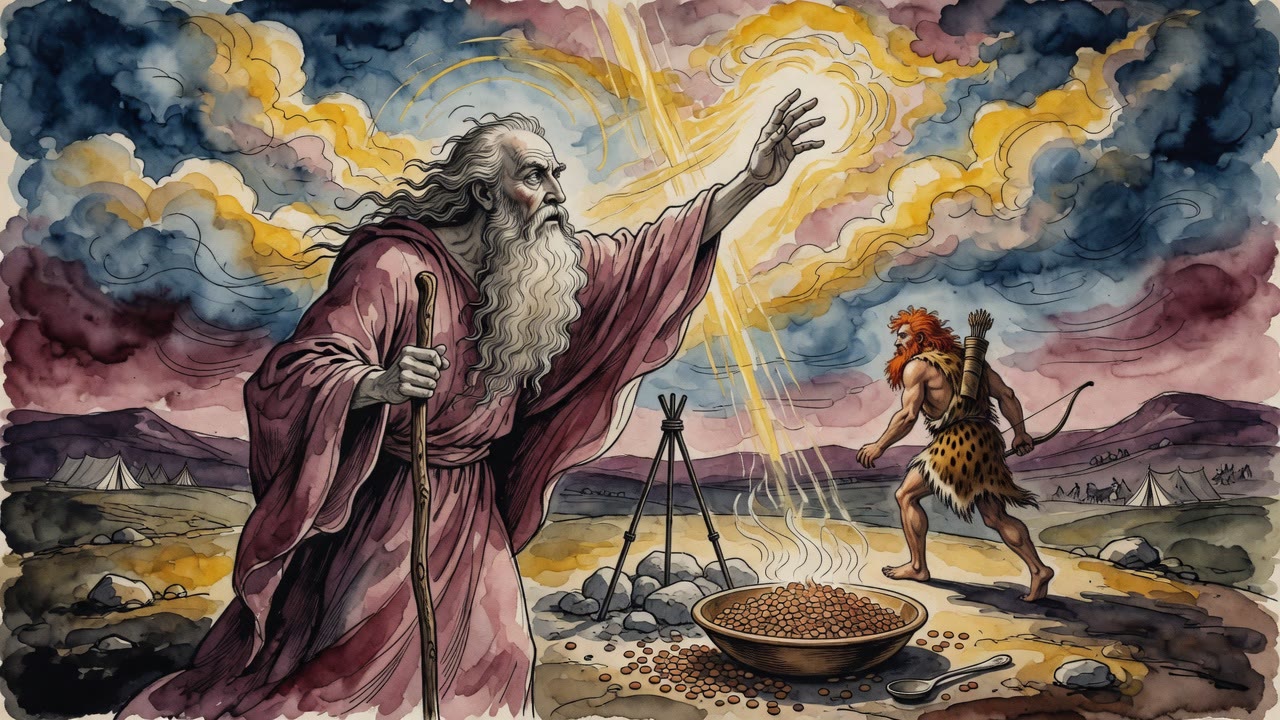
Esau answered, and his answer was built to close every door that could ever open between them.
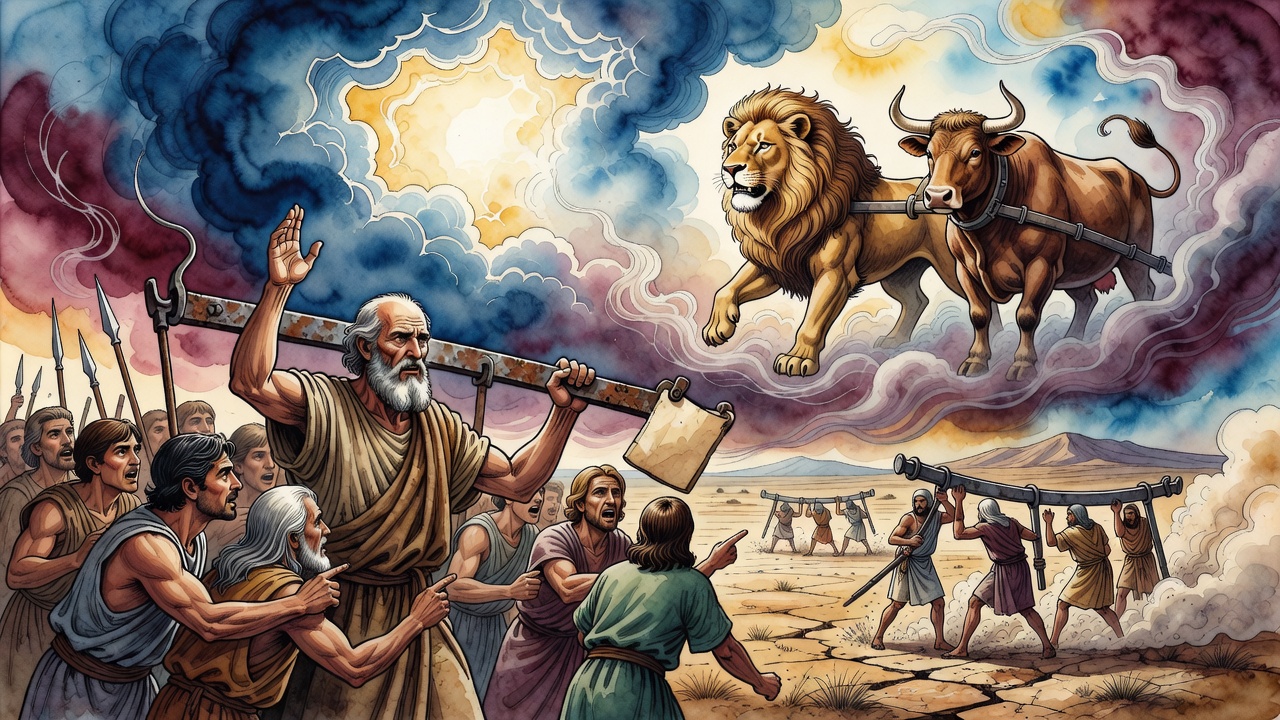
"When the lion becomes the friend of the ox," he said, "when it is bound under one yoke with the ox and plows beside it in the field, then I will make peace with you. When the raven turns white as the râzâ, then know that I have loved you and will make peace with you. You shall be rooted out, and your sons shall be rooted out, and there shall be no peace for you, ever."
A lion yoked to the ox it would otherwise devour. A raven gone white as snow. He named the impossible as the price of peace, which was the same as saying there would be no peace while the world held its shape. Then he gave the order, and the army came forward.
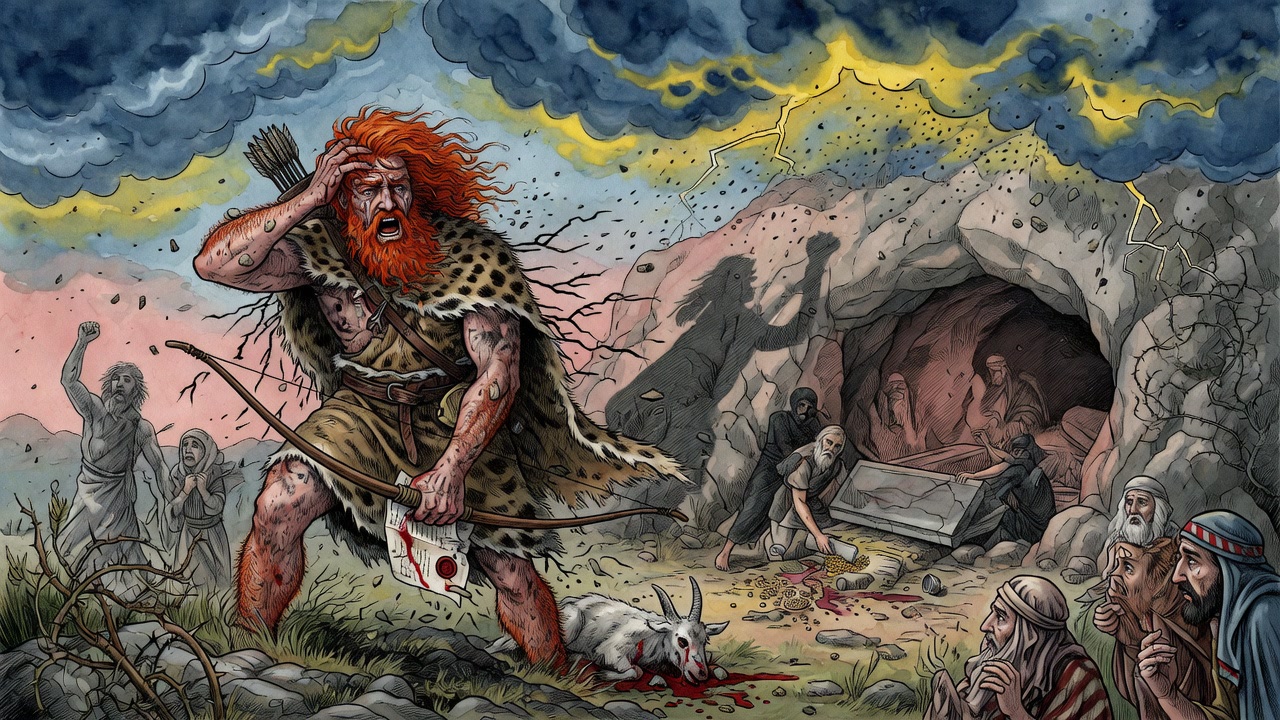
From the wall, Jacob watched his brother throw himself into the attack. There was something in it past anger. Esau came on the way a wild boar charges the spear set against it, driving its own body onto the iron that kills it and never once recoiling from the wound. A creature that would rather die on the blade than turn aside. Jacob saw that this was a man who wanted his death more than he wanted to live, and he understood that the law of brotherhood was finished.
The War in the Mountains of Seir
So Jacob came down off the wall, and the old man fought. The sons of Jacob stood with their father, and they were terrible in the field. The host that had marched so confidently out of Seir broke against them. Esau, who had sworn the lion would befriend the ox before he made peace, fell in the fighting he had demanded. The vow of eternal hatred ended with the man who swore it lying dead on the ground he had crossed to take.
The war did not end at the wall. The sons of Jacob carried it up into the red mountains, into Seir itself, where the children of Esau had their cities and their high places. They pressed hard, and harder, until the descendants of the elder twin bowed their necks. The sons of the man who had held the birthright by right of being born first knelt to the sons of the brother who had bought it. They became servants. The order of the womb was overturned in the field.
A boy from Seir dropped his spear and put his forehead in the dust. Around him the high places of Edom stood empty of defenders. The mountain that had sent four thousand down now sent tribute up.
The Yoke That Outlived the Oath
When the fighting was done, the sons of Jacob stood over a beaten people and did not know what to do with them. Finish it, or stop. Wipe out the line of Esau, or let it live. They sent word down to their father and asked him.
Jacob, who had stood at the tower asking for peace before a single arrow flew, asked for peace again. But it was not the peace of two brothers under one father's roof. It was the peace of a yoke. They made peace with the sons of Esau, and they laid the yoke of servitude across their necks, and from that day the children of Edom paid tribute to Jacob and to his sons. A tax, a gift, a minkha (offering), carried up the mountain and set down before the house of the younger brother. Year after year it came, the sign of who had won and who had knelt.
It came while Jacob lived, and it kept coming after. It was still coming the day Jacob went down into Egypt with his household. And the sons of Edom never threw it off. The yoke the twelve sons of Jacob set on them in the mountains of Seir was still on their necks long after the war was a rumor, the unbroken weight of an oath that had promised hatred and delivered servitude instead.
Esau had named a lion beside an ox as the only peace he would accept. He got a yoke. The lion did not plow. The raven did not turn white. Peace came anyway, and it came as a weight on the necks of his children, sealed not by the oath he swore but by the war he would not refuse.
← All myths