Parshat Toldot5 min read

The Five Sins Esau Committed While Abraham Was Buried

The day Abraham died, Esau came home starving and sold his birthright for soup. The rabbis say that was the least of what he did that afternoon.

Curated by Arthur · Told by Maggid ·
Table of Contents
  1. What Jacob Was Cooking and Why
  2. Five Sins Before Sunset
  3. What Abraham Saw Before He Died
  4. Why Esau Scorned the Birthright

What Jacob Was Cooking and Why

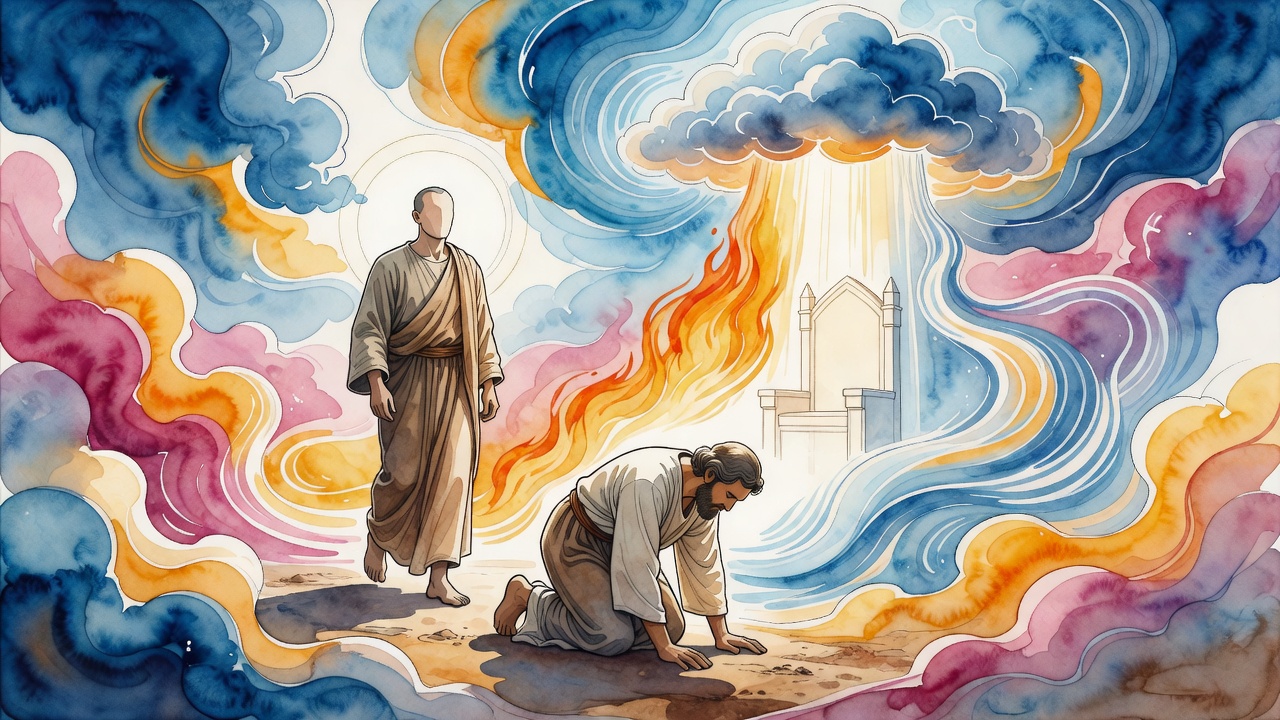
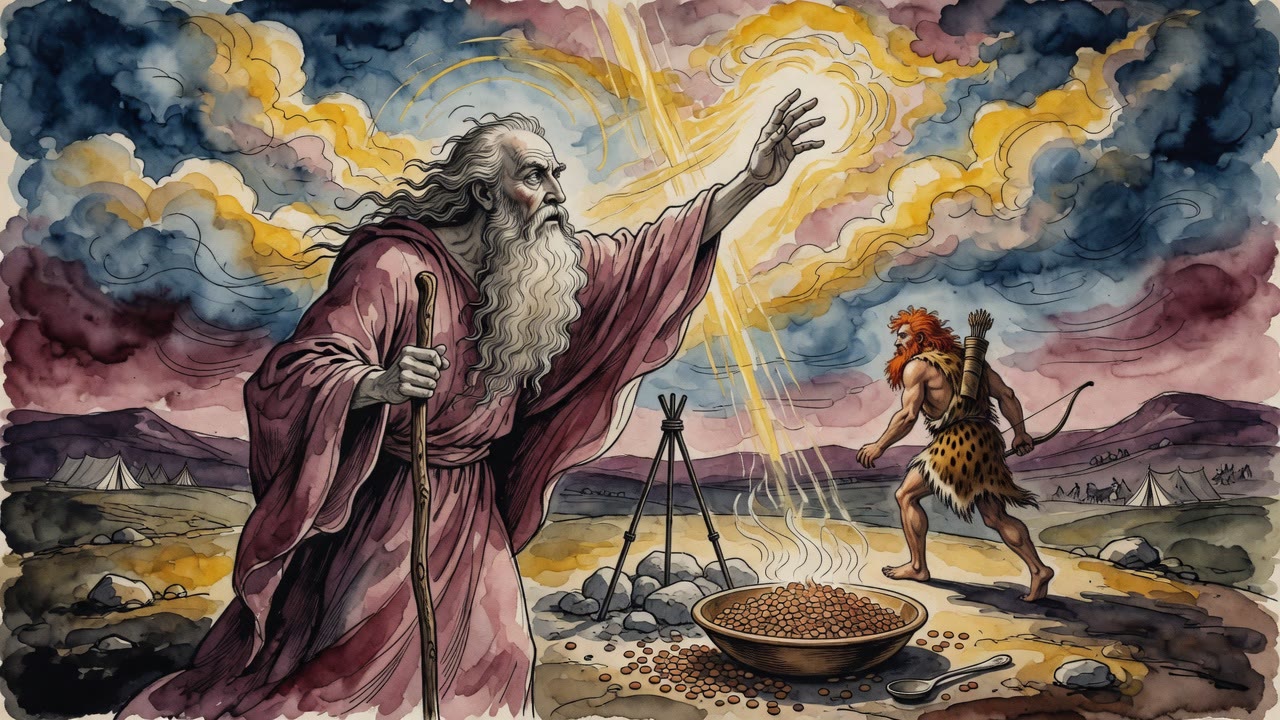
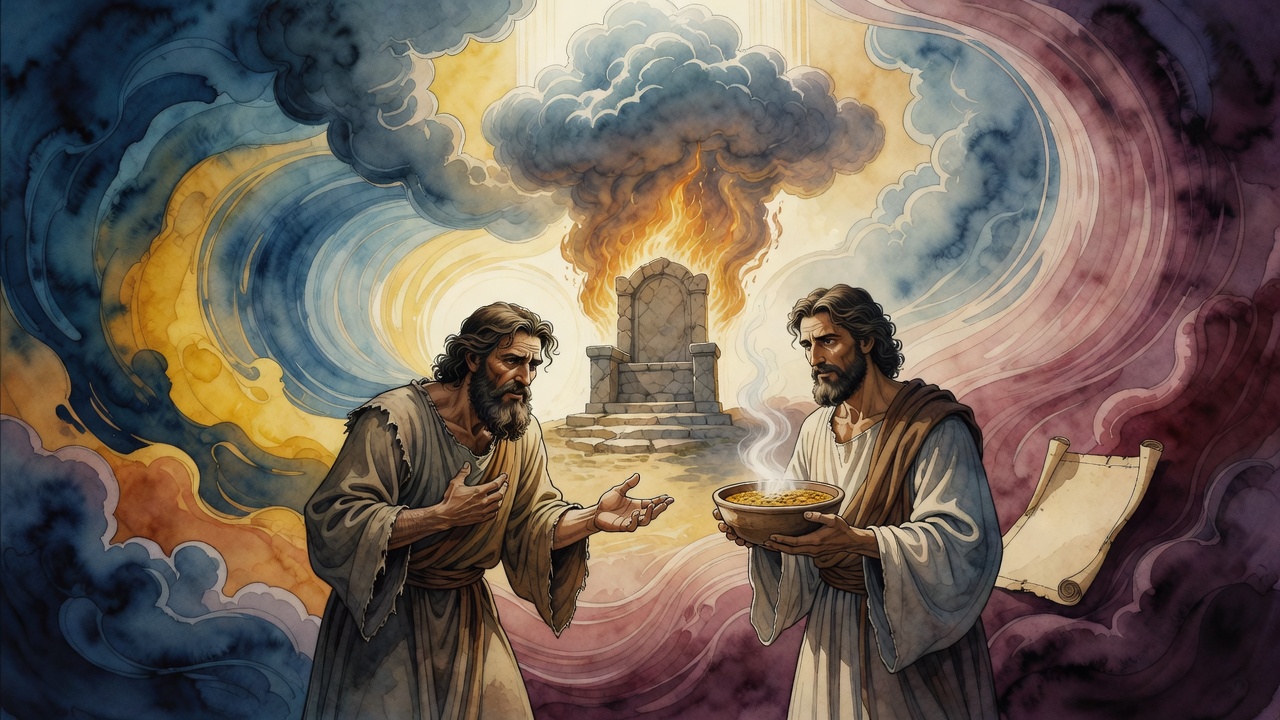
The morning Abraham died, Jacob was in the tent cooking lentils. He was not cooking for himself. He was cooking for Isaac, his father, who was mourning. Lentils were the food of mourning in Jewish tradition, their round shape representing the cycle of life and loss, their sealed surface standing for the silence a mourner maintains. Jacob, the son who stayed home, who tended the camp and learned from his father while Esau hunted, was performing an act of consolation.

This is the context Targum Jonathan, the expansive Aramaic translation of the Torah composed in the early centuries CE, supplies for a scene the Torah presents without background. Jacob was sitting with his grieving father when Esau came in from the field. And what Esau did next, the exchange that lasts barely forty words in the Hebrew text, was only the last item on a list that had been accumulating since dawn.

Five Sins Before Sunset

The rabbis counted them. On the day his grandfather was buried, Esau committed five transgressions.

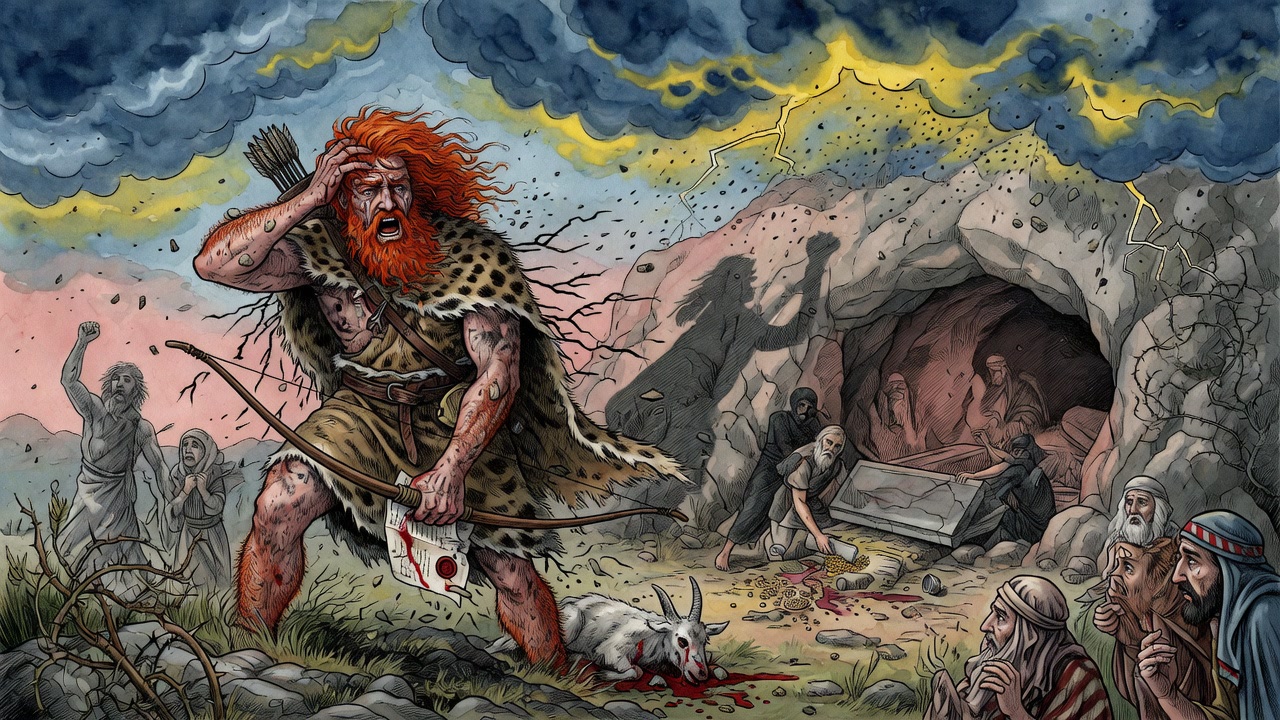
He violated a betrothed woman. He murdered a man. He denied the resurrection of the dead, saying directly that a man lives and then is gone, that the promise of return was a lie. He denied God's existence, dismissing the divine framework that his family had built their entire lives around. And he sold his birthright, the inheritance of the covenant, the spiritual legacy of Abraham and Isaac, for a bowl of lentil soup because he was hungry from the exertion of the previous four sins and could not think past his own stomach.

Bereshit Rabbah, the foundational midrashic collection on Genesis compiled in the Land of Israel in the fifth century CE, does not separate the stew from the rest. The round lentil on the fire was a symbol of the cycle: life turns, loss comes to everyone, the world goes around. Esau, who had just denied that the cycle meant anything, who had spent the morning murdering and violating and rejecting the promises his grandfather had died holding, now stood in his father's tent demanding to be fed. And Jacob, watching all of this, named his price.

What Abraham Saw Before He Died

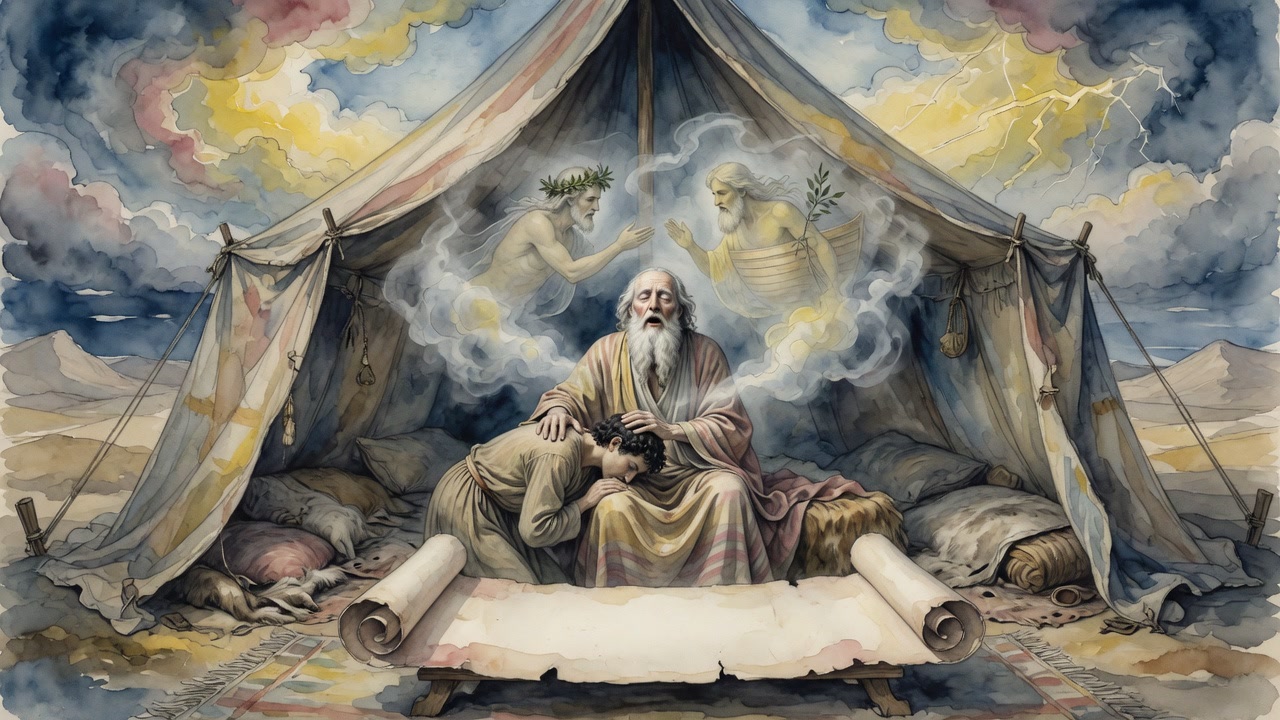
Targum Jonathan adds a detail about Abraham's death that changes how the whole scene reads. God shortened Abraham's life by five years. Abraham was supposed to live to one hundred and eighty. He died at one hundred and seventy-five. Why? So that he would not live to see what Esau became.

This is a mercy that functions as a judgment. Abraham, who had pleaded with God to spare Sodom, who had loved his grandchildren and welcomed them into his household, was spared the knowledge of what his grandson was doing on the day of his burial. God removed him before the evidence arrived. That removal was both a gift to Abraham and an indictment of Esau: the grandson was bad enough that God edited the patriarch's life to protect him from the information.

Why Esau Scorned the Birthright

Genesis 25:34 says it plainly: he ate, he drank, he arose, he went, and Esau scorned the birthright. The Midrash zeroes in on the word scorned. Not sold. Not traded. Scorned. Esau did not make a reluctant transaction under pressure. He held the covenant of his grandfather in contempt. He looked at the promise that had sustained Abraham through Ur and Canaan and Egypt and Moriah, the promise that had cost Isaac the altar and Jacob twenty years in exile, and he dismissed it as worth less than dinner.

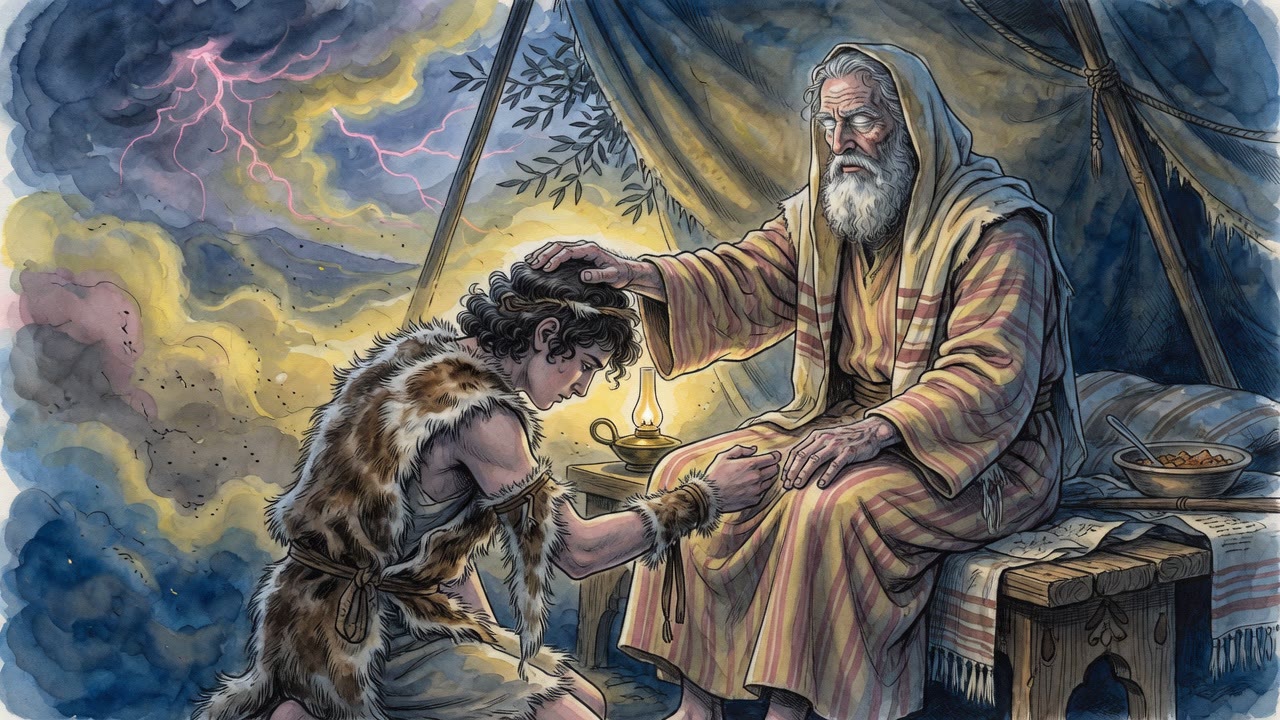
The Book of Jubilees extends the picture further. After Isaac died, it records, Esau's sons heard that Jacob had received the portion of the firstborn from Isaac's blessing and came immediately to contest it. The family argument that began at the lentil pot continued into the next generation, the sons inheriting the father's grievance long after the day of the five sins had passed into legend.


← All myths

From the tradition

Sources

9 sources

The texts this telling draws on, in full. Open a card to read inline, or expand it for a wider, quieter read.

Targum Jonathan on Genesis 25Targum Jonathan

Abraham married again after Sarah's death. The Torah calls his new wife Keturah. The Targum reveals her true identity in a single phrase: "She is Hagar, who had been bound to him from the beginning." The woman Abraham had once sent into the desert with a letter of divorce came back. They had six more sons together.

Abraham died at one hundred and seventy-five, and the Targum adds a detail about Ishmael that changes everything: "Ishmael wrought repentance in his days." The wild son of the desert returned to God before he died. That is why the Torah records that both Isaac and Ishmael buried Abraham together, they had reconciled. The Targum also explains why Abraham never blessed Isaac directly: he did not want to bless Isaac without also blessing Ishmael, knowing it would cause enmity between them. So God blessed Isaac Himself after Abraham's death.

When Rebecca became pregnant, the twins fought inside her so violently that the Targum compares them to "men doing battle." She went to the school of Shem the Great to pray. God's answer contained a conditional clause the Torah does not include: "the elder shall serve the younger, if the children of the younger will keep the commandments of the Law." Jacob's supremacy was not guaranteed. It depended on obedience.

Esau was born fully formed, with hair, a beard, and teeth. Jacob was a "peaceful man" who studied at the school of Eber. The Targum says Isaac loved Esau because "words of deceit were in his mouth." Isaac was being fooled.

The chapter reaches its climax on the day Abraham died. Jacob was cooking lentil stew to comfort his mourning father. Esau came in from the field, and the Targum lists his five transgressions committed that single day: idol worship, murder, violation of a betrothed woman, denial of the world to come, and contempt for the birthright. When Esau sold his birthright, the Targum says he sold not just inheritance rights but "the portion of the world that is to come." He traded eternity for soup.

Full source
Bereshit Rabbah 63:14Bereshit Rabbah

Take the story of Jacob and Esau and that fateful bowl of lentil stew. it is often remembered as a simple transaction, a hungry Esau trading away his birthright for a quick meal. But Bereshit Rabbah, a classic collection of rabbinic interpretations on the Book of Genesis, sees so much more. "Jacob gave Esau bread and a stew of lentils; he ate, he drank, he arose, and he went, and Esau scorned the birthright" (Genesis 25:34). It seems straightforward. But the Rabbis of the Midrash (rabbinic interpretive commentary), those ancient interpreters of sacred texts, loved to find hidden layers of meaning. They start with the lentils themselves.

"Jacob gave Esau bread and a stew of lentils" – the Midrash points out that lentils are round. "Just as this lentil is shaped like a circle, so, the world is cyclical." Life, death, rebirth, seasons... everything moves in cycles. And then, "Just as this lentil has no opening, so, it is prohibited for a mourner to speak." A powerful image of grief and silence.

It gets even more interesting. "Just as this lentil has aspects of mourning and rejoicing, so, mourning because our patriarch Abraham died; rejoicing, because Jacob took the birthright." So, even in this seemingly simple meal, there’s a complex interplay of sadness and joy, loss and gain.

Then, the Midrash shifts to the aftermath of the meal: "He ate, he drank." Here, Bereshit Rabbah suggests that Esau didn't just eat and drink alone. "He brought a group of immoral people in with him. They said: ‘We will eat his food and mock him.’" Can you imagine the scene? A group of scornful people, reveling in Esau’s recklessness.

But hold on, because the Divine is watching. "But the Divine Spirit was saying: “Set the table” (Isaiah 21:5) – prepare the table; “set the lookout to watch [tzafo hatzafit]” (Isaiah 21:5) – prepare the candelabrum." Rabbi Abba bar Kahana even tells us, "There is a place where they call the candelabrum tzafita." The imagery here is striking – even amidst the mockery, there’s a call for holiness, for light, for preparation.

The Midrash continues, "'Arise princes' (Isaiah 21:5) – this is Mikhael and Gavriel. 'Anoint a shield' (Isaiah 21:5) – write that the birthright is to Jacob." According to Bar Kappara, "Because they were mocking Jacob, the Holy One blessed be He agreed, and mocked them, and authorized the birthright to Jacob." It's a fascinating idea – that even mockery can be turned to divine purpose.

And where does the text derive proof of this from? “So said the Lord: My firstborn son is Israel” (Exodus 4:22).

But the story doesn’t end there. "He arose, and he went" – Rabbi Levi says, "He departed from his world." A chilling thought. "He lost his share in the World to Come."

And finally, "Esau scorned the birthright [et habekhora]" – the Midrash asks, "What did he scorn with it?" The word et, seemingly a small, untranslatable word, is seen as an amplification. "Rabbi Levi said: He scorned the revival of the dead with it." Wow. According to Ginzberg's retelling in Legends of the Jews, Esau not only despised the service of God, but also denied the resurrection of the dead (Ginzberg, Legends, I, 318).

The Midrash then connects this to (Proverbs 18:3): “With the coming of the wicked, comes also scorn.” "‘With the coming of the wicked’ – this is Esau, as it is stated: 'They will be called the region of the wicked' (Malachi 1:4). ‘Comes also scorn [buz]’ – as his disgrace [bizyono] comes with him. ‘And with shame [kalon], humiliation [ḥerpa]’ – as the shame of famine accompanies him. Ḥerpa is nothing other than famine, just as it says: 'So that you will no longer be subject to the humiliation of [ḥerpat] famine among the nations' (Ezekiel 36:30)." So, Esau's scorn leads to disgrace, shame, and ultimately, spiritual famine.

What does this all mean? It's more than just a story about sibling rivalry and a hasty decision. It's about cycles, mourning, rejoicing, divine intervention, and the ultimate consequences of our choices. It's a reminder that even seemingly small actions can have profound and lasting effects, impacting not only our present but also our future – perhaps even our share in the World to Come. Next time you see a lentil, maybe you'll think of Jacob and Esau, and the weighty significance of a simple bowl of stew.

Full source
Book of Jubilees 37:1Book of Jubilees

The Book of Jubilees tells us he "remembered all her deeds which she had done during her life, and he lamented her exceedingly; for he loved her with all his heart and with all his soul." Can you feel the weight of that love, the depth of that mourning? It's a reminder that even the patriarchs, those larger-than-life figures from our sacred stories, experienced the same profound human emotions we do.

Jubilees doesn't linger too long in the shadow of mourning though. It quickly moves on to another, very different kind of drama.

Fast forward a bit. Isaac, son of Abraham, has passed away. And wouldn’t you know it, the family drama is far from over. The Book of Jubilees tells us that "on the day that Isaac the father of Jacob and Esau died, the sons of Esau heard that Isaac had given the portion of the elder to his younger son Jacob and they were very angry." inheritance for a moment. What does it truly mean to be the "elder" son? It signifies a birthright, a claim to leadership, to a double portion of the inheritance. Now, picture how Esau's sons must have felt! They learned that Isaac had essentially bypassed their father, Esau, and given the blessing, the bracha, directly to Jacob.

Anger. Betrayal. Resentment.

These are powerful emotions, and they’re about to ignite a whole new chapter in our saga. What’s going to happen now that Esau's sons are seething with rage? How will Jacob respond? It's a story as old as time, isn't it? Sibling rivalry, the struggle for power, and the enduring legacy of choices made long ago.

What do you think: Is Esau’s anger justified, or is he simply reaping what he sowed by selling his birthright in the first place? It's a question that echoes through generations, a reminder that our actions, and the actions of our ancestors, have consequences that can ripple through time.

Full source
Targum Pseudo-Jonathan on Genesis 25:34Targum Pseudo-Jonathan on Genesis

The Torah's plain verse reads almost like an afterthought. "He ate and drank, and rose up and went his way; thus Esau despised his birthright" (Genesis 25:34). Five short verbs for the loss of an eternity.

The Targum Pseudo-Jonathan sharpens the blade. It tells us Jacob gave Esau bread and lentil pottage, and Esau ate and drank and arose and went, "and Esau scorned the birthright, and the portion of the world that cometh."

There are those two little words again: the world that cometh. Pseudo-Jonathan keeps pressing the point. What Esau walked away from that day was not just priestly duty. It was olam ha-ba itself, the portion in the world-to-come that the firstborn was supposed to carry.

Why does the Targum add this line twice?

Because the Torah's silence is deafening. The verse says Esau "despised" the birthright, but it does not say what he despised about it. Pseudo-Jonathan, composed in Aramaic over centuries and widely taught to Jews who did not read Hebrew fluently, fills in the silence with theology. The birthright was not real estate. It was a seat at the table of eternity. And Esau, belly full, walked out.

The rabbis' verdict on speed

Notice the pace of Esau's day: ate, drank, rose, went, scorned. The sages loved to point out that sacred things take time. Berakhot teaches patience in prayer. Pirkei Avot teaches deliberation in judgment. But Esau does everything fast, including throw away his soul.

Pseudo-Jonathan leaves us with the same haunting question its first verse posed: what do we eat, drink, and walk away from without noticing?

Full source
Yalkut Shimoni on Torah 110:31Yalkut Shimoni on Torah

"And Jacob cooked a stew" (Genesis 25:29). Esau said to him, "What is the nature of this dish?" He answered, "That old man has died." Esau said, "The measure of strict justice has touched that old man!" He said, "If so, there is no reward to be given and no resurrection of the dead." And the Holy Spirit says, "Weep not for the dead" (Jeremiah 22:10), this is Abraham; "weep sore for him that goes away" (ibid.), this is Esau, and so on.

"And Jacob cooked a stew." It was taught: on that very day Abraham our father passed away, and Jacob our father prepared a dish of lentils to comfort Isaac his father. And why lentils in particular? Just as a lentil is round, so mourning comes round to everyone. Others say: just as a lentil has no mouth [no opening or crease], so a mourner has no mouth [is silenced by grief]. The difference between them is whether one may comfort with eggs.

Rabbi Yohanan said: that wicked man committed five transgressions on that day. He violated a betrothed maiden, as it is written, "And Esau came in from the field," and it is written elsewhere, "for he found her in the field" (Deuteronomy 22:27). He committed murder, for it is written here, "and he was faint," and it is written elsewhere, "for my soul is faint before murderers." He denied the resurrection of the dead, as it is written, "Behold, I am going to die" (below, verse 32). He denied the Essential Root [of faith, God Himself], for it is written here, "Why then do I have a birthright?" and it is written elsewhere, "This is my God, and I will glorify Him." He despised the birthright, as it is written, "And Esau despised the birthright" (below, verse 34).

Full source
Targum Pseudo-Jonathan on Genesis 25:29Targum Pseudo-Jonathan on Genesis

Of all the Targum's expansions, this one may be the darkest. Pseudo-Jonathan on (Genesis 25:29) describes the day Esau sold his birthright for a bowl of lentils. And tells us exactly why he was exhausted when he arrived.

It was the day Abraham died. Jacob, the Targum says, was cooking a pot of lentils to serve as the traditional mourner's meal, round food, as the sages teach, because death rolls through the world in a circle (Bava Batra 16b). He was preparing to comfort his grieving father Isaac.

Esau came in from the wilderness, exhausted, not from hunting, but because "in that day he had committed five transgressions." The Targum lists them one by one. He had worshipped with strange worship. He had shed innocent blood. He had gone in unto a betrothed woman. He had denied the life of the world to come. And he had despised the birthright.

Five sins in a single afternoon. Idolatry. Murder. Sexual violation. Heresy. And contempt for the covenant. The Targum is naming the five transgressions that later Jewish law will consider most severe. And packing them all into one day in Esau's life. This is not just a difficult man. This is a man who broke something foundational the day his grandfather was being buried.

Now picture the scene with the Targum's lens. Jacob is cooking lentils in mourning. Abraham is dead. And Esau walks in, still flushed from the worst day of his moral life, and demands food. The birthright he sells in the next verses is not carelessly lost. It is the final transgression in a day that was already a catalogue of ruin.

The Maggid's hardest teaching: some inheritances are not stolen from us. We spend them ourselves, in an afternoon, without noticing the price.

Full source
Midrash Tanchuma Buber, Toldot 3:1Midrash Tanchuma Buber, Toldot
Midrash Aggadah, Genesis 25:30Midrash Aggadah

"Pour that red stuff into me," Esau demands, and the Sages catch how he says it. Open my mouth and tip it in like filling a pot, like loading a camel before a long desert haul. He even names himself by his appetite, calling the food "red" after the red he was born as.

Behind the bowl of lentils, the rabbis hide a death. That very day, they say, Esau committed five sins, and that same day Abraham died. God had promised Abraham a peaceful old age, and the Sages explain the mercy in it. He was taken before he could watch his grandson turn to evil. Of Esau the verse later says, let his father's sin be remembered (Psalms 109:14), and they read it as the charge that he hastened Abraham's death.

Why did Jacob even want the birthright? Because in those days the firstborn served at the altar. Jacob saw himself as too plain for it and Esau as too wicked for it, so he bought the right to draw near to God.

Full source
Midrash Aggadah, Genesis 25:29Midrash Aggadah

The day Abraham died, Jacob was stirring a pot of lentils. Not a casual lunch. It was a mourner's meal, cooked for his shattered father Isaac, who had just buried his own father.

Why lentils? Because a mourner is forbidden to speak, and a lentil has no mouth, no opening, smooth and sealed all the way around. Silence on the plate. "Aaron was silent" (Leviticus 10:3), the same wordless grief. And the lentil is round, the sages add, because death itself is a wheel, rolling through the world and coming for everyone in turn.

Then in walked Esau, back from the field, and the rabbis read his fatigue as guilt. On that single day he committed five sins, each one buried in a stray word the Bible reuses elsewhere. He stole (Obadiah 1:5). He violated a betrothed woman (Deuteronomy 22:25). He killed a man (Jeremiah 4:31). He denied the foundation of faith (Exodus 15:2). And to crown it, he sold his birthright for a bowl of soup, spurning everything sacred in his line (Genesis 25:34). One brother grieving in silence. One brother burning it all down.

Full source