6 min read

Two Debtors Forgive Each Other at Jeweled Borders

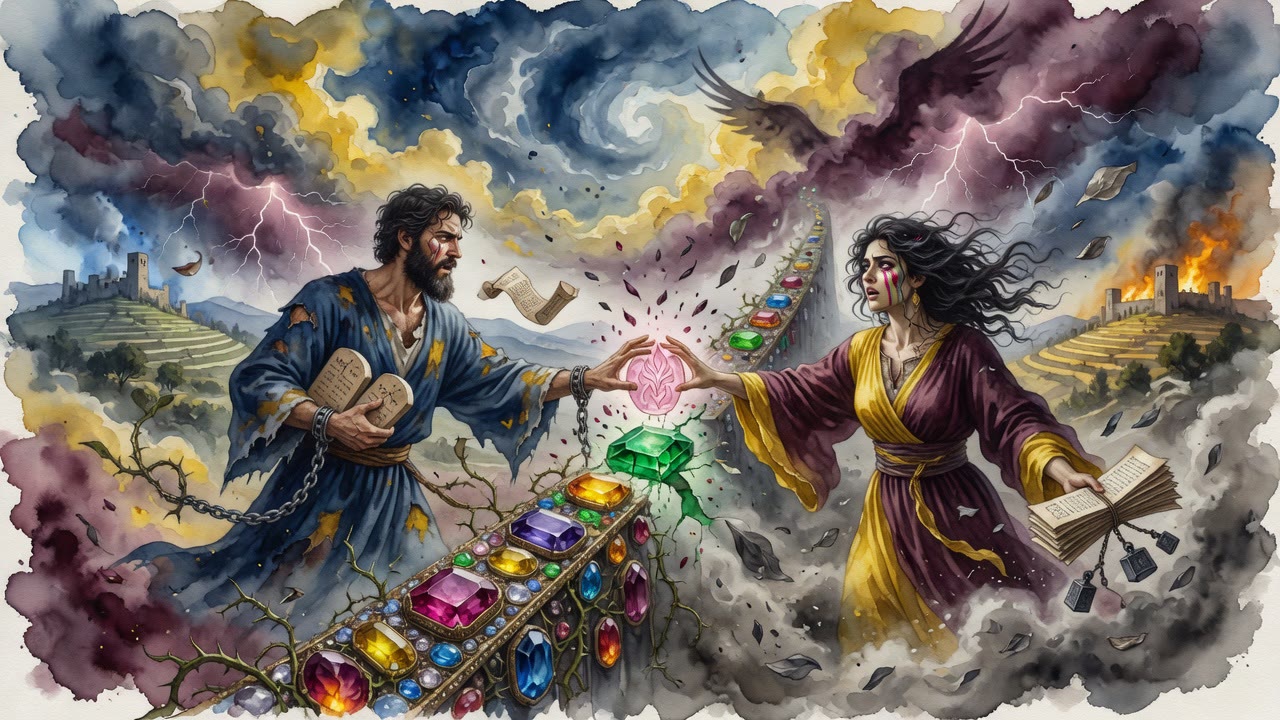
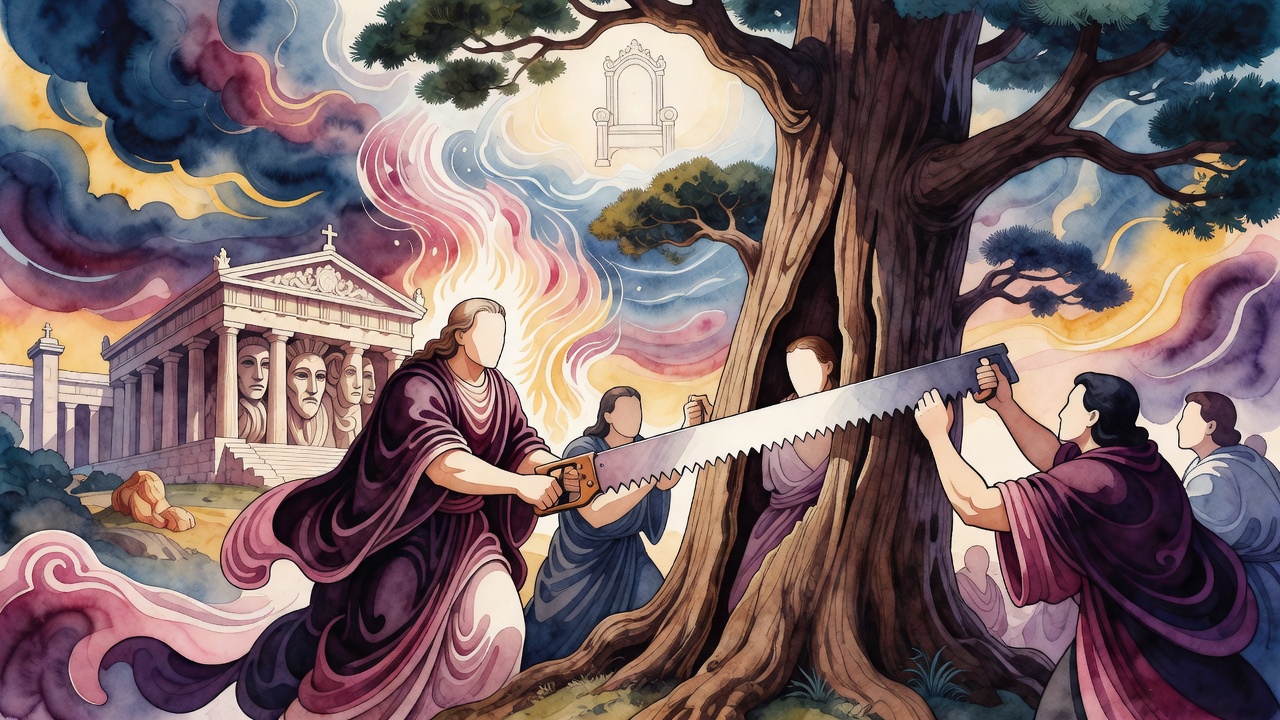
One man owed the other silver, so they walked to Jerusalem to find a judge. At the edge of the city they found gems lying loose on the ground.

Curated by Arthur · Told by Maggid ·
Table of Contents
  1. The Road to Judgment
  2. Gems Where Stones Used to Be
  3. He Makes Your Borders Peace
  4. A Stream From the Sanctuary
  5. The Temple That Cannot Fall
Two Debtors Forgive Each Other at Jeweled Borders Click for full size

The Road to Judgment

Two men left their town before dawn with the same stubborn silence between them. One owed silver. The other had counted every missing coin until the number lived in his jaw. They walked toward Jerusalem to stand before a judge, because in this world a border is a heap of rough rocks, and a debt is a wound that does not close when the verdict is read.

Dust rose around their sandals. Neither offered water first.

Gems Where Stones Used to Be

At the city's edge the ground changed. Where farmers once set hewn boundary markers, gems and pearls lay free for any hand. Rabbi Binyamin ben Levi had pictured it for a generation that still marked fields with rubble. Rabbi Levi had measured the jeweled frontier wide enough to shame every old quarrel. The debtor stopped. He knelt and scooped two bright stones that threw morning into his palms.

"Did I really owe you more than this?" he asked.

The creditor looked from the jewels to the man's face and felt the old arithmetic fall apart. "You owed me nothing at all. Consider it forgiven."

They never reached the court. The border had already made peace.

He Makes Your Borders Peace

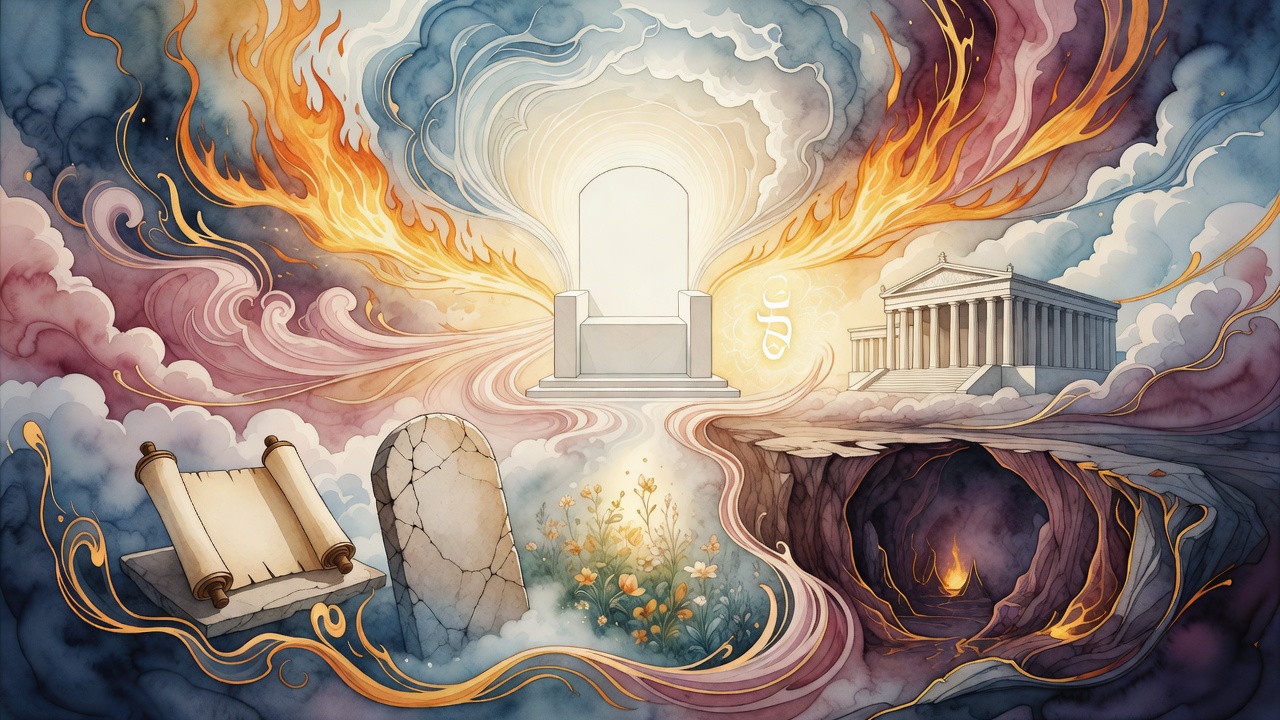
That is how the sages heard Isaiah's line about borders of precious stones, and how they heard the psalm that says God makes the borders peace (Psalms 147:14). Four peaces stack in Scripture for the days ahead: peace for the righteous, peace for lovers of Torah, peace for the humble who inherit land, and peace for the children of the rebuilt city. None of them requires a bitter walk home after a judge's gavel.

The two men turned back carrying nothing but lighter chests. Behind them Jerusalem glittered like a promise that wealth at the edge can end what law alone sometimes cannot.

A Stream From the Sanctuary

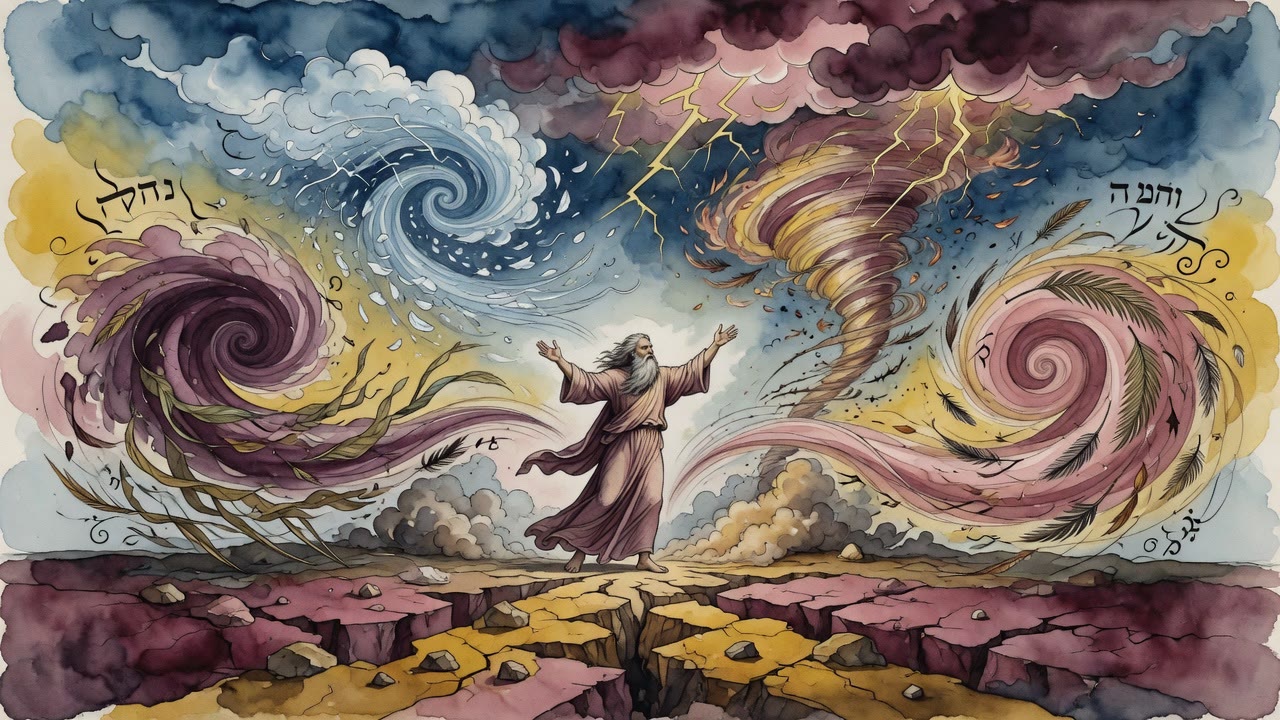
In another teaching the same city pours water. Ezekiel saw a stream leave the sanctuary and thicken as it ran. The teachers read that current as households that rise early and late for Torah in a hostile town. Ten families keep the study house warm. Neighbors who meant to sneer learn respect. A light commandment and a heavy one both heal, the way every dish at a shared table feeds everyone who brought only one.

A king coming home, they said, does not audit gold first. He asks which servant studied and repented, and rejoices with that one. Joy renews for the Holy One on the day Torah renews below.

The Temple That Cannot Fall

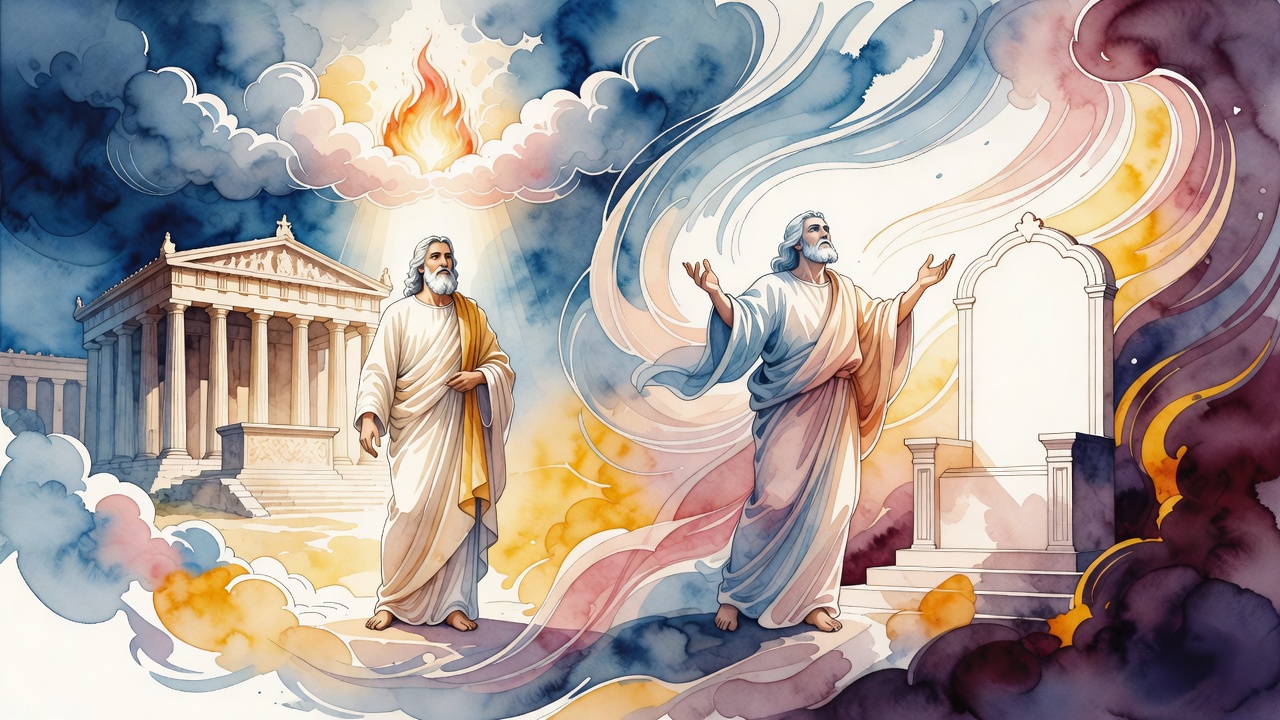
Repentance crowns a person, lifts grief, and pulls a soul back from the edge of Gehinnom (the place of punishment after death). Rebels once tried to tear the throne from David's line and failed because Heaven still held the line taut. Moses' Tabernacle was never conquered. Solomon's Temple fell. The final house God will build will stand with no enemy ruling over it, and the stream and the jewels are only early signs of that peace.

On the road the two former enemies shared bread. Somewhere ahead a border waited that would make even their kind of quarrel look small.

Before the jewels, their argument had seasons. Spring planting had been ruined by a loan not repaid. Summer heat made every reminder sharper. Autumn market day they avoided the same stall. Winter they shared a synagogue bench and let the space between their shoulders do the talking. A judge in their town had already postponed them twice. Jerusalem was supposed to be the place where the law finally chose a winner.

The debtor's wife had packed bread without olive paste, a quiet punishment. The creditor's son had asked why Papa walked like a man going to war over coins. Neither man had a clean answer. Pride had grown a second ledger beside the silver one.

When the gems appeared, the first impulse in both chests was greed. The second was confusion. Wealth that belongs to no one yet lies open is a test. The debtor could have filled his cloak and run. The creditor could have claimed the whole border as interest. Instead the two stones in an open palm rewrote the story. Forgiveness arrived dressed as surplus so large that tracking a debt became embarrassing.

They sat on the jeweled ground like fools and laughed once, short and startled. A caravan far off raised dust toward the gates. Temple smoke, or the dream of it, smudged the sky. The stream the teachers map from the sanctuary was not water they could drink that morning, yet something in the city felt wet with future, as if study houses and repaired hearts were already feeding a current under the streets.

On the walk home they spoke of ordinary things first: a mule's bad hoof, a daughter's wedding date, the price of linen. Then the creditor said, "If the border can pay, I can forget." The debtor answered, "If the border can pay, I can stop hiding." They passed a study house where ten voices braided one verse into ten understandings, and both men slowed, hearing in that braid the parable of dishes on a shared table.

Years later one of them would tell his grandson that peace is sometimes a place you reach before you reach the courtroom. The grandson would not believe it until he owed someone and felt the old jaw-tight arithmetic return. Then he would remember the story of gems at the edge of Jerusalem and try, clumsily, to put two bright stones of his own into an enemy's hand, even if the stones were only words.


← All myths
From the tradition

Sources

2 sources

The texts behind this telling. Some cards carry a translation of the source; others are our own retelling of it, and each card says which. Every card links out to the original.

Pesikta DeRav Kahana 18:6Pesikta de-Rav Kahana

Translation of the source text.Pesikta de Rav Kahana according to an Oxford manuscript, Dov Mandelbaum ed., N.Y. 1987 · CC-BY

"And all your border of precious stones" (Isaiah 54:12). Rabbi Binyamin ben Levi said: The boundaries of Jerusalem are destined to be full of precious stones and pearls, and all Israel will come and take their needs from them. For in this world Israel marks its boundaries with stones and hewn rocks, but in the time to come they will mark them with precious stones and pearls, as it is written, "And all your border of precious stones" (Isaiah 54:12). Rabbi Levi said: The boundaries of Jerusalem are destined to be full, twelve mil by eighteen mil, of precious stones and pearls. For in this world a man owes his fellow, and the fellow says to him, "Let us go and be judged before the judge." Sometimes the judge makes peace between them and sometimes he does not, and the two parties do not leave satisfied. But in the time to come, a man owes his fellow, and the fellow says, "Let us go and be judged before the King Messiah in Jerusalem." When they reach the boundaries of Jerusalem they find them full of precious stones and pearls, and the debtor takes two of them and says to his creditor, "Did I owe you more than these?" And the creditor says, "Not even this much. It is released to you, it is forgiven you." This is what is written, "He makes your borders peace" (Psalms 147:14). "And all your children shall be taught of the LORD, and great shall be the peace of your children" (Isaiah 54:13). There are four great peaces: "In his days shall the righteous flourish, and abundance of peace till the moon is no more" (Psalms 72:7); "Great peace have they that love Your Torah" (Psalms 119:165); "But the humble shall inherit the land and delight themselves in abundance of peace" (Psalms 37:11); and this one, "And all your children shall be taught of the LORD, and great shall be the peace of your children" (Isaiah 54:13). The end.

Full source
Tanna Debei Eliyahu Rabbah 18:3Tanna DeBei Eliyahu Rabbah

Translation of the source text.Tanna debei Eliyahu Rabbah, Warsaw 1880 · Public Domain

Another interpretation: "It shall bring forth its fruit each month" (Ezekiel 47:12) refers to those who honor the Torah, who honor the Torah every single day continually. How so? A city in which there are idolaters and in which there are ten houses of Israel who rise early and stay late in the synagogue and the study house, even though the idolaters encamp round about them, even so the idolaters honor them and fear them, as it is said (Isaiah 25:3-4), "Therefore a strong people shall honor You, the city of terrible nations shall fear You," and so forth. And what is the meaning of "for their waters issue out of the sanctuary"? From the mouth, that the light commandment is like the weighty one and the weighty one is like the light one; and likewise both these and those are a healing for Israel, whether in this world, or in the days of the son of David, or in the World to Come, as it is said, "and its fruit shall be for food, and its leaf for healing." And at the time when Israel occupy themselves with Torah and do charity and justice, the Holy One, blessed be He, rejoices over them and tells them that His rejoicing over them is a thousand thousands for good, doubly more than theirs, as it is said (Song of Songs 6:11), "I went down into the garden of nuts," and so forth. Just as this nut has four chambers, so every single sage of Israel who has true words of Torah in him has four things in him: wisdom, understanding, knowledge, and discernment. They told a parable: to what is the matter like? To a king who comes after several days and years into his house; when he inspects his servants, he does not inspect them over silver and gold and precious stones and pearls, but he says, "Did such-and-such a servant of mine read and study?" If they tell him that he read and studied and surpassed his fellows in that he repented, immediately the king acknowledges him and abandons everything and rejoices with him. Therefore it is said, "I went down into the garden of nuts to look at the green plants of the valley, to see whether the vine had budded and the pomegranates were in flower", these are good deeds and the study of Torah which the sages of Torah await; and from where does all of it come? From before the Holy One, blessed be He, whose hands are stretched out to those who repent, and all is His and all is the work of His hands. And the Holy One, blessed be He, left nothing that He did not reveal to Israel, as it is said (Psalms 25:14), "The secret of the Lord is for those who fear Him, and His covenant, to make them know it," and it says (Amos 3:7), "For the Lord God does nothing without revealing His secret to His servants the prophets." What is the meaning of "and it shall not fear when heat comes" (Jeremiah 17:8)? It is to tell you that everyone who occupies himself with Torah does not see the measure of retribution, whether in this world, or in the days of the son of David, or in the World to Come. And what is a dwelling of moderate measure, neither hot nor cold? Which is this? The festival season of the Feast of Tabernacles, as it is said (Hosea 12:10), "I will yet make you dwell in tents, as in the days of the appointed season." And what is the meaning of "and its leaf shall be green" (Jeremiah 17:8)? That contentment of spirit goes forth from it into the world; for when Israel do the will of the Omnipresent, what is said of them? "A green olive tree, fair with goodly fruit, the Lord called your name" (Jeremiah 11:16). Therefore it is said, "and it shall not fear when heat comes, and its leaf shall be green, and in the year of drought it shall not be anxious, nor cease from yielding fruit." They told a parable: to what is the matter like? To ten men who came to one gathering. One brought large fish, the second brought small fish, the third brought kinds of salted foods, the fourth brought kinds of unsalted foods, the fifth brought boiled cabbage and beets, the sixth brought eggs, the seventh brought cheese, the eighth brought ox meat, the ninth brought ram meat, the tenth brought fowl meat. Each one brought one food to the table, and each one takes from all ten foods and goes home with ten kinds of food. So too, since ten men came to the synagogue and to the study house, and each one of them learns with each of his fellows one thing or one verse or one law, it turns out that each one of them holds ten laws or ten things, and goes home with ten things or ten verses or ten laws. Therefore I would say: let a person always sit and occupy himself with Torah and with the Work of the Chariot and with all the good traits in the world, and let him leave everything and go to the synagogue and to the study house, and to every place where they renew Torah; for in the sitting of the synagogue and the sitting of the study house joy is renewed for the Holy One, blessed be He, every single day continually. And so it is explained in tradition through Isaiah son of Amoz: "The Lord God has given me a learned tongue, to know how to sustain with a word him who is weary; He wakens morning by morning, He wakens my ear to hear as the learned. The Lord God has opened my ear," and so forth, "and I shall know that I shall not be put to shame" (Isaiah 50:4-5). These things the prophet Isaiah spoke concerning the sitting of the synagogue and the sitting of the study house and the renewal of Torah in the study house. What does it say? (Lamentations 3:23-24) "They are new every morning; great is Your faithfulness. The Lord is my portion, says my soul," and so forth. And so, when the transgressors of Israel came to uproot the kingship of the house of David from Israel, and brought it back in repentance, and from the repentance with which they brought it back the Shekhinah came above David, answering and saying to him, "David My son, of you it is said (Psalms 110:4), 'The Lord has sworn and will not repent,'" and so forth. Come and see how great is the power of repentance, which enthrones men in the world and binds for men bonds (another version: crowns) upon their heads, and heals the sick of itself, and rescues him from all sorrow and sighing and pain, and delivers him from the judgment of Gehinnom. And at the time when Israel do the will of their Father in heaven and return in complete repentance before Him, what is said of them? "Return, O backsliding children," and so forth (Jeremiah 3:14). Happy is the man who fears Heaven out of lowliness of spirit, and out of humility, and out of repentance, and out of judgment. Another interpretation: "Arise, sing in the night" (Lamentations 2:19), this "singing" is none other than Torah, as it is said (Psalms 32:7), "You are a hiding place for me; You preserve me from trouble; You surround me with songs of deliverance. Selah." What is written after it? "Be glad in the Lord and rejoice, O righteous ones, and shout for joy, all you upright in heart." And lest you say that until that hour the righteous had no joy, but have we not found that they had joy in the days of David, and in the days of Solomon, and in the time of the men of the Great Assembly? And from where do we know that they had joy in the days of David and in the days of Solomon? As it is said (I Chronicles 29), "And they sacrificed sacrifices to the Lord," and so forth, "a thousand bulls, a thousand rams, a thousand lambs, with their drink offerings, and sacrifices in abundance for all Israel; and they ate and drank before the Lord on that day with great gladness," and so forth. And from where do we know that they had joy in the time of the men of the Great Assembly? As it is said (Nehemiah 12:43), "And they offered great sacrifices on that day, and rejoiced; for God had made them rejoice with great joy; and also the women and the children rejoiced; so that the joy of Jerusalem was heard far off." Happy are the righteous, over whom and over the work of whose hands no enemy rules; for so we found regarding the Tabernacle that Moses made, that no enemy ruled over it and its table was not overturned upon its face; but the sanctuary that Solomon made, an enemy ruled over it and its table was overturned upon its face. But the last Temple, which the Holy One, blessed be He, is destined to build speedily and in a near time, shall not be torn down, nor shall an enemy ever rule over it, and the Holy One, blessed be He, shall dwell in it forever and ever. Go forth and learn the difference between the company of Moses and the company of Solomon. Regarding the company of Moses, what does it say? (Exodus 34:34) "And when Moses went in before the Lord," and so forth. And regarding the company of Solomon, what does it say? (II Chronicles 7:3) "And all the children of Israel saw when the fire came down, and the glory of the Lord upon the house, and they bowed themselves with their faces to the ground upon the pavement, and prostrated themselves, and gave thanks to the Lord, saying, For He is good, for His mercy endures forever." And it says (Psalms 32:11), "Be glad in the Lord and rejoice, O righteous ones, and shout for joy, all you upright in heart." And it says (Psalms 149:5), "Let the pious exult in glory; let them sing aloud," and so forth. And it says (Psalms 118:18), "The Lord has chastened me sorely," and so forth. And likewise concerning the tent of meeting at Horeb, what does it say? (Numbers 19:14) "This is the Torah: when a man dies in a tent." And it says (Isaiah 42:21), "The Lord was pleased, for His righteousness' sake, to make the Torah great and glorious," and so forth.

Full source