5 min read

Seven Things Stood Ready Before the First Light

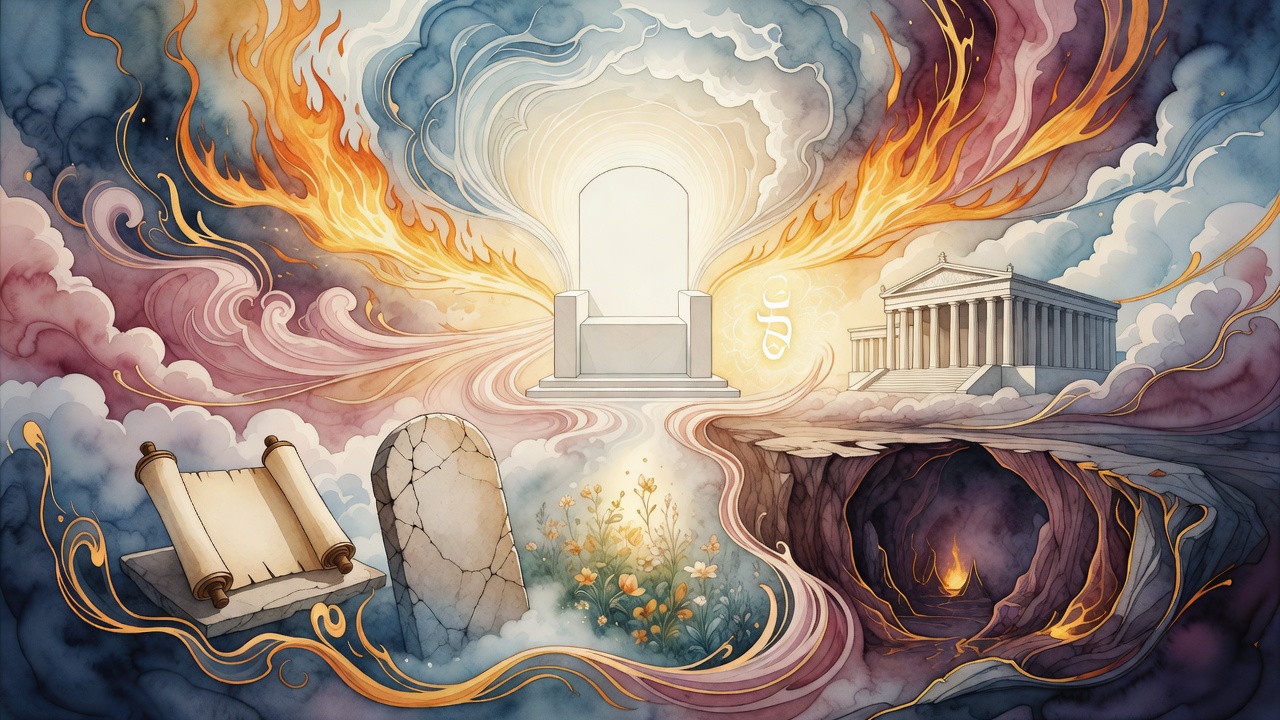
Before the first dawn, Torah, repentance, Eden, Gehinnom (afterlife of judgment), Throne, Temple, and the Messiah's name already waited in God's mind.

Curated by Arthur · Told by Maggid ·
Table of Contents
  1. The Scroll Before Any Floorboards
  2. Two Doors for a Soul Still Unmade
  3. Throne, Temple, and a Name Before the Sun
  4. When the First Blueprint Broke
  5. The Man Who Learned the Streets of Heaven

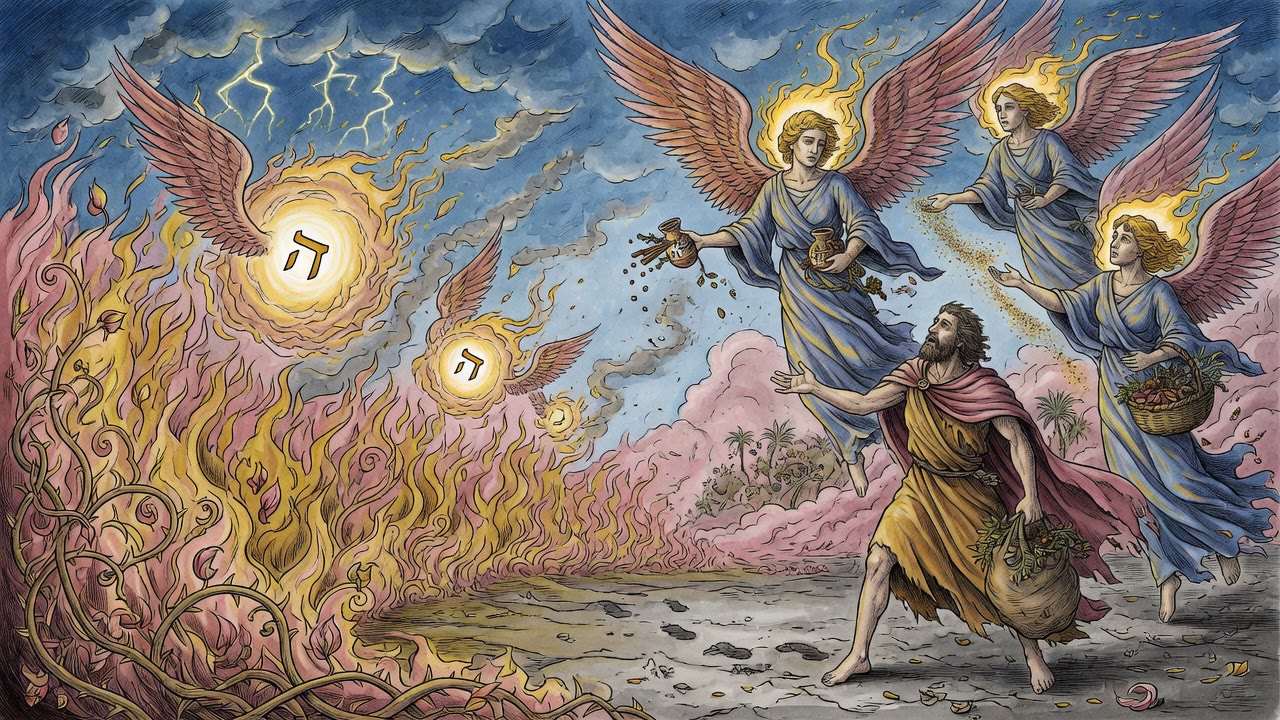
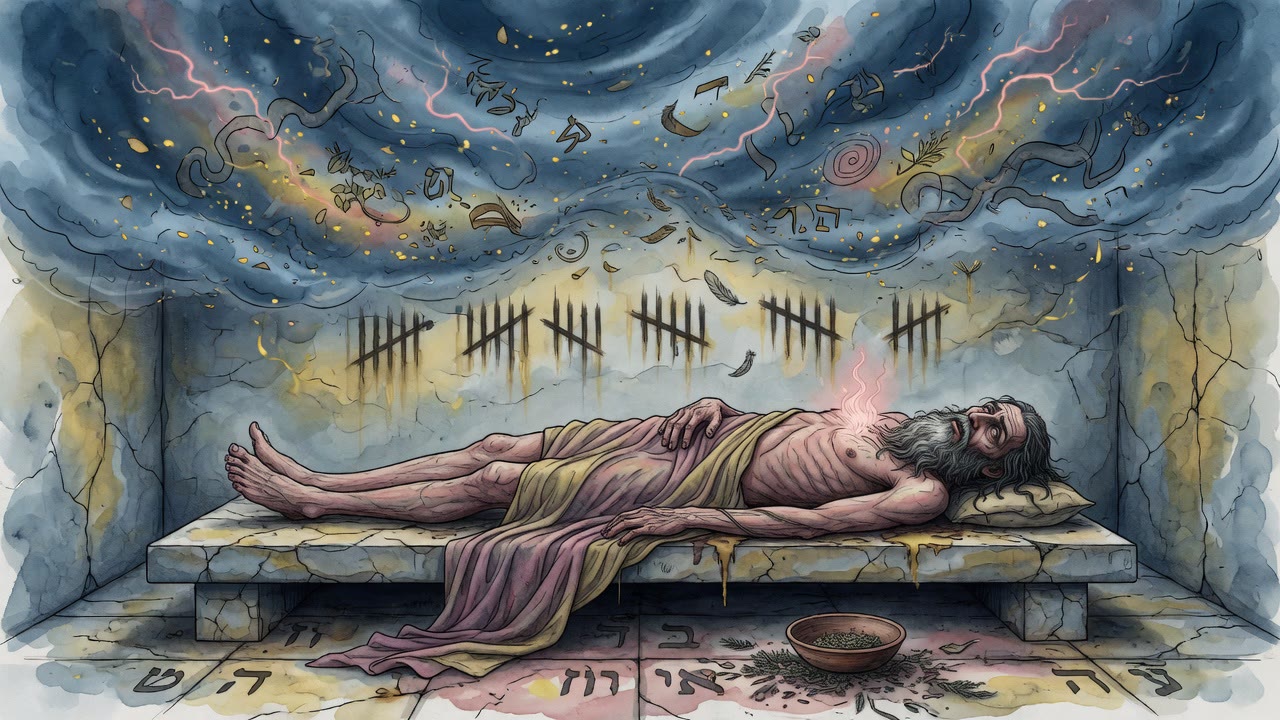
Before there was a sky to split, God held seven things the way a builder holds blueprints against a cold chest. No sun. No wind. No Adam yet to need forgiveness or a crown. Still the plans were already warm.
Seven Things Stood Ready Before the First Light Click for full size

The Scroll Before Any Floorboards

First came the Torah. The Holy One acquired it as the beginning of His way, before any work of creation. Not a book on a shelf. A design so complete that later study would let a man walk the streets of heaven as if he knew Nehardea by heart. Rabbi Shmuel bar Abba said it that way: he knew the upper realm the way he knew his own alleys, and he got there with pages, not wings.

Beside the Torah stood repentance. A road home was poured before the first foot could stray. Mercy was not an apology invented after the flood. It was furniture already in the empty house.

Two Doors for a Soul Still Unmade

Then came the Garden of Eden and Gehinnom, reward and reckoning, twin destinations ready before anyone could earn either. The scales waited for weight that had not been born. That is the strangeness of the teaching. Justice and delight were not reactions. They were rooms with the doors unlocked and the lamps still dark.

Rabbi Hoshaya stood later under a different sky and spoke of spaces between waters. Just as there is a gap between the lower waters and the expanse, there is a gap between the upper waters and the expanse (Genesis 1:7). Rain would one day lean on air and fall. The midrash hears structure in the dark, layers that would water mountains from chambers not yet named (Psalm 104:13). Creation would not be a smash of light. It would be ordered space.

Throne, Temple, and a Name Before the Sun

The Throne of Glory and the Temple shared one source. Rule above and dwelling below were cut from the same intention. God would sit high and still want an address among Israel. Last of the seven was the name of the Messiah, set before the sun itself. Redemption was not a repair after a broken world. The name was older than daylight.

A later mystic pressed the same patience into another language. God could have spoken everything into being with one utterance. He chose step by step. Each power had to show where it came from, what it caused, what details it could bear. Wisdom sparked. Understanding cradled the spark until it became a face, a partzuf, a configuration able to give birth to effects. Without that differentiation, the powers could not create.

When the First Blueprint Broke

There is a harder memory in the same school of thought. One early mode of existence ran toward ruin. Order failed. Evil stood ready to leap. A second mode rose, better repaired, and the shattered first was not thrown away. It was reorganized inside the new order. Sefirot (the ten channels of divine power) lined into columns. Faces of divinity learned balance. Evil did not vanish, but its free run was checked. The deepest aim turned toward turning leftover damage into good.

So the seven things and the staged creation and the repaired mode all say the same quiet thing. Forgiveness, presence, and redemption were not afterthoughts. They were woven into existence before the first day had a name.

The Man Who Learned the Streets of Heaven

When the world finally stood, people still asked how to know the upper architecture. The answer that stuck was not a ladder of fire for every dreamer. It was Torah study hard enough that the heavens felt local. The expanse told God's glory the way a city tells its builder's mind. Between waters, between worlds, between a broken mode and a mended one, the old designs kept their pressure.

Somewhere before light, seven blueprints still lean against an infinite chest. The Messiah's name is among them. So is the road home. The first day only made the floorboards for what was already waiting.

Angels, when they later argued over whether humans should be made at all, would be arguing inside a house that already had a throne and a temple plan and a name of repair. The argument was never held in a vacuum. It was held in a workshop where the tools of mercy already hung on the wall. A person who sins and turns back is not inventing a loophole. He is walking a road poured before his first breath. A people that builds a sanctuary is not flattering God with architecture. It is answering a design older than brick.

Stand in a dry place and try to feel the weight of that claim. Before rain, the chambers above the expanse were already imagined. Before a single bird, Gehinnom (the realm of judgment after death) and Eden already waited for a soul. The first light did not invent meaning. It only revealed a structure that had been patient in the dark. Step-by-step creation, broken modes repaired into better order, seven things held ready: all of it says the world was never a shrug. It was a project with rooms labeled in advance.


← All myths
From the tradition

Sources

4 sources

The texts behind this telling. Some cards carry a translation of the source; others are our own retelling of it, and each card says which. Every card links out to the original.

Yalkut Shimoni on Torah 20:16Yalkut Shimoni on Torah

Translation of the source text.Torat Emet (Yalkut Shimoni) · CC-BY-NC

Seven things were created before the world was created: the Torah, repentance, the Garden of Eden, Gehinnom, the Throne of Glory and the Temple, and the name of the Messiah.

The Torah, from where? As it says, "The LORD acquired me as the beginning of His way" (Proverbs 8:22). Repentance, from where? As it says, "Before the mountains were brought forth... and You said, Return, O children of man" (Psalms 90:2-3). The Garden of Eden, from where? As it says, "And the LORD God planted a garden in Eden in the east" (Genesis 2:8). Gehinnom, from where? As it says, "For Tophet is ordained from of old" (Isaiah 30:33). The Throne of Glory and the Temple, from where? As it says, "A throne of glory on high from the beginning is the place of our Sanctuary" (Jeremiah 17:12). The name of the Messiah, from where? As it says, "Before the sun, his name shall be continued" (Psalms 72:17).

Full source
Midrash Tehillim 19:3Midrash Tehillim

Retold in our words. Read the original at the link below.Rabbi Mike Feuer, Jerusalem Anthology · CC-BY

The Midrash Tehillim, a collection of rabbinic interpretations on the Book of Psalms, dives deep into this very question, exploring the mysteries of the heavens. It offers us not just a poetic sentiment, but a glimpse into the ancient Jewish understanding of the cosmos.

One fascinating interpretation hinges on this idea: the heavens themselves are constantly telling God's story. They're a living evidence of His creative power.

How can we, down here on Earth, begin to understand these celestial declarations? Rabbi Shmuel bar Abba makes a bold claim. He says, "I am familiar with the heavenly realm just as I am familiar with the streets of Nehardea.” Nehardea was a well-known city in Babylonia, a place Rabbi Shmuel knew intimately.

Did Rabbi Shmuel actually take a trip up to the heavens? Well, no. The Midrash (rabbinic interpretive commentary) clarifies that it was through his intense study of Torah – that is, the teachings and wisdom within Jewish scripture – that he gained such profound knowledge of what exists beyond our world. Torah study, in this view, becomes a telescope, allowing us to peer into the divine architecture. The idea that immersing oneself in sacred text can grant insight into the very structure of the universe?

But what exactly is this heavenly realm that the Psalms are talking about?

Rabbi Hoshaya offers another layer of understanding. He tells us, "Just as there is a space between the lower waters and the sky, there is also a space between the upper waters and the sky.”

Wait, "upper waters?" What's he talking about?

The Midrash directs us to (Genesis 1:7), "And God made the expanse and separated the waters that were below the expanse from the waters that were above the expanse." Rabbi Pinchas HaKohen (a priest) bar Chama elaborates, explaining that these "waters above the expanse" are dependent on the air and are responsible for producing rain, quoting (Psalm 104:13): "He waters the mountains from his chambers; the earth is satisfied by the fruit of your work."

Again, we have Rabbi Hoshaya's profound understanding. Did he also literally ascend to the heavens? The Midrash makes the same point: No, it was through his dedicated study of Torah that he gained insight into the workings of the sky and the source of rain.

So, what do we take away from all this? It's more than just ancient cosmology. It's about the power of learning, the potential within sacred texts to unlock deeper truths about the world around us, and the constant dialogue between the heavens and the earth. Perhaps the heavens aren't just declaring God's glory. Perhaps they're inviting us to join the conversation, to seek understanding, and to be awed by the wonders of creation.

Full source
Kalach Pitchei Chokhmah 63:15Kalach Pitchei Chokhmah

Retold in our words. Read the original at the link below.138 Openings of Wisdom, trans. Rabbi Avraham Greenbaum, Azamra Institute (2005) · CC-BY

God, blessed be He, could have brought everything into being with a single utterance, yet He instead opted for a step-by-step approach.

Why?

To reveal how each power develops. To show us where it emerges from, its overall cause, and what produces its myriad details.

This is where it gets really interesting. God ordered His powers – those energies involved in creating worlds – to function in a way we understand as male and female. Now, before you conjure up images, this isn't about physical genders. In Kabbalah, the concepts of male and female represent active and receptive forces, giving and receiving.

This dynamic plays out within the soul itself, specifically through Chochmah (wisdom) and Binah (understanding), which Kabbalists often associate with the archetypal male and female energies. Chochmah is the initial spark of insight, the seed of an idea. Binah is the nurturing womb that develops and elaborates upon that seed, giving it form and substance.

Kalach Pitchei Chokhmah introduces the concept of a Partzuf (literally "face" or "configuration"). This represents the specific arrangement a causal agent needs to assume in order to effectively bring forth its effect. It's like preparing the soil perfectly before planting a seed. The Partzuf is how the divine "faces" creation, so to speak.

The text suggests that the various powers of the soul differentiate into their particular components through this process. And that's when they gain the power to produce new effects. Without this differentiation, this dance of energies, they wouldn't have the capacity to create. It is a process of constant refinement, a divine engine of becoming.

So, next time you're struggling with a problem, remember the divine blueprint. Maybe the key isn't a single, earth-shattering solution, but a series of carefully considered steps. Perhaps it's about finding the right Partzuf, the right configuration, to unlock the power within. After all, if it's good enough for creating worlds, it might just be good enough for our everyday challenges, too.

Full source
Kalach Pitchei Chokhmah 47:14Kalach Pitchei Chokhmah

Retold in our words. Read the original at the link below.138 Openings of Wisdom, trans. Rabbi Avraham Greenbaum, Azamra Institute (2005) · CC-BY

Kabbalah, Jewish mystical tradition, grapples with these questions in profound ways. And one text, Kalach Pitchei Chokhmah ("47 Doors of Wisdom"), offers a fascinating glimpse into the cosmic drama of creation, destruction, and repair. It's a dense text, for sure, but the core idea is surprisingly relatable: things don't always go as planned, but even mistakes can be opportunities for growth.

The Kalach Pitchei Chokhmah speaks of different "modes of existence." Think of them as different blueprints for reality. The first, called BaN, didn't quite work out. In fact, it led to "entire destruction." Whoa. What went wrong? The text doesn't spell it out in everyday language, but hints that the problem stemmed from a lack of order. Things were out of balance. The potential for evil wasn't held in check; it was ready to pounce.

The story doesn't end there! A second mode of existence, MaH, emerged. This wasn't just a simple do-over. It was an improvement, a "better repaired mode of existence." And here's the really interesting part: BaN, the first mode, didn't just disappear. It was integrated into MaH.

How did that work? Well, according to Kalach Pitchei Chokhmah, the first mode itself was "organized in a new order." Imagine taking a chaotic mess and carefully sorting each piece, putting everything in its proper place. That's what happened on a cosmic scale. The "hard part", the lack of order, was addressed through the ordering of the Sefirot (divine emanations) in balanced columns and the construction of the Partzufim (a divine configuration) (divine "faces" or configurations). These are complex Kabbalistic concepts, but essentially, they represent a system of divine organization that brought harmony and balance.

So, what was the result? "Evil no longer stood ready to attack with such great power." It wasn't eliminated entirely, but its power was diminished. More importantly, the "deepest intention" shifted towards transforming even the remaining negative aspects into good. We all make mistakes. We create messes, both big and small. But what if those mistakes aren't just failures? What if they're opportunities to learn, to grow, to create something even better than we originally imagined? The Kalach Pitchei Chokhmah suggests that this isn't just a nice idea; it's a fundamental principle of the universe. Even destruction can be a stepping stone to a more ordered, more balanced, and ultimately, more good world.

And a reminder that even in the face of chaos, the potential for repair and transformation always exists.

Full source