When Children Asked for Bread and Got Silence
Eikhah Rabbah faces the siege famine through children who remembered abundance, a stream that ran dry, and women who gave away their last loaf to a mourner.
Table of Contents
 Click for full size
Five Loaves and Aged Wine
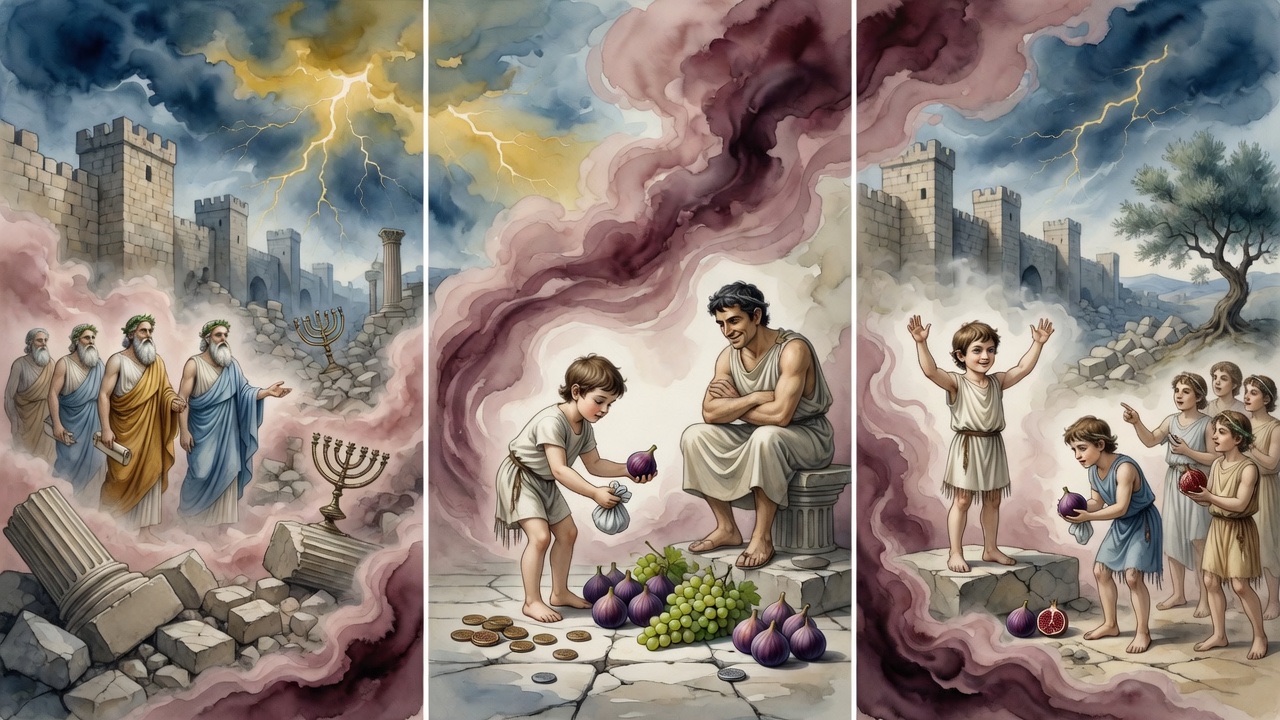
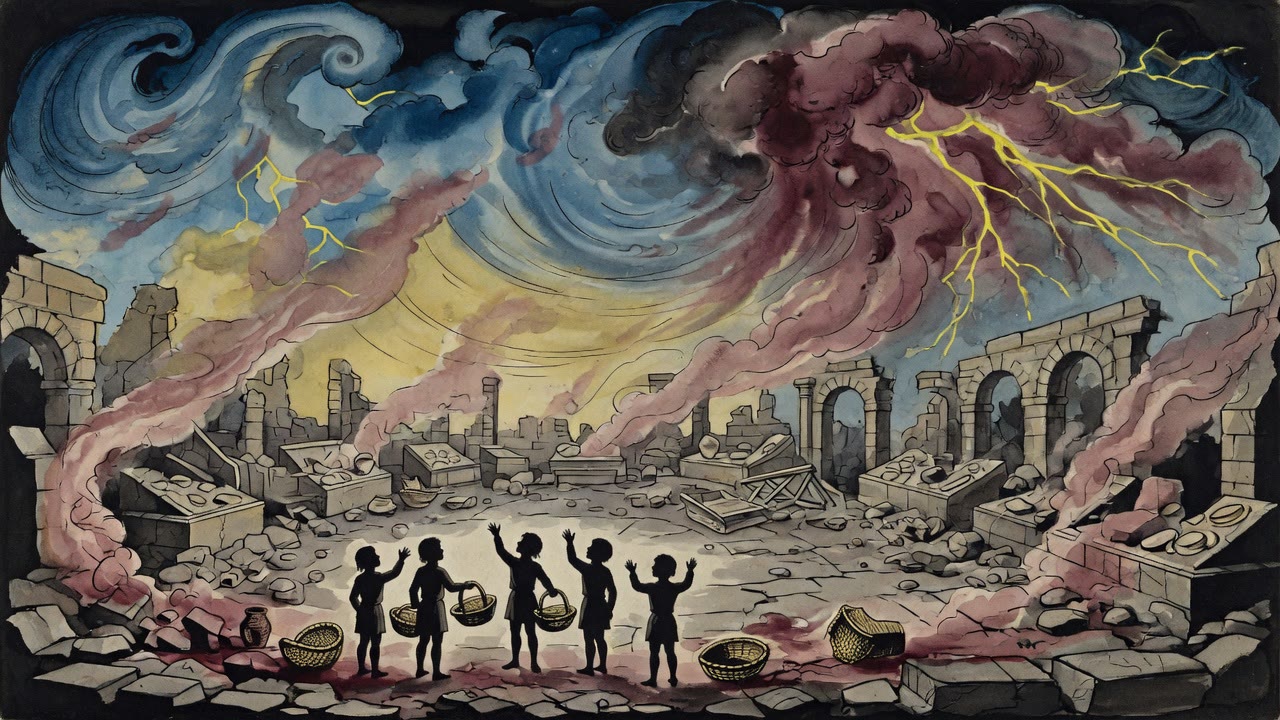
The children asked their mothers where the grain and wine were. Rabbi Hanina said they meant five loaves and spiced wine. Rabbi Simon said fine loaves and aged wine. Both answers pointed to the same thing: these were children who remembered delicacy. They were not asking for survival rations. They were asking for what had always been there before the siege, the specific tastes and textures of an ordinary table in a city that had not yet learned what hunger meant in its full weight.
A woman gave her husband her jewelry. Go to the market, she said, find something for us to eat. He went. He searched. He found nothing. He writhed in the street and died. Their son went to look for the father and died beside him. The verse from Lamentations became literal: corpses in the city squares, souls poured into the bosoms of the mothers who had sent the men out with the jewelry that could not buy what no longer existed to buy.
The Stream Near the Shops
Rabbi Abba bar Kahana pointed to a stream of water that had flowed from the shops near the Temple Mount. The tormentors destroyed it and emptied it. A man leading his son to the water found nothing. The child's tongue stuck to his palate. The image was specific: a particular stream at a particular location that had been part of the daily life of the city, destroyed not as a side effect of battle but deliberately, because the people who controlled the city now controlled what the people inside it could drink.
Infants requested bread and no one broke it for them. Rabbi Yehuda said: if there is no one to give, who will comfort them? Rabbi Nechemya said: there is no one who will give them a satisfying portion. The rabbis disagreed about what the verse meant and both readings were true: no food existed, and if food had existed, no one was left with the capacity to give it properly, to sit with a child and break the loaf with the attention that feeding a child requires.
The Women Who Still Practiced Mercy
The merciful women cooked their children. That verse from Lamentations stood at the bottom of everything the midrash had been describing, the terminal point of famine when the most primal human bond became the final resource. The midrash did not read it as condemnation. Rabbi Huna said in the name of Rabbi Yosei that God said: they did not allow me to extend my hand against my world.
How? In the context of famine so severe that the verse could name what it named, the midrash remembered something else. A woman had one loaf, enough for herself and her husband for one day. When her neighbor's child died, she took that loaf and brought it to the mourner's house for the first meal of consolation. The tradition held that the first meal a mourner eats after burial should come from others. Even in a famine, this woman maintained that tradition.
She could not stop the siege. She could not bring back the water from the destroyed stream. She could not answer the children who asked for aged wine. But she could give away her last food to a neighbor sitting shiva. That act, performed in the worst possible conditions, was what the midrash meant by the women who were still merciful. They had not stopped practicing the disciplines of ordinary life even when ordinary life had become impossible.
Water Sold and Wood Priced
Our water we drank for money; our wood comes at a price. The tormentors entered and took bread, wine, oil, and water. Having stripped the household, they turned around and sold the same goods back to the people they had taken them from. Water that had been in the family's vessels became a commodity available for purchase from the army that had stolen it.
The cruelty in the verse was not only hunger. It was the structure imposed on the hunger. The mechanism of price turned survival into a transaction that favored whoever held the supplies, which was the occupying force. The people of Jerusalem were not simply starving. They were being charged for the food and water that had been theirs before the siege began.
← All myths