5 min read

Jacob Sat Down in Canaan and Misfortune Came Through the Door

Jacob counted the chiefs of Edom and could not see how his household would survive them. Heaven's answer was a blacksmith standing beside a load of flax.

Curated by Arthur · Told by Maggid ·
Table of Contents
  1. The Chiefs of Edom Went Past in a Column
  2. One Spark Out of His Own Forge
  3. What Happens Right After Anyone Sits Down
  4. Everything That Happened to the Father Happened to the Son
  5. The Last Time They Sat Down
Jacob Sat Down in Canaan and Misfortune Came Through the Door Click for full size

The Chiefs of Edom Went Past in a Column

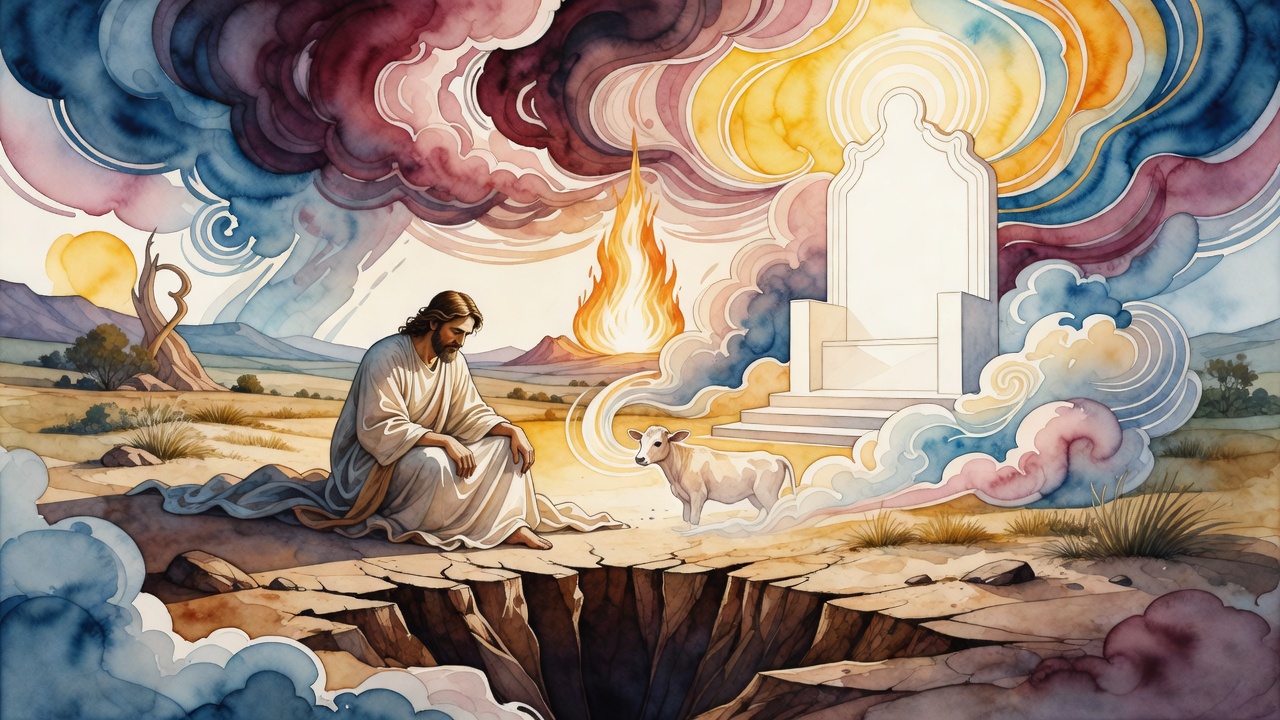
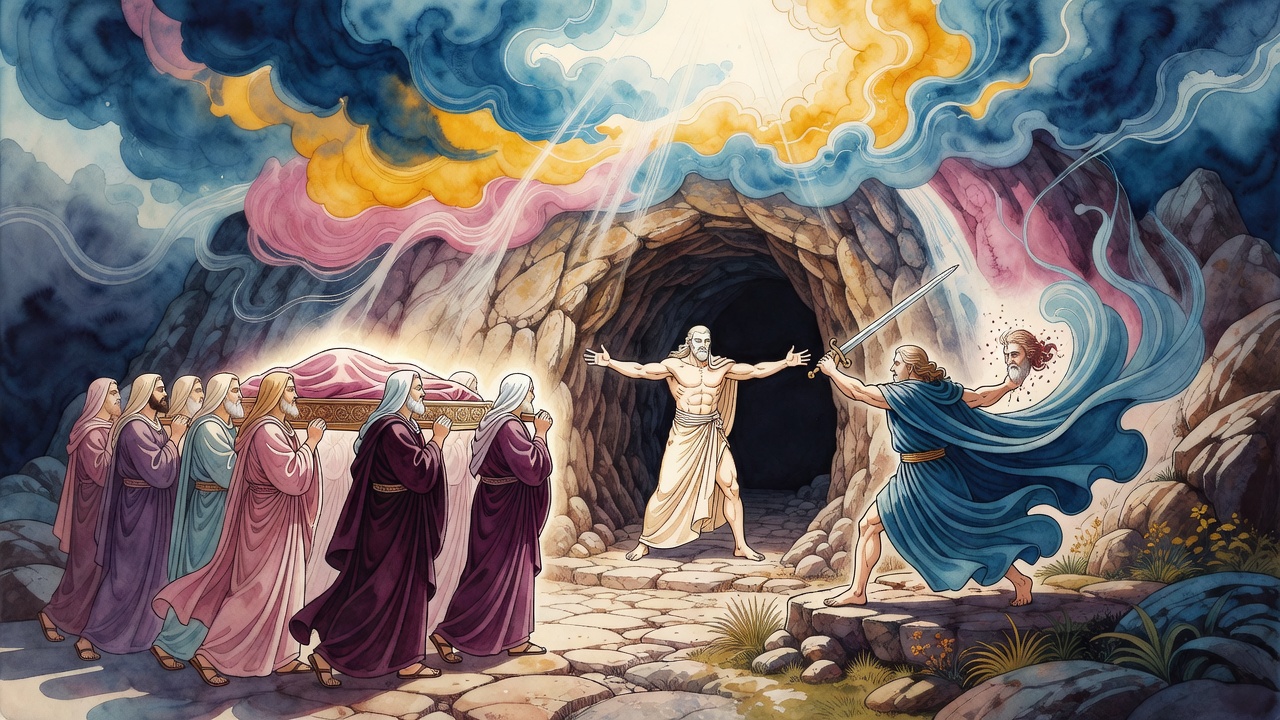
Jacob stood over the roll of his brother's descendants and counted. Chief Lotan. Chief Timna. Chief Magdiel. Chief after chief after chief, a whole administration of them, every one descended from Esau, every one with land and men and a title that meant he gave orders.

Jacob had wrestled a stranger at a ford and walked away limping, but he had still come out ahead. He had gotten past Laban. He had gotten past Esau himself, out on the road with four hundred men, by bowing seven times and sending droves of goats ahead of him.

He looked at the list and could not do it again.

"Who is going to stand up against all of these," he said.

One Spark Out of His Own Forge

The answer he got was a story about a blacksmith.

Camels came into a town loaded with flax. More camels behind them, and more after that, until the bales were stacked past the roofs and a smith standing in his doorway looked at the whole shining mountain of it and said, "Where is anyone going to put all that?"

A man beside him laughed. "You are worried about storage. One spark out of that forge behind you and there is nothing left to store."

That was the answer. All those chiefs and all that flax, and out of Jacob's own house would come the spark. The house of Jacob would be fire and the house of Joseph would be the flame, and the house of Esau would be stubble in front of it.

So Jacob stopped watching the road from Edom. He settled in Canaan where his father had lived as a stranger, and he sat down.

What Happens Right After Anyone Sits Down

Sitting is the most dangerous verb in the book, because every time a man sits down in Scripture, misfortune is already standing in his doorway.

Israel sat down in Egypt, in the good pasture of Goshen, and the next thing recorded is that the days drew near for Jacob to die. The people at the mountain sat down to eat and drink, and got up to dance in front of a calf, and three thousand of them were dead by evening. Israel settled at Shittim and began going after the daughters of Moab. Judah and Israel sat in safety, every man under his own vine, and God raised up an adversary against Solomon. The adversary was Hadad, of the royal seed of Edom. The chiefs Jacob had been afraid of took two hundred years and came anyway.

And Jacob sat in the land of Canaan, and the very next line in the account is Joseph bringing his father a bad report about his brothers.

The worst of them is the one nobody notices. The brothers threw Joseph into a dry pit and then sat down to eat bread. They were passing the loaf around when they lifted their eyes and saw the caravan coming up from Gilead, camels carrying spice and balm and myrrh down to Egypt, and Judah said what he said, and the boy went into the traders' hands with his brothers' crumbs still on the ground.

Everything That Happened to the Father Happened to the Son

Jacob's brother envied him. Joseph's brothers envied him.

Jacob ran for his life to Haran and worked fourteen years for a wife. Joseph went down to Egypt in a rope and worked his way up from a cell.

Jacob told Laban he had covered every loss himself, whether the animal was stolen by day or stolen by night. Years later, in a prison, Joseph told a royal cupbearer the same word about himself. I was stolen. Stolen out of the land of the Hebrews.

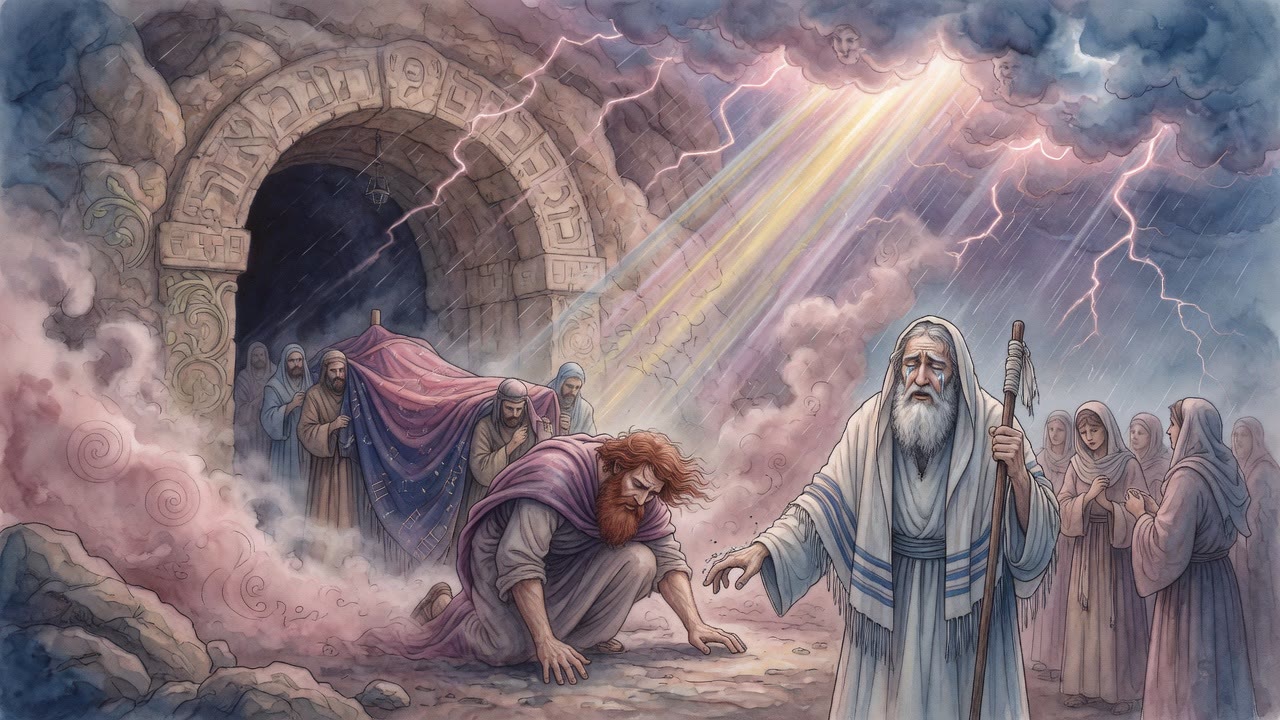
So the spark that was supposed to burn Edom spent thirteen years underground, and the father who had been promised that spark tore his clothes and refused to be comforted and said he would go down to his son in mourning.

The Last Time They Sat Down

Years later Benjamin walked to Egypt with his brothers, the youngest and the one their father had sworn would never leave the house. They put him in the middle and kept him there the whole road, because their father had sworn the boy would never leave the house, the wolf of the family walking under guard by the sheep, and Joseph lifted his eyes in his own hall and saw his mother's other son standing in the crowd of them.

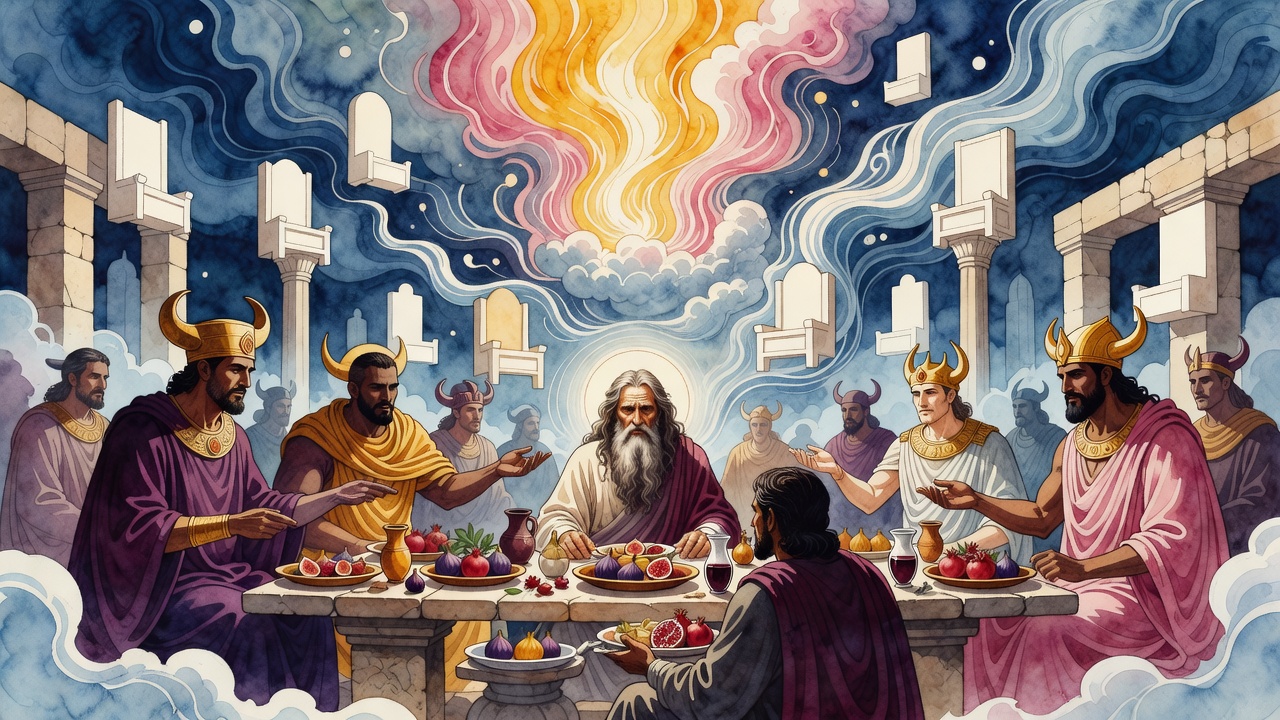
Then the steward seated the eleven of them at the table.

He put them in order. Firstborn first, then the next, then the next, straight down to the youngest, and the brothers stared at each other because nobody in Egypt could have known the order they were born in. The portions came around from Joseph's own table. The lion of the family ate quietly beside the ox.

They sat down, all of them, and for once nothing fell.


← All myths
From the tradition

Sources

2 sources

The texts behind this telling. Some cards carry a translation of the source; others are our own retelling of it, and each card says which. Every card links out to the original.

Midrash Tanchuma, Vayeshev 1Midrash Tanchuma

Retold in our words. Read the original at the link below.Townsend 1989 translation of Midrash Tanhuma, S. Buber Recension · CC-BY

And Jacob sat in the land (Gen. 37:1). Whenever Scripture uses the expression and he sat (also translated “and he dwelt”), it connotes misfortune: And Israel sat in the land of Egypt, in the land of Goshen, … and the time drew near that Israel must die (Gen. 47:29); And the people sat down to eat and drink, and rose up to make merry (Exod. 32:6); And there fell of the people on that day three thousand men (Exod. 32:28); And they sat down to eat bread; and they lifted up their eyes and looked, and, behold, a caravan of Ishmaelites (Gen. 37:25); And Judah and Israel sat safely (I Kings 5:5); And the Lord raised up an adversary against Solomon (ibid. 11:14); And Israel sat among the cedars, etc., and the people began to commit harlotry (Num. 25:1). You may explain every other use of “and he sat” with this negative implication. In this instance And Jacob sat is followed by and Joseph brought evil report of them unto his father (Gen. 37:2).

What is written prior to this episode? These are the chiefs of the sons of Esau: … the chief of Lotan, the chief of Magdiel … These are the chiefs of Edom (ibid. 36:15–43). When Jacob saw the chiefs of the sons of Esau, he was terrified. “Who will be able to withstand these chiefs?” he exclaimed. To what may this be compared? It may be compared to many camels laden with flax (in a certain place), and a blacksmith standing nearby asked in amazement: “Where will it be possible to store all this flax?” An observer responded: “Why do you wonder about that? After all, a single spark from your forge can consume it all.” Similarly, when our patriarch Jacob became terrified at the sight of Esau and the chiefs, and cried out: “Who will be able to assist me against them?” The Holy One, blessed be He, answered: A spark from you will consume them. And Joseph was that spark, as it is said: And the house of Jacob shall be a fire, and the house of Joseph a flame, and the house of Esau for stubble, and they shall kindle in them, and devour them (Obad. 1:18). Therefore it is written: And Jacob sat … these are the generations of Jacob. Joseph, etc.

Another explanation. Why did Scripture concern itself with the genealogy of the chiefs? Did the Holy One, blessed be He, have nothing else to write about other than the chief of Timna, the chief of Lotan, etc.? He did so to teach us that from the very beginning of the creation of the world, the Holy One, blessed be He, concerned himself with the genealogies of the idolatrous nations so that it would not be left to them to describe for mankind their sterility and their degeneracy. How did He do that? When He came to the genealogy of the sons of Ham, He said: The sons of Ham: Cush, and Mizraim … and Cush begot Nimrod (Gen. 10:6–8); thus He indicated that they had become defiant, as it is said: He began to be a mighty one in the earth (ibid., v. 8). Similarly, when He said: And Mizraim begot Ludim … whence went forth (ibid., vv. 13–14), He did not say “he bore him” but he went forth, thereby informing us that he was the product of an incestuous relationship.

He concerned Himself also with the genealogy of Esau’s sons in the chapter These are the generations of Esau to disclose their degeneracy. You find that they too were the offspring of incestuous relations. Scripture states in one place: And the children of Elephaz were: Teman, and Omar, Zepho, and Gatam, and Kenaz. And Timna (ibid. 36:11), and elsewhere it states: And Timna was concubine to Elephaz (ibid., v. 12). This clearly informs us that Elephaz had sexual relations with his own daughter. How did that occur? He had sexual relations with Seir’s wife first and made her pregnant and begot Timna. Later he married Timna, as though she were Seir’s daughter, when in fact she was his own. That is why it says: And the children of Seir: Lotan … and Timna was Lotan’s sister (I Chron. 1:38–39). She was Lotan’s sister by her mother, but not by his father; Elephaz was her father, and Timna became the concubine of Elephaz the son of Esau.

You find likewise (that the expression sat also alludes to) the degeneracy of the descendants of Seir, since it is written: These are the sons of Seir the Horite, who sat on the land: Lotan and Shobal and Zibeon and Anah (Gen. 36:20). However, Anah is elsewhere called the son of Zibeon: And these are the children of Zibeon: Aiah and Anah (ibid., v. 24). We learn from this that Zibeon had sexual relations with his own mother, and conceived and begot Anah by her. Consequently, (Anah) was both (Zibeon’s) brother and his son. Later he had intercourse with his daughter-in-law, the wife of Anah, and Oholibamah was their child, as it is said: And these were the sons of Oholibamah the daughter of Anah, the daughter of Zibeon, Esau’s wife (ibid., v. 14), and Esau took her as a wife. Inasmuch as they were all products of incestuous relations, Scripture mentions them only to disclose their degeneracy.

The Holy One, blessed be He, however, befriended Israel and called them his possessions, inheritance, (and) portion, as it is said: For the portion of the Lord is His people Jacob, the lot of His inheritance (Deut. 32:9); and ye shall be Mine own treasure among all the peoples (Exod. 19:5); and I have planted thee a noble vine, wholly a right seed (Jer. 2:21). Why did the Holy One, blessed be He, concern Himself from the very beginning of time with the genealogies of the nations? This may be likened to a king who dropped a pearl into sand and pebbles. The king was compelled to search the sand and the pebbles to recover the pearl. As soon as he recovered the pearl, however, he discarded the sand and the pebbles, for he was only interested in retrieving the pearl.

Similarly, the Holy One, blessed be He, devoted Himself superficially to the earlier generations, and then ignored them. He mentioned Adam, Seth, Enoch, Kenan, Mahalalel, Jared, etc. (I Chron. 1:1–2), and also the second ten generations, Shem, Arpachshad, Shelah, etc. (ibid. 1:24), so that a child could take the Bible and read about the ten generations from Adam to Noah at a single sitting, and also about the ten generations from Noah to Abraham at one time. But when he reached the section dealing with the pearls, Abraham, Isaac, and Jacob, he would have to apply himself diligently in reading about them. That is why the section on Elephaz the son of Esau is included in this chapter.

Another comment on These are the generations of Jacob. Joseph, etc. (Gen. 37:2). Was not Reuben actually the firstborn? He was, but since he defiled his father’s couch (I Chron. 5:1), his birthright was given to the descendants of Joseph, the descendants of Israel. However, they are not actually accounted as the firstborn in the genealogy of the people. Another explanation. These are the generations of Jacob. Joseph. You find that Joseph resembled his father in every way, and that everything that happened to Jacob also happened to Joseph. Jacob’s brother was envious of him, and Joseph’s brothers were envious of him; Jacob was exiled to Haran, and Joseph was exiled to Egypt; Jacob said: Whether stolen by day or stolen by night (Gen. 31:39), and Joseph said: For, I was stolen away (ibid. 40:15).

Full source
Midrash Tanchuma, Vayigash 8Midrash Tanchuma

Retold in our words. Read the original at the link below.Townsend 1989 translation of Midrash Tanhuma, S. Buber Recension · CC-BY

And he sent Judah before him (Gen. 46:28). Scripture says elsewhere in reference to this verse: The wolf and the lamb shall feed together (Isa. 65:25). Observe that whomever the Holy One, blessed be He, afflicts in this world, He heals in the world-to-come. The blind, for it is written: The eyes of the blind shall be opened, and the ears of deaf shall be unstopped (Isa. 35:5); the lame: Then shall the lame man leap as a hart, and the tongue of the dumb shall speak (ibid. v. 6). In the same way all others shall be healed.

Just as a man departs this world he will return. If he departs lame, he will return lame; if he departs deaf, he will return deaf; if he departs blind, he will be resurrected blind. Thus everyone returns as he departed.

Those who depart clothed will return clothed, as it is said: It is changed as clay under the seal; and they stand as a garment (Job 38:14). Come and learn from Samuel. When Saul caused him to be brought up (by the witch of Endor), he said to the woman: “What does he look like?” And she answered: An old man cometh up; and he is covered with a robe (I Sam. 28:14). And Scripture states elsewhere: His mother made him a little robe (ibid. 2:19). This teaches us that just as one departs (this life), so he will return. The reason for this is that the wicked should not say: “Some He puts to death, and others He restores to life.” The Holy One, blessed be He, said: Let them arise just as they departed, and then I will heal them. Why so? To confirm the verse Before Me there was no God formed, neither shall any be after Me (Isa. 43:10)

After that the animals will also be healed, as it is said: The wolf and the lamb shall feed together … and dust shall be the serpent’s food (ibid. 65:25). But the serpent shall not be healed. And why not? Because it was responsible for mankind being brought down to the dust.

Another comment on The wolf and the lamb shall feed together. The wolf refers to Benjamin, as it is said: Benjamin is the wolf that raveneth (Gen. 49:37), and the lamb alludes to the tribes, as is said: Israel is a scattered sheep (Jer. 50:17).

Shall feed together. When did that occur? When Benjamin descended with his brothers. Though Jacob had said: My son shall not go down with you (Gen. 42:38), yet when the time for departure came, he did descend with them. They placed him between themselves and guarded him. And thus it says: Joseph lifted up his eyes, and saw Benjamin his brother, his mother’s son (Gen. 43:29).

And the lion shall eat straw like the ox (Isa. 65:25). “The lion” refers to Judah, as it is said: Judah is a lion’s whelp (Gen. 49:9), and like the ox alludes to Joseph, as is said: His firstling bullock, majesty is his (Deut. 33:17). Finally however, all of them ate together, as it is said: And they sat before him, the firstborn according to his birthright (Gen. 43:33). And it is also written: And portions were taken unto them (ibid. v. 3). Hence Scripture states: And the lion shall eat straw like the ox.

Full source