5 min read

Worldly Strength Failed Against the Other Side

Gold, armies, and cleverness ran out at the edge of the Other Side. Only the four letters of the Name, held in exile faith, dissolved the counterfeit power.

Curated by Arthur · Told by Maggid ·
Table of Contents
  1. The Rich Man Hits a Wall That Is Not Stone
  2. Four Letters Against a False Throne
  3. Exile Among the Nations, Sparks Underfoot
  4. When the Illusion Loses Its Face
Worldly Strength Failed Against the Other Side Click for full size

The Rich Man Hits a Wall That Is Not Stone

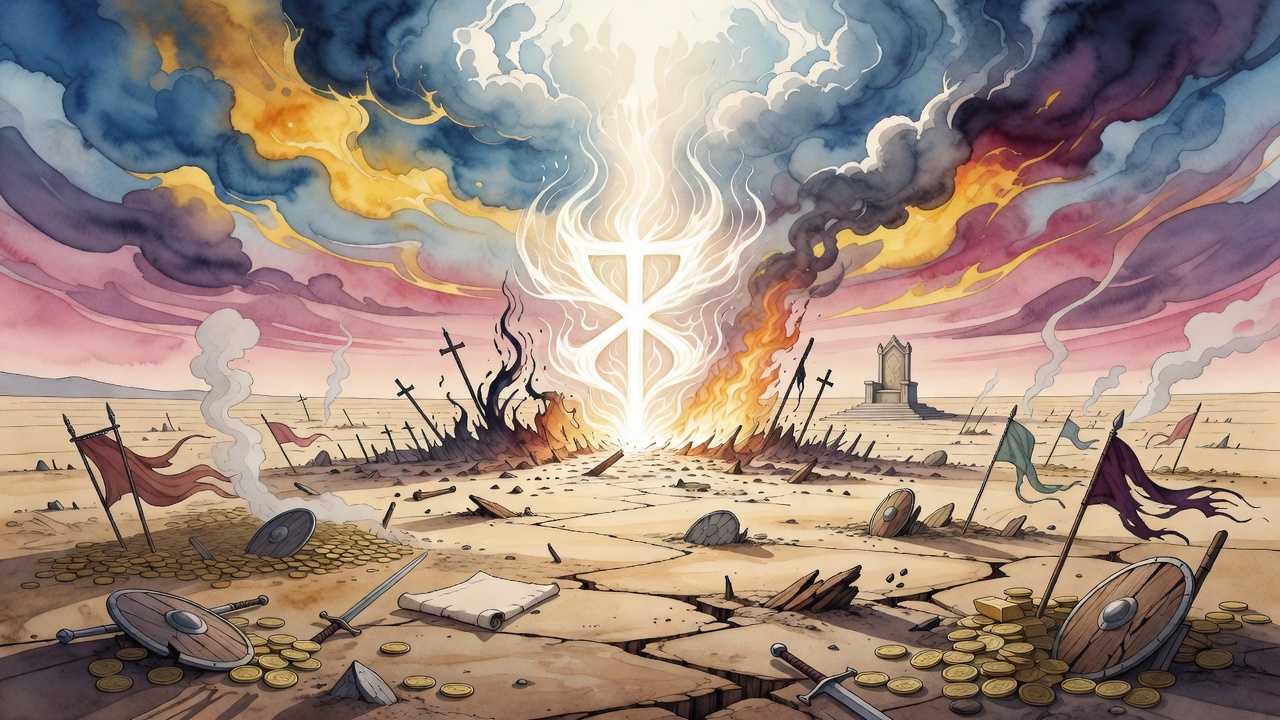
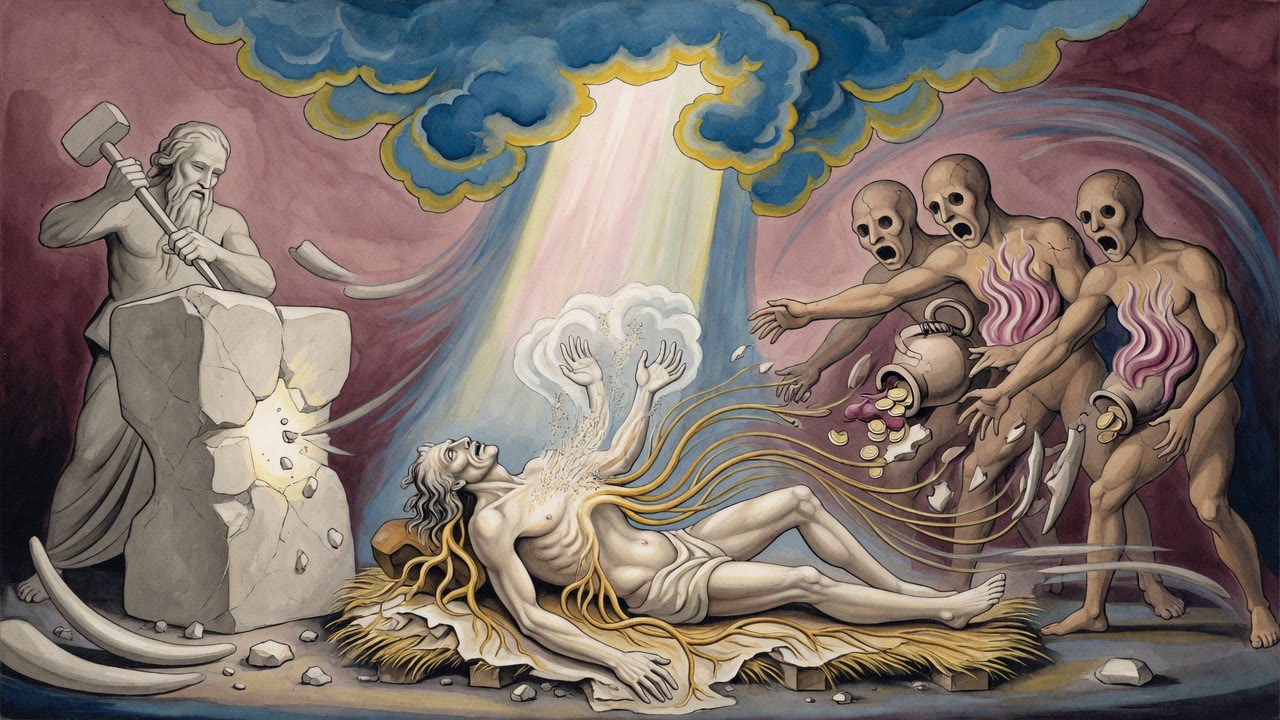
A man who had never lost a bargain stood at the edge of a darkness that did not care about his ledgers. He had silver, clients, a name that opened doors, a body still strong enough for long roads. None of it reached the thing pressing on his sleep. The Other Side does not take bribes in coin. It feeds on fracture, and fracture is not impressed by status.

Worldly power, the masters said, cannot overcome that force alone. Influence stalls. Muscle tires. Cleverness invents new reasons to serve what it meant to outwit. The Other Side is a problem of ontology, not of strategy. It loses ground only when a creature wakes to the unity of God, the Cause of causes, and the illusion of a second government dissolves.

The man put down his purse. The dark did not step back yet. It waited for a different weapon. He tried alliances next, then threats, then a night of wine that only made the pressure clearer. Each tool that had worked in the marketplace rang hollow here, like a key made for another door.

Four Letters Against a False Throne

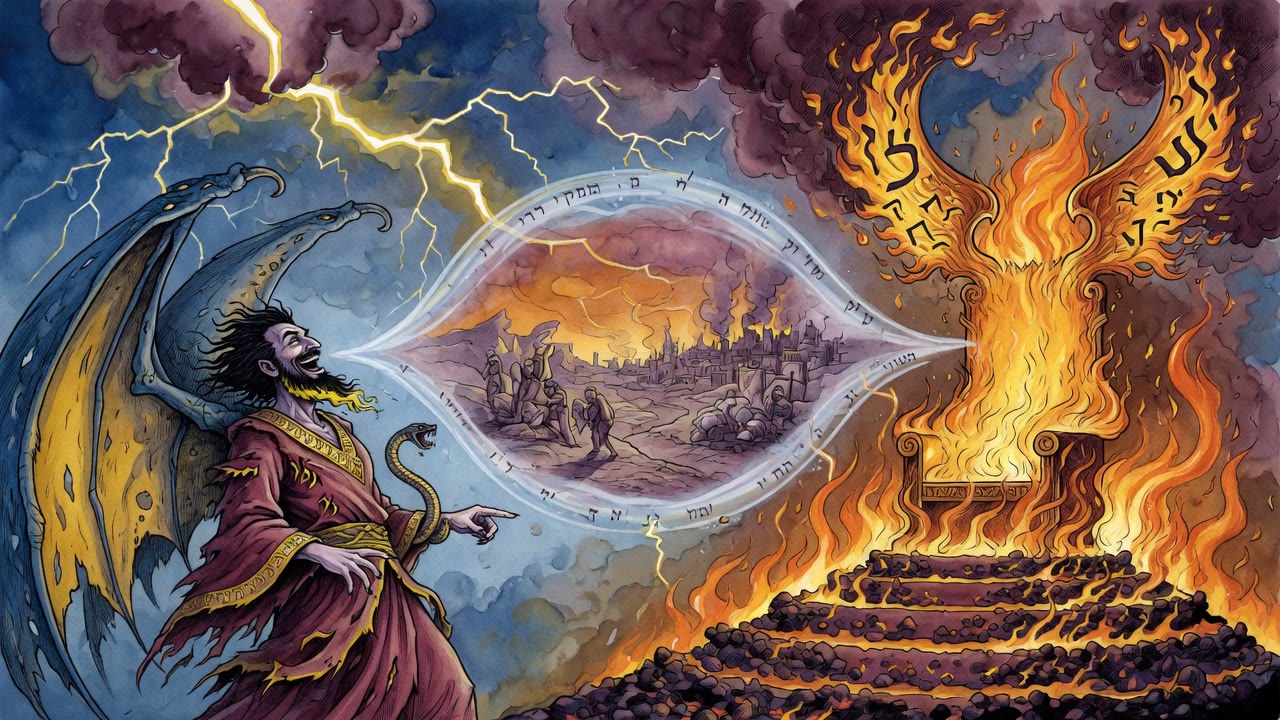
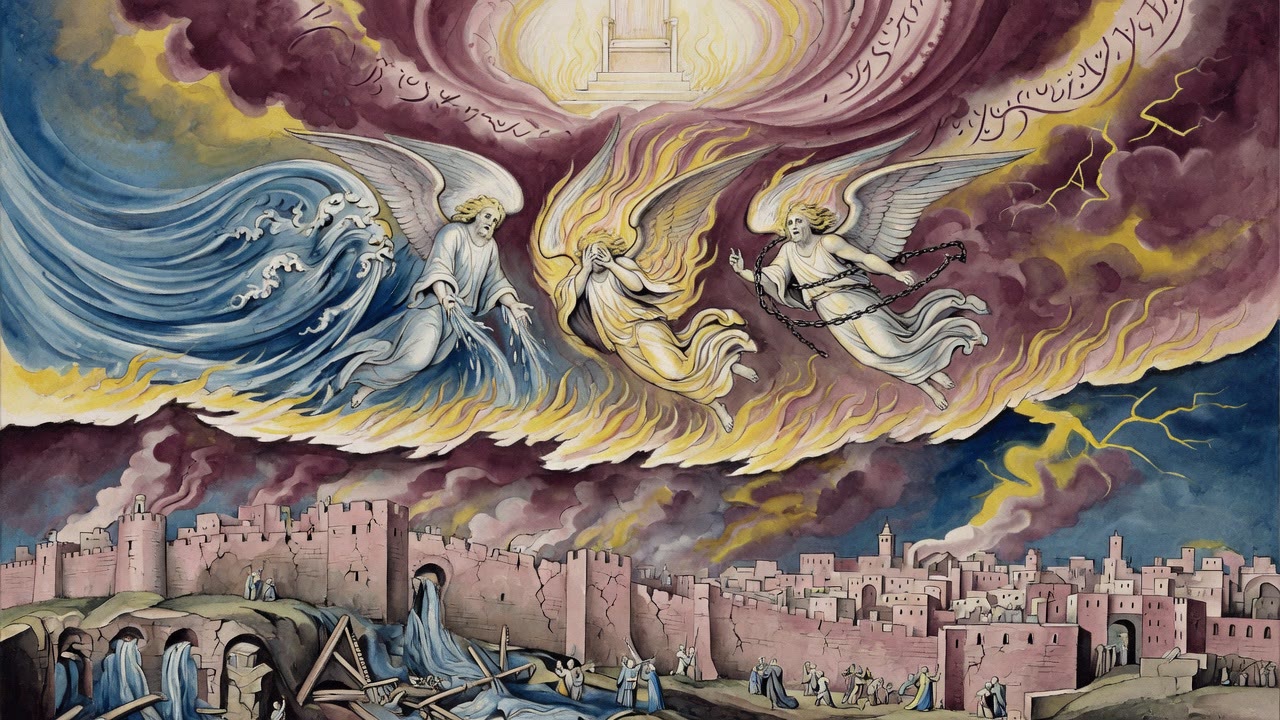
Israel's faith, even in long exile, centered on four letters: the Name HaVaYaH, Yud-Heh-Vav-Heh, held with a reverence that refuses casual speech. The letters are not a charm for markets. They are the signature of the One who does not change while every empire changes. When the Other Side claims total control, the Name answers that control is incomplete, borrowed, and temporary.

A mother in a foreign city taught her child the letters without promising safety. She promised belonging to a unity larger than the marketplace that mocked them. The child repeated the sounds softly, as if volume might invite danger, and felt something in the room recalibrate. Not magic theater. Recognition.

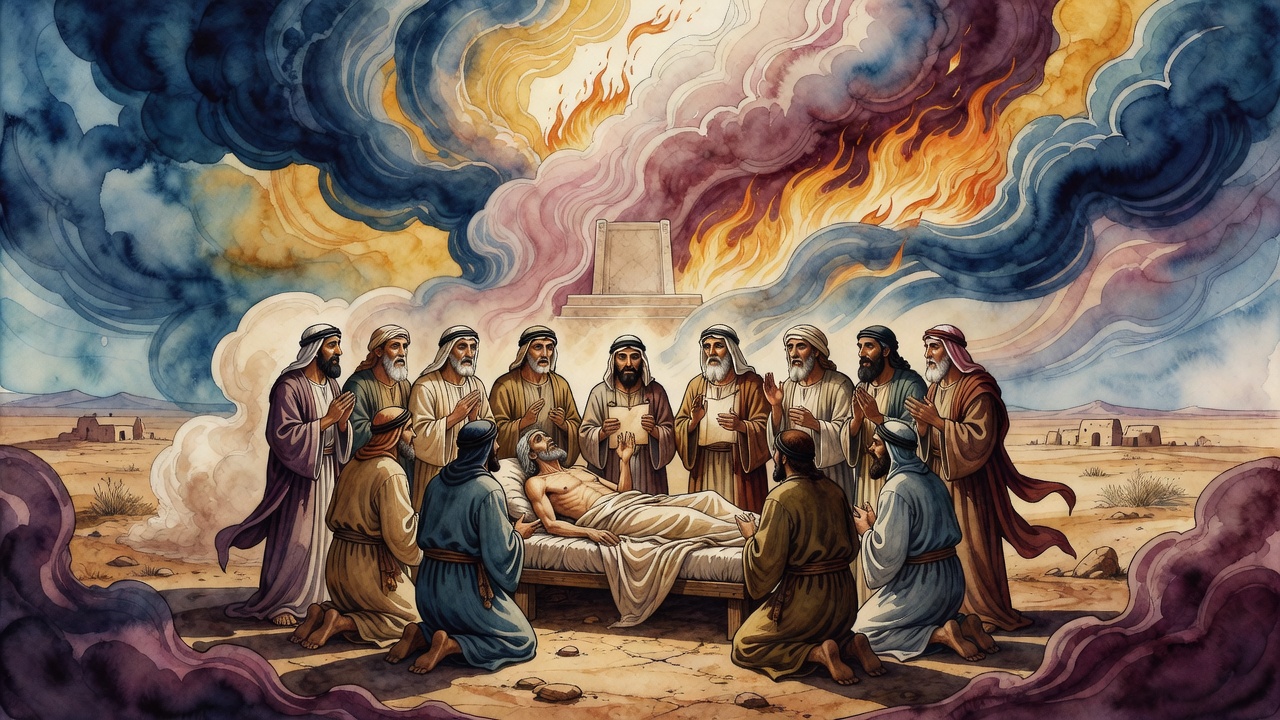
Rabbi voices later would warn against calculating the end of days as if arithmetic could bully heaven. The Name is already within the long exile. Faith that waits for a chart before it stands has already half-surrendered to the fringe's demand for spectacle.

Exile Among the Nations, Sparks Underfoot

After the vessels broke, sparks fell into every nation, every language, every hard place. Exile is not only punishment. It is also a scattering of repair-work into streets that never asked for holy cargo. If there had been no damage, the masters taught, there would have been no need for this long hunt among the peoples. Because damage came first, repair walks foreign roads.

A merchant among strangers, a scholar under a foreign law, a family that keeps Shabbat while the city clocks ignore it: each can lift a spark the Other Side had claimed as food. Worldly power cannot do that work. Only a life oriented to the Cause of causes can starve a parasite that lives on misplaced light.

The rich man, traveling later through a port city, watched a poor man refuse a dishonest gain and felt envy that had nothing to do with coin. The refusal shone. The fringe, which had been thick around the docks, thinned by a finger's width that no inspector could measure and every hidden spark could feel.

When the Illusion Loses Its Face

The Other Side's deepest trick is to look complete. Complete fear. Complete decree. Complete night. The moment a person asserts God's absolute oneness, that completeness cracks. Not always with fireworks. Sometimes with a quiet refusal to treat cruelty as ultimate law. Sometimes with a prayer said without audience. Sometimes with justice done when no ledger rewards it.

The rich man returned to his house poorer in pride and richer in a single clarity: escape is impossible while he treats the dark as equal, and possible the moment he stops funding its theater with belief in two thrones. The four letters did not make him emperor. They made him a servant of the only King who was never invented by fear.

Outside, the city still shouted prices. Inside, the Name held. He slept, and for the first time in months the pressure in the dark had to invent a new strategy, because the old one, status and noise, had failed against a man who had finally put his gold down and picked up a unity older than gold.

Years later his grandchildren would still live among the nations. The work of lifting sparks would not be finished. The law of the wall that was not stone would still be the same. Armies can move borders. Only recognition of the One moves the fringe's food supply.

He opened a ledger one last time and closed it without adding a number. The blank line felt like prayer. Outside a cart rattled past with goods that had once defined him. He let the rattle fade and kept the four letters instead, not as merchandise, as orientation.


← All myths
From the tradition

Sources

3 sources

The texts behind this telling. Some cards carry a translation of the source; others are our own retelling of it, and each card says which. Every card links out to the original.

Kalach Pitchei Chokhmah 30:63Kalach Pitchei Chokhmah

Retold in our words. Read the original at the link below.138 Openings of Wisdom, trans. Rabbi Avraham Greenbaum, Azamra Institute (2005) · CC-BY

It's a concept that can feel both abstract and deeply personal.

So, what exactly is this Other Side? The Kalach Pitchei Chokhmah, a Kabbalistic text, offers a fascinating perspective. It tells us that worldly power, on its own, simply isn't enough to overcome this force. wealth, influence, even physical strength – they can only take you so far. The Other Side, according to this text, presents such a profound challenge that true escape is impossible without recognizing something far greater: God's unity.

What does that mean, “recognizing God’s unity”? The Kalach Pitchei Chokhmah suggests that when we awaken to the absolute, all-encompassing oneness of God, asserting His ultimate control, the illusion of the Other Side dissolves. Suddenly, there's no room for it anymore. Poof! Gone.

Why? Because the Other Side, by its very nature, lacks complete control. It may wield significant power – a power granted to it, – but it's ultimately a "subject slave," lacking true dominion. It's powerful, yes, but not in charge. It's like a puppet with impressive strings, but still a puppet nonetheless.

Only God possesses that complete control. He is the ultimate Master, the single source of all things. The text emphasizes this with a resounding affirmation: "Blessed be He and blessed be His Name for ever and ever."

This isn't just some theological exercise, though, is it? It speaks to our lives. It's about recognizing that the challenges we face, the darkness we confront, don't have the final say. They hold no eternal power. They only seem insurmountable when we forget the ultimate unity and control of the Divine.

So, the next time you feel overwhelmed by the Other Side, whatever form it may take in your life, remember this teaching. Remember that recognizing God's unity isn't just a belief; it's a powerful act of asserting truth over illusion. It's a way of reclaiming your own power by acknowledging the One who holds it all. And perhaps, in that recognition, you'll find that the Other Side isn't so mighty after all. Perhaps, it never was.

Full source
Kalach Pitchei Chokhmah 31:18Kalach Pitchei Chokhmah

Retold in our words. Read the original at the link below.138 Openings of Wisdom, trans. Rabbi Avraham Greenbaum, Azamra Institute (2005) · CC-BY

For the Jewish people, the answer, according to Kalach Pitchei Chokhmah (Wisdom), lies in unwavering faith in the "Cause of all causes" – in God. It's a faith so profound that it persists despite the long, painful exile and the constant challenges thrown their way by the "Other Side," a term often used to describe negative spiritual forces.

What fuels this incredible faith?

The text continues: "Because of this, the faith of Israel is centered on these four letters." These aren't just any letters; they're the four letters of the Name of HaVaYaH – what readers often call the Tetragrammaton, the sacred, unpronounceable Name of God, usually rendered in English as YHVH.

The Zohar, that foundational text of Jewish mysticism, echoes this idea. In Vayera 117a, we read that Rabbi Yose cautioned against getting caught up in calculating the end of days, emphasizing that He – God – is within the mystery of these letters. Instead of trying to predict the future, focus on the divine presence embedded in the very letters of God's Name.

What's so special about these four letters? According to Kalach Pitchei Chokhmah, it's through them that the "Cause of all causes" – God – unifies all the different levels of existence. This unification, this harmonizing force, is what the Redemption truly depends upon. It's not just about waiting for a messianic figure or a specific date; it's about connecting to the divine unity that permeates everything.

It means that even when faced with challenges, doubts, or despair, we can draw strength from the same source that has sustained the Jewish people for centuries: faith in the unifying power of the divine Name.

Full source
Kalach Pitchei Chokhmah 37:2Kalach Pitchei Chokhmah

Retold in our words. Read the original at the link below.138 Openings of Wisdom, trans. Rabbi Avraham Greenbaum, Azamra Institute (2005) · CC-BY

Jewish mystical tradition offers a profound, and frankly, pretty comforting explanation. It all boils down to the idea of the breaking of the vessels, a concept explored in texts like Kalach Pitchei Chokhmah, a Kabbalistic work.

Before our world as we know it existed, there were divine vessels meant to contain the immense light of the Creator. But these vessels, for reasons we’ll perhaps never fully grasp, couldn't hold that infinite light. They shattered. And that shattering, that shevirat ha-kelim (שְׁבִירַת הַכֵּלִים), is the root of all the chaos, suffering, and imperfection we see around us.

You might be thinking, "Great, so we're stuck with brokenness forever?" Not exactly. The story doesn't end there. The breaking wasn't the end, but the beginning of a process of repair, of tikkun (תִּקּוּן).

Kalach Pitchei Chokhmah makes a really interesting point: If there had been no damage, there would be no destruction in the world. And conversely, if the repair had been fully completed, that would be the end of everything. for a second. It’s suggesting that the tension between destruction and repair is what drives existence.

The repair, however, is not yet complete. And according to this teaching, it's not meant to be. Not yet. The repair has only gone far enough to allow the cycle of destruction and repair to continue. Think of it like this: each act of kindness, each moment of compassion, each attempt to heal a broken relationship or a broken world… all of it contributes to the ongoing process of tikkun olam (תִּקּוּן עוֹלָם), repairing the world.

We build, we create, we love…and then things fall apart. But the falling apart isn't necessarily a failure. It’s part of the process. It creates the space for something new, something perhaps even more beautiful, to emerge.

The promise, the hope, is that one day, at the "end of everything," there will be a complete repair, a tikkun shalem (תִּקּוּן שָׁלֵם). After that, there will be no more damage at all.

Until then, we’re all participants in this grand, ongoing project. We are, in our own small ways, helping to gather the shattered pieces and put them back together. And maybe, just maybe, the cracks themselves will become part of the masterpiece.

Full source