Translation of the source text.Otzar Midrashim, New York 1915, Public Domain · CC-BY-SA
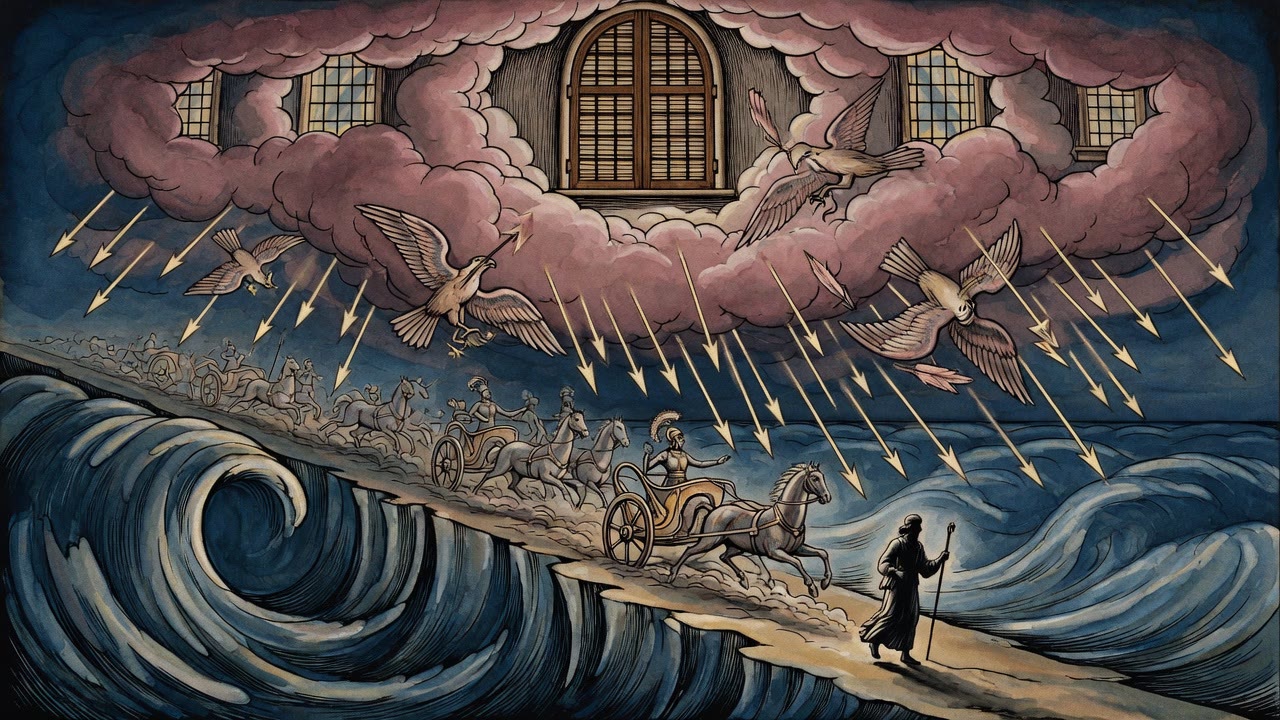
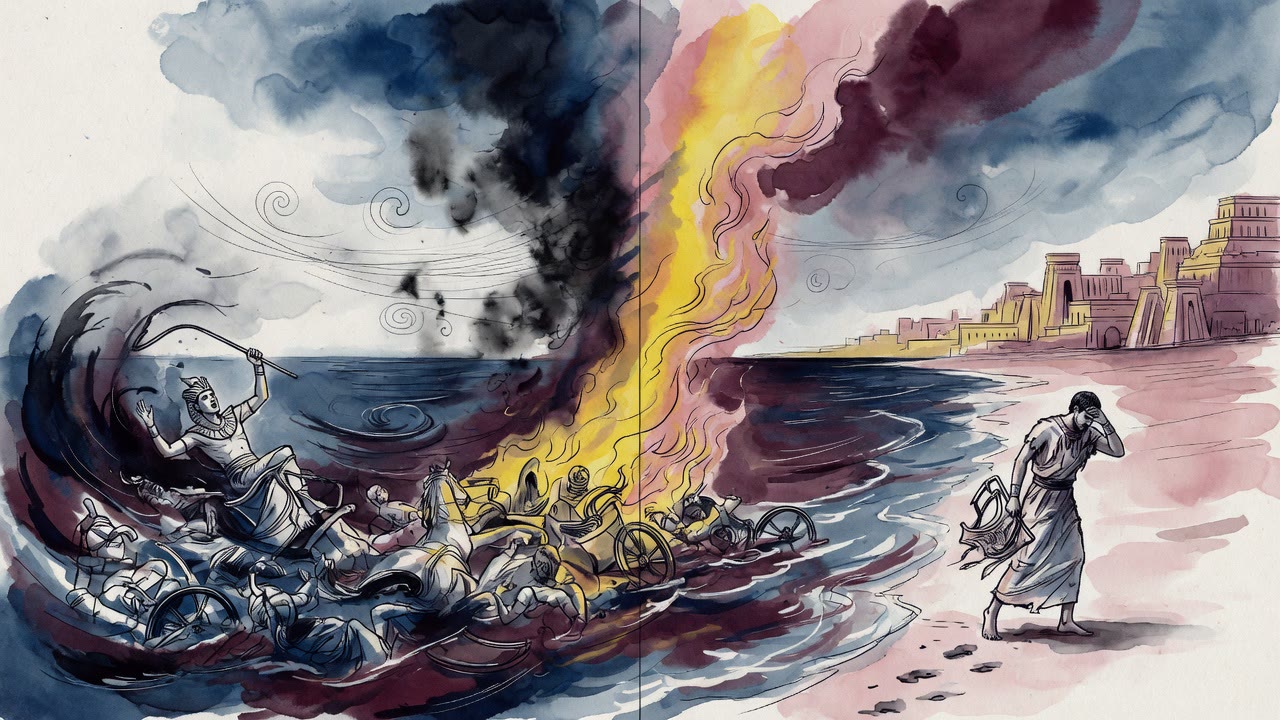
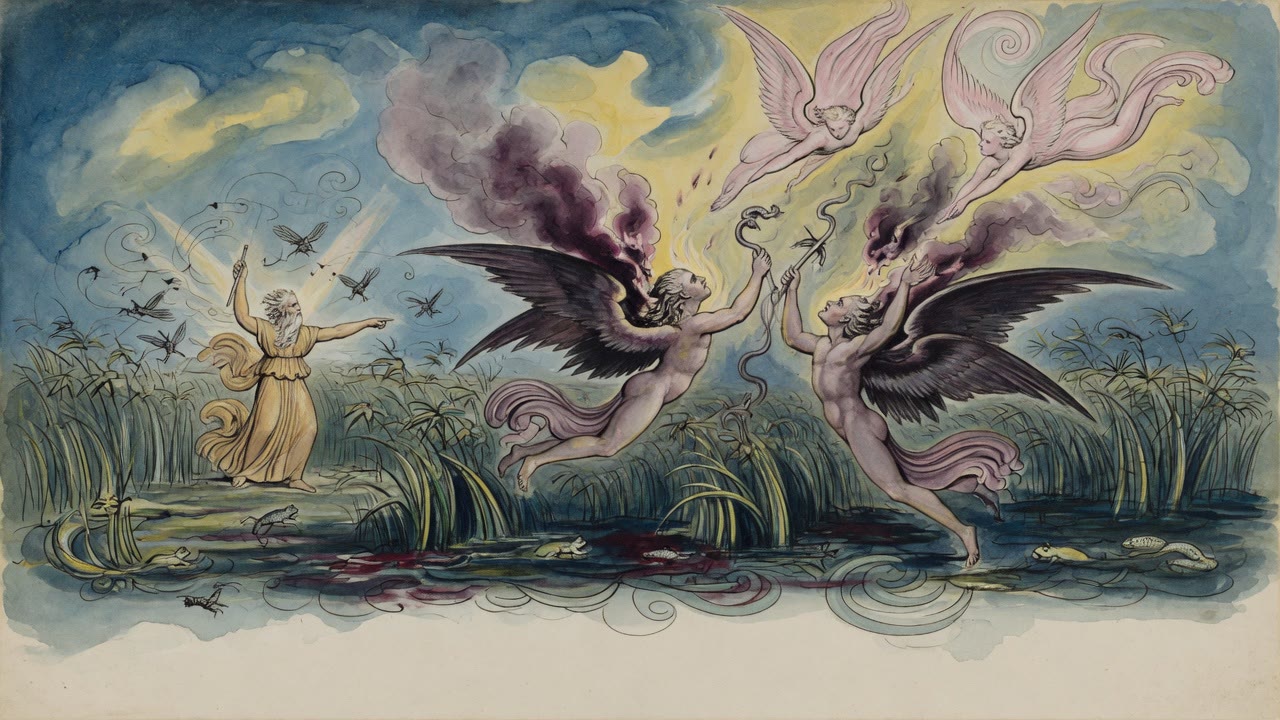
"You blew with Your wind, the sea covered them" (Exodus 15:10). Our Sages of blessed memory said: At the time when the Egyptians drowned in the sea, there were among them two sorcerers, and their names were Yochani and Mamre. They said to Pharaoh: If this miracle is by the hand of the Holy One, blessed be He, we cannot prevail against it; but if it is by the hand of angels, we are able to shake them (the angels) off into the sea. They performed sorceries and brought them (the angels) down into the sea. Then the angels said, "Save us, O God, for the waters have come up to the soul" (Psalms 69:2). (Something is missing here, namely that) the Holy One, blessed be He, came to the aid of the angels, and then the angels gave thanks to the Holy One, blessed be He, for He had rescued them, and in their place He drowned Yochani and Mamre. (And in Yalkut, Beshalach, remez 235, it is brought that) Yochani and Mamre made themselves wings by sorcery and flew into the air and suspended themselves in the height of the world. Gabriel said, "And in the greatness of Your majesty You overthrow those who rise up against You" (Exodus 15:7). At once the Holy One, blessed be He, said to Michael: Go and execute judgment upon them. Michael seized them by the forelock of their head and dashed them upon the face of the waters. This is what is written: "You broke the sea apart by Your strength; You shattered the heads of the sea-monsters upon the waters" (Psalms 74:13). And You, by Your word, drowned them in the sea, in the mighty waters; therefore it is said, "You blew with Your wind, the sea covered them; they sank like lead in the mighty waters" (Exodus 15:10).
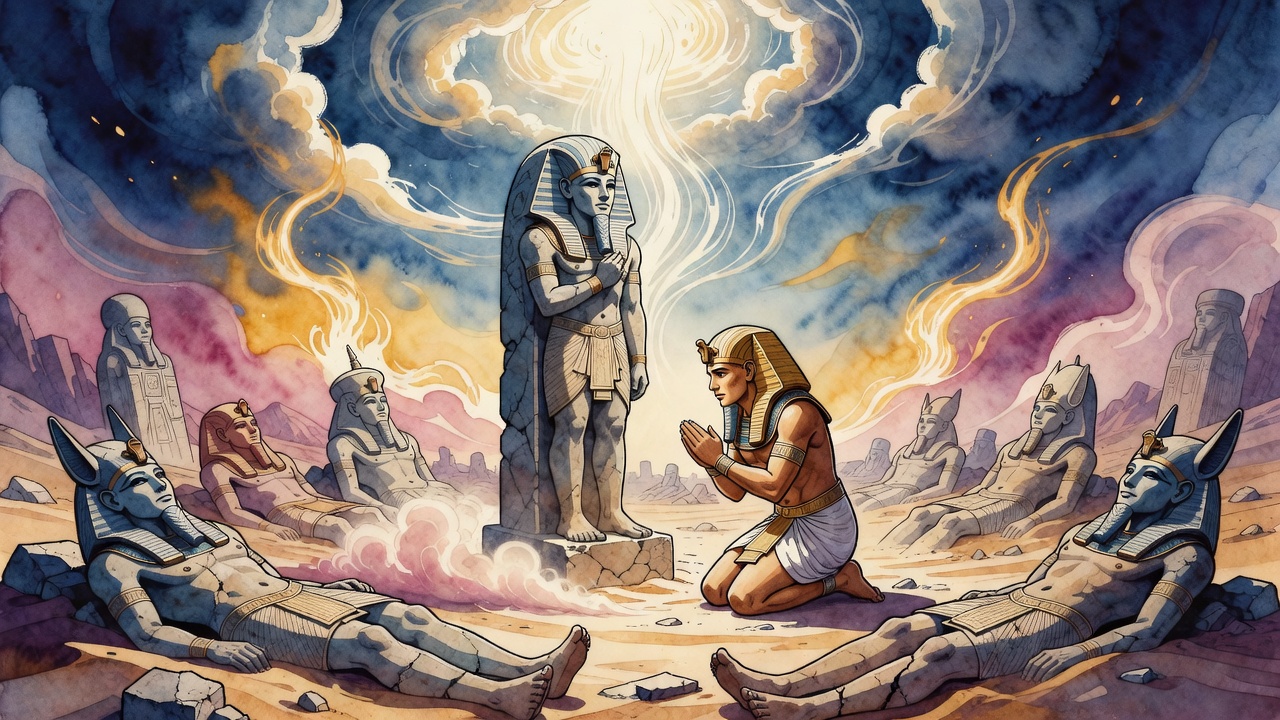
"Who is like You" (Exodus 15:11). Our Sages of blessed memory said: At the time when Israel said this song before the Holy One, blessed be He, Pharaoh heard it while he was being tossed about in the sea, and he raised his finger toward the heavens and said: I believe in You, that You are the righteous one, and I and my people are the wicked, and there is no god in the world but You. At that moment Gabriel descended and placed upon his neck a chain of iron, and said to him: Wicked one! Yesterday you said, "Who is the LORD that I should hearken to His voice?" (Exodus 5:2), and now you say, "The LORD is righteous"? (Exodus 9:27). At once they brought him down to the depths of the sea and detained him there fifty days, and afflicted him so that he would recognize the wonders of the Holy One, blessed be He; and afterward they brought him up from the sea and made him king over Nineveh. And when Jonah came to Nineveh and said, "Yet forty days, and Nineveh shall be overthrown" (Jonah 3:4), at once trembling and quaking seized him, and he rose from his throne and covered himself with sackcloth and sat upon the ashes, and he himself cried out and said, "Let neither man nor beast, herd nor flock, taste anything; let them not feed, nor drink water" (Jonah 3:7), for I know that there is no other god in all the world like Him, and all His words are truth and all His judgments are in truth and in faithfulness. And Pharaoh is still alive and stands at the gate of Gehinnom, and when the kings of the nations of the world enter, at once he makes known to them the mighty deeds of the Holy One, blessed be He, and says to them: Fools of the world, why did you not learn knowledge from me, for I denied the Holy One, blessed be He, and therefore He sent against me ten plagues, and even drowned me in the sea and detained me there fifty days, and afterward brought me up from the sea, and in the end I believed in Him against my will. Therefore Israel sang this song and said all together, "Who is like You among the mighty, O LORD, who is like You, glorious in holiness, awesome in praises, doing wonders?" (Exodus 15:11).
"You stretched out Your right hand" (Exodus 15:12). Our Sages of blessed memory said: We are able to learn from this verse that the sea did not wish to receive them and the earth did not wish to swallow them. The sea would cast them onto the land and the land would cast them into the sea. And why? Because the sea was afraid of the day of judgment, lest the Holy One, blessed be He, seek them from it, and the earth was likewise afraid lest the Holy One, blessed be He, curse it, just as He cursed it when He created His world. For at the time when He created His world, it was wide and level in every place, and when Cain arose and killed Abel his brother, his blood seethed in the earth, and the Holy One, blessed be He, cursed it; at once the mountains and the hills were formed (see Midrash Tehillim, Psalm 93, and Pirkei de-Rabbi Eliezer chapter 5, where it is brought in another manner). And on account of this the earth did not wish to swallow them. Then the Holy One, blessed be He, said to the earth: Do not fear; at once the ground opened its mouth and swallowed them. Therefore it is said, "You stretched out Your right hand, the earth swallowed them" (Exodus 15:12).
"You led in Your loving-kindness" (Exodus 15:13). Our Sages of blessed memory said: Blessed be the name of the Holy One, blessed be He, whose ways are not like the ways of flesh and blood. The way of flesh and blood: when he goes out at night, his princes and his servants carry before him candles and torches, and by day they make for him a shade against the sun so that no distress will come upon his body; but the Holy One, blessed be He, is not so, for out of the abundance of love with which He loved Israel, He Himself went before them. And were it not that Scripture is written, it would be impossible to say it, for thus it is written, "And the LORD went before them by day in a pillar of cloud to lead them the way, and by night in a pillar of fire to give them light, that they might go by day and by night" (Exodus 13:21). Therefore it is said, "You led in Your loving-kindness this people whom You redeemed; You guided them in Your strength to Your holy habitation" (Exodus 15:13).
"The peoples heard" (Exodus 15:14). Our Sages of blessed memory said: Moses said to Israel: You have seen all these miracles that the Holy One, blessed be He, did for us at this time; so is He destined to do for Edom at the time when He redeems Israel. For thus the Sages said: Three days before the Messiah comes, Elijah will come first and will stand upon the mountains of Zion and cry out in bitterness and weep and lament over them and say: How long will they be in ruins? And the sound of his weeping will be heard from one end of the world to the other. And afterward he will come and say: Peace has come to the world, as it is said, "How beautiful upon the mountains are the feet of the herald, who proclaims peace" (Isaiah 52:7). And when the wicked in Gehinnom hear this, at once they will rejoice and say: Peace has come to the world. On the second day he will come and stand upon the mountains of Israel and say: Good has come to the world, as it is said, "who heralds good" (Isaiah 52:7), and even the wicked will rejoice. On the third day he will come and say: Salvation has come to the world, as it is said, "who proclaims salvation" (Isaiah 52:7). And since the wicked in Gehinnom see that Elijah will say this, he says "to Zion: Your God reigns" (Isaiah 52:7), to teach you that upon Zion and her children He will bring the salvation, and not upon the wicked: "trembling shall seize them" (cf. Exodus 15:15). At that moment the Holy One, blessed be He, will show His kingship and His glory to the righteous and to every nation and tongue, and at once He will redeem Israel and they will inherit Mount Zion. Therefore it is said, "The peoples heard, they trembled; pangs took hold of the inhabitants of Philistia" (Exodus 15:14).
"Then were dismayed" (Exodus 15:15). Our Sages of blessed memory said: Why were the inhabitants of Philistia afraid? Because they had killed two hundred thousand men of the children of Ephraim, who counted the End at the going out from Egypt and erred by thirty years and went out by the strength of their might, and the Holy One, blessed be He, was angry with them and delivered them into the hand of the Philistines (in Pirkei de-Rabbi Eliezer and likewise in Targum Yonatan, Parashat Beshalach, two hundred thousand; and in Shemot Rabbah chapter 20, three hundred thousand). And now they were afraid and said: Now Israel will roll [vengeance] upon us and kill us and inherit our land. And why were the chiefs of Edom afraid? They said: Now there will be visited upon us that hatred which was between Esau and Jacob, and they will kill us and inherit our land. And why were the mighty ones of Moab afraid? They said: Now there will be visited upon us that quarrel which was between the shepherds of Abraham and the shepherds of Lot our father. And when the kings of Canaan saw that all of these were afraid, they said: If these, whom Israel does not even wish to return to their land, have dread and fear, then we, whose land the Holy One, blessed be He, gave to Abraham their father, and who are coming upon that promise, how much more so! Therefore it is said, "Then were the chiefs of Edom dismayed; the mighty ones of Moab, trembling took hold of them; all the inhabitants of Canaan melted away" (Exodus 15:15).
"Terror falls upon them" (Exodus 15:16). Our Sages of blessed memory said: Moses said to Israel: My brothers! Know that not by wisdom, nor by understanding, nor by strength, nor by wealth can a man conquer even a single city, but only by the mighty deeds of the Holy One, blessed be He; for behold, how many mighty men are destined to fight against you, and the Holy One, blessed be He, is destined to put dread of you and fear of you upon them, and no man will stand before you. And the Holy One, blessed be He, is destined to write in His Torah, "Let not the mighty man glory in his might" (Jeremiah 9:22); and if you do the will of the Omnipresent, He will save you from the hand of your enemies. And Moses said before the Holy One, blessed be He: Master of the Universe, when Amalek comes to fight with Israel, may terror and fear fall upon them; and when the kings of the Amorites come to hide themselves in the wadis of Arnon, by the greatness of Your arm may they be still as a stone, until this people, whom You have acquired with Joshua, passes over the Jordan and comes and inherits their land, and the vow which You vowed to Abraham their father is fulfilled. And also in the days of the Messiah He will do for them miracles and wonders, as it is written, "As in the days of your coming out of the land of Egypt I will show him wonders" (Micah 7:15). And therefore it is said, "Terror and dread fall upon them; by the greatness of Your arm they are still as a stone, until Your people pass over, O LORD, until the people pass over whom You have acquired" (Exodus 15:16).
"You bring them in and plant them" (Exodus 15:17). Our Sages of blessed memory said: Praised be the name of the Holy One, blessed be He, who out of the abundance of love with which He loved Israel called them "My firstborn son." Come and see how many are the acts of loving-kindness of the Holy One, blessed be He: a servant clothes his master, but the Holy One, blessed be He, clothes Israel, as it is said, "And I clothed you with embroidered cloth" (Ezekiel 16:10); a servant washes his master, but the Holy One, blessed be He, washes Israel, as it is said, "And I washed you with water" (Ezekiel 16:9); a servant shoes his master, but the Holy One, blessed be He, shoes Israel, as it is said, "And I shod you with tachash-leather" (Ezekiel 16:10). And above all this, when they went into exile to Egypt the Shekhinah was with them, as it is said, "I will go down with you to Egypt" (Genesis 46:4); they went into exile to Elam, the Shekhinah was with them, as it is said, "And I will set My throne in Elam" (Jeremiah 49:38); they went into exile to Babylon, the Shekhinah was with them, as it is said, "For your sake I have sent to Babylon" (Isaiah 43:14); and the Holy One, blessed be He, is destined to bring Israel back to His holy mountain, as it is said, "And I will bring them to My holy mountain" (Isaiah 56:7), and it is written after it, "And I will plant them upon their land" (Amos 9:15, end). When Moses saw the love of the Holy One, blessed be He, with which He loved Israel, he said before Him: Master of the Universe, bring them in and plant them there, and may that planting be complete, that it never have any uprooting forever; and bring down Jerusalem from the heavens and never destroy it forever; and gather the exiles of Israel into it, and may they dwell upon it in security. Therefore it is said, "You bring them in and plant them in the mountain of Your inheritance, the place, O LORD, which You have made for Your dwelling, the sanctuary, O LORD, which Your hands have established" (Exodus 15:17).

 Click for full size