5 min read

Zion Cast from Shoulders Like a Crying Son

A king lifted his weeping son from knees to arms to shoulders, then cast him down at once. So the splendor of Israel fell from heaven to earth.

Curated by Arthur · Told by Maggid ·
Table of Contents
  1. The Climb
  2. Clouded Vision
  3. The Sunburned Daughter
  4. When the Master Carried the Servant
  5. Long Patience and the Spies
Zion Cast from Shoulders Like a Crying Son Click for full size

The Climb

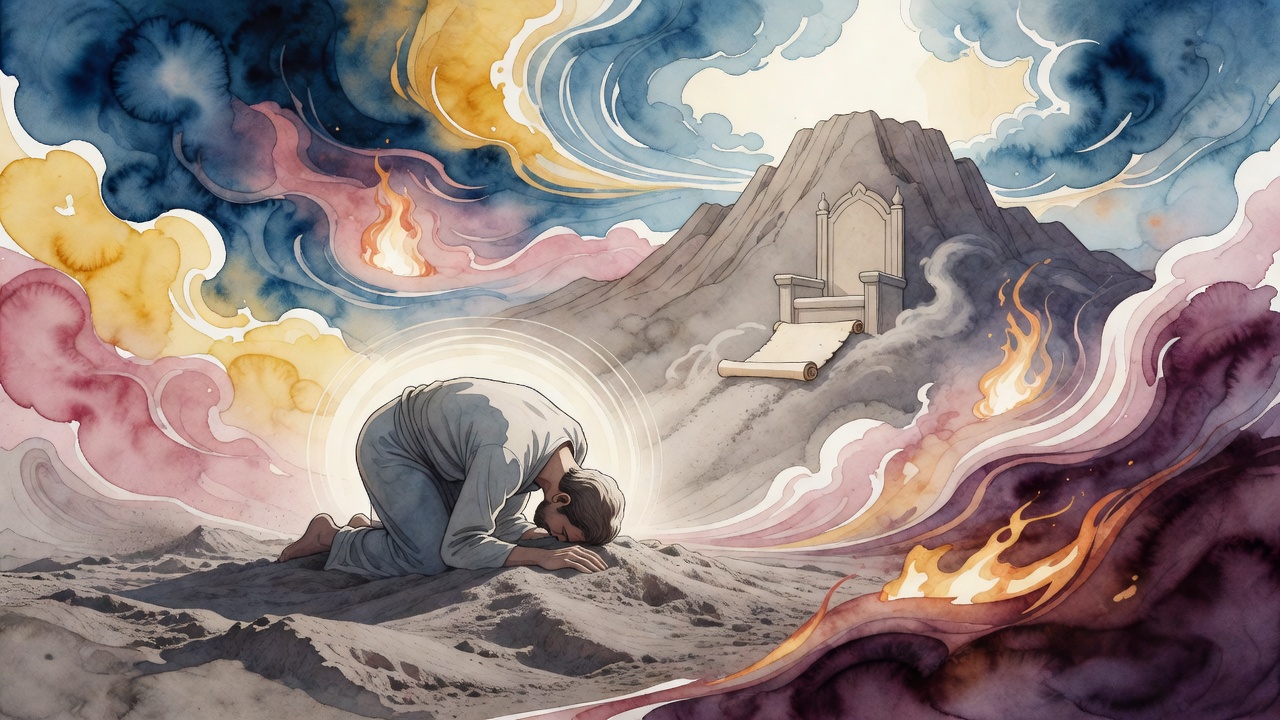
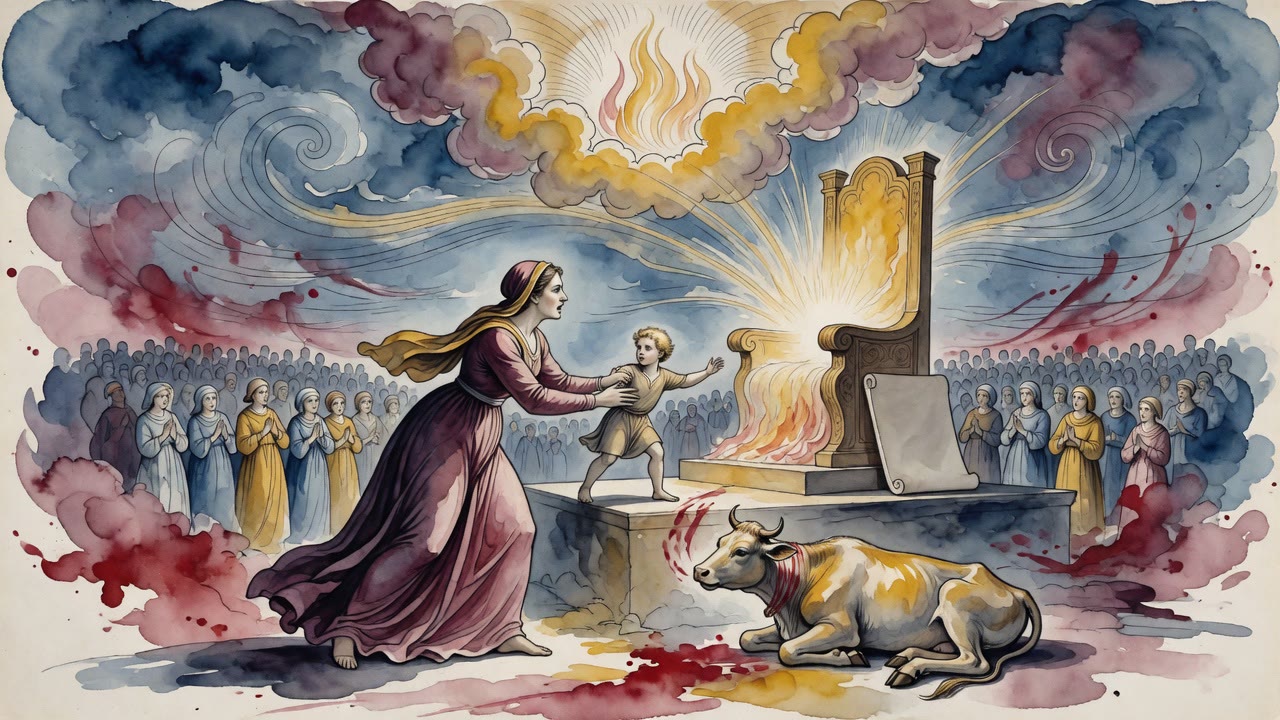
The boy would not stop weeping. The king set him on his knees and tried a soft voice. The boy wept harder, so the king lifted him into his arms and walked the length of the hall. Still the crying rose, so the king set the child on his shoulders, high above the court, a living crown of noise and need. Courtiers watched the ascent in three stages and thought the storm would pass.
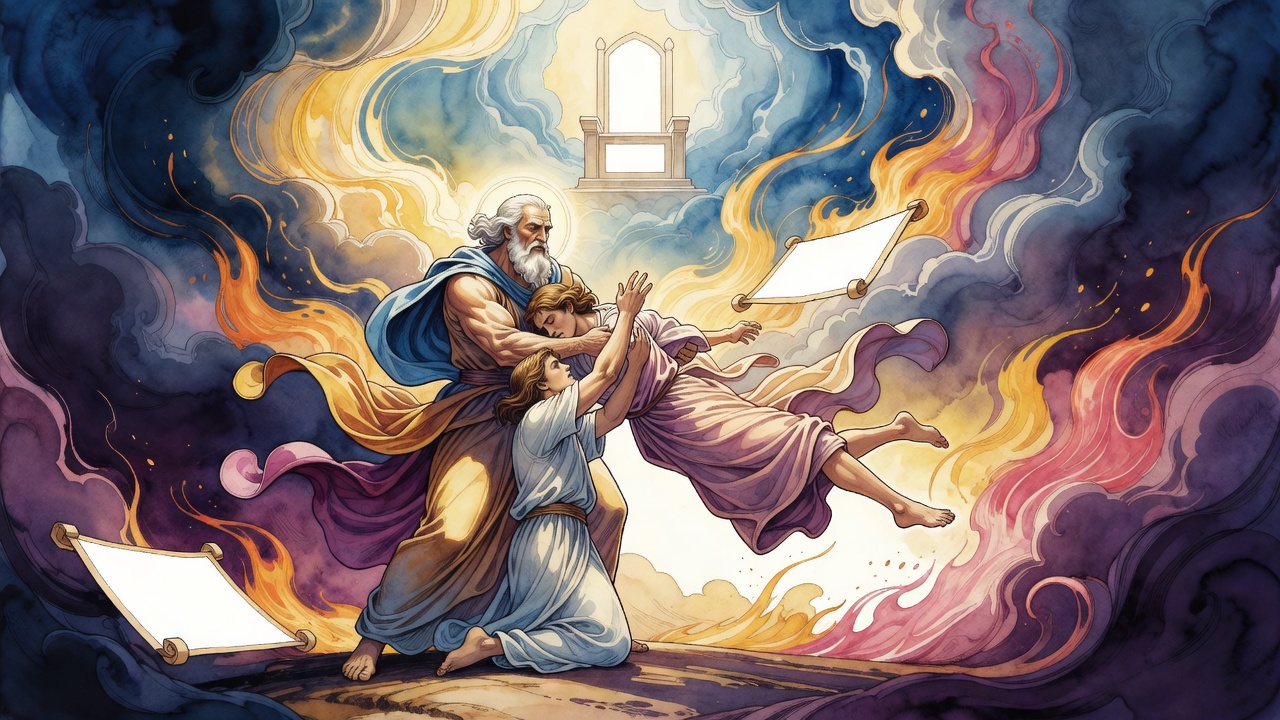
Then the boy made a mess on him. The king cast him to the ground in one motion. The descent was not like the ascent. The ascent had taken three stages. The fall took one. Dust rose from the floor. The child lay where favor had been.

So the midrash reads the line, "He cast the splendor of Israel from the heavens to the earth." God had coddled Ephraim, taken them by the arms, raised them high. Then the splendor dropped all at once (Lamentations 2:1). Hosea had already named the stages: I coddled Ephraim, taking them by their arms. I elevated Ephraim. Then the cast. Memory of the climb makes the fall sharper.

Clouded Vision

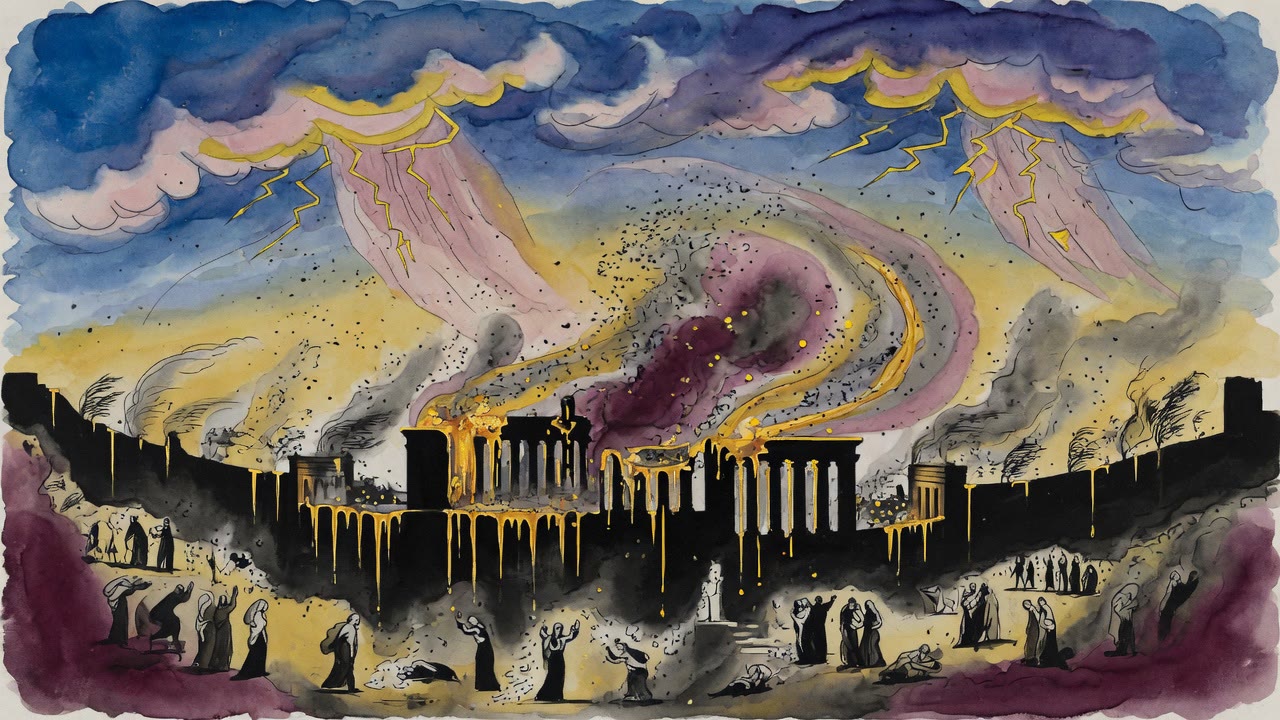
How the Lord has clouded the daughter of Zion in His wrath. Some heard "clouded" as condemned, a liability written across a people. Some heard pain, the word for ache turned inside the same letters. The rabbis heard vision going dark. The daughter of Zion could no longer see her own height. Wrath put fog where memory used to stand. Streets that once looked golden looked only like ash.

Another parable cut deeper. A province made a crown for its king, then provoked him again and again. He tolerated them. They provoked him again. At last he said, Are you not bold only because of the crown you set on me? Here it is, thrown in your faces. So the Holy One spoke of the image of Jacob engraved on the Throne. You provoke Me by the very favor I keep of you. Take the image back. Watch it fall from heaven to the dirt of the street.

The Sunburned Daughter

Before the fall, there was another face of the same people. The Congregation of Israel stood before the Holy One like a sunburned daughter. Her own brothers had driven her into the fields. The sun blackened her skin until her friends jeered, "This is the beauty you bragged about?" They pointed at the dark cheeks as if beauty were a costume she had ruined on purpose.

She answered without shame. It was my brothers who put me here. No stranger ruined me. A tree is uprooted by its own kind. Meat spoils from the inside. The parable does not flatter. It refuses the easy story in which only empires are villains.

So Israel said to God: the wound is family work. The strangers only finished what our own hands began. That plea is not an excuse. It is a map of how a people can blacken its own face and still demand to be recognized as a king's child standing in the heat.

When the Master Carried the Servant

Once the order of the world had run the other way. A servant carries his master on his shoulders. A servant bathes him, clothes him, sets shoes on his feet, lights the road ahead with a lamp. When Israel left Egypt, the Holy One reversed the order. He carried them on eagles' wings. He washed them with water. He clothed them in embroidered cloth. He shod them with tachash leather. He went before them in cloud by day and fire by night.

The Master served the servants because they were near to His heart. Nearness is not a permanent elevation. Nearness can also mean the child is high enough on the shoulders that the fall will be total. The same arms that lifted are the arms that can cast. The cloud that led can become the cloud that blinds.

Long Patience and the Spies

Moses once asked by what measure God judges the world. God answered, With long patience. Moses pushed back. They eat from Your table and kick at You and Your Torah. God said nothing. He waited. The silence was the measure.

When the spies broke Israel's nerve and the camp wept through the night, Moses finally begged for the same long patience he had doubted. God forgave. The decree still stood. The generation that wept would die in the wilderness. Patience can pardon a soul without erasing a consequence. Forgiveness and geography can disagree.

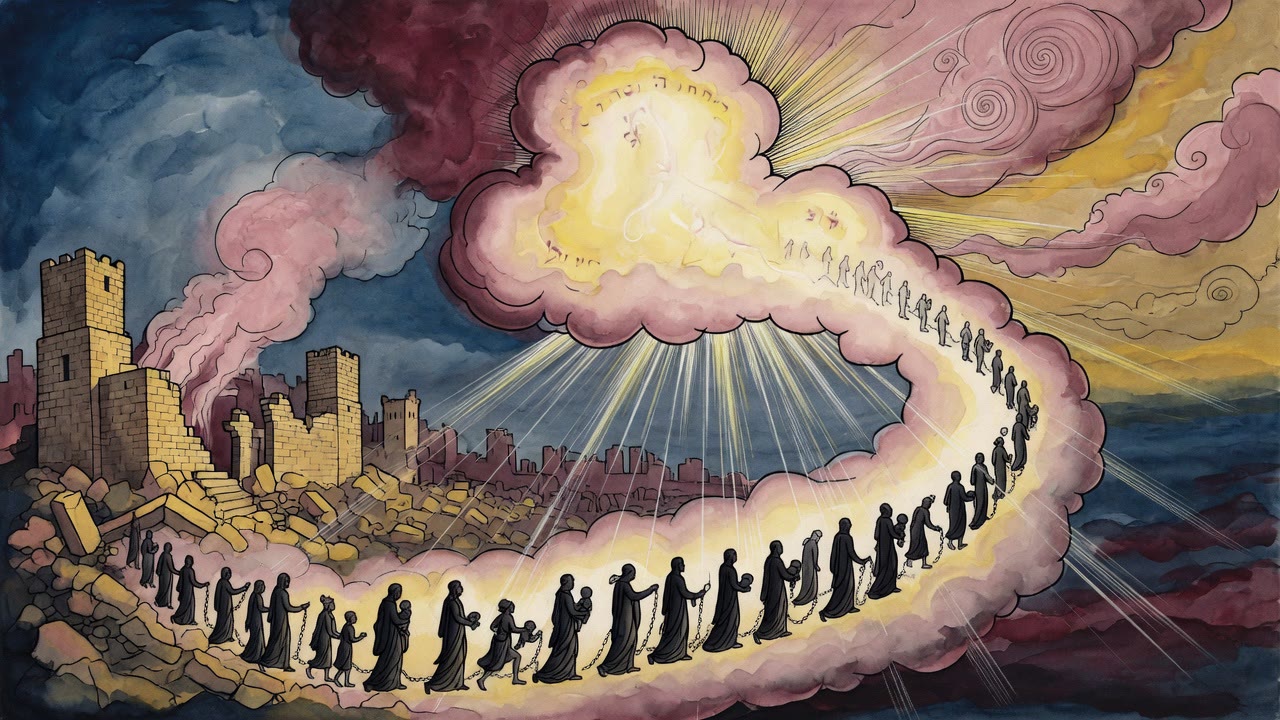
That is the hard hinge between the carrying and the casting. The same God who reversed the servant's labor can still drop the spoiled child from His shoulders. The sunburned daughter still claims her father's house. The clouded vision still remembers the height she lost. Between eagles' wings and the ground of Lamentations runs one long argument about how close love can stand to wrath without becoming either cheap or final.


← All myths

From the tradition

Sources

3 sources

The texts behind this telling. Some cards carry a translation of the source; others are our own retelling of it, and each card says which. Every card links out to the original.

Eikhah Rabbah 2:2Eikhah Rabbah

Retold in our words. Read the original at the link below.The Sefaria Midrash Rabbah, 2022 · CC-BY

“How the Lord has clouded [ya’iv] the daughter of Zion in His wrath.” Rabbi Ḥama bar Rabbi Ḥanina said: How did the Lord condemn in His wrath the daughter of Zion?8Rabbi Ḥama interprets the word ya’iv as to condemn rather than clouded. There are places where they call one who is liable [ḥayava], ayava. Rabbi Shmuel bar Naḥmani said: How did the Lord cause pain [kayev] in His wrath? There are places that call pain [keiva], eiva. The Rabbis say: How did the Lord cloud in His wrath the vision of the daughter of Zion?“He cast the splendor of Israel from the heavens to the earth.” Rabbi Huna and Rabbi Aḥa, in the name of Rabbi Ḥanina son of Rabbi Abahu: This is analogous to a king who had a son. [The son] wept and he placed him on his knees. He wept and he placed him in his arms. He wept and he placed him on his shoulders. He made a mess upon him and he immediately cast him to the ground. His descent was not like his ascent. His ascent was in increments, but his descent was all at once. So too, “I have coddled [tirgalti]9This is from the root reish gimmel lamed, and is an allusion to placing the child on his knees, as the Hebrew word for leg is regel. Ephraim, taking them by their arms” (Hosea 11:3). Then, “I have elevated10This is an allusion to placing the child on his shoulders. Ephraim; Judah has plowed, Jacob has harrowed for him” (Hosea 10:11). Then, “He cast the splendor of Israel from the heavens to the earth.”Another matter, “He cast the splendor of Israel from the heavens to the earth.” Rabbi Yehoshua ben Rabbi Naḥman said: This is analogous to residents of a province who crafted a crown for the king. They provoked him and he tolerated them. They provoked him and he tolerated them. Then the king said to them: ‘Are you not provoking me only due to the crown with which you crowned me? Here it is, thrown in your faces.’ So too, the Holy One blessed be He said to Israel: ‘Are you not provoking Me only due to the image of Jacob that is engraved on My throne? Here it is, thrown in your faces.’ That is: “He cast [the splendor of Israel]11According to this interpretation, “the splendor of Israel” is a reference to that image of Jacob, who was also called Israel. from the heavens to the earth.”

Full source
Tanna Debei Eliyahu Rabbah 29:1Tanna DeBei Eliyahu Rabbah

Translation of the source text.Tanna debei Eliyahu Rabbah, Warsaw 1880 · Public Domain

Scripture says, "Do not gaze at me because I am swarthy, because the sun has scorched me; my mother's sons were angry with me" (Song of Songs 1:6). The Congregation of Israel said before the Holy One, blessed be He: Master of the universe, no creature has sinned against me except my own mother's sons. Know that this is so, for a tree is uprooted only by one of its own kind, and meat goes foul only from within itself.

Rabbi Ishmael would offer a parable. To what may the matter be compared? To a king's daughter whose brothers grew angry with her and drove her into the field to gather grain. The sun seized her and her face was blackened like the bottom of a pot, and her companions mocked her, saying, "Is this the king's daughter you call lovely and praiseworthy?" She answered, "Because my brothers grew angry with me and sent me into the field to gather grain, the sun seized me and my face was blackened like the bottom of a pot." So the Congregation of Israel said: Master of all worlds, who brought me to this state? The sons of my own nation caused it. Therefore it says, "my mother's sons were angry with me" - do not read "my mother's sons" [benei immi] but "the sons of my nation" [benei ummati].

From within mercy, how so? Just as the Holy One, blessed be He - may His great Name be blessed forever and ever - shows His mercy to Israel in all their dwellings, and His mercy to the poor and the needy and the lowly and the destitute, to orphans in their season and to widows everywhere, so should a person be merciful to Israel and to all these, so that his own wife not become a widow and his children orphans, as it says, "You shall not afflict any widow or orphan. If you afflict them..." and "your wives shall become widows and your children orphans" (Exodus 22:21-23). From here they said: let a person perform the commandments of the Torah with joy, and it will be reckoned to him as charity, as it says, "For I said, the world is built on lovingkindness; in the heavens You establish Your faithfulness" (Psalms 89:3) - just as the world grows and is built only through charity, as it says, "In righteousness you shall be established" (Isaiah 54:14). Of these David, king of Israel, peace be upon him, said, "I beseech You, O LORD, deliver my soul" (Psalms 116:4); and it says, "For the LORD your God is a merciful God" (Deuteronomy 4:31); and it says, "The LORD, the LORD, a God merciful and gracious, slow to anger" (Exodus 34:6).

Moses asked before the Holy One, blessed be He, and said before Him: Master of the universe, by what standard do You judge the world? The Holy One, blessed be He, said to Moses: With long patience. Moses said to Him: But they eat and drink and kick against You and Your Torah out of their well-being. The Holy One, blessed be He, was silent and said nothing to him, until a great matter came upon Israel through the spies. The Holy One said, "How long will this people spurn Me, and how long will they refuse to believe in Me? I will strike them with pestilence and dispossess them, and make of you a nation greater and mightier than they" (Numbers 14:11-12). Moses said before the Holy One, blessed be He, "The Egyptians will hear... and now, let the power of my Lord be great, as You have spoken, saying, the LORD is slow to anger and abounding in lovingkindness" (Numbers 14:13, 17). The Holy One said to Moses: Now you have recourse to the very words I spoke to you at first. Moses said: It is true, I have recourse to Your first words - "and now let the power of the LORD be great... pardon, I pray, the iniquity of this people according to the greatness of Your lovingkindness, and as You have forgiven this people from Egypt until now." At once, "the LORD said, I have pardoned according to your word" (Numbers 14:19-20). What is "according to your word"? The Holy One, blessed be He, said to Moses: Even though I have pardoned, nonetheless the decree still stands in its place.

From here they said: anyone who recognizes words of Torah and transgresses them is a complete wicked person, for Israel should have said to their leaders, "We will not listen to you, for from Egypt He brought us up in peace; He gave us the silver and gold and all the good treasures of the Egyptians, and He even killed their firstborn while we lay down in peace." But they did not do so. Rather, once they came up from the Sea they pressed Moses with words, and afterward they said, "Let us send men ahead of us to spy out [the land]" (Deuteronomy 1:22).

Moses was afraid before the LORD and said: Perhaps it is not the will of the Holy One in this matter, for He Himself in His own glory goes before them, as it says, "And the LORD went before them by day in a pillar of cloud to lead them on the way, and by night in a pillar of fire" (Exodus 13:21). Were Scripture not written it would be impossible to say it. And they sought to send spies to search out the land, as it says, "And you all approached me and said, Let us send men ahead of us to search out the land for us" (Deuteronomy 1:22). At that moment the Holy One, blessed be He, said to Moses, "Send for yourself men, that they may scout the land of Canaan" (Numbers 13:2). What is "Send for yourself"? Send by your own knowledge and not by Mine. Another interpretation: "Send for yourself" - you need to send and I do not need to send; you need to scout and I do not need to scout.

Moses sent ten of their princes, with Joshua and Caleb among them. Moses said to them: Do not enter like thieves. If they ask you, "Why have you come upon us?" tell them, "We have come for five figs and five pomegranates and one cluster of grapes." And if they say, "Perhaps you have come to cut down the trees of idolatry and to chop down the sacred tree," tell them, "No." They entered as messengers and went out as donkeys. They reached Hebron and took from there five figs and five pomegranates and one cluster of grapes. Ahiman, Sheshai, and Talmai, the children of the giant [Anak], heard of them and came out toward them. Sheshai let out a single shout at them and they fell on their faces to the ground, and the giants began blowing into their nostrils and fanning their faces until their minds were settled again. Afterward they said to them, "Why have you come upon us? Perhaps to cut down our trees and the sacred tree of idolatry? But the whole world belongs to your God; to whom He wishes He gives it." They answered, "No." [The giants] sent them off in peace and did not kill them, for the Holy One left over some of the Canaanites until the destruction of the latter Temple. Some say, until that very hour - and there is no need to speak of the Gibeonites who remained there.

When Moses and Israel heard that the spies had come, he entered and sat in his great study hall, and all Israel sat before him over twelve mil, and on every side Israel heard the voice of Moses up to the boundary of twelve mil. When the spies came they made room for them and they sat among them. Israel said to the spies, "Why are you sitting? Tell us what you have in hand." At once they opened their mouths and said, "The land through which we passed to scout it is a land that devours its inhabitants... and there we saw the Nephilim, the sons of Anak" (Numbers 13:32-33). Immediately, "the whole community raised their voices and the people wept that night" (Numbers 14:1) and complained against Moses and Aaron, and they said one to another, "Let us appoint a leader and return to Egypt" (Numbers 14:4).

Full source
Midrash Tanchuma Buber, Beshalach 10:1Midrash Tanchuma Buber, Beshalach

Translation of the source text.Midrash Tanchuma (Buber), Public Domain, on Sefaria · CC-BY-SA

Another interpretation: AND GOD DID NOT LEAD THEM (Exodus 13:17), He did not lead them according to the way of all the earth. How so? It is the way of the earth that the servant carries his master; would his master carry him? The Holy One, blessed be He, did not behave with them in this way. Rather: AND IN THE WILDERNESS, WHERE YOU SAW HOW THE LORD YOUR GOD CARRIED YOU, and so forth (Deuteronomy 1:31). And it says: AND I CARRIED YOU ON EAGLES' WINGS, and so forth (Exodus 19:4). It is the way of the earth that the servant washes his master, but here the Holy One, blessed be He, washed us, as it is said: AND I WASHED YOU WITH WATER (Ezekiel 16:9). It is the way of the earth that the servant clothes his master, but here the Holy One, blessed be He, clothes them, as it is said: AND I CLOTHED YOU WITH EMBROIDERED CLOTH (ibid., verse 10). It is the way of the earth that the servant puts shoes on his master, but here: AND I SHOD YOU WITH TACHASH LEATHER (ibid.). It is the way of the earth that the servant gives light to his master, but here the Holy One, blessed be He, gives light to Israel, as it is said: AND THE LORD WENT BEFORE THEM, and so forth (Exodus 13:21). Thus, AND GOD DID NOT LEAD THEM according to the way of all the earth. And why all this? BECAUSE IT WAS NEAR (Exodus 13:17), for they are near to the Holy One, blessed be He, as it is said: AND HE HAS RAISED UP A HORN FOR HIS PEOPLE, [A PRAISE FOR ALL HIS FAITHFUL ONES,] FOR THE CHILDREN OF ISRAEL, A PEOPLE NEAR TO HIM (Psalms 148:14).

Full source