Parshat Beshalach5 min read

Coals and Loaves Fell From One Sky Over Israel

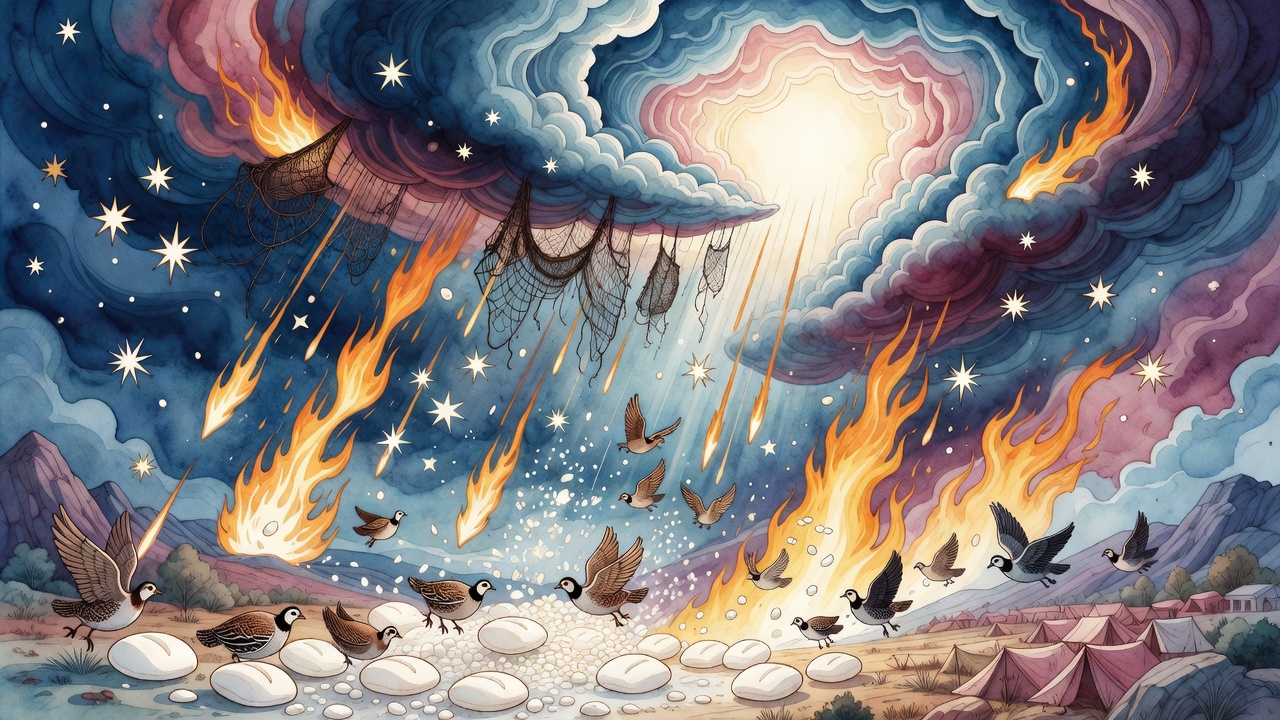
From one heaven God rained snares, fire, and stars of war, then soft manna for Israel, while quail fell with a darkened face beside the white bread of the camp.

Curated by Arthur · Told by Maggid ·
Table of Contents
  1. The Baker's Oven
  2. Quail With a Darkened Face
  3. Manna Prepared Like Tables of Gold
  4. How Long the Taste Lasted

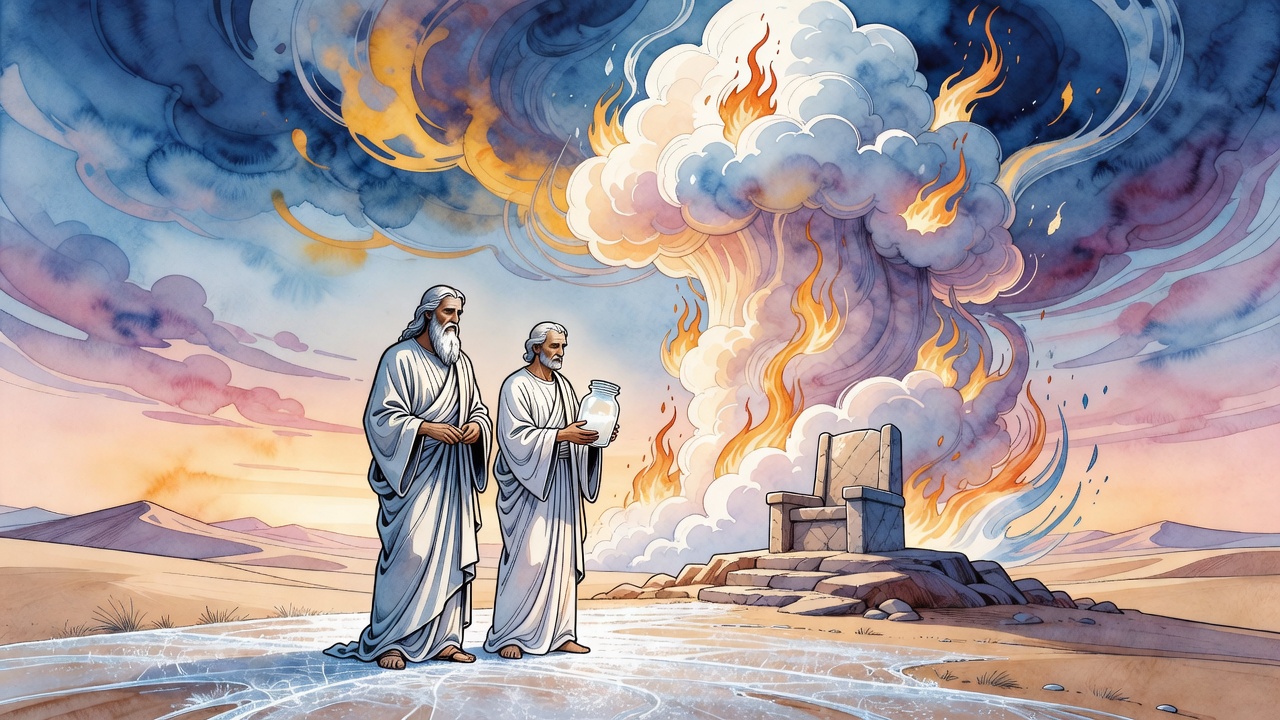
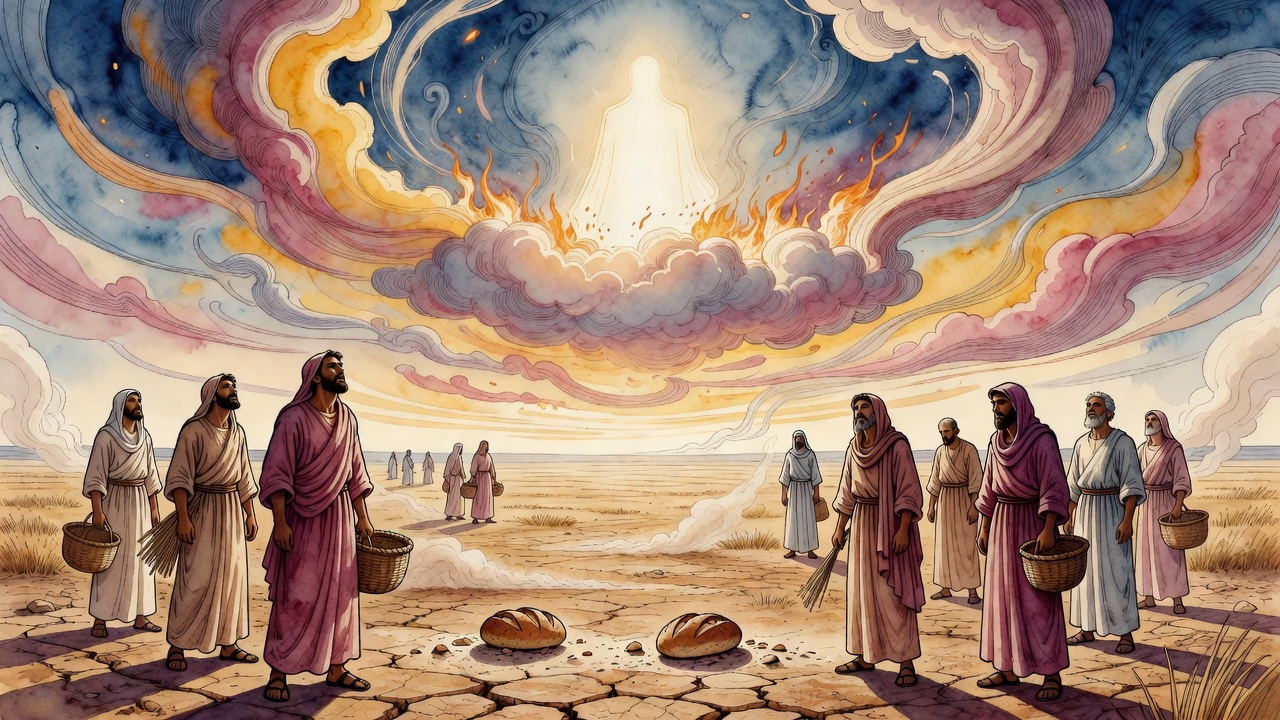
Moses stood under a sky that had already killed and already fed, and the people wanted breakfast with a complaint attached. "I will rain bread from heaven for you," the LORD said, and the sages heard Job answering from another age: by them He judges peoples; He gives food in abundance. One sky. Two works.
Coals and Loaves Fell From One Sky Over Israel Click for full size

Israel looked up the way every generation looks up when the stomach leads the theology. Some wanted bread because empty bellies are an honest argument. Some wanted meat because appetite can dress itself as need. Heaven already knew both sentences before Moses repeated them.

The Baker's Oven

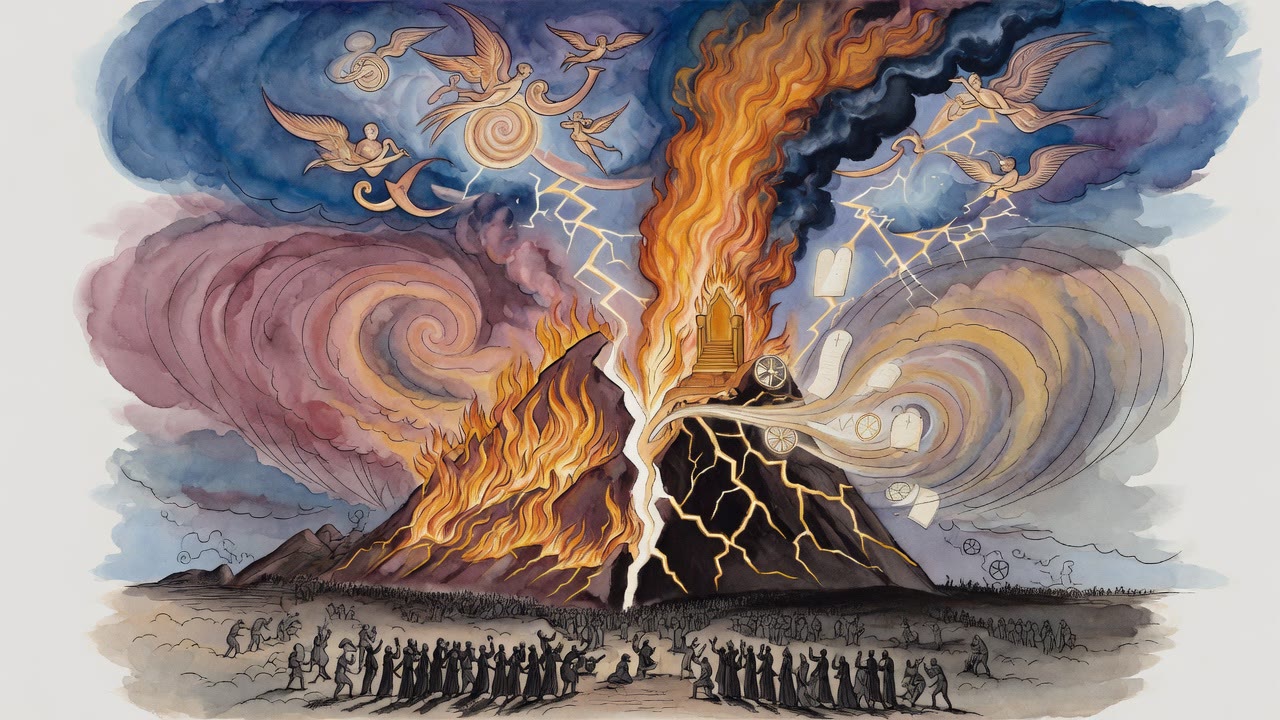
Picture a baker at his oven, the midrash says. An enemy comes and rakes out burning coals to heap on the baker's head. A friend comes and draws out a fresh hot loaf for his hands. Coals and loaf rose from one fire. So with the Holy One. The generation of the Flood took snares from above. Sodom took fire and brimstone. Sisera took stars fighting in their courses. Israel took soft white manna. The flame did not split into a kind god and a cruel god. The difference lay in who stood under the same power.

Heaven is not divided into a gentle half and a hard half. Judgment and provision share a roof. The people who murmur under that roof still eat, and the people who once drowned under it still prove that the roof can open as doom.

Quail With a Darkened Face

Bread was a true need, so God gave bread. Meat rode in on a full appetite, so God gave meat too, not as a clean prize but as a proof of power that would later weigh as judgment. The quail fell at evening with what the midrash calls a darkened face. Still the measures were wild. Some said two cubits high, gathered at the heart. Rabbi Yose the Galilean stretched it three parasangs. Others worked the numbers larger still, yet the food landed near the dwellings, a table set even before people who had angered God.

Israel looked at that abundance and drew a harder line than the menu. If this is what the Omnipresent gives His provokers, the reward stored for the righteous must be greater still. The gift became a mirror. The darkened face of the quail warned that not every full mouth is a blessing without remainder.

Manna Prepared Like Tables of Gold

A north wind swept the wilderness clean. Rain pressed the earth flat. Dew rose. Wind shaped the surface into tables, and manna descended on them. The people who would later feed idols with that same bread still found morning portions waiting, because righteousness in the feeding belonged to God, not to their manners.

Aaron set aside a jar of manna in the second year, when the Ark was made, so the sign could rest before the testimony. The sages placed that manna among ten things created at twilight on the first Sabbath eve, in the seam between labor and rest: manna, rainbow, Moses' staff, the shamir, script and tablets, the mouth of the earth, the mouth of Balaam's donkey, Moses' hidden grave, the cave of Moses and Elijah. Planted wonders sat beside sealed mysteries no one owns: day of death, hour of comfort, depth of judgment, another heart, the timing of David's restored kingdom.

How Long the Taste Lasted

Scripture says Israel ate manna forty years, until the edge of an inhabited land. The fall stopped the day Moses died, on the seventh of Adar. Vessels held the remainder until the sixteenth of Nisan in Joshua's book. Some counted leftover days one way, some another. Rabbi stretched the experience to fifty-four years when conquest still tasted of that bread.

When Miriam died, the well dried. When Aaron died, the cloud left. Both returned for Moses' sake. When Moses died, well, cloud, and manna withdrew together, and even the hornet that had driven enemies did not cross the Jordan with them. The gifts had ridden on the lives of those who carried them. One sky had judged and fed. One jar kept the proof. One people learned that the oven never needed two gods to bake both coal and loaf.

Mothers ground manna with whatever tool the morning allowed and tasted a sweetness that did not match the bitterness of their complaints. Children asked why meat arrived with a shadowed face and bread with a clean one. Elders who remembered Egypt's pots had to learn a new kitchen under an open sky that answered appetite and guilt on the same wind.

Aaron's jar was not nostalgia in glass. It was a portable proof for generations who would forget how daily bread once refused to be stored past trust. Forty years of falling, then a death date, then vessel days, then silence. The oven in heaven never needed a second flame to switch from coal to loaf. Israel only needed eyes honest enough to notice which gift they were standing under.


← All myths
From the tradition

Sources

4 sources

The texts behind this telling. Some cards carry a translation of the source; others are our own retelling of it, and each card says which. Every card links out to the original.

Yalkut Shimoni on Torah 258:1Yalkut Shimoni on Torah

Translation of the source text.Torat Emet (Yalkut Shimoni) · CC-BY-NC

"And the LORD said to Moses, Behold, I will rain bread from heaven for you" (Exodus 16:4). This is what the verse says: "For by them He judges peoples; He gives food in abundance" (Job 36:31). By these very heavens He judges the nations of the world. Know it for yourself: when the generation of the Flood sinned, He judged them by the heavens, as it is said, "He will rain upon the wicked snares" (Psalms 11:6). When the men of Sodom sinned, He judged them through the heavens, as it is said, "And the LORD rained upon Sodom." When Sisera sinned, He judged him through the heavens, as it is said, "From heaven they fought" (Judges 5:20). "He gives food in abundance" (Job 36:31): from those same heavens He gave sustenance to Israel, as it is said, "Behold, I will rain bread from heaven for you." To what may the matter be compared? To a baker who was standing at the oven. His enemy entered and raked out coals and set them upon his head; his friend entered and drew out a hot loaf and gave it to him. The coals and the loaf both came out of the same oven. So too the Holy One, blessed be He, brought down fire upon the Sodomites and burned them from heaven, and brought down manna for Israel.

Full source
Yalkut Shimoni on Torah 259:1Yalkut Shimoni on Torah

Translation of the source text.Torat Emet (Yalkut Shimoni) · CC-BY-NC

"And the LORD spoke to Moses, saying, I have heard the complaints of the children of Israel" (Exodus 16:11-12). Rabbi Yehoshua says: The Holy One, blessed be He, said to Moses, Revealed before Me is what Israel has said and what they are destined to say. "Speak to them, saying, At twilight you shall eat meat" (Exodus 16:12): say to them, You stand between two matters. You asked Me for bread, because flesh and blood cannot live without bread, and I gave it to you. You returned and asked for meat to fill the belly; behold, I am giving it to you, lest you say that I do not have the capacity to give it to you. But in the end I will exact payment from you. "And you shall know that I am the LORD your God" (Exodus 16:12): I am Judge enough to exact payment from you.

"And it came to pass in the evening that the quail came up and covered the camp" (Exodus 16:13). From here you learn that the quail was given to Israel with a darkened face. "And it covered the camp": I do not know how much. Scripture therefore teaches, "and about two cubits upon the face of the earth" (Numbers 11:31): it was two cubits high from the ground, so that a person could stand, take it opposite his heart without strain, and remain upright, for from his heart downward is two cubits and from his heart upward is one cubit. Rabbi Yose the Galilean says: "And He spread it over the camp, about a day's journey on this side and about a day's journey on that side" (Numbers 11:31): three parasangs in every direction. "And about two cubits upon the face of the earth around the camp" (Numbers 11:31), and it says, "He let it fall in the midst of their camp" (Psalms 78:28). Rabbi Yoshiyah says: Scripture says, "And He spread it over the camp," three parasangs in every direction. What does Scripture teach by "about a day's journey"? Three; three by three makes nine, and nine plus nine makes eighteen. "And about two cubits upon the face of the earth around the camp," and it says, "He let it fall in the midst of their camp, around their dwellings" (Psalms 78:28). Others say: "about a day's journey on this side," a medium day's journey is ten parasangs; "and about a day's journey on that side" makes twenty [parasangs of] day-journey. "And about two cubits upon the face of the earth around the camp," and it says, "You prepare a table before me in the presence of my enemies" (Psalms 23:5). One might think the roads were ruined; what does Scripture teach by "upon the face of the earth"? Upon the open ground of the earth. One verse says "around the camp," and one verse says "around their dwellings"; rather, it was attached to their dwellings.

Rabbi Elazar of Modiin says: "and about two cubits upon the face of the earth" means that the manna was two cubits high from the ground, and Israel took it only from above. You say: go out and see how the manna would descend for Israel. A north wind would go out and sweep the wilderness; rain would descend and press down the earth; the dew would rise; the wind would blow and make it like tables of gold; and the manna would descend upon them. From those tables Israel would take it, and they would say: if the Omnipresent prepared this for those who anger Him, how much more will He pay good reward to the righteous in the time to come.

Full source
Yalkut Shimoni on Torah 261:10Yalkut Shimoni on Torah

Translation of the source text.Torat Emet (Yalkut Shimoni) · CC-BY-NC

(Exodus 16:32-34) "This is the thing that the LORD commanded." One might think Aaron only placed it down in the fortieth year after the Exodus; therefore Scripture says, "And Aaron placed it," etc. And when was the Ark made? In the second year; so too Aaron only placed it down in the second year. And this is one of ten things created at twilight on the eve of the Sabbath, and these are they: the rainbow, the manna, the staff, the shamir-worm, the script, the tablets, the opening of the earth's mouth that swallowed the wicked, the opening of the donkey's mouth, the grave of Moses, and the cave in which Moses and Elijah stood. Another interpretation: also the garments of the first man, and the staff of Aaron with its almonds and blossoms.

Seven things are hidden from human beings: the day of death, the day of consolation, the depth of judgment, no person knows by what he will profit, no person knows what is in his fellow's heart, when the kingdom of the house of David will return to its place, and when the kingdom of the Samaritans will be uprooted.

Full source
Yalkut Shimoni on Torah 261:12Yalkut Shimoni on Torah

Translation of the source text.Torat Emet (Yalkut Shimoni) · CC-BY-NC

(Exodus 16:35) "And the children of Israel ate the manna forty years." It is impossible to say "until they came to an inhabited land," for it already says "to the edge of the land of Canaan"; and it is impossible to say "to the edge of the land of Canaan," for it already says "to an inhabited land." How so? On the seventh of Adar Moses died and the manna stopped coming down, and they were supplied from the manna in their vessels until the sixteenth of Nisan. Another teaching: "And the children of Israel ate," etc. Did they eat it forty years? Rather, the cakes that Israel brought out of Egypt, in them they tasted the taste of manna.

"And the children of Israel ate the manna" forty days after the death of Moses. How so? Moses died on the seventh of Adar, and they ate from it twenty-four days of Adar and sixteen of Nisan, as it is said (Joshua 5:12), "And the manna ceased on the next day." Rabbi Eleazar of Modi'in says: seventy days they ate the manna after the death of Moses. How so? Moses died on the seventh of the first Adar, and they ate from it twenty-four days of the first Adar and thirty of the second Adar, for it was a leap year, and sixteen of Nisan, as it is said, "And the manna ceased on the next day." Rabbi Eliezer says: seventy days Israel ate the manna after the death of Moses. How so? Moses died on the seventh of Shevat and they ate from it twenty-four days of Shevat and thirty of Adar, and that year was not a leap year, and sixteen of Nisan, as it is said, "And the manna ceased." Rabbi says: fifty-four years Israel ate the manna, forty years in the lifetime of Moses, as it is said, "And the children of Israel ate the manna," for there is no need for Scripture to say "the manna they ate until they came to the edge of the land of Canaan"; rather these are the fourteen years after the death of Moses, namely the seven of conquest and the seven of division.

When Miriam died the well was removed; when Aaron died the pillar of cloud was removed, and both returned by the merit of Moses. When Moses died all three were removed and did not return. And the hornet did not cross the Jordan with them.

Full source