Retold in our words. Read the original at the link below.Townsend 1989 translation of Midrash Tanhuma, S. Buber Recension · CC-BY
And Abraham was old, well stricken in age (Gen. 24:1). Scripture states elsewhere in allusion to this verse: Bless the Lord, O my soul. O Lord my God, Thou art very great; Thou art clothed with glory and majesty (Ps. 104:1). What prompted David to bless the Holy One, blessed be He, with his soul? He did so because the soul sees but is not seen, and the Holy One, blessed be He, sees but is not seen. Hence, the soul that sees but is not seen praised the Holy One, blessed be he, who sees but is not seen. Similarly, the soul guards the body and the Holy One, blessed be He, guards the entire universe. It is fitting, therefore, that the soul which guards the body should praise the Holy One, blessed be He, who guards His world. What is the meaning of the verse O Lord my God, Thou art very great? R. Eleazar explained it thus: “You were great before You created Your world, but Your greatness was magnified after You created Your world,” as it is said: Thou art very great.
If a mortal king engraves his image upon a plaque, the plaque must be larger than the image, but the Holy One, blessed be He, is great and his image is larger than the entire world. In regard to heaven, it is written: Behold, the heavens and the heavens of heavens cannot contain Thee (I (Kings 8:2)7), and concerning the earth, it is said: The whole earth is full of His glory (Isa. 6:3). The fact is that the heavens are contained merely in the span of the Holy One, blessed be He, as it is said: And meted out heaven with the span (ibid. 40:12), and the earth is but a third of his span, as is said: And comprehended the dust of the earth in a measure (ibid.). He measured the seas and the rivers in the hollow of His hand, as it is written: Who hath measured the waters in the hollow of his hand (ibid.).
Scripture states: For the Lord (be-Yah) the Lord is an everlasting rock (ibid. 26:4). What is meant by zur ‘olamim (“everlasting rock”)? This verse informs us that all the worlds are considered as nothing in His sight, for with only half His name He created the world. Indeed the worlds would have continued to expand without end had He not said enough, as it is written: I am God, Shaddai (Gen. 17:1). What is signified by the word Shaddai? That I said to the world, dai (“enough”)! Hence, it is said: O Lord my God, Thou art very great.
A mortal king first constructs the lower story of his home, and then builds an attic upon it, but the Holy One, blessed be He established His (heavenly) throne first and then erected the upper story. Upon what did he fashion the upper story? Upon the empty space beneath. After this He made His chariots, the clouds, as David informs us in the verse: Who layest the beams of His upper chambers in the waters, who makest the clouds His chariot, who walkest upon the wings of the wind (Ps. 104:3). He fashioned the upper stories with beams and balconies of water, not with brass or iron, and He constructed the heavenly spheres with walls of compressed water, not with stones or hewn blocks, as it is said: Who layest the beams of His upper chambers in waters.
A mortal king builds his chariots of iron or silver, so that they may be strong enough to bear his weight, but the Holy One, blessed be He, made the clouds His chariots, as it is said: Who maketh the clouds His chariot. If the path before a mortal king is muddy, he walks upon stones which are firmly set within it, but the Holy One, blessed be He, abandons the visible clouds and travels upon the invisible winds, as it is said: Who walkest upon the wings of the wind. A mortal king surrounds himself with mighty officers and arms them with weapons and armor, but the officers of the Holy One, blessed be He, are invisible, as it is said: Who makest winds His messengers (ibid. v. 4). And the wind produces the lightning, as is said: Flaming fire His ministers (ibid.).
After He fashioned the firmament, He created the angels, and the fire of Gehenna on the second day, for about that day it is not written: And God saw that it was good (Gen. 1:1). However, the pits of Gehenna were created two thousand years before, as it is said: For a hearth is ordered of old (lit. “yesterday”) (Isa. 30:33). Just as a man who is about to purchase some slaves tells his servants: “Prepare the executioner’s sword so that they will hear the call to judgment if they should rebel,” likewise, the Holy One, blessed be he, may His Name be blessed, prepared Gehenna so that if His creatures sin, they can be cast down into it.
Whence do we know that Gehenna was created on the second day? From the verse For a hearth is ordered of yesterday (Isa. 30:33). It was the day on which a man could refer only to yesterday and not to “the day before yesterday.” When could a man refer to yesterday? Only on the second day (of Creation), which was preceded by the first day of the week. After that He created the dry land on the third day of the week, as it is said: Who didst establish the earth upon its foundations, that it should never be moved forever and ever (Ps. 104:5). He covered one part of the world, and uncovered another. To what may this be compared? To a man who owns two slaves, and strips the clothing from one in order to cloth the other. The Holy One, blessed be He, did likewise. He gathered the waters beneath the heavens to one place, and in that way uncovered the earth while covering the deep, as it is said: Thou didst cover the deep as with a vesture (ibid. v. 6).
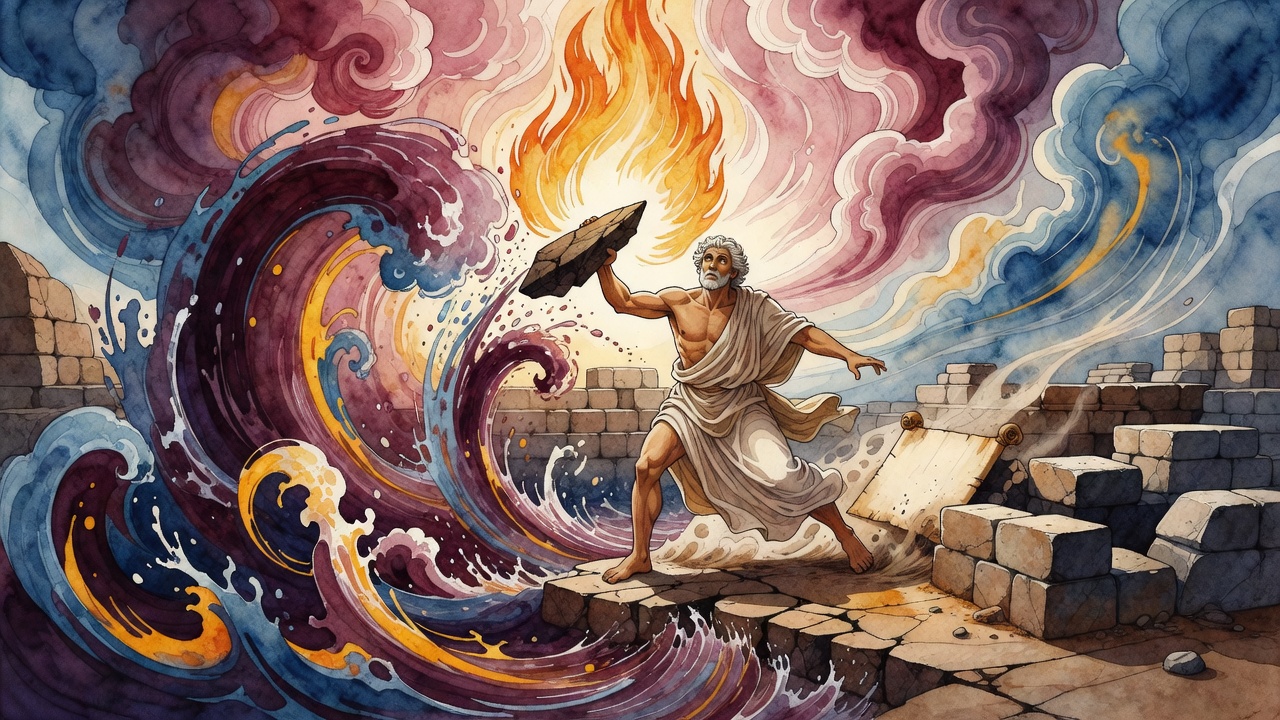
At Thy rebuke they fled (ibid.). When a man sees that his winepress is filled with grapes, and that his vineyard is ready for cutting, others may ask him: “What will you do with these grapes, since the vat is too small to contain them?” What does he do? He treads down the grapes in the vat and then puts in the new grapes. Then it is able to contain all his grapes. Similarly, though the entire world was submerged under water, the Holy One, blessed be He, declared: Let the dry earth appear (Gen. 1:9). The water thereupon cried out: “Though we fill the entire world, it is cramped for us. Whither shall we go?” What did the Holy One, blessed be He, do? He trampled upon the ocean and slew its prince, as it is said: He stirreth up the sea with His power, and by His understanding he smiteth through Rahab (Job 26:12). Smiteth is an expression that indicates slaying, as it is said: And with the hammer she smote Sisera, she smote through his head, yea, she pierced and struck through his temple (Judg. 5:26). The seas mourn (bohin) to this very day because He slew the prince of the sea, as is said: Hast thou entered into the springs (nibhe) of the sea? (Job 38:16). Why did He slay him? Because a house that can accommodate a hundred living people can contain a thousand dead. That is why the ocean is called the Dead Sea. However, the Holy One, blessed be He, will heal it, as it is said: When they shall enter into the sea of the putrid waters, the waters shall be healed (Ezek. 47:8). When the other waters observed that the Holy One, blessed be He, had trampled upon the ocean, they fled from the loud cries of their fellow-waters, as it is said: At Thy rebuke they fled, at the voice of Thy thunder they hastened away (Ps. 104:7).
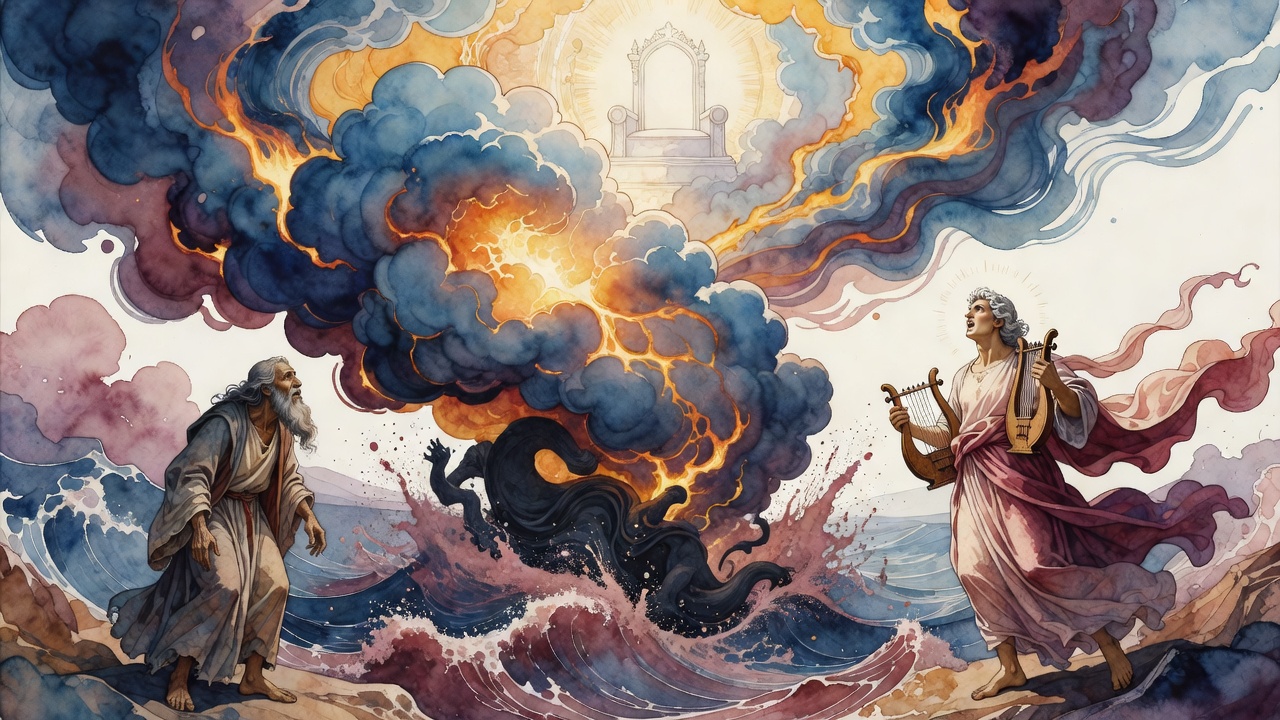
They fled, but they did not know where to flee, as it is said: The mountains rose, the valleys sank down, unto the place which Thou hast founded for them (ibid. v. 8). This may be compared to a slave whose master commands him to wait for him in the market but neglects to tell him where to wait. The slave asks himself: “Perhaps my master meant that I should wait near the basilica, or the bathhouse, or the theater.” When they finally meet, the master slaps him on the face, and says: “I sent you to the gate of the duke’s palace.” Similarly, when the waters heard the decree, Let the waters underneath the heavens gather in one place (Gen. 1:9), they did not know whether (they were to go) to the north or the south. And so, they raced about, as it is said: The mountains rose, the valley sank (Ps. 104:8), until the Holy One, blessed be He, struck them, and declared: I ordered you to assemble at the place of the Leviathan, as is said: There go the ships; there is the leviathan, whom Thou hast formed to sport therein (ibid. v. 26).
Thou didst set a bound beyond which they should not pass (ibid. v. 9). Just like a man who drives his cow into the barn and then locks the door so that the cow might not escape and consume the grain, so the Holy One, blessed be He, hemmed in the waters of the sea with sand, and exacted the promise that they would not pass beyond the sand, as it is said: Thou didst set a bound beyond they should not pass (ibid.). Who sendeth forth springs into the valleys; they run between the mountains (ibid. v. 10). For example, a man who has two bales of olives will press the beam against both of them, and the oil will descend, and flow out below. Similarly, when the hill from one place pressed against the hill of another place, the waters cut their way through and flowed forth from between the hills.
Who causeth the grass to spring forth for the cattle (ibid. v. 14). There are three things a man does not wish to have happen to him: weeds in his field; a woman among his sons; and ferment within his wine. But all three were created to meet the needs of the world. And thus it is said: O Lord my God, Thou art very great (ibid. v. 1). Another comment on O Lord my God, Thou are very great: Thou art very great refers to the wondrous deeds You performed for man when you gave him old age and a hoary head. If this had not been done, men would not know whom to honor. The word very alludes only to old age, as it is said: Eli was very old (I Sam. 2:22). Thou art clothed with glory and majesty (Ps. 104:1). Glory signifies the strength with which I clothed you at the sea, as is said: The Lord is my strength and my song (Exod. 15:2). R. Judah the son of Ilai said: He praised Me and I praised him (Israel). Majesty alludes to the majesty with which you were adorned through Me at Sinai above all the nations of the world. R. Judah the son of Simon stated: Because they declared: All that the Lord hath spoken we will do and hear (Exod. 24:7), Scripture speaks of them at that moment As a lily between the thorns (Song 2:22). Another comment on Thou art clothed with majesty and glory. This refers to the adornment with which you crowned the head of Abraham when you gave him the crown of old age, as it is said: And Abraham was old.

 Click for full size