Parshat Toldot5 min read

Esau Killed Nimrod and Stole the Garments of Adam

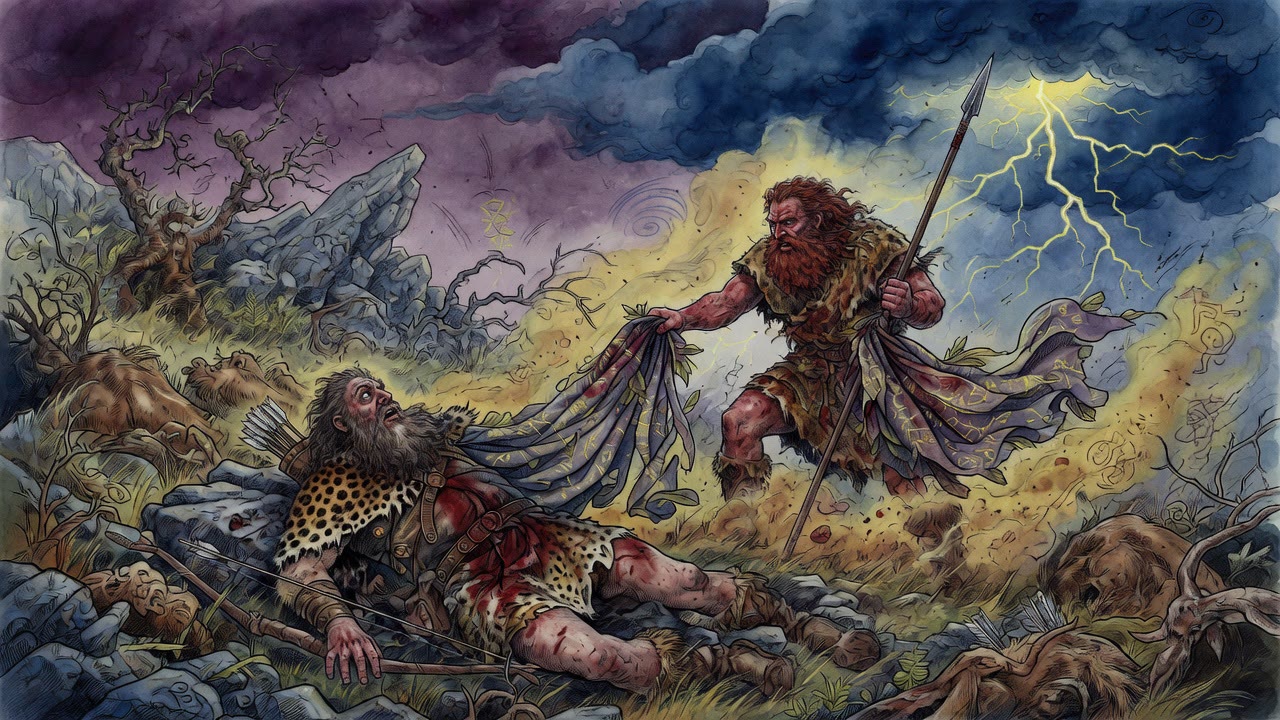
Before Esau sold his birthright, he had already killed a king. The clothes he stripped from Nimrod's body had belonged to Adam himself in the Garden of Eden.

Curated by Arthur · Told by Maggid ·
Table of Contents
  1. What Changed Hands That Afternoon
  2. How the Garments Gave Nimrod His Power
  3. The Jealousy That Festered for Years
  4. The Day of the Hunt
  5. What the Garments Mean as a Set

What Changed Hands That Afternoon

On the day Esau came home from the field exhausted and sold his birthright for a bowl of stew, he had already committed a murder. The bowl of lentils was the last transaction of a much longer day. Most readings of Genesis 25 focus on the bread and the soup. The ancient sources knew that something far older had changed hands that afternoon.

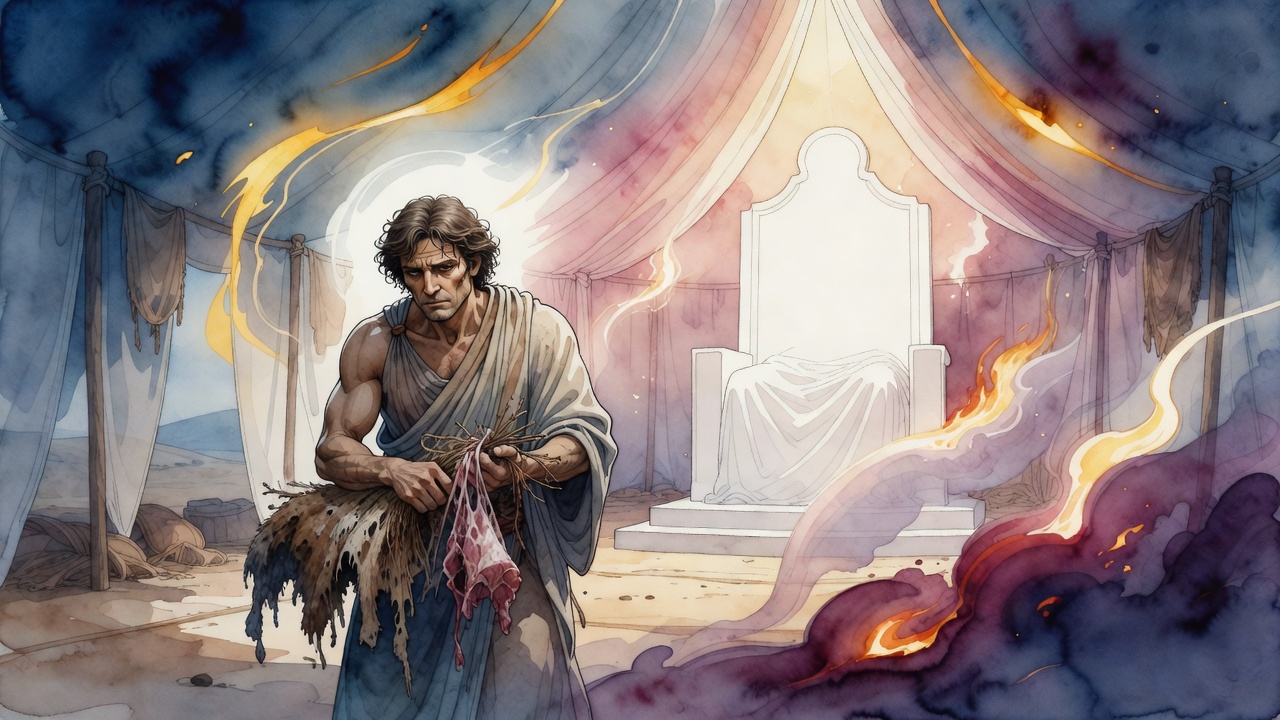
The clothes were older than the murder, older than Nimrod, older than Abraham. They were the garments God had made for Adam and Eve after the fall, described in Genesis 3:21 as coats of skin that God fashioned Himself. These were not ordinary hunting clothes. They carried within them something of the original dominion God had given Adam over every living creature. When Adam wore them, he was clothed in the authority of creation's first morning. When those garments left the garden, they carried that authority with them.

How the Garments Gave Nimrod His Power

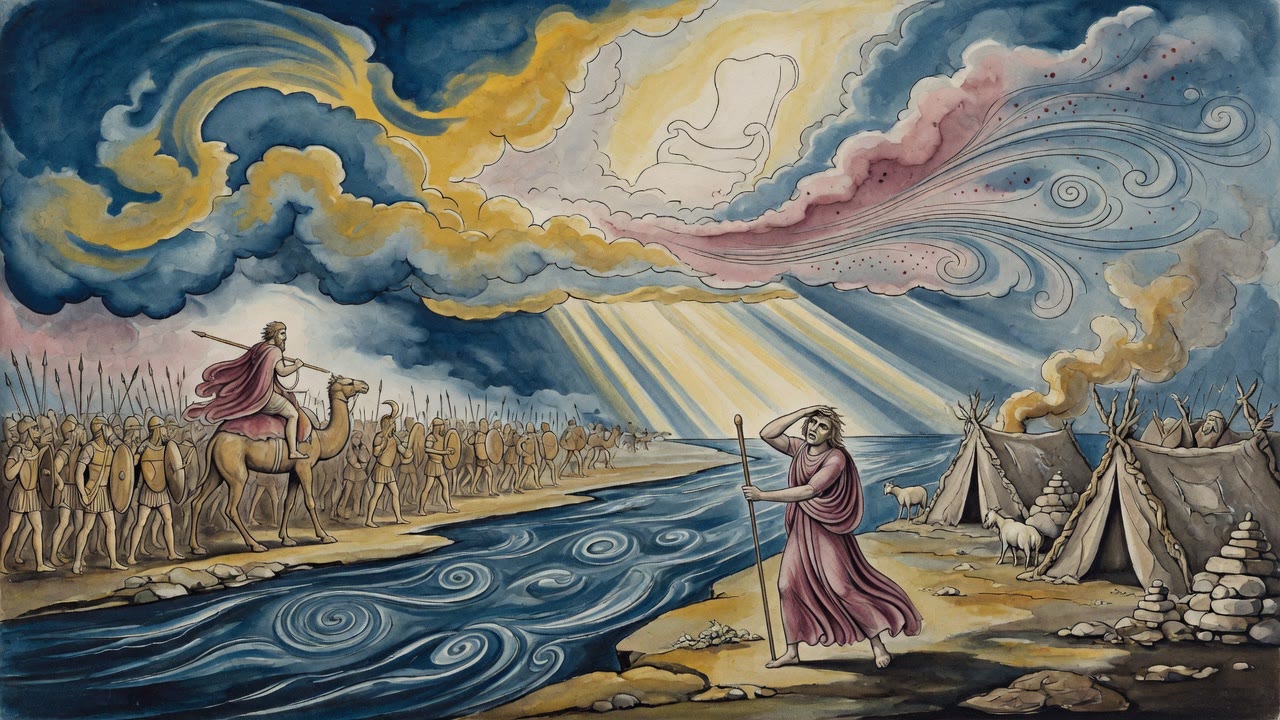
The Book of Jasher, an ancient text referenced in the Hebrew Bible at Joshua 10:13 and 2 Samuel 1:18, records the chain of possession. The garments passed from Adam to his descendants and eventually came to Nimrod. When Nimrod put them on, every living thing submitted to him. Animals came when he called. Men followed him instinctively. His uncanny power as a hunter, his ability to build empires and command armies, his reputation as a mighty man before the Lord, all of it derived not from his own strength but from what he was wearing.

This is why the tradition calls him a mighty hunter before the Lord and not a mighty hunter in his own right. The garments were making the claim, not the man inside them. Nimrod understood this, which is why he never took them off willingly.

The Jealousy That Festered for Years

Esau was a hunter by nature, the best of his generation, a man who lived in the field and came home smelling of game. Nimrod was also a hunter, also the best of his generation in his own era, also a man who dominated the wilderness. The two great hunters of their respective ages could not coexist without tension.

Jealousy formed in Nimrod's heart against Esau, the Book of Jasher records, and it accumulated over years. The exact source of the jealousy is not stated explicitly, but the shape of it is clear: Nimrod saw in Esau a rival for the title that his garments were supposed to guarantee him. Every animal Esau killed was an implicit challenge to the dominion that Nimrod wore on his body every day. The garments gave Nimrod power over living things, but Esau had that power without garments, from his own instinct and skill.

The Day of the Hunt

Esau was returning from the field, exhausted and hungry, when he crossed paths with Nimrod and two of his servants. The specifics of what happened are slightly different in the two accounts: the Book of Jasher describes an ambush, Esau waiting in concealment and striking when the opportunity came; Legends of the Jews, Ginzberg's synthesis of rabbinic tradition, describes a confrontation born of years of accumulated enmity.

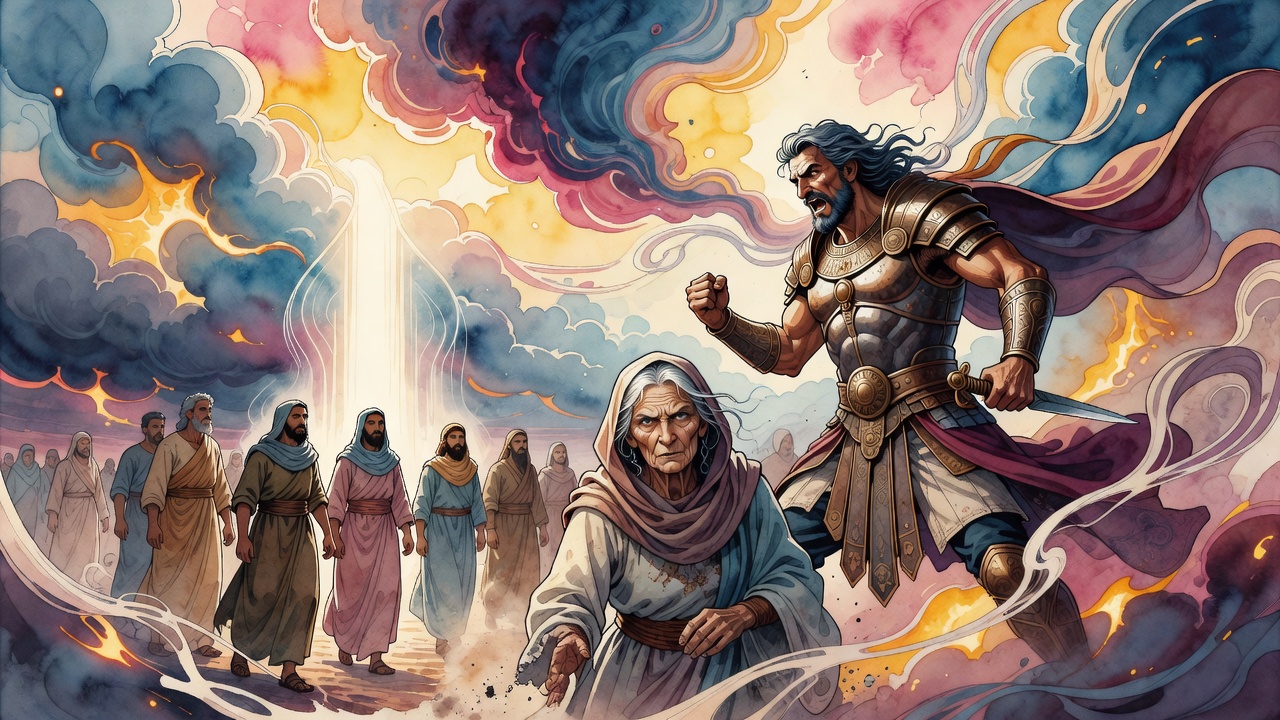
In both versions, Esau killed Nimrod and took the garments. He killed Nimrod's two servants as well. Then he ran, because Nimrod had warriors and Esau had just killed their king. He ran until he reached his father's house, exhausted, the garments under his arm. Exhausted from the killing, from the running, from whatever had preceded the encounter, from the strange weight of carrying something older than any living person could remember.

He came in and found Jacob cooking lentils. He sat down and asked for soup and sold the birthright of Abraham, the covenant promise that had sustained his grandfather through the furnace and the stars and Moriah, for a bowl of stew. He ate. He drank. He rose. He went. He scorned the birthright.

What the Garments Mean as a Set

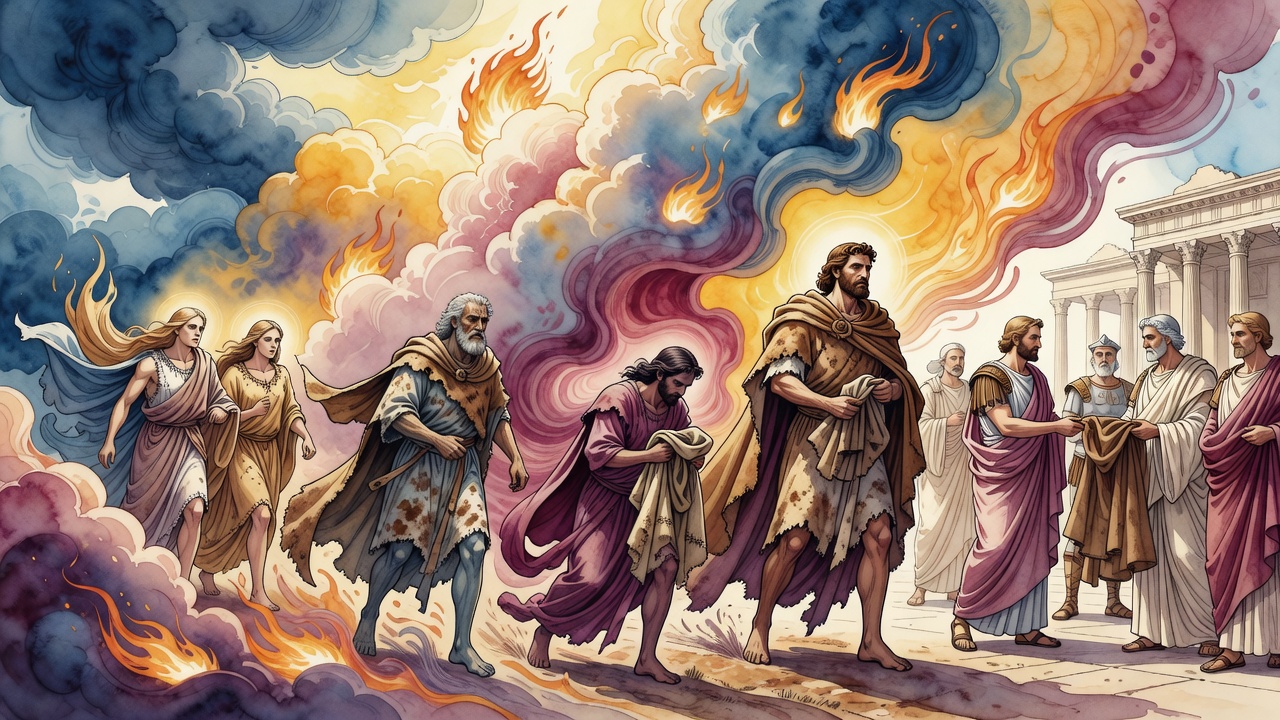
The garments that gave Nimrod power over living things and that Esau stripped from his corpse are the same garments that Rebekah would later take from her elder son and put on Jacob so that Isaac would smell Esau when Jacob came in for the blessing. The chain is continuous. The clothes that God made in the garden to cover Adam's nakedness traveled from Adam to Nimrod to Esau to the tent of Isaac, and in the tent of Isaac they surrounded Jacob and gave him his father's blessing.

Esau killed a king to get them. He sold his birthright the same day. He did not, apparently, understand what he was carrying. The man who owned the garments of Adam, who had just proven he could take them by force from the mightiest king in the world, traded the spiritual legacy of his family for dinner. The garments outlasted the transaction. They always did.


← All myths
From the tradition

Sources

5 sources

The texts this telling draws on, in full. Open a card to read inline, or expand it for a wider, quieter read.

Jasher 27Book of Jasher

Sefer haYashar, as it's known in Hebrew, is an ancient text referenced in the Bible itself (Joshua 10:13 and (2 Samuel 1:1)8), though the version we have today is likely a medieval work that draws upon older traditions and midrashic (rabbinic interpretive commentary) interpretations.

Our story centers on Esau, the brother of Jacob, and Nimrod, the mighty hunter and king of Babel. According to the Book of Jasher, after the death of Abraham, Esau was frequently out hunting. Nimrod, identified here as Amraphel (a name familiar from the story of Abraham and the kings in Genesis 14), was also a keen hunter, often accompanied by his warriors.

There was a darkness brewing. That "a jealousy was formed in the heart of Nimrod against Esau all the days." Why? The Jasher doesn't explicitly say, but we can infer a power struggle, a sense of rivalry between these two powerful figures.

One day, Esau is out hunting and spots Nimrod in the wilderness with only two companions. Nimrod's mighty men were also in the field, but they were far away. Seizing the opportunity, Esau ambushes Nimrod, drawing his sword and cutting off his head! A brutal act, to be sure.

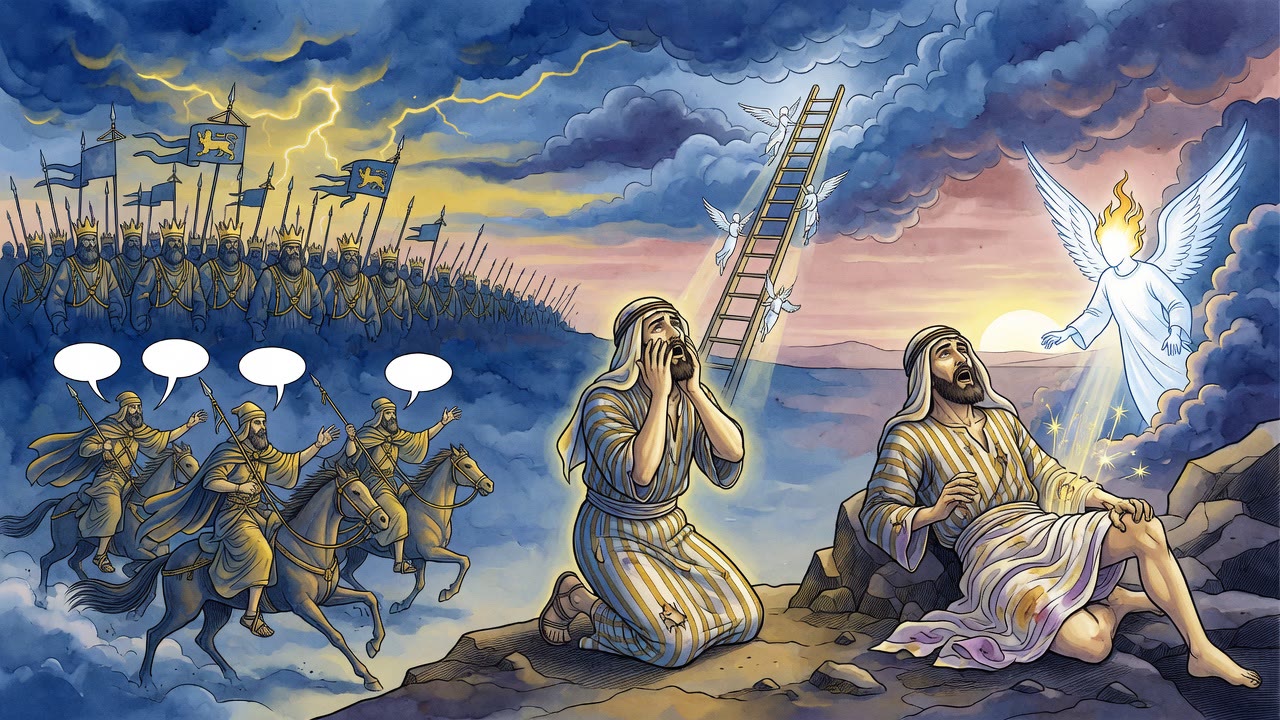
Esau then fights and kills Nimrod's two companions. The cries of these men are heard by Nimrod's warriors in the distance. They rush to the scene, only to find their king and his companions dead. Seeing them approach, Esau flees.

But he doesn't leave empty-handed. Esau takes Nimrod's valuable garments, garments that Nimrod's father had bequeathed to him, garments that had, helped Nimrod gain power over the land. Esau hides these garments in his house.

Exhausted and grief-stricken from the fight, Esau stumbles into his brother Jacob's presence. "Behold I shall die this day," he cries, "and wherefore then do I want the birthright?"

Ah, the birthright. The inheritance, the blessing, the future. Jacob, ever the pragmatist, seizes the moment. He acts "wisely," the text says, and Esau sells his birthright to Jacob. Not only that, but Esau also sells his portion in the Cave of Machpelah, the burial ground Abraham had purchased (Genesis 23). Jacob documents the entire transaction, sealing it with witnesses.

And what of Nimrod? His men carry his body back to the city and bury him. The Book of Jasher tells us Nimrod lived for 215 years and reigned for 185. He died, the text emphasizes, "by the sword of Esau in shame and contempt," and that the seed of Abraham caused his death, as Nimrod had seen in a dream.

The aftermath is significant. Nimrod's kingdom fractures, and the lands he controlled are returned to their original rulers. The people of Nimrod's house are enslaved.

What are we to make of this story? It’s a violent tale of power, jealousy, and opportunity. It paints Esau as a cunning and ruthless figure, not just the simple hunter of popular imagination. And it highlights Jacob's shrewdness, his ability to recognize and seize opportunities, even in the midst of tragedy. It's a far more complex and nuanced picture than we often get.

The Book of Jasher provides us with a glimpse into the tradition of Jewish tradition, displaying how stories evolve, adapt, and offer different perspectives on familiar narratives. It reminds us that even the most well-known figures have hidden depths, and that the past is never quite as simple as it seems.

Full source
Legends of the Jews 6:19Legends of the Jews

Esau. We know him as Jacob's brother, the one who traded his birthright for a bowl of stew. But there's so much more bubbling beneath the surface. According to Ginzberg's retelling in Legends of the Jews, Esau was involved in a deadly feud, a clash of titans, really.

His rival? None other than Nimrod. Yes, that Nimrod – the "mighty hunter before the Lord," as the Bible describes him (Genesis 10:9).

You might be thinking, what’s the beef? Why would these two be at odds?

The answer, it seems, lies in jealously and the thrill of the hunt. Both men, Esau and Nimrod, dedicated themselves to the chase. Legends of the Jews tells us that Nimrod was envious of Esau's hunting prowess. Imagine the tension! Two alpha males, each vying for dominance in the wilderness.

The stage is set for a showdown.

One fateful day, as Nimrod was hunting, he became separated from the main group. Only two of his adjutants remained with him. Esau, ever the opportunist, saw his chance. He lay in ambush, patiently waiting for Nimrod to pass by.

Can you feel the suspense building?

Then, in a flash, Esau sprang into action. He attacked Nimrod and his two companions, felling them all. The cries of Nimrod's men alerted the rest of his attendants, but it was too late. Esau had already stripped Nimrod of his garments and fled to the city.

A dramatic escape, a brutal end.

This wasn't just a random act of violence, though. It was the culmination of a long-standing feud, a battle for supremacy between two powerful figures. And it all happened, according to the Legends of the Jews, on the very same day that Esau was mourning his father, Isaac. The complexity of grief mixed with violence, revenge intertwined with familial duty. It paints a far more nuanced picture of Esau than the simple story of the lost birthright. It begs the question, how well do we really know the characters in our most beloved stories? And what hidden depths lie beneath the surface of even the most familiar narratives?

Full source
Targum Pseudo-Jonathan on Genesis 27:15Targum Pseudo-Jonathan on Genesis

The Targum Pseudo-Jonathan adds a line that pulls the whole arc of Genesis together in one verse. The vestments Rebekah puts on Jacob, the Targum tells us, "had formerly been Adam's" (Genesis 27:15).

The garments Esau loved. The garments he kept with his mother in the house instead of in his own tent. Those garments, Pseudo-Jonathan reveals, reach all the way back to the first man in the garden.

The garments of Adam in Jewish tradition

The rabbis taught that the first garments Adam and Eve wore, the kotnot or, the garments of skin or light (the Hebrew can mean either), did not disappear when Adam died. They were passed to Noah, and from Noah to Shem, and from Shem eventually to Nimrod, who used them to hunt because they gave their wearer power over animals. Pirkei DeRabbi Eliezer chapter 24 traces this genealogy of holy clothing.

How did Esau get them? The Midrash tells us he killed Nimrod and took them. Now they sit, folded, in his mother's tent.

Why this detail changes the story

When Rebekah dresses Jacob in these vestments, she is not just covering his smooth arms to fool Isaac. She is clothing him in the oldest sacred garments in human history. The blessing Isaac is about to give is not landing on some ordinary shepherd. It is landing on a man wearing the primal robes of Adam.

The Targum is making a cosmic claim. The covenant with Jacob is a restoration, the return of a sanctity that began in Eden and was scattered through the generations. Pesach night, Adam's clothes, and Isaac's blessing converge on one son.

The takeaway: in Pseudo-Jonathan's world, the past is never gone. Every garment carries a lineage, and every blessing lands on a history.

Full source
Yalkut Shimoni on Torah 111:4Yalkut Shimoni on Torah

Another interpretation of "Behold, I am going to die": that Nimrod was seeking to kill him on account of that garment which had belonged to Adam the first man, for when Esau wore it and went out to the field, all the beasts and birds in the world would come and gather around him.

"And he said, Swear to me" (Genesis 25:33). Why did our father Jacob wish to give his life for the birthright? As we learned: before the Tabernacle was set up, the high places were permitted and the service was performed by the firstborn; once the Tabernacle was set up, the high places were forbidden and the service was performed by the priests. Jacob said, "Shall this wicked man stand and offer sacrifices?" This is what is written, "surely you hated blood, therefore blood shall pursue you" (Ezekiel 35:6), and this Esau hated blood. Rabbi Levi said: this is the blood of circumcision. Rabbi Shmuel bar Nahman said: this is the blood of the sacrifices. The Rabbis say: the hatred of a man's blood, yet you murder him! This is what is written, "He loved cursing, and it came upon him; he delighted not in blessing" (Psalms 109:17). Rabbi Levi said: he delighted not in the birthright. Rabbi Hama said: this is the blood of the sacrifices, which is called blessing, as you say, "An altar of earth you shall make for Me" (Exodus 20:21), and it is written, "I will come to you and bless you" (ibid.).

Full source
Midrash Aggadah, Genesis 27:15Midrash Aggadah

"The desirable garments of Esau her elder son" (Genesis 27:15). Some say these were the garments of Adam the first man, and they came into the hand of Nimrod; and he [Esau] coveted them, and killed him, and took the garment from him. "Which were with her in the house" (Genesis 27:15), now did he not have wives with whom he could have deposited them? Rather, he placed them in his father's house, in order to serve his father while wearing them.

Full source