Parshat Naso5 min read

Fire Defends Solomon From the Assembly's Ban

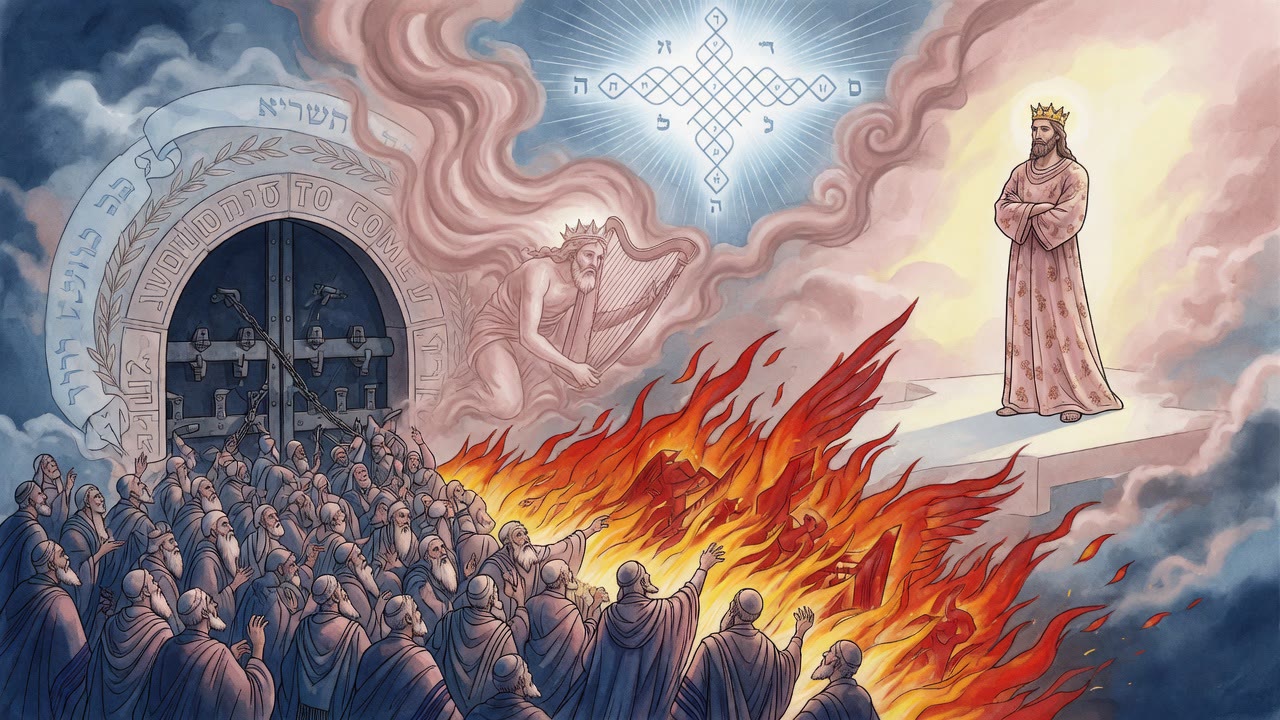
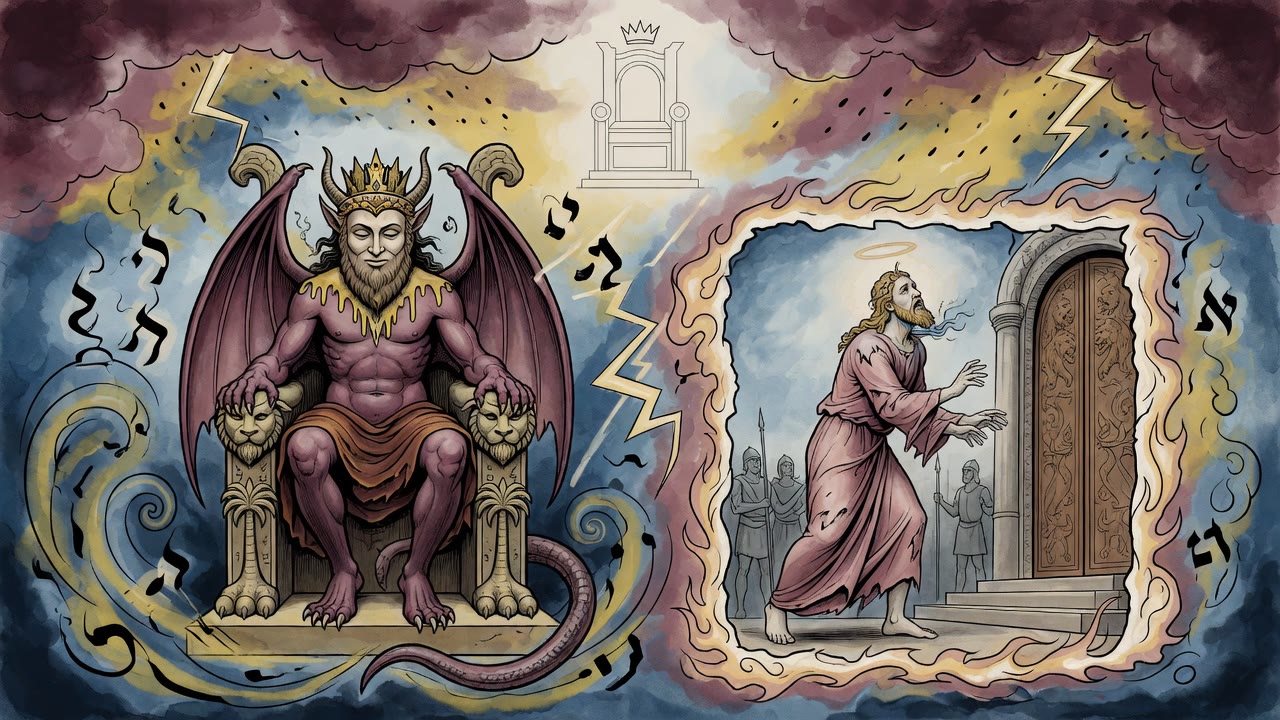
The Great Assembly moves to lock Solomon out of the World to Come until David's likeness bows, fire leaps, and a bat kol, a heavenly voice, forbids the ban.

Curated by Arthur · Told by Maggid ·
Table of Contents
  1. The Argument Over Menashe
  2. Someone Said Solomon
  3. David Went Down on the Floor
  4. The Verse From Job
Fire Defends Solomon From the Assembly's Ban Click for full size

The Argument Over Menashe

The list was doing damage before it ever reached the hard names, since a man's share in the World to Come is not a thing a room can weigh gently. Yerovam went down without trouble, and Ahab after him, and Bilam and Doeg and Ahithophel and Gehazi followed, because nobody in the Great Assembly needed persuading about any of them.

Menashe stopped the room. Rabbi Yehuda would not give him up, because Chronicles says the man prayed and was heard and was carried back to Jerusalem to his kingdom, and if repentance on that scale buys nothing, then nothing anyone does buys anything. The others granted him the kingdom and would go no further, since being restored to Jerusalem and being restored to the World to Come are two different ledgers, and the king who had filled that city with what he filled it with does not get both.

So Menashe stayed on the list, and the room found out that it could do that. A serious man had argued for a name and the name had gone down anyway, which left the pen warm for whatever came next.

Someone Said Solomon

Nobody had to explain the proposal, because the scroll of Kings lay open in front of them and every man there had read the end of it, the foreign wives and the high places raised on the hill east of the city. Once the name was out of a mouth it sat on the table like a stone none of them wanted to pick up.

Half of them understood at once that if Solomon could go on the Assembly's list, then no king in the record was safe. The other half thought that was the entire point of keeping a ledger, so the pen went toward the parchment.

David Went Down on the Floor

Then the likeness of David prostrated itself in front of them, a form of the father face down on the floor of the chamber, holding the posture a beggar holds, while the scholars above it went on deciding about the son. It should have ended the session, but somebody said the sight proved nothing about the boy's accounts, and the pen kept moving.

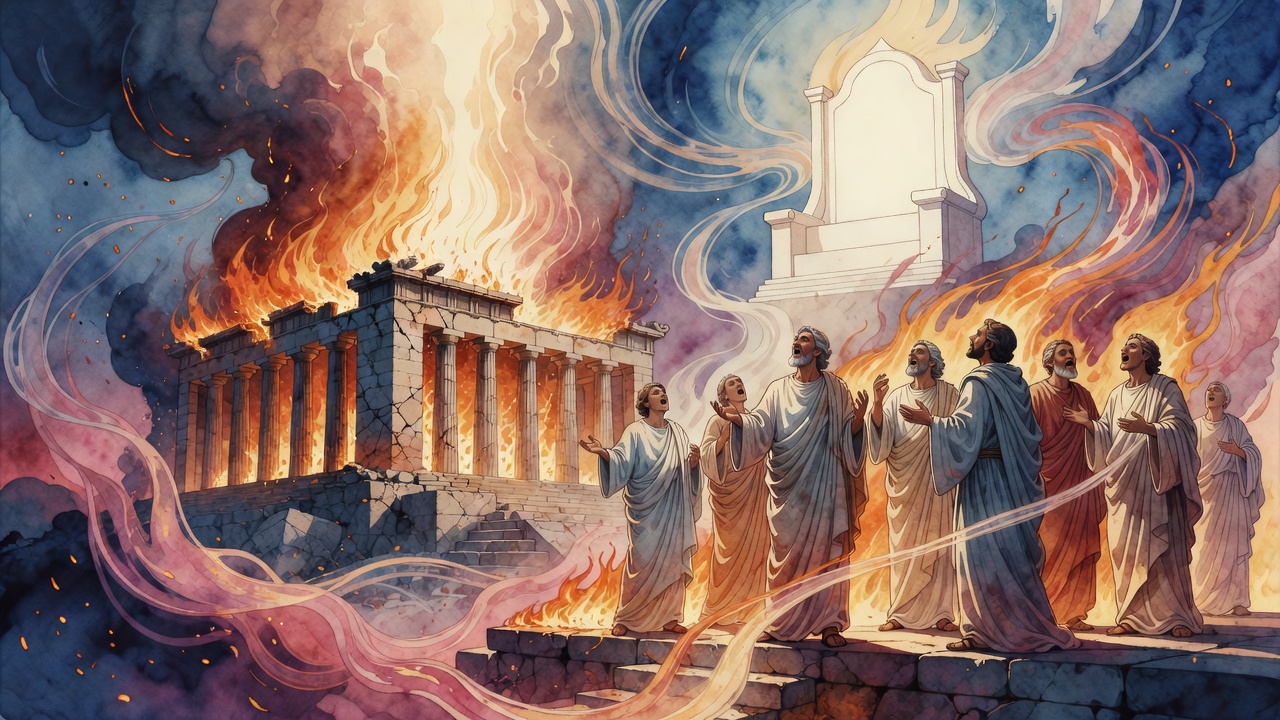
Fire came out of the Holy of Holies. It came the way fire comes out of a doorway, with no hand behind it and no lamp to blame, and it ran along the floor toward the table where they were sitting, so men got up and shoved their benches back against the wall. Not one of them let go of the argument, since a room that has just refused Menashe on principle does not care to be moved by heat.

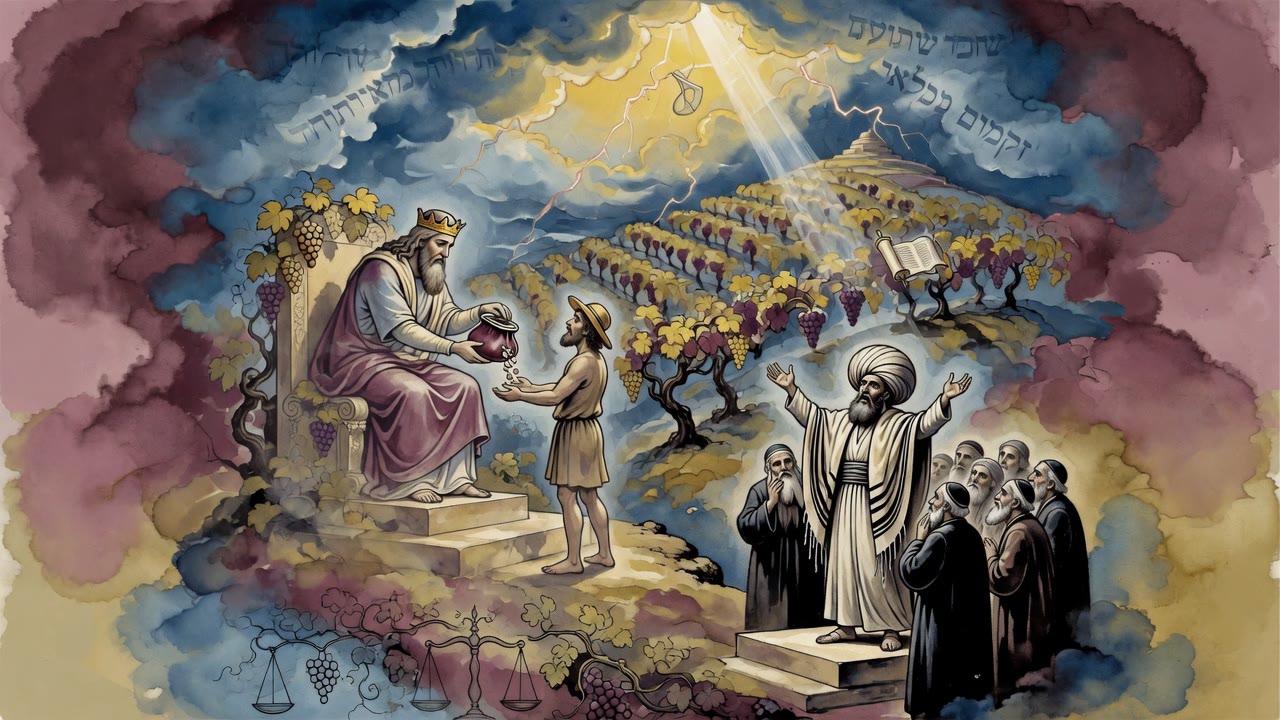
Then the voice came, and it did not argue theology with them at all. It quoted a proverb about a workman: "Have you seen a man diligent in his work? He shall stand before kings; he shall not stand before mean men." Seven years of building, the cedar and the gold and the dedication of the house, all of it pressed into one line about a craftsman and where a craftsman is entitled to stand.

The oldest man in the room said what a father owes a son, which is circumcision and redemption and Torah and a trade and a wife and a portion of land, and what a son owes back, which is a gift carried up to the father's house. This one, he said, brought the house itself.

They heard the old man, and they heard the voice, and they went on writing.

The Verse From Job

What stopped them was not the fire.

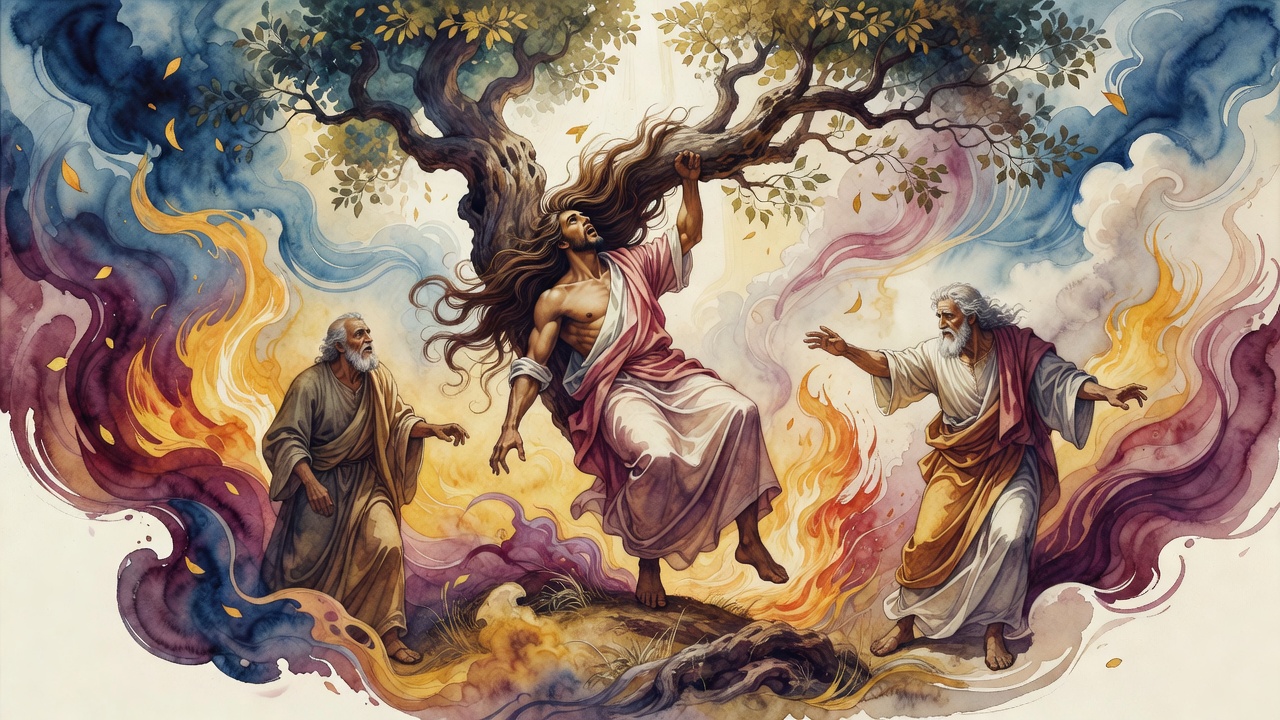
Somebody read out the line from Job instead. Should He then requite it according to your mind, seeing that you refuse? The man holding the pen sat with that for the length of a breath, and what he understood in it had nothing to do with Solomon. He had come into the chamber to write down heaven's accounting and had been keeping his own the whole time, since he had crossed out a bowed father and a burning doorway and a voice over the ark, all three, on the grounds that none of them said what he had already settled. The refusing in the verse was his.

He set the pen down, and the room went quiet in pieces, one man at a time, the way a room does when its loudest part stops first.

The fire drew back toward the sanctuary door and went wherever fire from that door goes, and the likeness of David was no longer on the floor. On the table the list lay open with seven names down the column in a good hand, and after Gehazi the parchment stayed empty, and the ink dried on the nib while nobody reached for it.


← All myths
From the tradition

Sources

2 sources

The texts behind this telling. Some cards carry a translation of the source; others are our own retelling of it, and each card says which. Every card links out to the original.

Bamidbar Rabbah 14:1Bamidbar Rabbah

Retold in our words. Read the original at the link below.The Sefaria Midrash Rabbah, 2022 · CC-BY

It's like peeling back the layers of an onion – the deeper you go, the more you discover.

Bamidbar Rabbah 14, a section of the Bamidbar Rabbah, which itself is a Midrash, a collection of rabbinic interpretations of the Book of Numbers. It focuses on a seemingly simple verse from (Numbers 7:48): "On the seventh day, the prince of the children of Ephraim, Elishama son of Amihud." But from this one verse, the Rabbis unpack a whole world of ideas about redemption, repentance, and divine justice. Get ready, because this is going to be a wild ride!

The jumping-off point is the verse in (Psalms 60:9): "Gilead is mine, and Manasseh is mine, and Ephraim is my stronghold, Judah my lawgiver." This verse becomes a key to unlocking hidden meanings and connections. The Rabbis, in their ingenious way, see these geographical locations as allusions to specific figures from Jewish history, both righteous and wicked.

Things get interesting. The text brings up the question of who has a share in the World to Come – the Olam Ha-Ba (the World to Come), that ultimate reward in Jewish tradition. It mentions a list of kings and commoners who, according to some, are excluded from this privilege: Yerovam, Ahab, Menashe, Bilam, Do’eg, Aḥitofel, and Geḥazi. Pretty heavy stuff!

But here's where the rabbinic debate kicks in. Rabbi Yehuda, for example, argues that King Menashe does have a share in the World to Come, citing II (Chronicles 33:13), which describes Menashe's repentance and restoration to his kingdom. The other rabbis concede that he was restored to his kingdom, but not necessarily to life in the World to Come. It shows how the Rabbis wrestled with concepts of repentance and divine forgiveness. Can even the most wicked be redeemed?

The text even recounts a dramatic scene where the Great Assembly – a pivotal group of Jewish leaders – tried to add King Solomon to the list of those excluded from the World to Come. Imagine the scene: a likeness of King David prostrates itself before them, fire erupts from the Holy of Holies, and even a Divine Voice (a Bat Kol) speaks out in Solomon's defense, reminding them of his dedication to building the Temple (Proverbs 22:29). Yet, they initially ignore these signs! Finally, they are rebuked with a quote from Job (34:33) and relent.

The Midrash then dives deeper into the verse from Psalms, associating each region with a specific individual. "Gilead is mine" is linked to Ahab, who died in Ramot Gilead. "Manasseh is mine" is, in its plain sense, associated with Menashe. "Ephraim is my stronghold" refers to Yerovam. And "Judah my lawgiver" points to Aḥitofel.

But what about the others on the list? "Moav is my washbasin" is connected to Geḥazi, who was afflicted because of his involvement in the story of Naaman (II Kings 5). "I will cast my shoe at Edom" is linked to Do’eg the Edomite. It's a complex web of associations, drawing connections between biblical figures and geographical locations to illustrate a deeper theological point.

A fascinating idea emerges: God will ensure that these figures, despite their wickedness, are "comrades with one another." Why? Because King David cursed Do’eg, wishing him no share in the World to Come (Psalms 55:24). To reconcile this, God will "search [lefalesh] for good deeds for them" and bring them together. This highlights the tension between divine justice and the desire for even the wicked to find some measure of redemption.

The text then shifts to a discussion about the "anointed ones," the future redeemers of Israel. Some say there will be seven, others eight, citing (Micah 5:4). But (Zechariah 2:3-4) points to four "craftsmen": Elijah, the Messianic king, the one anointed for war, and the great redeemer from the line of David. Even when these redeemers arrive, God says, "I will not come and assist them until the Moavites come with them," referring to the Messiah's lineage through Ruth the Moabitess.

The Midrash continues, drawing parallels between God's past battles with Pharaoh, Amalek, and others, and the future vengeance against Edom. "I will cast My shoe at Edom" (Psalms 60:10) signifies God's ultimate triumph over evil.

Then, the focus shifts again, this time on David and his reign. Even though Avner supported Saul's son, Ish Boshet, to be king over Gilead, Yizre'el, and Ephraim, David declares, "Gilead is mine, and Manasseh is mine, and Ephraim is my stronghold, Judah my lawgiver." It's a declaration of David's divinely ordained kingship over all Israel.

The text also explores how David, while fleeing from Saul, entrusted his parents to the king of Moav, due to his lineage from Ruth. Sadly, the king of Moav killed them, leading David to wage war against Moav.

The Midrash then offers another layer of interpretation, connecting "Gilead is mine" to Elijah, who came from Gilead and brought the dead back to life. "Manasseh is mine" is linked to Menashe, who repented and was forgiven. "Ephraim is my stronghold" points to Elkana, who was from the Ephraim highlands, and whose wife Hannah was remembered by God after being barren. And "Judah my lawgiver" refers to Ḥananya, Mishael, and Azarya, who were rescued from the fiery furnace.

It's a powerful reminder that even in the face of death, repentance, barrenness, and fire, God's power and mercy endure.

The text goes on to discuss those who sacrificed offerings during the prohibition of improvised altars (bamot): Elijah, Gideon, Joshua, and David. It acknowledges that they seemingly violated the Torah's command to offer sacrifices only in the designated place (Deuteronomy 12:13-14), but argues that they did so at God's command.

Finally, the Midrash returns to the original verse about Elishama, the prince of Ephraim, who presented his offering on the seventh day, which, according to the Rabbis' calculations, was Shabbat (the Sabbath). While individual offerings don't override Shabbat, Elishama's offering was part of a larger, divinely mandated sequence, justifying his actions.

So, what can we take away from this deep dive into Bamidbar Rabbah 14? It's a reminder that the Torah is not a static text, but a living document that invites interpretation, debate, and constant re-evaluation. It reveals the Rabbis' profound belief in the power of repentance, the enduring nature of divine justice, and the hope for redemption, even for those who seem lost. It reminds us that even seemingly simple verses can unlock a universe of meaning, if we're willing to dig deep and explore the layers of tradition. And ultimately, it's evidence of the enduring power of Jewish storytelling to illuminate the complexities of faith and the human experience.

Full source
Bamidbar Rabbah 17:1Bamidbar Rabbah

Retold in our words. Read the original at the link below.The Sefaria Midrash Rabbah, 2022 · CC-BY

The ancient rabbis pondered this very question, drawing a profound parallel between a human father and God, our ultimate Father. to Bamidbar Rabbah, specifically section 17, to unpack this fascinating idea.

It all starts with the verse, "Speak to the children of Israel, and say to them: When you will come into the land of your dwellings, that I am giving to you" (Numbers 15:2). "When you will come into the land of your dwellings…" – this seemingly simple phrase sparked a whole line of thought. The rabbis asked a halakhic question (a question of Jewish law): what exactly is a father obligated to do for his son?

Our Rabbis taught: There are five matters that a father is obligated to perform for his son (Tosefta Kiddushin 1:8). But here’s the twist. The father in this case is God, blessed be He, and the son is Israel! It’s a powerful metaphor, a way of understanding God's relationship with His people.

So, what are these five obligations?

First, just as a father is obligated to circumcise his son, so too did God, blessed be He, do for Israel. He circumcised them by means of Joshua, as we see in (Joshua 5:2): “Make flint knives for yourself [and circumcise the children of Israel]."

Next, a father is obligated to redeem his son. And how did God redeem Israel? "To redeem for Himself as a people" (II (Samuel 7:2)3). God took us out of Egypt, freeing us from slavery.

The third obligation? To teach him Torah. And did God teach Torah to Israel? Absolutely! "You shall teach them to your children" (Deuteronomy 11:19), and even more explicitly, "I am the Lord your God, who teaches you for your own benefit" (Isaiah 48:17). God gave us the Torah as a gift, a guide for living a meaningful life.

Fourth, to teach him mitzvot (commandments) – commandments. The Holy One, blessed be He, taught mitzvot to Israel, giving us a framework for ethical and spiritual growth.

And finally, to marry a wife to him. Now, this one's interesting. The Holy One, blessed be He, said to them: “Be fruitful and multiply” (Genesis 1:28). He encouraged Israel to build families and continue the Jewish people.

But the analogy doesn't stop there! The text continues: the father is obligated to his son to feed him, give him drink, bathe him, smear him with oil, and clothe him. And again, the Holy One, blessed be He, did all of these things for Israel. "I washed you with water and rinsed your blood…[and I anointed you with oil]. I clothed you in embroidery" (Ezekiel 16:9–10); "and My bread that I gave you" (Ezekiel 16:19); "rise, well, call to it" (Numbers 21:17). Think of the manna in the desert, the water from the well – all signs of God's nurturing care.

Just as a father gives property to his son, so too did God do for Israel: "I gave you a desirable land" (Jeremiah 3:19). The land of Israel, a gift from God to His people.

Now, comes the reciprocal part. What is the son obligated to offer up to his father? It is a gift. So the Holy One, blessed be He, said to Israel: "When you will come into the land…you will perform…a burnt offering…to the Lord" (Numbers 15:2–3). The offerings, the sacrifices – expressions of gratitude and devotion from Israel to God.

What I find so striking about this passage is its emphasis on mutual responsibility. It's not just about God's obligations to us, but also our obligations to God. It suggests that the relationship between God and Israel (and by extension, between God and each of us) is a dynamic partnership, built on love, care, and a shared commitment to living a meaningful life. What does this tell you about our role in this covenantal partnership? What gifts are we obligated to offer up?

Full source