6 min read

Gabriel Throws Haman Onto the Couch Before the King

When Haman fell onto Esther's couch, an unseen archangel had pushed him, and ten angels in the king's garden were felling trees to time it.

Curated by Arthur · Told by Maggid ·
Table of Contents
  1. The King Storms Into the Garden
  2. Haman Falls at the Queen's Feet
  3. Gabriel Throws Him Down
  4. The Trap a Hundred Years in the Making
  5. The Gallows He Built Himself

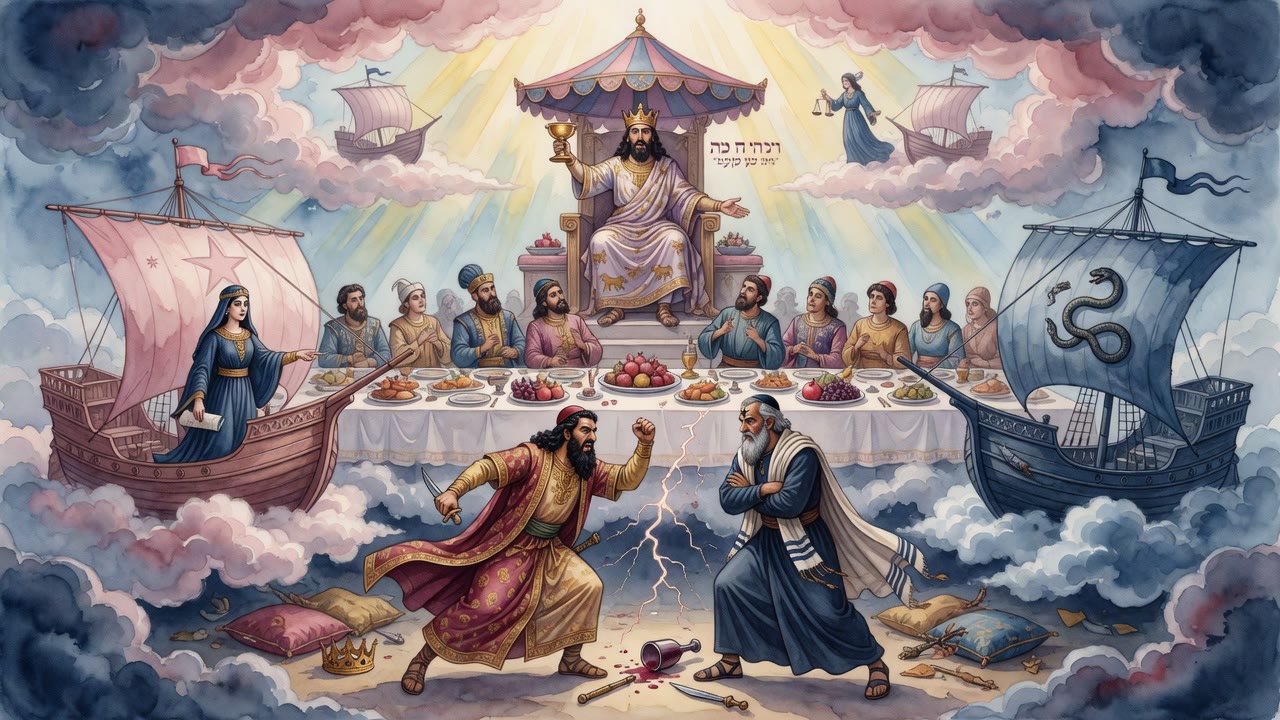
The second banquet was nearly over, and Haman could feel the room tilting under him. The wine was sweet. The lamps burned low. King Ahasuerus leaned toward the queen with the heavy attention of a man who had already promised to give her whatever she wanted, even half the kingdom, and meant it. Across the couch Esther set down her cup. She had drawn this out across two nights, two feasts, letting the king's eagerness ripen like fruit on a branch. Now she let it fall.
"The adversary," she said, "the enemy, is this wicked Haman."

Haman's blood went cold in his hands. He understood everything in a single breath. The man who had signed his decree against the Jews was the same king now staring at him across the lamplight, and the woman asking for that decree to be torn up was the queen, and the queen was a Jew, and he had not known.

The King Storms Into the Garden

Ahasuerus rose so fast the couch rocked. His face had gone the color of the wine. He did not speak. He walked, fast and blind, out through the wide doors and into the palace garden to cool the rage building behind his eyes, the way a man walks away from a thing before he does something he cannot take back.

The garden should have calmed him. It did the opposite.

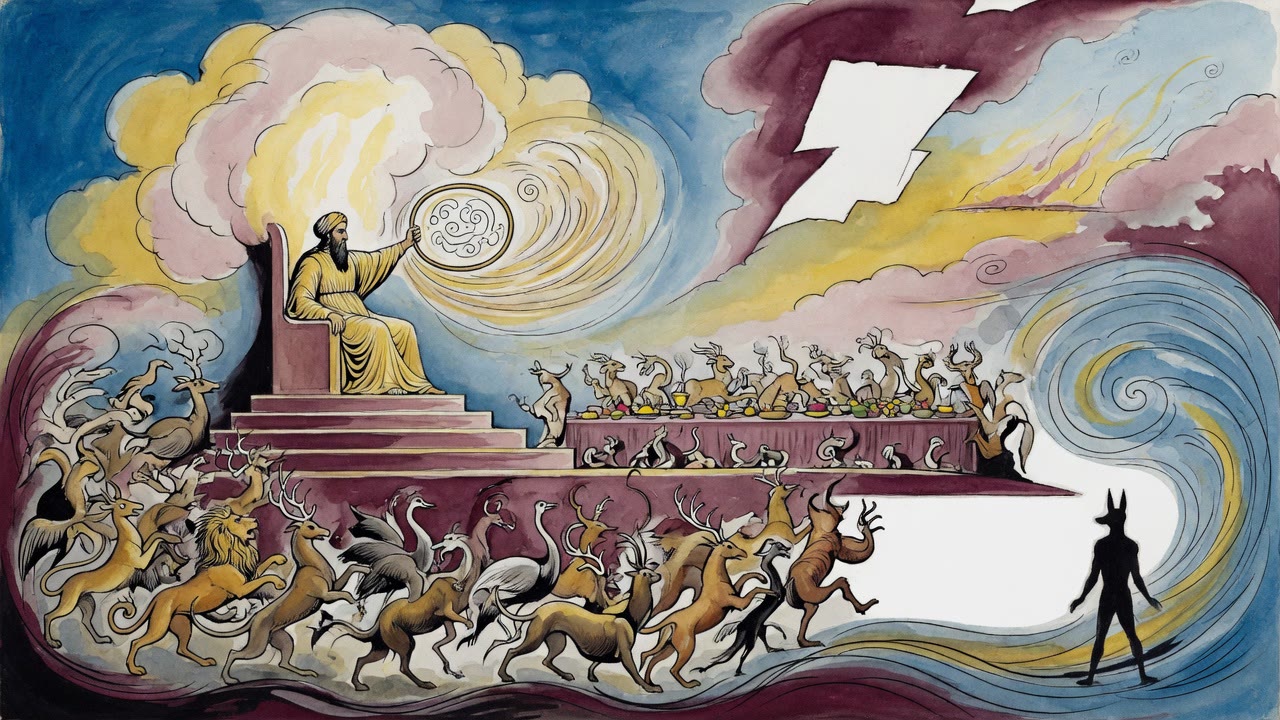
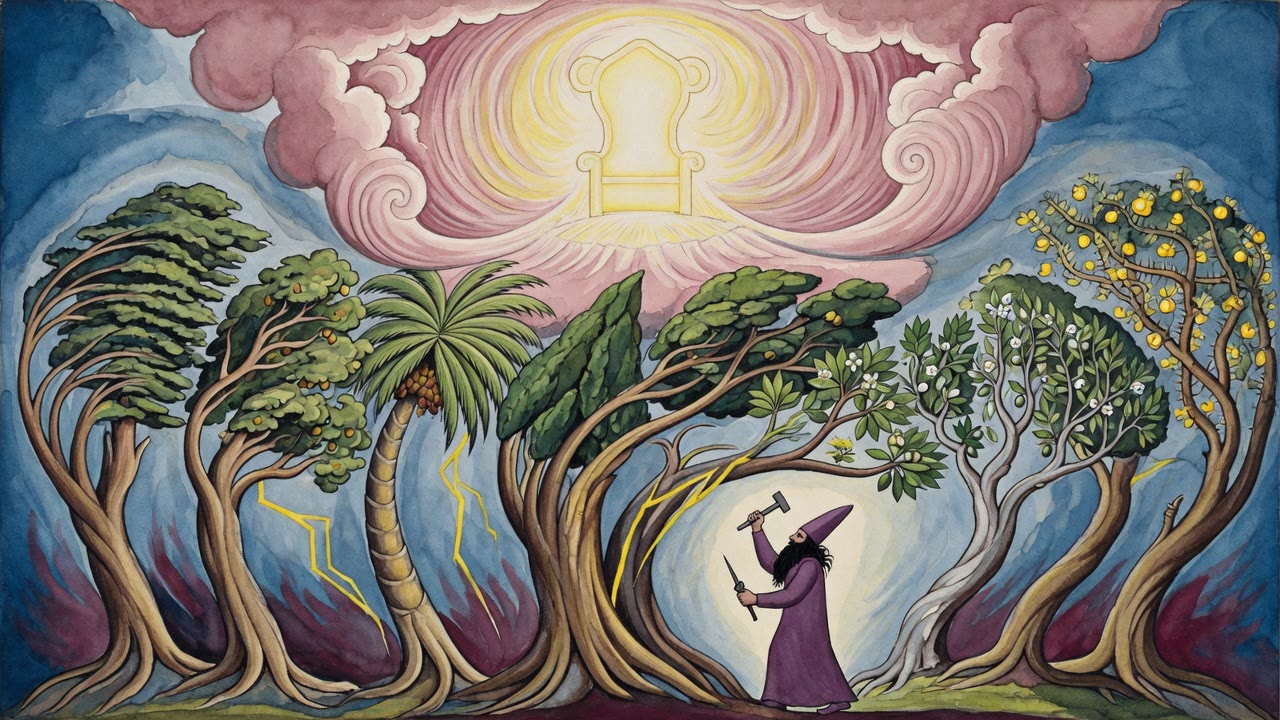
Out among the cypress and the date palms, ten figures were at work. They looked exactly like Haman's ten sons, the same beards, the same fine robes, the same arrogant set of the shoulders. They were not Haman's sons. God had sent ten angels down into the royal park wearing those faces, and the angels were tearing the garden apart. They ripped young trees up by the roots. They snapped branches and flung them across the paths. They worked with a cold, deliberate fury, not the wild thrashing of vandals but something worse, something patient, as if the destruction were a job to be finished on time.

The king saw his garden being dismembered by men who wore the face of his fallen favorite's house, and whatever cooling the night air had offered burned away at once.

Haman Falls at the Queen's Feet

Inside, Haman had no king to plead to. He had only Esther, the very woman he had meant to destroy, and now she was the only door left between him and the gallows. He went down. He threw himself at her feet, then onto the couch where she reclined, his hands reaching, his voice cracking open with begging. Mercy. He needed her mercy. He pressed close to her, too close, the way a drowning man grabs whatever is nearest without thinking what it looks like from the shore.

He did not see the figure standing over him. No one in that room could see it.

Gabriel Throws Him Down

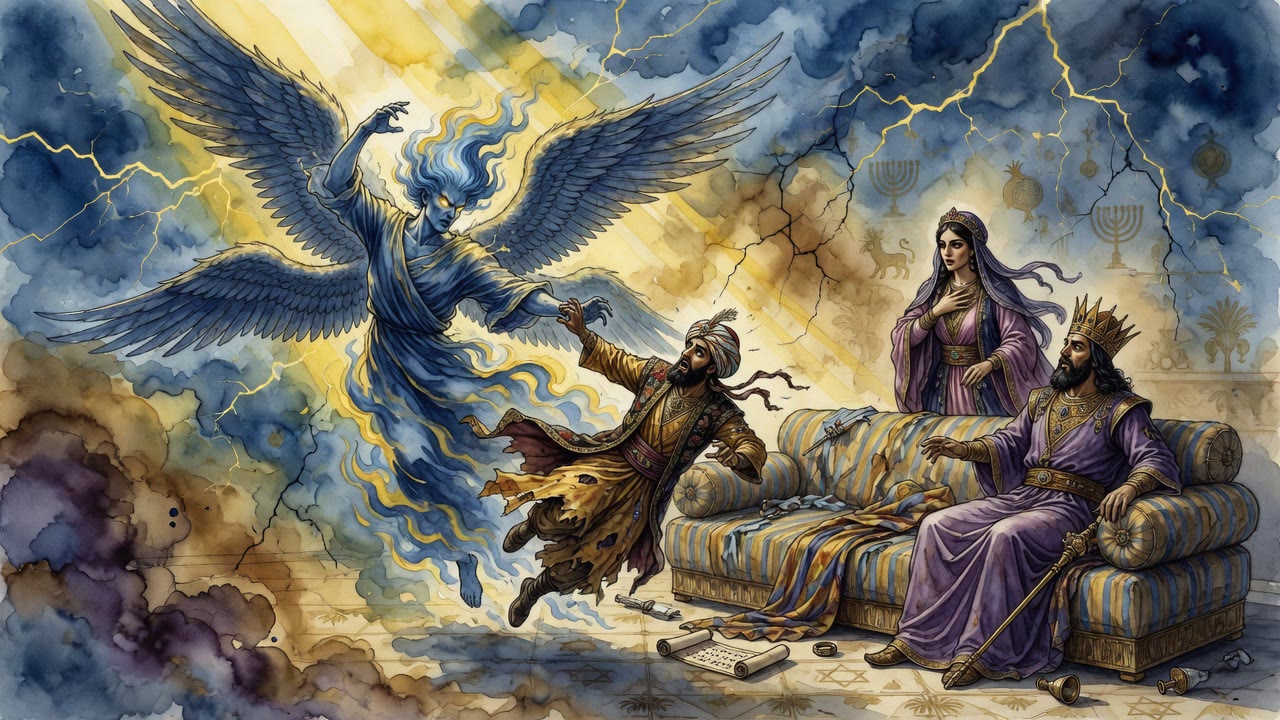
The archangel Gabriel had been waiting. As the sound of the king's returning footsteps came across the marble, Gabriel set a hand against Haman and shoved. The motion was hidden inside Haman's own panic, folded into his own lunging, so that even Haman would have sworn he had only stumbled, only fallen forward in his desperation. He sprawled across the queen's couch in the worst possible posture at the worst possible instant, half on the cushions, half on Esther, exactly as the king crossed the threshold.

Ahasuerus stopped. He took in the scene with eyes already half-mad from the wrecked garden. There was his enemy lying across his wife, in his own house, in his own presence.

"Will he even violate the queen," the king roared, "here, with me in the house?"

The word had barely left his mouth before they covered Haman's face. A man whose face is covered in that court is a man already dead.

The Trap a Hundred Years in the Making

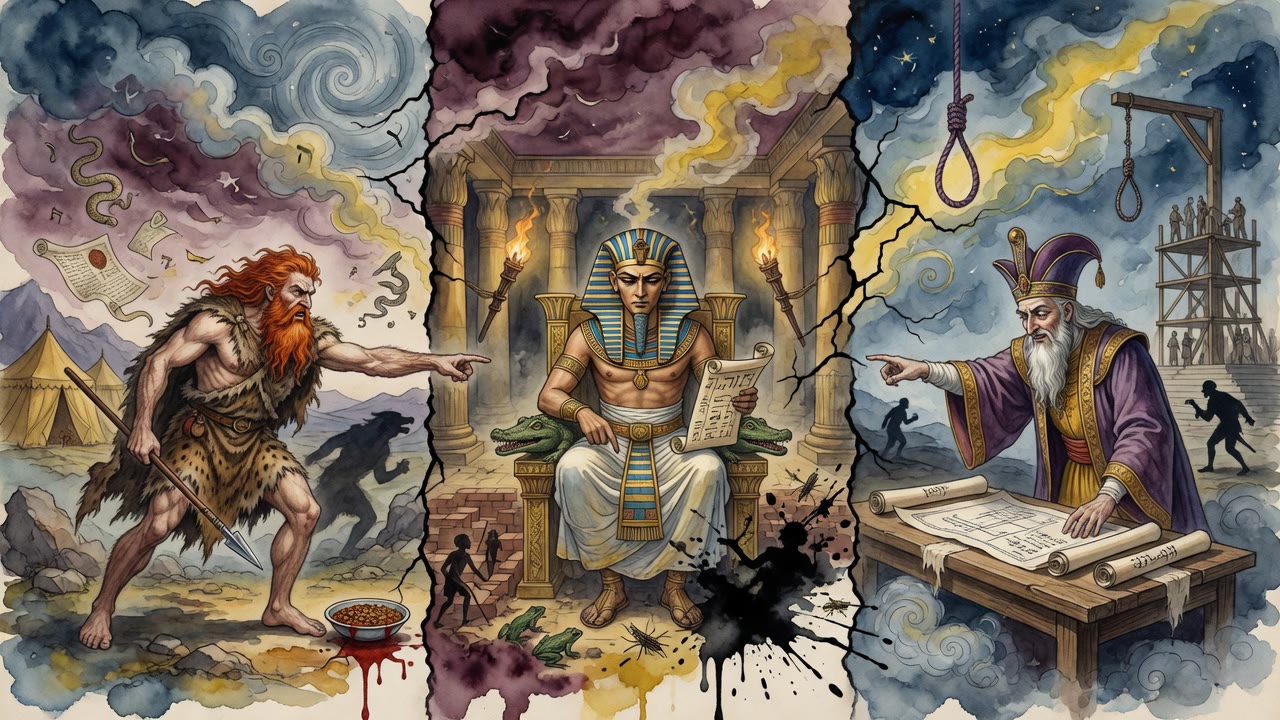
None of it was accident, and none of it was new. The hatred had roots older than either man. Mordecai, Esther's kinsman, came down from Saul, the king who had once cut the Amalekites down across the desert from Havilah to Shur. Haman came down from the survivors of that slaughter, and he had carried the grudge of his whole burned-out people in his chest his entire life, against Mordecai and against all of Judah and the tribe of Benjamin.

That grudge had already cost him once. Sitting at the king's gate, Mordecai had overheard two of the king's chamberlains, Bigthan and Teresh, whispering a plot to behead Ahasuerus and carry his head to a rival king at war with Persia. Mordecai had warned Esther, Esther had warned the king, and the two conspirators had hanged for it. They had been Haman's own men. Every loss had sharpened him. Every sharpening had drawn him closer to this couch, this garden, this single tilted instant where an unseen hand finished what an old king's sword had started.

The Gallows He Built Himself

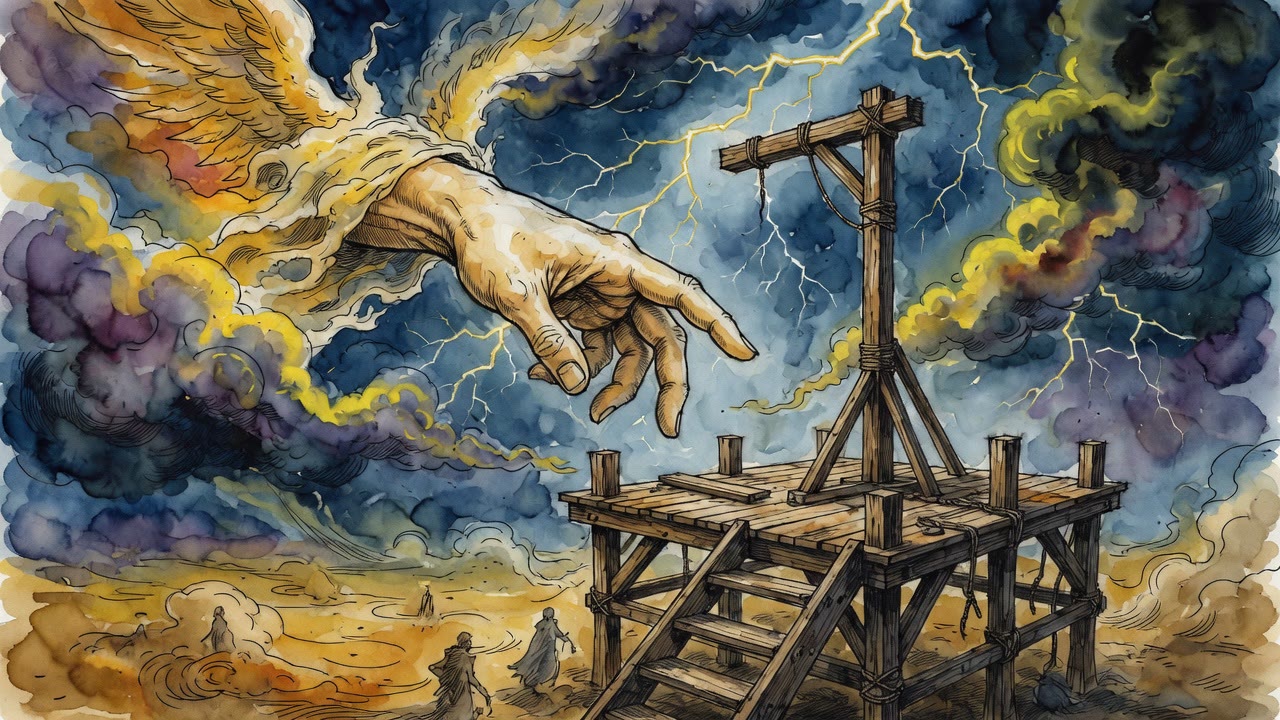
Haman had raised a gallows for Mordecai, tall enough to be seen across the city. The king's servant remembered it. He named it aloud, that high wooden frame standing ready in Haman's own courtyard.

"Hang him on it," the king said.

And they did. The man who timed his decrees so carefully had been outtimed at every turn, the footsteps, the falling, the felling of the trees, all of it arranged to land in the same breath. Haman went up on his own gallows, and the day he had cast lots to choose for the death of a people became, instead, the day a people lived (Esther 9:1).


← All myths
From the tradition

Sources

4 sources

The texts this telling draws on, in full. Open a card to read inline, or expand it for a wider, quieter read.

Legends of the Jews 12:232Legends of the Jews

Esther’s carefully laid trap is working. He's practically begging her to name Haman as the villain. "Just say the word, Esther," he's thinking, "and heads will roll!"

It's not enough for a regular takedown. So, what happens next? According to Legends of the Jews, God sends ten angels, disguised as none other than Haman’s ten sons. Can you imagine the chaos? They start tearing through the royal park, felling trees left and right. This isn't just vandalism; it's a deliberate act designed to push Ahasuerus over the edge.

The king, already on high alert, glances out into the park, and sees the destruction. That’s it. He's gone ballistic. Blind rage consumes him. He storms out into the garden, probably sputtering and fuming.

This, my friends, is where the drama really hits its peak. Haman, desperate and realizing the gravity of his situation, throws himself at Esther's feet, begging for mercy. He’s pleading for his life.

Now, picture this: Gabriel, the archangel, steps in – unseen, of course. He doesn’t just nudge Haman; he throws him onto the queen's couch. And not in a good way. He's positioned to look like he's about to assault her.

Timing, as they say, is everything. Just as Haman lands awkwardly on the couch, Ahasuerus bursts back into the room. The scene that greets him is… well, let's just say it's not good for Haman’s continued existence.

The king, seeing what he thinks he sees, completely loses it. "Haman attempts the honor of the queen in my very presence!" he roars. And then, in a moment of theatrical fury, he cries out: "Come, then, ye peoples, nations, and races, and pronounce judgment over him!"

Talk about a mic-drop moment! The stage is set. The accusations are flying. And Haman’s fate is sealed.

It makes you wonder, doesn't it? How much of what we see is truly what's happening, and how much is orchestrated by forces beyond our understanding? And how often do our own biases and assumptions lead us to misinterpret the scenes unfolding before our very eyes? Just some food for thought.

Full source
Chronicles of Jerahmeel LXXIXChronicles of Jerahmeel (Gaster, 1899)

The hatred between Haman the Amalekite and Mordecai the Jew had deep ancestral roots. According to the Chronicles of Jerahmeel, a 12th-century Hebrew chronicle translated by Moses Gaster in 1899, Mordecai was a descendant of Saul, who had destroyed the Amalekites from Havilah to Shur, slaying more than 500,000 men, women, and children. Haman descended from those same Amalekites and nursed that ancient grudge against all of Judah and the tribe of Benjamin.

While sitting at the king's gate, Mordecai overheard two Persian chamberlains, Bigthan and Teresh, plotting to behead Ahasuerus and deliver his head to the Macedonian king, whose empire was then at war with Persia. Mordecai told Esther, who told the king. The conspirators were hanged, but because they were Haman's counselors, their execution only deepened his rage.

Mordecai remembered a dream from the second year of Ahasuerus's reign. A great earthquake shook the earth. Two immense dragons fought each other with terrible noise while a small nation lived among the watching peoples. All the surrounding nations rose to destroy this small nation. Thick darkness fell. Then Mordecai saw a small brook of water flow between the two dragons, separating them. The brook grew into a flood like the Great Sea, covering the whole earth. The sun returned, the small nation was exalted, the proud were humbled, and peace was restored.

When Haman's plot took shape, Mordecai told Esther to remember that dream and go before the king. Then Mordecai himself prayed with extraordinary intensity: "It is well known to the throne of Thy glory, O Lord, that it was not from pride or haughtiness I refused to bow to this Amalekite. I would prostrate myself to no being except Thy holy presence. But for Israel's salvation I would lick the shoe upon his foot and the dust upon which he walks."

Full source
Legends of the Jews 12:6Legends of the Jews

Legends of the Jews turns to Esther's Miracle.

The miracle of Purim isn’t just about escaping the evil decree of Haman, may his name be blotted out. It’s also about the incredible elevation of the Jewish people in the eyes of the Persian Empire, and particularly the ascent of Esther herself. this young woman, secretly Jewish, becomes queen!

That's where the seemingly excessive, almost unbelievable, feast that King Ahasuerus throws for his kingdom comes into play. It's not just a random detail in the Book of Esther, is it? It’s absolutely crucial.

The sheer, over-the-top extravagance of this feast – imagine, a celebration that lasts for 180 days, followed by another week-long party for everyone in the capital city of Shushan! – it serves as a measuring stick. As a gauge. (Esther 1:4-5)

Why?

Because it shows us the immense wealth and power that Esther would later wield. The Book of Esther makes it clear the king was very, very rich. This wasn't just a party; it was a display of imperial might. The more lavish the feast, the more impressive Esther's rise to power becomes. The Zohar, that foundational text of Jewish mysticism, hints at the deeper, hidden meanings within the story, and the feast certainly fits that bill, doesn't it?

The more we understand the opulence surrounding her, the more we appreciate the magnitude of her transformation. She wasn’t just saving her people; she was stepping into a position of unparalleled influence within one of the greatest empires of the ancient world.

So, the next time you read the story of Esther, don't just skim over the details of the feast. Imagine the spectacle, the grandeur, the sheer excess of it all. It's not just background noise; it’s a vital piece of the puzzle, setting the stage for Esther’s extraordinary journey. It reminds us that sometimes, the most miraculous transformations come from the most unexpected places.

Full source
Esther Rabbah 10:9Esther Rabbah

“The king rose in his fury from the wine banquet to the palace garden and Haman stood to plead for his life from Esther the queen, for he saw that the king has resolved to do him harm” (Esther 7:7).“The king rose in his fury from the wine banquet to the palace garden.” What did the angel Michael do? He began cutting the saplings before him, adding fury to his fury; he returned to the wine banquet and Haman stood up to plead for his life. What did Michael do? He pushed him [Haman] onto Esther, and she was crying ‘My lord, the king, here he is overpowering me before you!’ The king said: “Will he also overpower the queen with me in the house?” (Esther 7:8). Haman heard this statement and his face fell. What did Eliyahu, of blessed memory, do? He appeared as Ḥarvona and said to him [to the king]: ‘My lord the king, “indeed, here is the gibbet that Haman had made for Mordekhai…”’ (Esther 7:9). As Rabbi Pinḥas said: One must say ‘Ḥarvona, of blessed memory.’ And Rav said: One must say ‘cursed is Haman, cursed are his sons, cursed is Zeresh his wife, as it is written: “The name of the wicked will rot”’ (Proverbs 10:7). The king immediately commanded to hang him on the gibbet that he had prepared for Mordekhai, and about this, Solomon, in his wisdom, said: “A righteous person will be delivered from trouble and the wicked will come in his stead” (Proverbs 11:8). For Haman got up early to hang Mordekhai and was hanged himself on the gibbet that he prepared for Mordekhai, and [the king] gave everything that was Haman’s to Esther the queen, and Esther gave it to Mordekhai. This is what is written: “On that day King Aḥashverosh gave the house of Haman, adversary of the Jews, to Queen Esther…” (Esther 8:1), and it is written: “As for his harvest, the hungry will eat it and take it from shields [tzinim] and the bound [tzamim] will swallow their wealth”10 The midrash (rabbinic interpretive commentary) understands this verse idiosyncratically. The word mitzinim, here translated as ‘from shields,’ is usually translated as ‘from thorns’ or ‘from baskets.’ The word tzamim, here translated as ‘the bound,’ is usually translated as ‘the thirsty.’ (Job 5:5). “As for his harvest,” that is Haman. “The hungry will eat it,” that is Mordekhai and Esther. “Take it from shields,” not with a weapon, and not with a shield, but with prayer and supplication, as you say: “His truth is a shield [tzina] and a buckler” (Psalms 91:4). That is prayer, which protects him from trouble like a shield protects a person in battle. By the merit of prayer, which is called a shield, he will take Haman. From where [is it known] that they engaged in prayer? That is what is written: “Sackcloth and ashes were worn by many” (Esther 4:3). What is the use of sackcloth and ashes without prayer? “And the bound will swallow their wealth.” Who overcame Haman’s wealth? Mordekhai and Esther and those bound to them.

Full source