6 min read

God Rode a Cherub and Answered Pharaoh's Arrows

At the sea Pharaoh loosed arrows at Israel. God rode a cherub through fire, answered shot for shot, and waved the angels back so the war stayed His alone.

Curated by Arthur · Told by Maggid ·
Table of Contents
  1. Do You Have a Cherub
  2. When I Go Out, I Go Alone
  3. The Face of Abraham
  4. The Tent Outside the Camp

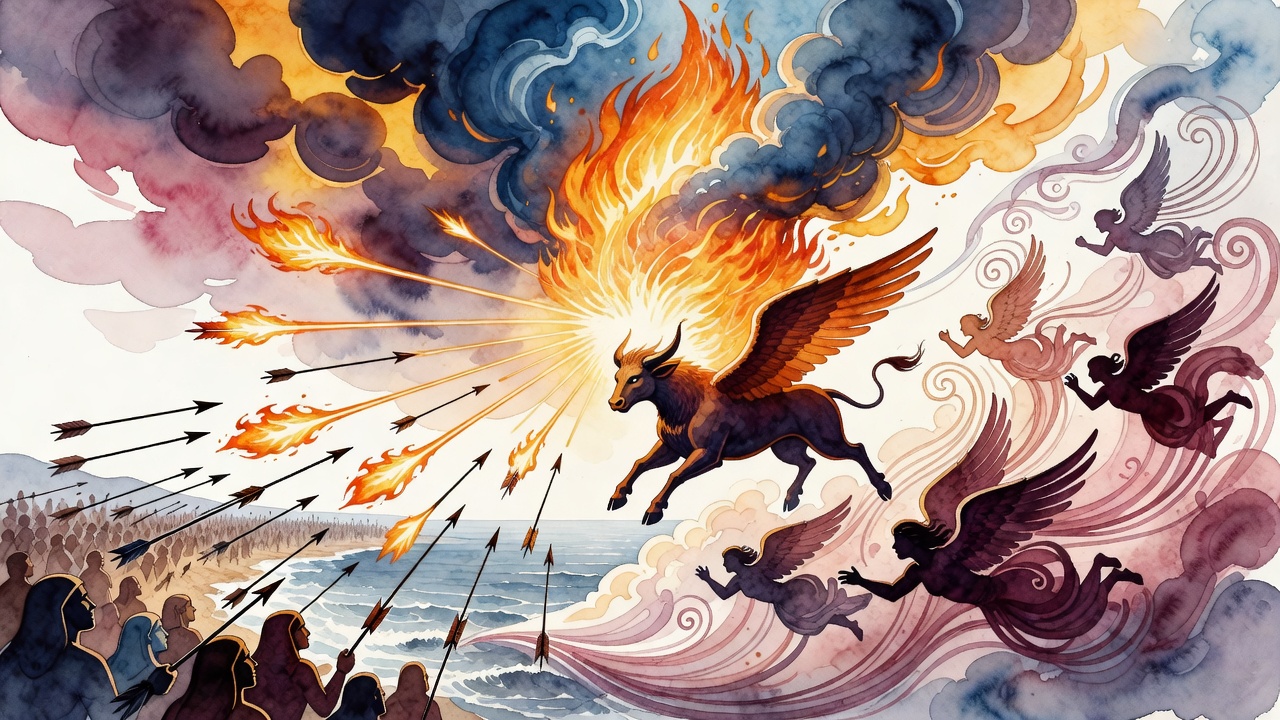
Pharaoh's archers loosed first, because the columns ahead of them were slow and packed and had a wall of water at their backs, and there is no easier shooting in the world than that.
God Rode a Cherub and Answered Pharaoh's Arrows Click for full size

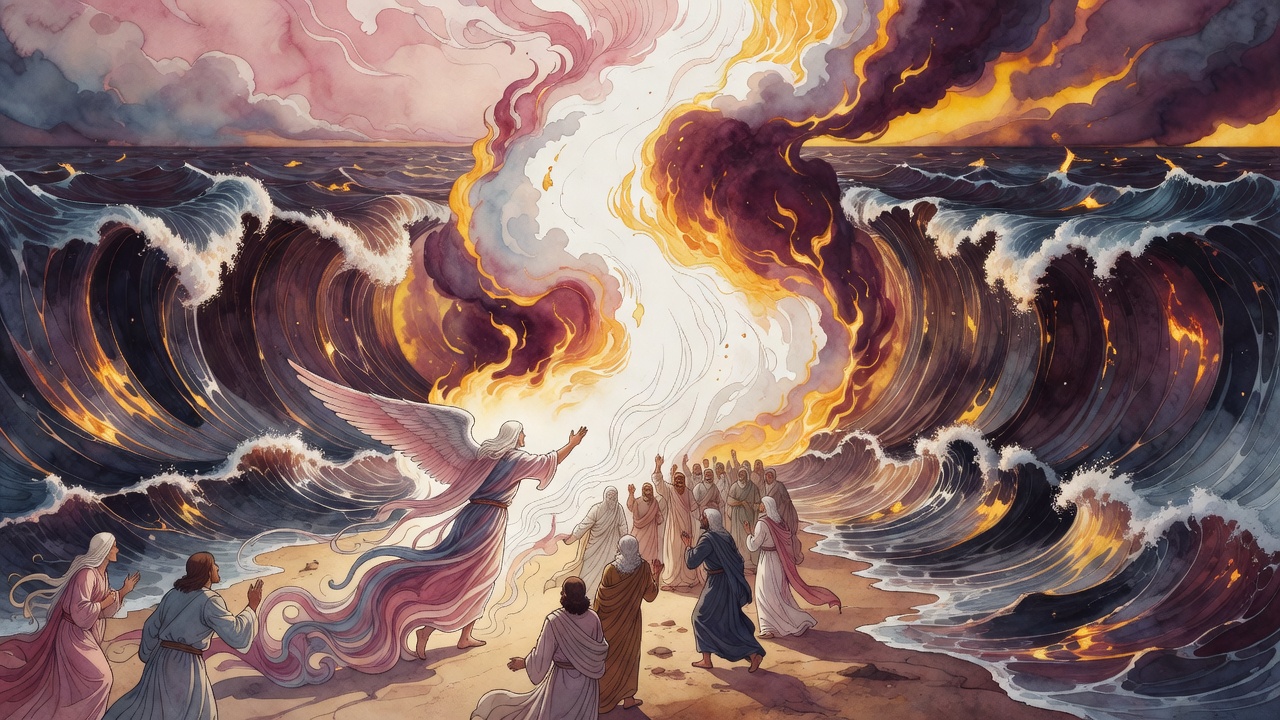
What came back was not bronze. The arrows that answered were burning, and they did not fall the way arrows fall. Stones flung by the Egyptian engines turned to hail in the middle of their arc and came down as weather instead of shot, and the catapults coughed up coals. The horses knew before the men did.

Above the spray a bow was drawn that was made of fire. The arms holding it were flame, the spear beside it a torch, the shield a bank of cloud, the sword one long stroke of lightning. The Egyptian magicians had told Pharaoh months before, back when the lice were still in their beards, that a finger of God was at work in the country. A finger. Now the whole arm was out over the water and the country was on the wrong end of it.

Do You Have a Cherub

He did not stand off and manage the battle. He rode. A cherub came up under Him and He went out over the sea on its back, stepping from one wing to the other the way a man shifts his feet on a moving deck, and the heat of it rolled down onto the Egyptian line.

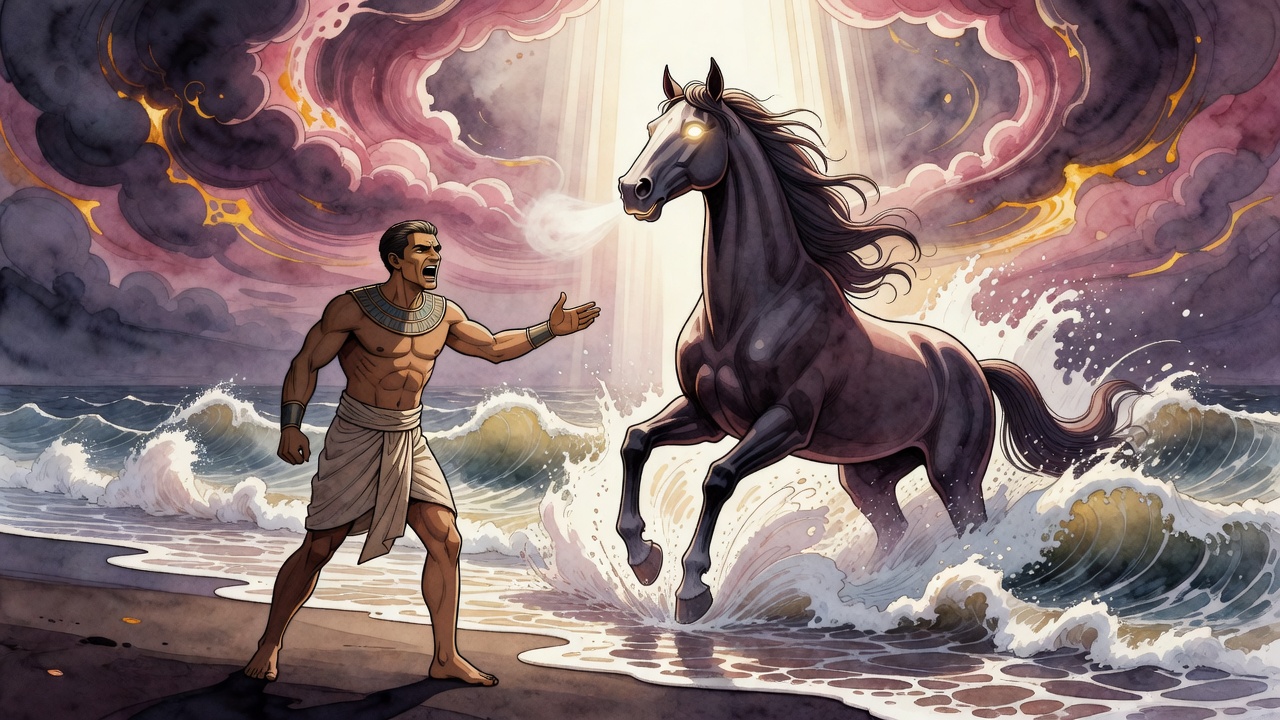
Then He leaned down and taunted the king. "Wicked one, do you have a cherub? Can you do this?"

Pharaoh had six hundred chariots with iron on all of them, and a god of his own on every second street in Egypt. He had no answer that could get up that high, so he kept shooting, which was the only thing left in his hands.

When I Go Out, I Go Alone

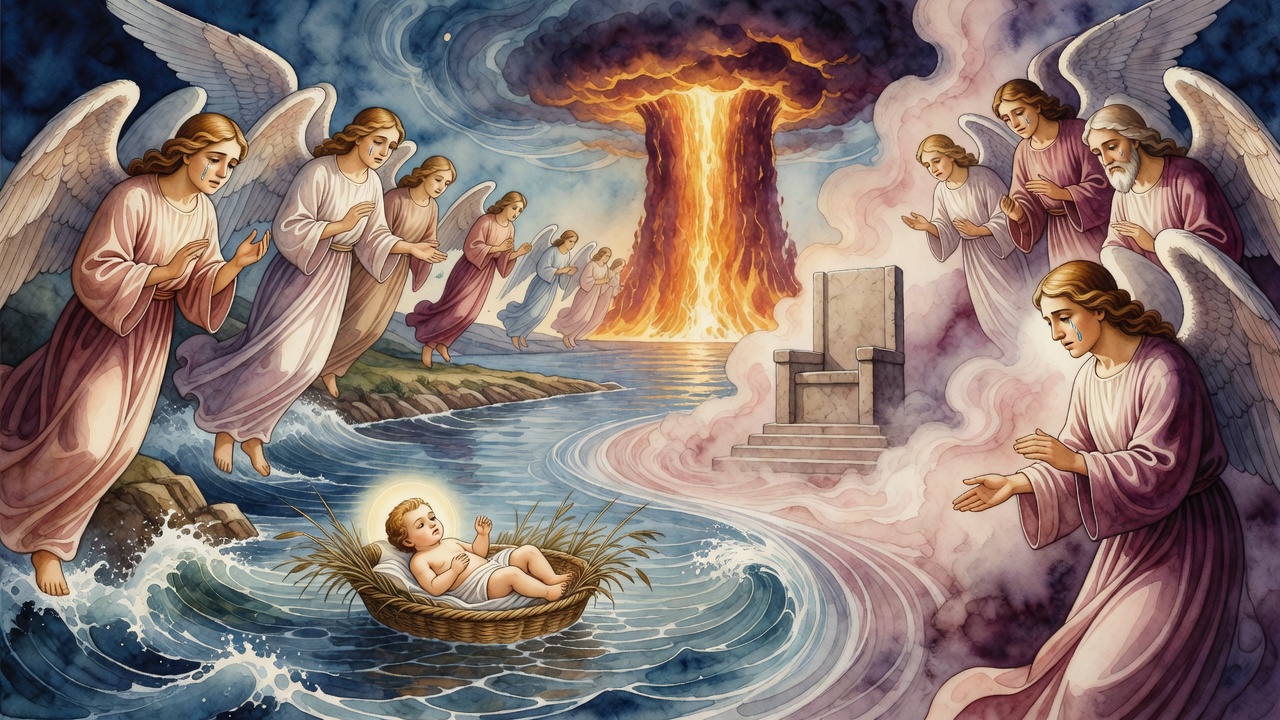
The hosts of heaven had been arming themselves since the first arrow. Swords out. Bows strung. Lances angled down toward the shore. They had watched the brick quotas and the drowned infants and the night of the firstborn from a great height without permission to touch any of it, and now the man responsible was standing in a chariot in the open with nothing over his head.

They came forward to join the strike, and He waved them back.

"I do not need your help," He told them. "When I go out to battle, I go out alone."

So the sea closed on Egypt with every blade in heaven still drawn and unused. No angel got a share of it. No one above the water could say afterward that he had been in on the thing, and when the singing started on the far shore the song had one name in it and no others. The Lord is a man of war. The Lord is His name. Miriam took up a drum on wet sand, and the angels heard it from a distance, holding weapons that had not been permitted to fall.

The Face of Abraham

Because they had been kept out of the war, they were watching very closely when Moses came up the mountain, and what they saw was a man climbing toward the one thing in heaven they had wanted for themselves.

You ascended on high, the psalm says, you took captives. A conqueror usually hauls off whatever the locals think is worthless. Moses took the Torah, which was not worthless to anybody up there, and he did not get it handed to him at the door either. The word in the verse means acquired as much as received, so he had to work for it, argue for it, stand in front of beings older than the sea and make a case. The tablets themselves ran six handbreadths. Two of those handbreadths were in the hand of God and two were in the hand of Moses, and the two between them stayed empty the whole time, which is exactly the distance the angels objected to.

They moved on him, and there was nothing on that mountain to stop them.

Then God changed the man's face. In the space of a breath the features rearranged themselves into a face those particular angels had seen before, at midday, under a tree, at the door of a tent near Hebron. "Are you not ashamed," He asked them. "Is this not the one whose house you went into? Did you not eat at his table?" The swords came down. They had taken bread and curds from those hands and there was no unmaking that meal, so Moses walked out through them with the tablets and nobody laid a finger on him.

The Tent Outside the Camp

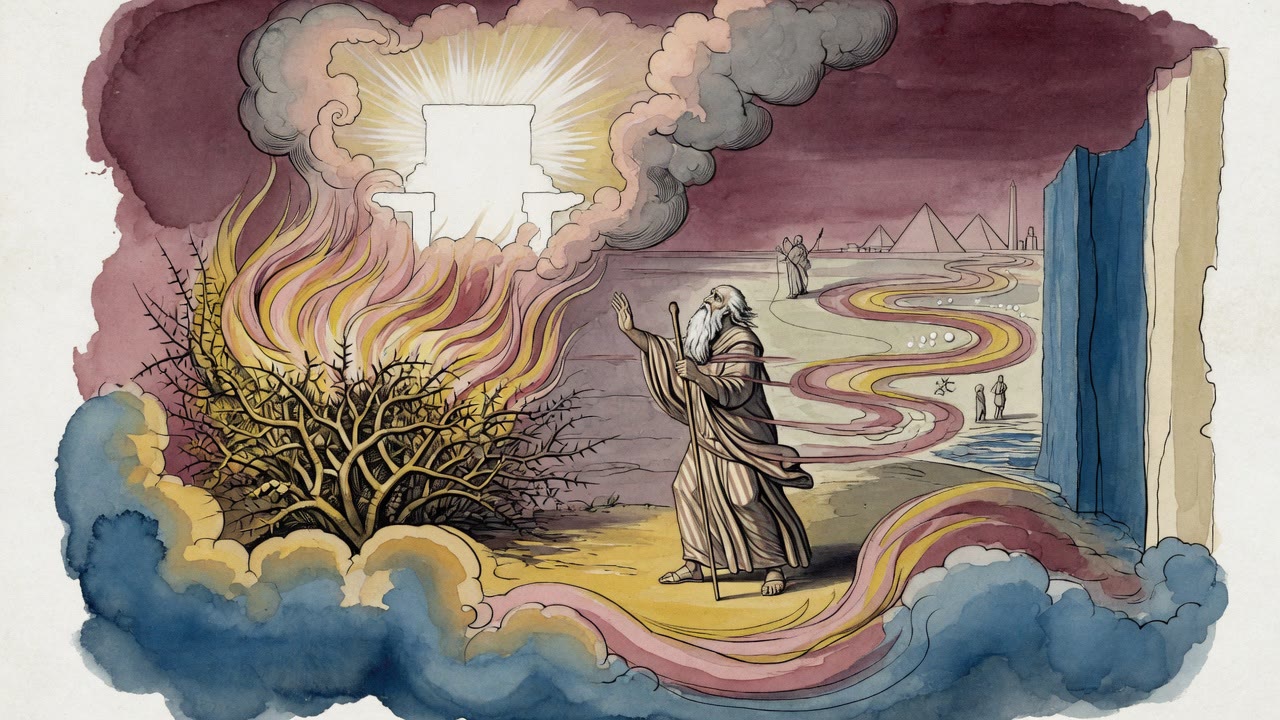
After that He stopped visiting. Moses pitched a tent well outside the camp, far off, and whoever wanted anything from God had to walk out of the settlement to get it. The people stood in their own doorways and watched him go until he was inside and the flap dropped. Then the pillar of cloud came down and stood at the door of that tent, and every man bowed at his own entrance, because the thing was happening in plain daylight. Inside, God spoke with Moses' face to face, the way a man speaks to his friend.

Later the cloud settled on the finished Tabernacle and the glory filled it so completely that Moses could not get in. He put a hand on the fabric at the opening and stopped there. The Presence takes up room, and there was no room.

Everything above had been copied below by then, and the copy was the one He wanted. A dwelling in heaven with a thick cloud in it, and a house down here built to hold a thick cloud. Seraphim standing up there, acacia beams standing in the Tabernacle. Cherubs surrounding Him above, and two cherubs of beaten gold below, facing each other over a lid with their wings out.

He left the upper house for the lower one, and the voice came down between those two gold wings like a pillar of flame, and Moses standing under it heard it as though it were coming from inside his own chest.


← All myths
From the tradition

Sources

4 sources

The texts behind this telling. Some cards carry a translation of the source; others are our own retelling of it, and each card says which. Every card links out to the original.

Shemot Rabbah 5:14Shemot Rabbah

Translation of the source text.Midrash Rabbah -- TE · Public Domain

He said to them: And what are His deeds? They said to him: He stretches out the heavens and lays the foundation of the earth; His voice hews out flames of fire; He shatters mountains and breaks rocks; His bow is fire, His arrows a flame, His spear a torch, His shield clouds, His sword lightning; He forms mountains and hills; He covers the mountains with grasses; He sends down rains and dews; He makes the green herbs sprout; He answers the beasts; He fashions the embryo in its mother's womb and brings it forth into the air of the world.

He said to them: From the very start you speak falsehood, for I am the lord of the world, and I created myself and the Nile, as it is said: "My river is my own, and I have made myself" (Ezekiel 29:3).

Full source
Shemot Rabbah 28:1Shemot Rabbah

Retold in our words. Read the original at the link below.The Sefaria Midrash Rabbah, 2022 · CC-BY

The familiar story is this:, but the Rabbis of the Midrash (rabbinic interpretive commentary), those ancient interpreters of scripture, explore the details, revealing layers of meaning we might otherwise miss. one fascinating passage from Shemot Rabbah, a compilation of interpretations on the Book of Exodus.

"Moses ascended to God." That's how (Exodus 19:3) begins. But what does it truly mean to "ascend"? The verse connects this ascent to (Psalm 68:19), "You ascended on high; you took captives." The Midrash understands "ascended" not just as a physical act, but as exaltation. Moses wasn't just climbing a mountain; he was elevated to a higher spiritual plane, struggling, as it were, with angels on high. The Talmud in Shabbat 88b tells us that Moses actually debated with the angels about whether the Torah should be given to humanity!

The Midrash continues with a powerful image. Rabbi Berekhya suggests that the tablets Moses received were six handbreadths long. Two handbreadths, metaphorically, were in the hand of God, two in the hand of Moses, and two separated them. This image speaks volumes about the connection, and the space, between the divine and the human in the giving of the Torah. It highlights the idea that both God and Moses had a "hand" in this momentous occasion.

Then comes a fascinating twist. "You ascended on high; you took captives." Usually, when someone conquers a land, they take something the locals don't value. But Moses took the Torah, something that was desired by all, even the angels! Was this a free gift, easily obtained? Not at all. The verse continues, "You received gifts among men" (Psalm 68:19). The word "lakahta" – "you received" – can also mean "you acquired." Shemot Rabbah uses this to suggest that Moses had to work to receive the Torah. It was no simple handout.

But if it wasn't free, did Moses have to pay for it? No, the verse specifies "gifts," implying it was freely given. So, what's the deal? The Midrash tells us that the ministering angels, perhaps feeling slighted that humanity was receiving the Torah, wanted to harm Moses!

Here's where it gets really interesting. God made Moses's face resemble Abraham's. Why? God then challenged the angels: "Aren't you ashamed? Isn't this the one you visited and ate in his house?" In other words, God reminds the angels of Abraham's legendary hospitality.

The Midrash concludes that the Torah was given to Moses because of the merit of Abraham. The verse "You received gifts among men [adam]" is interpreted as referring to Abraham, who is also called adam, "man," in (Joshua 14:15): "The greatest man [adam] among the Anakim." As the Soferim 21:9 explains, this verse points to Abraham.

So, what does it all mean? This passage from Shemot Rabbah isn't just a simple retelling of a Bible story. It's a complex tapestry woven with themes of divine-human interaction, the value of Torah, the importance of Abraham's legacy, and the idea that even spiritual gifts require effort and aren't always easily given.

Full source
Shemot Rabbah 45:2Shemot Rabbah

Translation of the source text.Midrash Rabbah -- TE · Public Domain

What is written above? "And the children of Israel stripped themselves of their ornaments" (Exodus 33:6). Rabbi Hanin of Sepphoris said: The crown that He had placed upon their heads, as it is said: "And a crown of beauty upon your head" (Ezekiel 16:12). And Rabbi Shimon ben Yochai says: The weapons that He had girded upon them. And Rabbi Simai said: Purple robes, as it is said: "And I clothed you with embroidered garments" (Ezekiel 16:11). And so it says: "You have declared the LORD this day, and the LORD has declared you this day" (Deuteronomy 26:17-18). In that hour Moses was angry with them, and he took the tent and went off, as it is said: "And Moses would take the tent" (Exodus 33:7).

Rabbi Yehuda the son of Rabbi said: See the honor that the Holy One, blessed be He, accorded to Moses, that He left the upper beings and came to Moses. And the ministering angels would come to recite a hymn before Him, yet He was set beside Moses. And likewise the sun and the moon and the stars would come to bow down before Him and to take permission to go out and give light to the world, for were it not that they take permission and bow down, they would not go out, as it is said: "And the host of heaven bow down to You" (Nehemiah 9:6). They asked the living creatures: Where is the throne of glory? They said to them: Go to Moses. From where do we know that it is so? As it is said: "And it came to pass that everyone who sought the LORD" (Exodus 33:7). "Sought Moses" is not written here, but rather "sought the LORD." What is written there? "And the LORD would speak to Moses face to face" (Exodus 33:11). The Holy One, blessed be He, said to him: Did I not make this condition with you, that when your face is angry My face will appease your face, and when My face is angry your face will appease My face? Return, and enter the camp, as it is said: "And the LORD would speak to Moses face to face."

Full source
Shemot Rabbah 33:4Shemot Rabbah

Retold in our words. Read the original at the link below.The Sefaria Midrash Rabbah, 2022 · CC-BY

Shemot Rabbah turns to Yours O Lord Is the Greatness and the Might.

It's a mirror, of sorts. Everything that the Holy One, blessed be He, created above, He also created below. the story turns to some examples..

Above, there's an abode and a thick cloud. We see this reflected in verses like (Isaiah 63:15): “See from the abode of Your holiness,” and (Exodus 20:18): “Moses approached the thick cloud [where God was].” Even (ob 22:13) asks, "Can He judge through the thick cloud?" Below, we have the Temple, the Beit Hamikdash, which is described in I (Kings 8:12): “The Lord said that He would dwell in the thick cloud," and I (Kings 8:13): "I have built a house as an abode for You.”

The connections keep coming. Above, seraphim, fiery angels, stand before God ((Isaiah 6:2)). Below, we have "standing acacia wood" in the Tabernacle ((Exodus 26:15)). Above, cherubs surround the Divine Presence ((Isaiah 37:16)). Below, “the cherubs shall be” in the Temple ((Exodus 25:20)).

The parallels extend to the very structure of the universe. Above, the heavens are divided by a firmament ((Genesis 1:6)). Below, "the curtain shall divide for you [between the Sanctuary and the Holy of Holies]" ((Exodus 26:33)). Even the armies of heaven have their earthly counterparts. "The kings of hosts flee again and again" ((Psalms 68:13)) above, while below, "the hosts of the Lord departed" from Egypt ((Exodus 12:41)).

And it goes on! From the throne of God above (I (Chronicles 29:23)) to the Temple below, which is described as the "Throne of glory, exalted from the first" ((Jeremiah 17:12)). From countless stars above ((Genesis 15:5)) to the numerous Israelites below ((Deuteronomy 1:10)). Angels above (malakh meaning "messenger" in Hebrew - (Psalms 34:8), (alachi 2:7)) to priests below.

This isn't just a list of coincidences. The Midrash (rabbinic interpretive commentary), in this case Shemot Rabbah, is trying to tell us something profound. It's suggesting that the earthly realm is a reflection, a microcosm, of the divine.

But here's the kicker: according to the Midrash, what's below is more beloved than what's above. Why? Because God chose to forsake the heavens and dwell among us.

The passage concludes with a powerful idea. Even though God possesses everything – “Mine is the silver, and Mine the gold, the utterance of the Lord of hosts” ((aggai 2:8)) – He desires to be among us, in the earthly sanctuary.

So, what does this all mean? Perhaps it means that the divine isn't some far-off, unattainable ideal. It's present here, within our world, within our communities, even within ourselves. The challenge, then, isn't to reach for the heavens, but to recognize the heaven that already exists right here on earth. The sacred can be found in the seemingly mundane, if only we know where. And how, to look.

Full source