Parshat Ki Tisa6 min read

God Showed Moses the Spring Where Justice Looked Like Cruelty

On Sinai Moses begged to see the law behind the world, and God led him to a spring where one lost purse left a boy rich and an old man dead.

Curated by Arthur · Told by Maggid ·
Table of Contents
  1. The Lawgiver's Complaint on the Mountain
  2. The Spring at the Foot of the Rock
  3. The Purse, the Boy, and the Dead Man
  4. The Ledger No Living Eye Was Meant to Read
  5. The Faces That Had Not Been Born
God Showed Moses the Spring Where Justice Looked Like Cruelty Click for full size

The Lawgiver's Complaint on the Mountain

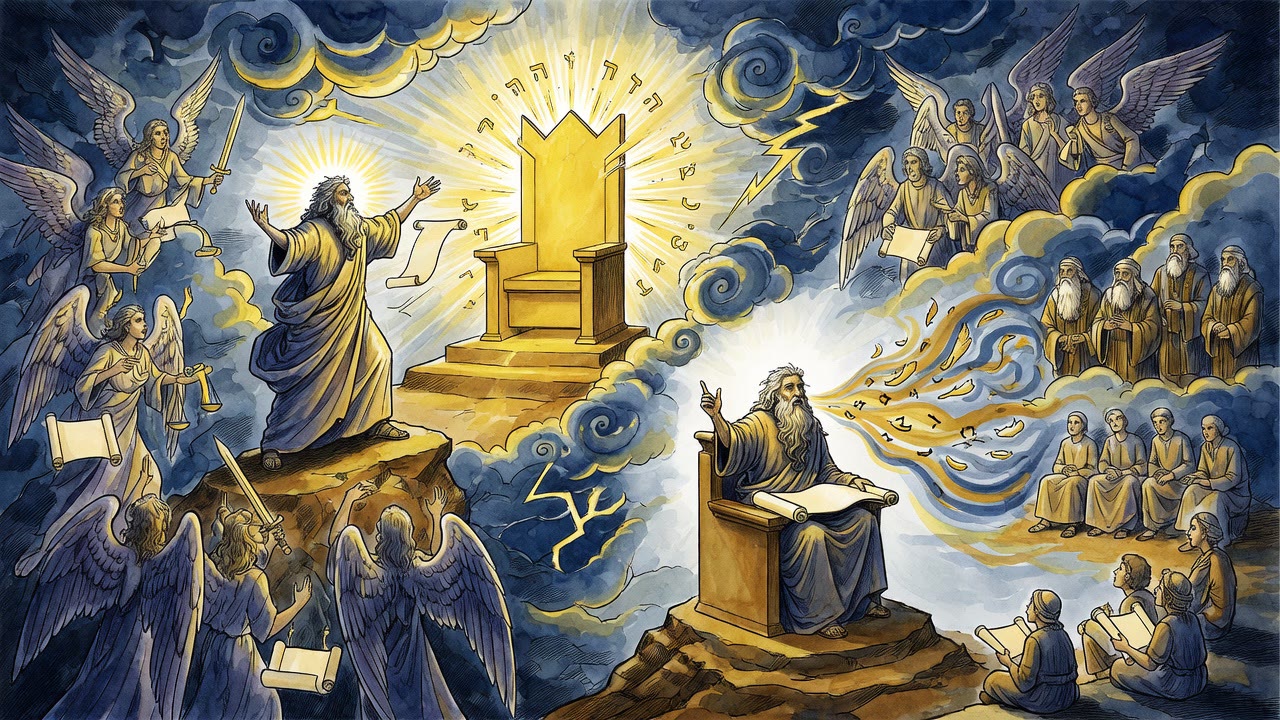
Forty days inside the cloud, with the tablets still uncut, Moses could not swallow the question any longer. He had watched the road that led him up to Sinai. A widow left to bury her own dead. A liar grown fat on other men's fields. A gentle man buried young while the one who cursed him kept climbing.

"Show me Your ways," he said into the fire. "Why does one honest man eat and another starve? Why does one wicked man fall and another rise? Master of the world, let me see the law by which You rule it."

The voice on the mountain did not defend itself. It opened a window in the air and told him to look down.

The Spring at the Foot of the Rock

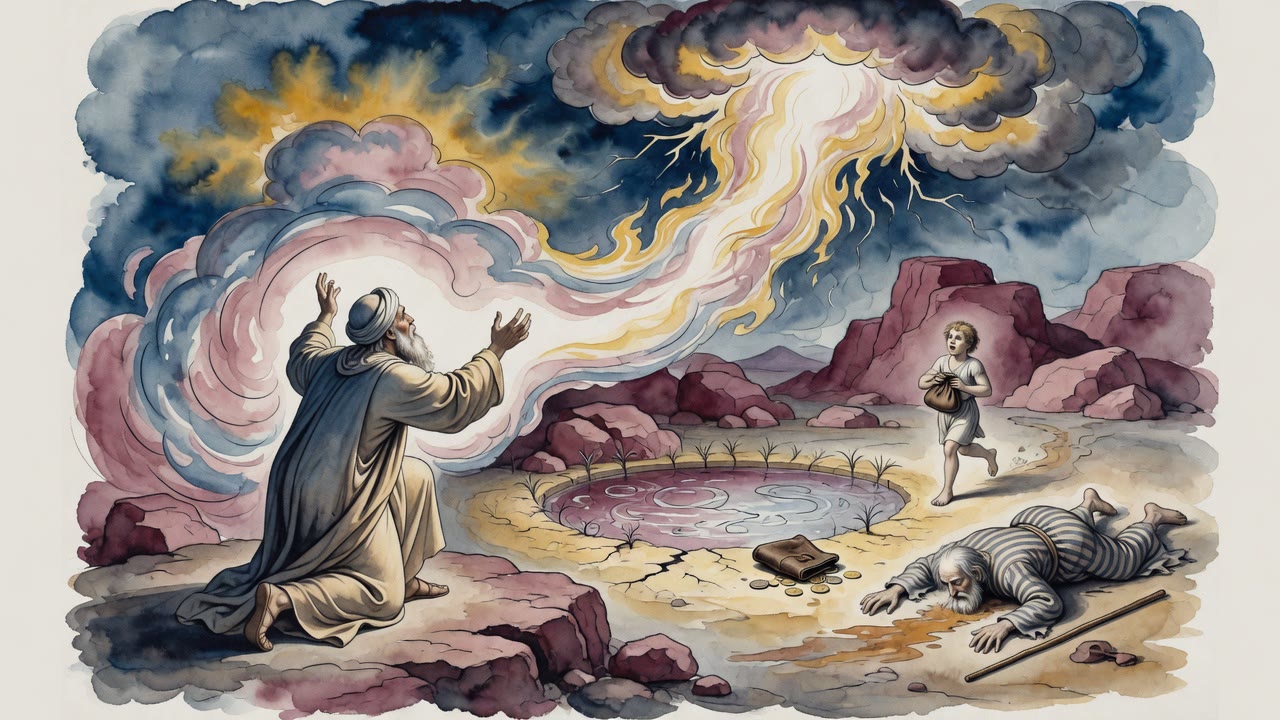
Below him a spring ran out of a rock into a stone basin, the way water runs anywhere men and animals gather. A traveler rode up, dropped from his horse, knelt, and drank until his beard streamed. When he stood he left behind a purse heavy with gold, forgotten in the grass. He mounted and rode north without a backward glance.

A boy came next, driving a goat to water. He saw the leather purse lying in the grass, weighed it in his palm, felt the coins shift, and ran. He did not look back either.

Then an old man came to the spring with an empty jug, lowered himself onto the stone, and drank.

The Purse, the Boy, and the Dead Man

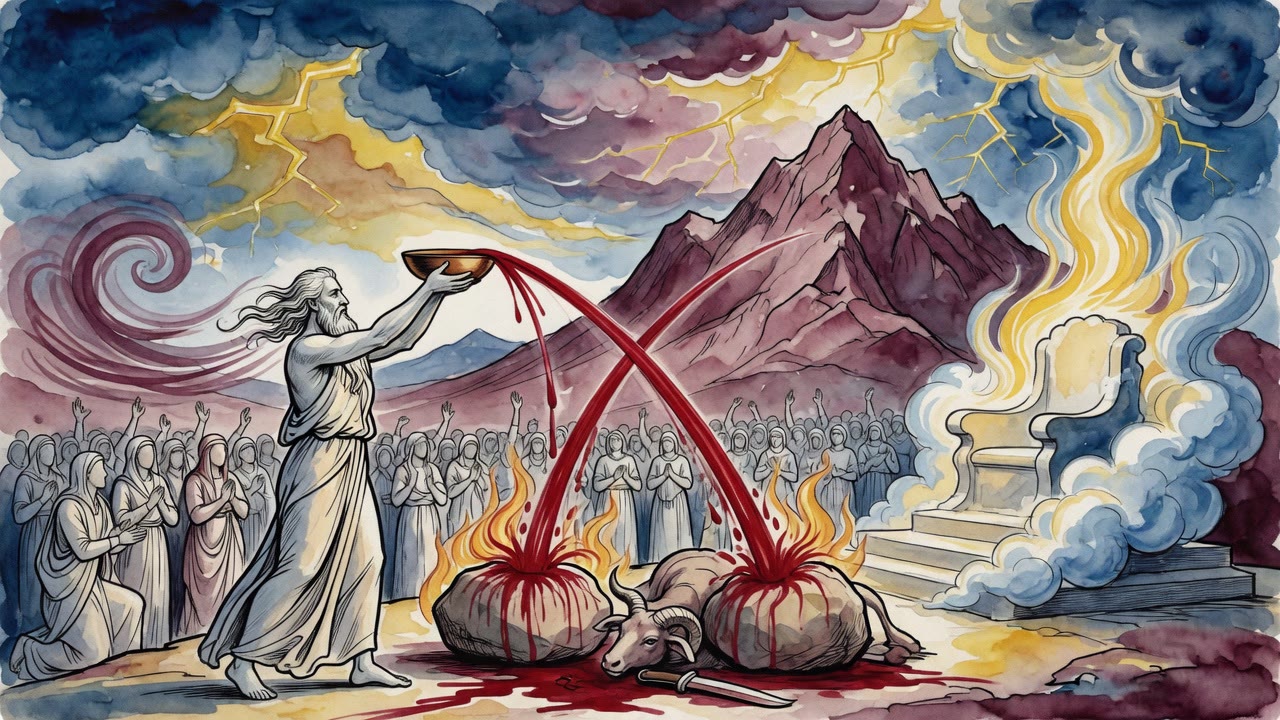
The traveler returned at a gallop, his face white. He had felt the weight gone from his belt. He found the old man alone at the water and saw no one else, and something in him tore loose. "Thief," he shouted. "Give it back." The old man lifted his wet hands, empty, and swore he had touched nothing but the spring. The traveler did not wait. He drew, and he struck, and the old man folded over the stone basin, and the clear water went dark and then red.

Moses turned his face from the window. "This is Your law?" he said. "The boy runs off rich. The old man dies for a coin he never saw. The killer rides home clean. Master of the world, I would rather not have looked."

The Ledger No Living Eye Was Meant to Read

Then God unrolled the account beneath the scene, the part no living eye is built to read.

The gold in that purse had never belonged to the traveler. Years before, in another town, he had robbed it from the boy's father, coin for coin, and left that house poor. The boy who snatched the purse from the grass had carried off nothing but his own. And the old man bleeding on the stone was no innocent stopping for water. In his youth he had murdered the traveler's father and walked away, and no court had ever found him. The traveler, riding blind with rage, had at last avenged a father he barely remembered, and paid a debt he never knew he carried.

Three men at one spring, and every stroke of it had closed an old account. Measure answered measure, the same reckoning that would one day thicken the Nile into blood because Egypt had fouled the water of Hebrew slaves. Nothing at the spring was cruelty. It was arithmetic run across three lifetimes, and Moses had been shown only the middle line.

The Faces That Had Not Been Born

The window widened. Now the generations still unborn crowded into the light, rank on rank: the interpreters bent over letters he had not yet carved, the prophets, the judges, the quiet pious ones no chronicle would name. He watched a righteous man promised rest and then stripped of it. Whenever such a man leaned toward a season of peace, the Accuser rose in the court above and argued that a soul already promised the world to come had no claim on comfort in this one. Even Jacob, who had begged heaven for nothing but to sit still at last, had heard that voice at his door and lost Joseph the moment the road seemed to smooth.

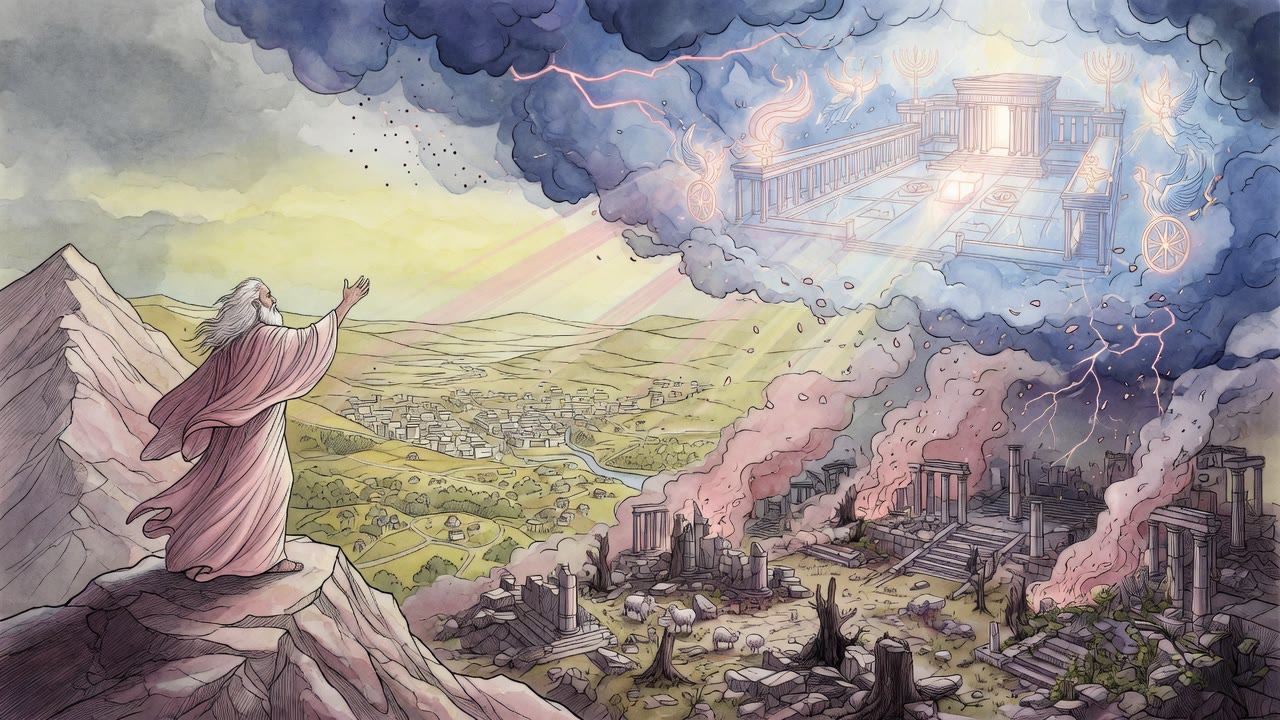
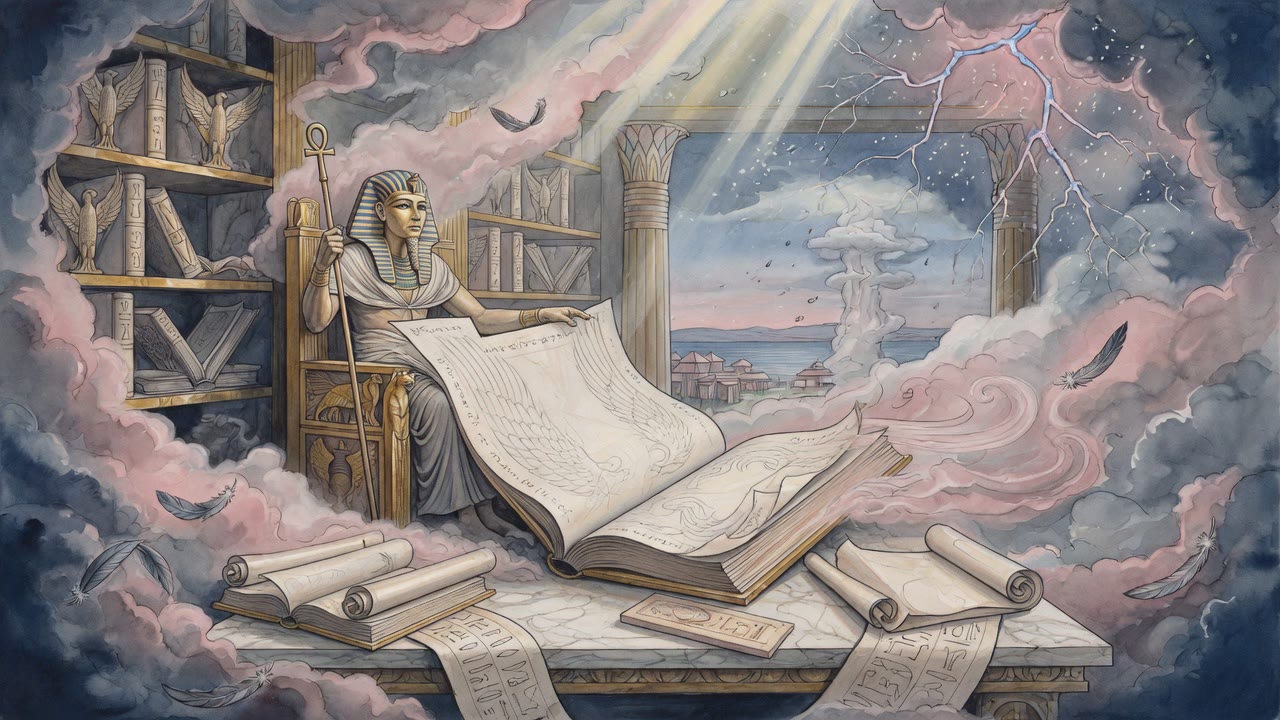
Then God showed him the far edge of the account. Above the earthly sanctuary Moses was commanded to build, another was rising, raised by no human hands, a house of jewels and pearls and the light of the Shekhinah (the Divine Presence), kept for Israel to the end of all the generations he had just watched file past. The ledger that looked like slaughter at the spring came out even there, in a Temple that would never fall.

Moses pressed once more. "Teach me the whole of it," he said.

"You cannot hold all the rules by which I govern the world," the voice answered, "but take one. When a man comes to Me with no claim, nothing owed him for his own deeds or his fathers', and still he begs and will not stop, I answer him, and I give him what he needs."

The window shut. Below the mountain the spring still ran out of the rock into the basin, clear again, catching the light, telling no one what it had balanced. Moses gathered the tablets and started down toward the people who would ask him, in every generation, the same thing he had asked, and to whom he could carry back only the single line he had been given.


← All myths
From the tradition

Sources

4 sources

The texts behind this telling. Some cards carry a translation of the source; others are our own retelling of it, and each card says which. Every card links out to the original.

Legends of the Jews 2:119Legends of the Jews

Retold in our words. Read the original at the link below.The Legends of the Jews by Louis Ginzberg (1909) · Public Domain

It’s a question as old as time, and one that even Moses, the great lawgiver himself, wrestled with.

The Ginzberg’s says retelling in Legends of the Jews, while Moses was up on Mount Sinai – that sacred place where he received the Torah, the first five books of the Hebrew Bible – he witnessed a scene that shook him to his core.

A man stops at a river for a drink, unknowingly drops his purse, and walks off. Another man happens upon the purse, pockets the cash, and hurries away. Later, the first man realizes his loss, returns to the river, and confronts an innocent bystander who was simply fetching water. Accusing him of theft, the first man murders the innocent water-fetcher.

Moses, witnessing this apparent injustice, is understandably horrified. He cries out to God, "Show me your ways! Why was this innocent man slain, and why does the thief go unpunished?" It’s a raw, human reaction to a seemingly senseless act.

God, in His infinite wisdom, responds by revealing the hidden connections. The man who kept the purse wasn't stealing, but reclaiming what was rightfully his – the first man had stolen it from him earlier! And the seemingly innocent man who was murdered? He was atoning for a past sin – the murder of the slayer's father.

Wow. Talk about a cosmic balancing act.

This story isn't just a quirky anecdote; it's a powerful illustration of how limited our human understanding can be. We see a snapshot, a single moment in time, without knowing the full history, the karmic debts, the intricate web of cause and effect that shapes our world.

God only granted Moses a partial glimpse. He showed him all the generations to come, the sages and prophets, the interpreters of scripture, the leaders and the pious.

But Moses, still troubled, pressed further. "O Lord of the world!" he pleaded, "Let me see by what law Thou dost govern the world; for I see that many a just man is lucky, but many a one is not; many a wicked man is lucky, but many a one is not; many a rich man is happy, but many a one is not; many a poor man is happy, but many a one is not." He’s basically saying, "God, this whole thing feels random!"

God’s reply is profound. He tells Moses, "Thou canst not grasp all the principles which I apply to the government of the world, but some of them shall I impart to thee. When I see human beings who have no claim to expectations from Me either for their own deeds or for those of their fathers, but who pray to Me and implore Me, then do I grant their prayers and give them what they require from subsistence."

In other words, God's ways are complex and beyond our complete comprehension. Sometimes, grace is given simply because it is asked for, even when it isn't "deserved" based on past actions.

Maybe it’s a call to humility. A reminder that what appears unjust on the surface might be part of a larger, more intricate plan that we can't fully grasp. And perhaps, most importantly, it’s an affirmation of the power of prayer, of reaching out to the Divine, even when we feel unworthy. Because sometimes, that’s all it takes.

Full source
Legends of the Jews 7:15Legends of the Jews

Retold in our words. Read the original at the link below.The Legends of the Jews by Louis Ginzberg (1909) · Public Domain

Being in his sandals, standing in the very presence of God. It's a question that has captivated Jewish scholars and storytellers for centuries. The Legends of the Jews, that incredible compilation of rabbinic lore assembled by Louis Ginzberg, offers a glimpse into just such a mystical encounter.

In this tradition, after receiving the Torah, Moses pleaded with God. He didn't ask for power or glory. He asked for something far more profound: "Permit me to speak to Thy Messiah before I die." To speak to the Messiah before death.. what a powerful desire!

God, in His infinite wisdom, granted Moses this request. But there was a condition. "Come," God said, "I shall teach thee My great name, that the flames of the Shekinah (the Divine Presence) not consume thee." The Shekinah (שְׁכִינָה) refers to the divine presence, the radiant glory of God. The name God was to impart was so potent, so filled with divine energy, that it could be dangerous if not handled with the utmost reverence.

Moses, imbued with the secret, approaches the Messiah, David's son, and Aaron. They immediately recognized that Moses had been taught the great name. In a moment of profound respect, they greeted him with the words: "Blessed be he that cometh in the name of the Lord." A beautiful moment of recognition and blessing.

Moses, overwhelmed by what he was witnessing, then exclaimed, "God told me that Israel was to erect a Temple to Him upon earth, and I now see Him build His own Temple, and that, too, in heaven!" He realized that the earthly Temple was just a reflection of something far grander, a divine archetype existing in the celestial realms.

The Messiah responded, offering a profound insight. "Thy father Jacob saw the Temple that will be erected on earth, and also the Temple that God rears with His own hand in heaven, and he clearly understood that it was the Temple God constructed with His own hand in heaven as house of jewels, of pearls, and of the light of the Shekinah, that was to be preserved for Israel to all eternity, to the end of all generations. A Temple built of light and jewels, a celestial sanctuary meant to endure forever.

The Messiah continues, elaborating on Jacob's vision. "This was in the night when Jacob slept upon a stone, and in his dream beheld one Jerusalem upon earth, and another in heaven. God then said to Jacob, 'My son Jacob, to-day I stand above thee as in the future thy children will stand before Me.'" According to this legend, Jacob's famous dream wasn't just about angels ascending and descending a ladder. It was about seeing the two Jerusalems, the earthly and the heavenly, side by side.

Jacob, upon seeing these two cities, understood something crucial. "The Jerusalem on earth is nothing, this is not the house that will be preserved for my children in all generations, but in truth that other house of God, that He builds with His own hands." The earthly Jerusalem is important, yes, but it is the heavenly Jerusalem, the divine Temple, that holds the true promise of eternity.

But the Messiah offers a final, reassuring thought. "But if thou sayest that God with His own hands builds Himself a Temple in heaven, know then that with His hands also He will build the Temple upon earth." The Zohar, that foundational text of Jewish mysticism, often speaks of the interconnectedness of the earthly and heavenly realms. The Messiah's words echo this idea. The divine blueprint exists, and God will ensure its manifestation here on earth.

So, what does this all mean for us? Perhaps it's a reminder that even in the midst of our earthly concerns, we should never lose sight of the divine, the eternal, the heavenly Jerusalem that exists within us and above us. Perhaps the story encourages us to seek out those moments of connection, those glimpses of the Shekinah, that remind us of the grander, more beautiful reality that surrounds us. Can we, like Moses, strive to see beyond the veil?

Full source
Legends of the Jews 1:2Legends of the Jews

Retold in our words. Read the original at the link below.The Legends of the Jews by Louis Ginzberg (1909) · Public Domain

Legends of the Jews turns to Why the Righteous Suffer Just When Peace Seems Near.

"The standard of the Messiah shall wave forever and ever." This sets the stage for understanding earthly suffering as temporary when viewed against the backdrop of eternity.

What about those earthly struggles? Why can’t the righteous catch a break? According to Legends of the Jews, whenever a truly pious person anticipates a period of peace, Satan, the Satan – the Accuser – steps in. He appears before God and argues that the righteous are already destined for the rewards of the World to Come, Olam Ha-Ba (the World to Come). Why, he asks, should they also get to enjoy the pleasures of this world?: Is it fair for someone to win the lottery if they already have a trust fund? The Accuser makes a similar claim about spiritual rewards.

This brings us back to Jacob. He had endured so much – the deception of Laban, the wrestling with the angel, the constant sibling rivalry. Just when he thought he could finally relax, tragedy struck again with the loss of Joseph. As Jacob himself laments, "Few and evil have been the days of the years of my pilgrimage."

The text emphasizes that Jacob only truly valued the time he spent in the Holy Land, occupied with the sacred work of making proselytes, following the examples of his father, Isaac, and grandfather, Abraham. This notion of "making proselytes" refers to actively drawing others closer to God, a concept we find echoed throughout Jewish tradition. But even this fulfilling period was cut short when Joseph was taken from him. Only eight years had passed since his return.

What does this tell us? Perhaps it's a reminder that true fulfillment isn’t about avoiding hardship, but about finding meaning and purpose even within it. Jacob's suffering didn’t negate his righteousness. Instead, it highlighted the contrast between the fleeting nature of earthly joys and the enduring value of spiritual pursuits.

The story invites us to consider what we truly value. Are we chasing fleeting pleasures, or are we building something that will last, something that contributes to the greater good, like Abraham, Isaac, and Jacob did? And when the inevitable hardships come – as they do for everyone – can we see them not as punishments, but as opportunities to deepen our faith and strengthen our resolve?

Full source
Legends of the Jews, IV. Moses In Egypt, Measure For MeasureLegends of the Jews

Retold in our words. Read the original at the link below.Project Gutenberg eBook #1494, The Legends of the Jews, Volume 2 · Public Domain

A reader can see them as just random acts of divine power, but Jewish tradition teaches us there’s so much more going on. It's not just about punishment, it's about midah k'neged midah, measure for measure – a cosmic sense of justice.

The story of the plagues, as retold in Ginzberg's Legends of the Jews (drawing from various Midrashic (rabbinic interpretive commentary) sources), paints a picture of a God who is meticulous and intentional in His response to Egyptian oppression. The Torah details ten distinct plagues, each more devastating than the last, but what often gets overlooked is the why behind them.

The tradition says the plagues weren't just randomly selected. They were carefully chosen to mirror, and ultimately avenge, the specific cruelties inflicted upon the Israelites. The Egyptians forced the Israelites to draw water and prevented them from using the ritual baths, the mikvaot. What was the first plague? The water turning to blood. "Because they forced the Israelites to draw water for them…He changed their water into blood." Seemingly a direct response to their actions.

It goes on. The Egyptians made the Israelites catch fish for them, so God brought forth frogs that swarmed their homes, even invading their kneading troughs and bedchambers! Imagine that! As Ginzberg retells, it was considered the most severe of all the plagues. The Egyptians forced the Israelites to sweep and clean, so God turned dust into swarms of lice that covered everything. You start to see the pattern. Even the division of labor in bringing the plagues is significant. God divided the ten punishments: Aaron brought plagues arising from the earth and water, the more solid elements. Moses brought those from air and fire, the more volatile elements. God reserved three plagues for Himself. In this way, God acted like a king preparing for war, strategizing against the Egyptians.

But it's not just about direct retribution. It’s also about striking at the core of Egyptian arrogance. Pharaoh famously boasted, "My Nile is my own; I made it for myself" (Ezekiel 29:3). So, God turned the Nile, the very source of Egypt's life and prosperity, into a symbol of death and decay. The arrogance of Pharaoh was repaid in kind by the plague of blood.

The Midrash takes it even further, suggesting that each plague was a cosmic response to Egypt's desire to destroy the Israelites. The frogs avenge the desire to destroy the people destined to receive the Torah, which is likened to water. The lice avenge the desire to destroy the nation whose seed is like the dust of the earth. Even the darkness, a plague that seems almost merciful in its quiet horror, is seen as divine justice. As we find in Midrash Rabbah, "Darkness…shall come and take vengeance upon the Egyptians for desiring to destroy the nation upon which shineth the light of the Lord."

The tenth and final plague, the slaying of the firstborn, is perhaps the most direct, echoing the Egyptian decree to kill Israelite baby boys. It's a brutal act, but within this framework of midah k'neged midah, it becomes a chillingly logical consequence of their actions.

Now, it's important to acknowledge the difficult questions this raises. Does this mean God is always this literal in meting out justice? Is every suffering a direct consequence of a specific sin? Jewish tradition offers a range of perspectives on this, and it's a conversation that continues to this day.

But what the story of the plagues, as presented in Legends of the Jews and other sources, highlights is the concept of cosmic accountability. Our actions have consequences, not just on a personal level, but on a universal one. The story invites us to consider the ripples we create, and the kind of world we want to build.

So, the next time you read about the plagues, remember it's not just a story of divine power, but a complex and nuanced reflection on justice, responsibility, and the interconnectedness of all things. What kind of ripples are we creating?

Full source