6 min read

Isaac's Dark Blessing Returned to Jacob by God

Isaac blessed the son in Esau's clothes. Later heaven answered each line with dew, grain, bowed kings, and a second blessing no one could undo.

Curated by Arthur · Told by Maggid ·
Table of Contents
  1. The Tent Smelled Like the Wrong Son
  2. Dew Fell Twice
  3. The Earth Gave Its Fatness Back
  4. Kings Bent Low in the Echo
  5. Isaac Signed What He Had Spoken
  6. The Lie Stayed Outside the Blessing

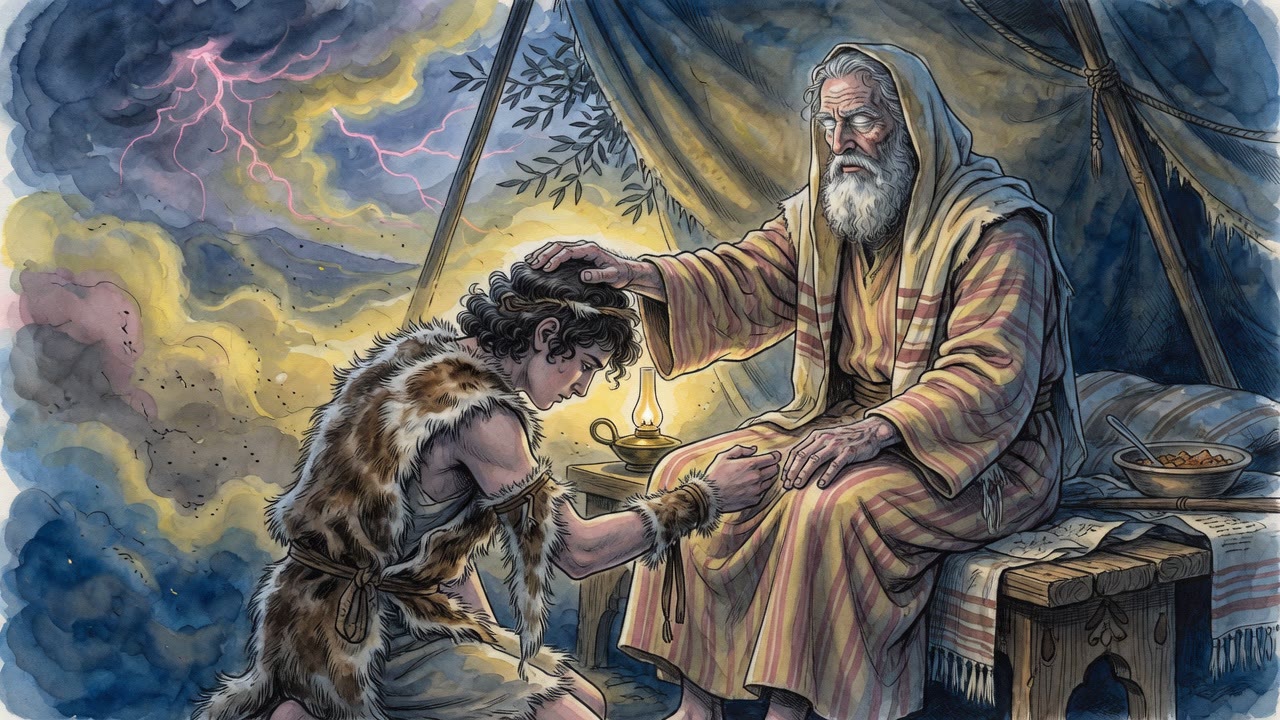
The tent smelled like Esau, but the voice inside it trembled like Jacob.
The Tent Smelled Like the Wrong Son

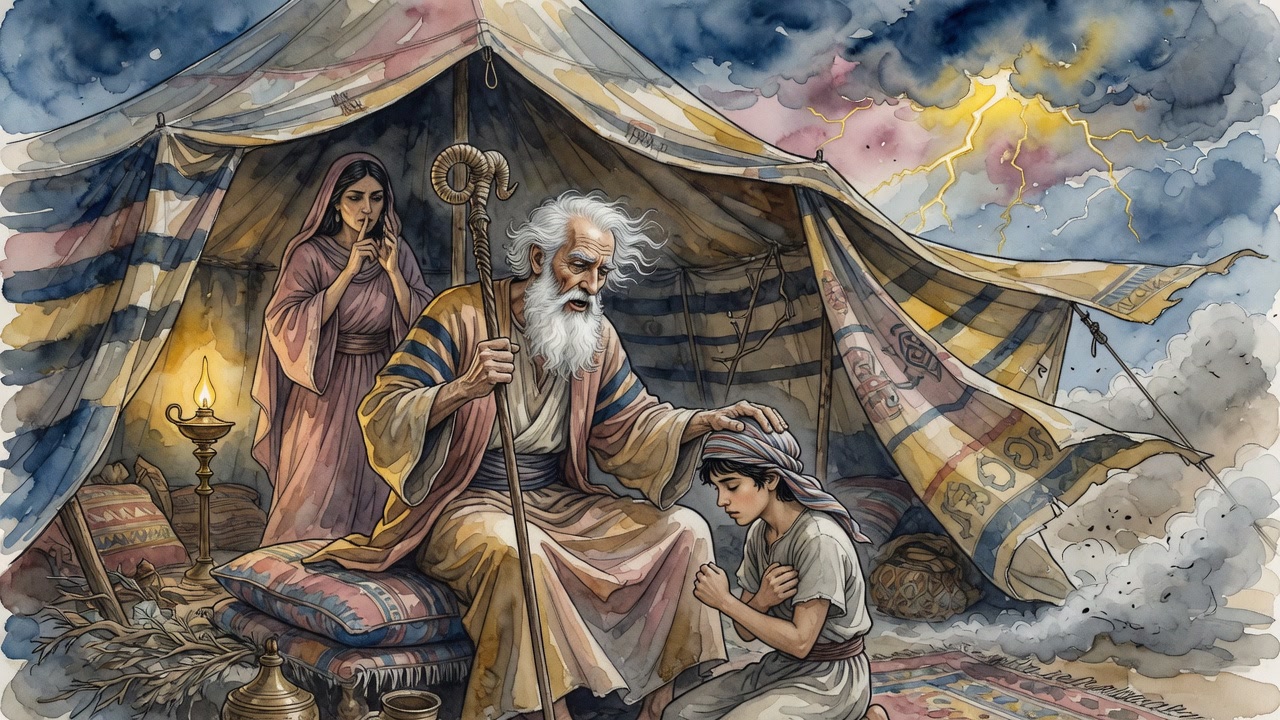
Blind Isaac sat with the meal before him and the world narrowed to touch, scent, and sound. Goat skins roughened the arms under his hands. Esau's garments carried the field into the room. The old hunter's smell rose from the cloth, strong enough to persuade a father whose eyes had gone dark.

But the voice. The voice would not settle. It came soft, urgent, familiar in the wrong way. Isaac reached for certainty and found only signs that argued with one another. Hair like Esau. Clothing like Esau. Words like Jacob. The blessing waited in his mouth, heavy as a sealed jar.

Then he opened it.

He asked God to give the son before him the dew of heaven and the fatness of the earth, grain and wine, nations bending, peoples serving. The words left Isaac before the room could be corrected. They crossed the dim tent and fastened themselves to the younger son standing in his brother's clothes.

Dew Fell Twice

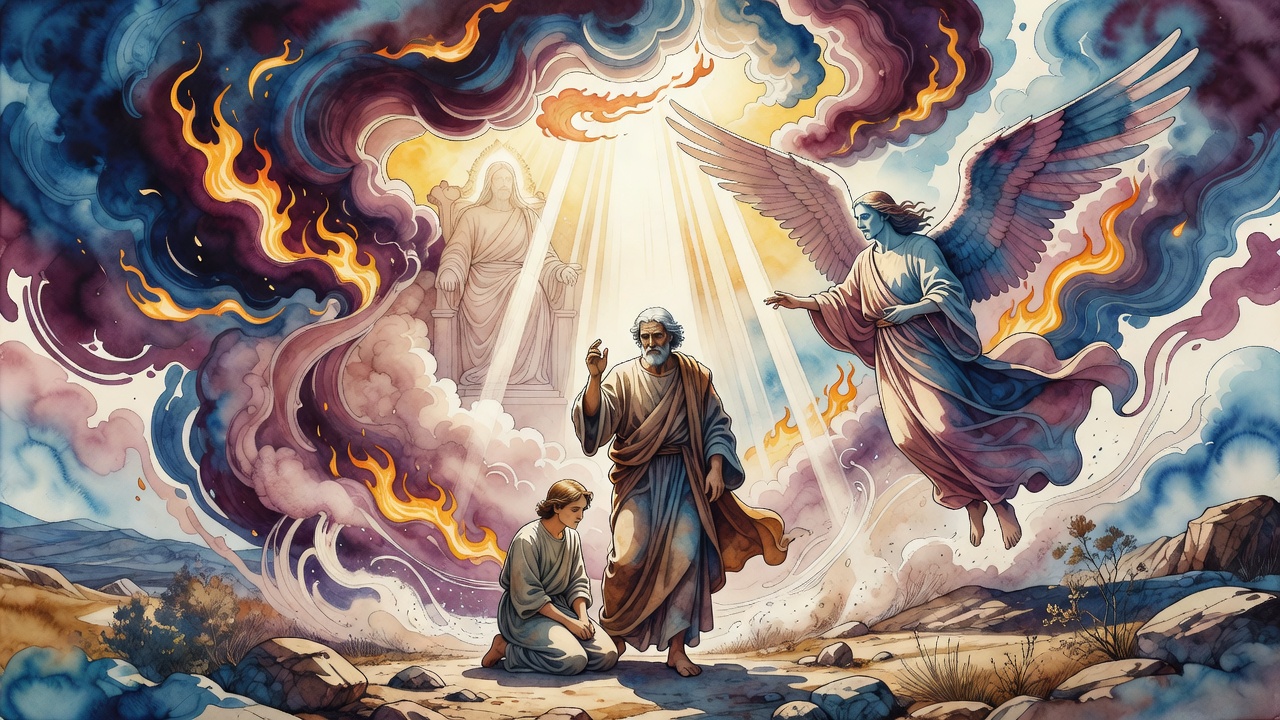
Dew was the first gift. Not rain, loud and visible, but the quiet wetness that appears before the day fully wakes. Isaac placed it on Jacob, and centuries later the same image rose again over Jacob's descendants. The remnant would stand among many peoples like dew from the Lord, not dependent on human command, not waiting for a man to summon it.

That echo matters because the first blessing had been spoken under pressure. Rebekah had moved quickly. Jacob had obeyed with a frightened boldness. Isaac had been deceived by skins, scent, food, and a son who answered too well. A family had bent itself around one old man's failing senses.

Still, dew fell twice.

The first drop came from a father's mouth in a dark tent. The second came through the mouth of prophecy, clear and public, after generations had carried Jacob's name through famine, exile, fear, and return. A blessing born in confusion did not remain confused forever.

The Earth Gave Its Fatness Back

Isaac had asked for the fatness of the earth. The phrase is physical. It is soil that answers the plow. It is seed that does not rot. It is bread thick enough to break in both hands.

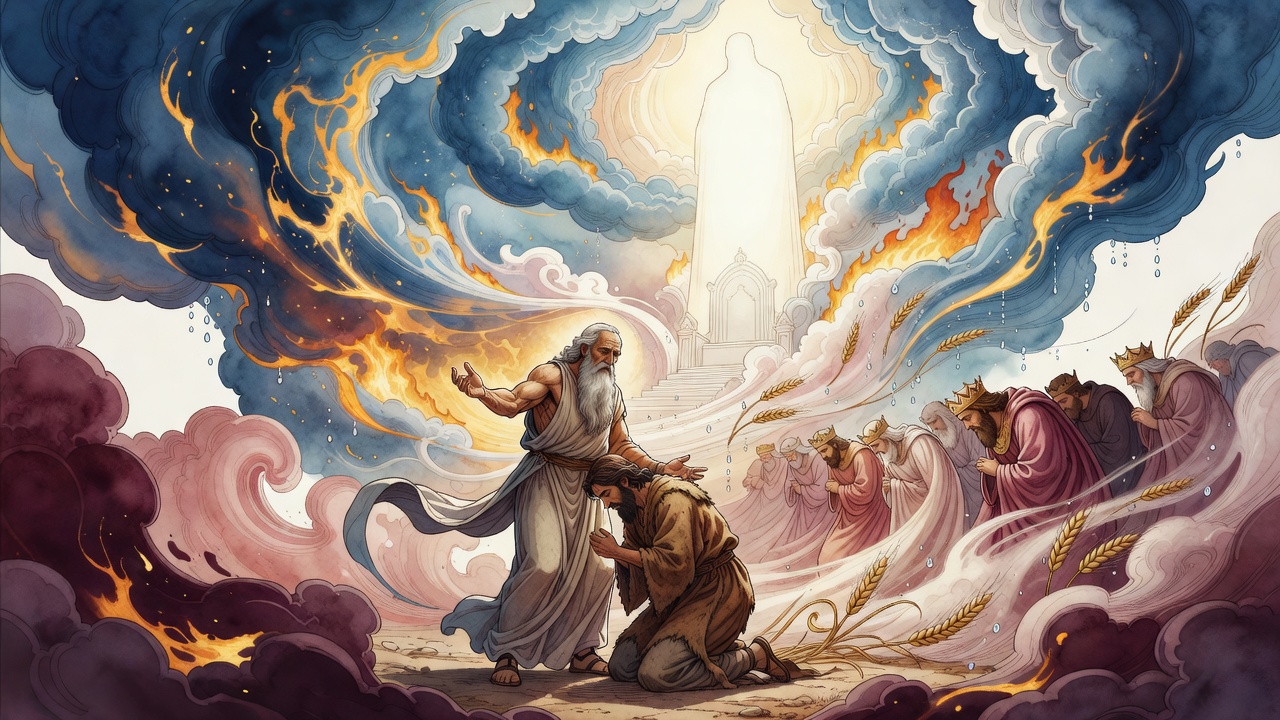
Later, another voice promised rain for the seed and bread from the increase of the ground, fat and plentiful. The echo did not float above the world. It entered fields, stalks, threshing floors, vineyards, barns. Isaac had blessed Jacob with a world that would feed him, and heaven answered in the language of farmers who wait for clouds and count sacks after harvest.

Then came grain and wine. Isaac spoke them over one son, and the future handed them back to a people. Grain for survival. Wine for the table after fear has loosened its grip. The blessing did not become abstract when God confirmed it. It became more edible.

Kings Bent Low in the Echo

The darker words came next. Peoples would serve. Nations would bow. Isaac's blessing did not only promise food. It promised standing, rank, and a reversal of humiliation before it had even arrived.

The echo sharpened the image until it almost hurt to look at. Kings would become nursing fathers. Queens would bow with their faces to the earth. Their mouths would touch dust at Jacob's feet. The descendants of the younger son, the one who entered the tent under a false name, would not always stand at the mercy of stronger houses.

That did not make Jacob innocent. The lie stayed a lie. But the blessing moved along another road. A father may be tricked. Heaven is not. If the words were wrong, God could have let them fall dead in the tent. Instead, the future kept speaking them.

Isaac Signed What He Had Spoken

After the disguise was uncovered, Isaac did not tear the blessing out by the roots. He trembled. He learned which son had stood before him. Esau cried out. The house shook with the cost of words that could not be taken back.

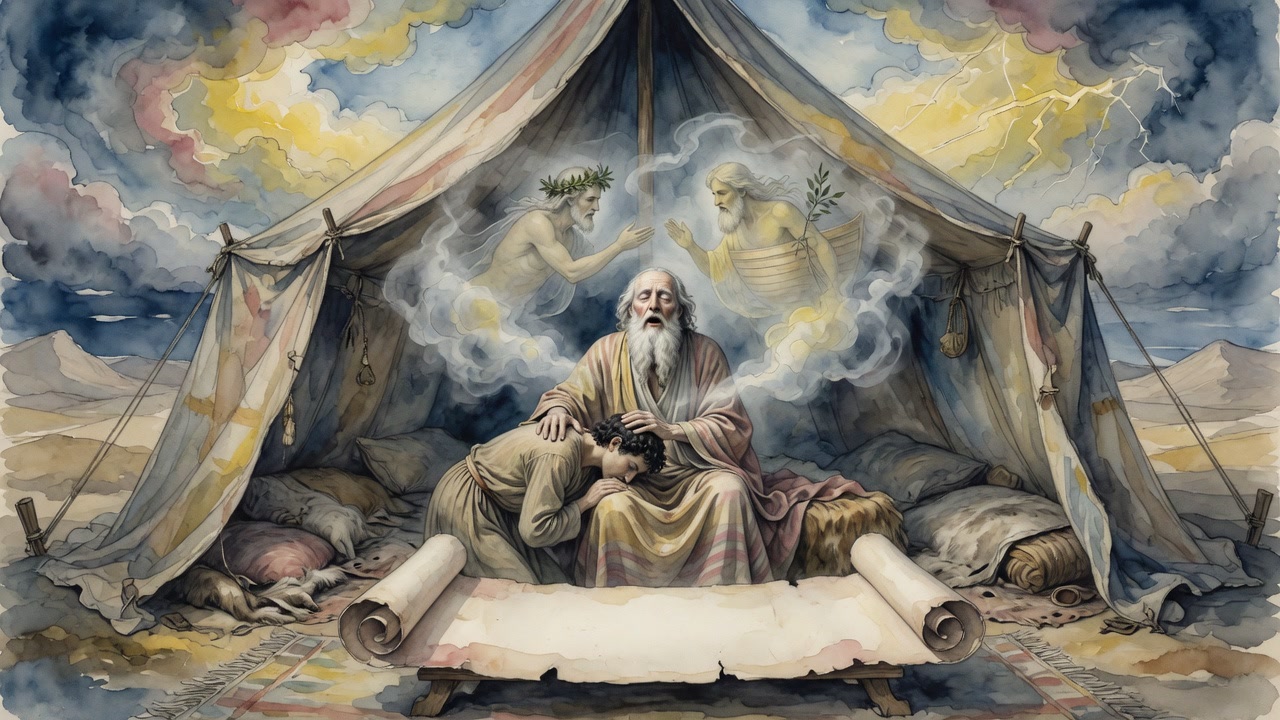
Then Isaac blessed Jacob again.

This time there were no goat skins. No borrowed garment pressed against Jacob's shoulders. No voice performing another man's name. Isaac knew who stood before him, and he placed his signature at the bottom of the document his mouth had already written.

He gave three more blessings. First, as far as his own power to bless reached, he bestowed it on Jacob. Second, he asked the endless God of blessing to give Jacob His blessing. Third, he passed onward the blessing Abraham had wanted to give Isaac, the blessing Abraham had held back so Ishmael would not burn with jealousy.

A withheld inheritance crossed three generations and landed on Jacob in the open.

The Lie Stayed Outside the Blessing

Jacob had entered the tent by a crooked path. Nothing in the second blessing erased that. The old father had been deceived. The older brother had been wounded. Rebekah's plan had worked, and the working of it left scars across the household.

But Isaac's second act closed one accusation. No one could say the blessing belonged to Jacob only because he stole a moment from a blind man. Isaac knew. Isaac spoke again. Isaac sent him forward under Abraham's line, under God's endless blessing, under the old promise that could survive a damaged house.

The tent stayed behind. The words did not. Dew, earth, grain, wine, bowed nations, and the hidden blessing of Abraham followed Jacob out into the open air, where every line would be answered again.


← All myths

From the tradition

Sources

3 sources

The texts this telling draws on, in full. Open a card to read inline, or expand it for a wider, quieter read.

Legends of the Jews 6:64Legends of the Jews

The story of Jacob and his blessings takes on a whole new dimension when you realize just how closely God mirrors the blessings given by Isaac. It's almost as if the divine is saying, "Yeah, what your dad said? I second that."

It's a powerful idea, isn't it? Isaac, nearing the end of his days, blesses Jacob, unknowingly (or perhaps knowingly!) setting in motion a chain of events that would shape the destiny of a nation. But these aren't just empty words. These blessings, as Ginzberg recounts in Legends of the Jews, are echoed, amplified, and confirmed by God Himself. It's like a divine rubber stamp of approval.

Isaac blesses Jacob with dew, a symbol of sustenance and divine favor. And what does God say? "And the remnant of Jacob shall be in the midst of many peoples as dew from the Lord." (Micah 5:7). It’s not just about physical nourishment anymore; it’s about Jacob’s descendants becoming a source of blessing and renewal for others, like life-giving dew.

Then there's the blessing of the "fatness of the earth," a promise of abundance and prosperity. God echoes this, promising rain for the seed and rich bread from the ground. "And he shall give the rain of thy seed, that thou shalt sow the ground withal; and bread of the increase of the ground, and it shall be fat and plenteous." (Isaiah 30:23) It’s about more than just having enough to eat; it's about a land overflowing with bounty, a evidence of God's provision.

And the blessing of corn and wine? God responds in kind: "I will send you corn and wine." (Hosea 2:22). A promise of plenty, a life of joy and celebration.

Perhaps the most striking parallel comes in the blessings of power and dominion. Isaac says, "Peoples shall serve thee." A bold declaration! But God takes it even further: "Kings shall be thy nursing fathers, and their queens thy nursing mothers; they shall bow down to thee with their faces to the earth, and lick the dust of thy feet." (Isaiah 49:23) It’s a powerful image, one of ultimate respect and submission.

And when Isaac declares, "Nations shall bow down to thee," God proclaims, "And He will make thee high above all nations which He hath made, in praise, and in name, and in honor." (Deuteronomy 26:19). This isn’t just about political power; it’s about a people elevated for their righteousness, a light unto the nations.

What does it all mean? Is it simply a literary device, a way to emphasize the importance of Jacob and his descendants? Or is it something more profound? Perhaps it's a reminder that parental blessings, especially those rooted in faith and tradition, carry a weight that resonates with the divine. That God sees, hears, and affirms the hopes and dreams we have for our children, and for the generations to come. It suggests that bracha (blessing), when given with intention and love, can unlock something truly powerful, a divine echo that shapes destiny itself.

Full source
Legends of the Jews 6:84Legends of the Jews

After Jacob, disguised as his brother Esau, received Isaac's blessing, a lesser man might have tried to retract it. But Isaac, despite the deception, understood the weight of what he had done.

As Legends of the Jews (Ginzberg) tells us, Isaac, in a moment of profound confirmation, reaffirmed the blessing he'd unwittingly bestowed. It was as if the very act of signing a document, the final seal of approval, required him to stand by his words. He knew that the value of his pronouncements rested upon his unwavering commitment to them.

To ensure that no one could accuse Jacob of securing the blessing through trickery alone, Isaac bestowed upon him three additional blessings. It wasn't just a simple confirmation; it was an amplification, a strengthening of the divine favor.

These weren't just empty words. Isaac declared, "In so far as I am endowed with the power of blessing, I bestow blessing upon thee." He was acknowledging his role as a conduit, a vessel for divine grace. He then added, "May God, with whom there is endless blessing, give thee His…" He invoked the ultimate source of all blessings, recognizing that his own power was but a reflection of God's infinite abundance.

And finally, perhaps the most poignant of the three: "…and also the blessing wherewith Abraham desired to bless me, desisting only in order not to provoke the jealousy of Ishmael." Isaac was acknowledging the lineage of blessing, the passing of the torch from grandfather to father to son. He also hints at a delicate balance within the family, a need to temper the blessing so as not to incite sibling rivalry.

These three additional blessings, according to Legends of the Jews, weren't just a formality. They were a evidence of the enduring power of a father's word, even in the face of deception. They were a recognition that some things, once set in motion, cannot be undone.

So, what does this teach us? Maybe it's about the weight we give to our words, the power they hold to shape not only our own lives but the lives of those around us. Or perhaps it's a reminder that even when things don't go as planned, even when we're tricked or misled, there's still an opportunity to find grace, to reaffirm our commitments, and to pass on the blessings we have received. What do you think?

Full source
Book of Jubilees 26:23Book of Jubilees

Like, you read them and think, "Wait, did that really happen that way?" Let's It's in the Book of Jubilees, chapter 26, and it's about Isaac, Jacob, and Esau.

The familiar story is this:. Isaac is old and blind, and he wants to give his blessing to his elder son, Esau. But Rebecca, Isaac's wife and mother to both boys, favors Jacob. So, she arranges a plan to deceive Isaac. Jacob pretends to be Esau, complete with hairy goat skins to mimic Esau's hairy arms.

This passage from Jubilees focuses on the pivotal moment of deception. Isaac asks Jacob, "How hast thou found so quickly, my son?" Jacob answers, "Because (the Lord) thy God caused me to find." for a second. Jacob is invoking God's name in a lie! Bold, isn't it?

Then comes the moment of truth. Isaac, suspicious, says, "Come near, that I may feel thee, my son, if thou art my son Esau or not." He's trying to use his sense of touch since his sight is failing.

Jacob approaches, and Isaac feels him. Here’s the kicker: "The voice is Jacob's voice, but the hands are the hands of Esau." He knows something is amiss! He can hear Jacob's voice, but feels the hairy hands of Esau. So why doesn’t Isaac realize the truth?

the verse says, “and he discerned him not, because it was a dispensation from heaven to remove his power of perception.” Dispensation, in this context, means a divine act or decree. In other words, it was God’s will that Isaac not see through the deception.

Isaac "discerned not, for his hands were hairy as (his brother) Esau's, so that he blessed him." The deception works. Jacob receives the blessing meant for Esau.

But why? Why would God allow, even orchestrate, such a thing?

That’s the question that has occupied rabbis and scholars for centuries. Was it simply to fulfill a prophecy? Was it part of a larger divine plan that we can’t fully comprehend?

The Book of Jubilees, considered apocryphal by many, offers this blunt explanation: it was a dispensation from heaven, a removal of Isaac's perception. Other interpretations found in classical Jewish texts offer further nuance. Some suggest Isaac subconsciously knew it was Jacob but proceeded anyway, perhaps sensing Jacob was more fit to carry the blessing. This is a fascinating example of midrash (rabbinic interpretive commentary), interpreting scripture to fill in gaps and offer new perspectives.

Whatever the reason, this moment emphasizes the complex and sometimes ambiguous nature of divine intervention. It challenges us to confront the idea that even seemingly negative events can be part of a larger, incomprehensible plan. It is a reminder that stories in our sacred texts can be complex, messy, and leave us with more questions than answers – and maybe, that's the point.

Full source