Parshat Toldot5 min read

Isaac Went Blind So Jacob Could Receive the Blessing

Isaac loved Esau and reached for the wrong son. His blindness became the narrow door through which Jacob received the covenant.

Curated by Arthur · Told by Maggid ·
Table of Contents
  1. The Angels Had Wept Into His Eyes
  2. Love Became a Bribe
  3. Rebekah Put the Curse on Herself
  4. The Voice Was Jacob's
  5. Esau Brought Hell to the Door

Isaac reached old age with the blessing still in his hands.

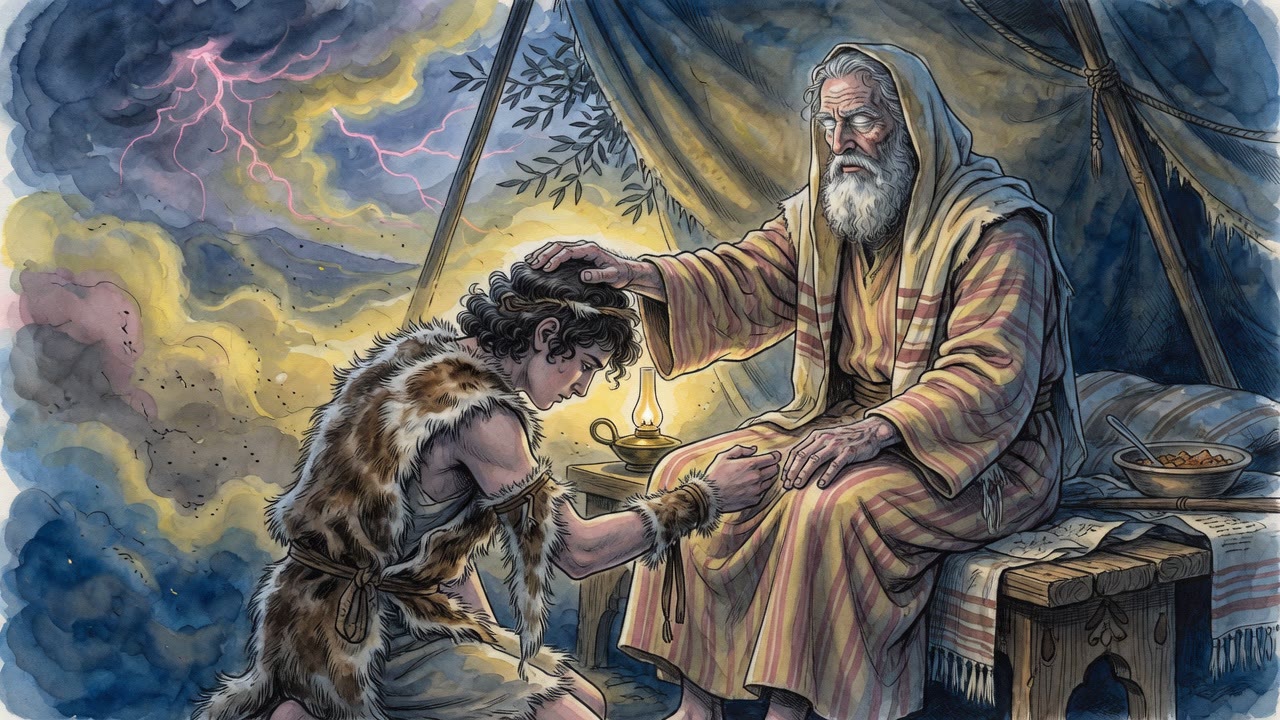
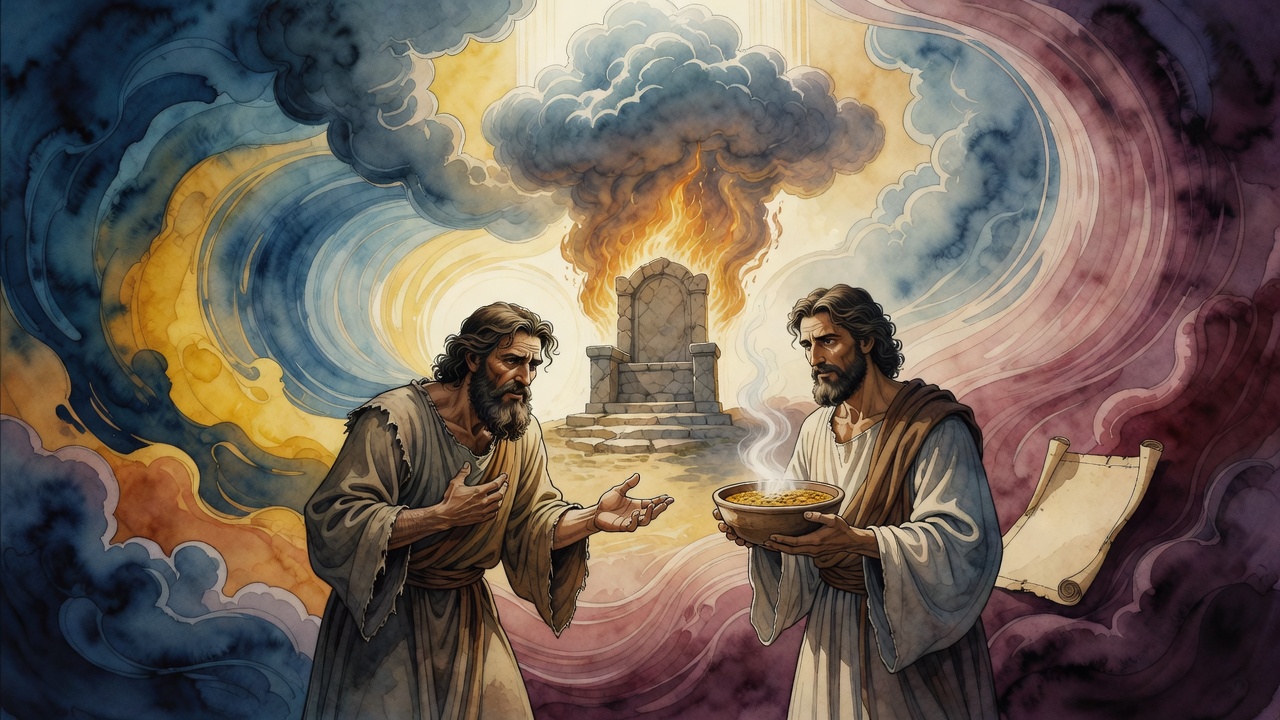
His eyes had gone dim. The tent had narrowed to sound, touch, smell, and memory. Outside, Esau still knew the fields. Inside, Jacob still knew the quiet of the house. Isaac loved the hunter's taste, the meat, the smell of the open country, the son who came in from the wild with blood on his hands and confidence in his voice.

He called Esau and asked for venison.

The Angels Had Wept Into His Eyes

Isaac's blindness did not begin in old age alone.

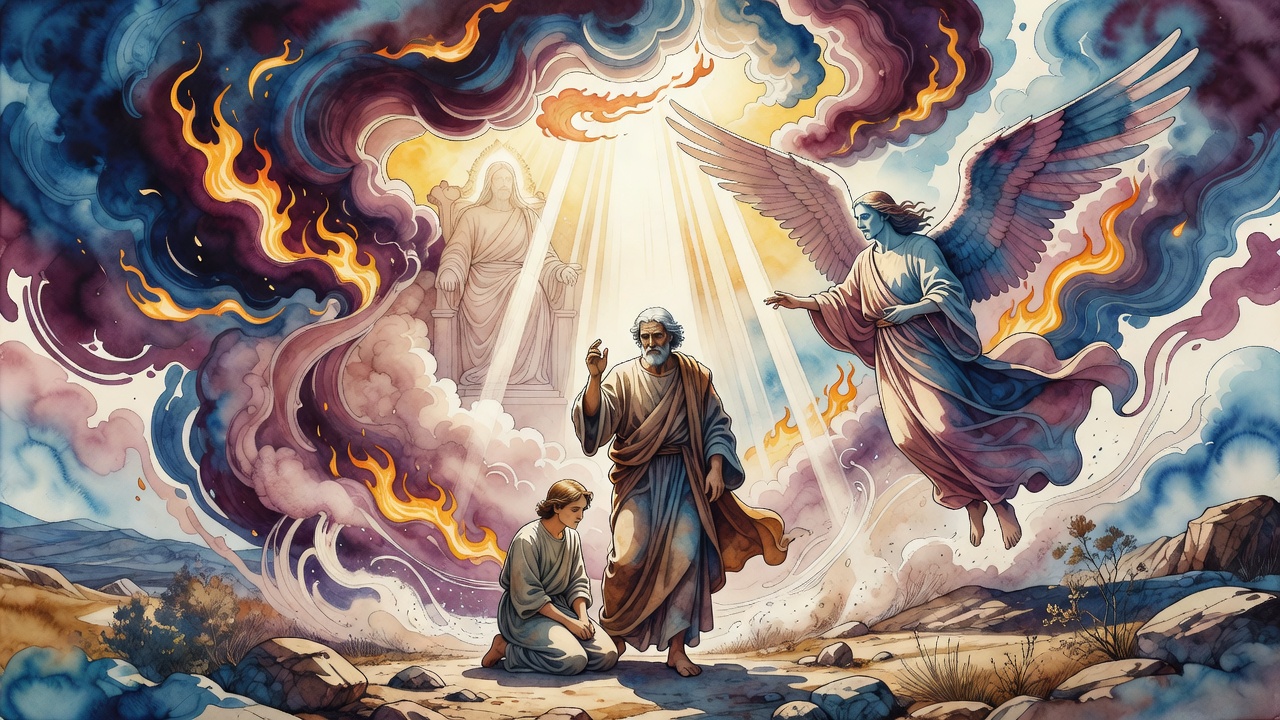
On Moriah, when Abraham bound him and lifted the knife, the angels wept above the altar. Their tears fell into Isaac's eyes. The wound stayed there, waiting through marriage, wells, famine, wealth, and the births of two sons who began fighting before they could breathe. Years later the tears ripened into darkness.

The eyes that had looked up from the altar could not safely guide the blessing by sight.

Love Became a Bribe

Isaac loved Esau.

That love was not clean sight. It was a gift placed into the hand of a judge. A gift blinds the eyes of the wise, and the father who could bless nations could still misread his own house. Esau's wives had brought bitterness into the tent. His hunger had sold the birthright. His hands were skilled, but the covenant did not belong to skill.

Isaac heard the son he wanted and prepared to bless him anyway.

Rebekah Put the Curse on Herself

Rebekah moved faster than grief.

She had heard the oracle before the twins were born. The elder would serve the younger. The struggle in her womb had not been a private discomfort. It had been prophecy pressing from inside her body. So when Isaac sent Esau to hunt, Rebekah called Jacob and dressed him for danger.

Jacob hesitated. If his father touched him and found smooth skin, the blessing might become a curse.

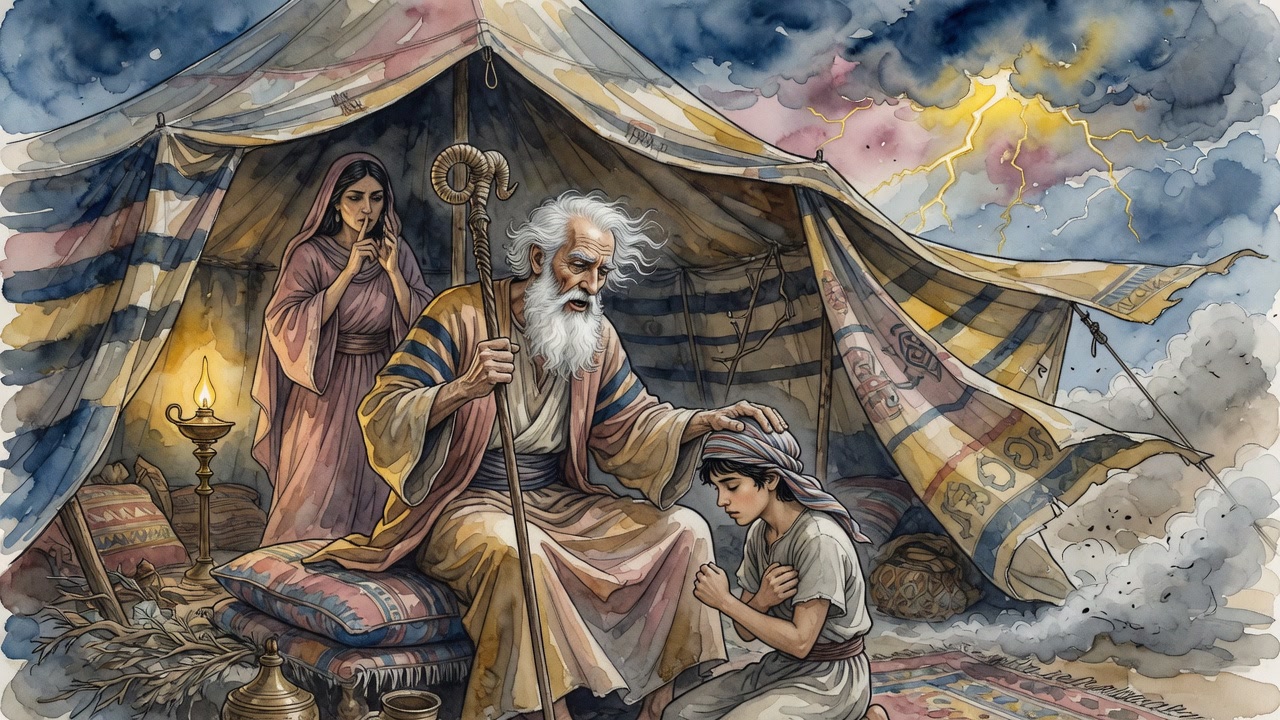
Then Rebekah placed herself beneath the storm. If there is a curse, she told him, let it fall on me and on my soul. She did not promise that the plan was painless. She promised to stand under its cost.

The Voice Was Jacob's

Jacob entered wearing his brother's garments.

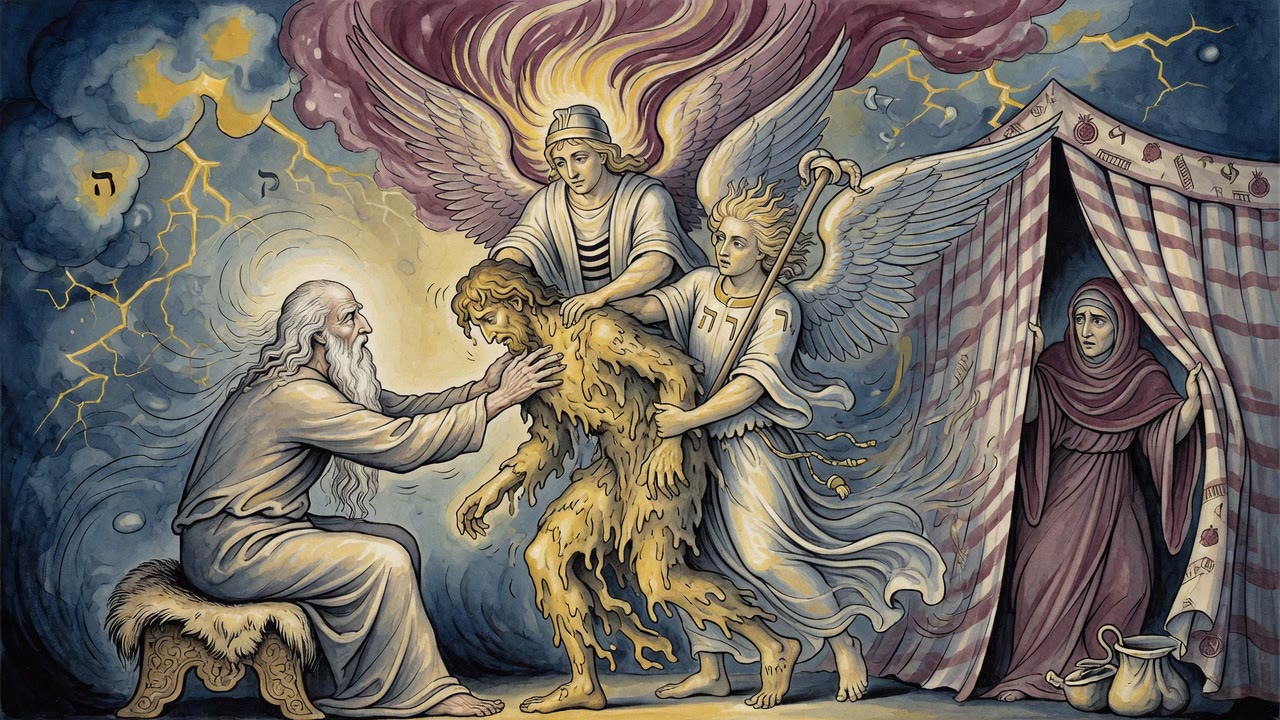
The skins covered his arms. The smell of the field rose from the clothing. Isaac reached out into darkness and found contradictions. The voice was Jacob's voice. The hands were Esau's hands. The old man stood at the border between what love expected and what heaven had already decided.

He ate. He smelled the garments. He blessed.

The blessing crossed the room through a disguise, but it did not land in the wrong place.

Esau Brought Hell to the Door

Esau came late.

The hunt had failed. The meal he brought carried the wrong weight. When he entered and spoke roughly to his father, Isaac trembled. Then the house itself seemed to heat. Isaac sensed Gehinnom near Esau's feet and cried out over who would burn there, himself or Jacob. Heaven answered that neither father nor Jacob would burn. The hunter would.

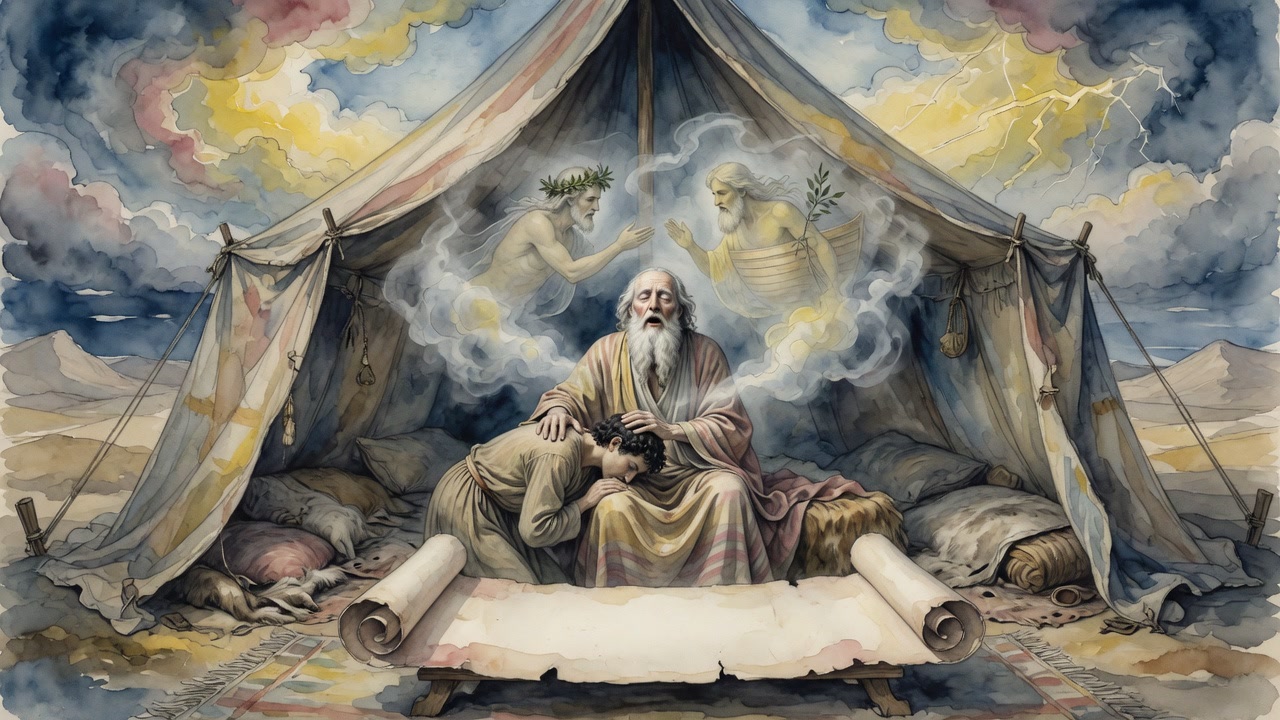
Only then did Isaac know that the darkness had protected him. The eyes that failed had saved the blessing from the hand his heart preferred. Rebekah's prophecy, Jacob's disguise, the angel tears, and Isaac's old age had all narrowed the door until covenant could pass through it.

Afterward, the Holy Spirit warned Rebekah that Esau was plotting murder. She heard what was hidden in his heart and moved again, sending Jacob away before the blessing could become blood on the tent floor.

Isaac's blindness looked like loss. It became the mercy that kept the future from being handed to the hunter.

Isaac went blind before Jacob could receive the blessing, and the timing made the whole room tremble. Had Isaac seen clearly, he might have blessed Esau with full confidence. Had he understood too early, Jacob might have fled before the words were spoken. The darkness held the moment together long enough for the younger son to come near.

Old age had already been given meaning in the patriarchal house. Lines on the face taught children to honor fathers. Here the dimming of the eyes taught something harsher: even a father worthy of honor can need heaven to protect him from the son he loves wrongly.


← All myths

From the tradition

Sources

9 sources

The texts this telling draws on, in full. Open a card to read inline, or expand it for a wider, quieter read.

Legends of the Jews, VI. Jacob, Isaac Blesses JacobLegends of the Jews

The story of Isaac blessing Jacob instead of Esau is definitely one of those moments. It’s a story filled with deception, family drama, and a bit of divine intervention, and it's far more complex than it might seem At first.

In Legends of the Jews, Esau’s marriages to Canaanite women were a constant source of grief for both Isaac and Rebekah. But why? Well, these marriages weren't just about differing social circles. They represented a clash of values, a deep-seated conflict between following God's path and embracing idolatrous practices. Rebekah found it distasteful, but Isaac, it seems, was particularly sensitive to it. The text suggests men are not as resilient to disagreeable circumstances as women. Interesting. And that's not the only reason Isaac's sight was failing. The Legends of the Jews (Ginzberg) also tells us about the tears of angels, shed when Isaac was bound on the altar by his father Abraham. These tears, the story goes, weakened his eyes. But there's also a more symbolic reason offered: Isaac's love for Esau, despite his wickedness, blinded him. It's like a "bribe" of filial affection, and as the saying goes, "A gift blinds the eyes of the wise."

Here's a twist: Isaac's blindness, despite being a hardship, actually turned out to be a blessing in disguise. It kept him at home, shielding him from the shame of being known as the father of the wicked Esau. And, crucially, it paved the way for Jacob to receive the blessing. It’s as if God was arranging events, guiding them toward a specific outcome. Like a physician tricking a sick man into drinking water he thinks is wine to make him feel better.

As Isaac approached the age his mother had reached when she passed away - one hundred and twenty-three - he began to think about his own mortality. According to Jewish tradition, it’s proper to prepare for death when you approach the age at which your parents passed. He decided it was time to bestow his blessing upon his elder son, Esau. He called for Esau, but the Holy Spirit intervened. The text says that even though Esau disguised his voice to sound sweet, Isaac shouldn't trust him, because there were seven abominations in his heart. Isaac, however, remained spiritually blind to Esau's true nature.

On the eve of Passover, Isaac instructed Esau to prepare a special meal, saying, "Tonight the whole world will sing the Hallel unto God." The Hallel (הלל) are Psalms of praise and thanksgiving recited on Jewish holidays. Isaac wanted to bless Esau before he died. But again, the Holy Spirit interjected, "Eat not the bread of him that hath an evil eye."

Why the fuss over food? Well, the text suggests that Isaac's blindness made him crave especially flavorful dishes. But there's also a deeper meaning here. Food, in this context, becomes a symbol of blessing and connection. And the Holy Spirit is warning against accepting blessings from someone with impure intentions.

Meanwhile, Rebekah, through divine inspiration, knew what Isaac was planning. But it wasn't simply love for Jacob that motivated her; it was a desire to prevent Isaac from making a terrible mistake. She instructed Jacob to deceive his father, to present himself as Esau and receive the blessing.

Jacob, understandably, hesitated. He feared incurring his father's curse. But Rebekah reassured him, saying she would bear any curse that might fall upon him. She even invoked her marriage contract, claiming it entitled her to two kids daily, one for the Passover sacrifice and one for the festival sacrifice and they would bring good unto him.

To complete the deception, Rebekah dressed Jacob in Esau's clothes, special garments that had been passed down through generations, even from Adam himself! These garments were priestly raiment, befitting the firstborn. And since Jacob had bought the birthright from Esau, Rebekah believed he was entitled to them. The text describes Esau as always wearing them in front of his father because he saw Isaac as a king.

When Jacob entered Isaac's chamber, he spoke hesitantly, trying to avoid a direct lie. But Isaac grew suspicious. He questioned Jacob's speed and decided to feel him. It's a moment of intense tension, fraught with the potential for discovery and disaster.

As Isaac touched Jacob, God intervened, sending angels to support him. Isaac noticed the hairy hands and declared, "The voice is Jacob's voice, but the hands are the hands of Esau." These words, contain a prophecy: as long as the voice of Jacob is heard in houses of prayer and learning, the hands of Esau will not prevail against him. Isaac, still hesitant, was shown that even the sinners in Israel would turn penitent, and then he was ready to bless Jacob.

Isaac then smelled the fragrance of Paradise clinging to Jacob. The archangel Michael fetched wine from Paradise. Filled with the Holy Spirit, Isaac bestowed upon Jacob a tenfold blessing, a blessing that echoed God's own blessings. Dew from heaven, fatness of the earth, plenty of corn and wine – all symbols of abundance, prosperity, and divine favor. And with each blessing from Isaac, a corresponding blessing was bestowed by God himself. Even Rebekah joined in, adding her own blessings.

As Jacob left his father's presence, he was transformed, bathed in celestial dew and filled with strength. He was also unknowingly saved from a deadly encounter with Esau, thanks to a revolving door that concealed him at the last moment.

So, what are we to make of this story? It's a complex and morally ambiguous tale. Deception is involved, but so is divine intervention. It raises questions about fate, free will, and the nature of blessing. Was Jacob destined to receive the blessing all along? Did Rebekah's actions undermine Isaac's authority? Or was she simply acting as God's agent, ensuring that the divine plan unfolded as it should? It's a story that continues to resonate with us today, prompting us to confront these timeless questions.

Full source
Legends of the Jews, VI. Jacob, Esau's True Character RevealedLegends of the Jews

The traditional texts offer some fascinating, and frankly, unsettling insights into Esau's true character and the events surrounding that infamous stolen blessing.

In Legends of the Jews, a retelling of rabbinic tradition compiled by Louis Ginzberg, Esau’s arrival was delayed. Four hours delayed, to be exact. And after all that effort, he couldn’t even bag a proper deer! Instead, he had to kill a dog and try to pass its meat off as venison for his father’s meal. Can you imagine? This already sets a pretty grim tone. And it gets worse. When Esau tells his father to eat, Ginzberg notes the harshness in his voice. "Let my father arise," he said, "and eat of his son's venison." Compare that to Jacob's earlier words: "Arise, I pray thee, sit and eat of my venison." A world of difference!

Isaac, blind and frail, is terrified. "Who then is he that hath been the mediator between me and the Lord, to make the blessing reach Jacob?" he cries, implying Rebekah's involvement.

Why such a dramatic reaction? Well, here's where things get really interesting. Isaac sees hell at Esau's feet! The walls of the house, begin to heat up because of hell’s nearness. He cries out in anguish, "Who will be burnt down yonder, I or my son Jacob?" And the Lord answers him: "Neither thou nor Jacob, but the hunter." A chilling image, isn't it?

Isaac then marvels at the food Jacob presented him, saying it had marvelous qualities. Any flavor he desired, it possessed, even the taste of the food that God will grant the pious in the world to come. He says, "I know not what the meat was. But I had only to wish for bread, and it tasted like bread, or fish, or locusts, or flesh of animals, in short, it had the taste of any dainty one could wish for."

When Esau hears the word "flesh," he breaks down, weeping. He laments that Jacob only gave him lentils in exchange for his birthright. "What must he have taken from thee for flesh of animals?" he cries.

It's only then, upon hearing that Jacob had acquired the birthright, that Isaac fully accepts what has happened. "I gave my blessing to the right one!" he declares. He'd considered cursing Jacob, but God reminded him that the blessing itself contained the words, "Cursed be every one that curseth thee." It was a divinely ordained act. "Yea, he shall be blessed," Isaac finally concedes.

Esau, understandably, is distraught. His "exceeding great and bitter cry" is so profound that, as the story goes, a descendant of Jacob, Mordecai, will later echo this grief, brought on by Haman, the Amalekite descendant of Esau. Talk about long-lasting consequences!

Isaac then tells Esau some pretty harsh truths: Jacob is his lord, his king, and all his brethren are his slaves. Esau will be getting his bread "baked from thy master." Ouch.

The narrative doesn't let Isaac off scot-free, either. God rebukes him for his kindness towards Esau, "To Mine enemy, thou sayest, 'What shall I do for thee, my son?'" Isaac tries to defend Esau, citing his honor for his parents, but God reveals that Esau will ultimately "deal wrongfully" and "stretch his hand forth… against the Temple."

Desperate, Esau tries to wring another blessing from his father, suggesting that God surely has two blessings to give. But the Lord Himself intervenes, declaring that Jacob will bless the twelve tribes, each with a unique blessing.

Finally, Isaac, moved by pity, blesses Esau, though the Shekinah, the divine presence, has forsaken him. He pronounces, "Behold, of the fat of the earth shall be thy dwelling… and of the dew of heaven from above; and by thy sword shalt thou live, and thou shalt serve thy brother; and it shall come to pass when thou shalt break loose, that thou shalt shake his yoke from off thy neck." This blessing, unlike Jacob's, is unconditional. Esau will enjoy the goods of this world regardless of his deeds.

The text explains Isaac's reasoning: Jacob, being righteous, will not murmur even if he suffers. But Esau, being a "reprobate," would lose faith if his prayers went unanswered. So, Isaac bestows an unconditional blessing upon him.

What does it all mean? This story, as retold in Legends of the Jews and sourced from various Midrashim (rabbinic interpretive commentary) like Midrash Rabbah, paints a complex picture. It's not just about trickery, but about destiny, character, and the difficult choices parents sometimes make. It invites us to consider the long-term consequences of our actions and the intricate ways in which blessings and curses can intertwine. It makes you wonder: are we ever truly free from the echoes of our ancestors' choices?

Full source
Targum Pseudo-Jonathan on Genesis 27:13Targum Pseudo-Jonathan on Genesis

The moment Jacob hesitates is the moment Rebekah makes her most astonishing offer. "If with blessings he bless thee, they shall be upon thee and upon thy sons; and if with curses he should curse thee, they shall be upon me and upon my soul" (Genesis 27:13).

The Targum Pseudo-Jonathan preserves the full weight of her pledge. She is not just saying don't worry, I'll figure it out. She is saying put the curse in my account. Whatever storm falls on you, I will stand in it.

A mother's guarantee

The rabbis read this verse as one of the great acts of maternal faith in the Torah. Rebekah has heard the oracle in her womb, the elder shall serve the younger (Genesis 25:23). She knows, with prophetic certainty, that Jacob is the son of the covenant. And she is willing to absorb every possible curse to make the covenant reach him.

Pseudo-Jonathan's Aramaic doubles the pledge: upon me and upon my soul. It is not enough to say on me. She binds it to her nefesh, her very life. The Targum is telling us that Rebekah's love of Jacob is rooted in a conviction deeper than comfort. She believes the blessing must reach him, and she is willing to stake her eternity to make it so.

The takeaway

Jewish tradition is full of mothers who moved history, Sarah, Rebekah, Rachel, Leah, Yocheved, Miriam, Hannah. Pseudo-Jonathan here gives us Rebekah at her most fierce. She knows the stakes. She knows the cost. And when her son hesitates, she does not reassure him with platitudes. She guarantees the loss with her own soul. That is what covenant faith looks like at 2 a.m. in a tent on Pesach night.

Full source
Targum Pseudo-Jonathan on Genesis 27:42Targum Pseudo-Jonathan on Genesis

The Targum Pseudo-Jonathan does not let us wonder how Rebekah heard. "The words of Esau her elder son, who thought in his heart to kill Jakob, were shown by the Holy Spirit to Rivekah" (Genesis 27:42).

Ruach ha-kodesh. The Holy Spirit. The same prophetic whisper that spoke to Sarah, to Hagar, to Miriam, to Deborah. It comes to Rebekah now, warning her that her firstborn is plotting murder in his heart.

Rebekah the prophet

The rabbinic tradition numbers Rebekah among the seven female prophets of Israel, alongside Sarah, Miriam, Deborah, Hannah, Abigail, and Esther (Megillah 14a). She has been hearing from Heaven since the womb, when she learned, before the twins were born, that the elder shall serve the younger (Genesis 25:23). Now, at the other end of the story, the Holy Spirit returns to her with the final warning.

Pseudo-Jonathan is emphasizing a pattern. Rebekah's life is bracketed by prophecy. The same sensitivity that heard the twin nations wrestling in her womb now hears the older brother plotting in his heart. She has always been the one who could hear what was coming.

The mother's immediate action

Rebekah does not wait. She calls Jacob, her younger son, the Targum specifies. And tells him plainly: Esau thy brother lieth in wait for thee, and plotteth against thee to kill thee. No softening. No explanation. The prophecy has come, and she acts on it within a single verse.

The takeaway: the rabbis teach that prophecy without action is wasted. Rebekah is the model. The Holy Spirit speaks, and she moves. Pseudo-Jonathan's lesson is simple but urgent, when you know what is coming, get your children out of its path.

Full source
Aggadat Bereshit 39Aggadat Bereshit

Twenty generations passed between Adam and Abraham without old age being mentioned once. Not because people didn't age. But because no one had earned the particular beauty of visible, dignified aging. Then Abraham appeared, and the verse says he was "old, coming with days" (Genesis 24:1). The phrase "coming with days" means something more than just "getting on in years", each day had been lived fully enough to accumulate into something visible on his face.

Isaac after him, then Jacob, each received the same gift. The rabbis said that Isaac, at a certain age, asked God to make the distinction between youth and old age visible, so that a father could be honored as a father. God agreed, and the lines appeared on Isaac's face first. Before that, father and son looked indistinguishable. After it, you could see the generations in the room.

Psalm 102 adds the spiritual dimension: "He will regard the prayer of the destitute, and not despise their prayer" (Psalm 102:17). The only path to this level of prayer, the midrash says, runs through old age, through the accumulation of loss and survival, through the decades in which a person learns what they cannot control and what they can ask for. Old age in the Torah is not a decline. It is an achievement. The "coming with days" is the sign that someone has been paying attention.

Full source
Yalkut Shimoni on Torah 113:5Yalkut Shimoni on Torah

(Genesis 27:1) "And it came to pass, when Isaac was old, that his eyes were dim." Rabbi Isaac opened: (Isaiah 5:23) "Those who justify the wicked for a bribe, and take away the righteousness of the righteous from him." Anyone who takes a bribe in order to justify the wicked, this is Isaac: because he justified the wicked [Esau, accepting the savory dishes Esau brought him as a kind of bribe], his eyes grew dim, [as it is written] "And it came to pass, when Isaac was old, that his eyes were dim," and so forth.

(Proverbs 17:15) "He who justifies the wicked and he who condemns the righteous, both alike are an abomination to the LORD." It was not because Rebecca loved Jacob more than Esau that she did this thing [arranging for Jacob to receive the blessing]; rather she said: "Let him not enter and lead that old man astray," on account of "both alike are an abomination to the LORD." And because he [Isaac] justified the wicked, his eyes grew dim.

Full source
Targum Jonathan on Genesis 27:1Targum Jonathan

The knife is raised. His father, Abraham, is about to fulfill what he believes is God's command. Terror? Certainly. But according to some traditions, something else happened to Isaac in that moment. Something… transformative.

The verse tells us, "When Isaac was old and his eyes were too dim to see.." (Genesis 27:1). Simple enough. Old age. But the rabbis saw something deeper. They connected Isaac's failing eyesight to that pivotal moment on Mount Moriah.

In a powerful, midrash (rabbinic interpretive commentary), it was on that very altar that Isaac lifted his eyes heavenward and saw the glory of the Shekhinah (Tree of Souls, Howard Schwartz). The Zohar, that foundational text of Jewish mysticism, echoes this idea of Isaac experiencing something profound on the altar. Can you imagine the intensity of such a vision? Perhaps so overwhelming that it changed him forever.

There are other versions of this story, too. More.poetic, perhaps. Pirkei de-Rabbi Eliezer 32 tells us that the angels themselves wept as they witnessed Abraham's near-sacrifice of his son. And, according to Targum Pseudo-Yonathan on (Genesis 27:1), Genesis Rabbah 65:10, and Deuteronomy Rabbah 11:3, their tears, those celestial tears of pure grief and empathy, fell into Isaac's eyes. image for a moment. The anguish of the heavens, literally blinding him. A beautiful, heartbreaking explanation for his later blindness.

So, which is it? Was it the sheer intensity of witnessing the Divine? Or the tears of angels? Maybe both. Maybe the two are intertwined. Perhaps Isaac's soul was so open, so receptive in that moment of crisis, that he was vulnerable to an experience that transcended human understanding. An experience that altered his very being, his very sight.

Whatever the reason, these traditions invite us to consider the cost of spiritual experience. The potential for transformation, yes, but also the potential for… something else. Something that might leave us changed, marked, even, in ways we can't fully comprehend. Was Isaac's blindness a curse? Or a sign of grace? A evidence of the power – and the peril – of seeing beyond the veil? We're left to ponder.

Full source
Midrash Aggadah, Genesis 27:1Midrash Aggadah

"And it came to pass when Isaac was old" (Genesis 27:1). This teaches that anger removes the light (of the eyes), as it is written, "and they were a bitterness of spirit" (Genesis 26:35), and immediately after it is written, "And it came to pass when Isaac was old."

Another interpretation of "And it came to pass when Isaac was old": Rabbi Hanina said, Isaac's eyes grew dim only so that Jacob would come and take the blessings. Rabbi Elazar says, Isaac's eyes grew dim only from the wickedness of Esau. Rabbi Berekhiah says, Isaac's eyes grew dim only because he gazed upon the Shekhinah at the time of the Binding.

Another interpretation of "And it came to pass when Isaac was old": And by right it was that Isaac's eyes should grow dim, because he benefited from the wicked one, and he loved him only because he would feed him game, as it is said, "And he called Esau" (Genesis 27:1), and the holy Torah said, "and you shall take no bribe" (Exodus 23:8).

"And he called Esau his elder son": And so too Rebecca called him great, as it is said, "her elder son" (Genesis 27:15). But the Holy One, blessed be He, called him small, as it is said, "Behold, I have made you small among the nations" (Jeremiah 49:15); but at his downfall He called him great, as it is said, "a great slaughter in the land of Edom" (Isaiah 34:6).

Full source
Yalkut Shimoni on Torah 114:1Yalkut Shimoni on Torah

Rabbi Yitzhak opened: (Deuteronomy 16:19) "And you shall take no bribe" etc. Now if one who took from one to whom he was indebted had his eyes dimmed, then one who takes a bribe from one to whom he is not indebted, how much more so! Rabbi Chanina bar Pappa opened: (Psalms 40:6) "Many things have You done, You, O LORD my God, Your wonders and Your thoughts toward us." All the deeds that You have wrought toward us are for our sake. Why were Isaac's eyes dimmed? So that Jacob might come and take the blessings. Isaac requested sufferings etc. (as is written in Remez 105). "And his eyes were dimmed from seeing", from seeing the wickedness of that wicked one. The Holy One, blessed be He, said: Shall Isaac go out into the marketplace and the people say, "This is the father of that wicked one"? Rather, behold, I will dim his eyes and he will sit within his house. This is what is written, "When the wicked rise, a man hides himself." From here [we learn]: anyone who raises up a wicked son or a wicked disciple, his eyes are dimmed. A wicked disciple, from Ahijah the Shilonite: (1 Kings 14:4) "And Ahijah could not see, for his eyes were set by reason of his age," because he had raised up Jeroboam the wicked. A wicked son, from Isaac: "And his eyes were dimmed from seeing," because he had raised up Esau the wicked.

Full source