Parshat Vayishlach6 min read

Jacob Led the Charge When Nineveh's Army Barred His Road

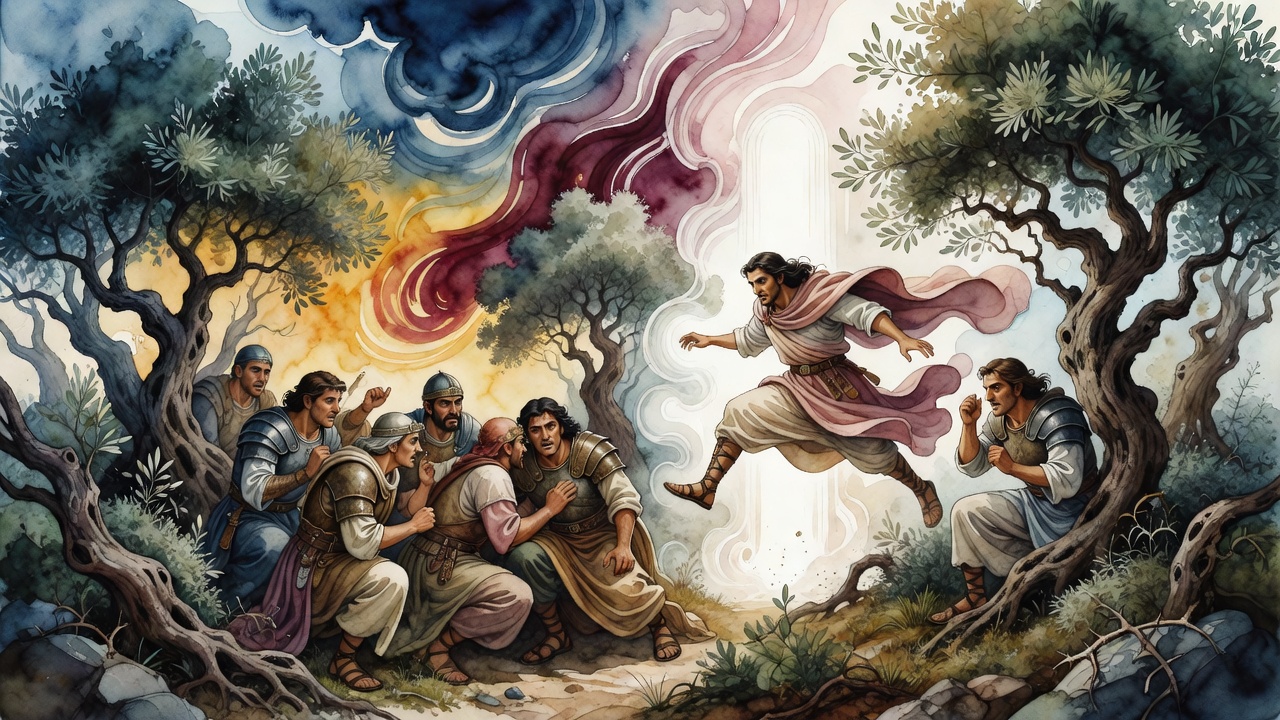
After two brothers razed Shechem, an army from Nineveh cut off Jacob's road, and the old patriarch and his twelve sons fought it like a nation.

Curated by Arthur · Told by Maggid ·
Table of Contents
  1. The Kings Did the Arithmetic After Shechem
  2. Jacob Struck First on the Road to His Father
  3. Judah's Face Became a Lion's
  4. Water Broke From Judah's Finger and the Ninevites Ran
  5. The First of the Wars That Would Not End

Two of them had leveled a city. Simeon and Levi had walked into Shechem while its men lay helpless and left nothing of it standing, and every people within a week's march did the arithmetic. If two of Jacob's sons could unmake a walled town in a single afternoon, what would the whole household do to a kingdom.
Jacob Led the Charge When Nineveh's Army Barred His Road Click for full size

The Kings Did the Arithmetic After Shechem

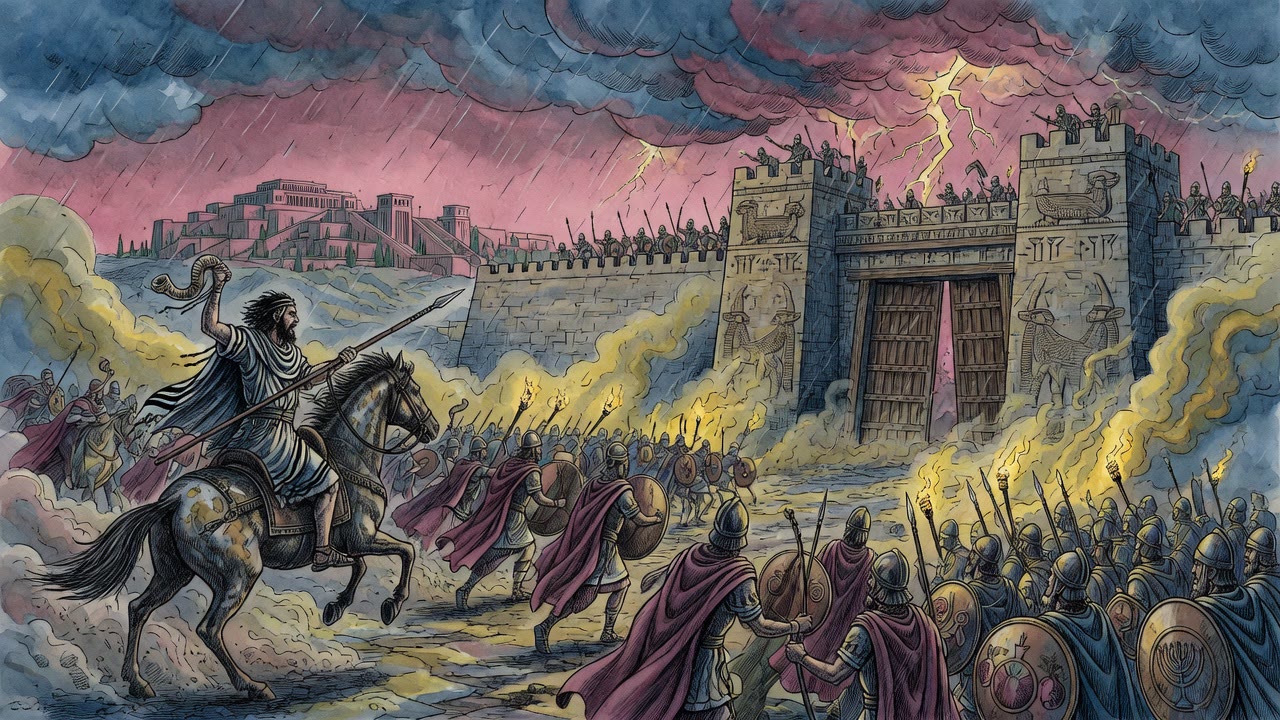
So Jacob loaded his family and his herds and turned toward Hebron, toward his father Isaac, and after eight days on the road the arithmetic answered him. An army came down out of Nineveh, sent to squeeze tribute from the world and bend every nation under one crown. When its captains heard whose caravan this was, they stopped caring about tribute. They wanted the family dead.

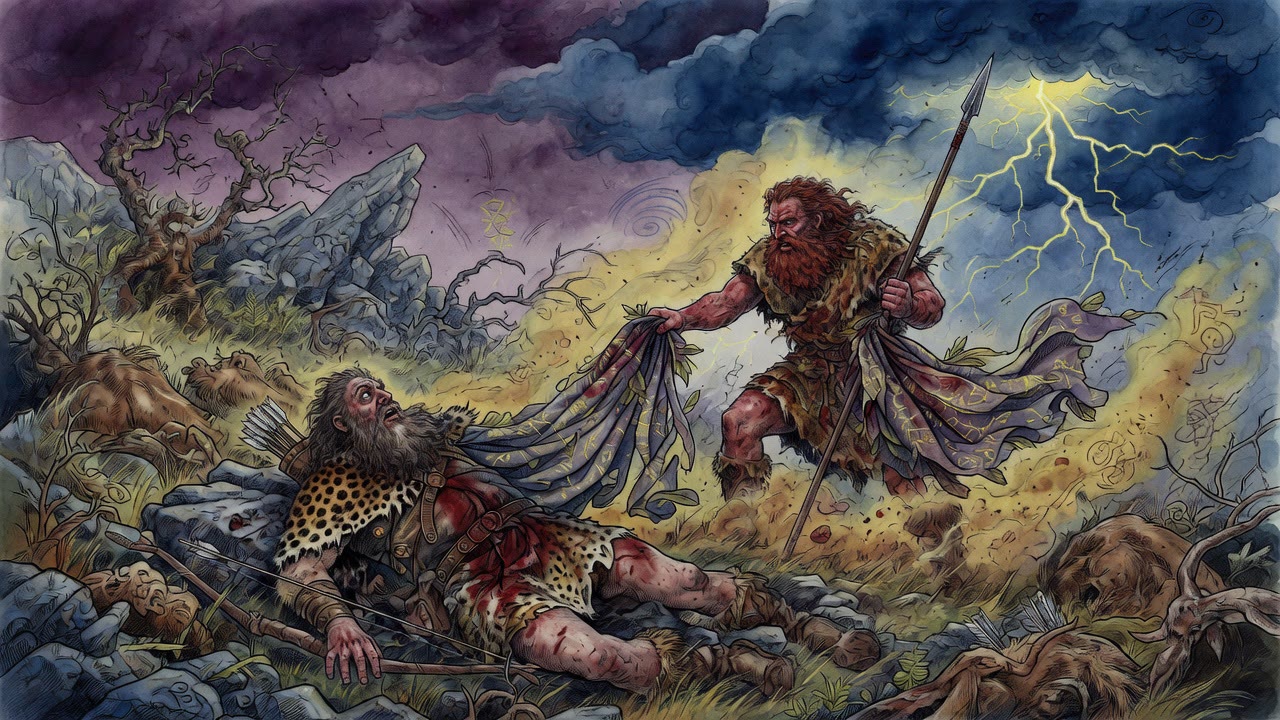
Jacob looked at his sons and did not tell them to run. "Fear not," he said. "God will be your helper, and He will fight for you against your enemies." Then he set a condition on the victory before it was won. "Put away from you the strange gods in your possession, purify yourselves, and wash your garments clean." They buried what they carried, they washed, and they took up their bows.

Jacob Struck First on the Road to His Father

The old man led the charge himself. In the first rush he cut down twelve thousand of the lighter troops, and when the Ninevite king threw his heavier ranks forward, Jacob set his twelve sons in a line with deliberate gaps between them and stood out ahead with sword and bow. He fought to the left and to the right. Two thousand men closed a ring around him, and he leapt clear over their heads and was simply gone from the middle of them. By the time the sun dropped he had killed two hundred and twenty thousand.

Then ninety thousand fresh soldiers came on, and his sword broke in his hand. He knelt, ground stones to powder between his palms, and flung the dust into their faces until they clawed at their own eyes and could not see to strike. Only darkness ended that day.

Judah's Face Became a Lion's

At first light Judah stepped in front of his father. "Father, thou art tired and exhausted," he said. "Let me fight the enemy alone." Jacob knew what his fourth son was. "Judah, my son, I know thy strength and thy bravery, that they are exceeding great, so that none in the world is like unto thee therein." Judah went in, and his face was the face of a lion. The Ninevites who saw it up close broke before his sword reached them. He killed a hundred and twenty thousand seasoned men, and when Levi came up beside him the enemy went down in rows like grain before a reaper.

Judah killed until his body failed him, eighty thousand and ninety-six of them, and then he could not lift his arm, and Zebulon took his place and mowed down eighty thousand more. When his strength came back Judah threw back his head and roared, and a whole army ran from the sound. Issachar and Gad drove another host into a cave, sealed its mouth with fire, and killed the ones the smoke pushed back out. Dan and Naphtali ran to their brothers, and still the Ninevites kept coming.

Water Broke From Judah's Finger and the Ninevites Ran

On the third morning the reinforcements arrived like the sand of the sea, past counting, and all twelve brothers broke them together and chased the survivors down. But the survivors turned. "Why should we flee," they said. "Let us fight them now, while they are weary." In the press they cut Judah off from the others. Jacob put his fingers to his mouth and whistled once, and Judah heard it across the field and answered, and his brothers tore through the line to reach him.

Judah was choking with thirst. He drove one finger into the dry ground, and water climbed out of the earth after it, and he drank where he knelt. The Ninevites watched a man pull a spring from the dirt with his hand, and something went out of them. "I will flee before these terrifying warriors," one of them cried, "for God fights on their side." They ran and did not turn again.

When it was over the brothers counted themselves and came up one short. Joseph was still out on the field, alone, trading blows with the last of them. Naphtali found him there, and the two finished it between them, and only then did Jacob turn the caravan back toward Hebron and his waiting father, as though the road had never been anything but a road.

The First of the Wars That Would Not End

It was the first of them, not the last. The hatred that woke at Shechem outlived every man who carried it onto that field. Years later, at the cave of Machpelah, Esau came to bar Jacob's burial with his own quarrel, and the sons answered him at the mouth of the grave and left forty of Esau's men dead in the dust. Joseph ran down Zepho and fifty of his fighters and dragged them to Egypt in chains, and when the sons of Seir and the children of the East marched to free them, six hundred thousand of them stayed behind on the field outside Egypt.

The whole world had caught the fever. Moab and Midian turned on each other until a Moabite caught in Midian was killed on sight and a Midianite in Moab fared no better, and kings of Edom and kings of Kittim rose, swore alliances, betrayed them, and went down under other kings. Through all of it the one family that came out of Shechem kept winning, because a single whistle across a battlefield still brought twelve brothers running to one another before it ever brought them to the sword.


← All myths
From the tradition

Sources

3 sources

The texts behind this telling. Some cards carry a translation of the source; others are our own retelling of it, and each card says which. Every card links out to the original.

Legends of the Jews, VI. Jacob, The War With The NinevitesLegends of the Jews

Retold in our words. Read the original at the link below.Project Gutenberg eBook #1493, The Legends of the Jews, Volume 1 · Public Domain

after the incident at Shechem, where Simon and Levi took drastic action, fear rippled through the surrounding lands. The neighboring peoples reasoned, if just two of Jacob’s sons could devastate a city like Shechem, what would the entire family accomplish together?

So, Jacob, with his family and possessions, decided to head towards his father Isaac. But their journey was far from peaceful. After eight days of travel, they encountered a formidable army dispatched from Nineveh. Their mission? To extract tribute from the world and bring everyone under their dominion. Imagine their surprise, or rather, their fury, when they heard what had happened to Shechem at the hands of Jacob's sons. War was on their minds.

Jacob, ever the patriarch, reassured his sons: "Fear not, God will be your helper, and He will fight for you against your enemies." But there was a condition. “You must put away from you the strange gods in your possession, and you must purify yourselves, and wash your garments clean." It's a reminder that even in times of war, spiritual purity and devotion to God were paramount.

Then, armed and ready, Jacob himself led the charge. In the initial assault, he slew twelve thousand of the weaker soldiers, evidence of his strength and commitment. But the battle was far from over. Judah, seeing his father's exhaustion, stepped forward, "Father, thou art tired and exhausted, let me fight the enemy alone."

Jacob, recognizing Judah's exceptional bravery, responded, "Judah, my son, I know thy strength and thy bravery, that they are exceeding great, so that none in the world is like unto thee therein." Can you picture this scene? The passing of the torch, the trust in his son's abilities? Judah, his face like a lion’s, attacked with unmatched ferocity, slaying twelve myriads – that’s 120,000! – of seasoned warriors. The battle raged fiercely, and Levi joined his brother, together achieving victory. Judah alone slew another five thousand, while Levi’s blows were so powerful that enemies fell like grain before a reaper, as Legends of the Jews dramatically puts it.

The people of Nineveh, witnessing this extraordinary display of strength, began to waver. "How long shall we fight with these terrifying warriors? Let us return to our land, lest they exterminate us root and branch, without leaving a remnant." Their king, however, wouldn't allow it. He rallied them, reminding them of their past conquests and urging them to stand their ground. They sent messengers for reinforcements, and renewed the assault.

Jacob, ever the strategist, positioned his twelve sons strategically, leaving gaps between them. He, armed with a sword and bow, faced the enemy head-on. The fight was desperate. He fought left and right, inflicting heavy losses. At one point, surrounded by two thousand men, he leapt over them and vanished. Legends of the Jews tells us he slew 220,000 that day! But the battle was far from over.

Ninety thousand more Ninevites appeared, forcing Jacob to continue fighting. His sword even broke, and he resorted to grinding rocks into powder to blind his enemies. Finally, darkness fell, offering a brief respite.

The next day, Judah again stepped up, offering to take his father's place. The Ninevites were terrified by Judah’s lion-like appearance and voice. He moved like a whirlwind, slaying 80,096 men before exhaustion overcame him. Zebulon then took his place, mowing down another 80,000. Judah, regaining his strength, unleashed a thunderous roar and sent the army fleeing.

But the war wasn't over. The Ninevites returned the following day. Issachar and Gad took up the fight, slaying 48,000 warriors and driving another 120,000 into a cave. They then set the cave on fire, forcing the remaining soldiers to emerge and fight. Dan and Naphtali rushed to their brothers' aid, and together they continued the battle.

On the third day, the Ninevites received reinforcements, an army as vast as the sands of the sea. All of Jacob's sons united to meet the challenge, routing the enemy. But when they pursued the fleeing soldiers, the Ninevites turned and fought back. "Why should we run away? Let us rather fight them, perhaps we may be victorious, now they are weary."

Seeing his children under attack, Jacob himself rejoined the fray, striking blows on all sides. Yet, the Ninevites managed to separate Judah from his brothers. Jacob whistled, and Judah responded, his brothers rushing to his aid. Judah, parched with thirst, struck the ground with his finger, and water miraculously gushed forth. Seeing this, the Ninevites cried out, "I will flee before these terrifying warriors, for God fights on their side," and they fled in terror.

After the battle, the sons of Jacob realized Joseph was missing. Naphtali found him still fighting the Ninevites, and together they vanquished the remaining soldiers. With the war finally over, Jacob and his family continued their journey to Isaac.

What does this incredible story tell us? It's more than just a war story. It's about faith, family, and the unwavering strength to overcome seemingly impossible odds. The Midrash Rabbah and the Zohar are filled with these types of stories, meant to instill courage and faith in the Jewish people throughout the generations. It makes you wonder, what "Ninevite armies" are we facing in our own lives, and how can we channel the spirit of Jacob and his sons to overcome them?

Full source
Legends of the Jews, I. Joseph, The Sons Of Jacob At War With The Sons Of EsauLegends of the Jews

Retold in our words. Read the original at the link below.Project Gutenberg eBook #1494, The Legends of the Jews, Volume 2 · Public Domain

The mourning period ended, but the story certainly didn't. In fact, it was then that the simmering conflict between the descendants of Jacob and Esau erupted again with full force.

Remember that initial clash at the Cave of Machpelah, when Esau tried to muscle his way into a burial plot while Jacob’s body was still unburied? It was a messy affair. According to Legends of the Jews, as retold by Ginzberg, Esau lost forty of his men then. But that was just the beginning.

The sons of Esau didn't fare much better afterward. They lost eighty more men in subsequent skirmishes, while Jacob’s sons didn't lose a single one. Joseph even managed to capture Zepho, the son of Eliphaz, along with fifty of his men, and hauled them off to Egypt in chains.

The remaining forces of Esau, led by Eliphaz, beat a hasty retreat to Mount Seir, dragging Esau's headless corpse with them for burial. The sons of Jacob pursued, but, showing respect for the dead, they didn’t kill anyone. A brief respite, perhaps? Not quite.

On the third day, a massive army of the inhabitants of Seir and the "children of the East" marched on Egypt, aiming to crush Joseph and his brothers. But in the ensuing battle, Joseph and his warriors decimated them, mowing down a staggering six hundred thousand men. The survivors fled in terror.

Back in their own lands, the sons of Esau and the sons of Seir started pointing fingers. The sons of Seir blamed the sons of Esau for their misfortune and demanded they leave. In desperation, the sons of Esau secretly appealed to Agnias, the king of Africa, for help. He sent them troops.

The sons of Seir, not to be outdone, secured the support of the "children of the East" and the Midianites. Battles raged, with the sons of Esau suffering repeated defeats, partly due to treachery within their own ranks. But finally, in the desert of Paran, the sons of Esau achieved a decisive victory, massacring the sons of Seir and scattering their allies.

Victorious but brutal, they returned to Seir and slaughtered nearly everyone – men, women, and children – sparing only fifty lads and maidens. These survivors were enslaved or taken as wives. The sons of Esau seized all the possessions of the sons of Seir, dividing the land amongst themselves. A grim consolidation of power.

Now needing a leader, but too full of hatred to pick one of their own, the descendants of Esau chose Bela, the son of Beor, a warrior sent by King Agnias. He was crowned king, given a palace, and showered with wealth. For thirty years, he reigned until he met his end in a war against – you guessed it – Joseph and his brethren.

Why this new war? The sons of Esau couldn’t let go of the humiliation Joseph had inflicted upon them. So, with the help of Agnias, the Ishmaelites, and other eastern nations, they launched a second campaign against Egypt, hoping to free Zepho and his followers. Despite their enormous army of eight hundred thousand men, they were crushed at Raamses by Joseph and his tiny band of six hundred. King Bela fell, a quarter of their army lay dead, and the rest fled.

Joseph, returning victorious, tightened the chains on Zepho and his men. The sons of Esau appointed Jobab of Bozrah as their new king. He reigned for ten years, but they didn’t dare to wage war against the sons of Jacob again. Their hatred, however, burned hotter than ever.

Their third king, Husham, ruled for twenty years. During his reign, Zepho finally escaped from Egypt. He found refuge with King Agnias, who made him commander-in-chief of his troops. Zepho relentlessly tried to persuade Agnias to attack Egypt, but Agnias, well aware of the strength of Jacob’s descendants, refused.

Instead, Agnias had other battles to fight. A man from the land of Kittim, named Uzi, who was revered as a god, died, leaving behind a beautiful and clever daughter, Yaniah. Agnias sought her hand in marriage, and the people of Kittim agreed. But as Agnias's messengers were returning with the promise, Turnus, the king of Benevento, arrived with the same request. Rejected, Turnus attacked Lucus, Agnias's brother, in Sardinia.

Agnias rushed to his brother's aid, and a battle ensued in the Valley of Campania. Initially, Turnus was victorious, and the Sardinians lost their general Niblos. But in the second engagement, Turnus's army was routed, and he was killed. Agnias pursued the fleeing army to the crossroads between Rome and Albano.

Niblos's body was placed in a golden statue, and his father erected a high tower over his grave, mirrored by another tower over Turnus's grave, both connected by a marble pavement. Agnias then went to Benevento, but spared the city because it belonged to the land of Kittim. However, under Zepho's command, African soldiers occasionally raided Kittim. Finally, Agnias went to Pozimana, married Yaniah, and returned with her to his capital in Africa.

What does this all mean? It's a cycle of conflict, revenge, and shifting alliances, playing out against a backdrop of ancient kingdoms and simmering resentment. While the sons of Jacob are not directly involved in every one of these conflicts, their initial victory and the subsequent captivity of Zepho set in motion a series of events that reverberate through generations. It serves as a potent reminder that the consequences of our actions, both good and bad, can extend far beyond our own lifetimes. And perhaps, a cautionary tale about the dangers of unchecked hatred and the futility of endless cycles of violence.

Full source
Legends of the Jews, I. Joseph, The Nations At WarLegends of the Jews

Retold in our words. Read the original at the link below.Project Gutenberg eBook #1494, The Legends of the Jews, Volume 2 · Public Domain

The Torah focuses on Abraham, Isaac, and Jacob, on Joseph and his brothers. But the world didn't stop spinning just because the Israelites were having family drama. According to Ginzberg's sweeping narrative in Legends of the Jews, the ancient world was a hotbed of conflict, alliances, and betrayals, all swirling around the central figures we know and love.

Take Hadad, the king of Edom. He wasn't exactly a star in Egypt, but he found his stride in a war against Moab. The Moabites, clever strategists as they were, teamed up with the Midianites. But when things got tough, they bailed, leaving their allies to face Hadad's wrath. The Edomites, with Hadad at the helm, decimated the Midianites.

Of course, the Midianites weren't too happy about this. They rallied their kin, the sons of Keturah (Abraham's other wife, as some traditions tell it), and sought revenge. But Hadad, ever the opportunist, stepped in to help Moab again, crushing the Midianites' hopes. Thus began a deep-seated hatred between the Moabites and Midianites. Ginzberg states that "If a single Moabite is caught in the land of Midian, he is killed without mercy, and a Midianite in Moab fares no better."

After Hadad's death, the Edomites crowned Samlah of Masrekah. He wanted to help Agnias, an old Edomite ally, against Zepho, but his own people wouldn't let him harm their kinsman. Speaking of Zepho, he died in the fourteenth year of Samlah's reign, after ruling Kittim (often associated with Cyprus or other Mediterranean locales) for fifty years. His successor, Janus, also enjoyed a lengthy reign.

And what of Balaam? Remember him, the non-Jewish prophet hired to curse the Israelites but who ended up blessing them instead? Well, after Zepho's death, he fled to Egypt, where he became a royal counselor thanks to his "exceeding great wisdom."

Back in Edom, Samlah was followed by Saul of Pethor, a handsome fellow who ruled for forty years. Then came Baal Hamon, whose thirty-eight-year reign saw the Moabites revolt and throw off the Edomite yoke. Talk about a turbulent time! According to Legends of the Jews, it was a time of trouble everywhere.

Agnias, the king of Africa, passed away, as did Janus of Kittim. Their successors, Asdrubal and Latinus, plunged into a long and bloody war. At first, Latinus had the upper hand, invading Africa by sea and defeating Asdrubal, who died in battle. Latinus even destroyed a canal built by Agnias and took Asdrubal's beautiful daughter, Ushpiziwnah, as his wife. Her beauty was so great that her countrymen wore her likeness on their garments.

But Latinus's victory was short-lived. Anibal, Asdrubal's younger brother, launched a series of attacks on Kittim, killing eighty thousand people, including nobles and princes, over eighteen years. Finally, he returned to Africa and ruled in peace.

Meanwhile, the Edomites weren't having an easy time either. Hadad, successor to Baal Hamon, tried to subdue the Moabites again, but a new Moabite king, supported by the Ammonites, proved too strong. These wars were followed by conflicts between Hadad of Edom and Abimenos of Kittim. Abimenos invaded Seir, defeated the Edomites, captured Hadad, and executed him. Seir became a province of Kittim, ending Edom's independence. They had to pay tribute to Kittim until Abimenos died in his thirty-eighth year.

So, what do we take away from this glimpse into the wider world of our ancestors? Even as the story of the Israelites unfolds, other nations are rising and falling, engaging in their own power struggles, and shaping the world around them. It's a tradition of human experience, woven with threads of war, ambition, and the enduring quest for power. It also reminds us that the story of the Jewish people is not one lived in isolation, but always in conversation and conflict with our neighbors.

Full source