Parshat Yitro4 min read

Jethro Waited at Sinai Nearly a Year for Moses to Come Down

Moses vanished into the clouds of Sinai for the better part of a year. When he finally came back down, his father-in-law was still there waiting.

Curated by Arthur · Told by Maggid ·
Table of Contents
  1. The Old Priest Who Pitched His Tent and Waited
  2. The Court No One Could Win
  3. The Convert Who Asked to Be Received
  4. The Oath That Bound Moses Before Egypt

The Old Priest Who Pitched His Tent and Waited

When Jethro heard what had happened at the Red Sea, he left Midian. He had been a priest of every idol the ancient Near East had a name for, and now he packed his household and went to find the son-in-law he had given his daughter to, the man who had walked into his camp years ago with a goat-staff and a speech impediment and ended up parting an ocean.

He arrived at the camp of Israel. And Moses was gone.

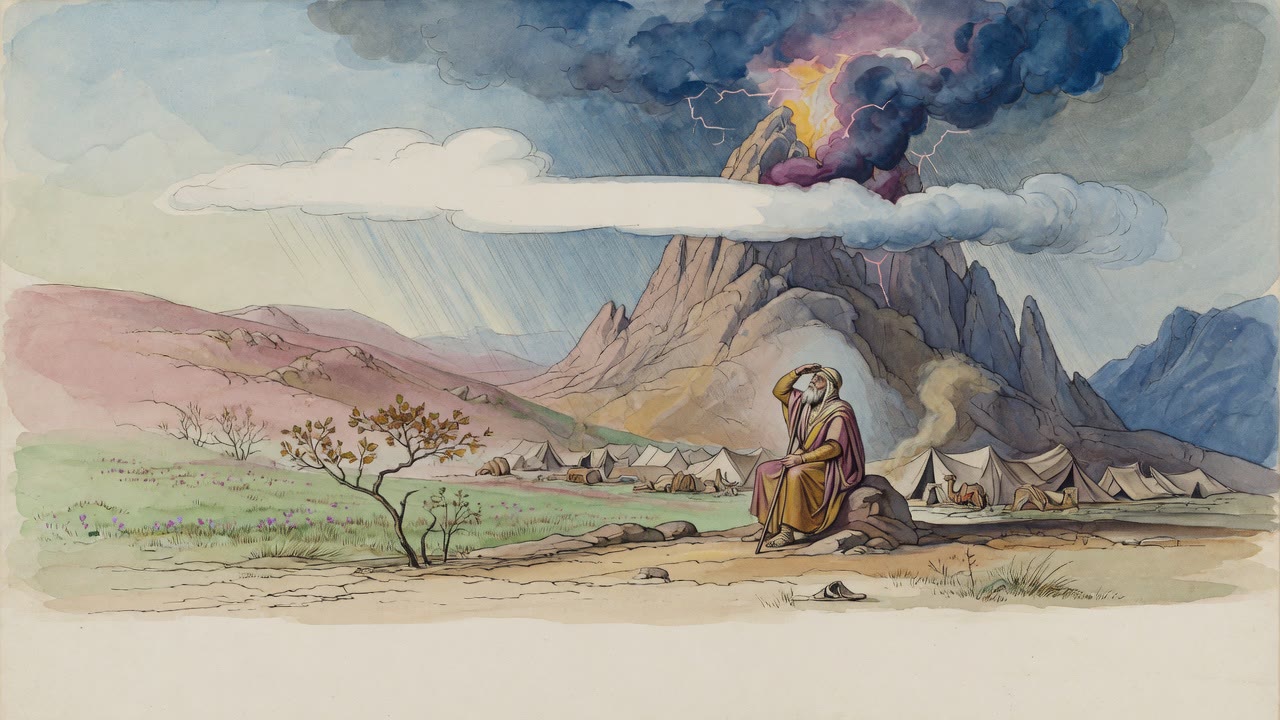
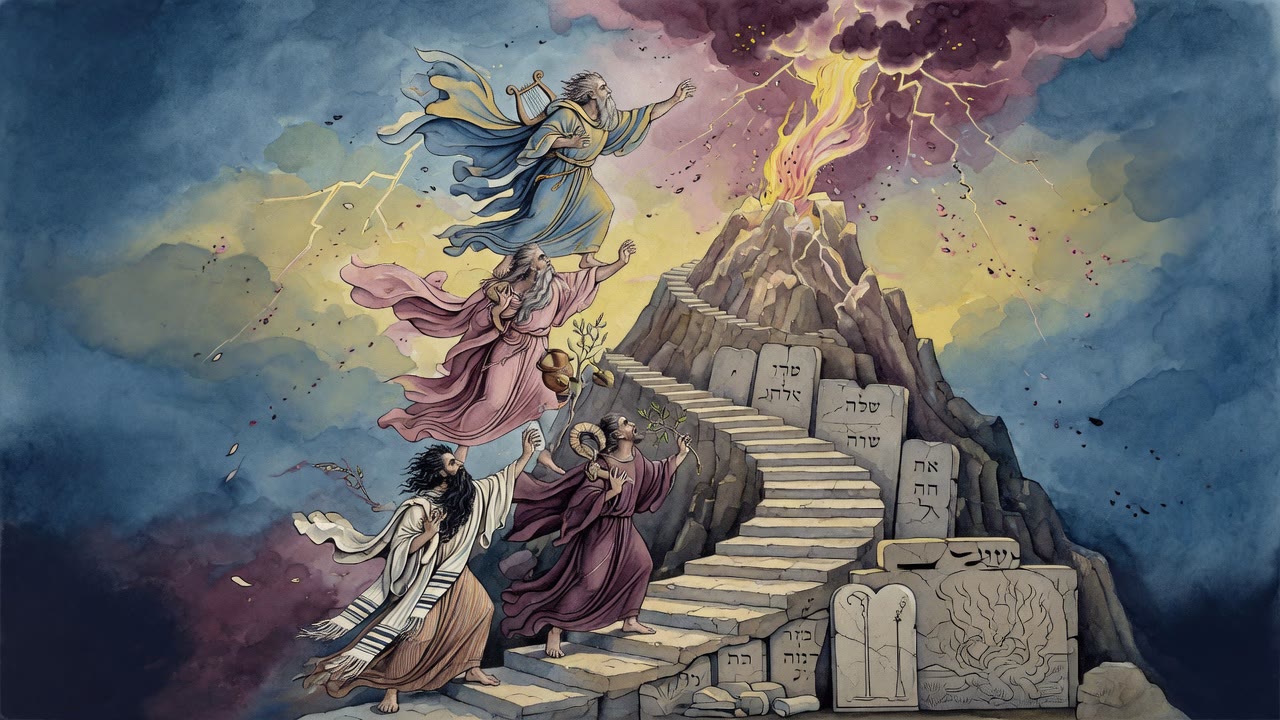
Moses had gone up the mountain of Sinai to receive the Torah, and he would not come back down, not for good, until the tenth of Tishri, most of a year later. Jethro pitched his tent at the edge of the camp and waited. He watched the cloud on the mountain. He watched the pillar of fire at night. He watched the Israelites receive manna in the mornings and quarrel among themselves in the afternoons, and he waited.

The Court No One Could Win

On the eleventh of Tishri, the day after Moses finally descended, Jethro watched his son-in-law hold court from dawn to dusk.

Every dispute in the camp came before Moses alone. Every question about law, every argument between neighbors, every complaint about water rights and borrowed tools and who said what to whom at the edge of the camp. Moses sat on a chair and heard them all, and the people stood in line from morning until the sun went down, and Moses was still there when they left.

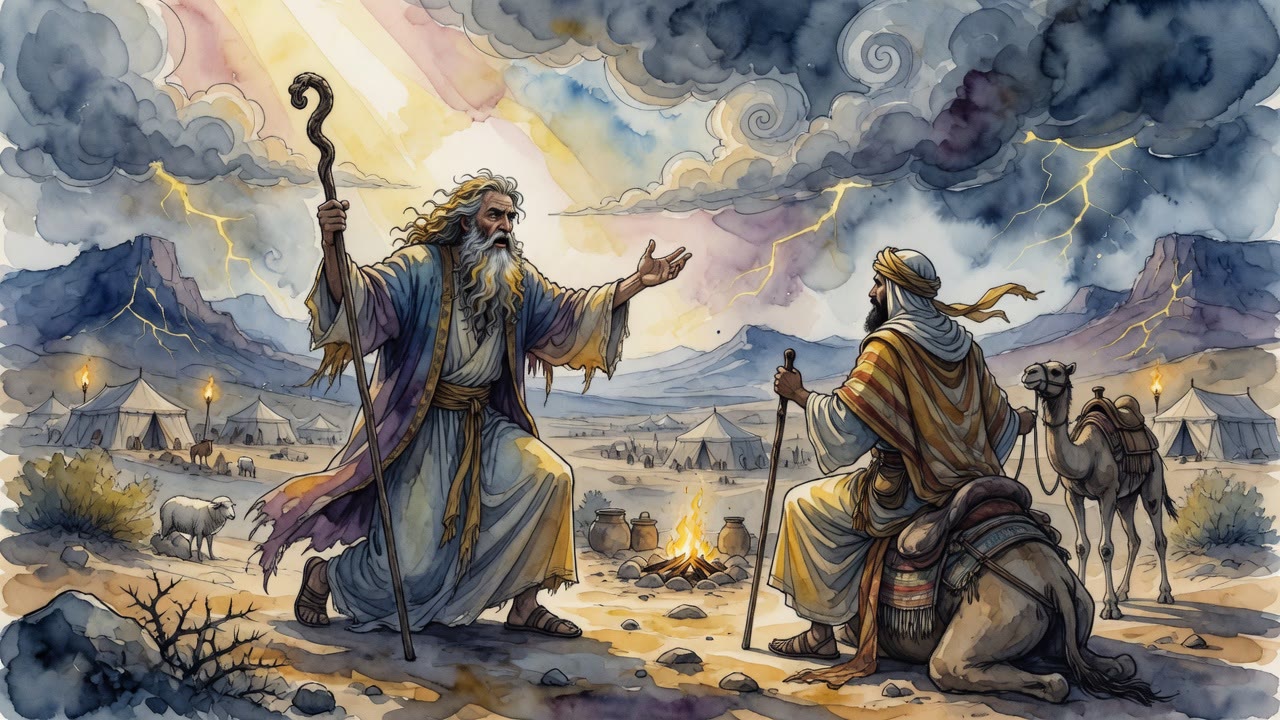
Jethro watched this for one day. Then he pulled Moses aside and told him he was going to destroy himself, and he was going to destroy the people in the process. "This is not good," he said. "You cannot do this alone. The thing you are doing is too heavy for you."

The Convert Who Asked to Be Received

The Targum Jonathan, the Aramaic translation of the Torah compiled in the Land of Israel over several centuries, does not let Jethro arrive as a simple advisor. It makes him a supplicant. It records his words to Moses: "I, your father-in-law Jethro, have come to be a proselyte; and if you will not receive me on my own account, receive me for the sake of your wife and of her two sons who are with her."

This was not the speech of a man who had come to offer management consulting. This was a man who had spent years considering something enormous and had finally arrived at a decision. He was asking to be let in, and he was not entirely sure he would be.

Moses came out from under the cloud of glory to greet him. The Targum specifies this: Moses had been dwelling inside the divine cloud and had to leave it to meet a man who was not yet one of the covenanted people. He bowed before his father-in-law and kissed him and brought him into the camp.

The Oath That Bound Moses Before Egypt

The Talmudic tradition preserved by Ginzberg also works backward, to the day before Moses went to Egypt, the day he went to ask Jethro's permission to leave. He had sworn when he first came to Midian that he would not return to Egypt without Jethro's knowledge. When the burning bush sent him, Moses's first act was not to pack his staff. It was to find his father-in-law and ask for release from a promise.

Jethro gave it. He said: "go in peace." Jethro's consent was the thing that made the Exodus legally possible in Moses's private reckoning, the clearance from the only human authority Moses had voluntarily placed himself under.

By the time Jethro arrived at Sinai with his daughter and her children and his own soul in his hands, asking to be received, Moses owed him a debt older than the parted sea.


← All myths

From the tradition

Sources

5 sources

The texts this telling draws on, in full. Open a card to read inline, or expand it for a wider, quieter read.

Legends of the Jews 2:2Legends of the Jews

He'd come to stay with Moses for over a year! But here's a little wrinkle in the story: for the first few months, Jethro didn't really see Moses in action as a judge. Why? Because, according to tradition, Moses was pretty much hanging out in heaven from the revelation at Mount Sinai until the tenth of Tishri (a month in the Hebrew calendar, usually falling in September or October).

So, it wasn't until the eleventh of Tishri – the day after Moses got back from his celestial sojourn – that Jethro finally witnessed Moses holding court. And what he saw, well, it didn't sit too well with him.

The scene: Moses, sitting like a king on his throne, while the people – all the folks with their disputes and legal questions – stood around him from morning till night. Ginzberg's Legends of the Jews vividly paints this picture. Jethro was troubled.

"Why are you doing this?" he asked Moses. "Why do you sit there all alone, with all these people standing around you from morning until evening?"

Moses, of course, had his reasons. "Because the people come to me to inquire of God," he explained. "It's not about honoring me, it's about honoring God, whose judgment they seek. When they're unsure about what's tahor (clean) or tamei (unclean), or when there's a disagreement they want settled according to the Law – or even through a fair compromise – they come to me."

He continued, "And when they leave, they leave as friends, not enemies. I also explain God's words and decisions to them." It sounds exhausting, doesn't it? And, you know, maybe Moses was a little too involved.

What do you think? Was Moses' system effective, or was Jethro right to be concerned? It's a question that gets to the heart of leadership, delegation, and how we balance our responsibilities. And it reminds us that even the greatest leaders, like Moses, can benefit from a little outside perspective.

Full source
Targum Jonathan on Exodus 18Targum Jonathan

In the Hebrew Bible, Jethro visits Moses in the wilderness, gives advice about delegating judges, and leaves. The Targum Jonathan on (Exodus 18) transforms this administrative visit into a dramatic conversion story.

The Targum says Jethro announced to Moses: "I, thy father-in-law Jethro, have come to thee to be a proselyte; and if thou wilt not receive me on my own account, receive me for the sake of thy wife and of her two sons who are with her." This is a plea. Jethro was not casually visiting. He was asking to join the covenant, and he offered his family connection as leverage in case Moses hesitated.

Moses "came forth from under the cloud of glory" to greet him. The Targum specifies that Moses was living inside God's protective cloud, and he had to leave it to meet a non-Israelite. He then "kissed him and made him a proselyte." The Hebrew says Moses bowed and kissed him. The Targum adds the conversion, turning a greeting into a religious ceremony.

They entered "the tabernacle, the house of instruction," a detail absent from the Hebrew. The meeting happened in a place of Torah study, not just any tent. Jethro's famous theological declaration, "Now I know that the Lord is greater than all gods," gets a pointed addition in the Targum: "for by the very thing by which the Mizraee wickedly would have punished Israel by drowning them in the sea, upon themselves came the punishment." God used Egypt's own weapon against them. This is the Targum's principle of measure-for-measure justice.

Jethro's judicial advice also expands. He told Moses to teach the people "the prayer they are to offer in the house of congregation, the manner of visiting the sick, of burying the dead, of being fruitful in doing good." These are recognizable rabbinic mitzvot (commandments), projected into the wilderness. The chapter ends with Jethro departing and converting "all the children of his land." He did not just become a proselyte. He became a missionary.

Full source
Shemot Rabbah 27:1Shemot Rabbah

This week, It uses the story of Yitro, Moses' father-in-law, to explore the nature of true friendship and kinship.

Then, it immediately connects this to a verse from Proverbs: “Do not forsake your friend, and your father’s friend. Do not enter your brother’s house on the day of your calamity. A close neighbor is better than a distant brother” (Proverbs 27:10).

Who are these "friends" the verse mentions? The Midrash (rabbinic interpretive commentary), this style of interpretive storytelling, identifies "your friend" as none other than the Holy One, blessed be He, citing the verse "For the sake of My brothers and friends" (Psalms 122:8). Isn't that a beautiful idea? God as a friend. And "your father's friend" is identified as Abraham, referred to as "the descendants of Abraham My beloved" (Isaiah 41:8).

The Midrash then takes a sharp turn, cautioning us, "Do not forsake." If you do, "do not enter your brother’s house on the day of your calamity," referring to Ishmael and Esau. The commentary Etz Yosef explains this to mean that even in times of suffering, Israel should not abandon its identity and seek refuge with these "brothers."

Rabbi Yehoshua ben Levi offers a powerful image: when Nebuchadnezzar exiled Israel to Babylon, their hands were bound behind them, as described in Midrash Eikha (Lamentations Rabbah) 2:4, until "they wandered due to swords" (Isaiah 21:15). God then rebukes Ishmael, reminding him that God saved Ishmael in the wilderness (Genesis 21:19), yet Ishmael caused the Israelites to die of thirst (Lamentations Rabbah 2:4).

This leads to the powerful statement: "a close neighbor is better than a distant brother." And who is that neighbor? It's Yitro.

The Midrash contrasts Yitro, who wasn’t even related to Israel, with Esau, Jacob’s own brother. It highlights how Yitro's actions demonstrated true kinship, while Esau’s actions were destructive.

Consider this: Saul tells the Kenites, descendants of Yitro (Judges 1:16), to "Go, depart, descend from among the Amalekites, lest I destroy you with them, for you showed kindness to all the children of Israel when they ascended from Egypt" (I Samuel 15:6). Conversely, regarding Esau, it is written: "Remember what Amalek did to you…" (Deuteronomy 25:17). Amalek, of course, being a descendant of Esau.

The Midrash continues this contrast, listing examples: Esau's descendants "tormented women in Zion" (Lamentations 5:11), while Yitro "gave Tzipora, his daughter, to him as a wife" (Exodus 2:21). Esau’s descendants "devour my people as if eating bread" (Psalms 14:4), but Yitro is told, "Call him and let him eat bread" (Exodus 2:20). Esau was "not God-fearing" (Deuteronomy 25:18), while Yitro is told, "And God will command you" (Exodus 18:23), referring to Yitro's wise advice to Moses about establishing a judicial system.

Esau’s legacy is further tarnished by the association of Rome, who destroyed the Temple, with him. In contrast, "Yitro, Moses’s father-in-law, took a burnt-offering and feast-offerings" (Exodus 18:12). Esau heard of Israel’s departure and waged war (Exodus 17:8), while "Yitro…heard Israel’s praise and came and joined them."

So, what can we take away from this? It's a powerful reminder that kinship isn't always about blood relation. It's about actions, about support, and about celebrating each other's successes. Yitro, the outsider, becomes the true friend, while Esau, the brother, represents betrayal and animosity. It challenges us to examine our own relationships. Who are our true neighbors? Who celebrates with us? And who do we choose to stand by, even when times are tough?

Full source
Shemot Rabbah 1:33Shemot Rabbah

It all centers around Moses, and a rather interesting agreement he makes with Jethro (also known as Yitro), his future father-in-law.

Remember, Moses has just fled Egypt after, shall we say, an unfortunate incident involving an Egyptian taskmaster. He finds himself in Midian, where he helps Jethro's daughters at a well. Jethro, impressed by Moses's character, invites him to stay. Then comes the verse: "Moses decided to dwell with the man, and he gave his daughter Tzipora to Moses" (Exodus 2:21). Simple enough. But what does "Moses decided" really mean?

That's where our Rabbis jump in with some fascinating interpretations. Rabbi Yehuda suggests that the Hebrew word for "decided" – vayoel – isn't just about making a choice. According to Rabbi Yehuda, it’s an expression of an oath. He sees echoes of this meaning elsewhere in the Bible, like in the book of Samuel where it says, "Saul administered an oath [vayoel] to the people" (I (Samuel 14:2)4). So, what oath did Moses take?

Apparently, Jethro was a little wary. He knew that Jacob, the patriarch, had left Laban's household rather… unceremoniously, taking Laban’s daughters (Jacob’s wives) with him without Laban’s permission. Jethro perhaps thought: "If I give my daughter to this man, will he do the same to me?" So, to ease Jethro's concerns, Moses swore an oath that he wouldn't run off with Tzipora without Jethro’s consent. Can you imagine the scene? A powerful moment of commitment and trust, born out of a little bit of understandable suspicion.

But wait, there's more! Rabbi Nehemiah offers another take. He understands vayoel as an expression of staying the night. He draws a parallel to the Book of Judges, where we find the word hoel, meaning "please agree and stay the night" (Judges 19:6). So, according to Rabbi Nehemiah, Moses agreed to stay with Jethro, to be a guest and a part of his household.

And our Rabbis, may their memories be a blessing, add yet another layer: Moses accepted the responsibility of herding Jethro's flocks. They see vayoel as an expression of beginning – of starting something new. By marrying Jethro's daughter, Moses was also committing himself to a new life, a new role, as a shepherd in a foreign land.

Now, fast forward a bit. Tzipora gives birth to a son, and Moses names him Gershom. Why Gershom? Because, as (Exodus 2:22) tells us, Moses said, "I was a stranger [ger] in a foreign land." The Rabbis point out that it’s a tradition among righteous people to name their children after significant events in their lives.

Think about Joseph. As (Genesis 41:51-52) recounts, Joseph named his firstborn Manasseh, "because God has made me forget [nashani] all my toil." And his second son he named Ephraim, "because God has made me fruitful [hifrani] in the land of my affliction." Joseph wanted to remember the miracles God performed for him.

Similarly, Moses named his son Gershom to remember that he was a stranger, a ger, in a foreign land, and that the Holy One, blessed be He, had brought him success even there. It’s a beautiful way to acknowledge God’s presence in his life, even in the midst of exile.

So, what does this all mean for us? It’s a reminder that even seemingly simple decisions – like agreeing to stay with someone, or naming a child – can be loaded with meaning, with history, and with a deep connection to our faith. And it reminds us that sometimes, even in moments of uncertainty and vulnerability, we can find ourselves on the path to something truly extraordinary.

Full source
Legends of the Jews 4:223Legends of the Jews

Moses sure did.

You’re tending sheep in the desert, happily married, a father. Then, BOOM! God appears in a burning bush and tells you to go liberate an entire nation from slavery. What do you do? Well, if you're Moses, you remember your promises.

See, before all the burning bush business, Moses had sworn an oath to his father-in-law, Jethro (also known as Reuel), never to return to Egypt without his permission. So, after his divine encounter, Moses' first act wasn't to rush headlong into Pharaoh's court. Nope. He went back to Midian to get Jethro’s blessing. Loyalty. And Jethro, being a wise and understanding man, readily gave his consent. "Go," he essentially said, "do what you must."

Here's where it gets a little more complicated. Moses, naturally, wanted to bring his wife, Zipporah, and their children along for the ride. A understandable desire. Family sticks together.

But Jethro raises a very valid point: "Those who are in Egypt are to leave it, and thou desirest to take more thither?" (Ginzberg, Legends of the Jews). It seems a bit counterintuitive, doesn’t it? Why bring more people into the very place God is commanding you to liberate people from?

Moses, ever the quick thinker, has an answer ready. He argues, and this is beautiful: "Very soon the slaves held in bondage in Egypt will be redeemed, and they will go forth from the land, and gather at Mount Sinai, and hear the words, 'I am the Lord thy God,' and should my sons not be present there?"

Think about the weight of that statement. He’s not just talking about a physical journey out of Egypt. He's talking about a spiritual journey, a pivotal moment in history when an entire people will encounter God. And he wants his children to be there. He wants them to witness the revelation at Sinai, to be part of that covenant.

Jethro, again showing his wisdom and understanding, recognizes the profoundness of Moses' words. He understands that this isn't just about escaping slavery; it's about witnessing the birth of a nation, the forging of a relationship with God.

So, he grants Moses his blessing, saying, "Go in peace, enter Egypt in peace, and leave the land in peace." A beautiful send-off, filled with hope and a recognition of the incredible journey ahead.

What does this little story, nestled within the larger narrative of the Exodus, tell us? Perhaps it’s about the importance of honoring our commitments, even when faced with divine commands. Or maybe it's about the delicate balance between family obligations and a higher calling. And certainly, it highlights the vital role of family in bearing witness to sacred moments.

It makes you wonder, doesn't it? What are the "Egypts" in our own lives that we need to leave? And who do we want by our side when we reach our own Mount Sinai?

Full source