Parshat Bereshit6 min read

Job Marched the Four Directions Knocking for God's Door

Job took his cry for God's abode as an address and marched east, west, south, and north, while the presence stood unseen in the west.

Curated by Arthur · Told by Maggid ·
Table of Contents
  1. He read the word and heard an address
  2. East, and the door was not there
  3. The friends closed in like a tidy court
  4. The presence stood in the west the whole time
  5. He could not find the house, but he knew he was seen

The cry came out of the ash heap like a man asking for directions. "If only I knew where to find Him," Job said, scraping his sores with a shard of broken pottery, "I would go to His abode." He did not mean it as a prayer. He meant it as a route. Somewhere in the round world there had to be a door, a threshold, a fixed place where the Holy One kept His house, and Job intended to stand on the step and knock until someone answered for what had been done to him.
He read the word and heard an address

It was the word for abode that started him walking. R. Abba bar Kahana turned it over in the study hall and found the same root buried in the book of Ezra, where the returning exiles set the new altar firmly upon its base. A base. A foundation. A platform with a floor you could stand on. So when Job said he longed to reach the Holy One's abode, he was not reaching for a feeling. He was reaching for a building.

"If He keeps a temple above," Job reasoned, "I will climb to His abode. And if He keeps a temple below, I will go down to His abode." Up or down, he would go. He only needed the coordinates.

East, and the door was not there

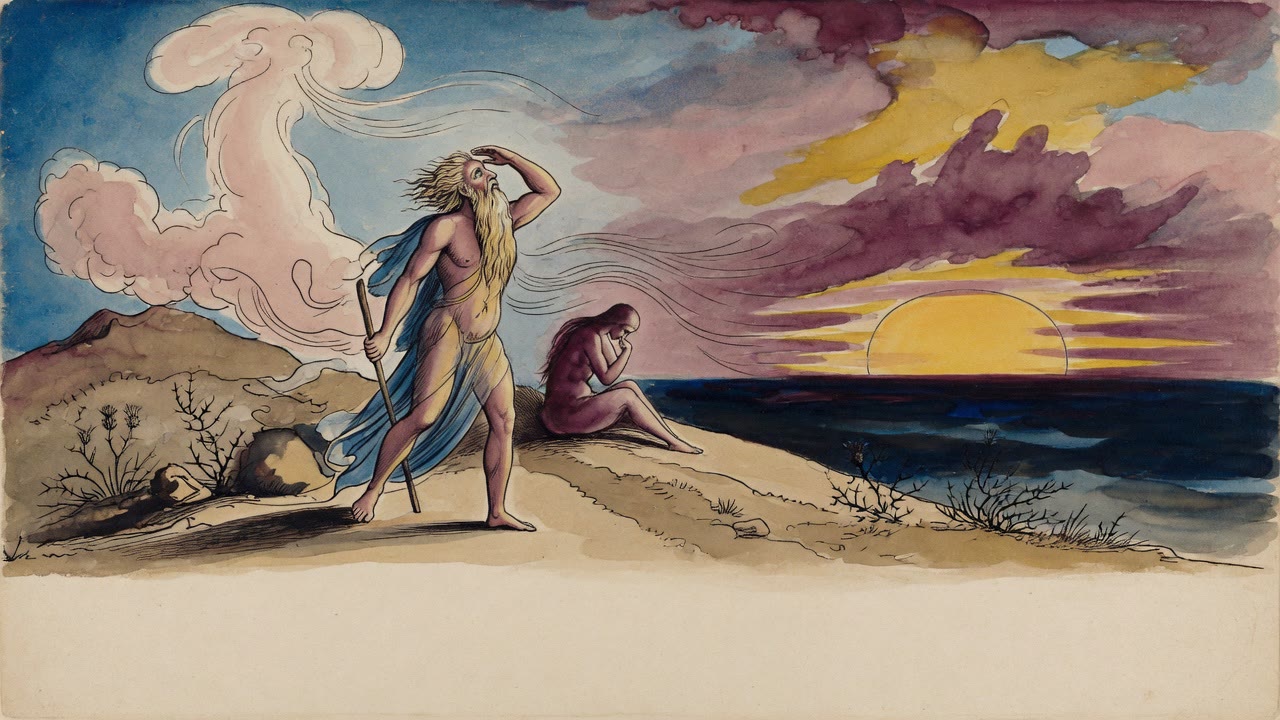
He went east first, toward the place the sun comes up, and he searched the horizon the way a creditor searches a debtor's street. Nothing. "I go forward," he said, "and He is not there." He turned and went backward, west, into the country of the setting sun, and he peered at every ridge and shadow. "I go back, and I cannot perceive Him." He swung left to the south and groped along the bright edge of the world. He swung right to the north and felt for any wall in the dark. Four directions. A door in none of them.

The compass had run out. The man had marched the whole rim of creation, knocking, and every quarter had answered with the same silence. He stood in the middle of everything with his hand still raised to knock, and there was nothing left to knock on.

The friends closed in like a tidy court

His three companions had been watching the search, and the spectacle of it offended them. A grown man tramping the four winds to serve a summons on the Almighty. "How long will you go on hunting Him with words?" they said. "Have we not told you over and over that you cannot march out and meet Him and argue your case to His face? You cannot even speak roughly to Michael. Could you stand before the chief of the angels and talk to him the way you are talking now? Then how much less the God who made Michael."

It was a clean argument. It shut every door Job had been pounding on and called the shutting wisdom. Know your station. Lower your eyes. Stop asking where He lives, because the question itself is insolence. Job listened to the neat little syllogism and refused to put down his shard.

The presence stood in the west the whole time

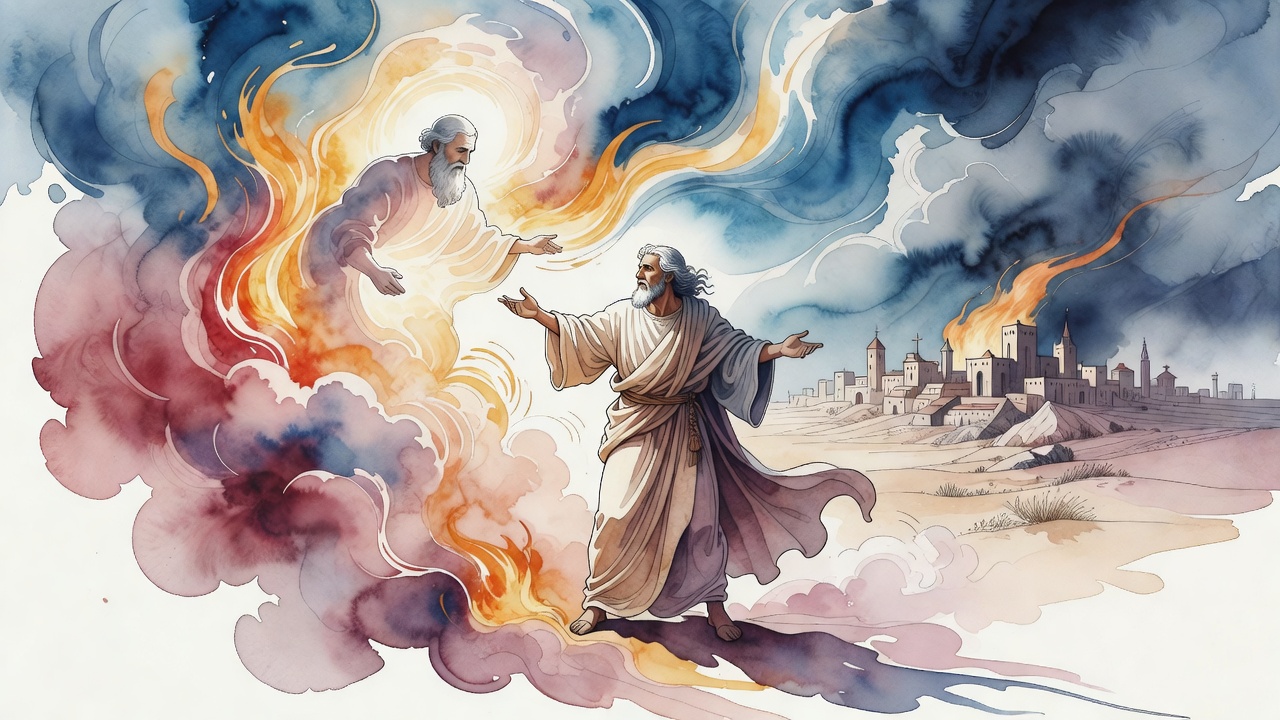
Then R. Yochanan leaned in over the verses and caught what Job in his agony had missed. The man's own words had betrayed a seam. East, Job had said, "He is not there." A flat absence. But west, Job had said only, "I cannot perceive Him." Not gone. Unseen. The wording had changed under his feet, and the change was a clue. When Job faced east the door was truly empty. When Job faced west the Shekhinah was standing in front of him.

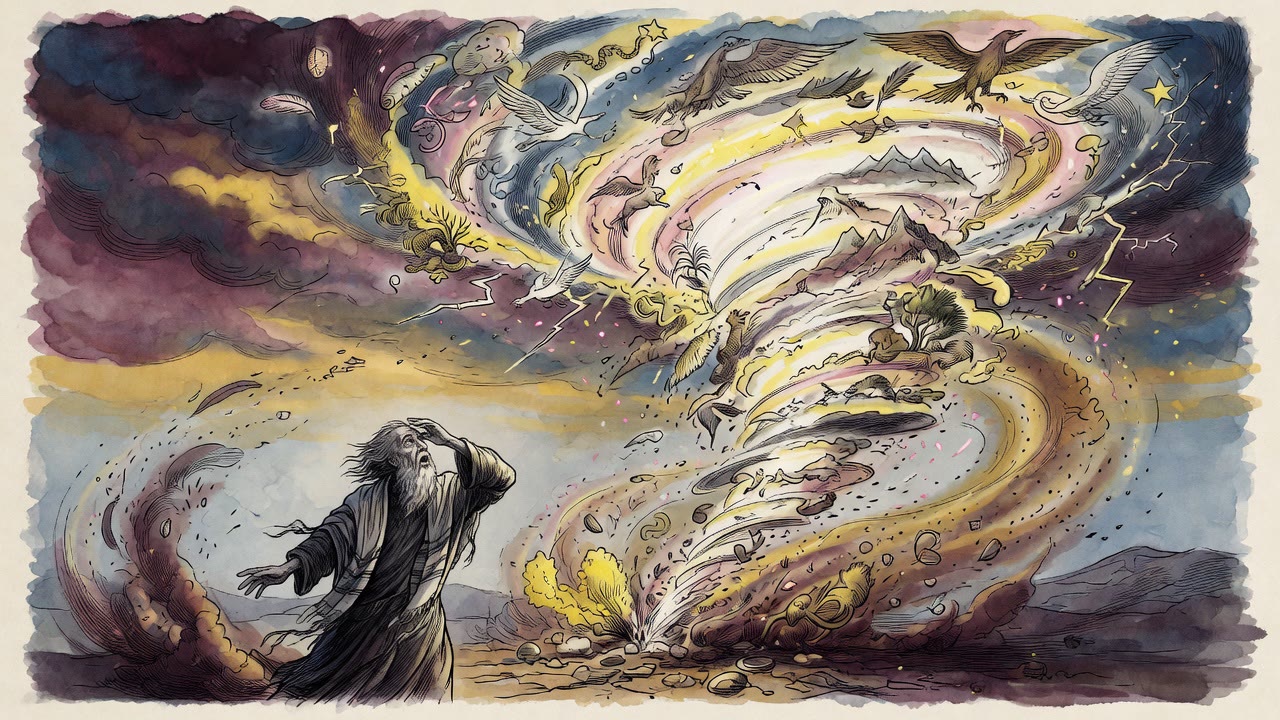
The Divine Presence had been in the west the entire time. Job had walked straight up to it and stared through it. Grief had fogged the glass. He had reached for the clouds the way a drowning man kisses the spray, frantic arms closing on vapor, certain he was grasping nothing, while the thing he wanted stood close enough to touch and let him pass his hands through it unknowing. Thick clouds veil Him, the saying went, so that He does not see. Job had it backwards. The clouds were over Job's own eyes.

He could not find the house, but he knew he was seen

And here is the strange thing the search did not break. Job never located the abode, never found the floor or the step or the door, and still he would not let go of one fact. "He knows the road I am on," Job said. "When He has tested me, I will come out the far side like gold from the fire." He could not see God. He was dead certain God could see him. The whole geography had failed, every direction had come up empty, and out of the emptiness Job pulled the one thing that held. He was being watched. The agony was a furnace and not a forgetting. The fire was an assay, and gold does not fear the assayer's flame.

His friends had a God too high to be questioned and too far to be reached, parked behind clouds that kept Him from seeing the world. Job had a God he could not find in any quarter of the sky and who never once stopped watching him scrape his sores in the ash. The friends bowed to the safe distance and called it reverence. Job kept his face raised to the west, to the presence he could not perceive, and kept on arguing toward the place where the gold comes out.


← All myths
From the tradition

Sources

2 sources

The texts this telling draws on, in full. Open a card to read inline, or expand it for a wider, quieter read.

Midrash Tanchuma Buber, Bereshit 13:1Midrash Tanchuma Buber, Bereshit

(Job 23:3) is one of the rawest lines in the Hebrew Bible. "Oh that I knew where I might find Him, that I might come to His abode." Midrash Tanchuma Buber, Bereshit 13:1 reads this as a literal geographical quest. And traces Job's steps through the compass of the world.

R. Abba bar Kahana on the abode

R. Abba bar Kahana began with the word makhon, translated as "abode." The Hebrew root also means "base" or "foundation," and it appears in (Ezra 3:3) describing the altar of the Second Temple: "they set the altar upon its base (mekhonotav)."

So when Job cries out, "if only I could come to His abode," R. Abba heard him asking to reach a temple, a place of divine presence. "If He is in a temple above, I will come to His abode; and if He is in a temple below, I will come to His abode."

The search by direction

(Job 23:8-9) describes the search methodically. "See, I go east, and He is not there; and west, but I do not perceive Him." Job then tries south and north. Four directions. Four failures.

But then R. Yochanan adds a piercing observation. Look at the wording. "I go east, and He is not there", negation. "I go west, but I do not perceive Him", failure of perception, not absence. The phrasing changes.

R. Yochanan concludes: "You learn from here that the Divine Presence is in the west." The Shekinah was actually present when Job turned west. But Job, in his suffering, could not see it. Perception failed where presence did not.

Job's confidence

Even in his despair, Job holds to something remarkable. (Job 23:10) continues: "Because He knows the way I take. When He has tried me, I shall come forth like gold." Job does not locate God, but he locates himself in God's awareness. Even invisible, the Holy One is watching. The trial is a test. The outcome is purification.

The friends' rebuke

Job's friends, increasingly frustrated with his persistence, mock him. "How long will you pester with words? Are we not telling you that you cannot go out to meet Him and speak insolently with Him? Can you speak insolently with Michael?" Even Michael, chief of the angels, is beyond Job's station. How much more so the God of Michael?

The friends' argument is logically tidy and theologically poor. The midrash preserves it to expose the inadequacy of piety that shuts down honest questioning. Job's insistence on locating God, even through a desperate east-west-south-north search, is, in the Jewish tradition, closer to holiness than his friends' fearful deference.

The takeaway: when you cannot find God in any direction, the problem may not be God's absence. It may be your own capacity to perceive in the west where the presence quietly waits.

Full source
Midrash Tehillim 10:7Midrash Tehillim

That feeling, that crushing sense of abandonment, isn't new. It echoes throughout Jewish history, woven into our prayers and our stories. Specifically,

The verse that sparks this particular midrash (rabbinic interpretive commentary) is a bleak one: "He said in his heart, 'God has forgotten; he has hidden his face; he will never see it.'" It's a raw, almost defiant statement of despair. The midrash immediately connects this sentiment to a passage in Job (22:14): "Thick clouds veil Him, so that He does not see."

That: a God obscured by clouds, indifferent to the suffering below.

The midrash takes this image and runs with it, exploring the depths of that feeling of divine abandonment. It's not just about physical hardship, but something far more profound: the sense that God has turned away, that our cries are unheard.

Now, here's where it gets interesting. Rabbi Yudan, quoting Rabbi Yehuda, offers a powerful image on behalf of the people of Israel. They cry out to the Holy One, blessed be He, saying that their troubles have overwhelmed them “like a man who kisses the clouds.” image for a moment. Frantically reaching, trying to connect, but only grasping at vapor.

It's a vivid depiction of futility, of struggling against something intangible and immense.

And then comes the plea: “Stretch out your hand and deliver us!”

It’s a desperate cry for intervention, for a tangible sign that God is still present, still listening. The midrash reminds us of Zion's lament: "The Lord has abandoned me; the Lord has forgotten me." This isn't just a personal crisis; it's a communal one. The very heart of Israel feels forsaken.

What does it mean when even Zion, the symbol of God's covenant with His people, feels forgotten?

This midrash isn't just a historical artifact; it's a mirror reflecting our own moments of doubt and despair. We all face times when we feel like God is hidden, when our prayers seem to vanish into thin air. Midrash Tehillim 10 acknowledges that feeling, validates it, and gives voice to that very human struggle to maintain faith in the face of adversity.

But it also offers a glimmer of hope. The plea to "stretch out your hand" implies a belief, however fragile, that God can still act, that He can still reach through the clouds. Maybe, just maybe, our cries aren't lost. Maybe, even in the darkest of times, we can still find the strength to reach for the heavens, even if all we feel is mist.

So, the next time you feel like you're shouting into the void, remember this story. Remember that you're not alone in your doubt, and that even in our despair, the possibility of connection remains.

Full source