Parshat Bereshit5 min read

Lilith Hid Inside the First Word of Creation

Bereishit is the first word of the Torah. The mystics say Lilith hid inside its six letters and waited there for a crack she could widen.

Curated by Arthur · Told by Maggid ·
Table of Contents
  1. Letters Before Light
  2. Joy With a Lurk Beside It
  3. Mistress and Maidservant
  4. What Nested Meaning Costs
  5. After the First Word
Lilith Hid Inside the First Word of Creation Click for full size

Letters Before Light

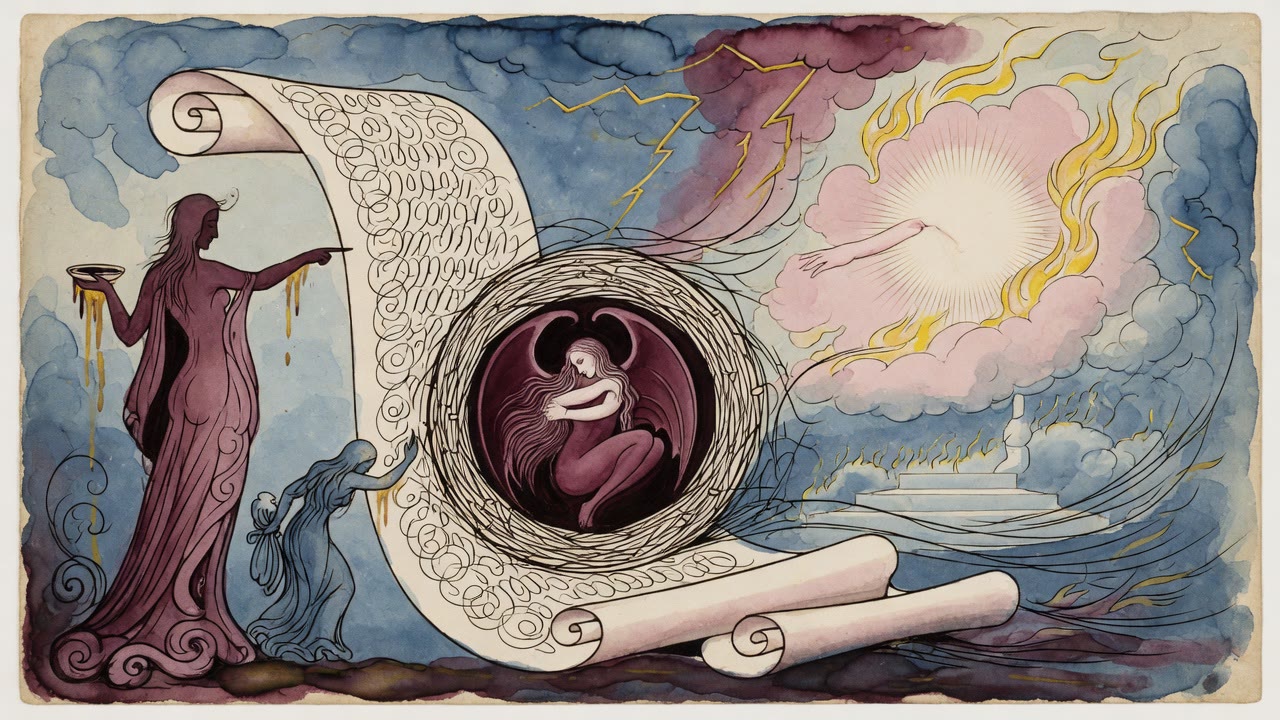
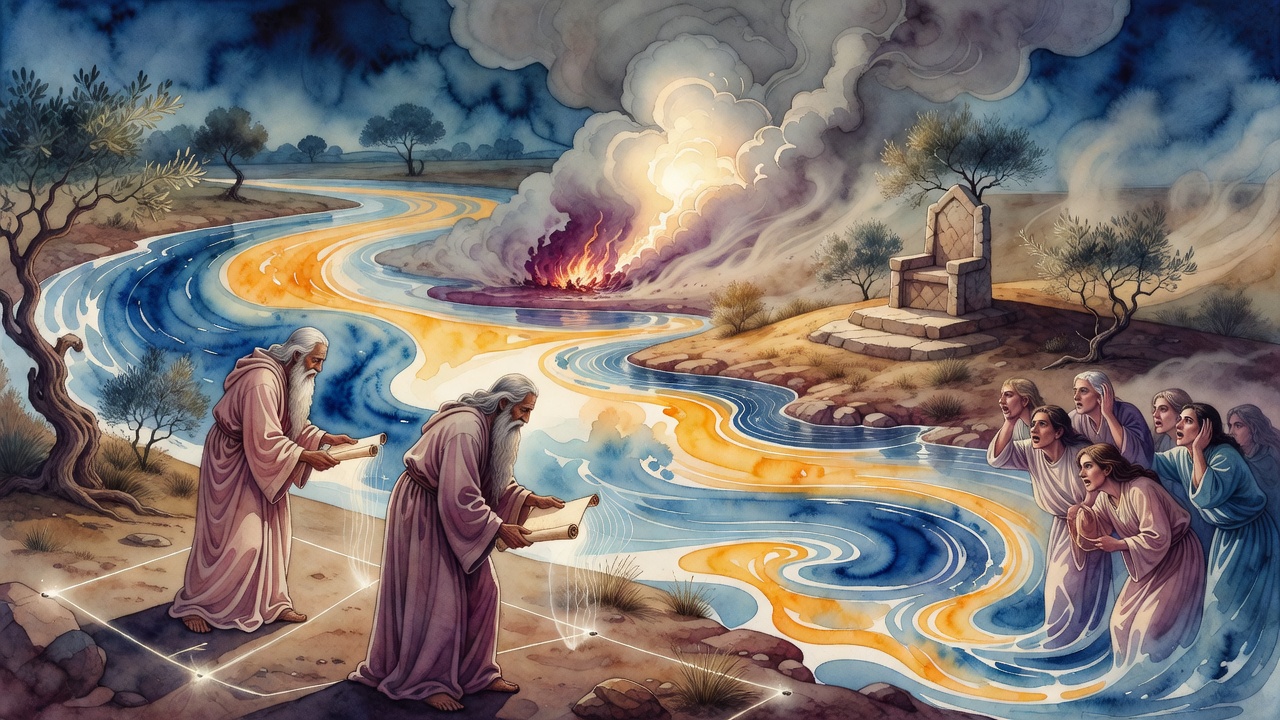
Before the first day finished saying itself, a shadow learned the shape of a word. Lilith did not wait for later folklore to invent her wings. In the repair books she nests inside Bereishit, the opening of openings, meaning folded into the six letters the way a thorn folds into a rose still closed on the bush. Creation spoke. Something uncreated in loyalty listened for cracks in the grammar of beginning.

This is not a second god. Jewish speech will not grant her that throne. She is the untamed claim on the edges of the feminine, the hunger that attaches when balance fails and the left side hosts a guest who was never invited to rule. The first word of Torah had to be strong enough to hold light and still leave a seam she could work with patience longer than empires.

Scribes who later counted every jot were not only pedants. They were border guards on a word that had already been colonized once in the nested meaning.

Joy With a Lurk Beside It

"Rejoice in the Shekhinah (God's Presence dwelling in the world) even when Lilith lurks," the texts insist, and the sentence is a tightrope over a real drop. Joy is commanded. The lurk is admitted. The Presence in exile and the shadow at the door share a neighborhood of symbols: night, desire, cradle edges, the risk that the left side will host a maidservant instead of the mistress who knows how to hold judgment without becoming cruelty.

A household that only fears Lilith becomes superstition hung with charms and emptied of song. A household that pretends she never learned the alphabet of Bereishit becomes naive enough to leave the seam unwatched while calling the neglect faith. The myth holds both: sing toward the Shekhinah (the Divine Presence) with a full throat, and do not leave the first word's seam for the lurk to widen in the dark.

Joy here is not denial with a smile. Joy is active feeding of the true Presence so the shadow starves of the attention it confuses with worship.

Mistress and Maidservant

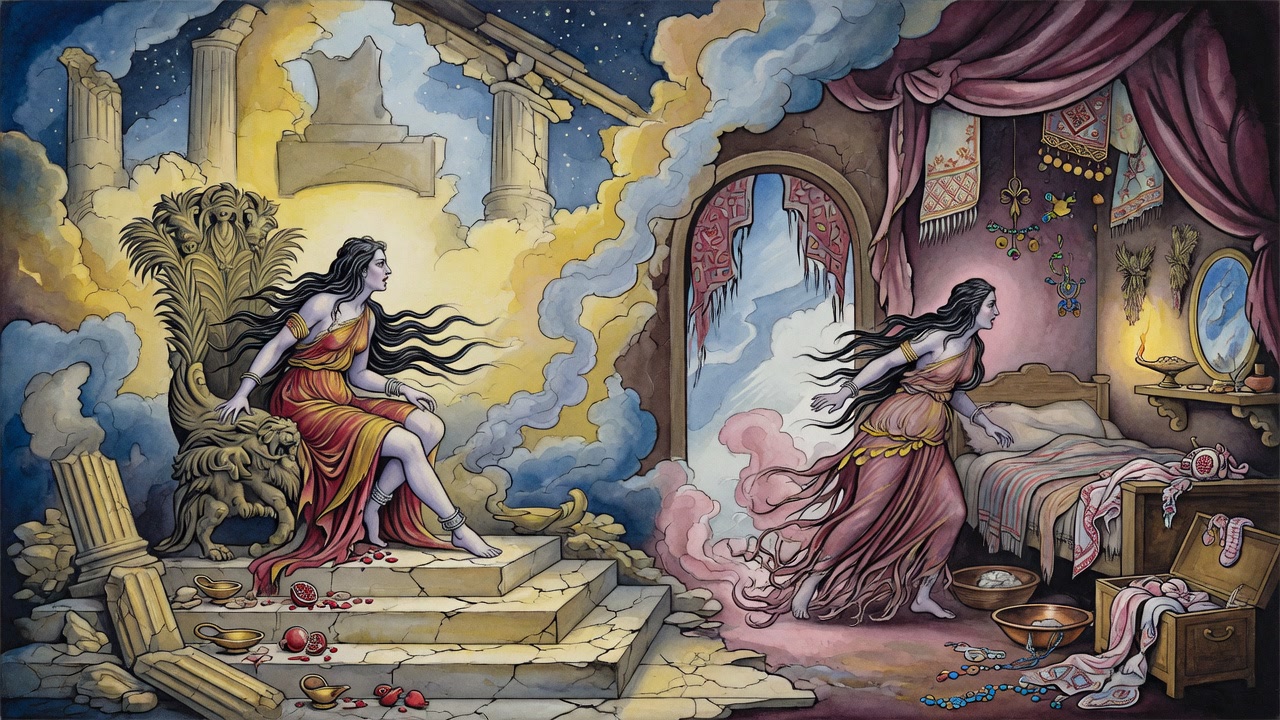
In a certain place an offering is required to bring near. Incense rises in a pattern that is not temple nostalgia only. Merit must be offered to the left-side mistress, and the maidservant must be distanced from the seat she wants to steal. The left is Gevurah's country: judgment, limit, the power that says no when no is the only mercy left. When the true mistress holds it, limit protects life. When the maidservant seizes it, limit becomes cruelty and impurity wearing judgment's coat and speaking in holy tones.

Malkhut, kingdom, the spine of the lower world, suffers the imbalance first. Names fail Her when the energies tangle and no single title can cover the range from compassion to severity without lying. Lilith thrives in that tangle. The Shekhinah suffers it as exile inside Her own house, a queen locked out of rooms that still carry her furniture.

The offering that distances the maidservant is not a spectacle for crowds. It is the hard work of giving the left side its due without handing it the keys to the whole house.

What Nested Meaning Costs

If Lilith can nest in Bereishit, then vigilance begins at the first syllable, not at midnight amulets alone. The same word that opens light opens a file for shadow. Adam and Eve would meet versions of that shadow in the garden's later hours when desire ran without a seated Yod. Israel would meet them in Egypt's fish and in every exile's night when the maidservant whispered that severity was the only realism left. The pattern is old as the first grammar and as current as any generation that mistakes hardness for holiness.

Still the command to rejoice stands. Joy is not denial. Joy is the act of feeding the mistress rather than the maidservant, of turning the left side back into holy limit instead of stolen throne, of singing toward the Shekhinah while knowing the lurk prefers silence and fear.

Children learn the first word in school. Few are told a shadow once nested there. The repair books tell it so adults will not treat beginnings as safe by default.

After the First Word

Light divided from darkness. Day took a number. Lilith did not vanish because a calendar began. She waited in the nested meaning for every generation that would rush past the first word without reading its seams, for every house that would choose either pure fear or pure cheer and call the half-choice wisdom.

The Shekhinah kept asking for joy loud enough to starve a lurk without pretending the lurk was imaginary. Between them the world learned to speak carefully, to offer on the left without surrendering the house, to open Bereishit each year as if the letters still needed witnesses who would not rush. Lilith listened for the years when the witnesses grew bored and left the seam unwatched. The first word kept its thorn and its light in the same six letters, waiting for mouths that would treat beginning as work and not as a soft door anyone could leave ajar.


← All myths
From the tradition

Sources

3 sources

The texts behind this telling. Some cards carry a translation of the source; others are our own retelling of it, and each card says which. Every card links out to the original.

Tikkunei Zohar 164:3Tikkunei Zohar

Retold in our words. Read the original at the link below.Sefaria-hosted English translation · CC-BY

The Tikkunei Zohar, a later, more expansive companion to the core Zohar text, is all about tikkun – repair, restoration. It seeks to mend the fractures in the cosmos, often through intensely symbolic interpretations of scripture.

Where better to start than at the beginning?

The passage tells us that within the letters of Bereishit, "there is two [trei] there; there is fire [esh] there." The very foundation of creation hints at duality and the raw, transformative power of fire. What could this "two" represent? Perhaps the two Torahs: the Written and the Oral.

This idea connects directly to the verse, "And God said, 'Let there be luminaries [meorot] in the firmament of the heavens'" (Genesis 1:14). But here's the kicker: The text points out that the word meorot, "luminaries," is spelled defectively – me’ort – lacking the letter vav. And this missing vav? It signifies a crucial difference.

According to the Tikkunei Zohar, this incomplete spelling alludes to the Written Torah, the text we can all read. But what, then, are the luminaries? They represent the Oral Torah! The vast, rich tradition of interpretation, commentary, and storytelling passed down through generations. It’s the living, breathing heart of Jewish law and lore.

The passage then throws us a curveball, mentioning that the defective spelling of me’ort has also been associated with Lilith. Yes, that Lilith. The mythical first wife of Adam, often depicted as a demonic figure. But the text quickly clarifies: "there are seventy faces [understandings] to the Torah." The Torah, and indeed all of Jewish tradition, is many-sided. It contains multitudes. One interpretation doesn’t negate another; they enrich each other.

Because of all this complexity, the text explains that these "luminaries" relate to the verse "For the commandment is a lamp and the Torah is light" (Proverbs 6:23). Here, we find a beautiful synthesis. The commandments, the mitzvot, are like individual lamps, illuminating our path. But the Torah itself? It's the greater light source, the sun that brightens the entire world.

Finally, the passage connects this to the familiar verse about the creation of the sun and moon: "the greater luminary to dominate the day and the lesser luminary to dominate the night" (Genesis 1:16). This verse is often interpreted as referring to the Written and Oral Torah, respectively. The Written Torah, like the sun, is clear, direct, and accessible to all. The Oral Torah, like the moon, reflects and refracts the light, offering deeper, more nuanced understandings.

So, what does this all mean for us? It highlights the incredible depth and complexity of Jewish tradition. The Torah isn't just a static text; it's a living conversation, an ongoing dialogue between generations.

Full source
Tikkunei Zohar 117:3Tikkunei Zohar

Retold in our words. Read the original at the link below.Sefaria-hosted English translation · CC-BY

Jewish mystical tradition recognizes this struggle, particularly when it comes to connecting with the Divine Feminine.

The Tikkunei (spiritual repair) Zohar, a core text of Kabbalah, explores this very idea. It tells us that we should rejoice in "Her", referring to the Shekhinah, the indwelling Divine Presence, often understood as the feminine aspect of God. But it’s not always easy, is it?

Deuteronomy (16:14) says, "And you shall rejoice in your festival." The Tikkunei Zohar connects this to the Shekhinah, saying she IS "the joy of the blessed Holy One." So, when we approach Her, when we seek that connection, we must be vigilant. We need to guard ourselves "from sadness, which is Lylyt, who is darkness, depression, sheol (the underworld), spleen."

Whoa, hold on a second. Lylyt? That's Lilith. Yes, here she's associated with negativity, a force that actively works against our joy. The text calls her a "blemish" (moom), and then quotes Leviticus (21:18): "..whoever has a blemish will not approach." It's a powerful image: sadness, depression, these things can block our access to the Divine.

But it's not all doom and gloom! There's a flip side. The Tikkunei Zohar goes on to quote Deuteronomy (16:17): "Each man according to his ability to give (matnat).." This, the text says, refers to the Higher Shekhinah. Giving, offering what we can, connects us to the Higher Shekhinah. Proverbs (21:14) comes into play here: "A gift (matan) in secret will subdue anger.." Because She is concealed, the world to come is called "a gift" (matanah), and about that is stated:cxiLiturgical: Sabbath Morning ‘Standing’ Prayer ‘Moses will rejoice in the giving (matnat) of his portion’, because: (Ecc. 3:13). it is the gift (matat) of ELQYM.

The key here seems to be hiddenness. The Shekhinah is not always readily apparent. The World to Come, Olam Ha-Ba (the World to Come), is a "gift" because it is concealed, something we must strive to attain. And according to the Midrash (rabbinic interpretive commentary), God offered the Torah to all the nations, but only Israel accepted it. The Torah, too, is a gift that requires effort to receive and understand.

So, what does it all mean? It sounds like connecting with the Divine Feminine, with the joy of the Holy One, is an active process. We must be aware of the forces that pull us down – the Lylyt within and without. And we must cultivate a spirit of generosity, of giving, to open ourselves to the hidden gifts that await.

Perhaps the takeaway is this: joy isn't just a feeling, it's a practice. It's a conscious choice to move towards the light, even when the shadows are nipping at our heels. And sometimes, the greatest gifts are the ones we have to work hardest to uncover.

Full source
Tikkunei Zohar 112:14Tikkunei Zohar

Retold in our words. Read the original at the link below.Sefaria-hosted English translation · CC-BY

Jewish mysticism has a lot to say about that very tension.

A small but powerful passage from the Tikkunei (spiritual repair) Zohar, a later expansion of the Zohar itself, the foundational work of Kabbalah. This particular section, Tikkunei Zohar 112, grapples with some pretty profound concepts related to the Divine Feminine and the challenges of spiritual balance.

In a certain "place" – and remember, in Kabbalah, "place" can often refer to a spiritual state or dimension – an offering is required to "bring near." This isn’t about animal sacrifice, of course. Instead, the offering represents our efforts to draw closer to the Divine. And what about the incense? That's used,

Here's where it gets interesting. The text goes on to say that we need to "offer merit to the left-side, 'the mistress,' and to distance the maidservant from there." Now, who are these characters?

In Kabbalistic thought, the "left side" often represents Gevurah, Divine judgment, severity, and limitation. The "mistress" is a symbolic representation of this aspect of the Divine Feminine. The "maidservant," on the other hand, symbolizes the forces of negativity and impurity that seek to attach themselves to this aspect.

Why is this important? Because according to the Tikkunei Zohar, this is why "all names are inapplicable to Her." It's a subtle but crucial point. Because the Divine Feminine encompasses such a range of energies, from compassion to judgment, it's difficult to define Her with any single name or attribute. She is beyond definition.

And the text continues, explaining that Malkhut (Sovereignty) – often translated as "Kingdom" or "Sovereignty," and representing the final Sefirah (sphere) on the Kabbalistic Tree of Life and, again, another aspect of the Divine Feminine – is called "the spine," the ahor, meaning "rear" or "back," from the aspect of the moon. The moon, traditionally associated with the feminine, reflects the light of the sun, just as Malkhut reflects the light of the higher Sefirot (the divine emanations). However, from the aspect of the Middle Pillar, it is called "front," or qedem. The Middle Pillar represents balance and harmony.

So, what are we to make of this? Back and front? Rear and front?

The text offers a clue with a verse from (Psalm 139:5): "Back and front You have created me." This verse speaks to the inherent duality within us and within the Divine. We are created with both a "back" and a "front," representing different aspects of our being. And just as we must strive to integrate these aspects within ourselves, so too must we recognize the many-sided nature of the Divine.

It's about recognizing the complexities of the Divine Feminine, the delicate balance between judgment and mercy, severity and compassion. It's about understanding that the spiritual path isn't always straightforward. Sometimes, we need to "bring near," and sometimes we need to "distance."

As Ginzberg tells us in Legends of the Jews, Jewish tradition is replete with such dualities, such seemingly contradictory forces that ultimately work together to create a harmonious whole.

Perhaps, then, the real offering isn't something we give out there, but something we cultivate in here. A willingness to embrace the tension, to work through the complexities, and to find balance within ourselves. Maybe that's the key to unlocking a deeper understanding of the Divine and our own place within it.

Full source